A Reflection on
Quantitative Approaches to Measurement
Renee Hobbs
Media Education Lab
University of Rhode Island USA
Catholic University of Louvain
Groupe de Researche en Mediation des Savoirs (GREMS)
September 14, 2016
PEER-TO-PEER FILE SHARING
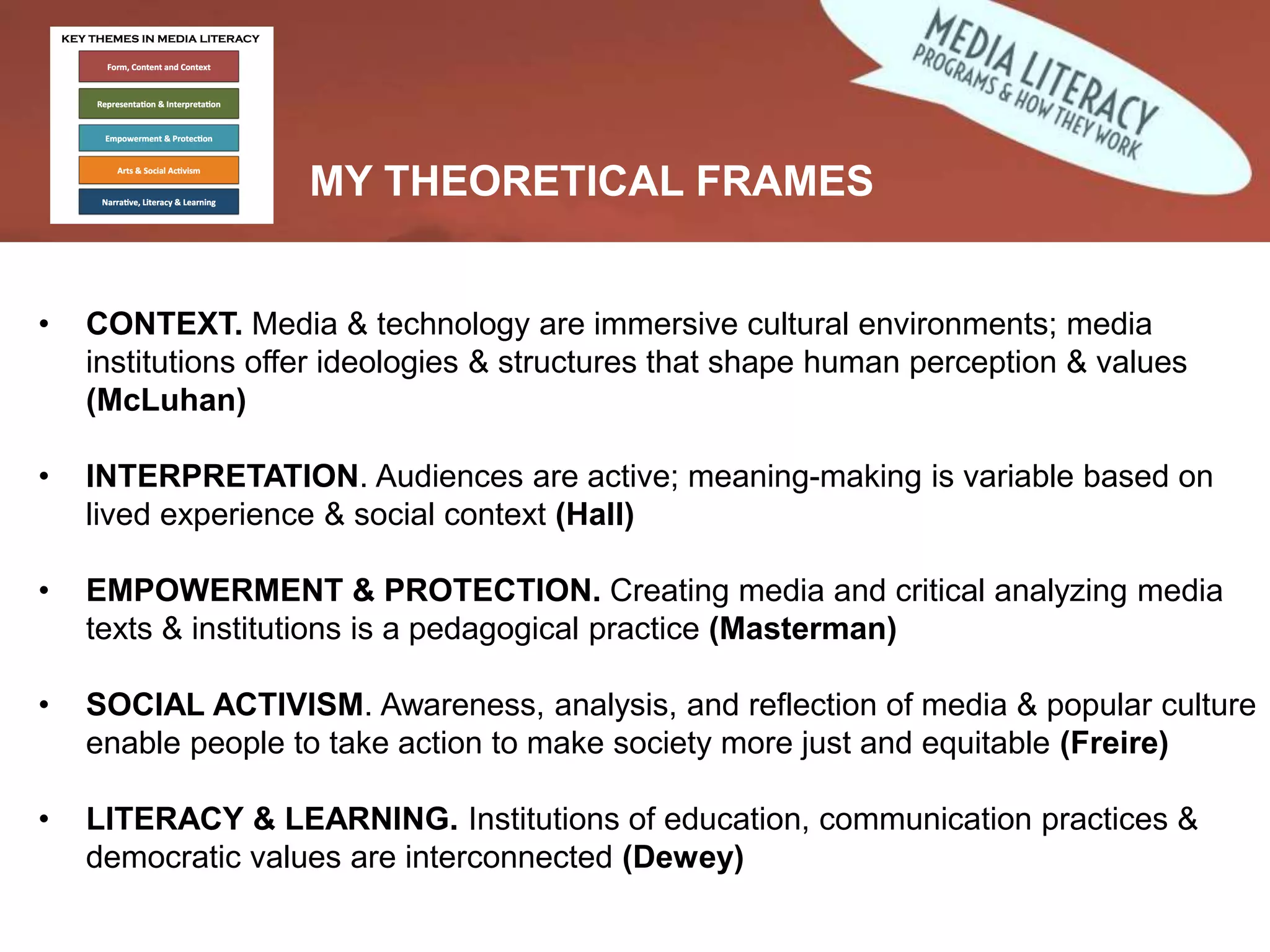
• CONTEXT. Media & technology are immersive cultural environments; media
institutions offer ideologies & structures that shape human perception & values
(McLuhan)
• INTERPRETATION. Audiences are active; meaning-making is variable based on
lived experience & social context (Hall)
• EMPOWERMENT & PROTECTION. Creating media and critical analyzing media
texts & institutions is a pedagogical practice (Masterman)
• SOCIAL ACTIVISM. Awareness, analysis, and reflection of media & popular culture
enable people to take action to make society more just and equitable (Freire)
• LITERACY & LEARNING. Institutions of education, communication practices &
democratic values are interconnected (Dewey)
MY THEORETICAL FRAMES
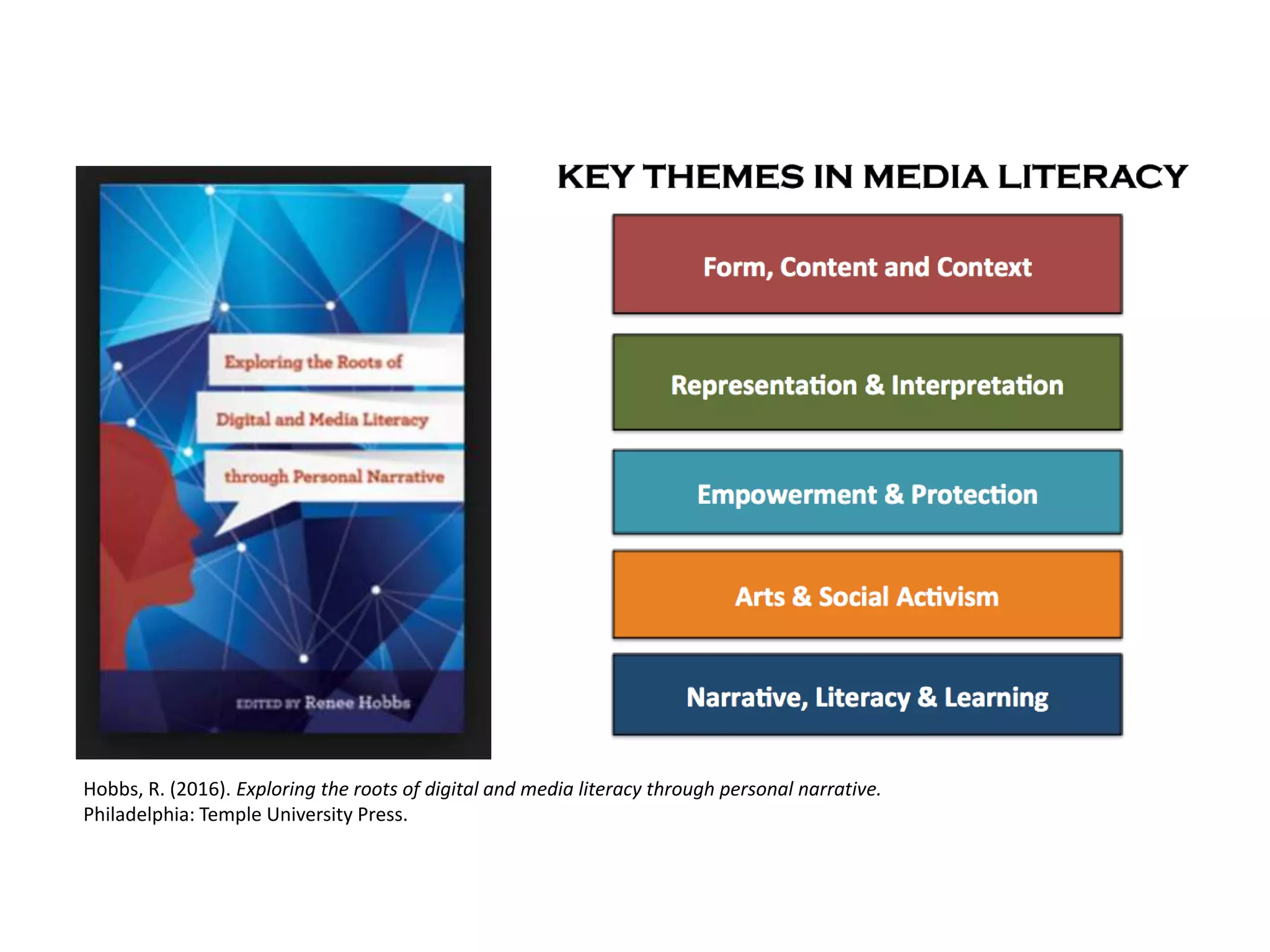
Hobbs, R. (2016). Exploring the roots of digital and media literacy through personal narrative.
Philadelphia: Temple University Press.
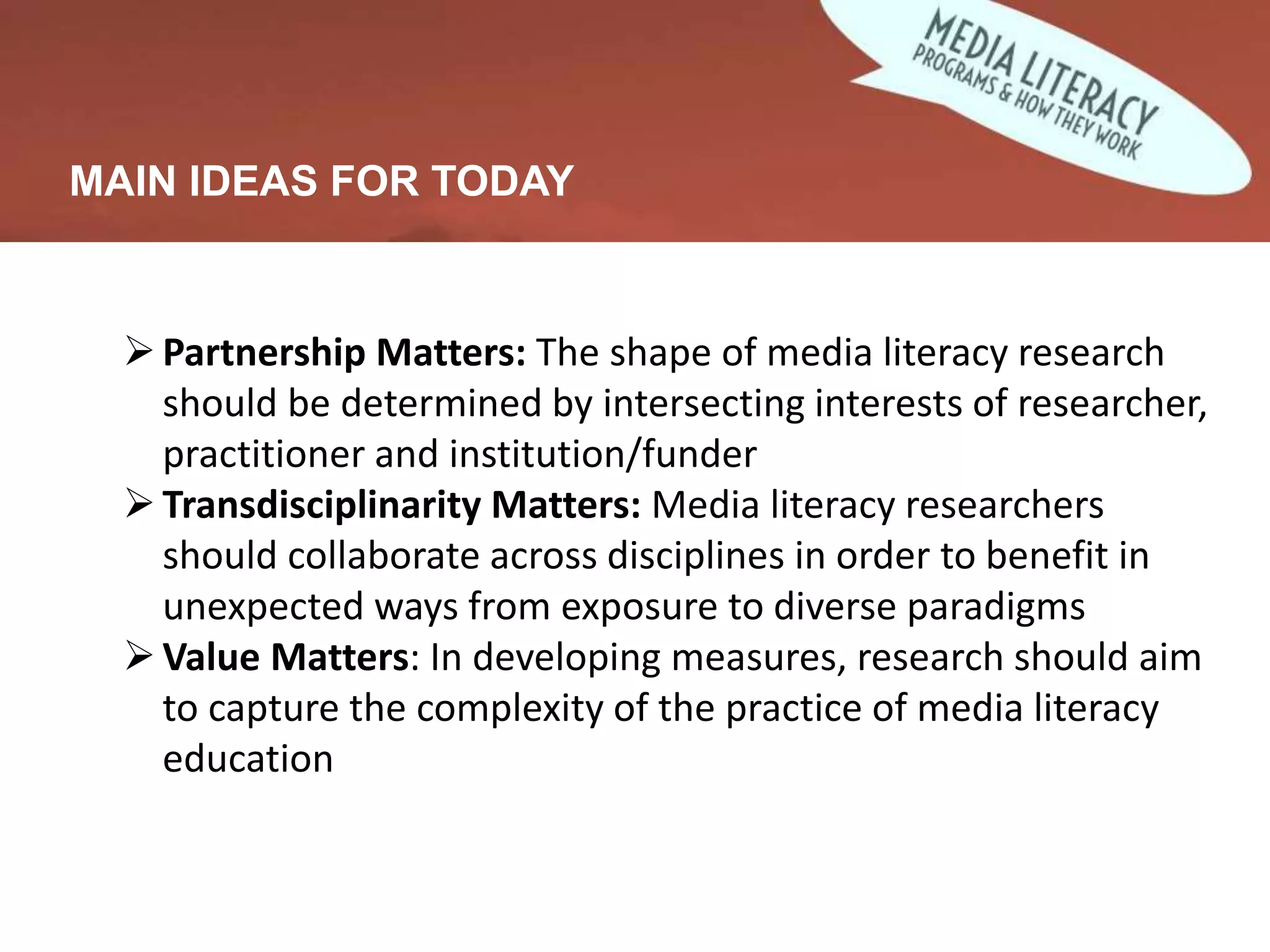
MAIN IDEAS FOR TODAY
Partnership Matters: The shape of media literacy research
should be determined by intersecting interests of researcher,
practitioner and institution/funder
Transdisciplinarity Matters: Media literacy researchers
should collaborate across disciplines in order to benefit in
unexpected ways from exposure to diverse paradigms
Value Matters: In developing measures, research should aim
to capture the complexity of the practice of media literacy
education
• Student Reporting Labs
• ML and Nonverbal Bias
• Teacher Motivations
Program Evaluation
Hypothesis Testing
Scale Construction
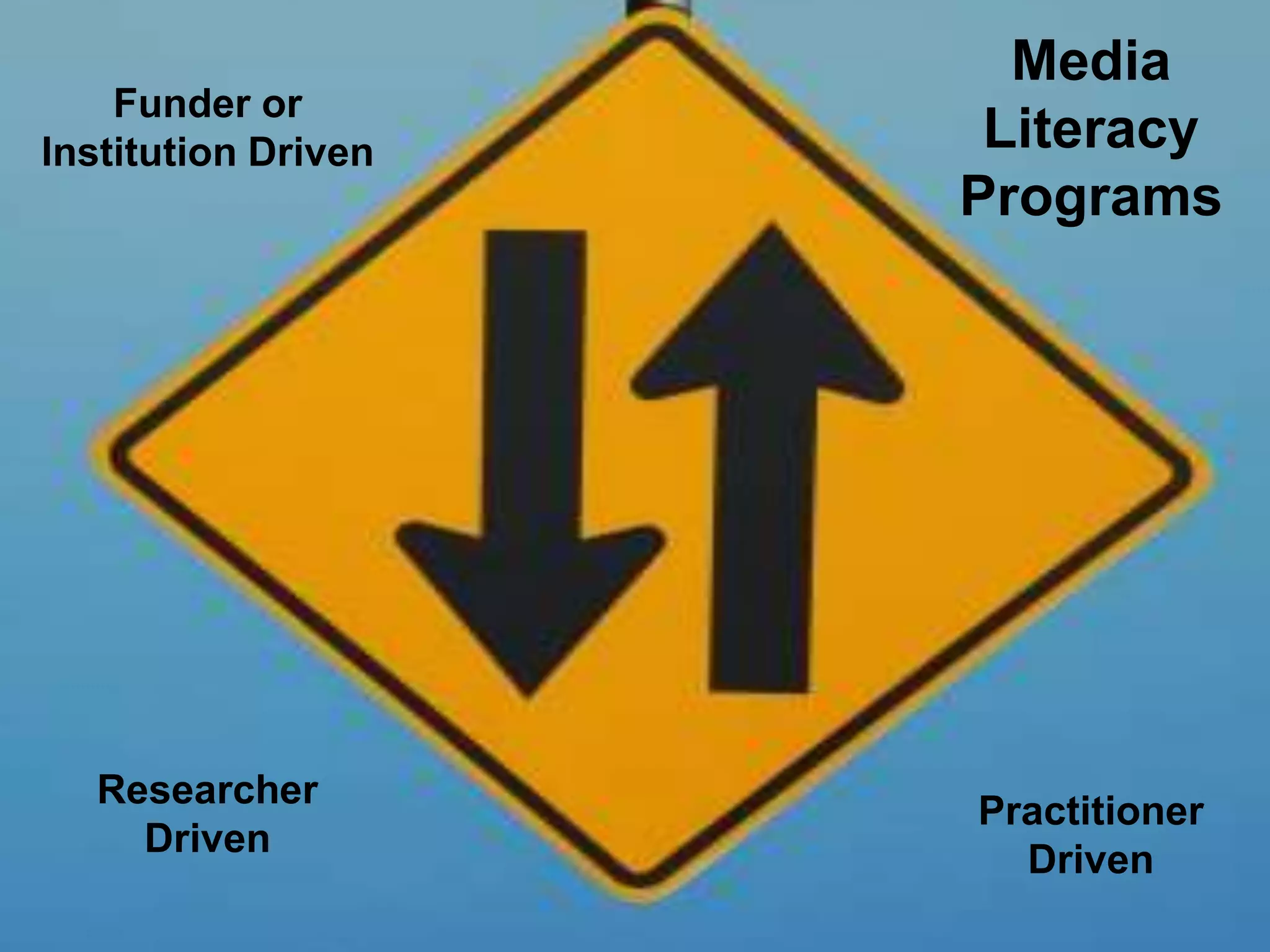
Media
Literacy
Programs
Researcher
Driven
Practitioner
Driven
Funder or
Institution Driven
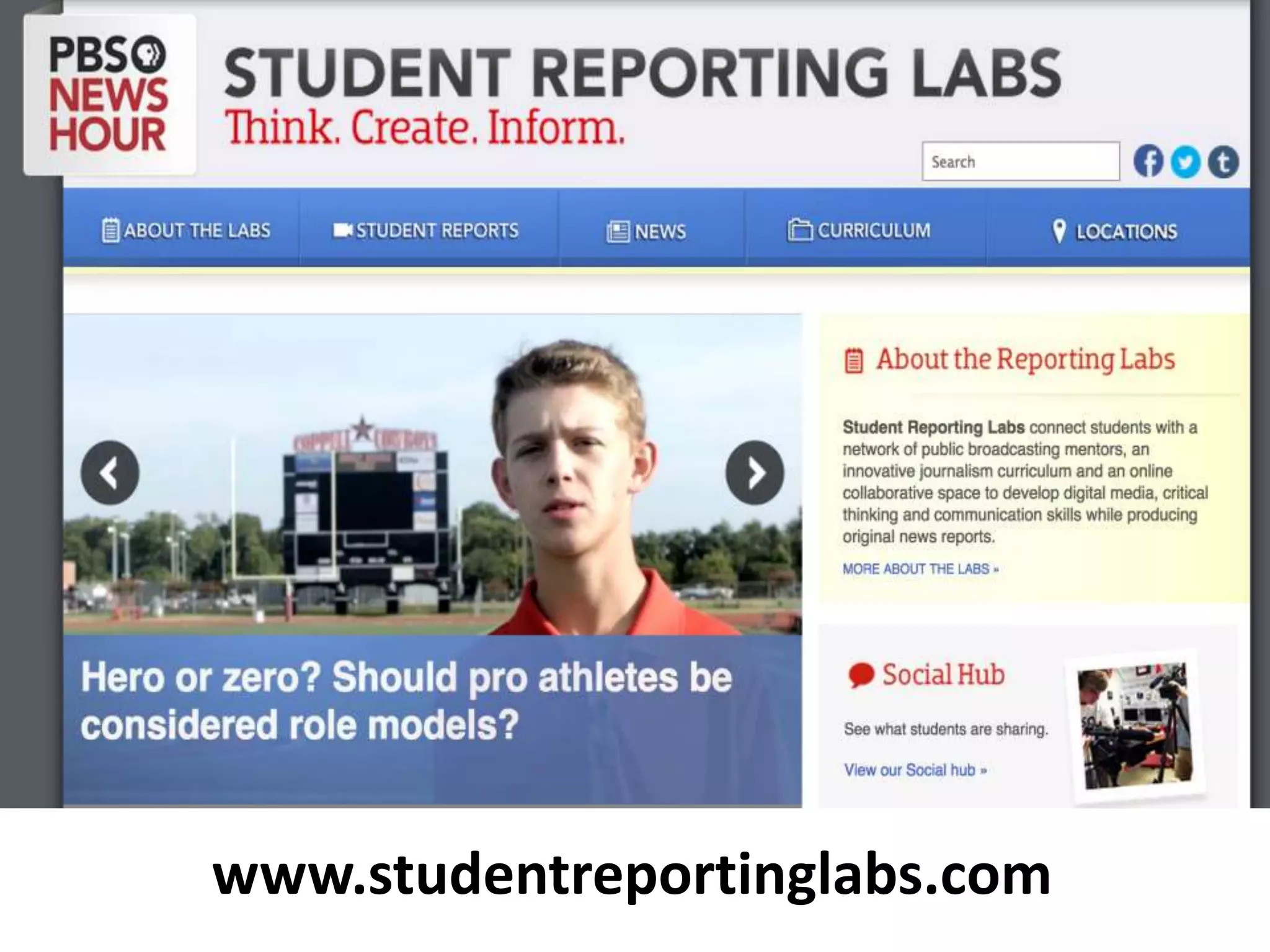
www.studentreportinglabs.com
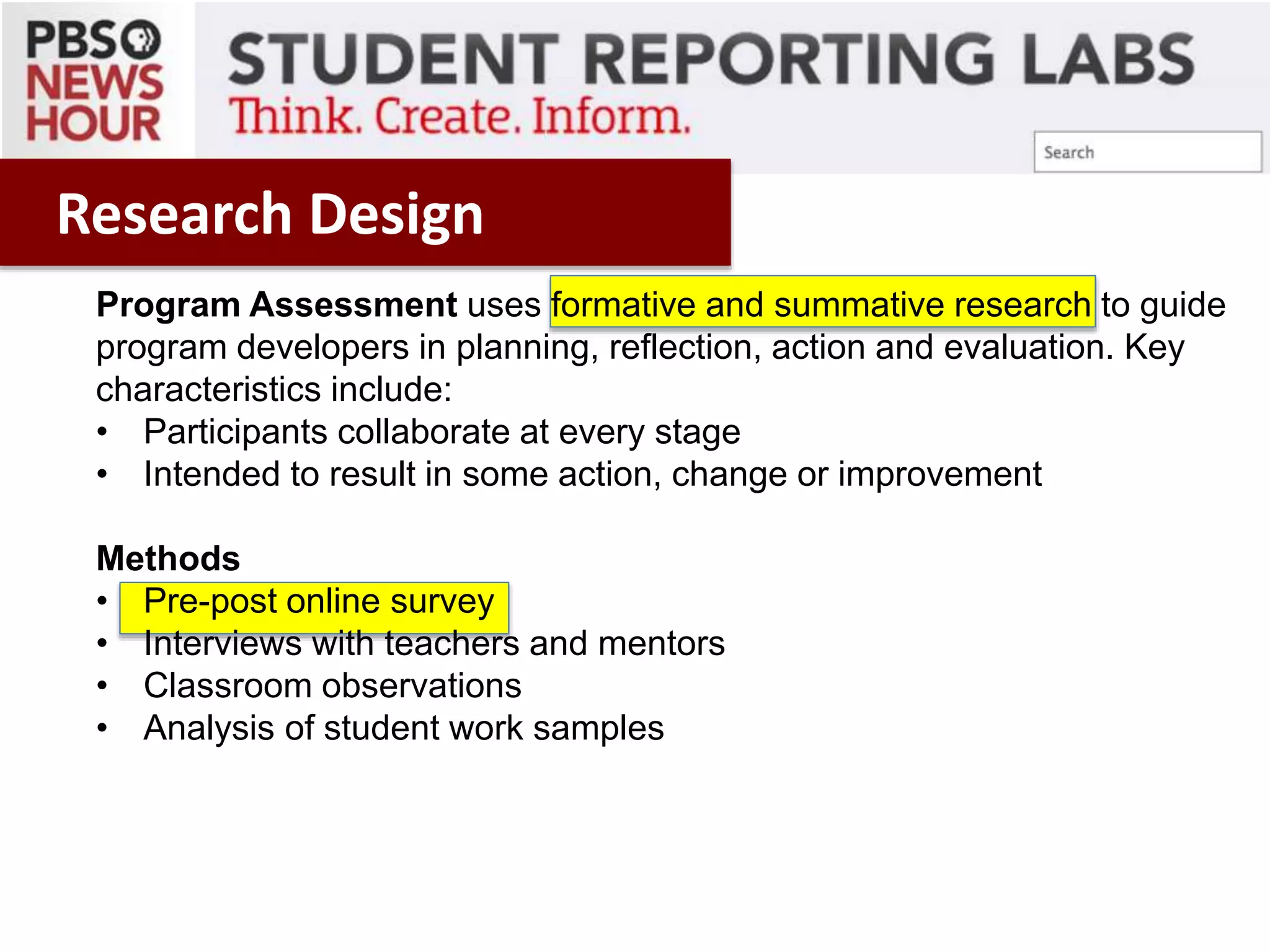
Program Assessment uses formative and summative research to guide
program developers in planning, reflection, action and evaluation. Key
characteristics include:
• Participants collaborate at every stage
• Intended to result in some action, change or improvement
Methods
• Pre-post online survey
• Interviews with teachers and mentors
• Classroom observations
• Analysis of student work samples
PEER-TO-PEER FILE SHARING
Research Design
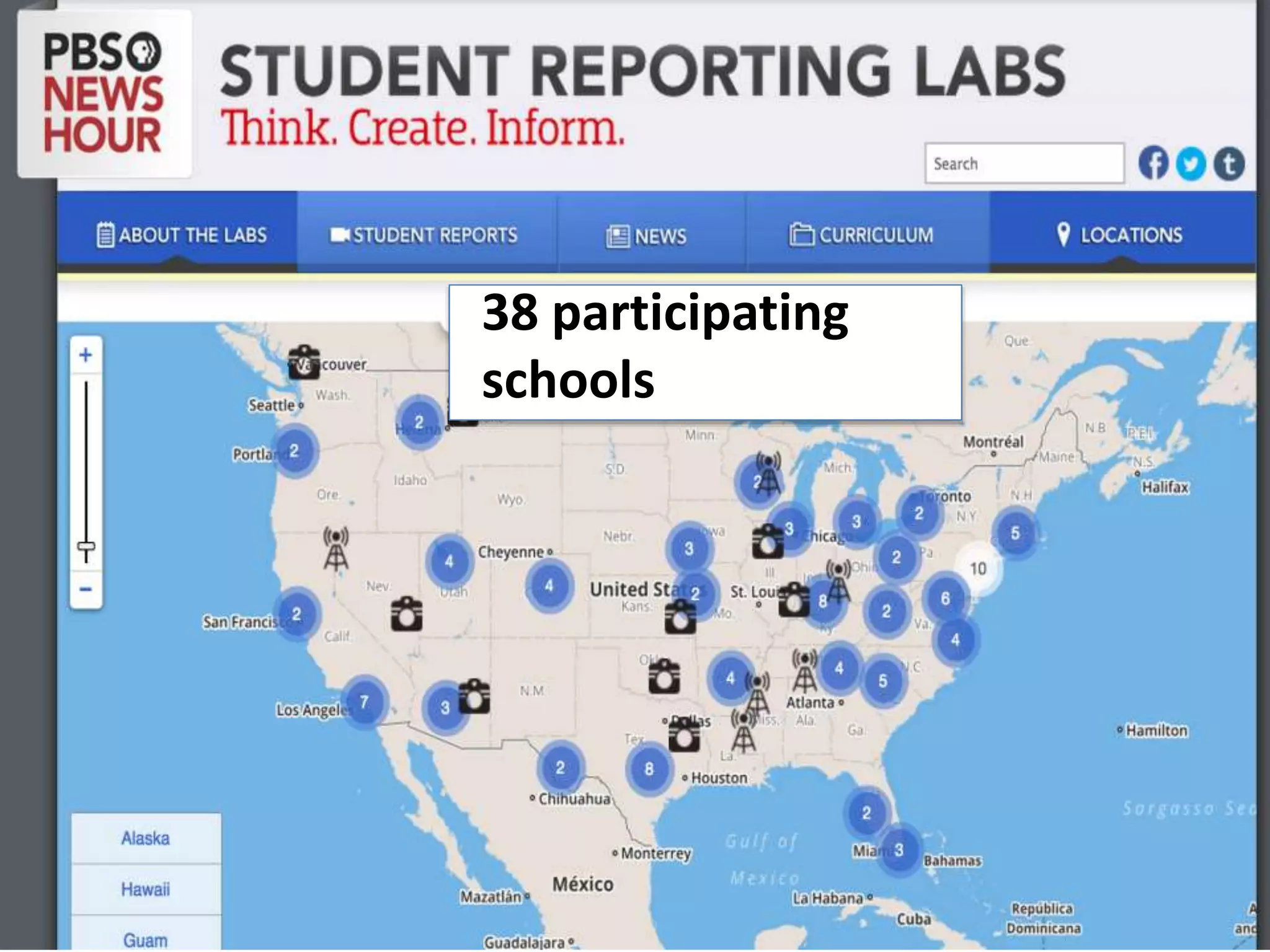
38 participating
schools
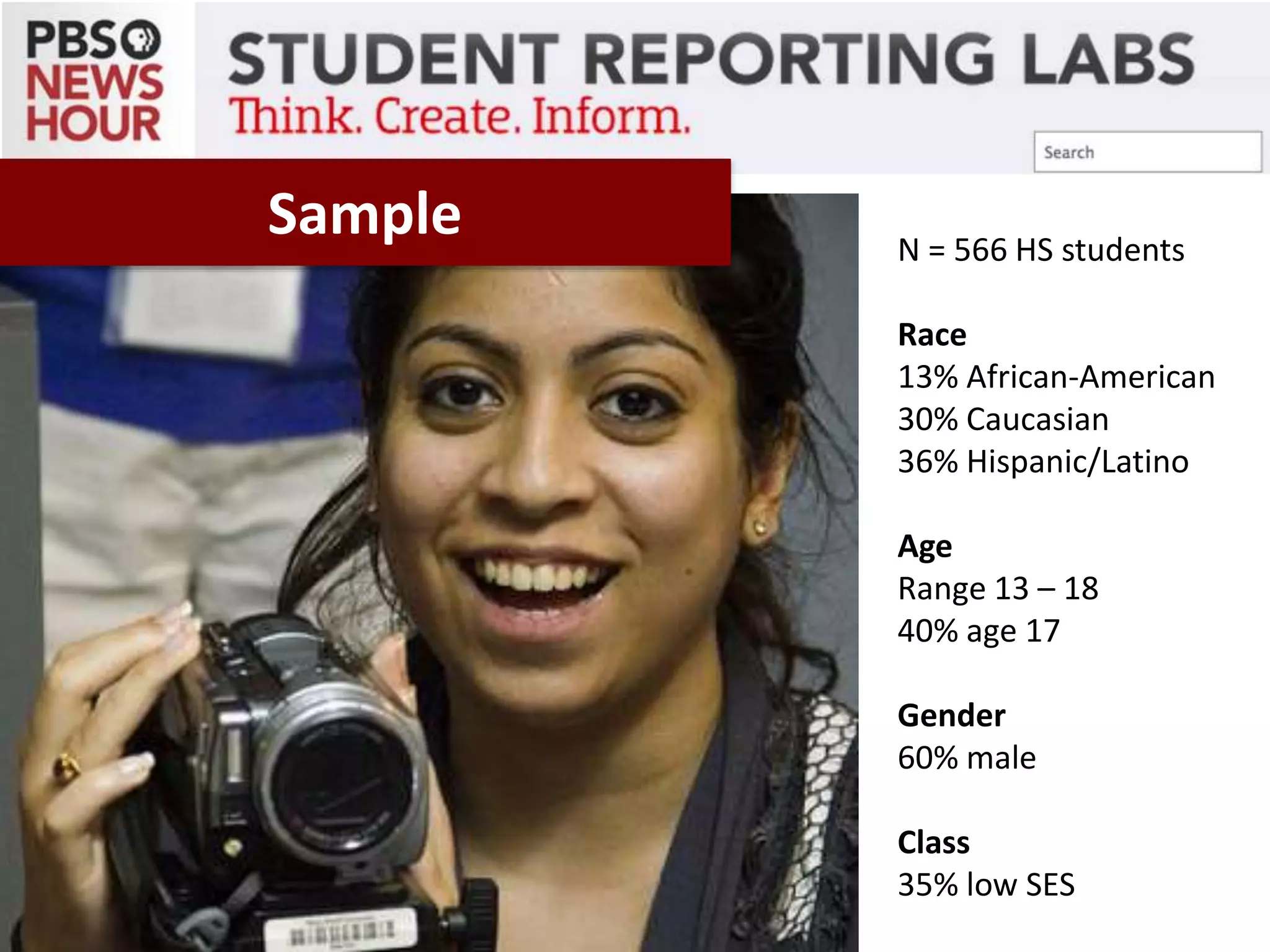
N = 566 HS students
Race
13% African-American
30% Caucasian
36% Hispanic/Latino
Age
Range 13 – 18
40% age 17
Gender
60% male
Class
35% low SES
Sample
PRODUCTION SKILLS
Non-technical skills
Technical skills
IN-CLASSROOM
ACTIVITIES
Gathering &
Synthesizing Info
Using Digital Media
Revision
MEDIA LITERACY
CIVIC
ENGAGEMENT
Sign an online
petition
Express an
opinion to news
media
Blog about an
issue
Write an opinion
letter
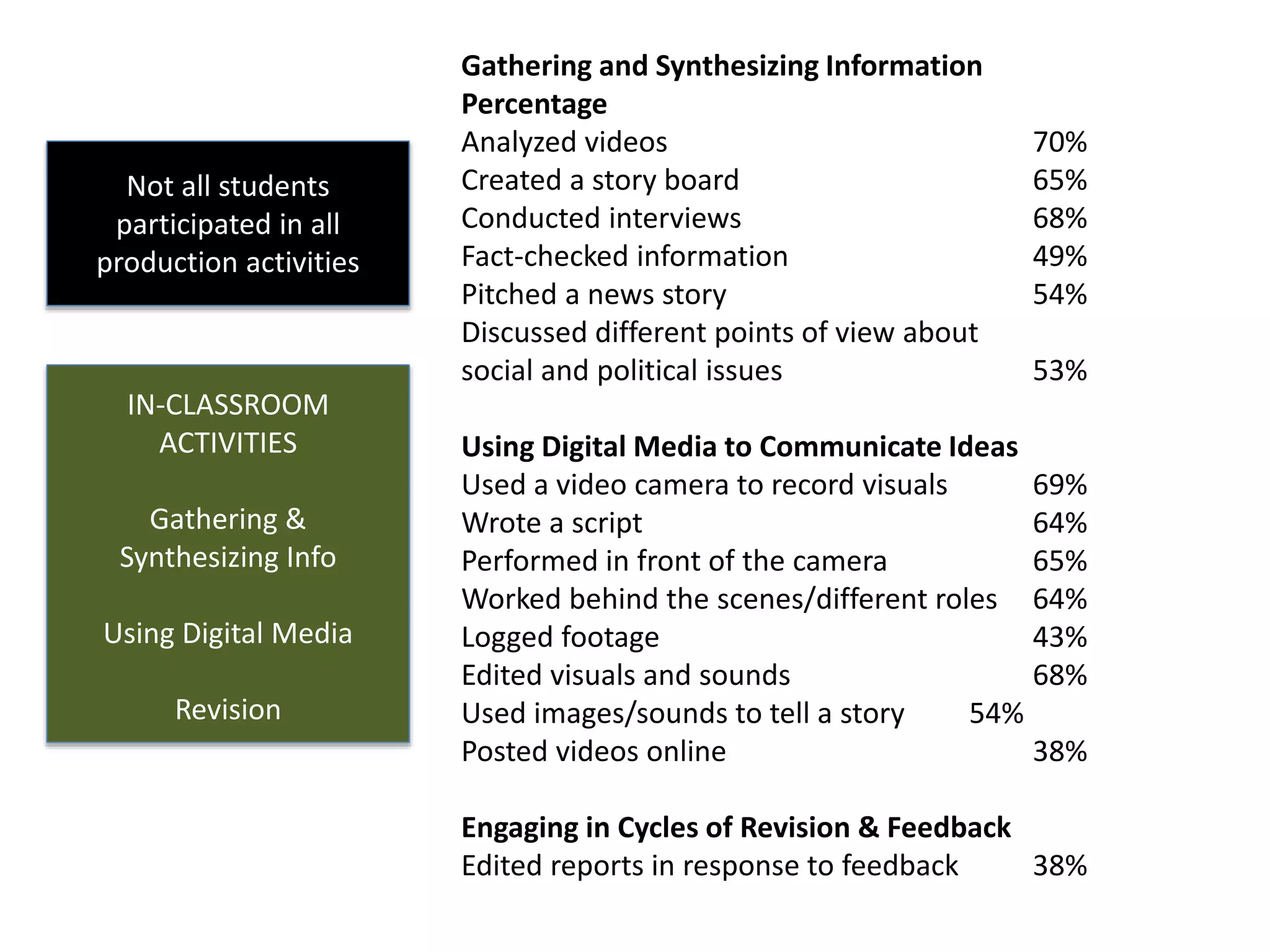
Gathering and Synthesizing Information
Percentage
Analyzed videos 70%
Created a story board 65%
Conducted interviews 68%
Fact-checked information 49%
Pitched a news story 54%
Discussed different points of view about
social and political issues 53%
Using Digital Media to Communicate Ideas
Used a video camera to record visuals 69%
Wrote a script 64%
Performed in front of the camera 65%
Worked behind the scenes/different roles 64%
Logged footage 43%
Edited visuals and sounds 68%
Used images/sounds to tell a story 54%
Posted videos online 38%
Engaging in Cycles of Revision & Feedback
Edited reports in response to feedback 38%
Not all students
participated in all
production activities
PRODUCTION SKILLS
MEDIA LITERACY
CIVIC
ENGAGEMENT
Sign an online
petition
Express an
opinion to news
media
Blog about an
issue
Write an opinion
letter
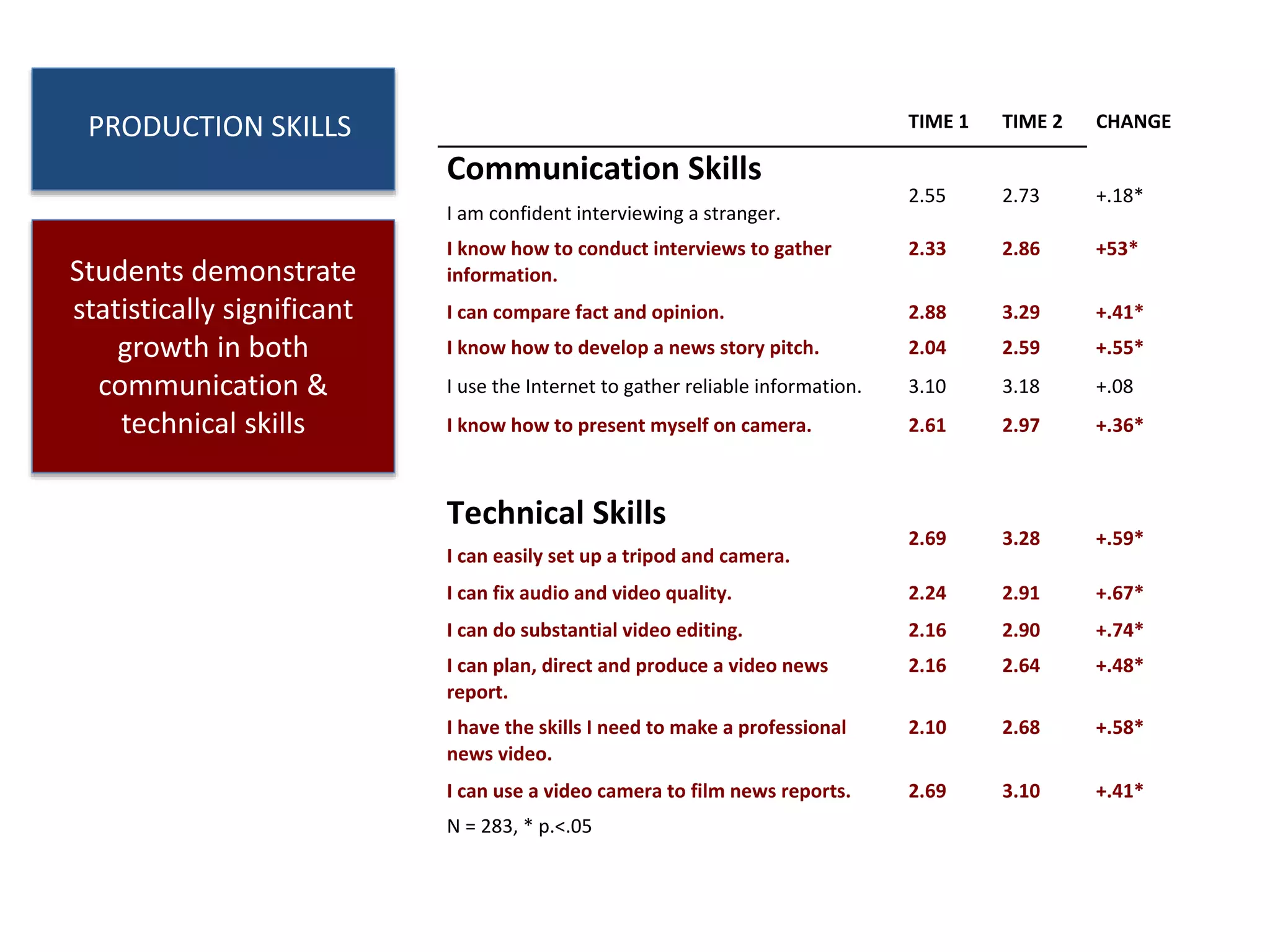
TIME 1 TIME 2 CHANGE
Communication Skills
I am confident interviewing a stranger.
2.55 2.73 +.18*
I know how to conduct interviews to gather
information.
2.33 2.86 +53*
I can compare fact and opinion. 2.88 3.29 +.41*
I know how to develop a news story pitch. 2.04 2.59 +.55*
I use the Internet to gather reliable information. 3.10 3.18 +.08
I know how to present myself on camera. 2.61 2.97 +.36*
Technical Skills
I can easily set up a tripod and camera.
2.69 3.28 +.59*
I can fix audio and video quality. 2.24 2.91 +.67*
I can do substantial video editing. 2.16 2.90 +.74*
I can plan, direct and produce a video news
report.
2.16 2.64 +.48*
I have the skills I need to make a professional
news video.
2.10 2.68 +.58*
I can use a video camera to film news reports.
N = 283, * p.<.05
2.69 3.10 +.41*
Students demonstrate
statistically significant
growth in both
communication &
technical skills
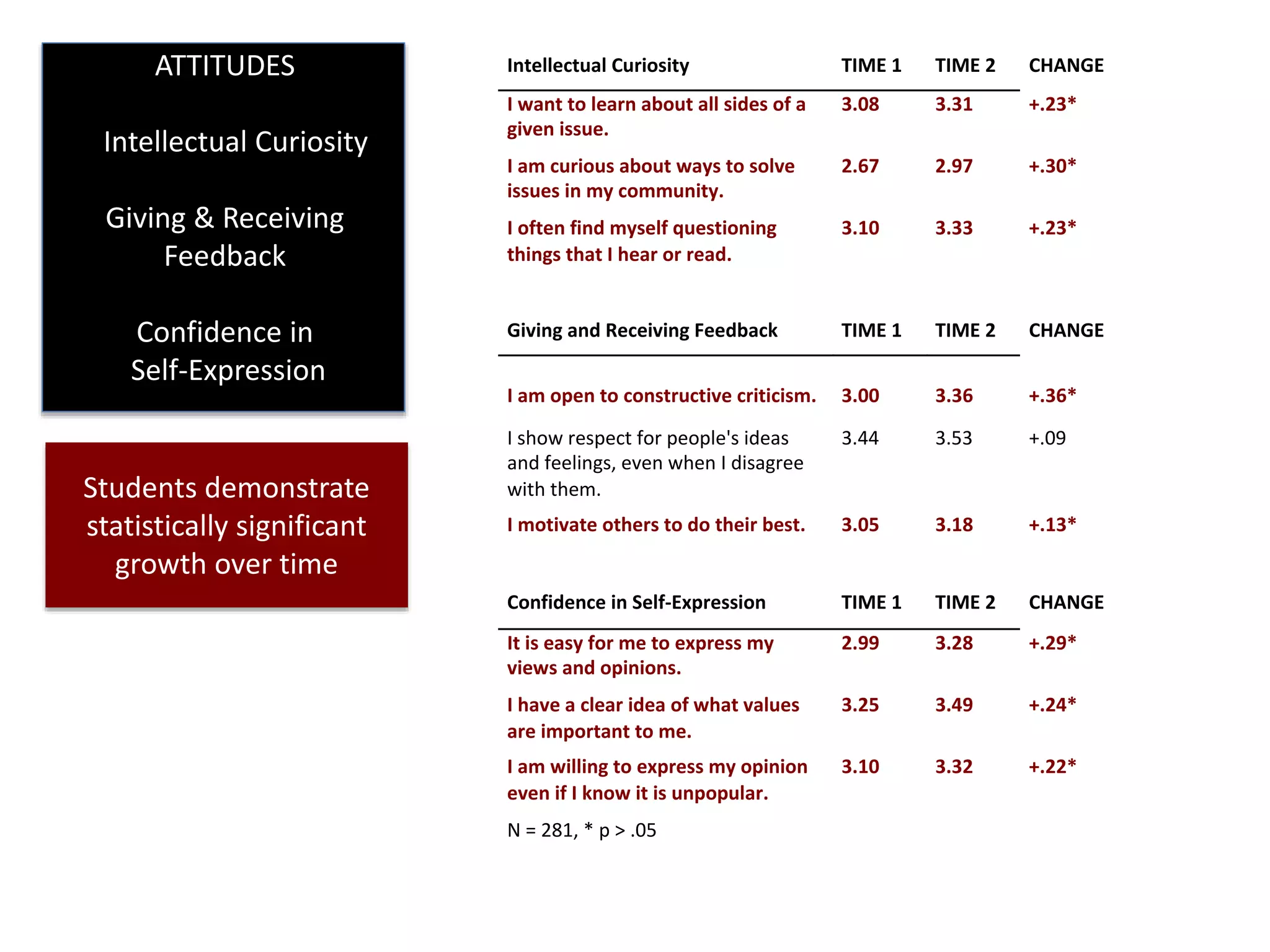
ATTITUDES
Intellectual Curiosity
Giving & Receiving
Feedback
Confidence in
Self-Expression
Intellectual Curiosity TIME 1 TIME 2 CHANGE
I want to learn about all sides of a
given issue.
3.08 3.31 +.23*
I am curious about ways to solve
issues in my community.
2.67 2.97 +.30*
I often find myself questioning
things that I hear or read.
3.10 3.33 +.23*
Giving and Receiving Feedback TIME 1 TIME 2 CHANGE
I am open to constructive criticism. 3.00 3.36 +.36*
I show respect for people's ideas
and feelings, even when I disagree
with them.
3.44 3.53 +.09
I motivate others to do their best. 3.05 3.18 +.13*
Confidence in Self-Expression TIME 1 TIME 2 CHANGE
It is easy for me to express my
views and opinions.
2.99 3.28 +.29*
I have a clear idea of what values
are important to me.
3.25 3.49 +.24*
I am willing to express my opinion
even if I know it is unpopular.
3.10 3.32 +.22*
N = 281, * p > .05
Students demonstrate
statistically significant
growth over time
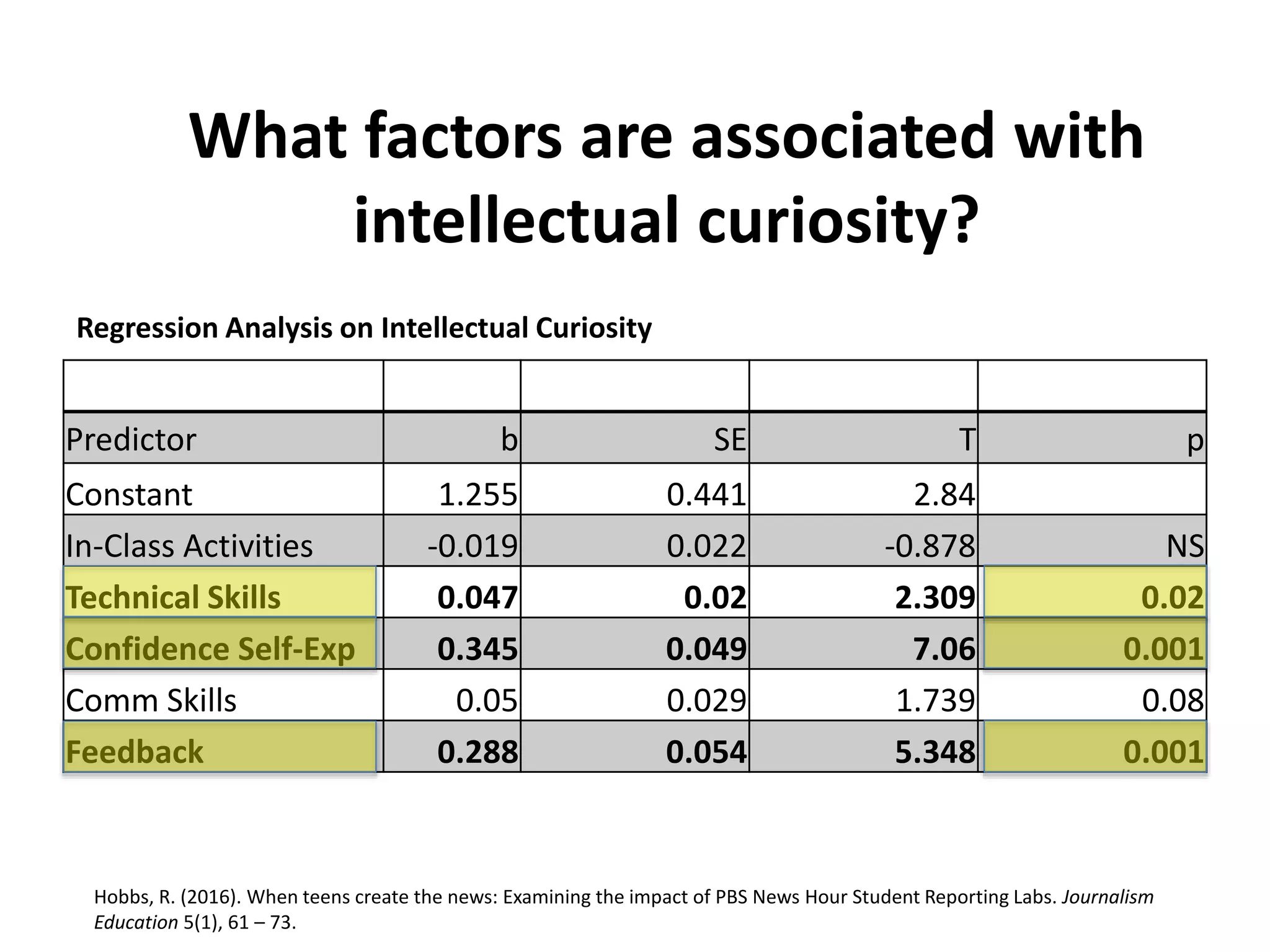
What factors are associated with
intellectual curiosity?
Predictor b SE T p
Constant 1.255 0.441 2.84
In-Class Activities -0.019 0.022 -0.878 NS
Technical Skills 0.047 0.02 2.309 0.02
Confidence Self-Exp 0.345 0.049 7.06 0.001
Comm Skills 0.05 0.029 1.739 0.08
Feedback 0.288 0.054 5.348 0.001
Regression Analysis on Intellectual Curiosity
Hobbs, R. (2016). When teens create the news: Examining the impact of PBS News Hour Student Reporting Labs. Journalism
Education 5(1), 61 – 73.
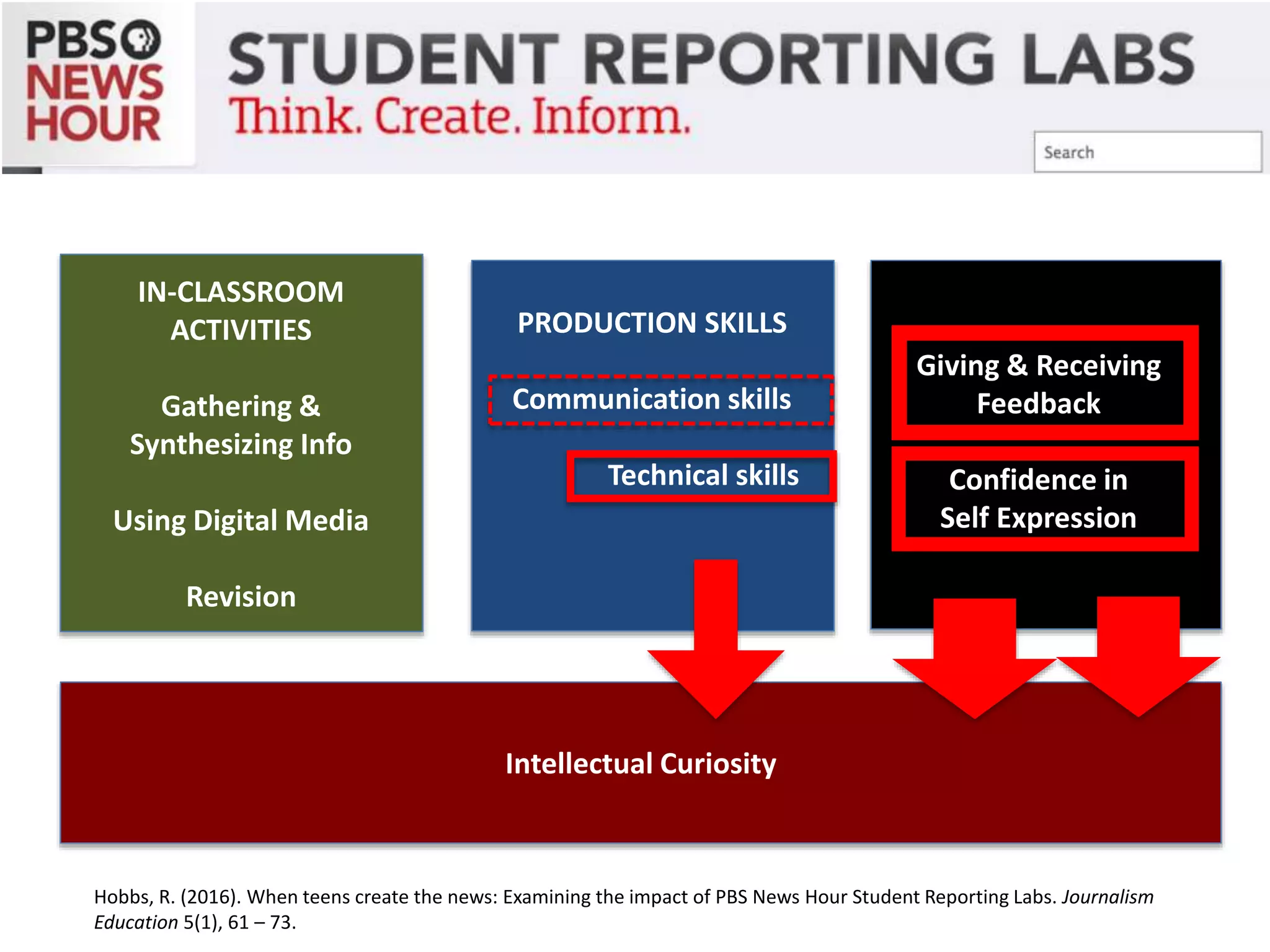
PRODUCTION SKILLS
Communication skills
Technical skills
Giving & Receiving
Feedback
Confidence in
Self Expression
IN-CLASSROOM
ACTIVITIES
Gathering &
Synthesizing Info
Using Digital Media
Revision
Intellectual Curiosity
Hobbs, R. (2016). When teens create the news: Examining the impact of PBS News Hour Student Reporting Labs. Journalism
Education 5(1), 61 – 73.
Developing and Validating Measures
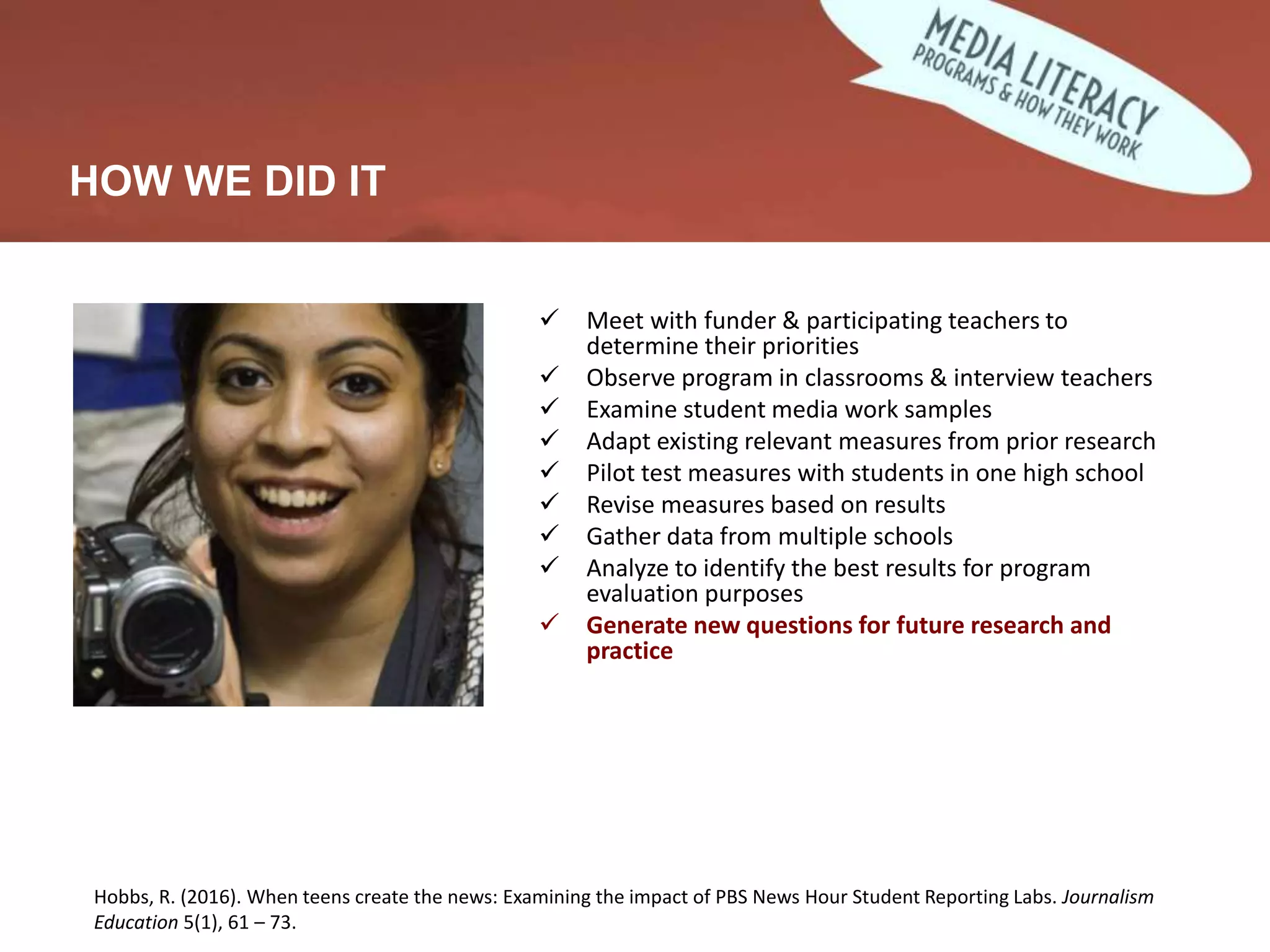
 Meet with funder & participating teachers to
determine their priorities
 Observe program in classrooms & interview teachers
 Examine student media work samples
 Adapt existing relevant measures from prior research
 Pilot test measures with students in one high school
 Revise measures based on results
 Gather data from multiple schools
 Analyze to identify the best results for program
evaluation purposes
 Generate new questions for future research and
practice
HOW WE DID IT
Hobbs, R. (2016). When teens create the news: Examining the impact of PBS News Hour Student Reporting Labs. Journalism
Education 5(1), 61 – 73.
Program evaluation of media literacy initiatives can help
advance both measurement & theory-building
THEMES FOR TODAY
Partnership Matters: The shape of media literacy research
should be determined by the intersecting interests of
researcher, practitioner and institution/funder
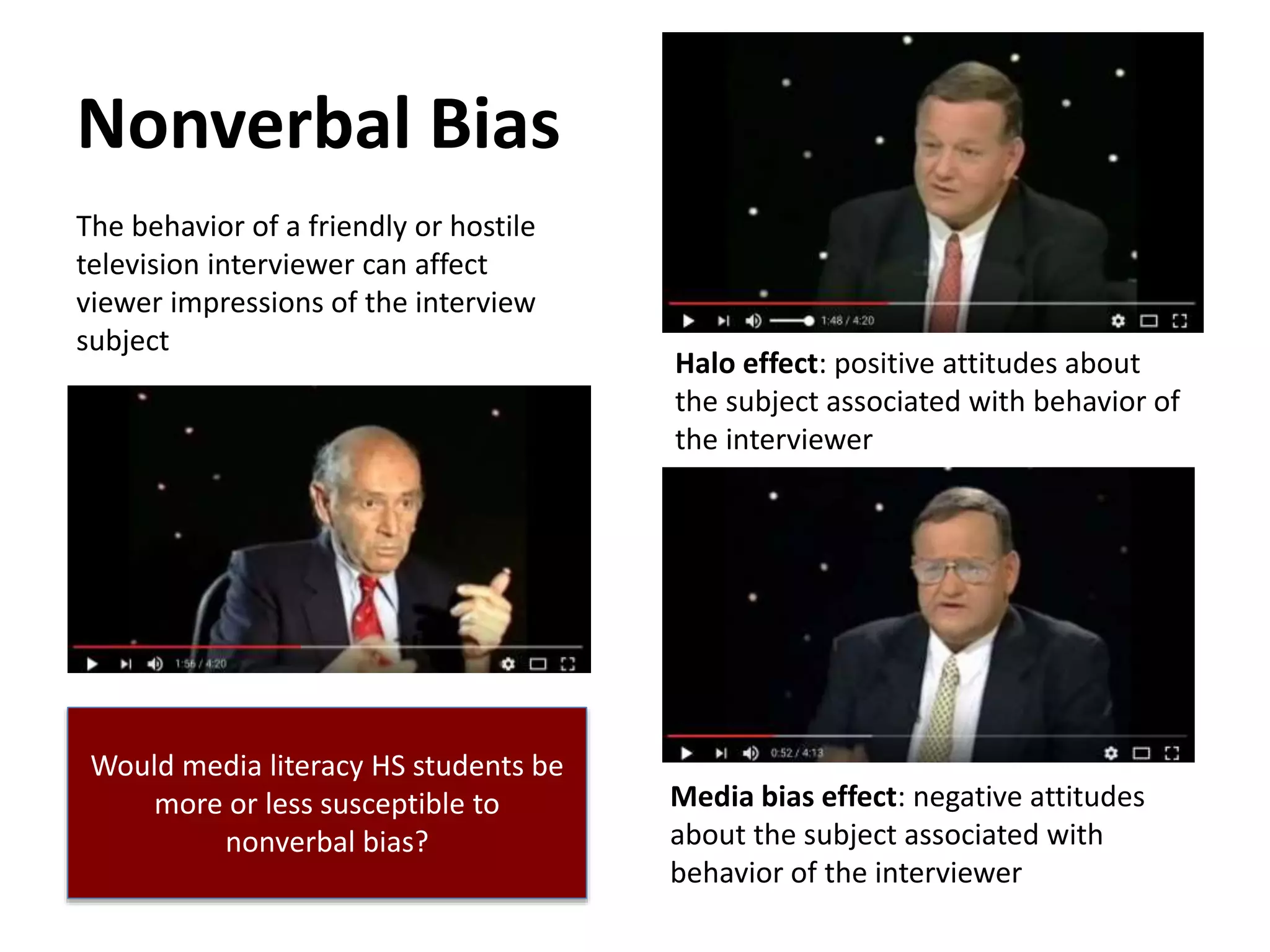
Nonverbal Bias
The behavior of a friendly or hostile
television interviewer can affect
viewer impressions of the interview
subject
Halo effect: positive attitudes about
the subject associated with behavior of
the interviewer
Media bias effect: negative attitudes
about the subject associated with
behavior of the interviewer
Would media literacy HS students be
more or less susceptible to
nonverbal bias?
Media Analysis
A one-semester course open to students
in all grades taught by a veteran media
literacy teacher.
The course emphasized the key concepts
of media literacy, and students engaged
in the process of critically analyzing
news, advertising, and film through
critical questioning.
Students completed assignments in
which they analyzed the credibility of TV
news and Internet Websites and
examined patterns in the representation
of violence in the media.
Other topics discussed in the class:
• body image and the representation of
gender in mass media
• media coverage of historical events
• presidential ad campaigns
Students learned to analyze media by
applying concepts such as purpose,
audience, point of view, media languages,
subtext, representation, and technology to
diverse forms of visual and digital
messages from contemporary and popular
culture.
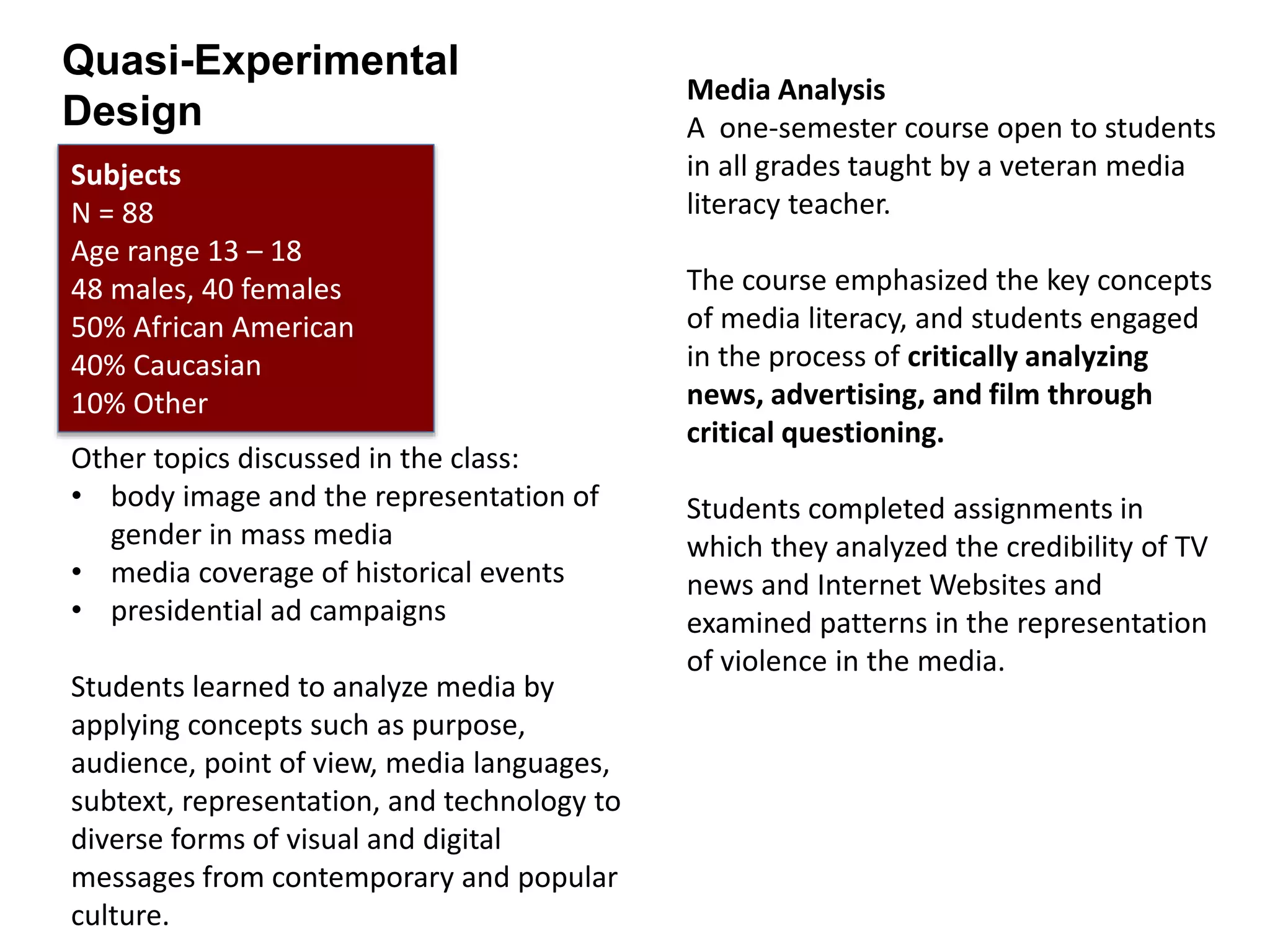
Subjects
N = 88
Age range 13 – 18
48 males, 40 females
50% African American
40% Caucasian
10% Other
Quasi-Experimental
Design
Babad, E., Peer, A., & Hobbs, R. (2012). Media literacy and media bias: Are media literacy students less susceptible to non-
verbal judgment biases? Psychology of Popular Media Culture 1(2), 97 – 107. DOI: 10.137/a0028181
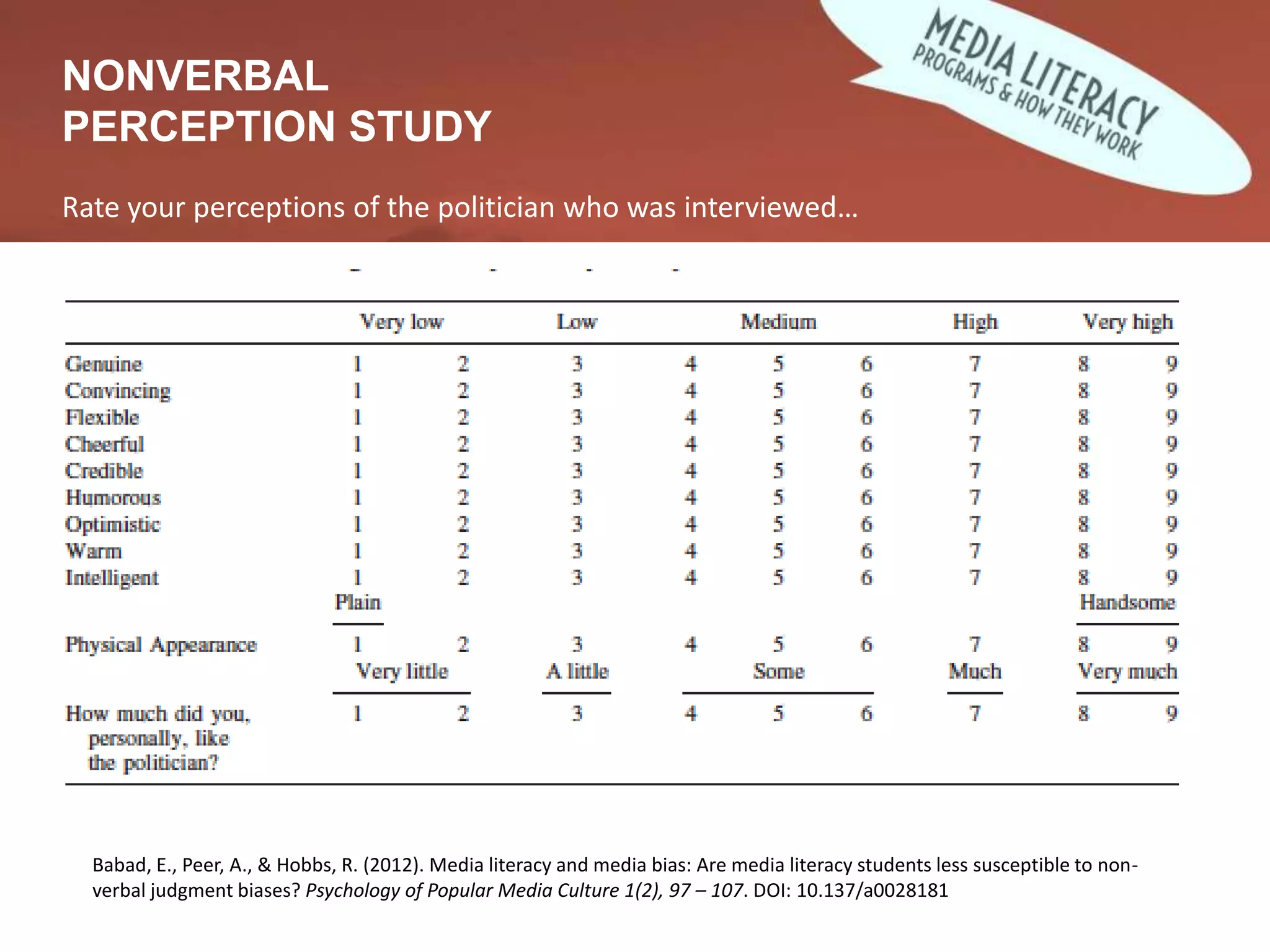
Rate your perceptions of the politician who was interviewed…
NONVERBAL
PERCEPTION STUDY
Babad, E., Peer, A., & Hobbs, R. (2012). Media literacy and media bias: Are media literacy students less susceptible to non-
verbal judgment biases? Psychology of Popular Media Culture.1(2), 97 – 107. DOI: 10.137/a0028181
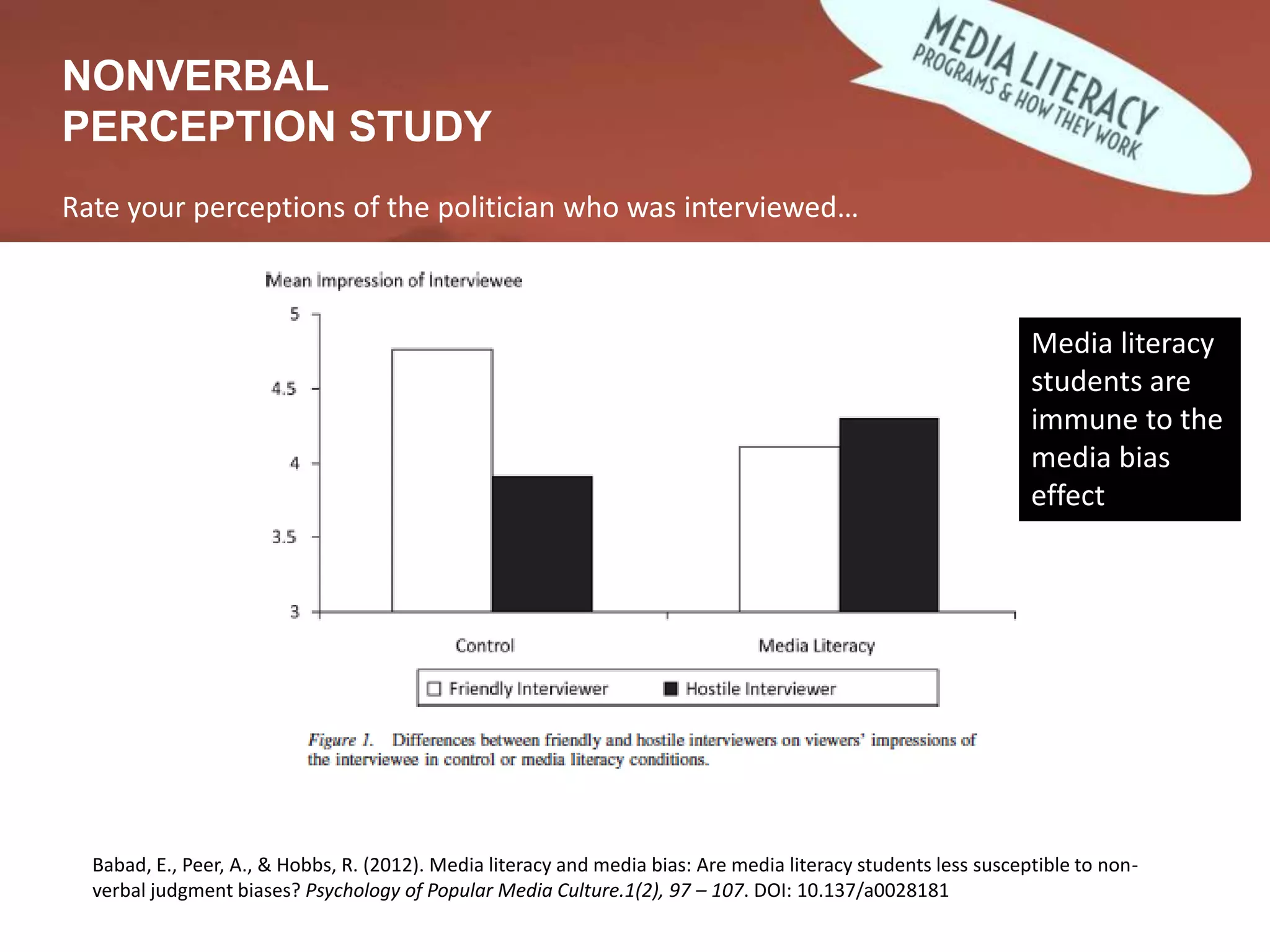
Media literacy
students are
immune to the
media bias
effect
NONVERBAL
PERCEPTION STUDY
Rate your perceptions of the politician who was interviewed…
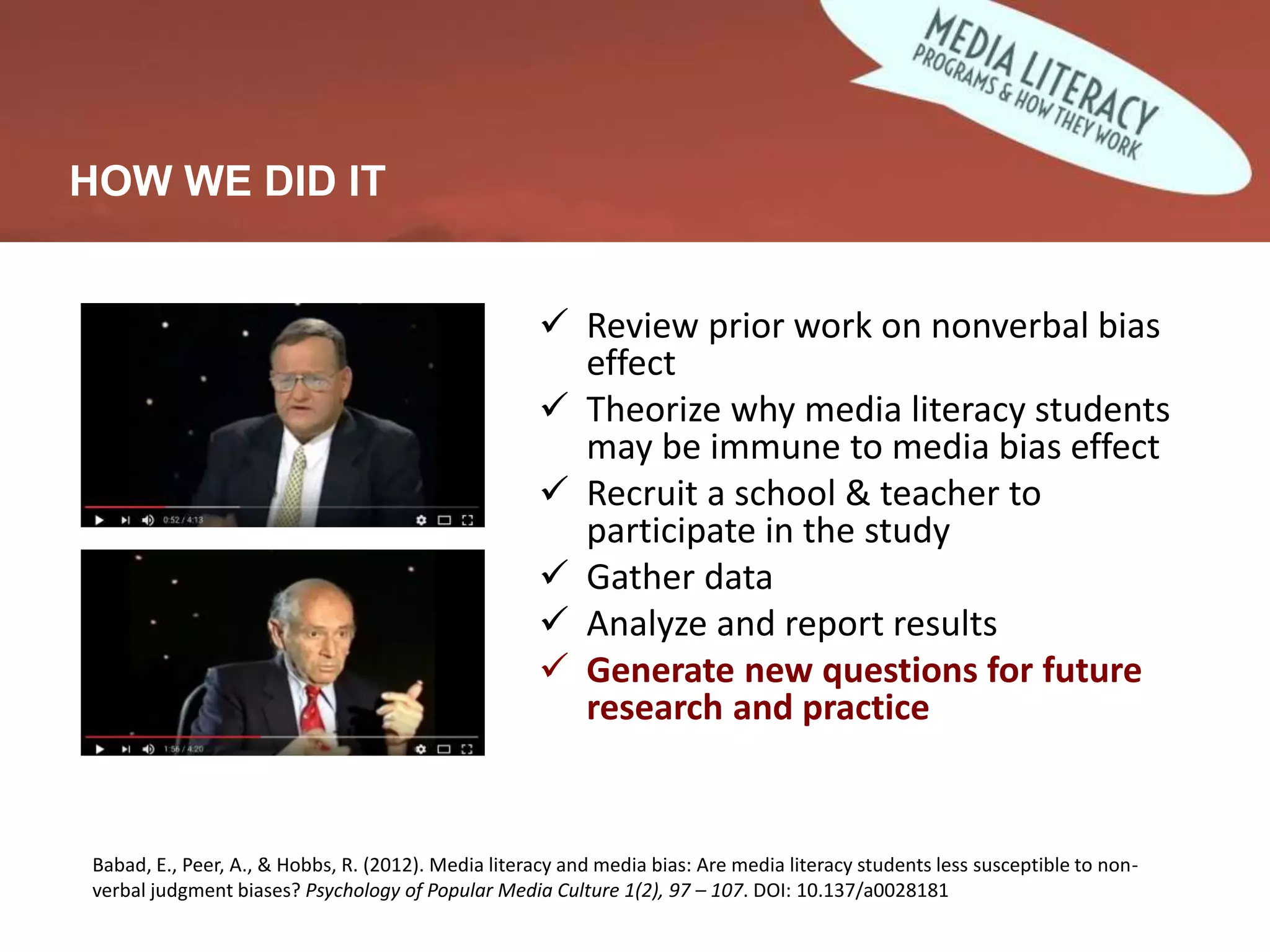
Developing and Validating Measures
 Review prior work on nonverbal bias
effect
 Theorize why media literacy students
may be immune to media bias effect
 Recruit a school & teacher to
participate in the study
 Gather data
 Analyze and report results
 Generate new questions for future
research and practice
HOW WE DID IT
Babad, E., Peer, A., & Hobbs, R. (2012). Media literacy and media bias: Are media literacy students less susceptible to non-
verbal judgment biases? Psychology of Popular Media Culture 1(2), 97 – 107. DOI: 10.137/a0028181
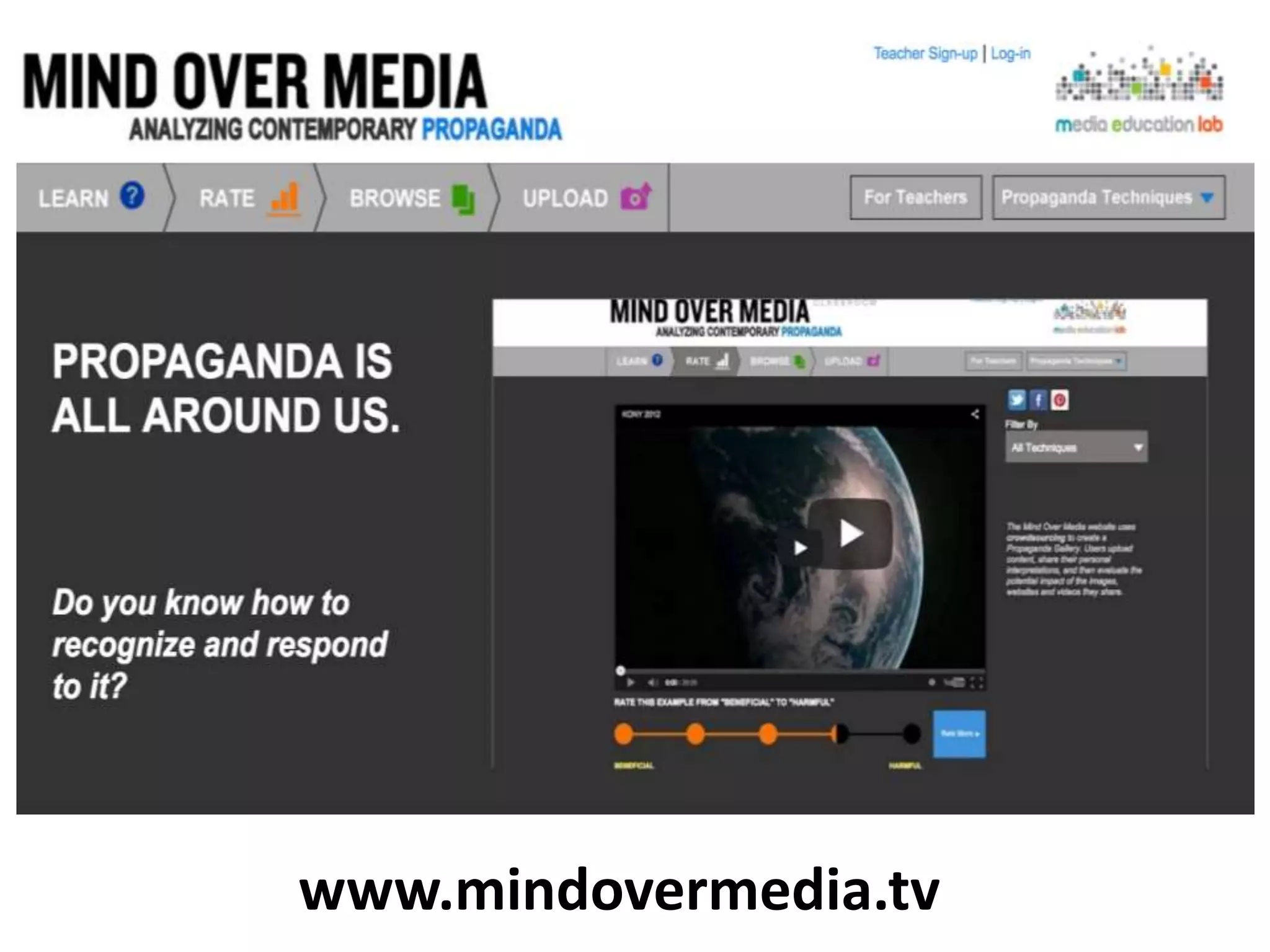
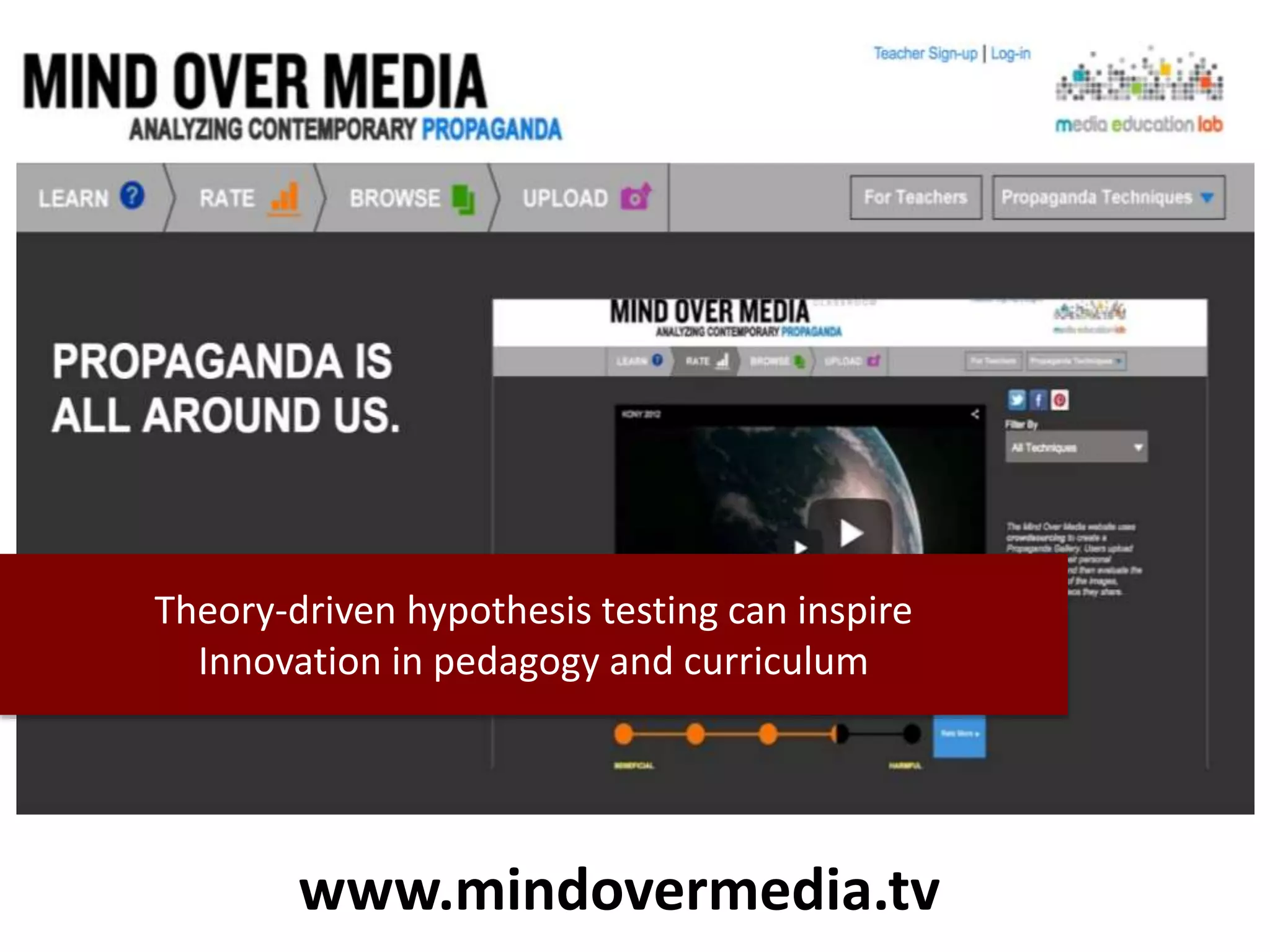
www.mindovermedia.tv
Theory-driven hypothesis testing can inspire
Innovation in pedagogy and curriculum
THEMES FOR TODAY
Partnership Matters: The shape of media literacy research
should be determined by intersecting interests of researcher,
practitioner and institution/funder
Transdisciplinarity Matters: Media literacy researchers
should collaborate across disciplines in order to benefit in
unexpected ways from exposure to diverse paradigms
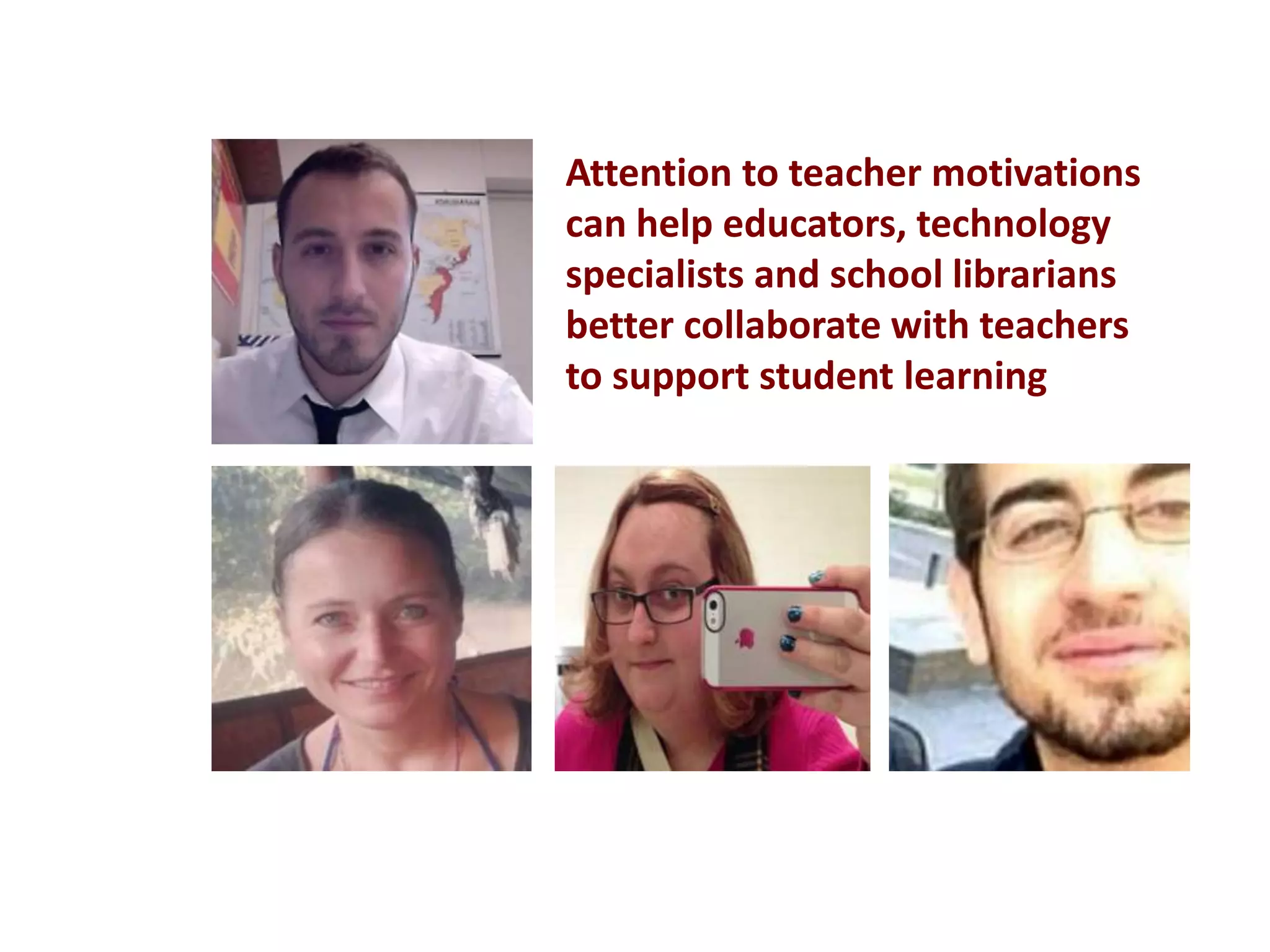
Attention to teacher motivations
can help educators, technology
specialists and school librarians
better collaborate with teachers
to support student learning
SKILLS & ABILITIES
➢ Knowledge about the Computer & Internet
➢ Digital Skills
LITERACY
➢ Online Reading & New Literacies
➢ Media Production / Youth Media
➢ Coding / Programming
TEACHING WITH
➢ Technology Integration
➢ Digital Learning
➢ Blended Learning
➢ Connected Learning
TEACHING ABOUT
➢ Information Literacy
➢ Media Literacy
➢ Internet Safety & Digital Citizenship
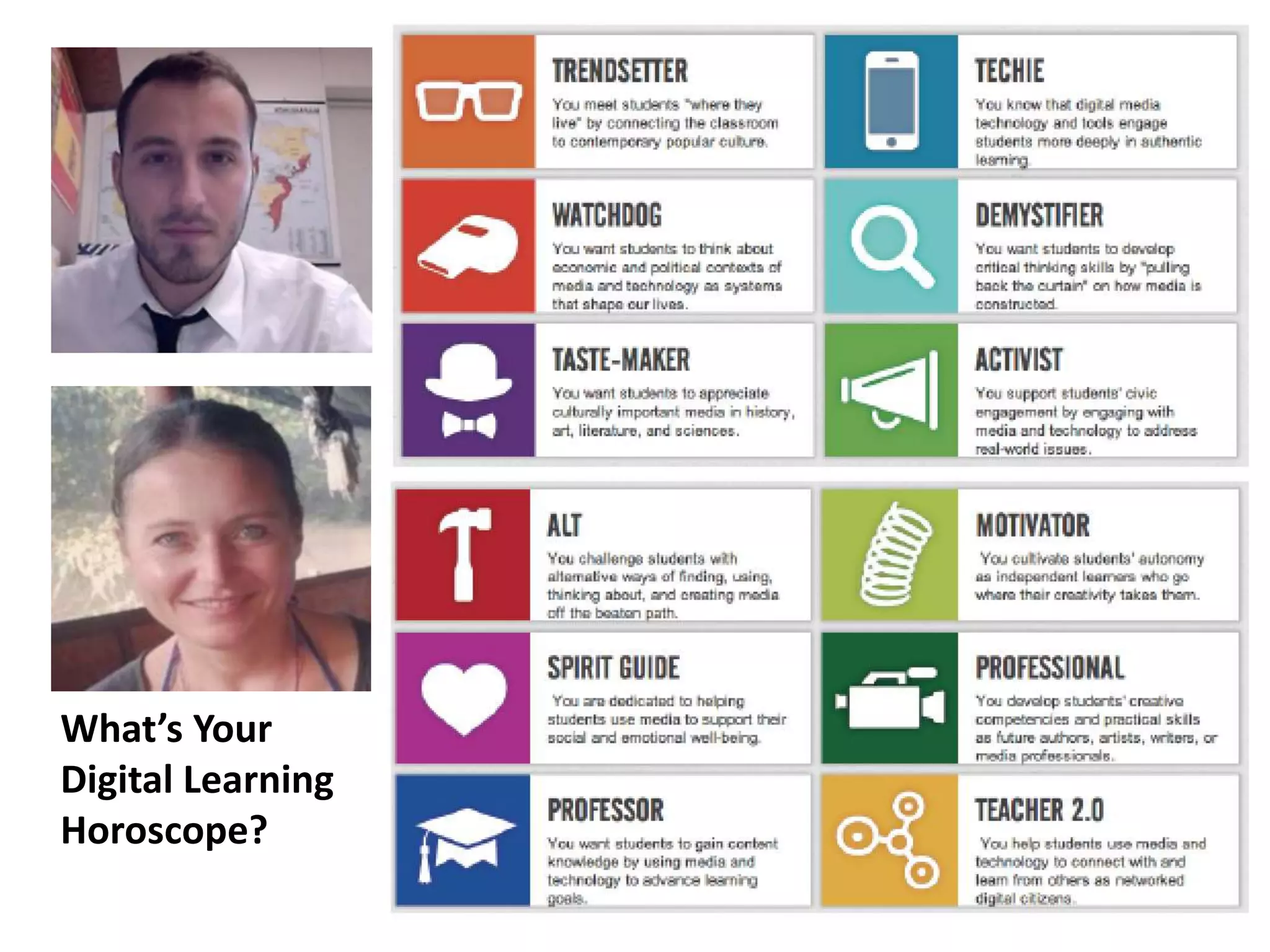
What Digital Learning Flavors have You Tasted?
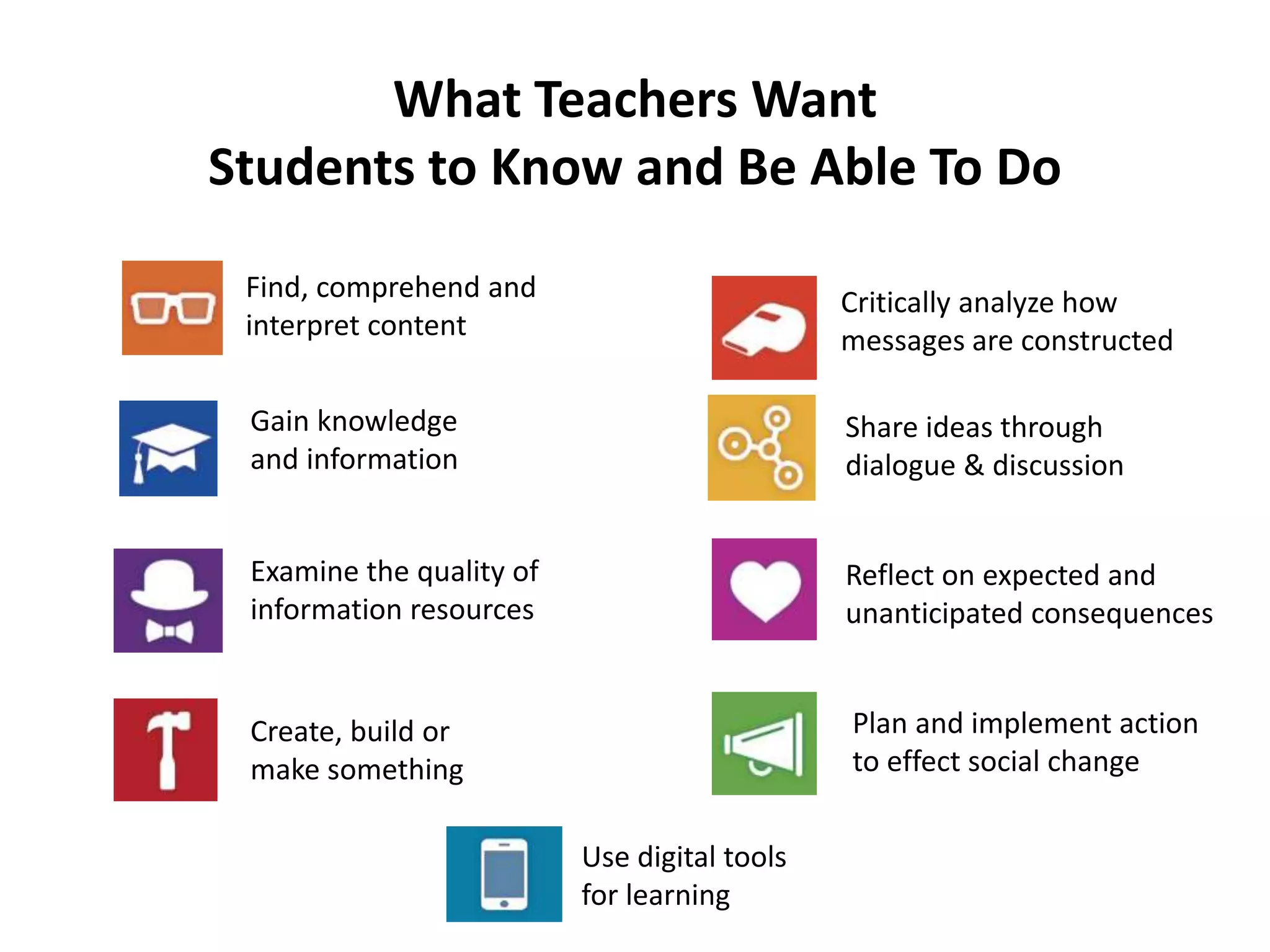
What Teachers Want
Students to Know and Be Able To Do
Find, comprehend and
interpret content
Gain knowledge
and information
Examine the quality of
information resources
Share ideas through
dialogue & discussion
Create, build or
make something
Reflect on expected and
unanticipated consequences
Plan and implement action
to effect social change
Critically analyze how
messages are constructed
Use digital tools
for learning
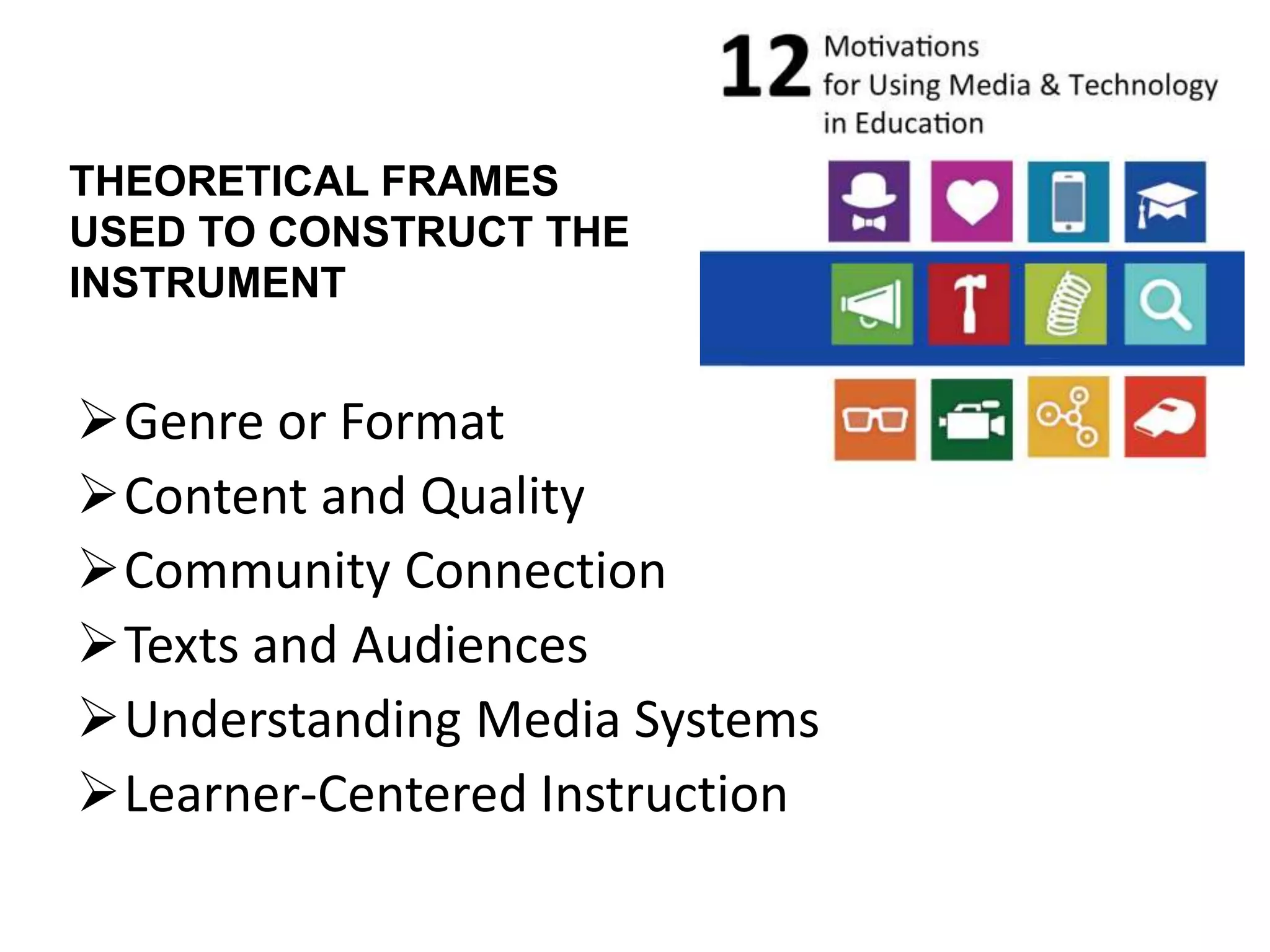
Genre or Format
Content and Quality
Community Connection
Texts and Audiences
Understanding Media Systems
Learner-Centered Instruction
THEORETICAL FRAMES
USED TO CONSTRUCT THE
INSTRUMENT
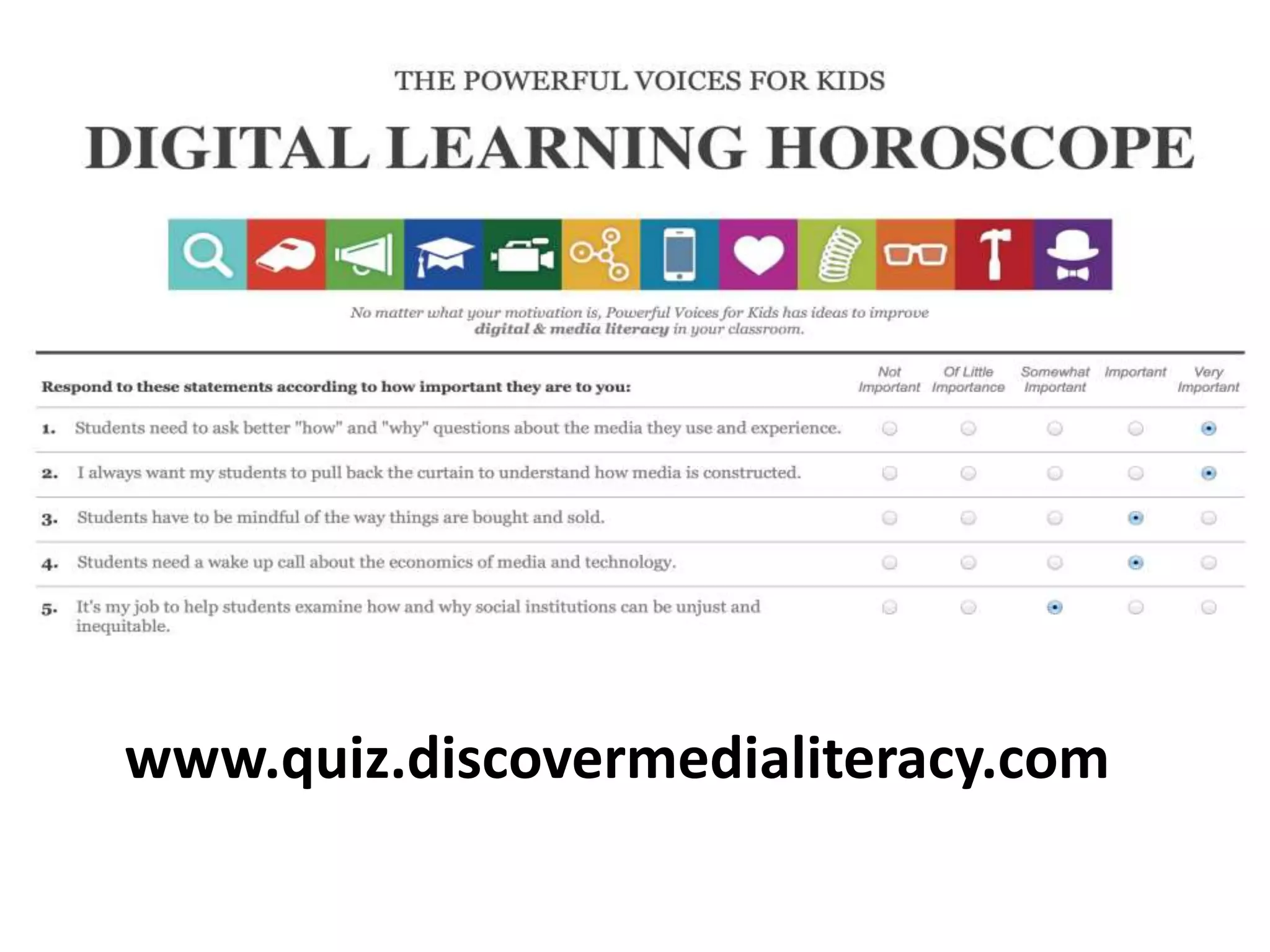
www.quiz.discovermedialiteracy.com
What’s Your
Digital Learning
Horoscope?
@reneehobbs #caslceca2015
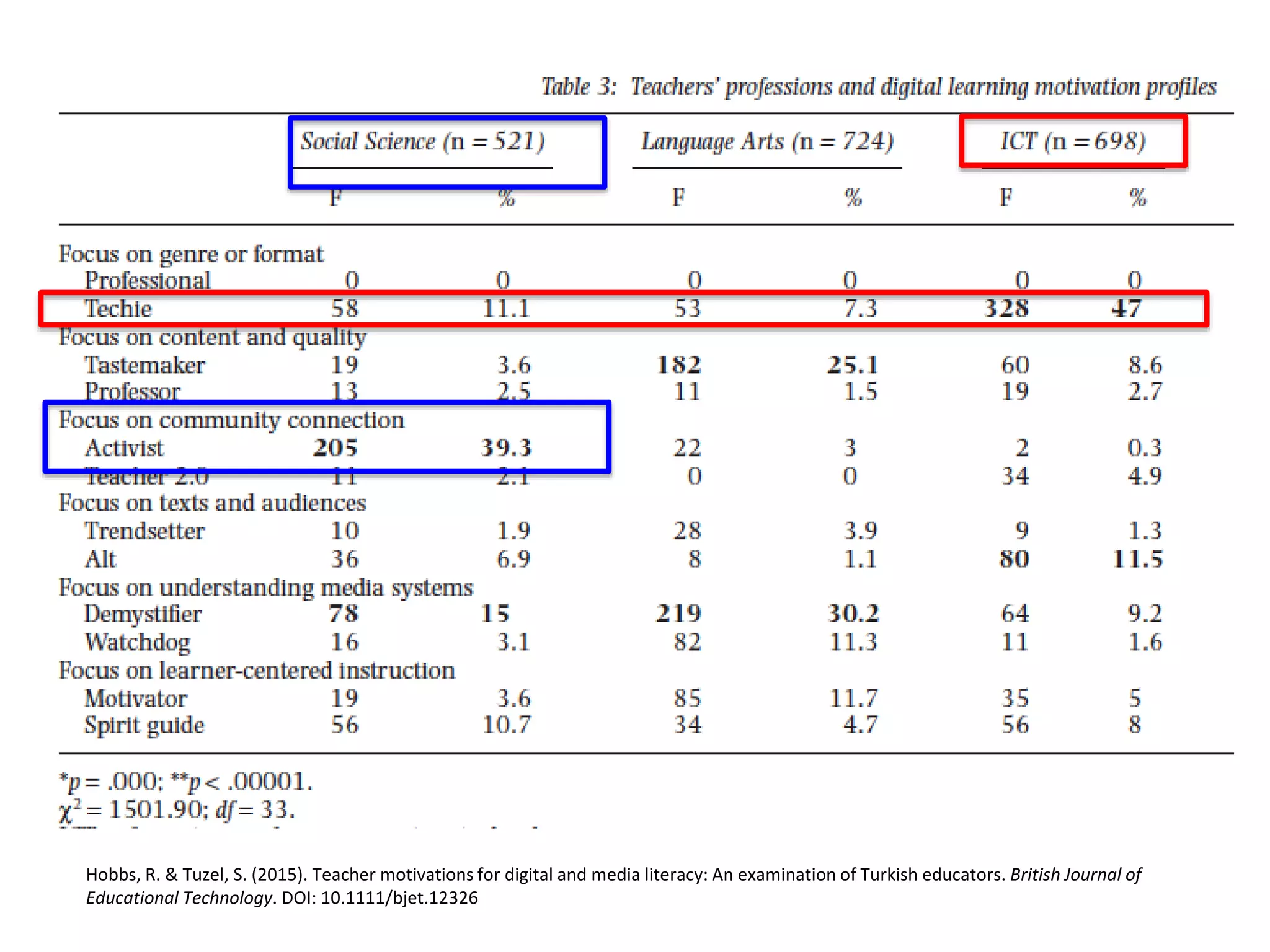
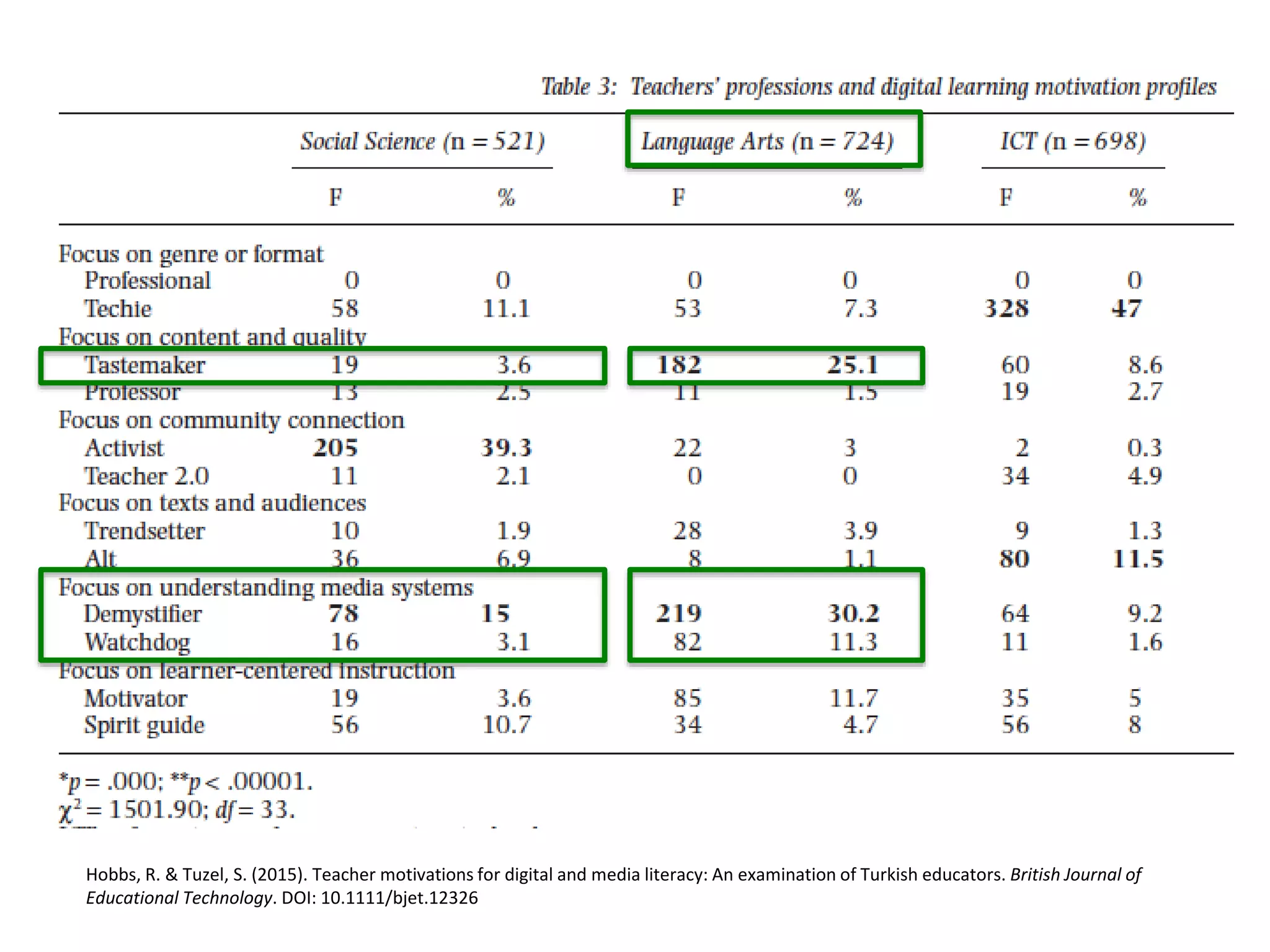
Hobbs, R. & Tuzel, S. (2015). Teacher motivations for digital and media literacy: An examination of Turkish educators. British Journal of
Educational Technology. DOI: 10.1111/bjet.12326
Hobbs, R. & Tuzel, S. (2015). Teacher motivations for digital and media literacy: An examination of Turkish educators. British Journal of
Educational Technology. DOI: 10.1111/bjet.12326
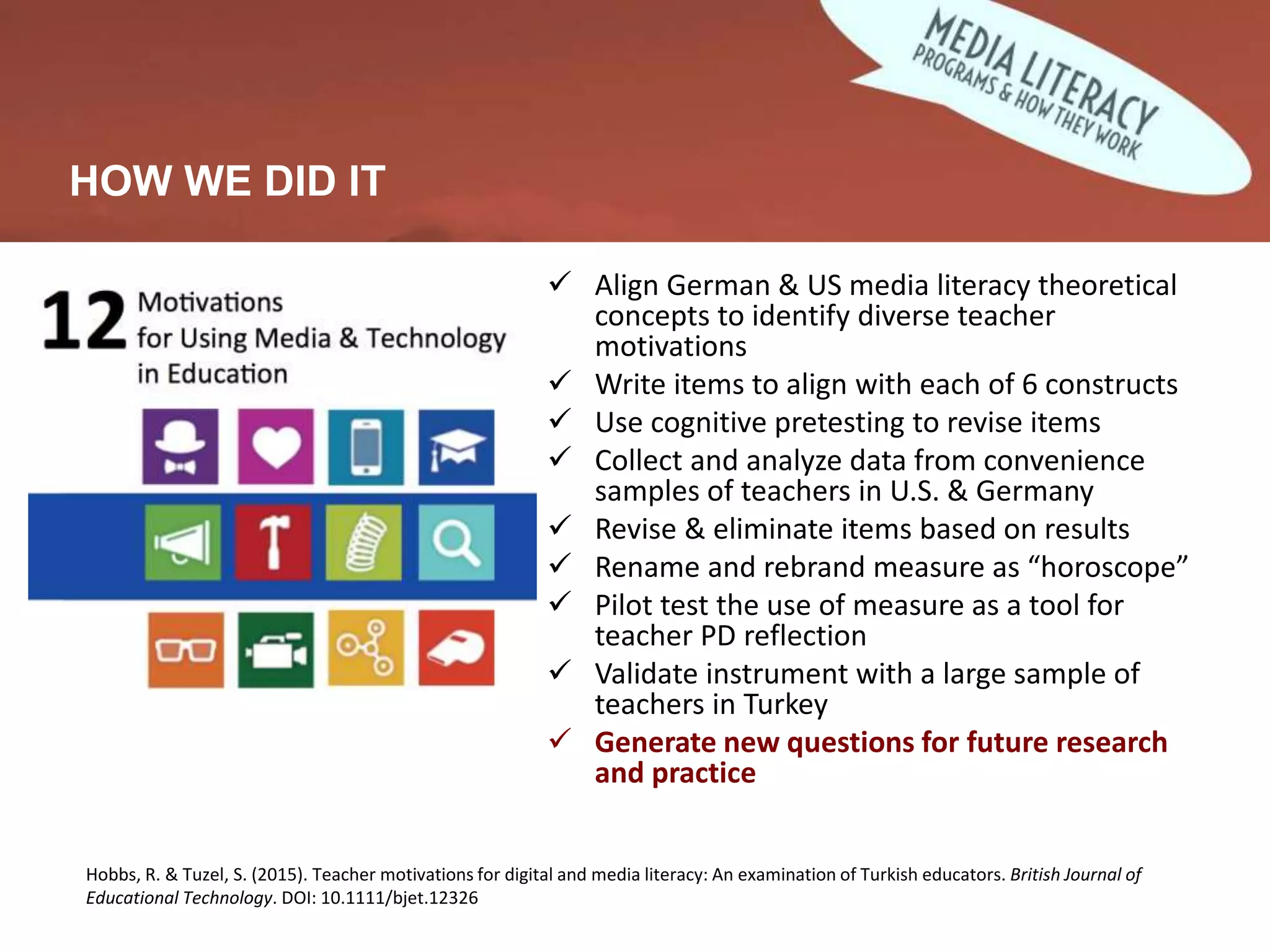
Developing and Validating Measures
 Align German & US media literacy theoretical
concepts to identify diverse teacher
motivations
 Write items to align with each of 6 constructs
 Use cognitive pretesting to revise items
 Collect and analyze data from convenience
samples of teachers in U.S. & Germany
 Revise & eliminate items based on results
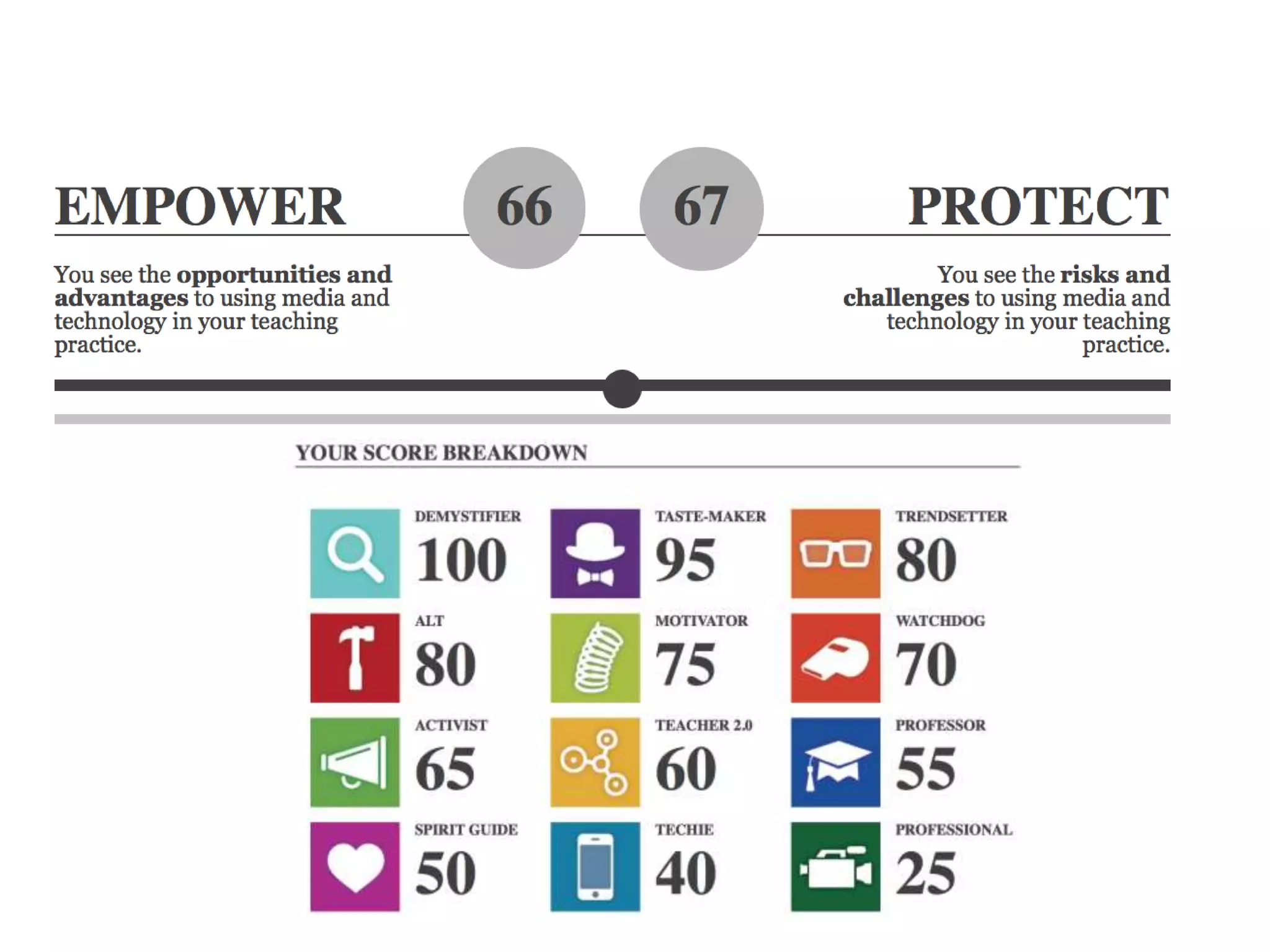
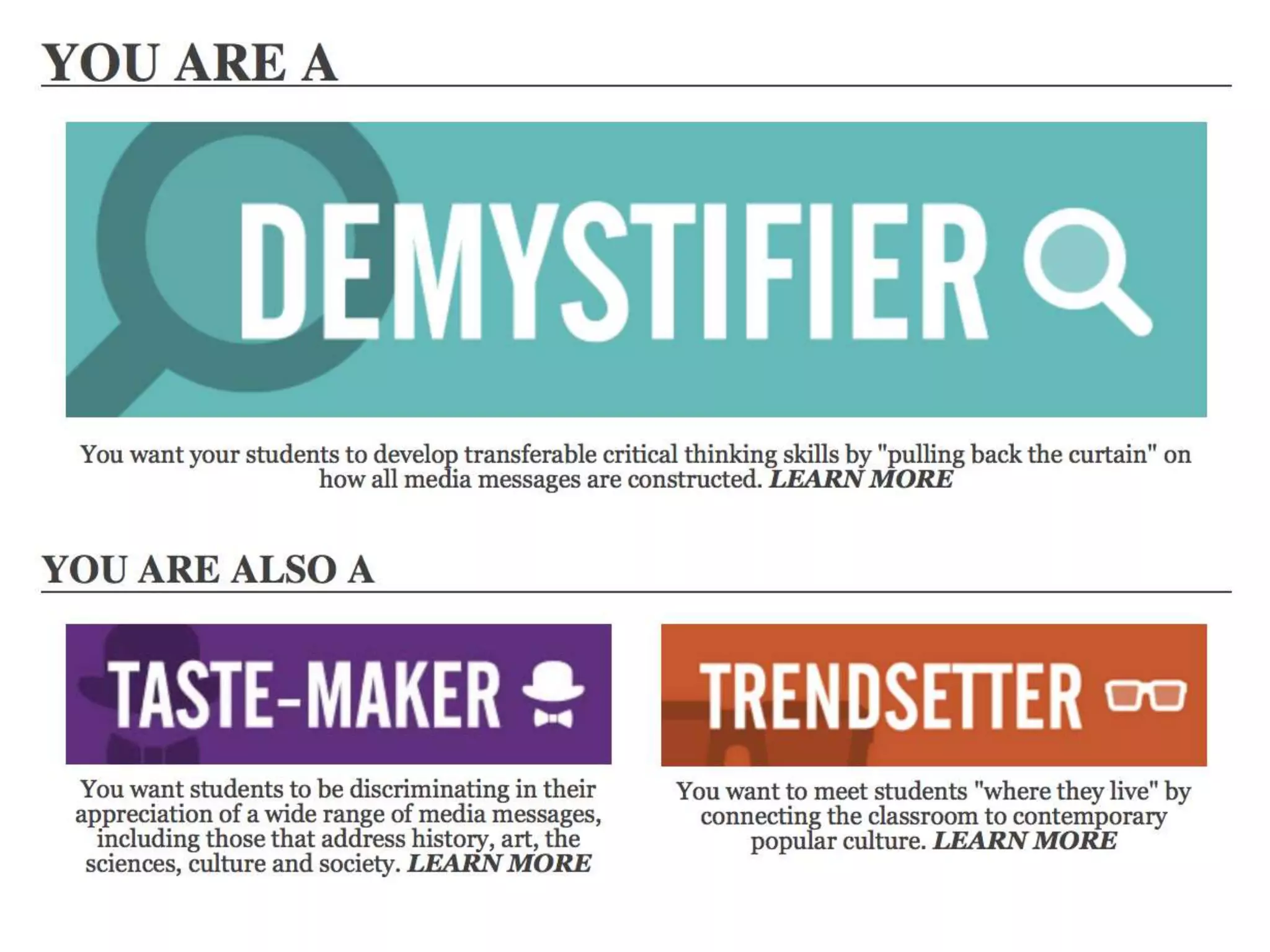
 Rename and rebrand measure as “horoscope”
 Pilot test the use of measure as a tool for
teacher PD reflection
 Validate instrument with a large sample of
teachers in Turkey
 Generate new questions for future research
and practice
HOW WE DID IT
Hobbs, R. & Tuzel, S. (2015). Teacher motivations for digital and media literacy: An examination of Turkish educators. British Journal of
Educational Technology. DOI: 10.1111/bjet.12326
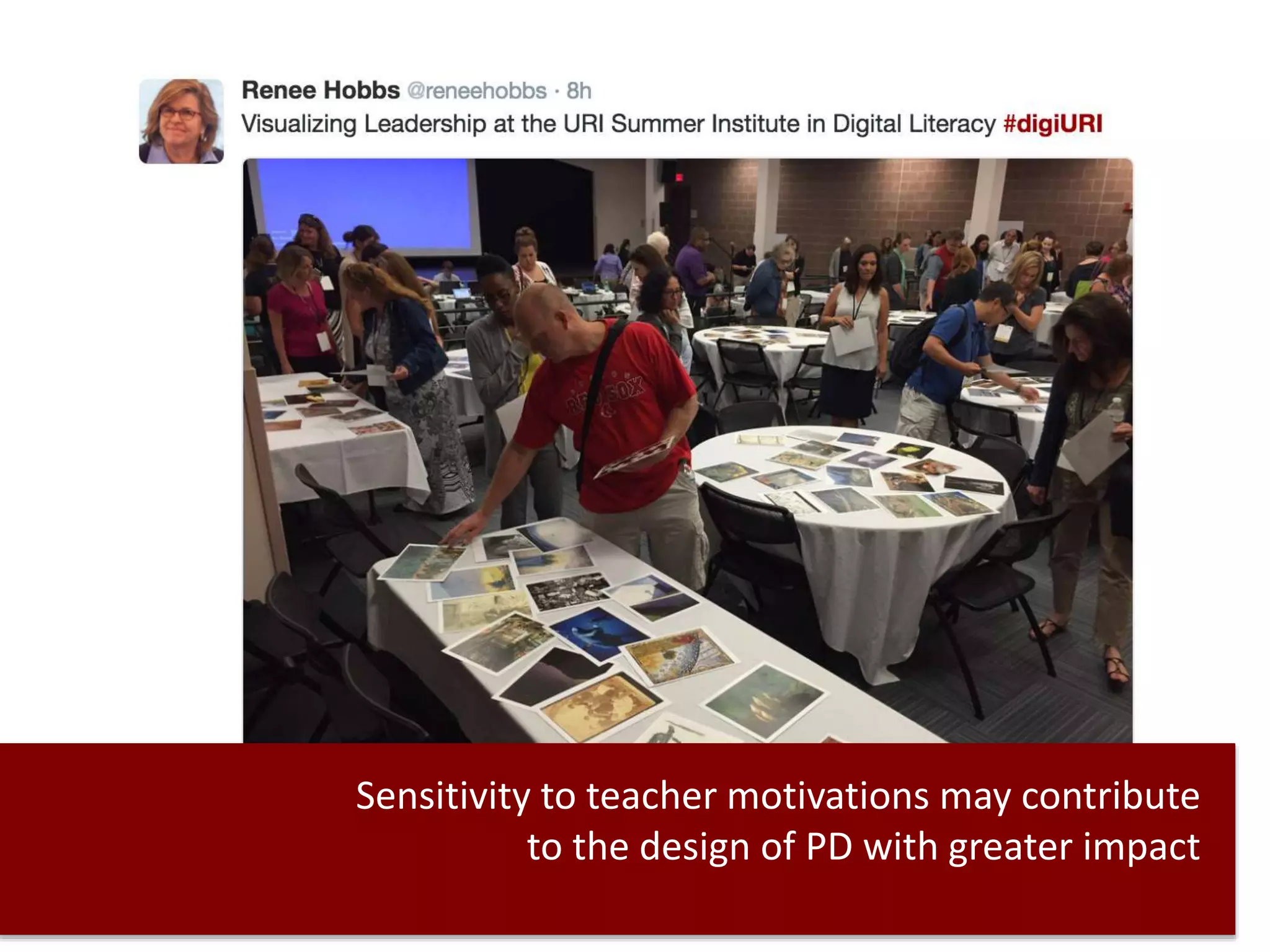
Sensitivity to teacher motivations may contribute
to the design of PD with greater impact
THEMES FOR TODAY
Partnership Matters: The shape of media literacy research
should be determined by intersecting interests of researcher,
practitioner and institution/funder
Transdisciplinarity Matters: Media literacy researchers
should collaborate across disciplines in order to benefit in
unexpected ways from exposure to diverse paradigms
Value Matters: In developing measures, research should aim
to capture the complexity of the practice of media literacy
education
SOME CAVEATS
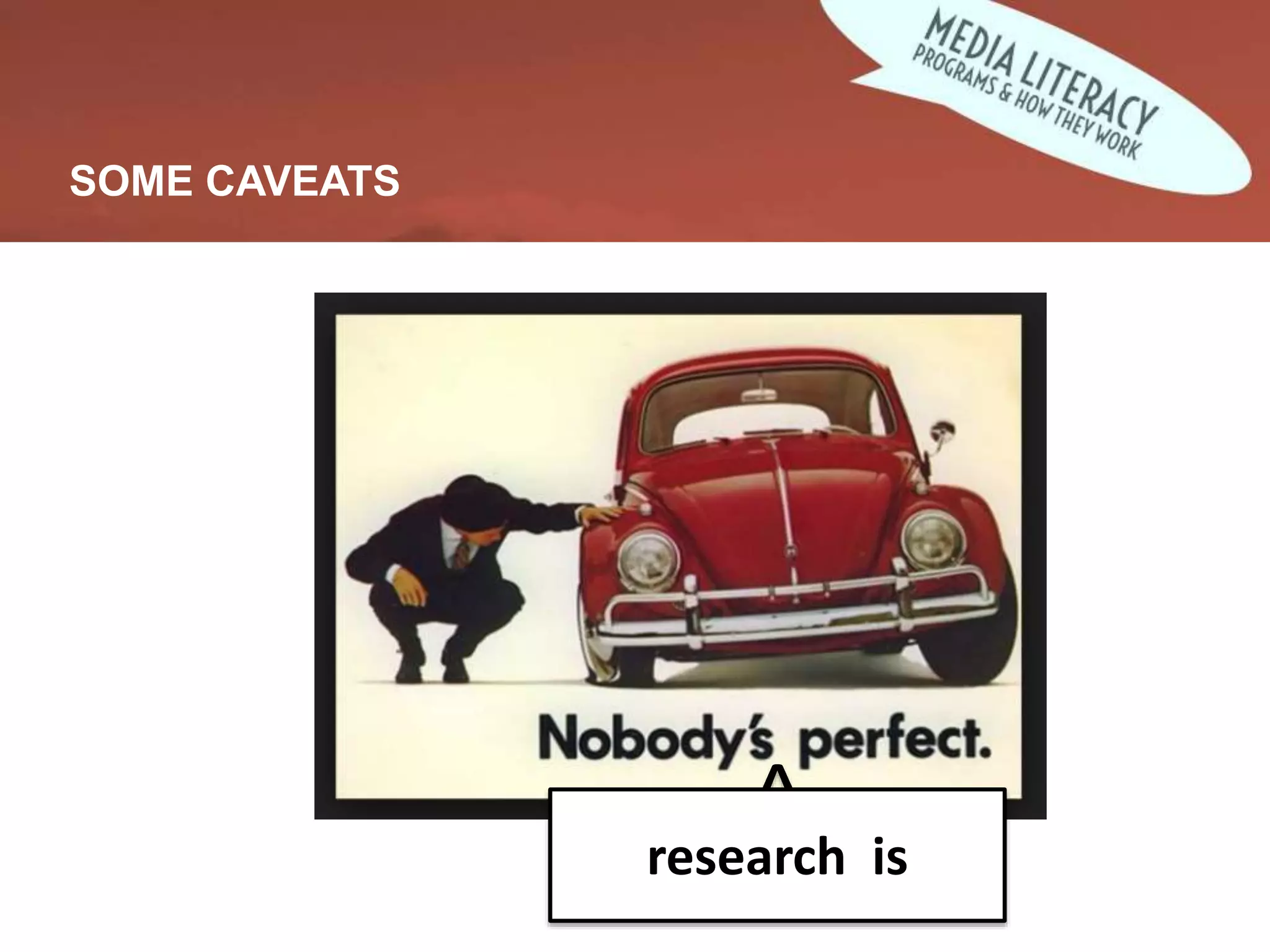
^
research is
SOME CAVEATS
Community of Scholars
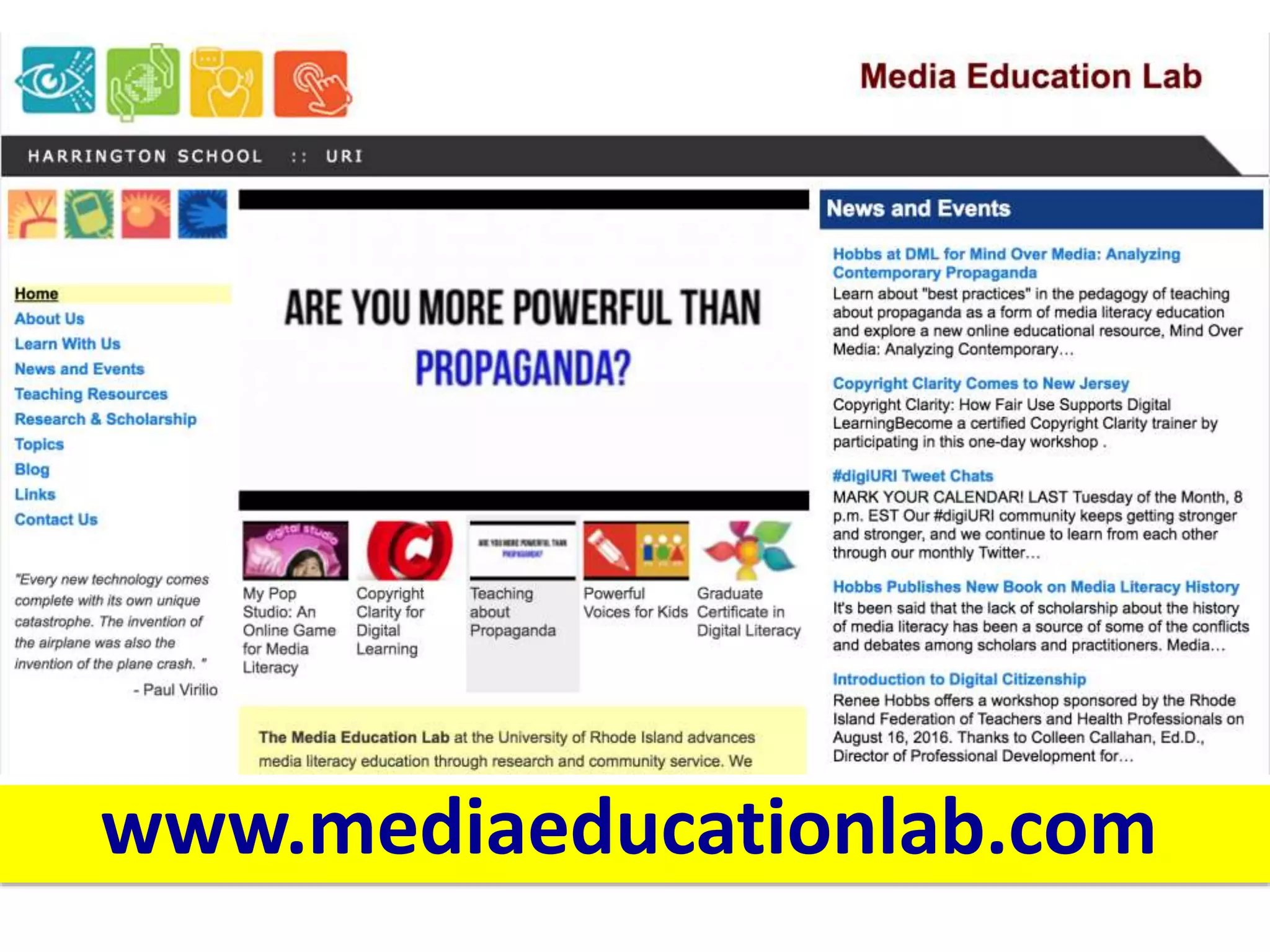
www.mediaeducationlab.com
SAVE THE DATE!
Summer Institute in Digital Literacy
July 23 – 28, 2017
www.mediaeducationlab.com
CONTACT ME
Renee Hobbs
Professor, Department of Communication Studies
Director, Media Education Lab
Harrington School of Communication and Media
University of Rhode Island USA
EMAIL: hobbs@uri.edu
TWITTER: @reneehobbs
WEB: www.mediaeducationlab.com

Media Literacy Programs and How They Work: Quantitative Approaches

  • 1.
    A Reflection on QuantitativeApproaches to Measurement Renee Hobbs Media Education Lab University of Rhode Island USA Catholic University of Louvain Groupe de Researche en Mediation des Savoirs (GREMS) September 14, 2016
  • 2.
    PEER-TO-PEER FILE SHARING •CONTEXT. Media & technology are immersive cultural environments; media institutions offer ideologies & structures that shape human perception & values (McLuhan) • INTERPRETATION. Audiences are active; meaning-making is variable based on lived experience & social context (Hall) • EMPOWERMENT & PROTECTION. Creating media and critical analyzing media texts & institutions is a pedagogical practice (Masterman) • SOCIAL ACTIVISM. Awareness, analysis, and reflection of media & popular culture enable people to take action to make society more just and equitable (Freire) • LITERACY & LEARNING. Institutions of education, communication practices & democratic values are interconnected (Dewey) MY THEORETICAL FRAMES
  • 3.
    Hobbs, R. (2016).Exploring the roots of digital and media literacy through personal narrative. Philadelphia: Temple University Press.
  • 4.
    MAIN IDEAS FORTODAY Partnership Matters: The shape of media literacy research should be determined by intersecting interests of researcher, practitioner and institution/funder Transdisciplinarity Matters: Media literacy researchers should collaborate across disciplines in order to benefit in unexpected ways from exposure to diverse paradigms Value Matters: In developing measures, research should aim to capture the complexity of the practice of media literacy education
  • 5.
    • Student ReportingLabs • ML and Nonverbal Bias • Teacher Motivations Program Evaluation Hypothesis Testing Scale Construction
  • 6.
  • 7.
  • 9.
    Program Assessment usesformative and summative research to guide program developers in planning, reflection, action and evaluation. Key characteristics include: • Participants collaborate at every stage • Intended to result in some action, change or improvement Methods • Pre-post online survey • Interviews with teachers and mentors • Classroom observations • Analysis of student work samples PEER-TO-PEER FILE SHARING Research Design
  • 10.
  • 11.
    N = 566HS students Race 13% African-American 30% Caucasian 36% Hispanic/Latino Age Range 13 – 18 40% age 17 Gender 60% male Class 35% low SES Sample
  • 12.
    PRODUCTION SKILLS Non-technical skills Technicalskills IN-CLASSROOM ACTIVITIES Gathering & Synthesizing Info Using Digital Media Revision MEDIA LITERACY CIVIC ENGAGEMENT Sign an online petition Express an opinion to news media Blog about an issue Write an opinion letter Gathering and Synthesizing Information Percentage Analyzed videos 70% Created a story board 65% Conducted interviews 68% Fact-checked information 49% Pitched a news story 54% Discussed different points of view about social and political issues 53% Using Digital Media to Communicate Ideas Used a video camera to record visuals 69% Wrote a script 64% Performed in front of the camera 65% Worked behind the scenes/different roles 64% Logged footage 43% Edited visuals and sounds 68% Used images/sounds to tell a story 54% Posted videos online 38% Engaging in Cycles of Revision & Feedback Edited reports in response to feedback 38% Not all students participated in all production activities
  • 13.
    PRODUCTION SKILLS MEDIA LITERACY CIVIC ENGAGEMENT Signan online petition Express an opinion to news media Blog about an issue Write an opinion letter TIME 1 TIME 2 CHANGE Communication Skills I am confident interviewing a stranger. 2.55 2.73 +.18* I know how to conduct interviews to gather information. 2.33 2.86 +53* I can compare fact and opinion. 2.88 3.29 +.41* I know how to develop a news story pitch. 2.04 2.59 +.55* I use the Internet to gather reliable information. 3.10 3.18 +.08 I know how to present myself on camera. 2.61 2.97 +.36* Technical Skills I can easily set up a tripod and camera. 2.69 3.28 +.59* I can fix audio and video quality. 2.24 2.91 +.67* I can do substantial video editing. 2.16 2.90 +.74* I can plan, direct and produce a video news report. 2.16 2.64 +.48* I have the skills I need to make a professional news video. 2.10 2.68 +.58* I can use a video camera to film news reports. N = 283, * p.<.05 2.69 3.10 +.41* Students demonstrate statistically significant growth in both communication & technical skills
  • 14.
    ATTITUDES Intellectual Curiosity Giving &Receiving Feedback Confidence in Self-Expression Intellectual Curiosity TIME 1 TIME 2 CHANGE I want to learn about all sides of a given issue. 3.08 3.31 +.23* I am curious about ways to solve issues in my community. 2.67 2.97 +.30* I often find myself questioning things that I hear or read. 3.10 3.33 +.23* Giving and Receiving Feedback TIME 1 TIME 2 CHANGE I am open to constructive criticism. 3.00 3.36 +.36* I show respect for people's ideas and feelings, even when I disagree with them. 3.44 3.53 +.09 I motivate others to do their best. 3.05 3.18 +.13* Confidence in Self-Expression TIME 1 TIME 2 CHANGE It is easy for me to express my views and opinions. 2.99 3.28 +.29* I have a clear idea of what values are important to me. 3.25 3.49 +.24* I am willing to express my opinion even if I know it is unpopular. 3.10 3.32 +.22* N = 281, * p > .05 Students demonstrate statistically significant growth over time
  • 15.
    What factors areassociated with intellectual curiosity? Predictor b SE T p Constant 1.255 0.441 2.84 In-Class Activities -0.019 0.022 -0.878 NS Technical Skills 0.047 0.02 2.309 0.02 Confidence Self-Exp 0.345 0.049 7.06 0.001 Comm Skills 0.05 0.029 1.739 0.08 Feedback 0.288 0.054 5.348 0.001 Regression Analysis on Intellectual Curiosity Hobbs, R. (2016). When teens create the news: Examining the impact of PBS News Hour Student Reporting Labs. Journalism Education 5(1), 61 – 73.
  • 16.
    PRODUCTION SKILLS Communication skills Technicalskills Giving & Receiving Feedback Confidence in Self Expression IN-CLASSROOM ACTIVITIES Gathering & Synthesizing Info Using Digital Media Revision Intellectual Curiosity Hobbs, R. (2016). When teens create the news: Examining the impact of PBS News Hour Student Reporting Labs. Journalism Education 5(1), 61 – 73.
  • 17.
    Developing and ValidatingMeasures  Meet with funder & participating teachers to determine their priorities  Observe program in classrooms & interview teachers  Examine student media work samples  Adapt existing relevant measures from prior research  Pilot test measures with students in one high school  Revise measures based on results  Gather data from multiple schools  Analyze to identify the best results for program evaluation purposes  Generate new questions for future research and practice HOW WE DID IT Hobbs, R. (2016). When teens create the news: Examining the impact of PBS News Hour Student Reporting Labs. Journalism Education 5(1), 61 – 73.
  • 18.
    Program evaluation ofmedia literacy initiatives can help advance both measurement & theory-building
  • 19.
    THEMES FOR TODAY PartnershipMatters: The shape of media literacy research should be determined by the intersecting interests of researcher, practitioner and institution/funder
  • 20.
    Nonverbal Bias The behaviorof a friendly or hostile television interviewer can affect viewer impressions of the interview subject Halo effect: positive attitudes about the subject associated with behavior of the interviewer Media bias effect: negative attitudes about the subject associated with behavior of the interviewer Would media literacy HS students be more or less susceptible to nonverbal bias?
  • 21.
    Media Analysis A one-semestercourse open to students in all grades taught by a veteran media literacy teacher. The course emphasized the key concepts of media literacy, and students engaged in the process of critically analyzing news, advertising, and film through critical questioning. Students completed assignments in which they analyzed the credibility of TV news and Internet Websites and examined patterns in the representation of violence in the media. Other topics discussed in the class: • body image and the representation of gender in mass media • media coverage of historical events • presidential ad campaigns Students learned to analyze media by applying concepts such as purpose, audience, point of view, media languages, subtext, representation, and technology to diverse forms of visual and digital messages from contemporary and popular culture. Subjects N = 88 Age range 13 – 18 48 males, 40 females 50% African American 40% Caucasian 10% Other Quasi-Experimental Design
  • 22.
    Babad, E., Peer,A., & Hobbs, R. (2012). Media literacy and media bias: Are media literacy students less susceptible to non- verbal judgment biases? Psychology of Popular Media Culture 1(2), 97 – 107. DOI: 10.137/a0028181 Rate your perceptions of the politician who was interviewed… NONVERBAL PERCEPTION STUDY
  • 23.
    Babad, E., Peer,A., & Hobbs, R. (2012). Media literacy and media bias: Are media literacy students less susceptible to non- verbal judgment biases? Psychology of Popular Media Culture.1(2), 97 – 107. DOI: 10.137/a0028181 Media literacy students are immune to the media bias effect NONVERBAL PERCEPTION STUDY Rate your perceptions of the politician who was interviewed…
  • 24.
    Developing and ValidatingMeasures  Review prior work on nonverbal bias effect  Theorize why media literacy students may be immune to media bias effect  Recruit a school & teacher to participate in the study  Gather data  Analyze and report results  Generate new questions for future research and practice HOW WE DID IT Babad, E., Peer, A., & Hobbs, R. (2012). Media literacy and media bias: Are media literacy students less susceptible to non- verbal judgment biases? Psychology of Popular Media Culture 1(2), 97 – 107. DOI: 10.137/a0028181
  • 25.
  • 26.
    www.mindovermedia.tv Theory-driven hypothesis testingcan inspire Innovation in pedagogy and curriculum
  • 27.
    THEMES FOR TODAY PartnershipMatters: The shape of media literacy research should be determined by intersecting interests of researcher, practitioner and institution/funder Transdisciplinarity Matters: Media literacy researchers should collaborate across disciplines in order to benefit in unexpected ways from exposure to diverse paradigms
  • 28.
    Attention to teachermotivations can help educators, technology specialists and school librarians better collaborate with teachers to support student learning
  • 29.
    SKILLS & ABILITIES ➢Knowledge about the Computer & Internet ➢ Digital Skills LITERACY ➢ Online Reading & New Literacies ➢ Media Production / Youth Media ➢ Coding / Programming TEACHING WITH ➢ Technology Integration ➢ Digital Learning ➢ Blended Learning ➢ Connected Learning TEACHING ABOUT ➢ Information Literacy ➢ Media Literacy ➢ Internet Safety & Digital Citizenship What Digital Learning Flavors have You Tasted?
  • 30.
    What Teachers Want Studentsto Know and Be Able To Do Find, comprehend and interpret content Gain knowledge and information Examine the quality of information resources Share ideas through dialogue & discussion Create, build or make something Reflect on expected and unanticipated consequences Plan and implement action to effect social change Critically analyze how messages are constructed Use digital tools for learning
  • 31.
    Genre or Format Contentand Quality Community Connection Texts and Audiences Understanding Media Systems Learner-Centered Instruction THEORETICAL FRAMES USED TO CONSTRUCT THE INSTRUMENT
  • 32.
  • 33.
  • 36.
    Hobbs, R. &Tuzel, S. (2015). Teacher motivations for digital and media literacy: An examination of Turkish educators. British Journal of Educational Technology. DOI: 10.1111/bjet.12326
  • 37.
    Hobbs, R. &Tuzel, S. (2015). Teacher motivations for digital and media literacy: An examination of Turkish educators. British Journal of Educational Technology. DOI: 10.1111/bjet.12326
  • 38.
    Developing and ValidatingMeasures  Align German & US media literacy theoretical concepts to identify diverse teacher motivations  Write items to align with each of 6 constructs  Use cognitive pretesting to revise items  Collect and analyze data from convenience samples of teachers in U.S. & Germany  Revise & eliminate items based on results  Rename and rebrand measure as “horoscope”  Pilot test the use of measure as a tool for teacher PD reflection  Validate instrument with a large sample of teachers in Turkey  Generate new questions for future research and practice HOW WE DID IT Hobbs, R. & Tuzel, S. (2015). Teacher motivations for digital and media literacy: An examination of Turkish educators. British Journal of Educational Technology. DOI: 10.1111/bjet.12326
  • 39.
    Sensitivity to teachermotivations may contribute to the design of PD with greater impact
  • 40.
    THEMES FOR TODAY PartnershipMatters: The shape of media literacy research should be determined by intersecting interests of researcher, practitioner and institution/funder Transdisciplinarity Matters: Media literacy researchers should collaborate across disciplines in order to benefit in unexpected ways from exposure to diverse paradigms Value Matters: In developing measures, research should aim to capture the complexity of the practice of media literacy education
  • 41.
  • 42.
  • 43.
  • 44.
  • 45.
    SAVE THE DATE! SummerInstitute in Digital Literacy July 23 – 28, 2017 www.mediaeducationlab.com
  • 46.
    CONTACT ME Renee Hobbs Professor,Department of Communication Studies Director, Media Education Lab Harrington School of Communication and Media University of Rhode Island USA EMAIL: hobbs@uri.edu TWITTER: @reneehobbs WEB: www.mediaeducationlab.com

Editor's Notes

  • #19 COMMENT ON HOW THIS STUDY in RELATION TO NEWS LITERACY