Renee Hobbs
Professor of Communication Studies
Director, Media Education Lab
University of Rhode Island USA
Twitter: @reneehobbs
Media Literacy
in an Age of Digital
Propaganda
Rising inequality is contributing to increased
political polarization, nationalism,
violent extremism and hate speech
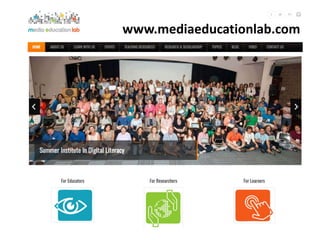
www.mediaeducationlab.com
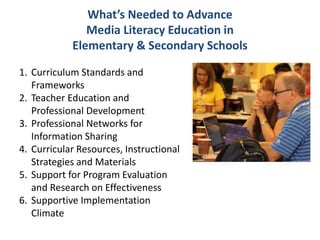
What’s Needed to Advance
Media Literacy Education in
Elementary & Secondary Schools
1. Curriculum Standards and
Frameworks
2. Teacher Education and
Professional Development
3. Professional Networks for
Information Sharing
4. Curricular Resources, Instructional
Strategies and Materials
5. Support for Program Evaluation
and Research on Effectiveness
6. Supportive Implementation
Climate
Why is digital propaganda rising around the world?
A lie can get
around the
world while
truth is still
putting on its
shoes.
- Mark Twain
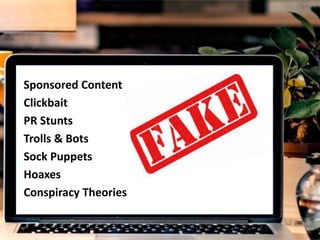
Sponsored Content
Clickbait
PR Stunts
Trolls & Bots
Sock Puppets
Hoaxes
Conspiracy Theories
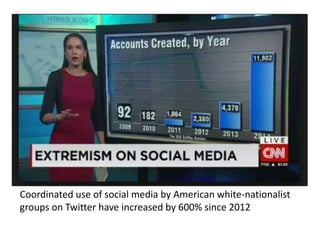
Coordinated use of social media by American white-nationalist
groups on Twitter have increased by 600% since 2012
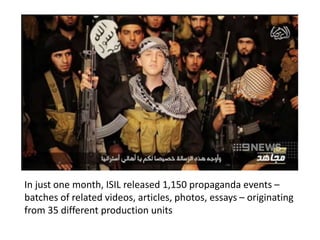
In just one month, ISIL released 1,150 propaganda events –
batches of related videos, articles, photos, essays – originating
from 35 different production units
New Realities in a
Networked Global Society
 Cost to produce
content is low
 Massive
fragmentation of
production &
consumption
 Viral sharing means
popularity = profit
 Content is consumed
as unbundled
snippets on social
media
 Selective exposure
 Confirmation bias
 Performative sharing
60% of people share
content without
reading/viewing it
Essentials of Human
Information Processing
New Forms of Authority
Attention economics are surpassing traditional forms of
authority and expertise
our attention — and
most of it free —
being found is
valuable."
 Immediacy
 Personalization
 Interpretation
 Findability
What instructional strategies help us find truth
in an age of digital propaganda?
Build awareness & understanding of
many forms of digital media
Critically analyze how stories are
presented in entertainment & non-
fiction media
Engage in global &
multi-perspectival dialogue
Use the power of social media to
speak out on behalf of truth
Instructional Strategies
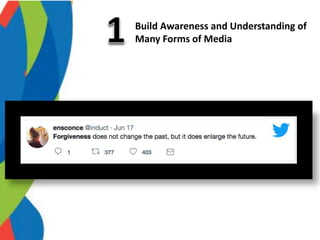
Build Awareness and Understanding of
Many Forms of Media
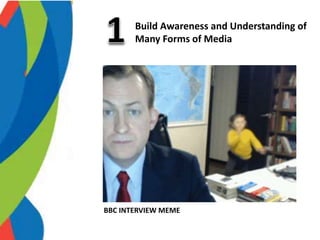
Build Awareness and Understanding of
Many Forms of Media
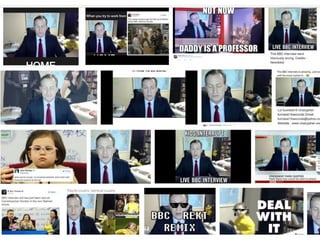
BBC INTERVIEW MEME
@reneehobbs
It’s time to stop
using the term
“fake news”
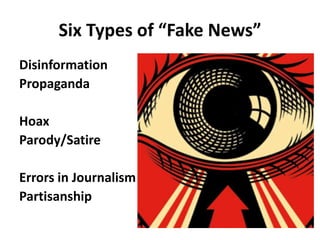
Six Types of “Fake News”
Disinformation
Propaganda
Hoax
Parody/Satire
Errors in Journalism
Partisanship
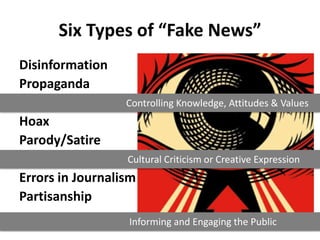
Six Types of “Fake News”
Disinformation
Propaganda
Hoax
Parody/Satire
Errors in Journalism
Partisanship
Informing and Engaging the Public
Controlling Knowledge, Attitudes & Values
Cultural Criticism or Creative Expression
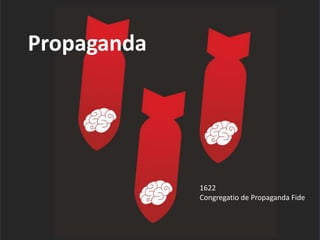
Propaganda
1622
Congregatio de Propaganda Fide
What is Propaganda?
• Propaganda appears in a variety of forms
• Propaganda is strategic and intentional
• Propaganda aims to influence attitudes, opinions and
behaviors
• Propaganda can be beneficial or harmful
• Propaganda may use truth, half-truths or lies
• To be successful, propaganda taps into our deepest
values, fears, hopes and dreams
Hobbs, R. (2013). The blurring of art, journalism and advocacy: Confronting 21st century propaganda in
a world of online journalism. I/S: A Journal of Law and Policy for the Information Society 8(3), 625 –
638.
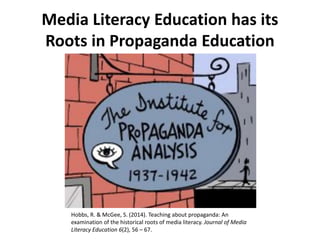
Media Literacy Education has its
Roots in Propaganda Education
Hobbs, R. & McGee, S. (2014). Teaching about propaganda: An
examination of the historical roots of media literacy. Journal of Media
Literacy Education 6(2), 56 – 67.
Where is Propaganda Found?
Advertising
Journalism & Public Relations
Political Communication
Education
Entertainment
Activism
Religion
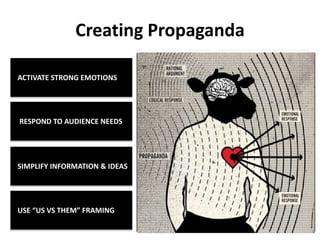
Creating Propaganda
Hoaxes
Parody/Satire
ACTIVATE STRONG EMOTIONS
USE “US VS THEM” FRAMING
SIMPLIFY INFORMATION & IDEAS
RESPOND TO AUDIENCE NEEDS
VIRALITY
when information, an image or video
gets circulated rapidly and widely
from one Internet user to another
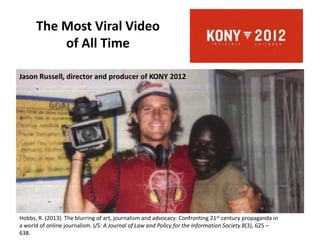
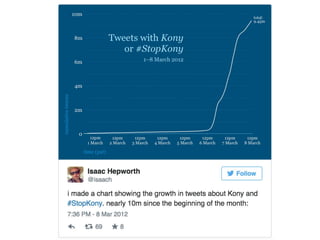
The Most Viral Video
of All Time
Jason Russell, director and producer of KONY 2012
Hobbs, R. (2013). The blurring of art, journalism and advocacy: Confronting 21st century propaganda in
a world of online journalism. I/S: A Journal of Law and Policy for the Information Society 8(3), 625 –
638.
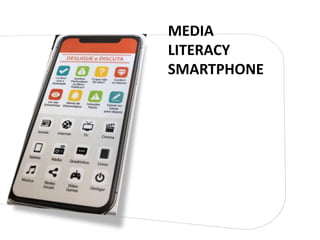
MEDIA
LITERACY
SMARTPHONE
KONY 2012
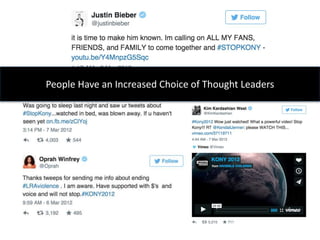
People Have an Increased Choice of Thought Leaders
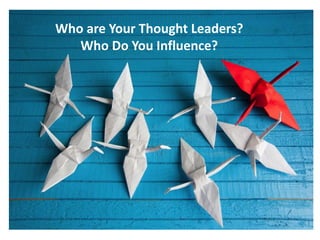
Who are Your Thought Leaders?
Who Do You Influence?
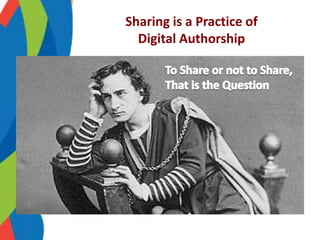
Sharing is a Practice of
Digital Authorship
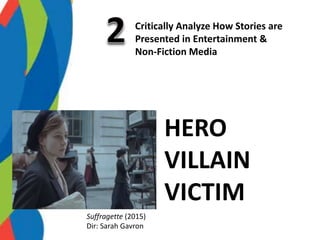
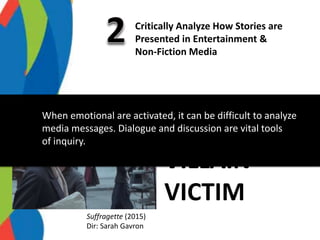
Critically Analyze How Stories are
Presented in Entertainment &
Non-Fiction Media
Suffragette (2015)
Dir: Sarah Gavron
HERO
VILLAIN
VICTIM
Suffragette (2015)
Dir: Sarah Gavron
Critically Analyze How Stories are
Presented in Entertainment &
Non-Fiction Media
Suffragette (2015)
Dir: Sarah Gavron
HERO
VILLAIN
VICTIM
When emotional are activated, it can be difficult to analyze
media messages. Dialogue and discussion are vital tools
of inquiry.
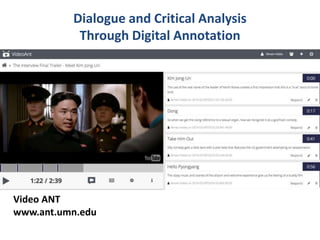
Dialogue and Critical Analysis
Through Digital Annotation
Video ANT
www.ant.umn.edu
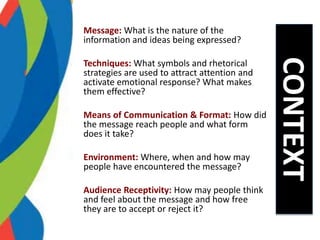
Message: What is the nature of the
information and ideas being expressed?
Techniques: What symbols and rhetorical
strategies are used to attract attention and
activate emotional response? What makes
them effective?
Means of Communication & Format: How did
the message reach people and what form
does it take?
Environment: Where, when and how may
people have encountered the message?
Audience Receptivity: How may people think
and feel about the message and how free
they are to accept or reject it?
CONTEXT
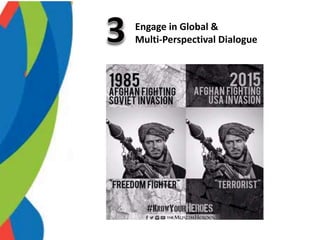
Engage in Global &
Multi-Perspectival Dialogue
Engage in Global &
Multi-Perspectival Dialogue
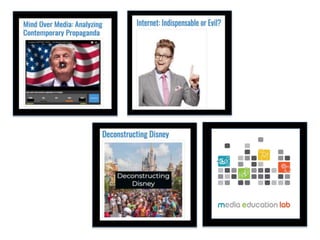
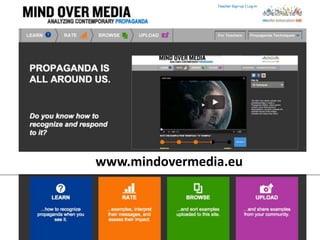
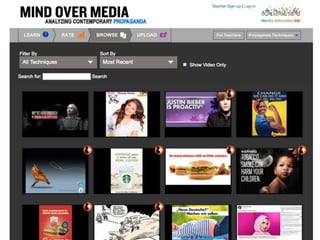
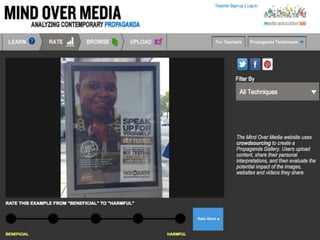
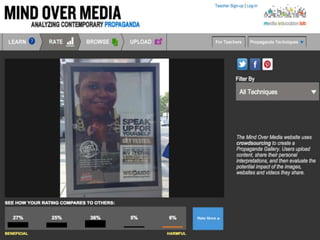
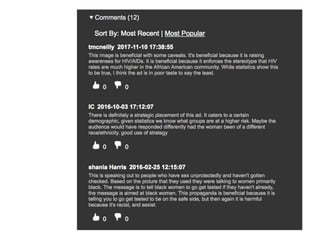
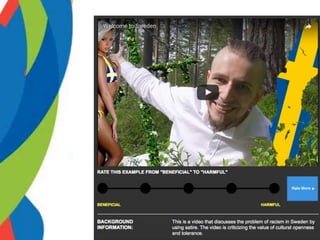
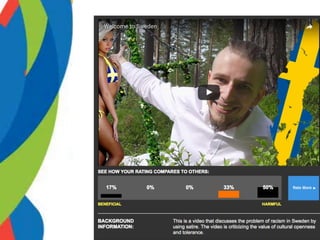
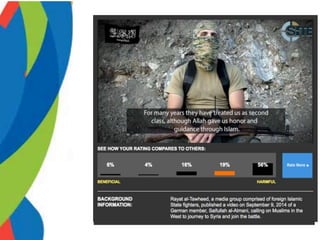
MIND OVER MEDIA
INTERCULTURAL ENCOUNTER
THROUGH SOCIAL MEDIA
www.mindovermedia.eu
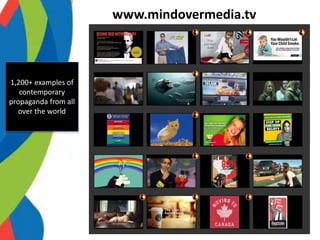
www.mindovermedia.tv
1,200+ examples of
contemporary
propaganda from all
over the world
Recognize and Resist Propaganda and
Hate Speech
Recognize and Resist Propaganda and
Hate Speech
Recognize and Resist Propaganda and
Hate Speech
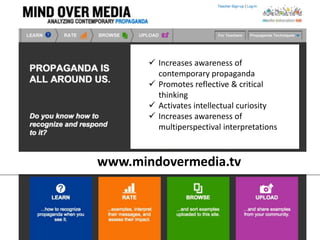
www.mindovermedia.tv
 Increases awareness of
contemporary propaganda
 Promotes reflective & critical
thinking
 Activates intellectual curiosity
 Increases awareness of
multiperspectival interpretations
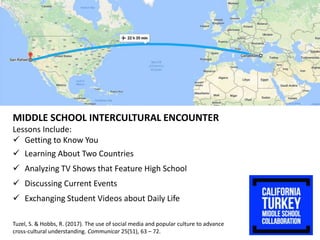
MIDDLE SCHOOL INTERCULTURAL ENCOUNTER
Lessons Include:
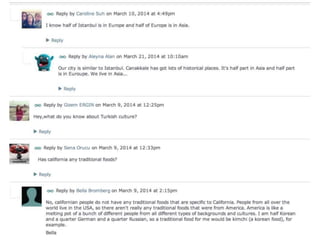
 Getting to Know You
 Learning About Two Countries
 Analyzing TV Shows that Feature High School
 Discussing Current Events
 Exchanging Student Videos about Daily Life
Tuzel, S. & Hobbs, R. (2017). The use of social media and popular culture to advance
cross-cultural understanding. Communicar 25(51), 63 – 72.
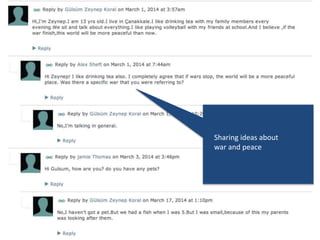
Sharing ideas about
war and peace
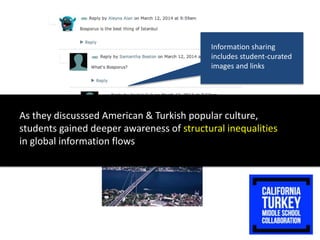
Information sharing
includes student-curated
images and links
As they discusssed American & Turkish popular culture,
students gained deeper awareness of structural inequalities
in global information flows
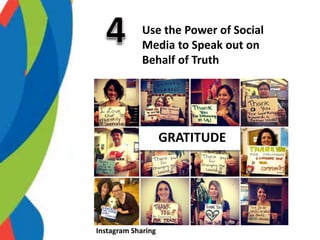
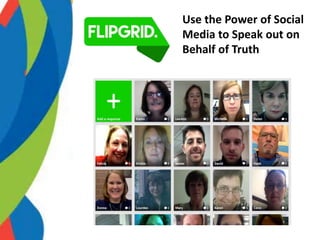
Use the Power of Social
Media to Speak out on
Behalf of Truth
Instagram Sharing
GrGRATITUDE
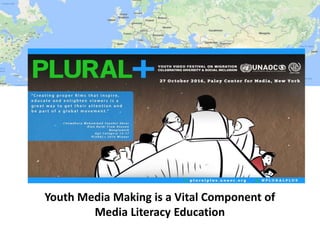
Youth Media Making is a Vital Component of
Media Literacy Education
Youth Media Making is a Vital Component of
Media Literacy Education
Use the Power of Social
Media to Speak out on
Behalf of Truth
Use the Power of
Communication to Speak
out on Behalf of Truth
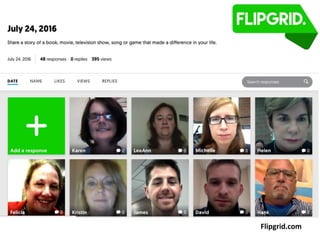
Flipgrid.com
Flipgrid.com
Use the Power of Social
Media to Speak out on
Behalf of Truth
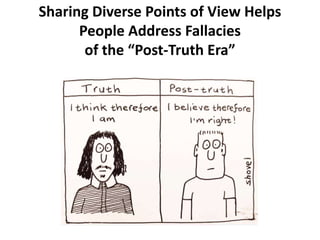
Sharing Diverse Points of View Helps
People Address Fallacies
of the “Post-Truth Era”
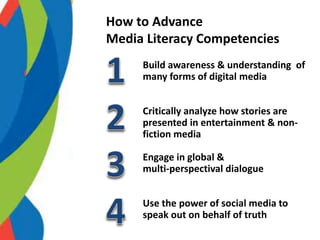
Build awareness & understanding of
many forms of digital media
Critically analyze how stories are
presented in entertainment & non-
fiction media
Engage in global &
multi-perspectival dialogue
Use the power of social media to
speak out on behalf of truth
How to Advance
Media Literacy Competencies
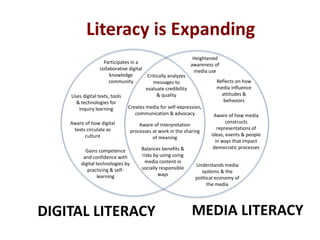
Heightened
awareness of
media use
Balances benefits &
risks by using using
media content in
socially responsible
ways
Critically analyzes
messages to
evaluate credibility
& quality
Creates media for self-expression,
communication & advocacy
Reflects on how
media influence
attitudes &
behaviors
Understands media
systems & the
political economy of
the media
Aware of how media
constructs
representations of
ideas, events & people
in ways that impact
democratic processes
Participates in a
collaborative digital
knowledge
community
Uses digital texts, tools
& technologies for
inquiry learning
Gains competence
and confidence with
digital technologies by
practicing & self-
learning
Literacy is Expanding
DIGITAL LITERACY MEDIA LITERACY
Aware of interpretation
processes at work in the sharing
of meaning
Aware of how digital
texts circulate as
culture
A democratic civilization will save itself only if it
makes the language of the image into a stimulus for
critical reflection, not an invitation to hypnosis.
-- Umberto Eco
Renee Hobbs
Professor of Communication Studies
Director, Media Education Lab
Harrington School of Communication & Media
University of Rhode Island USA
Email: hobbs@uri.edu
Twitter: @reneehobbs
LEARN MORE
Web: www.mediaeducationlab.com
www.mediaeducationlab.com

Digital Literacy - Propaganda ESPM

  • 1.
    Renee Hobbs Professor ofCommunication Studies Director, Media Education Lab University of Rhode Island USA Twitter: @reneehobbs Media Literacy in an Age of Digital Propaganda
  • 2.
    Rising inequality iscontributing to increased political polarization, nationalism, violent extremism and hate speech
  • 3.
  • 5.
    What’s Needed toAdvance Media Literacy Education in Elementary & Secondary Schools 1. Curriculum Standards and Frameworks 2. Teacher Education and Professional Development 3. Professional Networks for Information Sharing 4. Curricular Resources, Instructional Strategies and Materials 5. Support for Program Evaluation and Research on Effectiveness 6. Supportive Implementation Climate
  • 6.
    Why is digitalpropaganda rising around the world?
  • 10.
    A lie canget around the world while truth is still putting on its shoes. - Mark Twain
  • 11.
    Sponsored Content Clickbait PR Stunts Trolls& Bots Sock Puppets Hoaxes Conspiracy Theories
  • 12.
    Coordinated use ofsocial media by American white-nationalist groups on Twitter have increased by 600% since 2012
  • 13.
    In just onemonth, ISIL released 1,150 propaganda events – batches of related videos, articles, photos, essays – originating from 35 different production units
  • 14.
    New Realities ina Networked Global Society  Cost to produce content is low  Massive fragmentation of production & consumption  Viral sharing means popularity = profit  Content is consumed as unbundled snippets on social media
  • 15.
     Selective exposure Confirmation bias  Performative sharing 60% of people share content without reading/viewing it Essentials of Human Information Processing
  • 16.
    New Forms ofAuthority Attention economics are surpassing traditional forms of authority and expertise our attention — and most of it free — being found is valuable."  Immediacy  Personalization  Interpretation  Findability
  • 17.
    What instructional strategieshelp us find truth in an age of digital propaganda?
  • 18.
    Build awareness &understanding of many forms of digital media Critically analyze how stories are presented in entertainment & non- fiction media Engage in global & multi-perspectival dialogue Use the power of social media to speak out on behalf of truth Instructional Strategies
  • 19.
    Build Awareness andUnderstanding of Many Forms of Media
  • 20.
    Build Awareness andUnderstanding of Many Forms of Media BBC INTERVIEW MEME
  • 22.
    @reneehobbs It’s time tostop using the term “fake news”
  • 23.
    Six Types of“Fake News” Disinformation Propaganda Hoax Parody/Satire Errors in Journalism Partisanship
  • 24.
    Six Types of“Fake News” Disinformation Propaganda Hoax Parody/Satire Errors in Journalism Partisanship Informing and Engaging the Public Controlling Knowledge, Attitudes & Values Cultural Criticism or Creative Expression
  • 25.
  • 26.
    What is Propaganda? •Propaganda appears in a variety of forms • Propaganda is strategic and intentional • Propaganda aims to influence attitudes, opinions and behaviors • Propaganda can be beneficial or harmful • Propaganda may use truth, half-truths or lies • To be successful, propaganda taps into our deepest values, fears, hopes and dreams Hobbs, R. (2013). The blurring of art, journalism and advocacy: Confronting 21st century propaganda in a world of online journalism. I/S: A Journal of Law and Policy for the Information Society 8(3), 625 – 638.
  • 27.
    Media Literacy Educationhas its Roots in Propaganda Education Hobbs, R. & McGee, S. (2014). Teaching about propaganda: An examination of the historical roots of media literacy. Journal of Media Literacy Education 6(2), 56 – 67.
  • 28.
    Where is PropagandaFound? Advertising Journalism & Public Relations Political Communication Education Entertainment Activism Religion
  • 29.
    Creating Propaganda Hoaxes Parody/Satire ACTIVATE STRONGEMOTIONS USE “US VS THEM” FRAMING SIMPLIFY INFORMATION & IDEAS RESPOND TO AUDIENCE NEEDS
  • 30.
    VIRALITY when information, animage or video gets circulated rapidly and widely from one Internet user to another
  • 31.
    The Most ViralVideo of All Time Jason Russell, director and producer of KONY 2012 Hobbs, R. (2013). The blurring of art, journalism and advocacy: Confronting 21st century propaganda in a world of online journalism. I/S: A Journal of Law and Policy for the Information Society 8(3), 625 – 638.
  • 32.
  • 34.
  • 37.
    People Have anIncreased Choice of Thought Leaders
  • 38.
    Who are YourThought Leaders? Who Do You Influence?
  • 39.
    Sharing is aPractice of Digital Authorship
  • 40.
    Critically Analyze HowStories are Presented in Entertainment & Non-Fiction Media Suffragette (2015) Dir: Sarah Gavron HERO VILLAIN VICTIM
  • 41.
  • 42.
    Critically Analyze HowStories are Presented in Entertainment & Non-Fiction Media Suffragette (2015) Dir: Sarah Gavron HERO VILLAIN VICTIM When emotional are activated, it can be difficult to analyze media messages. Dialogue and discussion are vital tools of inquiry.
  • 43.
    Dialogue and CriticalAnalysis Through Digital Annotation Video ANT www.ant.umn.edu
  • 44.
    Message: What isthe nature of the information and ideas being expressed? Techniques: What symbols and rhetorical strategies are used to attract attention and activate emotional response? What makes them effective? Means of Communication & Format: How did the message reach people and what form does it take? Environment: Where, when and how may people have encountered the message? Audience Receptivity: How may people think and feel about the message and how free they are to accept or reject it? CONTEXT
  • 45.
    Engage in Global& Multi-Perspectival Dialogue
  • 46.
    Engage in Global& Multi-Perspectival Dialogue MIND OVER MEDIA INTERCULTURAL ENCOUNTER THROUGH SOCIAL MEDIA
  • 47.
  • 49.
  • 53.
    Recognize and ResistPropaganda and Hate Speech
  • 54.
    Recognize and ResistPropaganda and Hate Speech
  • 55.
    Recognize and ResistPropaganda and Hate Speech
  • 56.
    www.mindovermedia.tv  Increases awarenessof contemporary propaganda  Promotes reflective & critical thinking  Activates intellectual curiosity  Increases awareness of multiperspectival interpretations
  • 57.
    MIDDLE SCHOOL INTERCULTURALENCOUNTER Lessons Include:  Getting to Know You  Learning About Two Countries  Analyzing TV Shows that Feature High School  Discussing Current Events  Exchanging Student Videos about Daily Life Tuzel, S. & Hobbs, R. (2017). The use of social media and popular culture to advance cross-cultural understanding. Communicar 25(51), 63 – 72.
  • 59.
  • 60.
    Information sharing includes student-curated imagesand links As they discusssed American & Turkish popular culture, students gained deeper awareness of structural inequalities in global information flows
  • 61.
    Use the Powerof Social Media to Speak out on Behalf of Truth Instagram Sharing GrGRATITUDE
  • 62.
    Youth Media Makingis a Vital Component of Media Literacy Education
  • 63.
    Youth Media Makingis a Vital Component of Media Literacy Education
  • 64.
    Use the Powerof Social Media to Speak out on Behalf of Truth
  • 65.
    Use the Powerof Communication to Speak out on Behalf of Truth Flipgrid.com
  • 66.
    Flipgrid.com Use the Powerof Social Media to Speak out on Behalf of Truth
  • 67.
    Sharing Diverse Pointsof View Helps People Address Fallacies of the “Post-Truth Era”
  • 68.
    Build awareness &understanding of many forms of digital media Critically analyze how stories are presented in entertainment & non- fiction media Engage in global & multi-perspectival dialogue Use the power of social media to speak out on behalf of truth How to Advance Media Literacy Competencies
  • 69.
    Heightened awareness of media use Balancesbenefits & risks by using using media content in socially responsible ways Critically analyzes messages to evaluate credibility & quality Creates media for self-expression, communication & advocacy Reflects on how media influence attitudes & behaviors Understands media systems & the political economy of the media Aware of how media constructs representations of ideas, events & people in ways that impact democratic processes Participates in a collaborative digital knowledge community Uses digital texts, tools & technologies for inquiry learning Gains competence and confidence with digital technologies by practicing & self- learning Literacy is Expanding DIGITAL LITERACY MEDIA LITERACY Aware of interpretation processes at work in the sharing of meaning Aware of how digital texts circulate as culture
  • 70.
    A democratic civilizationwill save itself only if it makes the language of the image into a stimulus for critical reflection, not an invitation to hypnosis. -- Umberto Eco
  • 71.
    Renee Hobbs Professor ofCommunication Studies Director, Media Education Lab Harrington School of Communication & Media University of Rhode Island USA Email: hobbs@uri.edu Twitter: @reneehobbs LEARN MORE Web: www.mediaeducationlab.com
  • 72.