

“They Say, I Say:
The Moves That
Matter in Academic
Writing
Gerald Graff & Cathy
Birkenstein 2006
W.W. Norton
Renee Hobbs
Academic Discourse as a Conversation
The Conversation Has Been Going On
Before You Arrived
In fact, the discussion had already begun long before any
of them got there, so that no one present is qualified to
retrace for you all the steps that had gone before. You
listen for a while, until you decide that you have caught the
tenor of the argument; then you put in your oar. Someone
answers; you answer him; another comes to your defense;
another aligns himself against you, to either the
embarrassment or gratification of your opponent,
depending upon the quality of your ally’s assistance.
However, the discussion is interminable. The hour grows
late, you must depart. And you do depart, with the
discussion still vigorously in progress. (Kenneth Burke,
110-11, Philosophy of Literary Form)
They Say, I Say
• Academic writing is highly social: through writing, we
engage with the work of others
• We enter an academic conversation using the ideas of
others as a sounding board or launch pad for our own
ideas
• We can agree with, challenge or respond to the ideas
presented by others
• Templates or models can help writers structure their ideas
Using and Citing
Sources
There are three ways to incorporate other
people’s ideas into your writing:
1. Summarizing
2. Paraphrasing
3. Quoting directly from the source
SUMMARIZING
When you condense the main ideas of a
writer’s argument or evidence, you are
summarizing. You do not use the wording
of the writer, but you put the main ideas
into your own words. You show your
reader that the information you read has
passed through your mind, that you have
interpreted it and analyzed it, and that you
are not just copying from the original
source.
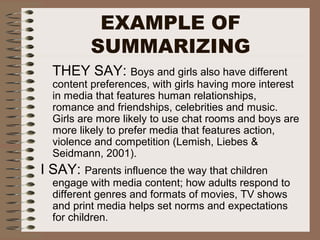
EXAMPLE OF
SUMMARIZING
THEY SAY: Boys and girls also have different
content preferences, with girls having more interest
in media that features human relationships,
romance and friendships, celebrities and music.
Girls are more likely to use chat rooms and boys are
more likely to prefer media that features action,
violence and competition (Lemish, Liebes &
Seidmann, 2001).
I SAY: Parents influence the way that children
engage with media content; how adults respond to
different genres and formats of movies, TV shows
and print media helps set norms and expectations
for children.
PARAPHRASING
When you focus on one or two sentences of a
writer’s work and put them into your own words,
you are paraphrasing. You paraphrase when you
want to highlight the details, facts or specific
information provided by an author.
EXAMPLE OF
PARAPHRASING
THEY SAY: Patterns of media use and access
to media show that in the U.S. and most Western
European nations, two-thirds of girls play electronic
games and an increasing number use the Internet.
However, media use is still somewhat
stereotypically gendered. For example, when asked
which medium children would prefer as a birthday
gift, girls are most likely to choose a television set
and boys are most likely to prefer a computer or
computer-related accessory (Livingstone & Bovill,
2001).
I SAY: Although family influence is important, the
ubiquitous presence of consumer merchandising of
toys, games and media is almost certainly a factor in
the maintenance of gender stereotypical responses
of children.
DIRECT QUOTATION
You may want to quote the source directly
if the language in a specific quote is very
powerful or the ideas in the quote are
very important to your argument.
You should try not to use too many direct
quotes or quotes that are too long – if you
did this, the writing would not truly be your
own work. When you quote, you must
alert your reader that you are quoting by
enclosing the quote in quotation marks
and make sure you copy the quote exactly
as it appears in the text, punctuation
included.
EXAMPLE OF DIRECT
QUOTATION
THEY SAY: Boys watch more television and
play more videogames; girls read more magazines
and books, listen to more music and watch more
movies. As Roe (1998, 23) has put it, "In this period
of their lives, boys and girls increasingly inhabit
different media worlds."
I SAY: Today there is very little media that can be
comfortably watched by boys and girls, parents and
children alike. Therefore, I contend that the extreme
specialization of media content is contributing to
increasing isolation among family members and a
diminishment in the quality of family life;
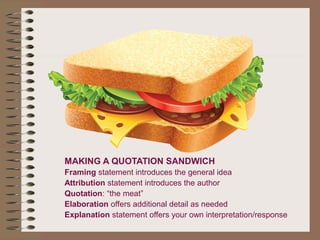
MAKING A QUOTATION SANDWICH
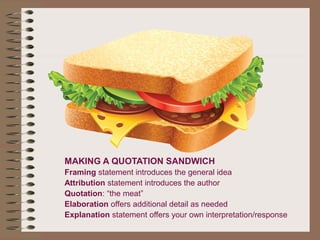
Framing statement introduces the general idea
Attribution statement introduces the author
Quotation: “the meat”
Elaboration offers additional detail as needed
Explanation statement offers your own interpretation/response
MAKING A QUOTATION SANDWICH
Framing statement introduces the general idea
Attribution statement introduces the author
Quotation: “the meat”
Elaboration offers additional detail as needed
Explanation statement offers your own interpretation/response
Summarizing to Agree
– She argues______, and I agree
because_____.
– Her argument that ______ is supported by
new research showing that _______.
Summarizing to Disagree
– While she argues ______, I disagree
because_______.
– The argument he proposes, while
persuasive, is inaccurate because______.
Summarizing to
Concede and Rebut
– He claims that _______, and I have mixed
feelings about it. On the one hand, I agree
that ______. On the other hand, I still insist
that_______.
– Although I grant that ____, I still maintain
that _____.
Citing your Sources
You should use a combination of:
• attributive tags
• in-text citations
to document the sources you used in
your work.
ATTRIBUTIVE TAGS
Attribution (n). Assigning to a source
Language that tells the reader that you are using another’s
ideas.
According to AUTHOR…
AUTHOR states that…
AUTHOR goes on to say that…
Attribution may be used with SUMMARIZING,
PARAPHRASING or DIRECT QUOTATION.
IN-TEXT CITATION
After summarizing, paraphrasing, or direct quotation, use
the (author-date) method of citation, following
guidelines for style (MLA, APA, Chicago, etc).
For summarizing or paraphrasing: (Author, year of
publication)
For direct quotation: (Author, date, page)

Academic Writing Fundamentals

  • 1.
    “They Say, ISay: The Moves That Matter in Academic Writing Gerald Graff & Cathy Birkenstein 2006 W.W. Norton Renee Hobbs
  • 2.
    Academic Discourse asa Conversation
  • 3.
    The Conversation HasBeen Going On Before You Arrived In fact, the discussion had already begun long before any of them got there, so that no one present is qualified to retrace for you all the steps that had gone before. You listen for a while, until you decide that you have caught the tenor of the argument; then you put in your oar. Someone answers; you answer him; another comes to your defense; another aligns himself against you, to either the embarrassment or gratification of your opponent, depending upon the quality of your ally’s assistance. However, the discussion is interminable. The hour grows late, you must depart. And you do depart, with the discussion still vigorously in progress. (Kenneth Burke, 110-11, Philosophy of Literary Form)
  • 4.
    They Say, ISay • Academic writing is highly social: through writing, we engage with the work of others • We enter an academic conversation using the ideas of others as a sounding board or launch pad for our own ideas • We can agree with, challenge or respond to the ideas presented by others • Templates or models can help writers structure their ideas
  • 6.
    Using and Citing Sources Thereare three ways to incorporate other people’s ideas into your writing: 1. Summarizing 2. Paraphrasing 3. Quoting directly from the source
  • 7.
    SUMMARIZING When you condensethe main ideas of a writer’s argument or evidence, you are summarizing. You do not use the wording of the writer, but you put the main ideas into your own words. You show your reader that the information you read has passed through your mind, that you have interpreted it and analyzed it, and that you are not just copying from the original source.
  • 8.
    EXAMPLE OF SUMMARIZING THEY SAY:Boys and girls also have different content preferences, with girls having more interest in media that features human relationships, romance and friendships, celebrities and music. Girls are more likely to use chat rooms and boys are more likely to prefer media that features action, violence and competition (Lemish, Liebes & Seidmann, 2001). I SAY: Parents influence the way that children engage with media content; how adults respond to different genres and formats of movies, TV shows and print media helps set norms and expectations for children.
  • 9.
    PARAPHRASING When you focuson one or two sentences of a writer’s work and put them into your own words, you are paraphrasing. You paraphrase when you want to highlight the details, facts or specific information provided by an author.
  • 10.
    EXAMPLE OF PARAPHRASING THEY SAY:Patterns of media use and access to media show that in the U.S. and most Western European nations, two-thirds of girls play electronic games and an increasing number use the Internet. However, media use is still somewhat stereotypically gendered. For example, when asked which medium children would prefer as a birthday gift, girls are most likely to choose a television set and boys are most likely to prefer a computer or computer-related accessory (Livingstone & Bovill, 2001). I SAY: Although family influence is important, the ubiquitous presence of consumer merchandising of toys, games and media is almost certainly a factor in the maintenance of gender stereotypical responses of children.
  • 11.
    DIRECT QUOTATION You maywant to quote the source directly if the language in a specific quote is very powerful or the ideas in the quote are very important to your argument. You should try not to use too many direct quotes or quotes that are too long – if you did this, the writing would not truly be your own work. When you quote, you must alert your reader that you are quoting by enclosing the quote in quotation marks and make sure you copy the quote exactly as it appears in the text, punctuation included.
  • 12.
    EXAMPLE OF DIRECT QUOTATION THEYSAY: Boys watch more television and play more videogames; girls read more magazines and books, listen to more music and watch more movies. As Roe (1998, 23) has put it, "In this period of their lives, boys and girls increasingly inhabit different media worlds." I SAY: Today there is very little media that can be comfortably watched by boys and girls, parents and children alike. Therefore, I contend that the extreme specialization of media content is contributing to increasing isolation among family members and a diminishment in the quality of family life;
  • 13.
    MAKING A QUOTATIONSANDWICH Framing statement introduces the general idea Attribution statement introduces the author Quotation: “the meat” Elaboration offers additional detail as needed Explanation statement offers your own interpretation/response
  • 14.
    MAKING A QUOTATIONSANDWICH Framing statement introduces the general idea Attribution statement introduces the author Quotation: “the meat” Elaboration offers additional detail as needed Explanation statement offers your own interpretation/response
  • 15.
    Summarizing to Agree –She argues______, and I agree because_____. – Her argument that ______ is supported by new research showing that _______.
  • 16.
    Summarizing to Disagree –While she argues ______, I disagree because_______. – The argument he proposes, while persuasive, is inaccurate because______.
  • 17.
    Summarizing to Concede andRebut – He claims that _______, and I have mixed feelings about it. On the one hand, I agree that ______. On the other hand, I still insist that_______. – Although I grant that ____, I still maintain that _____.
  • 18.
    Citing your Sources Youshould use a combination of: • attributive tags • in-text citations to document the sources you used in your work.
  • 19.
    ATTRIBUTIVE TAGS Attribution (n).Assigning to a source Language that tells the reader that you are using another’s ideas. According to AUTHOR… AUTHOR states that… AUTHOR goes on to say that… Attribution may be used with SUMMARIZING, PARAPHRASING or DIRECT QUOTATION.
  • 20.
    IN-TEXT CITATION After summarizing,paraphrasing, or direct quotation, use the (author-date) method of citation, following guidelines for style (MLA, APA, Chicago, etc). For summarizing or paraphrasing: (Author, year of publication) For direct quotation: (Author, date, page)