HOW, WHAT AND WHY OF ASSESSMENT
By
Dr. Thanuja.K
Associate Professor
Keyi Sahib Training College
Karimbam, Taliparamba
ASSESSMENT
Assessment is an integral part of teaching and learning process. It is a process of finding out
whether a particular sequence of instructional activities has resulted in the intended learning
outcomes. In other words, it is the process of collecting the quantified information about the
attributes and interpreting it.
Assessment is the process of gathering information to inform instructional decision making.
The purpose of assessment is judging the quality of performance of children while learning is
going on. Assessment is a means to gather evidence to meet the requirement of evaluation.
Assessment is “a systematic procedure for collecting information that can be used to
make inferences about the characteristics of people or objects. (AERA, et. al., 1999)”.
Assessment is referred to as “a process of collecting evidence and making judgments
relating to outcomes”. It is said that assessment has a narrower meaning than evaluation but
a broader meaning than measurement. In its derivation, the word assess means “to sit
beside” or “to assist the judge”, it reflects that assessment is a process of gathering data and
fashioning them into an interpretable form; judgment can be made on the basis of this
assessment.
In education, the term assessment refers to the wide variety of methods or tools that
educators use to evaluate, measure, and document the academic readiness, learning progress,
skill acquisition, or educational needs of students. Assessments are typically designed to
measure specific elements of learning—e.g., the level of knowledge a student already has
about the concept or skill the teacher is planning to teach or the ability to comprehend and
analyze different types of texts and readings. Assessments also are used to identify individual
student weaknesses and strengths so that educators can provide specialized academic support,
educational programming, or social services.
In classroom assessment, teacher observe the learners in the process of learning, collect
feedback on their learning, improve his/her teaching-learning strategy to facilitate them for
maximum learning, s/he is doing.
Why do we assess?
To determine the intended learning outcomes of the course are being achieved.
To clear the child criteria of learning and assessment.
To give information regarding the current skills, attitude and knowledge of the learner.
To understand the gaps in learning and the developmental needs of the child.
To provide feedback to students on their learning, enabling them to improve their performance.
To motivate students to undertake appropriate work.
To support and guide learning
To describe student attainment, informing decisions on progression of awards
To demonstrate that appropriate standards are being maintained.
To evaluate the effectiveness of teaching.
Role of Assessment in Learning
Assessment is the process of gathering information to inform instructional decision making.
The purpose of assessment is judging the quality of performance of children while learning is
going on. Assessment is a means to gather evidence to meet the requirement of evaluation.
Evaluation is the process of finding out to what extent changes have taken place in the
development and learning among children.
The assessment serves three purposes: 1. Inform decisions about the status of learning
and to promote greater learning. 2. Inform decisions about accountability and 3. Reflect on
their own learning. These can be termed as Assessment for Learning, Assessment of
Learning and Assessment as Learning respectively.
Assessment for Learning(AFL): Assessment for learning is a teacher initiated student –
context process and is integrated with each and every learning activity in the classroom. In this
process of assessment, teacher gather information about student learning using a variety of
strategies, tools, techniques and tasks and to provide specific and timely feedback about
students learning. The feedback and correctives help the child to bridge the gap between
student's current status and the desired outcome. Assessment practices are situated within the
social and cultural classroom interaction with the aim of informing and improving students‟
learning to enhance autonomy. AFL focuses on the purpose of formative assessment and is
aimed at providing evidence of students‟ learning progress (Wiliam, 2011). In an AfL
classroom, teachers define and share the learning intentions and criteria for success with
students at the very beginning of their learning. Learners not only learn about the learning
intentions but they also learn about scaffolding they receive in order to achieve the stated
learning intentions. Learners play an active role in monitoring their progress. They constantly
collaborate with their teacher to monitor their achievement level relative to the learning
intentions. During the learning process, students actively communicate their learning evidence
to their teacher and peers. Thus, students have a key role in assessing their own learning. They
monitor their learning progress, control their success, and believe that they can achieve success
if they try their best.
Features of Assessment for Learning
Assessment for learning Explain the learning objectives and feedback opportunities.
Check learner understanding of learning objectives.
Brief learners on what they have to do and what they have to hand in.
Introduce the assessment criteria to learners and check their understanding.
Provide learners with opportunities to apply the assessment criteria to examples of work
produced, possibly by a previous cohort, to illustrate standards required and the application of
the assessment criteria.
Provide the necessary guidance and support to learners on an individual basis and provide
oral feedback
Provide peer-assessment opportunities.
Provide self-assessment opportunities.
Undertake the teacher-led assessment of learners’ work.
Provide written feedback to learners.
Create opportunities for learners to undertake remedial action and/or consolidation
activities
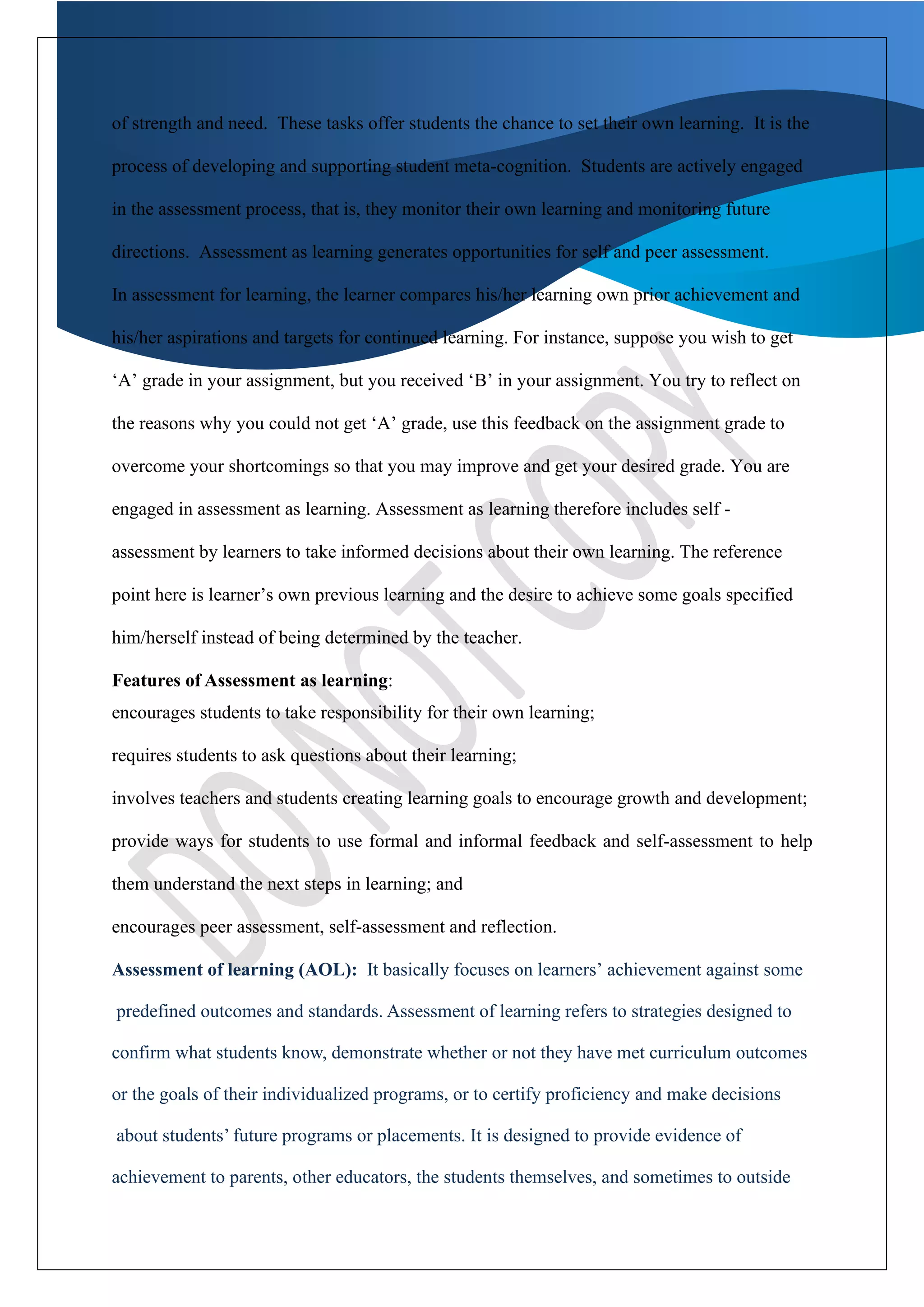
Assessment as learning (AAL) is a process of developing and supporting metacognition
((knowledge of one’s own thought processes) for students. Assessment as learning
focuses on the role of the students as the critical connector between assessment and learning.
When the students are active, engaged, and critical assessors, they make sense of information,
relate it to prior knowledge and use it for new learning. This is the regulatory process in meta
cognition. It occurs when students monitor their own learning and use the feedback from this
monitoring to make adjustments, adaptations, and even major changes in which they
understand. It requires that teachers help student develop, practice and become comfortable
with reflection and with a critical analysis of their own learning. It is the use of a task or an
activity to allow students the opportunity to use assessment to improve their own learning.
Self and peer assessments allow students to reflect on their own learning, and identify areas
of strength and need. These tasks offer students the chance to set their own learning. It is the
process of developing and supporting student meta-cognition. Students are actively engaged
in the assessment process, that is, they monitor their own learning and monitoring future
directions. Assessment as learning generates opportunities for self and peer assessment.
In assessment for learning, the learner compares his/her learning own prior achievement and
his/her aspirations and targets for continued learning. For instance, suppose you wish to get
‘A’ grade in your assignment, but you received ‘B’ in your assignment. You try to reflect on
the reasons why you could not get ‘A’ grade, use this feedback on the assignment grade to
overcome your shortcomings so that you may improve and get your desired grade. You are
engaged in assessment as learning. Assessment as learning therefore includes self -
assessment by learners to take informed decisions about their own learning. The reference
point here is learner’s own previous learning and the desire to achieve some goals specified
him/herself instead of being determined by the teacher.
Features of Assessment as learning:
encourages students to take responsibility for their own learning;
requires students to ask questions about their learning;
involves teachers and students creating learning goals to encourage growth and development;
provide ways for students to use formal and informal feedback and self-assessment to help
them understand the next steps in learning; and
encourages peer assessment, self-assessment and reflection.
Assessment of learning (AOL): It basically focuses on learners’ achievement against some
predefined outcomes and standards. Assessment of learning refers to strategies designed to
confirm what students know, demonstrate whether or not they have met curriculum outcomes
or the goals of their individualized programs, or to certify proficiency and make decisions
about students’ future programs or placements. It is designed to provide evidence of
achievement to parents, other educators, the students themselves, and sometimes to outside
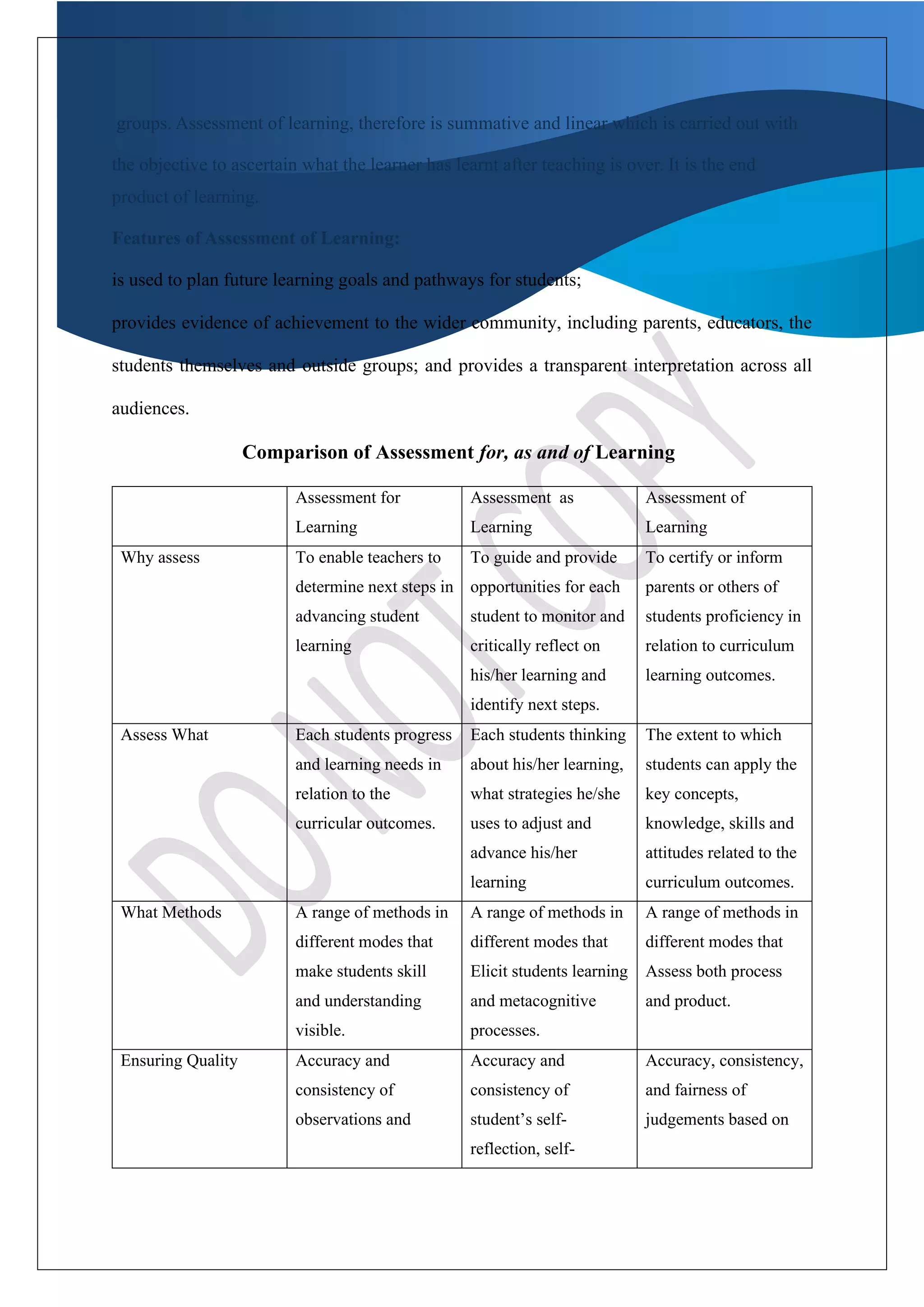
groups. Assessment of learning, therefore is summative and linear which is carried out with
the objective to ascertain what the learner has learnt after teaching is over. It is the end
product of learning.
Features of Assessment of Learning:
is used to plan future learning goals and pathways for students;
provides evidence of achievement to the wider community, including parents, educators, the
students themselves and outside groups; and provides a transparent interpretation across all
audiences.
Comparison of Assessment for, as and of Learning
Assessment for
Learning
Assessment as
Learning
Assessment of
Learning
Why assess To enable teachers to
determine next steps in
advancing student
learning
To guide and provide
opportunities for each
student to monitor and
critically reflect on
his/her learning and
identify next steps.
To certify or inform
parents or others of
students proficiency in
relation to curriculum
learning outcomes.
Assess What Each students progress
and learning needs in
relation to the
curricular outcomes.
Each students thinking
about his/her learning,
what strategies he/she
uses to adjust and
advance his/her
learning
The extent to which
students can apply the
key concepts,
knowledge, skills and
attitudes related to the
curriculum outcomes.
What Methods A range of methods in
different modes that
make students skill
and understanding
visible.
A range of methods in
different modes that
Elicit students learning
and metacognitive
processes.
A range of methods in
different modes that
Assess both process
and product.
Ensuring Quality Accuracy and
consistency of
observations and
Accuracy and
consistency of
student’s self-
reflection, self-
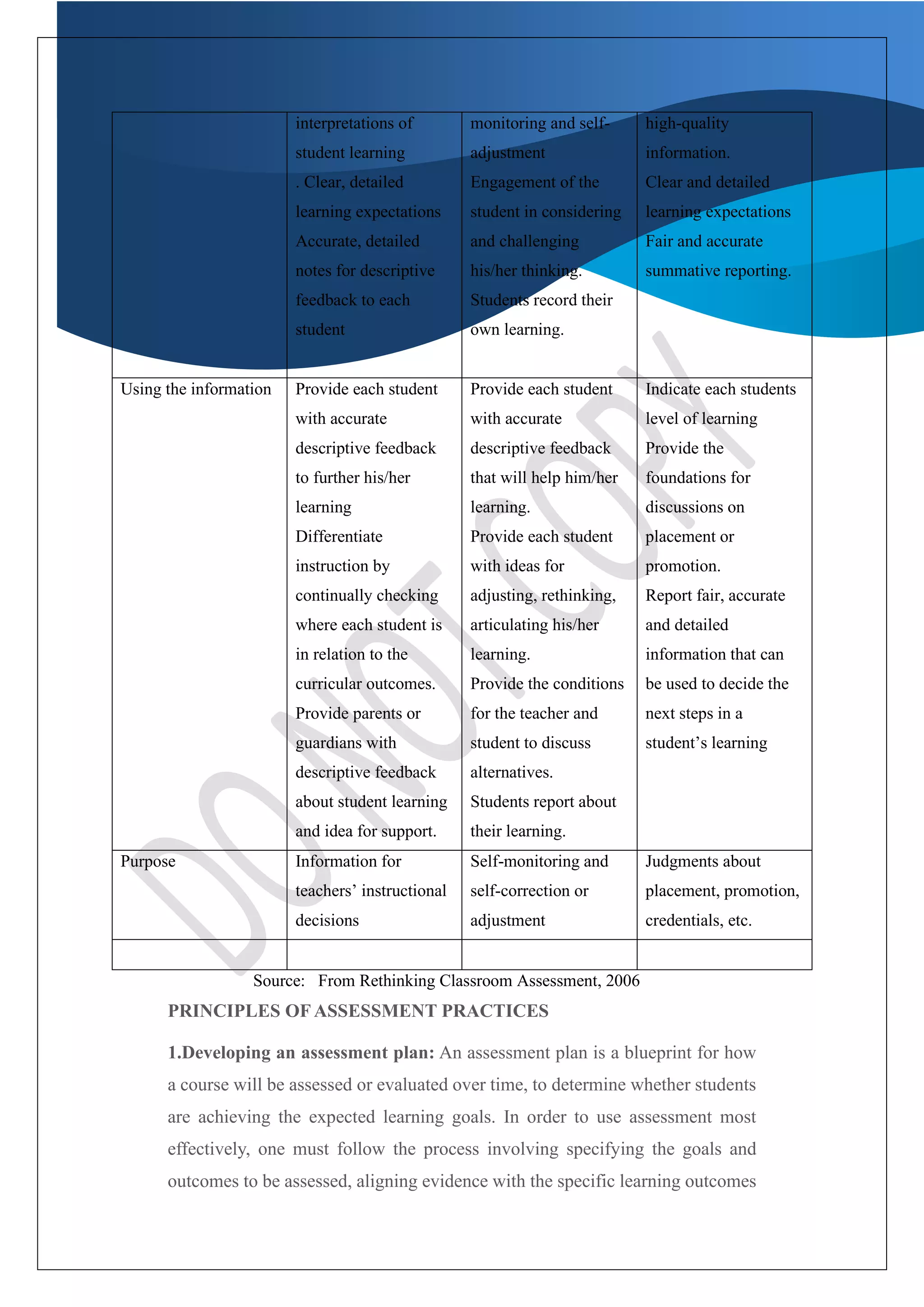
Accuracy, consistency,
and fairness of
judgements based on
interpretations of
student learning
. Clear, detailed
learning expectations
Accurate, detailed
notes for descriptive
feedback to each
student
monitoring and self-
adjustment
Engagement of the
student in considering
and challenging
his/her thinking.
Students record their
own learning.
high-quality
information.
Clear and detailed
learning expectations
Fair and accurate
summative reporting.
Using the information Provide each student
with accurate
descriptive feedback
to further his/her
learning
Differentiate
instruction by
continually checking
where each student is
in relation to the
curricular outcomes.
Provide parents or
guardians with
descriptive feedback
about student learning
and idea for support.
Provide each student
with accurate
descriptive feedback
that will help him/her
learning.
Provide each student
with ideas for
adjusting, rethinking,
articulating his/her
learning.
Provide the conditions
for the teacher and
student to discuss
alternatives.
Students report about
their learning.
Indicate each students
level of learning
Provide the
foundations for
discussions on
placement or
promotion.
Report fair, accurate
and detailed
information that can
be used to decide the
next steps in a
student’s learning
Purpose Information for
teachers’ instructional
decisions
Self-monitoring and
self-correction or
adjustment
Judgments about
placement, promotion,
credentials, etc.
Source: From Rethinking Classroom Assessment, 2006
PRINCIPLES OF ASSESSMENT PRACTICES
1.Developing an assessment plan: An assessment plan is a blueprint for how
a course will be assessed or evaluated over time, to determine whether students
are achieving the expected learning goals. In order to use assessment most
effectively, one must follow the process involving specifying the goals and
outcomes to be assessed, aligning evidence with the specific learning outcomes
that they measure to establish whether those outcomes have been met, selecting
methods for assessment, collecting data, judging and scoring of student’s
performance, summarizing and interpreting the results, and then reporting
assessment findings.
2.Selection of methods for assessment: Assessment methods should be
appropriate for and compatible with the purpose and context of the assessment.
When assessing a class, it is important to select appropriate methods and
develop appropriate tools for assessment. When determining which methods
you will use to assess student learning in your course, it is important to make
sure that the assessment tool aligns with the course goals and learning outcomes.
Selection of approaches and strategies depends on the available resources, kind
of information required, against the defined learning outcomes.
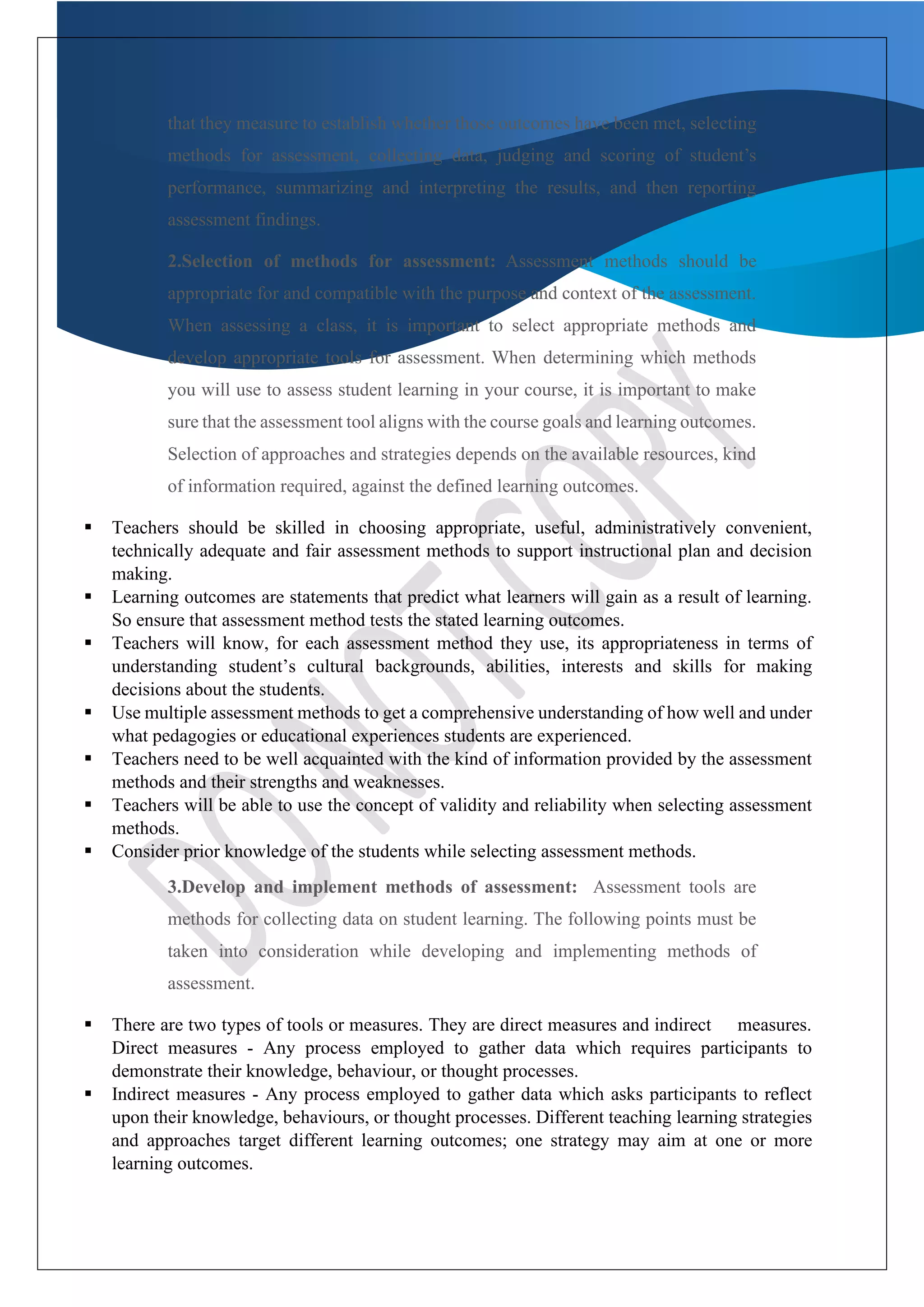
▪ Teachers should be skilled in choosing appropriate, useful, administratively convenient,
technically adequate and fair assessment methods to support instructional plan and decision
making.
▪ Learning outcomes are statements that predict what learners will gain as a result of learning.
So ensure that assessment method tests the stated learning outcomes.
▪ Teachers will know, for each assessment method they use, its appropriateness in terms of
understanding student’s cultural backgrounds, abilities, interests and skills for making
decisions about the students.
▪ Use multiple assessment methods to get a comprehensive understanding of how well and under
what pedagogies or educational experiences students are experienced.
▪ Teachers need to be well acquainted with the kind of information provided by the assessment
methods and their strengths and weaknesses.
▪ Teachers will be able to use the concept of validity and reliability when selecting assessment
methods.
▪ Consider prior knowledge of the students while selecting assessment methods.
3.Develop and implement methods of assessment: Assessment tools are
methods for collecting data on student learning. The following points must be
taken into consideration while developing and implementing methods of
assessment.
▪ There are two types of tools or measures. They are direct measures and indirect measures.
Direct measures - Any process employed to gather data which requires participants to
demonstrate their knowledge, behaviour, or thought processes.
▪ Indirect measures - Any process employed to gather data which asks participants to reflect
upon their knowledge, behaviours, or thought processes. Different teaching learning strategies
and approaches target different learning outcomes; one strategy may aim at one or more
learning outcomes.
▪ The intended learning outcomes are best indicated by performances that students would make,
say, or write but performances themselves are not learning outcomes, instead they indicate
progress on the learning outcomes.
▪ Rubrics may be developed to assess children’s performance and participation in their work.
4.Collection of assessment information: Assessment information can be
collected in a variety of ways. Assessment information is collected to determine
student’s achievement and their learning needs. It provides a basis for the
analysis of progress and achievement of students over time and assists the
diagnosis of individual learning needs Students should be provided with a
sufficient opportunity to demonstrate the knowledge, skills, attitudes, or
behaviours being assessed. Students should be told why assessment information
is being collected and how this information will be used. Assessment includes
information gathered from a wide range of sources and at different points in
time. These sources can include:
▪ knowledge gained from parents about their child;
▪ teacher’s knowledge drawn from their day-to-day interactions with students;
▪ results from teacher-designed classroom and school-wide tests, assessment tools and
techniques.
▪ assessment at school entry or transition points.
▪ Through self-assessment, peer assessment and portfolio assessment
5.Judging and scoring of student performance: Assessment information in
schools is only beneficial to teaching and learning if it is analysed and used. The
performance expectations for students should be clearly defined, so that
assessment results are defensible and meaningful. Procedures for judging or
scoring student performance should be appropriate for the assessment method
used and be consistently applied and monitored. The following points to be
considered while judging and scoring of student performance.
▪ The scoring criteria and indicators for assessment are clear to the students before they taking
part in the assessment.
▪ Teachers need to be clear about the target and the criteria for good work to be assessed based
on the criteria mentioned in the rubrics and the learning objectives.
▪ Before an assessment method is used, a procedure for scoring should be prepared to guide the
process of judging the quality of a performance or product the appropriateness of behaviour,
or the correctness of an answer.
▪ Contextual variables that may influence performance of the student should be identified and
considered, so that a student's performance can be validly interpreted.
▪ Information collected for student assessment should be systematically and accurately analysed,
so that the purposes of the assessment are effectively achieved.
▪ Judgements formed as part of scoring should be based on the responses made by the student’s
work and presented in a way that students can understand and use them.
▪ The procedures for assessing the students, both planned and actual, should be described, so that
the procedures can be explained and justified.
▪ The adequacy of information gathered should be ensured, so that good decisions are possible
and can be defended and justified.
▪ Scoring must be based on indicators of assessment criteria in order to be free from bias, so that
conclusions can be fair.
6.Summarizing and Interpreting Results: Procedures for summarizing and
interpreting assessment results should yield accurate and informative
representations of a student’s performance in relation to the goals and objectives
of instruction for the reporting period. The points to be noted while doing this
process are the following
▪ Procedures for summarizing and interpreting assessment results should yield accurate and
informative representations of a student’s performance in relation to the goals and objectives
of instruction for the reporting period.
▪ The conclusions drawn about student performance should be explicitly justified, so that
students, parents/guardians, and others can have confidence in them.
▪ Interpretation regarding student learning and performance must be aligned with the goals and
outcomes that each component of assessment tool or technique measures.
▪ The information collected, processed, and reported about students should be systematically
reviewed, corrected as appropriate, and kept secure, so that accurate judgments can be made.
▪ Take into consideration personal factors or extraneous events that might have influence test
performance.
▪ Use multiple sources and types of assessment information when making conclusions about an
individual’s performance.
▪ The way in which summary comments and grades are formulated and interpreted should be
explained to students and their parents.
▪ The individual results used and the process followed in deriving summary comments and
grades should be described in sufficient detail so that the meaning of a summary comment or
grade is clear.
▪ The basis for interpretation should be carefully described and justified.
7.Reporting Assessment Findings: Students and their parents have the right to
receive comprehensive information about assessment results presented in an
understandable and timely manner regarding the results of their assessments. It
is the teacher’s responsibility to provide the feedback to students and their
parents and to attempt to answer all of their questions. Providing feedback to
students regarding their performance and explaining the rationale for grading
decisions facilitate learning.
▪ Report result in an easily understandable manner.
▪ Explain to students and parents how they are likely to be impacted by assessment results.
▪ Reports should contain a description of the goals and objectives of instruction to which the
assessments are referenced.
▪ Reports should be complete in their descriptions of strengths and weaknessesof students, so
that strengths can be built upon and problem areas addressed.
▪ An appeal process should be described to students at the beginning of course of instruction that
they may use to appeal a result.
REFERENCES:
https://www.missouristate.edu/assessment/the-assessment-process.htm
https://dera.ioe.ac.uk/7800/1/AssessmentforLearning.pdf

How, what and why of assessment, by dr. thanujakarimbana converted

  • 1.
    HOW, WHAT ANDWHY OF ASSESSMENT By Dr. Thanuja.K Associate Professor Keyi Sahib Training College Karimbam, Taliparamba
  • 2.
    ASSESSMENT Assessment is anintegral part of teaching and learning process. It is a process of finding out whether a particular sequence of instructional activities has resulted in the intended learning outcomes. In other words, it is the process of collecting the quantified information about the attributes and interpreting it. Assessment is the process of gathering information to inform instructional decision making. The purpose of assessment is judging the quality of performance of children while learning is going on. Assessment is a means to gather evidence to meet the requirement of evaluation. Assessment is “a systematic procedure for collecting information that can be used to make inferences about the characteristics of people or objects. (AERA, et. al., 1999)”. Assessment is referred to as “a process of collecting evidence and making judgments relating to outcomes”. It is said that assessment has a narrower meaning than evaluation but a broader meaning than measurement. In its derivation, the word assess means “to sit beside” or “to assist the judge”, it reflects that assessment is a process of gathering data and fashioning them into an interpretable form; judgment can be made on the basis of this assessment. In education, the term assessment refers to the wide variety of methods or tools that educators use to evaluate, measure, and document the academic readiness, learning progress, skill acquisition, or educational needs of students. Assessments are typically designed to measure specific elements of learning—e.g., the level of knowledge a student already has about the concept or skill the teacher is planning to teach or the ability to comprehend and analyze different types of texts and readings. Assessments also are used to identify individual student weaknesses and strengths so that educators can provide specialized academic support, educational programming, or social services. In classroom assessment, teacher observe the learners in the process of learning, collect feedback on their learning, improve his/her teaching-learning strategy to facilitate them for maximum learning, s/he is doing. Why do we assess? To determine the intended learning outcomes of the course are being achieved. To clear the child criteria of learning and assessment. To give information regarding the current skills, attitude and knowledge of the learner. To understand the gaps in learning and the developmental needs of the child. To provide feedback to students on their learning, enabling them to improve their performance.
  • 3.
    To motivate studentsto undertake appropriate work. To support and guide learning To describe student attainment, informing decisions on progression of awards To demonstrate that appropriate standards are being maintained. To evaluate the effectiveness of teaching. Role of Assessment in Learning Assessment is the process of gathering information to inform instructional decision making. The purpose of assessment is judging the quality of performance of children while learning is going on. Assessment is a means to gather evidence to meet the requirement of evaluation. Evaluation is the process of finding out to what extent changes have taken place in the development and learning among children. The assessment serves three purposes: 1. Inform decisions about the status of learning and to promote greater learning. 2. Inform decisions about accountability and 3. Reflect on their own learning. These can be termed as Assessment for Learning, Assessment of Learning and Assessment as Learning respectively. Assessment for Learning(AFL): Assessment for learning is a teacher initiated student – context process and is integrated with each and every learning activity in the classroom. In this process of assessment, teacher gather information about student learning using a variety of strategies, tools, techniques and tasks and to provide specific and timely feedback about students learning. The feedback and correctives help the child to bridge the gap between student's current status and the desired outcome. Assessment practices are situated within the social and cultural classroom interaction with the aim of informing and improving students‟ learning to enhance autonomy. AFL focuses on the purpose of formative assessment and is aimed at providing evidence of students‟ learning progress (Wiliam, 2011). In an AfL classroom, teachers define and share the learning intentions and criteria for success with students at the very beginning of their learning. Learners not only learn about the learning intentions but they also learn about scaffolding they receive in order to achieve the stated learning intentions. Learners play an active role in monitoring their progress. They constantly collaborate with their teacher to monitor their achievement level relative to the learning intentions. During the learning process, students actively communicate their learning evidence to their teacher and peers. Thus, students have a key role in assessing their own learning. They monitor their learning progress, control their success, and believe that they can achieve success if they try their best. Features of Assessment for Learning Assessment for learning Explain the learning objectives and feedback opportunities.
  • 4.
    Check learner understandingof learning objectives. Brief learners on what they have to do and what they have to hand in. Introduce the assessment criteria to learners and check their understanding. Provide learners with opportunities to apply the assessment criteria to examples of work produced, possibly by a previous cohort, to illustrate standards required and the application of the assessment criteria. Provide the necessary guidance and support to learners on an individual basis and provide oral feedback Provide peer-assessment opportunities. Provide self-assessment opportunities. Undertake the teacher-led assessment of learners’ work. Provide written feedback to learners. Create opportunities for learners to undertake remedial action and/or consolidation activities Assessment as learning (AAL) is a process of developing and supporting metacognition ((knowledge of one’s own thought processes) for students. Assessment as learning focuses on the role of the students as the critical connector between assessment and learning. When the students are active, engaged, and critical assessors, they make sense of information, relate it to prior knowledge and use it for new learning. This is the regulatory process in meta cognition. It occurs when students monitor their own learning and use the feedback from this monitoring to make adjustments, adaptations, and even major changes in which they understand. It requires that teachers help student develop, practice and become comfortable with reflection and with a critical analysis of their own learning. It is the use of a task or an activity to allow students the opportunity to use assessment to improve their own learning. Self and peer assessments allow students to reflect on their own learning, and identify areas
  • 5.
    of strength andneed. These tasks offer students the chance to set their own learning. It is the process of developing and supporting student meta-cognition. Students are actively engaged in the assessment process, that is, they monitor their own learning and monitoring future directions. Assessment as learning generates opportunities for self and peer assessment. In assessment for learning, the learner compares his/her learning own prior achievement and his/her aspirations and targets for continued learning. For instance, suppose you wish to get ‘A’ grade in your assignment, but you received ‘B’ in your assignment. You try to reflect on the reasons why you could not get ‘A’ grade, use this feedback on the assignment grade to overcome your shortcomings so that you may improve and get your desired grade. You are engaged in assessment as learning. Assessment as learning therefore includes self - assessment by learners to take informed decisions about their own learning. The reference point here is learner’s own previous learning and the desire to achieve some goals specified him/herself instead of being determined by the teacher. Features of Assessment as learning: encourages students to take responsibility for their own learning; requires students to ask questions about their learning; involves teachers and students creating learning goals to encourage growth and development; provide ways for students to use formal and informal feedback and self-assessment to help them understand the next steps in learning; and encourages peer assessment, self-assessment and reflection. Assessment of learning (AOL): It basically focuses on learners’ achievement against some predefined outcomes and standards. Assessment of learning refers to strategies designed to confirm what students know, demonstrate whether or not they have met curriculum outcomes or the goals of their individualized programs, or to certify proficiency and make decisions about students’ future programs or placements. It is designed to provide evidence of achievement to parents, other educators, the students themselves, and sometimes to outside
  • 6.
    groups. Assessment oflearning, therefore is summative and linear which is carried out with the objective to ascertain what the learner has learnt after teaching is over. It is the end product of learning. Features of Assessment of Learning: is used to plan future learning goals and pathways for students; provides evidence of achievement to the wider community, including parents, educators, the students themselves and outside groups; and provides a transparent interpretation across all audiences. Comparison of Assessment for, as and of Learning Assessment for Learning Assessment as Learning Assessment of Learning Why assess To enable teachers to determine next steps in advancing student learning To guide and provide opportunities for each student to monitor and critically reflect on his/her learning and identify next steps. To certify or inform parents or others of students proficiency in relation to curriculum learning outcomes. Assess What Each students progress and learning needs in relation to the curricular outcomes. Each students thinking about his/her learning, what strategies he/she uses to adjust and advance his/her learning The extent to which students can apply the key concepts, knowledge, skills and attitudes related to the curriculum outcomes. What Methods A range of methods in different modes that make students skill and understanding visible. A range of methods in different modes that Elicit students learning and metacognitive processes. A range of methods in different modes that Assess both process and product. Ensuring Quality Accuracy and consistency of observations and Accuracy and consistency of student’s self- reflection, self- Accuracy, consistency, and fairness of judgements based on
  • 7.
    interpretations of student learning .Clear, detailed learning expectations Accurate, detailed notes for descriptive feedback to each student monitoring and self- adjustment Engagement of the student in considering and challenging his/her thinking. Students record their own learning. high-quality information. Clear and detailed learning expectations Fair and accurate summative reporting. Using the information Provide each student with accurate descriptive feedback to further his/her learning Differentiate instruction by continually checking where each student is in relation to the curricular outcomes. Provide parents or guardians with descriptive feedback about student learning and idea for support. Provide each student with accurate descriptive feedback that will help him/her learning. Provide each student with ideas for adjusting, rethinking, articulating his/her learning. Provide the conditions for the teacher and student to discuss alternatives. Students report about their learning. Indicate each students level of learning Provide the foundations for discussions on placement or promotion. Report fair, accurate and detailed information that can be used to decide the next steps in a student’s learning Purpose Information for teachers’ instructional decisions Self-monitoring and self-correction or adjustment Judgments about placement, promotion, credentials, etc. Source: From Rethinking Classroom Assessment, 2006 PRINCIPLES OF ASSESSMENT PRACTICES 1.Developing an assessment plan: An assessment plan is a blueprint for how a course will be assessed or evaluated over time, to determine whether students are achieving the expected learning goals. In order to use assessment most effectively, one must follow the process involving specifying the goals and outcomes to be assessed, aligning evidence with the specific learning outcomes
  • 8.
    that they measureto establish whether those outcomes have been met, selecting methods for assessment, collecting data, judging and scoring of student’s performance, summarizing and interpreting the results, and then reporting assessment findings. 2.Selection of methods for assessment: Assessment methods should be appropriate for and compatible with the purpose and context of the assessment. When assessing a class, it is important to select appropriate methods and develop appropriate tools for assessment. When determining which methods you will use to assess student learning in your course, it is important to make sure that the assessment tool aligns with the course goals and learning outcomes. Selection of approaches and strategies depends on the available resources, kind of information required, against the defined learning outcomes. ▪ Teachers should be skilled in choosing appropriate, useful, administratively convenient, technically adequate and fair assessment methods to support instructional plan and decision making. ▪ Learning outcomes are statements that predict what learners will gain as a result of learning. So ensure that assessment method tests the stated learning outcomes. ▪ Teachers will know, for each assessment method they use, its appropriateness in terms of understanding student’s cultural backgrounds, abilities, interests and skills for making decisions about the students. ▪ Use multiple assessment methods to get a comprehensive understanding of how well and under what pedagogies or educational experiences students are experienced. ▪ Teachers need to be well acquainted with the kind of information provided by the assessment methods and their strengths and weaknesses. ▪ Teachers will be able to use the concept of validity and reliability when selecting assessment methods. ▪ Consider prior knowledge of the students while selecting assessment methods. 3.Develop and implement methods of assessment: Assessment tools are methods for collecting data on student learning. The following points must be taken into consideration while developing and implementing methods of assessment. ▪ There are two types of tools or measures. They are direct measures and indirect measures. Direct measures - Any process employed to gather data which requires participants to demonstrate their knowledge, behaviour, or thought processes. ▪ Indirect measures - Any process employed to gather data which asks participants to reflect upon their knowledge, behaviours, or thought processes. Different teaching learning strategies and approaches target different learning outcomes; one strategy may aim at one or more learning outcomes.
  • 9.
    ▪ The intendedlearning outcomes are best indicated by performances that students would make, say, or write but performances themselves are not learning outcomes, instead they indicate progress on the learning outcomes. ▪ Rubrics may be developed to assess children’s performance and participation in their work. 4.Collection of assessment information: Assessment information can be collected in a variety of ways. Assessment information is collected to determine student’s achievement and their learning needs. It provides a basis for the analysis of progress and achievement of students over time and assists the diagnosis of individual learning needs Students should be provided with a sufficient opportunity to demonstrate the knowledge, skills, attitudes, or behaviours being assessed. Students should be told why assessment information is being collected and how this information will be used. Assessment includes information gathered from a wide range of sources and at different points in time. These sources can include: ▪ knowledge gained from parents about their child; ▪ teacher’s knowledge drawn from their day-to-day interactions with students; ▪ results from teacher-designed classroom and school-wide tests, assessment tools and techniques. ▪ assessment at school entry or transition points. ▪ Through self-assessment, peer assessment and portfolio assessment 5.Judging and scoring of student performance: Assessment information in schools is only beneficial to teaching and learning if it is analysed and used. The performance expectations for students should be clearly defined, so that assessment results are defensible and meaningful. Procedures for judging or scoring student performance should be appropriate for the assessment method used and be consistently applied and monitored. The following points to be considered while judging and scoring of student performance. ▪ The scoring criteria and indicators for assessment are clear to the students before they taking part in the assessment. ▪ Teachers need to be clear about the target and the criteria for good work to be assessed based on the criteria mentioned in the rubrics and the learning objectives. ▪ Before an assessment method is used, a procedure for scoring should be prepared to guide the process of judging the quality of a performance or product the appropriateness of behaviour, or the correctness of an answer. ▪ Contextual variables that may influence performance of the student should be identified and considered, so that a student's performance can be validly interpreted. ▪ Information collected for student assessment should be systematically and accurately analysed, so that the purposes of the assessment are effectively achieved.
  • 10.
    ▪ Judgements formedas part of scoring should be based on the responses made by the student’s work and presented in a way that students can understand and use them. ▪ The procedures for assessing the students, both planned and actual, should be described, so that the procedures can be explained and justified. ▪ The adequacy of information gathered should be ensured, so that good decisions are possible and can be defended and justified. ▪ Scoring must be based on indicators of assessment criteria in order to be free from bias, so that conclusions can be fair. 6.Summarizing and Interpreting Results: Procedures for summarizing and interpreting assessment results should yield accurate and informative representations of a student’s performance in relation to the goals and objectives of instruction for the reporting period. The points to be noted while doing this process are the following ▪ Procedures for summarizing and interpreting assessment results should yield accurate and informative representations of a student’s performance in relation to the goals and objectives of instruction for the reporting period. ▪ The conclusions drawn about student performance should be explicitly justified, so that students, parents/guardians, and others can have confidence in them. ▪ Interpretation regarding student learning and performance must be aligned with the goals and outcomes that each component of assessment tool or technique measures. ▪ The information collected, processed, and reported about students should be systematically reviewed, corrected as appropriate, and kept secure, so that accurate judgments can be made. ▪ Take into consideration personal factors or extraneous events that might have influence test performance. ▪ Use multiple sources and types of assessment information when making conclusions about an individual’s performance. ▪ The way in which summary comments and grades are formulated and interpreted should be explained to students and their parents. ▪ The individual results used and the process followed in deriving summary comments and grades should be described in sufficient detail so that the meaning of a summary comment or grade is clear. ▪ The basis for interpretation should be carefully described and justified. 7.Reporting Assessment Findings: Students and their parents have the right to receive comprehensive information about assessment results presented in an understandable and timely manner regarding the results of their assessments. It is the teacher’s responsibility to provide the feedback to students and their parents and to attempt to answer all of their questions. Providing feedback to students regarding their performance and explaining the rationale for grading decisions facilitate learning. ▪ Report result in an easily understandable manner.
  • 11.
    ▪ Explain tostudents and parents how they are likely to be impacted by assessment results. ▪ Reports should contain a description of the goals and objectives of instruction to which the assessments are referenced. ▪ Reports should be complete in their descriptions of strengths and weaknessesof students, so that strengths can be built upon and problem areas addressed. ▪ An appeal process should be described to students at the beginning of course of instruction that they may use to appeal a result. REFERENCES: https://www.missouristate.edu/assessment/the-assessment-process.htm https://dera.ioe.ac.uk/7800/1/AssessmentforLearning.pdf