AS Media Studies
   Unit G322a
Editing
Editing is largely to do with organising time.

It controls:

• WHAT we look at,

• in what ORDER we look at it,

• and HOW LONG it is before we look at something
  else.
Editing
• In most TV Dramas the main purpose of
  editing is to create CONTINUITY – a sense that
  the film makes LOGICAL SENSE in terms of
  immediate CAUSE and EFFECT and that it is
  CONSISTENT in the way it presents its world.

• Through continuity, audiences can make sense
  of, and believe in, the narrative.
What are we looking for when
       analysing editing in a clip?
•   Order of shots
•   Continuity/montage                   You need to be
•   Transitions                          able to discuss
                                           how these
•   Shot duration                           technical
•   Pace and rhythm                      elements help
                                        create meaning.
•   Special effects

Many of these areas overlap, i.e. order of shots and continuity.
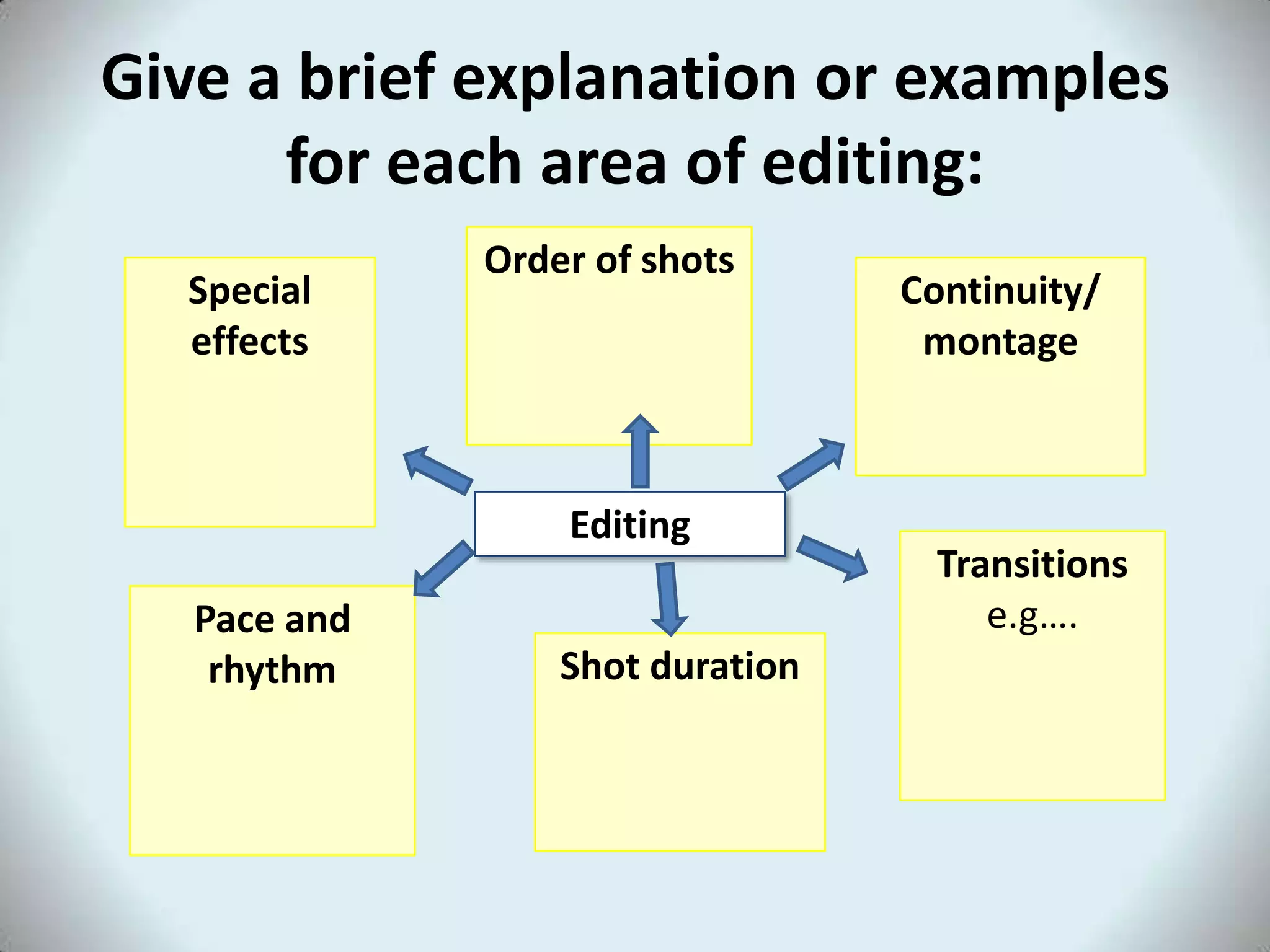
Give a brief explanation or examples
      for each area of editing:
              Order of shots
  Special                         Continuity/
  effects                          montage


                  Editing
                                    Transitions
   Pace and                            e.g….
    rhythm        Shot duration
Order of shots
• The meaning of a clip can change depending on the
  order the shots are cut together

• Hitchcock Loves Bikinis
http://www.youtube.com/watch?v=hCAE0t6KwJY&feature=PlayList&p=DC6A8F00C8251D2
5&index=3

• Putting two shots together can suggest a connection or
  emphasise contrast (juxtaposition).

• Refer to handout for further editing functions relating
  to this, e.g. intercutting.
Continuity
Continuity editing
• Cutting shots to tell a story with narrative continuity, helping the viewer
  make sense of the action by implying spatial relationships and ensuring
  smooth flow from shot to shot.
• Continuity techniques:
   • Establishing shot (establishes the space in which action is to happen)
   • The 180º rule (ensures that the same space is described in each shot)
   • Shot/reverse shot
   • Eyeline match (e.g. character looks off-screen, next shot shows us
      what they see)
   • Match on action (character begins to move in one shot, we see
      continuation of the same movement in the next shot)

• Realism - edit is invisible so action appears real rather than constructed.
Non-Continuity
• Montage – giving information in compressed
  form – the shots that are cut together may not
  appear connected but can be suggestive of
  particular meanings/ideas overall.
• Many of the title sequences we looked at during the
  coursework unit used a montage editing style).

• In Non-continuity editing – Continuity is broken
  and construction is more apparent. Meaning
  often created through juxtaposition and
  metaphor shot inserts.
Transitions
• The process of cutting from one shot to another usually
  involves a simple straight cut. However there are other means
  of transition available to a film editor, e.g.
• Fade to black
• Dissolve/cross fade
• Wipe

• What meaning could be created by the use of the transitions
  above?

• As well as simply moving to another shot, transitions can
  imply a passage of time or location, or emphasise a
  connection, perhaps what a character is thinking or dreaming
  about (dissolve/cross fade).
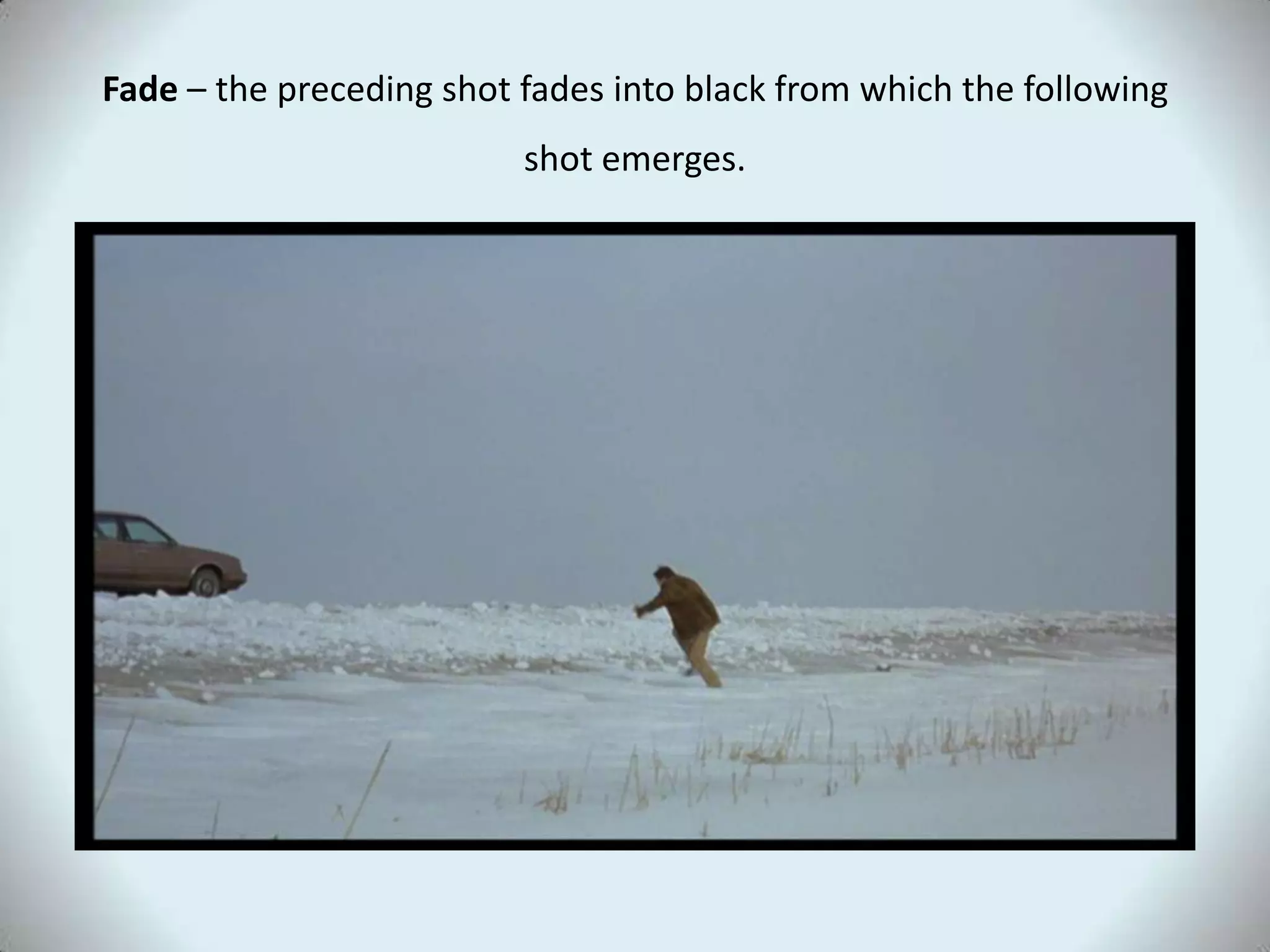
Fade – the preceding shot fades into black from which the following
                          shot emerges.
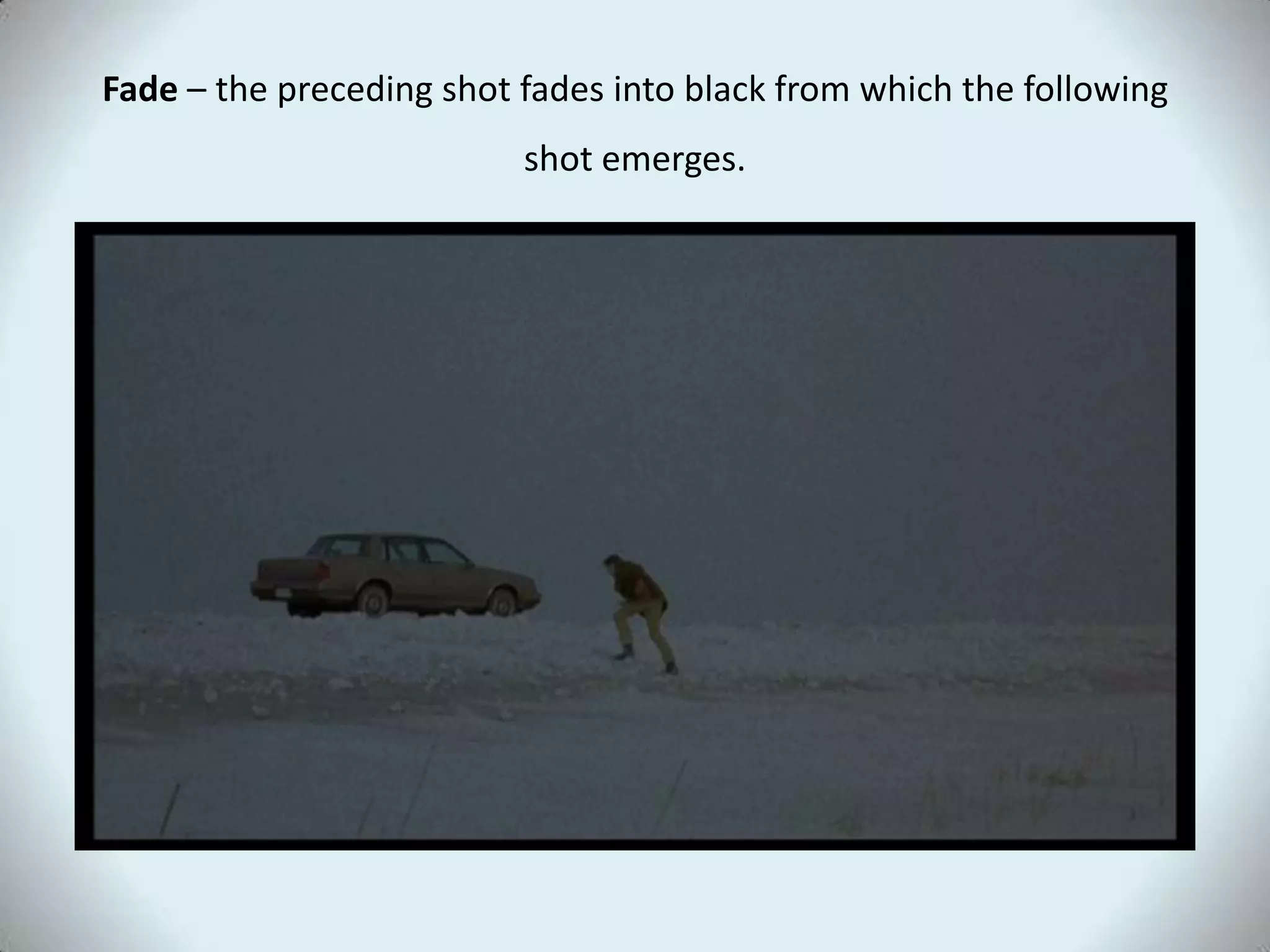
Fade – the preceding shot fades into black from which the following
                          shot emerges.
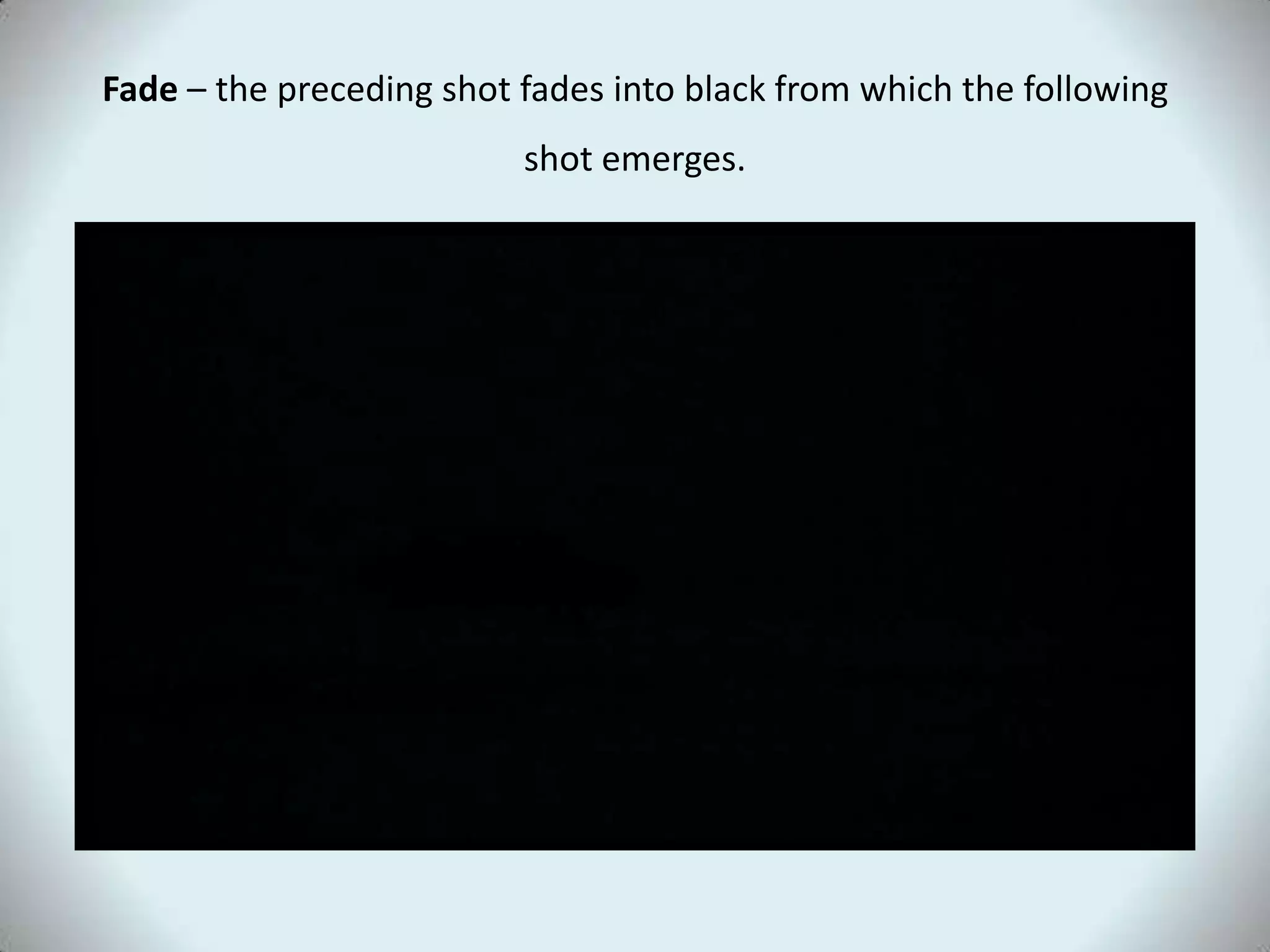
Fade – the preceding shot fades into black from which the following
                          shot emerges.
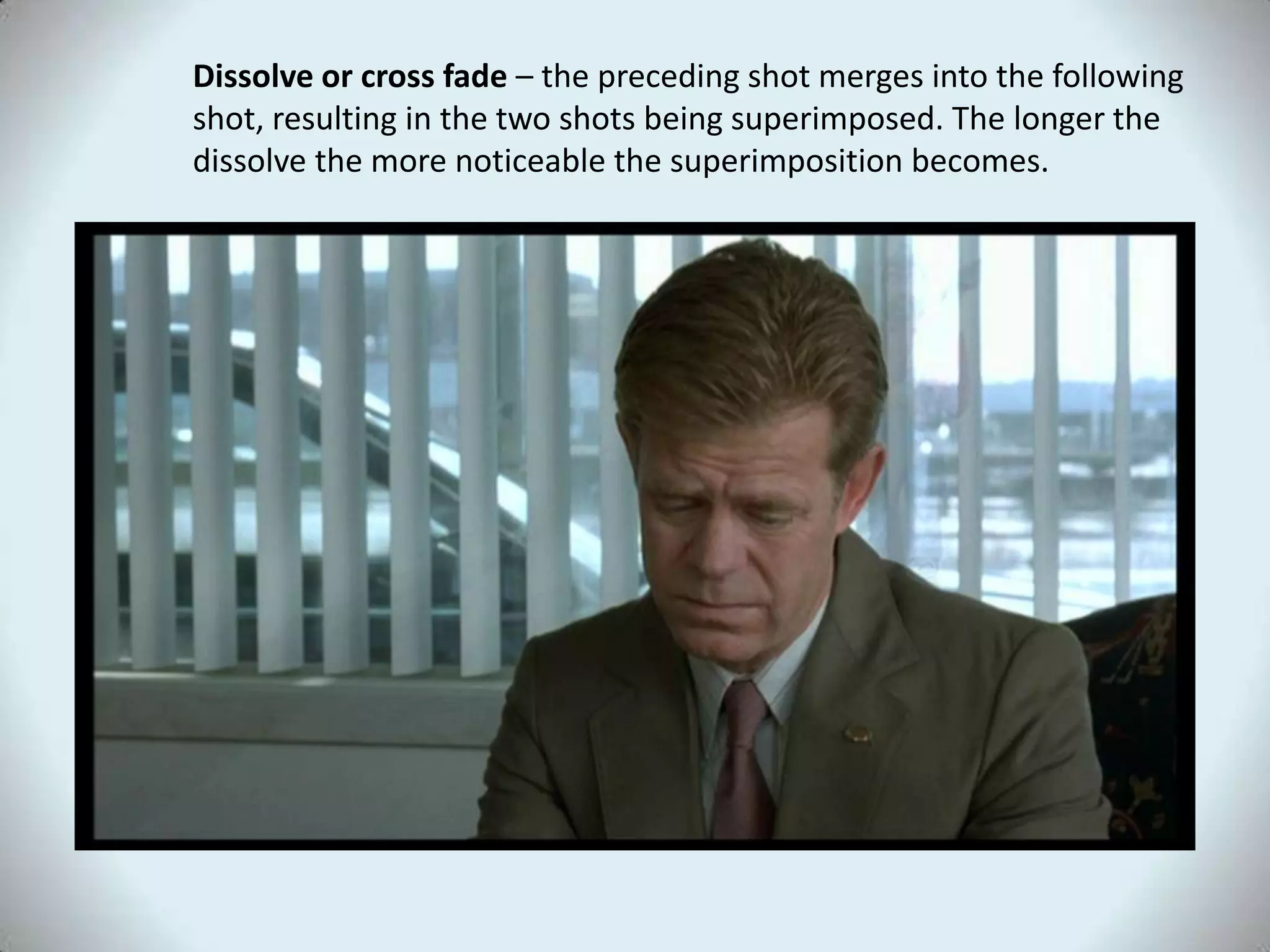
Dissolve or cross fade – the preceding shot merges into the following
shot, resulting in the two shots being superimposed. The longer the
dissolve the more noticeable the superimposition becomes.
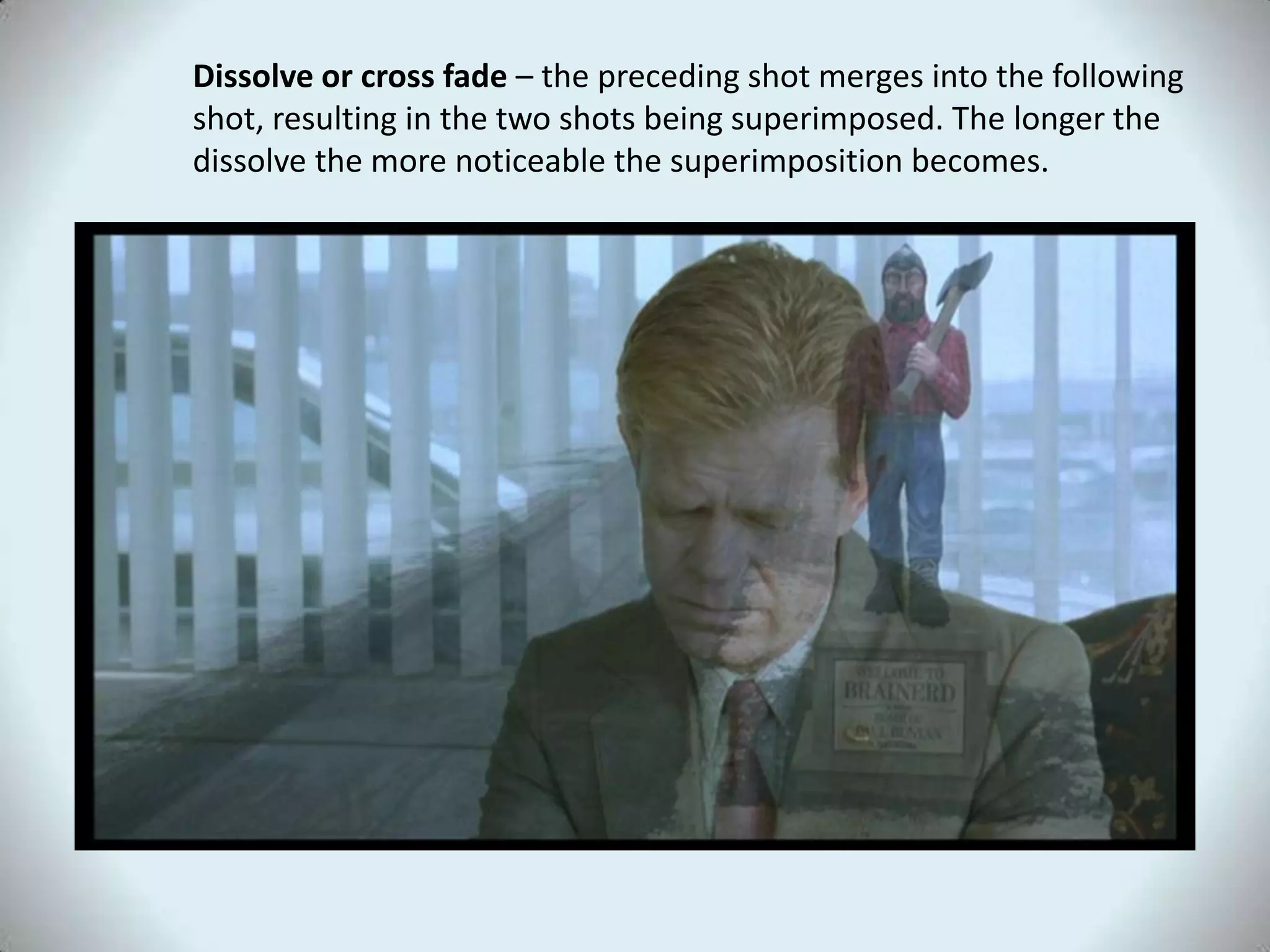
Dissolve or cross fade – the preceding shot merges into the following
shot, resulting in the two shots being superimposed. The longer the
dissolve the more noticeable the superimposition becomes.
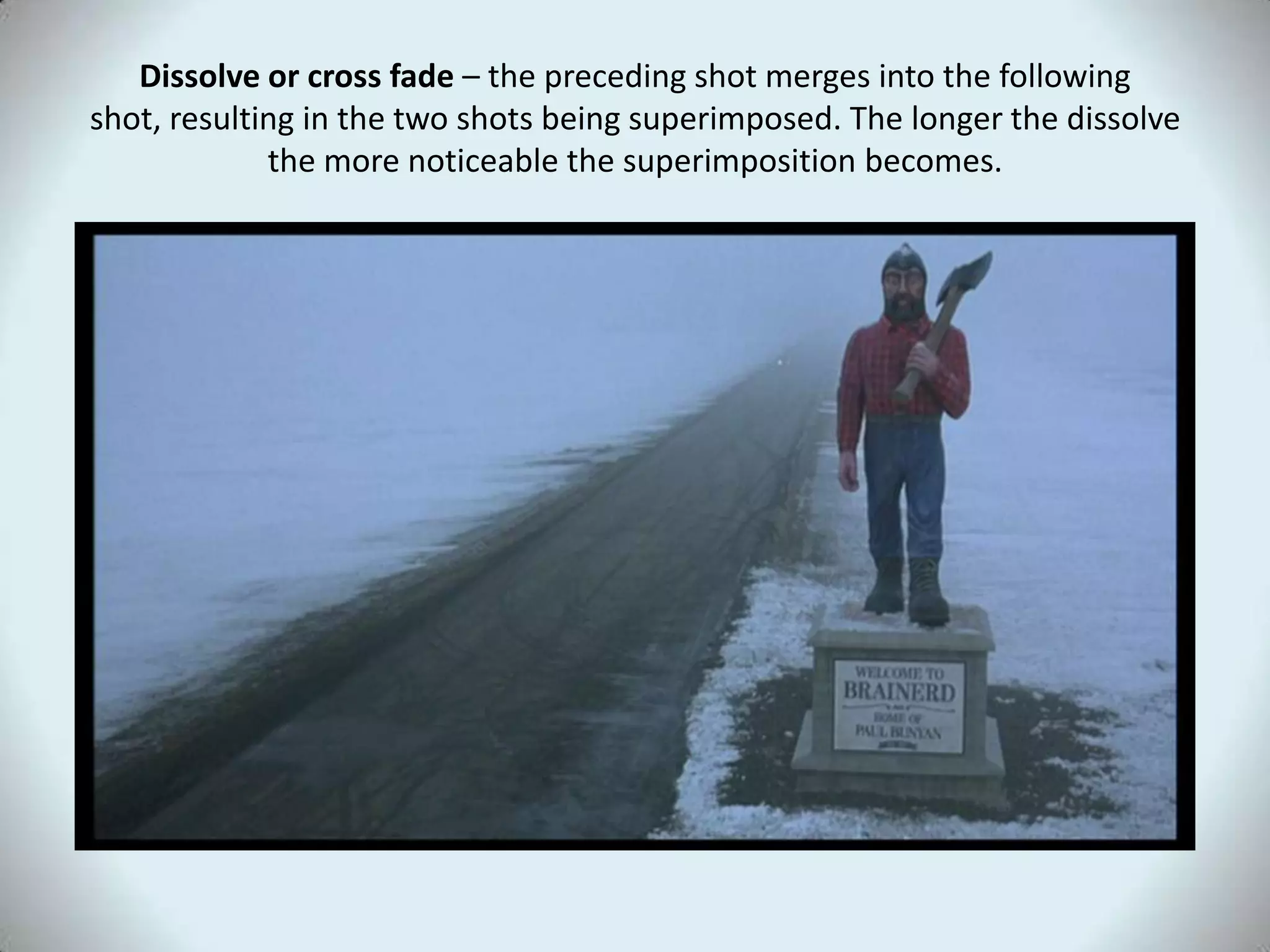
Dissolve or cross fade – the preceding shot merges into the following
shot, resulting in the two shots being superimposed. The longer the dissolve
             the more noticeable the superimposition becomes.
Shot duration/pace
• The duration of a shot will usually reflect the
  narrative context.

• Generally speaking short shot duration conveys
  action and urgency (say in a chase sequence). Click
  here for a chase sequence from Die Another Day. See
  if you can count the number of shots!

• Whilst long duration conveys intensity and intimacy
  within the narrative, it allows us to focus upon facial
  expression and other aspects of mise en scene which
  would otherwise be missed.
Some editing devices
•   Parallel editing - crosscutting or intercutting
    between different locations can convey the
    impression that two or more events are
    occurring simultaneously. This is often used
    to build tension.

•   split screen – where the frame is split into
    sections so that we can see different events
    occurring at the same time. This technique
    was used on the TV series 24.
Editing controls what information
    we get and when we get it
When analysing a clip consider how editing
techniques are used to control:
• What information is revealed to or hidden from
      a) the characters?
      b) the audience?
• As well as being used for dramatic effect, this
  control of information can tell you whose
  perspective is privileged - this is important when
  considering representation.

Editing Lesson 2013

  • 1.
  • 2.
    Editing Editing is largelyto do with organising time. It controls: • WHAT we look at, • in what ORDER we look at it, • and HOW LONG it is before we look at something else.
  • 3.
    Editing • In mostTV Dramas the main purpose of editing is to create CONTINUITY – a sense that the film makes LOGICAL SENSE in terms of immediate CAUSE and EFFECT and that it is CONSISTENT in the way it presents its world. • Through continuity, audiences can make sense of, and believe in, the narrative.
  • 4.
    What are welooking for when analysing editing in a clip? • Order of shots • Continuity/montage You need to be • Transitions able to discuss how these • Shot duration technical • Pace and rhythm elements help create meaning. • Special effects Many of these areas overlap, i.e. order of shots and continuity.
  • 5.
    Give a briefexplanation or examples for each area of editing: Order of shots Special Continuity/ effects montage Editing Transitions Pace and e.g…. rhythm Shot duration
  • 6.
    Order of shots •The meaning of a clip can change depending on the order the shots are cut together • Hitchcock Loves Bikinis http://www.youtube.com/watch?v=hCAE0t6KwJY&feature=PlayList&p=DC6A8F00C8251D2 5&index=3 • Putting two shots together can suggest a connection or emphasise contrast (juxtaposition). • Refer to handout for further editing functions relating to this, e.g. intercutting.
  • 7.
    Continuity Continuity editing • Cuttingshots to tell a story with narrative continuity, helping the viewer make sense of the action by implying spatial relationships and ensuring smooth flow from shot to shot. • Continuity techniques: • Establishing shot (establishes the space in which action is to happen) • The 180º rule (ensures that the same space is described in each shot) • Shot/reverse shot • Eyeline match (e.g. character looks off-screen, next shot shows us what they see) • Match on action (character begins to move in one shot, we see continuation of the same movement in the next shot) • Realism - edit is invisible so action appears real rather than constructed.
  • 8.
    Non-Continuity • Montage –giving information in compressed form – the shots that are cut together may not appear connected but can be suggestive of particular meanings/ideas overall. • Many of the title sequences we looked at during the coursework unit used a montage editing style). • In Non-continuity editing – Continuity is broken and construction is more apparent. Meaning often created through juxtaposition and metaphor shot inserts.
  • 9.
    Transitions • The processof cutting from one shot to another usually involves a simple straight cut. However there are other means of transition available to a film editor, e.g. • Fade to black • Dissolve/cross fade • Wipe • What meaning could be created by the use of the transitions above? • As well as simply moving to another shot, transitions can imply a passage of time or location, or emphasise a connection, perhaps what a character is thinking or dreaming about (dissolve/cross fade).
  • 10.
    Fade – thepreceding shot fades into black from which the following shot emerges.
  • 11.
    Fade – thepreceding shot fades into black from which the following shot emerges.
  • 12.
    Fade – thepreceding shot fades into black from which the following shot emerges.
  • 13.
    Dissolve or crossfade – the preceding shot merges into the following shot, resulting in the two shots being superimposed. The longer the dissolve the more noticeable the superimposition becomes.
  • 14.
    Dissolve or crossfade – the preceding shot merges into the following shot, resulting in the two shots being superimposed. The longer the dissolve the more noticeable the superimposition becomes.
  • 15.
    Dissolve or crossfade – the preceding shot merges into the following shot, resulting in the two shots being superimposed. The longer the dissolve the more noticeable the superimposition becomes.
  • 16.
    Shot duration/pace • Theduration of a shot will usually reflect the narrative context. • Generally speaking short shot duration conveys action and urgency (say in a chase sequence). Click here for a chase sequence from Die Another Day. See if you can count the number of shots! • Whilst long duration conveys intensity and intimacy within the narrative, it allows us to focus upon facial expression and other aspects of mise en scene which would otherwise be missed.
  • 17.
    Some editing devices • Parallel editing - crosscutting or intercutting between different locations can convey the impression that two or more events are occurring simultaneously. This is often used to build tension. • split screen – where the frame is split into sections so that we can see different events occurring at the same time. This technique was used on the TV series 24.
  • 18.
    Editing controls whatinformation we get and when we get it When analysing a clip consider how editing techniques are used to control: • What information is revealed to or hidden from a) the characters? b) the audience? • As well as being used for dramatic effect, this control of information can tell you whose perspective is privileged - this is important when considering representation.