Web 2.0
What is it?
What impact has it had?
Examples of Web 2.0 applications?
Make notes whilst watching each of the
following video clips:
David Gauntlett - Media and everyday life video
Xtra normal on David Gauntlett made by Reigate College students
Working with the people next to you, list 3 main points you can take
from Gauntlett’s video.
Wesch video - Web 2.0 ... The Machine is Us/ing Us
Working with the people next to you, sum up Wesch’s ideas in one
sentence.
Defining Web 2.0 – not easy!
‘Web 2.0 describes World Wide Web sites that emphasize user-generated
content, usability, and interoperability.’
‘Web 2.0 technologies facilitate participatory information sharing,
interoperability, user-centered design and collaboration on the World Wide
Web.’
A Web 2.0 site allows users to interact and collaborate with each other in a social
media dialogue as creators (prosumers) of user-generated content in a virtual
community, in contrast to websites where users (consumers) are limited to the
passive viewing of content that was created for them.
Examples of Web 2.0 include social networking sites, blogs, wikis, video sharing sites, hosted services, web
applications, mashups and folksonomies.’
(Wikipedia, 2012 & 2016)
See this link for a useful overview: http://www.techterms.com/definition/web20
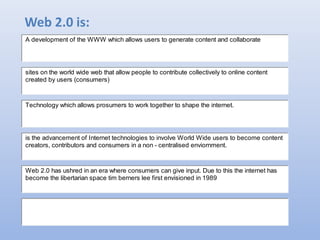
Web 2.0 is:
A development of the WWW which allows users to generate content and collaborate
Technology which allows prosumers to work together to shape the internet.
is the advancement of Internet technologies to involve World Wide users to become content
creators, contributors and consumers in a non - centralised enviornment.
Web 2.0 has ushred in an era where consumers can give input. Due to this the internet has
become the libertarian space tim berners lee first envisioned in 1989
sites on the world wide web that allow people to contribute collectively to online content
created by users (consumers)
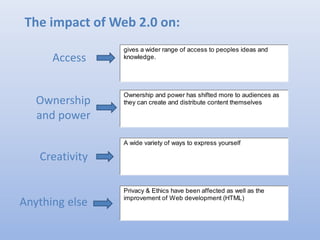
The impact of Web 2.0 on:
Access
Ownership
and power
Creativity
Anything else
Ownership and power has shifted more to audiences as
they can create and distribute content themselves
A wide variety of ways to express yourself
Privacy & Ethics have been affected as well as the
improvement of Web development (HTML)
gives a wider range of access to peoples ideas and
knowledge.

Web 2.0 2017 Class 4D

  • 1.
    Web 2.0 What isit? What impact has it had? Examples of Web 2.0 applications?
  • 2.
    Make notes whilstwatching each of the following video clips: David Gauntlett - Media and everyday life video Xtra normal on David Gauntlett made by Reigate College students Working with the people next to you, list 3 main points you can take from Gauntlett’s video. Wesch video - Web 2.0 ... The Machine is Us/ing Us Working with the people next to you, sum up Wesch’s ideas in one sentence.
  • 3.
    Defining Web 2.0– not easy! ‘Web 2.0 describes World Wide Web sites that emphasize user-generated content, usability, and interoperability.’ ‘Web 2.0 technologies facilitate participatory information sharing, interoperability, user-centered design and collaboration on the World Wide Web.’ A Web 2.0 site allows users to interact and collaborate with each other in a social media dialogue as creators (prosumers) of user-generated content in a virtual community, in contrast to websites where users (consumers) are limited to the passive viewing of content that was created for them. Examples of Web 2.0 include social networking sites, blogs, wikis, video sharing sites, hosted services, web applications, mashups and folksonomies.’ (Wikipedia, 2012 & 2016) See this link for a useful overview: http://www.techterms.com/definition/web20
  • 4.
    Web 2.0 is: Adevelopment of the WWW which allows users to generate content and collaborate Technology which allows prosumers to work together to shape the internet. is the advancement of Internet technologies to involve World Wide users to become content creators, contributors and consumers in a non - centralised enviornment. Web 2.0 has ushred in an era where consumers can give input. Due to this the internet has become the libertarian space tim berners lee first envisioned in 1989 sites on the world wide web that allow people to contribute collectively to online content created by users (consumers)
  • 5.
    The impact ofWeb 2.0 on: Access Ownership and power Creativity Anything else Ownership and power has shifted more to audiences as they can create and distribute content themselves A wide variety of ways to express yourself Privacy & Ethics have been affected as well as the improvement of Web development (HTML) gives a wider range of access to peoples ideas and knowledge.