Q1b Key Concepts
Audience
Audience – Who are they?
 Mass/Niche?


 Demographics – gender, age, nationality, income,
  etc.

 Values, attitudes, lifestyles?
Audience
– different theoretical approaches

 Effects Theory


 Reception Theory
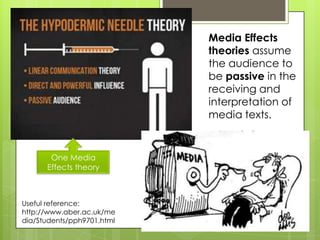
Media Effects
                            theories assume
                            the audience to
                            be passive in the
                            receiving and
                            interpretation of
                            media texts.


       One Media
      Effects theory


Useful reference:
http://www.aber.ac.uk/me
dia/Students/pph9701.html
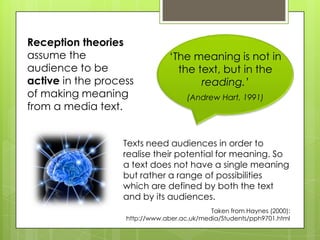
Reception theories
assume the                      ‘The meaning is not in
audience to be                    the text, but in the
active in the process                  reading.’
of making meaning                    (Andrew Hart, 1991)
from a media text.


                  Texts need audiences in order to
                  realise their potential for meaning. So
                  a text does not have a single meaning
                  but rather a range of possibilities
                  which are defined by both the text
                  and by its audiences.
                                            Taken from Haynes (2000):
                   http://www.aber.ac.uk/media/Students/pph9701.html
Audience – Reception Theory
So, Reception theory is audience centred thinking
about a media text.

It focuses on what an audience does with a media
text.

Stuart Hall’s work on the Encoding-Decoding Model
is most prominent in this field.
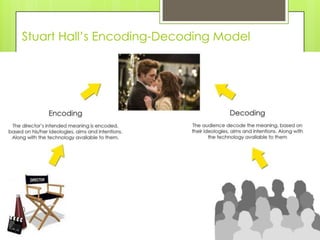
Stuart Hall’s Encoding-Decoding Model
The Encoding-Decoding Model explores the relationship
between media text and audience:
   producers encode a media text with an intended
    meaning

   audiences decode a media text and interpret its
    content in different ways, taking meanings from it that
    may or may not be in line with the intended meaning.

   Watch this 3 minute clip for an overview:
    http://youtu.be/LG1fAMiLv18
Stuart Hall’s Encoding-Decoding Model

Hall stated that audiences (depending on their own
knowledge, experience, values, attitudes and
beliefs) may respond differently to the same media
text and suggested that they can take the following
readings:
 Preferredreading

 Negotiatedreading

 Oppositional reading
Stuart Hall – Preferred Reading

 Some people may take a preferred reading and
  look at the representations as 'how it is' and/or
  something to emulate. They would not question
  the representations.

 Stuart Hall argues that this is the reading that the
  producers intend audiences to take.
Stuart Hall – negotiated reading
 Some people may take a negotiated               reading
   For example, they may recognise that a blockbuster film is
    made for commercial gain and offers a glamorous
    Hollywood version of the World and so does not accept the
    representations as reality, but perhaps still buys into them
    as unattainable cultural ideals that are pleasurable to
    consume for entertainment.
   Or, they may not associate the representations in the media
    text with their own attitudes and interests but could accept
    the representations as the dominant social view and go
    along to watch it anyway, especially if friends want to see it.
Stuart Hall – oppositional reading
   Some people may take an oppositional reading
    and completely reject the representations as they do
    not agree with the values they see embedded in the
    text.
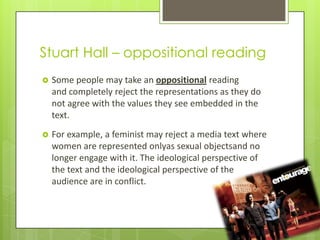
   For example, a feminist may reject a media text where
    women are represented onlyas sexual objectsand no
    longer engage with it. The ideological perspective of
    the text and the ideological perspective of the
    audience are in conflict.
What different interpretations and readings do you
think this TV Drama trailer might have got? Consider
different audiences:
 Skins Trailer
Apply to your product
Q: What is the intended/preferred meaning of your Trailer?

Q: Which audience is most likely to take a preferred reading and
why?
To help you answer this, consider how media language is used to
‘speak’ to a particular audience, how different audiences might
respond to signifiers of genre and narrative, and also, how audiences
might respond to how characters, places or subjects are represented.

Q: Who might take a negotiated reading of your trailer and why?

Q: Who might take an oppositional reading of your trailer and why?

In conclusion, how successful do you think your teaser trailer is in
enticing your target audience to want to watch the film?

Audience for Q1b 2013

  • 1.
  • 3.
    Audience – Whoare they?  Mass/Niche?  Demographics – gender, age, nationality, income, etc.  Values, attitudes, lifestyles?
  • 4.
    Audience – different theoreticalapproaches  Effects Theory  Reception Theory
  • 5.
    Media Effects theories assume the audience to be passive in the receiving and interpretation of media texts. One Media Effects theory Useful reference: http://www.aber.ac.uk/me dia/Students/pph9701.html
  • 6.
    Reception theories assume the ‘The meaning is not in audience to be the text, but in the active in the process reading.’ of making meaning (Andrew Hart, 1991) from a media text. Texts need audiences in order to realise their potential for meaning. So a text does not have a single meaning but rather a range of possibilities which are defined by both the text and by its audiences. Taken from Haynes (2000): http://www.aber.ac.uk/media/Students/pph9701.html
  • 7.
    Audience – ReceptionTheory So, Reception theory is audience centred thinking about a media text. It focuses on what an audience does with a media text. Stuart Hall’s work on the Encoding-Decoding Model is most prominent in this field.
  • 8.
  • 9.
    Stuart Hall’s Encoding-DecodingModel The Encoding-Decoding Model explores the relationship between media text and audience:  producers encode a media text with an intended meaning  audiences decode a media text and interpret its content in different ways, taking meanings from it that may or may not be in line with the intended meaning.  Watch this 3 minute clip for an overview: http://youtu.be/LG1fAMiLv18
  • 10.
    Stuart Hall’s Encoding-DecodingModel Hall stated that audiences (depending on their own knowledge, experience, values, attitudes and beliefs) may respond differently to the same media text and suggested that they can take the following readings:  Preferredreading  Negotiatedreading  Oppositional reading
  • 11.
    Stuart Hall –Preferred Reading  Some people may take a preferred reading and look at the representations as 'how it is' and/or something to emulate. They would not question the representations.  Stuart Hall argues that this is the reading that the producers intend audiences to take.
  • 12.
    Stuart Hall –negotiated reading  Some people may take a negotiated reading  For example, they may recognise that a blockbuster film is made for commercial gain and offers a glamorous Hollywood version of the World and so does not accept the representations as reality, but perhaps still buys into them as unattainable cultural ideals that are pleasurable to consume for entertainment.  Or, they may not associate the representations in the media text with their own attitudes and interests but could accept the representations as the dominant social view and go along to watch it anyway, especially if friends want to see it.
  • 13.
    Stuart Hall –oppositional reading  Some people may take an oppositional reading and completely reject the representations as they do not agree with the values they see embedded in the text.  For example, a feminist may reject a media text where women are represented onlyas sexual objectsand no longer engage with it. The ideological perspective of the text and the ideological perspective of the audience are in conflict.
  • 14.
    What different interpretationsand readings do you think this TV Drama trailer might have got? Consider different audiences:  Skins Trailer
  • 15.
    Apply to yourproduct Q: What is the intended/preferred meaning of your Trailer? Q: Which audience is most likely to take a preferred reading and why? To help you answer this, consider how media language is used to ‘speak’ to a particular audience, how different audiences might respond to signifiers of genre and narrative, and also, how audiences might respond to how characters, places or subjects are represented. Q: Who might take a negotiated reading of your trailer and why? Q: Who might take an oppositional reading of your trailer and why? In conclusion, how successful do you think your teaser trailer is in enticing your target audience to want to watch the film?