Editing Techniques
By Ben Warrington
What is editing?
Video editing is the process of manipulating and rearranging video
shots to create a new work. Editing is usually considered to be one
part of the post production process
The goals of editing
There are many reasons to edit a video and your editing approach will depend on the desired outcome. Before
you begin you must clearly define your editing goals, which could include any of the following:
Remove unwanted footage

This is the simplest and most common task in editing. Many videos can be dramatically improved by simply
getting rid of the flawed or unwanted bits.
Choose the best footage
It is common to shoot far more footage than you actually need and choose only the best material for the final
edit. Often you will shoot several versions (takes) of a shot and choose the best one when editing.
Create a flow
Most videos serve a purpose such as telling a story or providing information. Editing is a crucial step in making
sure the video flows in a way which achieves this goal.
Add effects, graphics, music, etc
This is often the "wow" part of editing. You can improve most videos (and have a lot of fun) by adding extra
elements.
Alter the style, pace or mood of the video
A good editor will be able to create subtle mood prompts in a video. Techniques such as mood music and visual
effects can influence how the audience will react.
Continuity editing
Continuity in editing just means that everything
flows in a consistent, orderly, smooth, sequential
manner. For example, in one frame of a movie, a
man might be wearing a red shirt. In the next
scene or frame, he should still be wearing the
same red shirt, not a blue or green one -indicating that the shot was maybe repeated the
next day and the wardrobe people forgot to have
the actor wear the same shirt.
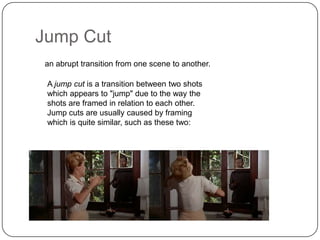
Jump Cut
an abrupt transition from one scene to another.
A jump cut is a transition between two shots
which appears to "jump" due to the way the
shots are framed in relation to each other.
Jump cuts are usually caused by framing
which is quite similar, such as these two:
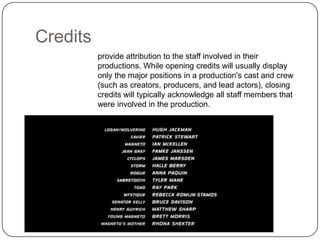
Credits
provide attribution to the staff involved in their
productions. While opening credits will usually display
only the major positions in a production's cast and crew
(such as creators, producers, and lead actors), closing
credits will typically acknowledge all staff members that
were involved in the production.
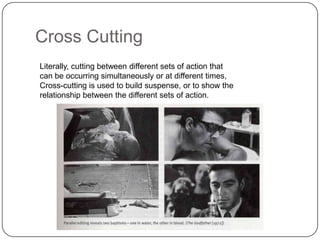
Cross Cutting
Literally, cutting between different sets of action that
can be occurring simultaneously or at different times,
Cross-cutting is used to build suspense, or to show the
relationship between the different sets of action.
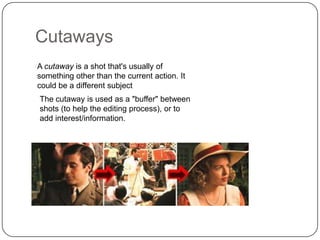
Cutaways
A cutaway is a shot that's usually of
something other than the current action. It
could be a different subject
The cutaway is used as a "buffer" between
shots (to help the editing process), or to
add interest/information.
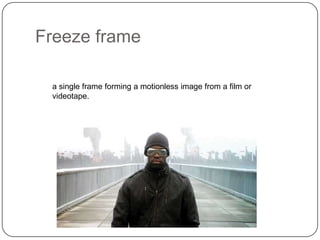
Freeze frame
a single frame forming a motionless image from a film or
videotape.
Eyeline match
An eyeline match is a film editing technique
associated with the continuity editing
system. It is based on the premise that the
audience will want to see what the
character on-screen is seeing
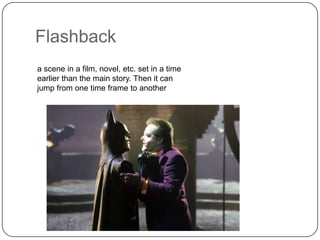
Flashback
a scene in a film, novel, etc. set in a time
earlier than the main story. Then it can
jump from one time frame to another
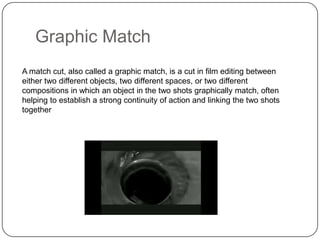
Graphic Match
A match cut, also called a graphic match, is a cut in film editing between
either two different objects, two different spaces, or two different
compositions in which an object in the two shots graphically match, often
helping to establish a strong continuity of action and linking the two shots
together
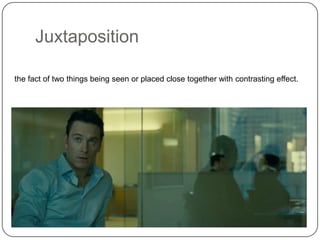
Juxtaposition
the fact of two things being seen or placed close together with contrasting effect.
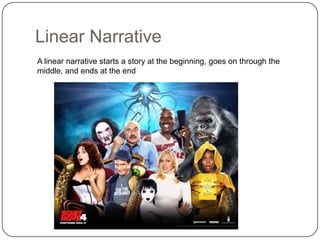
Linear Narrative
A linear narrative starts a story at the beginning, goes on through the
middle, and ends at the end
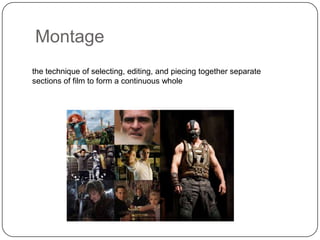
Montage
the technique of selecting, editing, and piecing together separate
sections of film to form a continuous whole
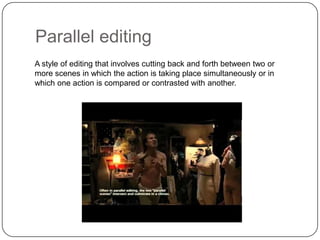
Parallel editing
A style of editing that involves cutting back and forth between two or
more scenes in which the action is taking place simultaneously or in
which one action is compared or contrasted with another.
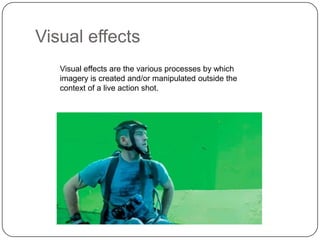
Visual effects
Visual effects are the various processes by which
imagery is created and/or manipulated outside the
context of a live action shot.
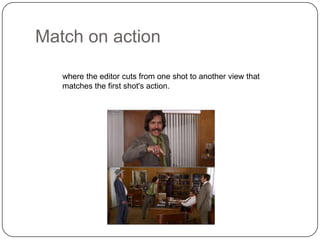
Match on action
where the editor cuts from one shot to another view that
matches the first shot's action.

Editing techniques

  • 1.
  • 2.
    What is editing? Videoediting is the process of manipulating and rearranging video shots to create a new work. Editing is usually considered to be one part of the post production process
  • 3.
    The goals ofediting There are many reasons to edit a video and your editing approach will depend on the desired outcome. Before you begin you must clearly define your editing goals, which could include any of the following: Remove unwanted footage This is the simplest and most common task in editing. Many videos can be dramatically improved by simply getting rid of the flawed or unwanted bits. Choose the best footage It is common to shoot far more footage than you actually need and choose only the best material for the final edit. Often you will shoot several versions (takes) of a shot and choose the best one when editing. Create a flow Most videos serve a purpose such as telling a story or providing information. Editing is a crucial step in making sure the video flows in a way which achieves this goal. Add effects, graphics, music, etc This is often the "wow" part of editing. You can improve most videos (and have a lot of fun) by adding extra elements. Alter the style, pace or mood of the video A good editor will be able to create subtle mood prompts in a video. Techniques such as mood music and visual effects can influence how the audience will react.
  • 4.
    Continuity editing Continuity inediting just means that everything flows in a consistent, orderly, smooth, sequential manner. For example, in one frame of a movie, a man might be wearing a red shirt. In the next scene or frame, he should still be wearing the same red shirt, not a blue or green one -indicating that the shot was maybe repeated the next day and the wardrobe people forgot to have the actor wear the same shirt.
  • 5.
    Jump Cut an abrupttransition from one scene to another. A jump cut is a transition between two shots which appears to "jump" due to the way the shots are framed in relation to each other. Jump cuts are usually caused by framing which is quite similar, such as these two:
  • 6.
    Credits provide attribution tothe staff involved in their productions. While opening credits will usually display only the major positions in a production's cast and crew (such as creators, producers, and lead actors), closing credits will typically acknowledge all staff members that were involved in the production.
  • 7.
    Cross Cutting Literally, cuttingbetween different sets of action that can be occurring simultaneously or at different times, Cross-cutting is used to build suspense, or to show the relationship between the different sets of action.
  • 8.
    Cutaways A cutaway isa shot that's usually of something other than the current action. It could be a different subject The cutaway is used as a "buffer" between shots (to help the editing process), or to add interest/information.
  • 9.
    Freeze frame a singleframe forming a motionless image from a film or videotape.
  • 10.
    Eyeline match An eyelinematch is a film editing technique associated with the continuity editing system. It is based on the premise that the audience will want to see what the character on-screen is seeing
  • 11.
    Flashback a scene ina film, novel, etc. set in a time earlier than the main story. Then it can jump from one time frame to another
  • 12.
    Graphic Match A matchcut, also called a graphic match, is a cut in film editing between either two different objects, two different spaces, or two different compositions in which an object in the two shots graphically match, often helping to establish a strong continuity of action and linking the two shots together
  • 13.
    Juxtaposition the fact oftwo things being seen or placed close together with contrasting effect.
  • 14.
    Linear Narrative A linearnarrative starts a story at the beginning, goes on through the middle, and ends at the end
  • 15.
    Montage the technique ofselecting, editing, and piecing together separate sections of film to form a continuous whole
  • 16.
    Parallel editing A styleof editing that involves cutting back and forth between two or more scenes in which the action is taking place simultaneously or in which one action is compared or contrasted with another.
  • 17.
    Visual effects Visual effectsare the various processes by which imagery is created and/or manipulated outside the context of a live action shot.
  • 18.
    Match on action wherethe editor cuts from one shot to another view that matches the first shot's action.