EDITING SYSTEMS:
 Continuity System: The Continuity Editing System is the most
common way of editing and is a part of the classical Hollywood
style of film. The editing is almost invisible to the audience which
makes for a seamless viewing of the film. It can be used to achieve a
number of effects such as shifting the audience’s attention to a
particular thing, imply emotion, cut between different events and
locations are to vary points of view.
 Non Continuity System: The Non Continuity System isn't used as
often as it's not a part of the Classical Hollywood Style of film. The
narrative is not the priority in the Non Continuity System which
can often confuse the audience.
CUTTING-Shot Reverse Shot:
 Once a 180 degree line has been established, we can
cut from one end to the other which allows us to see
both characters. This is often used in conversations as
we can see both characters to establish a relationship.
Eye Line Match:
 A cut which allows the audience to see what a certain
character was looking at that was previously off screen.
This allows the audience to find out extra information.
Graphic Match:
 Where two objects that are a similar shape
are dissolved into one another. This is used
to show a connection, similarity or
relationship between two objects.
 https://www.youtube.com/watch?v=sV56Ig
e8g14
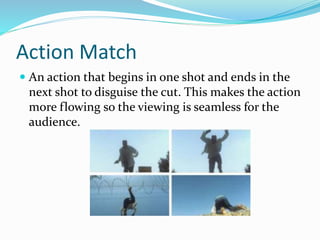
Action Match
 An action that begins in one shot and ends in the
next shot to disguise the cut. This makes the action
more flowing so the viewing is seamless for the
audience.
Jump Cut:
 A cut from one shot to the next with no attempt at
continuity which creates the appearance of a ‘jump’.
This is a part of the non continuity system.
 https://www.youtube.com/watch?v=1ov4mQJIHhc
Cross Cutting:
 When two events happening in separate locations are
cut together to give the appearance that they are
happening at the same time. This can show a
relationship between the two events.
 https://www.youtube.com/watch?v=KmptU7vEkNU
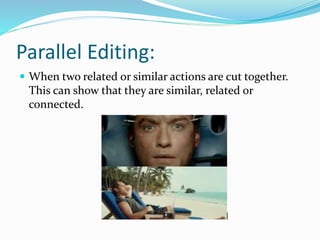
Parallel Editing:
 When two related or similar actions are cut together.
This can show that they are similar, related or
connected.
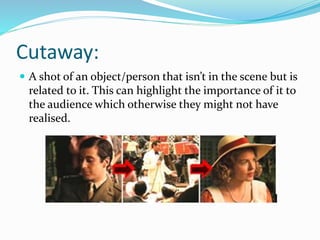
Cutaway:
 A shot of an object/person that isn’t in the scene but is
related to it. This can highlight the importance of it to
the audience which otherwise they might not have
realised.
Insert Shot:
 A shot of a small element within a scene that is used to
draw the audience’s attention to it to highlight it's
importance.
 https://www.youtube.com/watch?v=vsUxVJufiUI
DISSOLVE:
 Also known as Mix or Crossfade, the dissolve
transition is usually a more relaxed transition than a
simple cut. They are commonly used for scenery
sequences or photo montages, they can also convey a
sense of time passing or a change of location.
FADE IN/FADE OUT:
 Fade ins are when a solid colour is gradually
replaced by a picture and fade outs are the
opposite, when a picture is gradually
replaced by a solid colour or blank film.
Even though they are one of the most
popular transitions, they are used sparingly
in films/TV as they usually imply a
beginning or end to a major story segment.
WIPE:
 Wipes are when the new picture pushes the old picture
off the screen. The wipe transition is deliberately used
for dynamic effect.
SUPERIMPOSITION:
 Superimposition is when a picture is placed over the
top of another, but both are visible to the viewer.
Superimposition is used for dramatic effect and can
also let the audience know what a character is
thinking.
LONG TAKE/SHORT TAKE:
 A long take is an uninterrupted piece of film that lasts
longer than a usual shot would take. Long takes
usually last several minutes and are rarely used in
film/TV because they require none or very little
editing.
 A short take is the opposite to a long take, they are very
fast shots that last a lot shorter than a usual shot,
giving the viewer less time to establish what is
happening in the shot.
SLOW MOTION:
 Movements on the screen appearing slower than they
would in actual life. A filmmaker achieves slow motion
by running film through his camera at a speed faster
than the standard 24 frames per second; subsequent
projection at 24 frames per second slows down the
action. A shot shown in slow motion can make the
shot more dramatic and tense for the viewer.
 https://www.youtube.com/watch?v=WvKJ2gb9MJA
ELLIPSIS/EXPANSION OF TIME:
 Ellipsis is both a narrative device and the most basic idea in
film editing. Ellipsis concerns the omission of a section of
the story that is either obvious enough for the public to fill
in or concealed for a narrative purpose, such as suspense or
mystery.
 Expansion of time editing is when the time of a video is
manipulated into making the video sequence longer than it
originally was. This is usually used to make it easier for the
audience to see what is happening and is similar to slow
motion.
VISUAL EFFECTS:
 Visual effects are used to create scenes that seem/look
realistic to the audience when in reality they are
impossible to film in real life. The actual shots are
integrated with computer generated images to make
dangerous/expensive/impossible situations look real
to the viewer.
 https://www.youtube.com/watch?v=dyvwhhLXl60
QUIZ:
1. Where is shot reverse shot often used?
2. What is the effect of a graphic match?
3. Which film making system is a jump cut a part of?
4. What is cross cutting?
5. Why would you use an insert shot?
6. Why would you use visual effects?
7. What are dissolve transitions also known as?
8. Why would you use a superimposition?
9. How is slow motion achieved?
10. Why is ellipsis used in editing?

Editing media

  • 2.
    EDITING SYSTEMS:  ContinuitySystem: The Continuity Editing System is the most common way of editing and is a part of the classical Hollywood style of film. The editing is almost invisible to the audience which makes for a seamless viewing of the film. It can be used to achieve a number of effects such as shifting the audience’s attention to a particular thing, imply emotion, cut between different events and locations are to vary points of view.  Non Continuity System: The Non Continuity System isn't used as often as it's not a part of the Classical Hollywood Style of film. The narrative is not the priority in the Non Continuity System which can often confuse the audience.
  • 3.
    CUTTING-Shot Reverse Shot: Once a 180 degree line has been established, we can cut from one end to the other which allows us to see both characters. This is often used in conversations as we can see both characters to establish a relationship.
  • 4.
    Eye Line Match: A cut which allows the audience to see what a certain character was looking at that was previously off screen. This allows the audience to find out extra information.
  • 5.
    Graphic Match:  Wheretwo objects that are a similar shape are dissolved into one another. This is used to show a connection, similarity or relationship between two objects.  https://www.youtube.com/watch?v=sV56Ig e8g14
  • 6.
    Action Match  Anaction that begins in one shot and ends in the next shot to disguise the cut. This makes the action more flowing so the viewing is seamless for the audience.
  • 7.
    Jump Cut:  Acut from one shot to the next with no attempt at continuity which creates the appearance of a ‘jump’. This is a part of the non continuity system.  https://www.youtube.com/watch?v=1ov4mQJIHhc
  • 8.
    Cross Cutting:  Whentwo events happening in separate locations are cut together to give the appearance that they are happening at the same time. This can show a relationship between the two events.  https://www.youtube.com/watch?v=KmptU7vEkNU
  • 9.
    Parallel Editing:  Whentwo related or similar actions are cut together. This can show that they are similar, related or connected.
  • 10.
    Cutaway:  A shotof an object/person that isn’t in the scene but is related to it. This can highlight the importance of it to the audience which otherwise they might not have realised.
  • 11.
    Insert Shot:  Ashot of a small element within a scene that is used to draw the audience’s attention to it to highlight it's importance.  https://www.youtube.com/watch?v=vsUxVJufiUI
  • 12.
    DISSOLVE:  Also knownas Mix or Crossfade, the dissolve transition is usually a more relaxed transition than a simple cut. They are commonly used for scenery sequences or photo montages, they can also convey a sense of time passing or a change of location.
  • 13.
    FADE IN/FADE OUT: Fade ins are when a solid colour is gradually replaced by a picture and fade outs are the opposite, when a picture is gradually replaced by a solid colour or blank film. Even though they are one of the most popular transitions, they are used sparingly in films/TV as they usually imply a beginning or end to a major story segment.
  • 14.
    WIPE:  Wipes arewhen the new picture pushes the old picture off the screen. The wipe transition is deliberately used for dynamic effect.
  • 15.
    SUPERIMPOSITION:  Superimposition iswhen a picture is placed over the top of another, but both are visible to the viewer. Superimposition is used for dramatic effect and can also let the audience know what a character is thinking.
  • 16.
    LONG TAKE/SHORT TAKE: A long take is an uninterrupted piece of film that lasts longer than a usual shot would take. Long takes usually last several minutes and are rarely used in film/TV because they require none or very little editing.  A short take is the opposite to a long take, they are very fast shots that last a lot shorter than a usual shot, giving the viewer less time to establish what is happening in the shot.
  • 17.
    SLOW MOTION:  Movementson the screen appearing slower than they would in actual life. A filmmaker achieves slow motion by running film through his camera at a speed faster than the standard 24 frames per second; subsequent projection at 24 frames per second slows down the action. A shot shown in slow motion can make the shot more dramatic and tense for the viewer.  https://www.youtube.com/watch?v=WvKJ2gb9MJA
  • 18.
    ELLIPSIS/EXPANSION OF TIME: Ellipsis is both a narrative device and the most basic idea in film editing. Ellipsis concerns the omission of a section of the story that is either obvious enough for the public to fill in or concealed for a narrative purpose, such as suspense or mystery.  Expansion of time editing is when the time of a video is manipulated into making the video sequence longer than it originally was. This is usually used to make it easier for the audience to see what is happening and is similar to slow motion.
  • 19.
    VISUAL EFFECTS:  Visualeffects are used to create scenes that seem/look realistic to the audience when in reality they are impossible to film in real life. The actual shots are integrated with computer generated images to make dangerous/expensive/impossible situations look real to the viewer.  https://www.youtube.com/watch?v=dyvwhhLXl60
  • 20.
    QUIZ: 1. Where isshot reverse shot often used? 2. What is the effect of a graphic match? 3. Which film making system is a jump cut a part of? 4. What is cross cutting? 5. Why would you use an insert shot? 6. Why would you use visual effects? 7. What are dissolve transitions also known as? 8. Why would you use a superimposition? 9. How is slow motion achieved? 10. Why is ellipsis used in editing?