AS Media Studies
   Unit G322
Lesson Objectives
• All students to be able to explain diegetic and non-
  diegetic sound with examples.

• All students to be able to analyse how elements of sound
  create meaning for the audience in a short TV Drama clip.

• Many students will be able to use a wider range of sound
  terminology to discuss how sound is used in combination
  with other technical elements to create meaning for the
  audience.
                                               …and
                                   some students will be able
                                   to evaluate how the use of
                                      sound helps construct
                                   particular representations i
                                     n a short TV Drama clip.
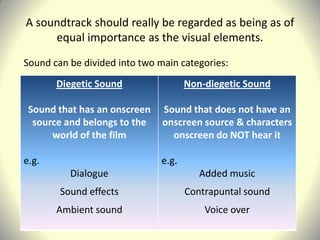
A soundtrack should really be regarded as being as of
     equal importance as the visual elements.
Sound can be divided into two main categories:
       Diegetic Sound                Non-diegetic Sound

 Sound that has an onscreen    Sound that does not have an
  source and belongs to the    onscreen source & characters
      world of the film          onscreen do NOT hear it

e.g.                          e.g.
          Dialogue                      Added music
        Sound effects                Contrapuntal sound
       Ambient sound                     Voice over
KEY SOUND TERMINOLOGY
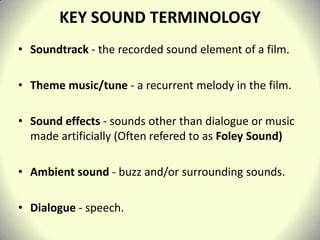
• Soundtrack - the recorded sound element of a film.

• Theme music/tune - a recurrent melody in the film.

• Sound effects - sounds other than dialogue or music
  made artificially (Often refered to as Foley Sound)

• Ambient sound - buzz and/or surrounding sounds.

• Dialogue - speech.
KEY SOUND TERMINOLOGY
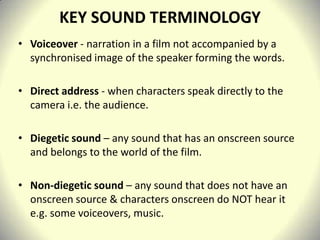
• Voiceover - narration in a film not accompanied by a
  synchronised image of the speaker forming the words.

• Direct address - when characters speak directly to the
  camera i.e. the audience.

• Diegetic sound – any sound that has an onscreen source
  and belongs to the world of the film.

• Non-diegetic sound – any sound that does not have an
  onscreen source & characters onscreen do NOT hear it
  e.g. some voiceovers, music.
KEY SOUND TERMINOLOGY
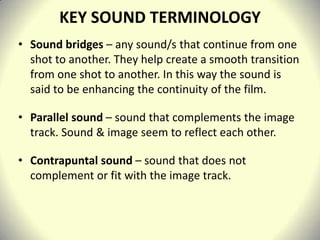
• Sound bridges – any sound/s that continue from one
  shot to another. They help create a smooth transition
  from one shot to another. In this way the sound is
  said to be enhancing the continuity of the film.

• Parallel sound – sound that complements the image
  track. Sound & image seem to reflect each other.

• Contrapuntal sound – sound that does not
  complement or fit with the image track.
Listen to the following sound clips.
      What do they make you think about? What
       mood/feelings do you attach to them?


• Sound clip 1

• Sound clip 2

• Sound clip 3

Does the meaning you attach to the first clips change now you have heard all 3?
Understanding how music can help
          create “meaning”
• Enhance the audience's emotional experience /
  providing emotional focus.

• Underlining psychological refinements - the unspoken
  thoughts of a character, or the unseen implications of a
  situation.

• Building a sense of continuity (moving in, out and
  Bridging scenes).

• Underpinning the theatrical build-up of a scene and
  rounding it off with a sense of finality.
Understanding how music can help
          create “meaning”
• Character representation / identification (e.g. good Vs evil
  in Star Wars, CSI Miami clip)

• Setting the location, e.g.

• Setting the period

• Paralleling the action

• Creating a more convincing atmosphere of space and time

• Serving as a kind of neutral background filler
Analyse the use of sound in CSI Miami
• Link to clip (watch first 2mins 40s):
  http://estream.reigate.ac.uk/view.aspx?id=2148~4p~QczvuqJw&chapID=10935

• Watch the CSI clip and make notes on the different
  elements of sound you can identify.

• In pairs, compare the notes you have made and consider
  the meanings created by them.
• Using your notes, write a paragraph summarising how
  sound helps create meaning in the clip. (8 mins)

• Stretch & Challenge: Consider how the use of sound helps
  construct particular representations of age or class & status
  in the clip.
Soundtrack Activity
Create a soundtrack for your new character.

Include:
• Both Diegetic and Non-diegetic sound
• Ambient sound
• Foley sound effects
• Theme music

Sound Lesson 2013

  • 1.
  • 2.
    Lesson Objectives • Allstudents to be able to explain diegetic and non- diegetic sound with examples. • All students to be able to analyse how elements of sound create meaning for the audience in a short TV Drama clip. • Many students will be able to use a wider range of sound terminology to discuss how sound is used in combination with other technical elements to create meaning for the audience. …and some students will be able to evaluate how the use of sound helps construct particular representations i n a short TV Drama clip.
  • 3.
    A soundtrack shouldreally be regarded as being as of equal importance as the visual elements. Sound can be divided into two main categories: Diegetic Sound Non-diegetic Sound Sound that has an onscreen Sound that does not have an source and belongs to the onscreen source & characters world of the film onscreen do NOT hear it e.g. e.g. Dialogue Added music Sound effects Contrapuntal sound Ambient sound Voice over
  • 4.
    KEY SOUND TERMINOLOGY •Soundtrack - the recorded sound element of a film. • Theme music/tune - a recurrent melody in the film. • Sound effects - sounds other than dialogue or music made artificially (Often refered to as Foley Sound) • Ambient sound - buzz and/or surrounding sounds. • Dialogue - speech.
  • 5.
    KEY SOUND TERMINOLOGY •Voiceover - narration in a film not accompanied by a synchronised image of the speaker forming the words. • Direct address - when characters speak directly to the camera i.e. the audience. • Diegetic sound – any sound that has an onscreen source and belongs to the world of the film. • Non-diegetic sound – any sound that does not have an onscreen source & characters onscreen do NOT hear it e.g. some voiceovers, music.
  • 6.
    KEY SOUND TERMINOLOGY •Sound bridges – any sound/s that continue from one shot to another. They help create a smooth transition from one shot to another. In this way the sound is said to be enhancing the continuity of the film. • Parallel sound – sound that complements the image track. Sound & image seem to reflect each other. • Contrapuntal sound – sound that does not complement or fit with the image track.
  • 7.
    Listen to thefollowing sound clips. What do they make you think about? What mood/feelings do you attach to them? • Sound clip 1 • Sound clip 2 • Sound clip 3 Does the meaning you attach to the first clips change now you have heard all 3?
  • 8.
    Understanding how musiccan help create “meaning” • Enhance the audience's emotional experience / providing emotional focus. • Underlining psychological refinements - the unspoken thoughts of a character, or the unseen implications of a situation. • Building a sense of continuity (moving in, out and Bridging scenes). • Underpinning the theatrical build-up of a scene and rounding it off with a sense of finality.
  • 9.
    Understanding how musiccan help create “meaning” • Character representation / identification (e.g. good Vs evil in Star Wars, CSI Miami clip) • Setting the location, e.g. • Setting the period • Paralleling the action • Creating a more convincing atmosphere of space and time • Serving as a kind of neutral background filler
  • 10.
    Analyse the useof sound in CSI Miami • Link to clip (watch first 2mins 40s): http://estream.reigate.ac.uk/view.aspx?id=2148~4p~QczvuqJw&chapID=10935 • Watch the CSI clip and make notes on the different elements of sound you can identify. • In pairs, compare the notes you have made and consider the meanings created by them. • Using your notes, write a paragraph summarising how sound helps create meaning in the clip. (8 mins) • Stretch & Challenge: Consider how the use of sound helps construct particular representations of age or class & status in the clip.
  • 11.
    Soundtrack Activity Create asoundtrack for your new character. Include: • Both Diegetic and Non-diegetic sound • Ambient sound • Foley sound effects • Theme music