ECOSYSTEM
Structure: Biotic and abiotic components,
Food chain, Food Web,
Ecological Pyramids,
Energy Flow,
Biogeochemical Cycles –Nitrogen and Phosphorus
By
Dr.. R. D. Madhekar
Assistant professor,
Department of Botany,
S. B. E. S. College of Science,
Aurangabad.
Key Concept of Ecosystem
The term first coined by A.G.Tansely. (1935)
Eco: Environment System: Interaction
Communities within given area interact among themselves and with
the surrounding physical environmental, so that flow of energy
leads to clearly defined trophic structure, biotic diversity and
material cycle.
Biosphere- Vast Ecosystem, Difficult to handle. Artificial subdivisions
Grassland Ecosystem Forest Ecosystem Ocean Ecosystem
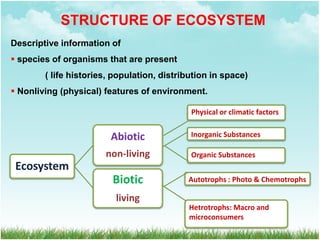
STRUCTURE OF ECOSYSTEM
Descriptive information of
 species of organisms that are present
( life histories, population, distribution in space)
 Nonliving (physical) features of environment.
Ecosystem
Abiotic
non-living
Biotic
living
Physical or climatic factors
Inorganic Substances
Organic Substances
Autotrophs : Photo & Chemotrophs
Hetrotrophs: Macro and
microconsumers
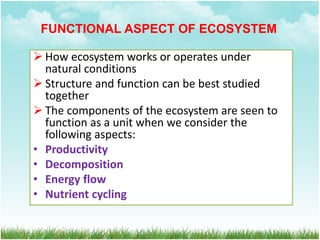
FUNCTIONAL ASPECT OF ECOSYSTEM
 How ecosystem works or operates under
natural conditions
 Structure and function can be best studied
together
 The components of the ecosystem are seen to
function as a unit when we consider the
following aspects:
• Productivity
• Decomposition
• Energy flow
• Nutrient cycling
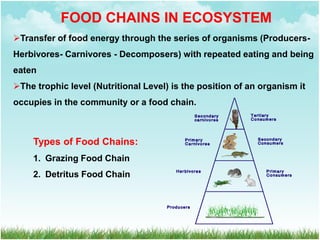
FOOD CHAINS IN ECOSYSTEM
Transfer of food energy through the series of organisms (Producers-
Herbivores- Carnivores - Decomposers) with repeated eating and being
eaten
The trophic level (Nutritional Level) is the position of an organism it
occupies in the community or a food chain.
Types of Food Chains:
1. Grazing Food Chain
2. Detritus Food Chain
(i) Grazing Food Chain
 Starts from living green plants goes to grazing
herbivores and on to carnivores.
 Directly depends on influx of solar radiation
 Depends upon autotrophic energy capture and
transfer of this captured energy to herbivores.
From energy point of view , very important.
 Most of the ecosystem in nature follows this type of
food chain.
Ex: grass => grasshopper => birds => falcon
Grazing Food
Chain
(ii) Detritus food chain
 This type of food chain starts from dead organic matter of
decaying animals and plant bodies to the micro-organisms and
then to detritus feeding organism and to other predators. Thus less
dependent on direct solar energy.
The food chain depends mainly on the influx of organic matter
produced in another system.
The organism of the food chain includes algae, bacteria,
fungi, protozoa, insects, nematodes etc.
 Detritus food chain ends up in manner similar to
grazing food chain but the way in which the two chain
begins is quite different
 Detritus food chain is simply a subcomponent of
another ecosystem
 Two types of food chains in nature indeed linked
together belonging to same ecosystem
Significance of Food Chain
 The knowledge of food chain helps in understanding
the feeding relationship as well as the interaction
between organism and ecosystem.
 It also help in understanding the mechanism of energy
flow and circulation of matter in ecosystem.
 It also helps to understand the movement of toxic
substance and the problem associated with biological
magnification in the ecosystem.
What is food web?
Food web can be defined as, "a network of food
chains which are interconnected at various tropic
levels, so as to form a number of feeding connections
amongst different organisms of a biotic
community".
It is also known as consumer-resource system or
interlocking pattern of organisms.
Important facts
•A node represents an individual species, or a group of related
species or different stages of a single species.
• A link connects two nodes. Arrows represent links, and
always go from prey to predator.
• The lowest tropic level are called basal species.
• The highest tropic level are called top predators.
•Movement of nutrients is cyclic but of energy is
unidirectional and non-cyclic.
Types of food web representation
• These food webs simply indicate a
feeding relationship.
TOPOLOGICAL
WEBS
• Bio-energetic webs, or flow webs,
include information on the strength of
the feeding interaction.
FLOW WEBS
• In interaction the arrows show how
one group influences another.
INTERACTION
WEB
Different food webs
• Soil food web
• Aquatic food web
• Food web in forest
• Food web of grassland
• Food web in terrestrial and aquatic ecosystem
Food web in
forest
Grassland Food
Web
Aquatic food web
s
Significance of Food Web
•Food webs distinguish levels of producers and consumers by
identifying and defining the importance of animal relationships
and food sources, beginning with primary producers such as
plants, insects and herbivores.
•Food webs are important tools in understanding that plants are
the foundation of all ecosystems and food chains, sustaining life
by providing nourishment and oxygen needed for survival and
reproduction.
•The food web provide stability to the ecosystem.
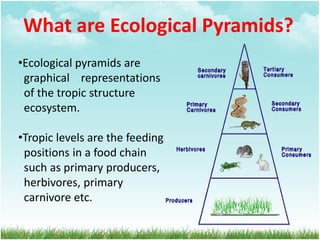
What are Ecological Pyramids?
•Ecological pyramids are
graphical representations
of the tropic structure
ecosystem.
•Tropic levels are the feeding
positions in a food chain
such as primary producers,
herbivores, primary
carnivore etc.
Ecological
Pyramids
Pyramid of
Number
Pyramid of
Biomass
Pyramid of
Energy
Types of Ecological Pyramid
Three types of ecological pyramids can usually be
distinguished
Pyramid of Numbers
•It is the graphic representation of number of
individuals per unit area of various tropic levels.
Evaluating pyramid of numbers
ADVANTAGES DISADVANTAGES
Simple method of
giving an overview
Number of specific
species may be too great
to measure accurately
Good for comparing
changes to the ecosystem
at different times
Does not take into
account “juveniles” or
immature forms
All organisms are included
regardless of size
Pyramid of Biomass
It is the graphical representation of biomass present
per unit area at different tropic levels, with producers
at the base and carnivores at the top.
 Biomass is calculated as:
mass of each individual X no. of individual at tropic
levels
 Shows quantitative relationship of standing crop i. e.
amount of living material in trophic level.
Evaluating pyramid of Biomass
ADVANTAGES DISADVANTAGES
Overcomes the problems
of pyramids of number
Only uses samples for
population so difficult to
measure biomass exactly
Time of year influences
result
Organisms of same size
do not necessarily have
the same energy content
Pyramid of Energy
• Graphical representation of the flow of energy
through each tropic level of a food chain over a
fixed time period.
•Pyramid of
Productivity
Evaluating pyramid of Energy
ADVANTAGES DISADVANTAGES
No inverted pyramids are
obtained
It is difficult and cumbersome
to collect energy data
Shows actual energy
transfer
Problem occurs in assigning
a species to a specific tropic
level
Can be compared different
ecosystems based on
relative energy transfer
Energy flow in different Trophic Levels
What are biogeochemical cycles?
• Earth system has four parts
– Atmosphere
– Hydrosphere
– Lithosphere
– Biosphere
• Biogeochemical cycles: The chemical
interactions (cycles) that exist between the
atmosphere, hydrosphere, lithosphere, and
biosphere.
• Abiotic (physio-chemical) and biotic
processes drive these cycles.
• All matter cycles...it is neither created nor destroyed...
• As the Earth is essentially a closed system with respect
to matter, we can say that all matter on Earth cycles .
NITROGEN CYCLE
Nitrogen (N) is an essential component of DNA, RNA, and
amino acids.
All organisms require nitrogen to live and grow.
Majority of the air we breath is N2. (78%)
Most of the nitrogen in the atmosphere is unavailable for use
by organisms.
In order for plants and animals to be able to use nitrogen,
N2 gas must first be converted to more a chemically available
form.
Natural cyclic process in the course of which atmospheric
nitrogen enters the soil and becomes part of living organisms
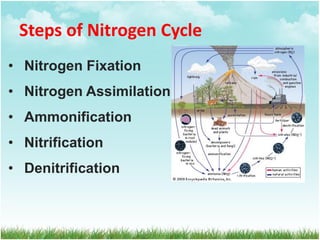
Steps of Nitrogen Cycle
• Nitrogen Fixation
• Nitrogen Assimilation
• Ammonification
• Nitrification
• Denitrification
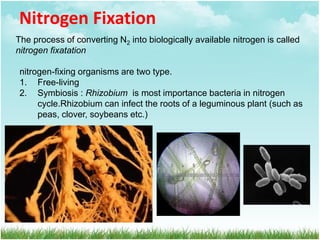
Nitrogen Fixation
The process of converting N2 into biologically available nitrogen is called
nitrogen fixatation
nitrogen-fixing organisms are two type.
1. Free-living
2. Symbiosis : Rhizobium is most importance bacteria in nitrogen
cycle.Rhizobium can infect the roots of a leguminous plant (such as
peas, clover, soybeans etc.)
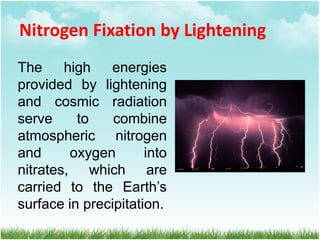
Nitrogen Fixation by Lightening
The high energies
provided by lightening
and cosmic radiation
serve to combine
atmospheric nitrogen
and oxygen into
nitrates, which are
carried to the Earth’s
surface in precipitation.
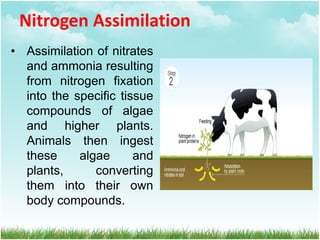
Nitrogen Assimilation
• Assimilation of nitrates
and ammonia resulting
from nitrogen fixation
into the specific tissue
compounds of algae
and higher plants.
Animals then ingest
these algae and
plants, converting
them into their own
body compounds.
Ammonification
• When an organism excretes
waste or dies, the nitrogen in
its tissues is in the form of
organic nitrogen (e.g. amino
acids, DNA). Various fungi
and prokaryotes then
decompose the tissue and
release inorganic nitrogen
back into the ecosystem as
ammonia in the process
known as ammonification.
The ammonia then becomes
available for uptake by plants
and other microorganisms for
growth.
Nitrification
• Nitrification is the process
that converts ammonia to
nitrite and then to nitrate.
• There are two distinct
steps of nitrification.
• The first step is the
oxidation of ammonia to
nitrite.
• ammonia oxidation carried out by only a few types of bacteria in
the genera Nitrosomonas, Nitrosospira, and Nitrococcus.
• The second step is the oxidation of nitrite (NO2
-) to nitrate (NO3
-)
carried out by bacteria such as a Nitrobacter.
Denitrification
• Denitrification is the
process that converts
nitrate to nitrogen gas.
• Some denitrifying bacteria include species in the genera
Bacillus, Paracoccus, and Pseudomonas.
• Denitrification is important in that it removes fixed nitrogen
from the ecosystem.
Nitrogen in air
Nitrogen fixatation
By
Rhizobium and Aztobactor
Nitrification
By
Nitrosomonas
NO2
- and NO3
-
Denitrification
by
Bacillus
Nitrogen
ammonification
Phosphorus is found in the components of an ecosystem.
It is an essential nutrient for plants and animals.
Phosphorus occurs in the plasma membranes of plants
and animal cells. It is an important component of the teeth
and the bones of the animals. It is a part of DNA-molecules
and RNA-molecules, molecules that store energy (ATP and
ADP)
In the non-living components of ecosystems phosphorus
occurs as minerals in rocks and as dissolved phosphate in
soils and rivers.
In contrast the carbon and nitrogen the phosphorus cycle
does not include cycling through the atmosphere in the
form of gas.
Diagrammatic Representation

Ecosystem

  • 1.
    ECOSYSTEM Structure: Biotic andabiotic components, Food chain, Food Web, Ecological Pyramids, Energy Flow, Biogeochemical Cycles –Nitrogen and Phosphorus By Dr.. R. D. Madhekar Assistant professor, Department of Botany, S. B. E. S. College of Science, Aurangabad.
  • 2.
    Key Concept ofEcosystem The term first coined by A.G.Tansely. (1935) Eco: Environment System: Interaction Communities within given area interact among themselves and with the surrounding physical environmental, so that flow of energy leads to clearly defined trophic structure, biotic diversity and material cycle. Biosphere- Vast Ecosystem, Difficult to handle. Artificial subdivisions Grassland Ecosystem Forest Ecosystem Ocean Ecosystem
  • 3.
    STRUCTURE OF ECOSYSTEM Descriptiveinformation of  species of organisms that are present ( life histories, population, distribution in space)  Nonliving (physical) features of environment. Ecosystem Abiotic non-living Biotic living Physical or climatic factors Inorganic Substances Organic Substances Autotrophs : Photo & Chemotrophs Hetrotrophs: Macro and microconsumers
  • 4.
    FUNCTIONAL ASPECT OFECOSYSTEM  How ecosystem works or operates under natural conditions  Structure and function can be best studied together  The components of the ecosystem are seen to function as a unit when we consider the following aspects: • Productivity • Decomposition • Energy flow • Nutrient cycling
  • 5.
    FOOD CHAINS INECOSYSTEM Transfer of food energy through the series of organisms (Producers- Herbivores- Carnivores - Decomposers) with repeated eating and being eaten The trophic level (Nutritional Level) is the position of an organism it occupies in the community or a food chain. Types of Food Chains: 1. Grazing Food Chain 2. Detritus Food Chain
  • 6.
    (i) Grazing FoodChain  Starts from living green plants goes to grazing herbivores and on to carnivores.  Directly depends on influx of solar radiation  Depends upon autotrophic energy capture and transfer of this captured energy to herbivores. From energy point of view , very important.  Most of the ecosystem in nature follows this type of food chain. Ex: grass => grasshopper => birds => falcon
  • 7.
  • 8.
    (ii) Detritus foodchain  This type of food chain starts from dead organic matter of decaying animals and plant bodies to the micro-organisms and then to detritus feeding organism and to other predators. Thus less dependent on direct solar energy. The food chain depends mainly on the influx of organic matter produced in another system. The organism of the food chain includes algae, bacteria, fungi, protozoa, insects, nematodes etc.
  • 9.
     Detritus foodchain ends up in manner similar to grazing food chain but the way in which the two chain begins is quite different  Detritus food chain is simply a subcomponent of another ecosystem  Two types of food chains in nature indeed linked together belonging to same ecosystem
  • 10.
    Significance of FoodChain  The knowledge of food chain helps in understanding the feeding relationship as well as the interaction between organism and ecosystem.  It also help in understanding the mechanism of energy flow and circulation of matter in ecosystem.  It also helps to understand the movement of toxic substance and the problem associated with biological magnification in the ecosystem.
  • 12.
    What is foodweb? Food web can be defined as, "a network of food chains which are interconnected at various tropic levels, so as to form a number of feeding connections amongst different organisms of a biotic community". It is also known as consumer-resource system or interlocking pattern of organisms.
  • 13.
    Important facts •A noderepresents an individual species, or a group of related species or different stages of a single species. • A link connects two nodes. Arrows represent links, and always go from prey to predator. • The lowest tropic level are called basal species. • The highest tropic level are called top predators. •Movement of nutrients is cyclic but of energy is unidirectional and non-cyclic.
  • 14.
    Types of foodweb representation • These food webs simply indicate a feeding relationship. TOPOLOGICAL WEBS • Bio-energetic webs, or flow webs, include information on the strength of the feeding interaction. FLOW WEBS • In interaction the arrows show how one group influences another. INTERACTION WEB
  • 15.
    Different food webs •Soil food web • Aquatic food web • Food web in forest • Food web of grassland • Food web in terrestrial and aquatic ecosystem
  • 16.
  • 17.
  • 18.
  • 19.
    s Significance of FoodWeb •Food webs distinguish levels of producers and consumers by identifying and defining the importance of animal relationships and food sources, beginning with primary producers such as plants, insects and herbivores. •Food webs are important tools in understanding that plants are the foundation of all ecosystems and food chains, sustaining life by providing nourishment and oxygen needed for survival and reproduction. •The food web provide stability to the ecosystem.
  • 21.
    What are EcologicalPyramids? •Ecological pyramids are graphical representations of the tropic structure ecosystem. •Tropic levels are the feeding positions in a food chain such as primary producers, herbivores, primary carnivore etc.
  • 22.
    Ecological Pyramids Pyramid of Number Pyramid of Biomass Pyramidof Energy Types of Ecological Pyramid Three types of ecological pyramids can usually be distinguished
  • 23.
    Pyramid of Numbers •Itis the graphic representation of number of individuals per unit area of various tropic levels.
  • 24.
    Evaluating pyramid ofnumbers ADVANTAGES DISADVANTAGES Simple method of giving an overview Number of specific species may be too great to measure accurately Good for comparing changes to the ecosystem at different times Does not take into account “juveniles” or immature forms All organisms are included regardless of size
  • 25.
    Pyramid of Biomass Itis the graphical representation of biomass present per unit area at different tropic levels, with producers at the base and carnivores at the top.  Biomass is calculated as: mass of each individual X no. of individual at tropic levels  Shows quantitative relationship of standing crop i. e. amount of living material in trophic level.
  • 27.
    Evaluating pyramid ofBiomass ADVANTAGES DISADVANTAGES Overcomes the problems of pyramids of number Only uses samples for population so difficult to measure biomass exactly Time of year influences result Organisms of same size do not necessarily have the same energy content
  • 28.
    Pyramid of Energy •Graphical representation of the flow of energy through each tropic level of a food chain over a fixed time period. •Pyramid of Productivity
  • 29.
    Evaluating pyramid ofEnergy ADVANTAGES DISADVANTAGES No inverted pyramids are obtained It is difficult and cumbersome to collect energy data Shows actual energy transfer Problem occurs in assigning a species to a specific tropic level Can be compared different ecosystems based on relative energy transfer
  • 30.
    Energy flow indifferent Trophic Levels
  • 31.
    What are biogeochemicalcycles? • Earth system has four parts – Atmosphere – Hydrosphere – Lithosphere – Biosphere • Biogeochemical cycles: The chemical interactions (cycles) that exist between the atmosphere, hydrosphere, lithosphere, and biosphere. • Abiotic (physio-chemical) and biotic processes drive these cycles. • All matter cycles...it is neither created nor destroyed... • As the Earth is essentially a closed system with respect to matter, we can say that all matter on Earth cycles .
  • 32.
    NITROGEN CYCLE Nitrogen (N)is an essential component of DNA, RNA, and amino acids. All organisms require nitrogen to live and grow. Majority of the air we breath is N2. (78%) Most of the nitrogen in the atmosphere is unavailable for use by organisms. In order for plants and animals to be able to use nitrogen, N2 gas must first be converted to more a chemically available form. Natural cyclic process in the course of which atmospheric nitrogen enters the soil and becomes part of living organisms
  • 33.
    Steps of NitrogenCycle • Nitrogen Fixation • Nitrogen Assimilation • Ammonification • Nitrification • Denitrification
  • 34.
    Nitrogen Fixation The processof converting N2 into biologically available nitrogen is called nitrogen fixatation nitrogen-fixing organisms are two type. 1. Free-living 2. Symbiosis : Rhizobium is most importance bacteria in nitrogen cycle.Rhizobium can infect the roots of a leguminous plant (such as peas, clover, soybeans etc.)
  • 35.
    Nitrogen Fixation byLightening The high energies provided by lightening and cosmic radiation serve to combine atmospheric nitrogen and oxygen into nitrates, which are carried to the Earth’s surface in precipitation.
  • 36.
    Nitrogen Assimilation • Assimilationof nitrates and ammonia resulting from nitrogen fixation into the specific tissue compounds of algae and higher plants. Animals then ingest these algae and plants, converting them into their own body compounds.
  • 37.
    Ammonification • When anorganism excretes waste or dies, the nitrogen in its tissues is in the form of organic nitrogen (e.g. amino acids, DNA). Various fungi and prokaryotes then decompose the tissue and release inorganic nitrogen back into the ecosystem as ammonia in the process known as ammonification. The ammonia then becomes available for uptake by plants and other microorganisms for growth.
  • 38.
    Nitrification • Nitrification isthe process that converts ammonia to nitrite and then to nitrate. • There are two distinct steps of nitrification. • The first step is the oxidation of ammonia to nitrite. • ammonia oxidation carried out by only a few types of bacteria in the genera Nitrosomonas, Nitrosospira, and Nitrococcus. • The second step is the oxidation of nitrite (NO2 -) to nitrate (NO3 -) carried out by bacteria such as a Nitrobacter.
  • 39.
    Denitrification • Denitrification isthe process that converts nitrate to nitrogen gas. • Some denitrifying bacteria include species in the genera Bacillus, Paracoccus, and Pseudomonas. • Denitrification is important in that it removes fixed nitrogen from the ecosystem.
  • 40.
    Nitrogen in air Nitrogenfixatation By Rhizobium and Aztobactor Nitrification By Nitrosomonas NO2 - and NO3 - Denitrification by Bacillus Nitrogen ammonification
  • 41.
    Phosphorus is foundin the components of an ecosystem. It is an essential nutrient for plants and animals. Phosphorus occurs in the plasma membranes of plants and animal cells. It is an important component of the teeth and the bones of the animals. It is a part of DNA-molecules and RNA-molecules, molecules that store energy (ATP and ADP) In the non-living components of ecosystems phosphorus occurs as minerals in rocks and as dissolved phosphate in soils and rivers. In contrast the carbon and nitrogen the phosphorus cycle does not include cycling through the atmosphere in the form of gas.
  • 42.