HUMAN IMPACT ON THE
ECOSYSTEM
By: Ms. Zeron
Important Vocabulary:
Vocabulary for this section is available on
Quizlet at the following link:
https://quizlet.com/_mwcrh
Goal: Students will be able to predicts the
impact of individuals on environmental
systems and examines how human lifestyles
affect sustainability. (Benchmark/Standards
SC.912.L.17.20)
Part 1: What do you know?
Myth or Truth?
Which statement(s) are true/false?
1. Anything natural is NOT pollution.
2. The human race is indestructible as a species.
3. Technology can resolve all environmental
problems.
4. If one can’t see it, then it doesn't affect us.
5. Global warming does NOT exist.
Answer….
All of these statements are common
misconceptions!
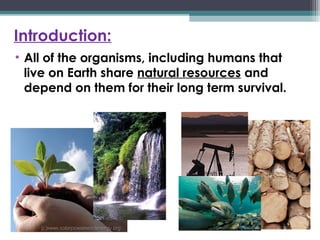
Introduction:
• All of the organisms, including humans that
live on Earth share natural resources and
depend on them for their long term survival.
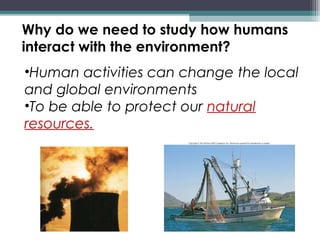
Why do we need to study how humans
interact with the environment?
•Human activities can change the local
and global environments
•To be able to protect our natural
resources.
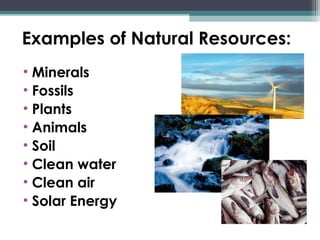
Examples of Natural Resources:
• Minerals
• Fossils
• Plants
• Animals
• Soil
• Clean water
• Clean air
• Solar Energy
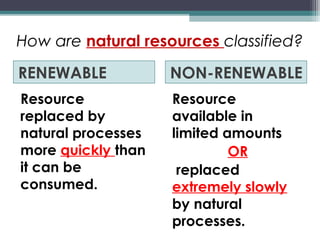
How are natural resources classified?
RENEWABLE NON-RENEWABLE
Resource
replaced by
natural processes
more quickly than
it can be
consumed.
Resource
available in
limited amounts
OR
replaced
extremely slowly
by natural
processes.
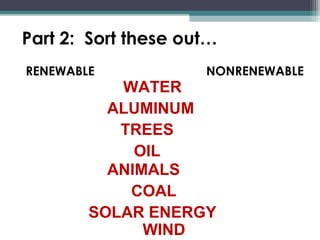
Part 2: Sort these out…
RENEWABLE NONRENEWABLE
ALUMINUM
TREES
OIL
WATER
ANIMALS
COAL
SOLAR ENERGY
WIND
Example of human activities that
affect the biosphere include:
• Hunting and Gathering
Ex. Fishing
• Agriculture
Ex. Crops
• Urban Development
Ex. Building highways and towns
How can we use and still protect our
resources?
Answer: Sustainable Development.
It is a way of using natural resources
without depleting them and
without causing long term
environmental harm.
What can happen if we do not use
sustainable development?
1. Desertification
2. Global Warming
3. Decrease/Loss of biodiversity
4. Deforestation
5. Acid Rain
6. Ozone Depletion
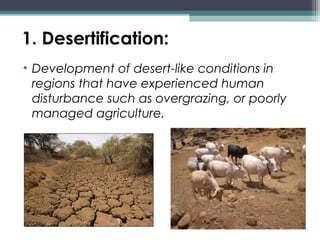
1. Desertification:
• Development of desert-like conditions in
regions that have experienced human
disturbance such as overgrazing, or poorly
managed agriculture. 
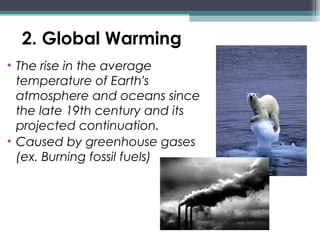
2. Global Warming
• The rise in the average
temperature of Earth's
atmosphere and oceans since
the late 19th century and its
projected continuation.
• Caused by greenhouse gases
(ex. Burning fossil fuels)
3. Decrease of Biodiversity
• Decrease in the diversity of life caused
by:
- Loss of habitat
- increase in human population
- pollution
- Introduction of foreign species
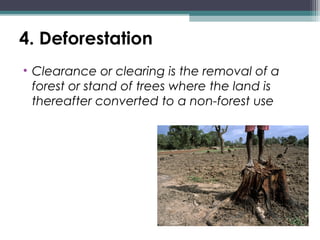
4. Deforestation
• Clearance or clearing is the removal of a
forest or stand of trees where the land is
thereafter converted to a non-forest use
5. Acid Rain
• It means any form of precipitation that
contains harmful substances such as
nitrogen and sulfur oxides.
• Cars release of sulfur dioxide and nitrogen
oxides when they burn fossil fuels.
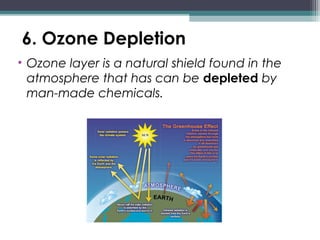
6. Ozone Depletion
• Ozone layer is a natural shield found in the
atmosphere that has can be depleted by
man-made chemicals.
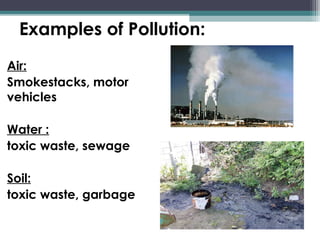
Examples of Pollution:
Air:
Smokestacks, motor
vehicles
Water :
toxic waste, sewage
Soil:
toxic waste, garbage
Effects
• Human health hazards
asthma, cancer, poisoning
• Loss of species
eagles-DDT, fish in great lakes
• Loss of usable land
Love Canal, Chernoble
Solutions
• Laws against pollution
Clean Air and Water Acts
• Government oversight
EPA – Environmental Protection Agency
• New technologies
Pollution control devices, filters
• Cleaner fuels
Wind, Solar, Nuclear?

Human Impact

  • 1.
    HUMAN IMPACT ONTHE ECOSYSTEM By: Ms. Zeron
  • 2.
    Important Vocabulary: Vocabulary forthis section is available on Quizlet at the following link: https://quizlet.com/_mwcrh Goal: Students will be able to predicts the impact of individuals on environmental systems and examines how human lifestyles affect sustainability. (Benchmark/Standards SC.912.L.17.20)
  • 3.
    Part 1: Whatdo you know? Myth or Truth? Which statement(s) are true/false? 1. Anything natural is NOT pollution. 2. The human race is indestructible as a species. 3. Technology can resolve all environmental problems. 4. If one can’t see it, then it doesn't affect us. 5. Global warming does NOT exist. Answer…. All of these statements are common misconceptions!
  • 4.
    Introduction: • All ofthe organisms, including humans that live on Earth share natural resources and depend on them for their long term survival.
  • 5.
    Why do weneed to study how humans interact with the environment? •Human activities can change the local and global environments •To be able to protect our natural resources.
  • 6.
    Examples of NaturalResources: • Minerals • Fossils • Plants • Animals • Soil • Clean water • Clean air • Solar Energy
  • 7.
    How are naturalresources classified? RENEWABLE NON-RENEWABLE Resource replaced by natural processes more quickly than it can be consumed. Resource available in limited amounts OR replaced extremely slowly by natural processes.
  • 8.
    Part 2: Sortthese out… RENEWABLE NONRENEWABLE ALUMINUM TREES OIL WATER ANIMALS COAL SOLAR ENERGY WIND
  • 9.
    Example of humanactivities that affect the biosphere include: • Hunting and Gathering Ex. Fishing • Agriculture Ex. Crops • Urban Development Ex. Building highways and towns
  • 10.
    How can weuse and still protect our resources? Answer: Sustainable Development. It is a way of using natural resources without depleting them and without causing long term environmental harm.
  • 11.
    What can happenif we do not use sustainable development? 1. Desertification 2. Global Warming 3. Decrease/Loss of biodiversity 4. Deforestation 5. Acid Rain 6. Ozone Depletion
  • 12.
    1. Desertification: • Developmentof desert-like conditions in regions that have experienced human disturbance such as overgrazing, or poorly managed agriculture. 
  • 13.
    2. Global Warming •The rise in the average temperature of Earth's atmosphere and oceans since the late 19th century and its projected continuation. • Caused by greenhouse gases (ex. Burning fossil fuels)
  • 14.
    3. Decrease ofBiodiversity • Decrease in the diversity of life caused by: - Loss of habitat - increase in human population - pollution - Introduction of foreign species
  • 15.
    4. Deforestation • Clearanceor clearing is the removal of a forest or stand of trees where the land is thereafter converted to a non-forest use
  • 16.
    5. Acid Rain •It means any form of precipitation that contains harmful substances such as nitrogen and sulfur oxides. • Cars release of sulfur dioxide and nitrogen oxides when they burn fossil fuels.
  • 17.
    6. Ozone Depletion •Ozone layer is a natural shield found in the atmosphere that has can be depleted by man-made chemicals.
  • 18.
    Examples of Pollution: Air: Smokestacks,motor vehicles Water : toxic waste, sewage Soil: toxic waste, garbage
  • 19.
    Effects • Human healthhazards asthma, cancer, poisoning • Loss of species eagles-DDT, fish in great lakes • Loss of usable land Love Canal, Chernoble
  • 20.
    Solutions • Laws againstpollution Clean Air and Water Acts • Government oversight EPA – Environmental Protection Agency • New technologies Pollution control devices, filters • Cleaner fuels Wind, Solar, Nuclear?

Editor's Notes

  • #4 believe that anything natural is not pollution. believe that biodegradable materials are not pollutants. believe that groundwater is a limitless resource. believe that the human race is indestructible as a species. believe that the environment will rebound. believe that global warming does not exist. believe that technology can resolve all environmental problems. believe that if one cannot see it, then it doesn't affect them.
  • #5 We need to understand how humans interact with the living world (biosphere) in order to protect our natural resources.
  • #6 We need to understand how humans interact with the living world (biosphere) in order to protect our natural resources.