ENVIRONMENTAL ENGINEERING
BIODIVERSITY AND ITS CONSERVATION
BIODIVERSITY:
 Introduction
 Levels of Biodiversity
 Genetic Diversity
 Species Diversity
 Ecosystem Diversity
 Biogeographical Classification in India
 Value of Biodiversity
 Consumptive Use Value
 Productive Use Value
 Social Use Value
 Ethical Use Value
 Aesthetic Use Value
 Option Value
 Biodiversity at Global, National and Local Level
Cont……
 India as a Mega – diversity Nation
 Hot Spots of Biodiversity
 Threats to Biodiversity
 Habitat Loss
 Poaching of Wildlife
 Man – Wildlife conflicts
 Endangered Species of India
 Endemic species of India
 CONSERVATION OF BIODIVERSITY
 In – situ Conservation of Biodiversity
 Ex – situ Conservation of Biodiversity
BIODIVERSITY - INTRODUCTION
Bio – Life
Diversity – Variety
Biodiversity is defined as, “the variety and
variability among all groups of living organisms and the
ecosystem in which they occur”.
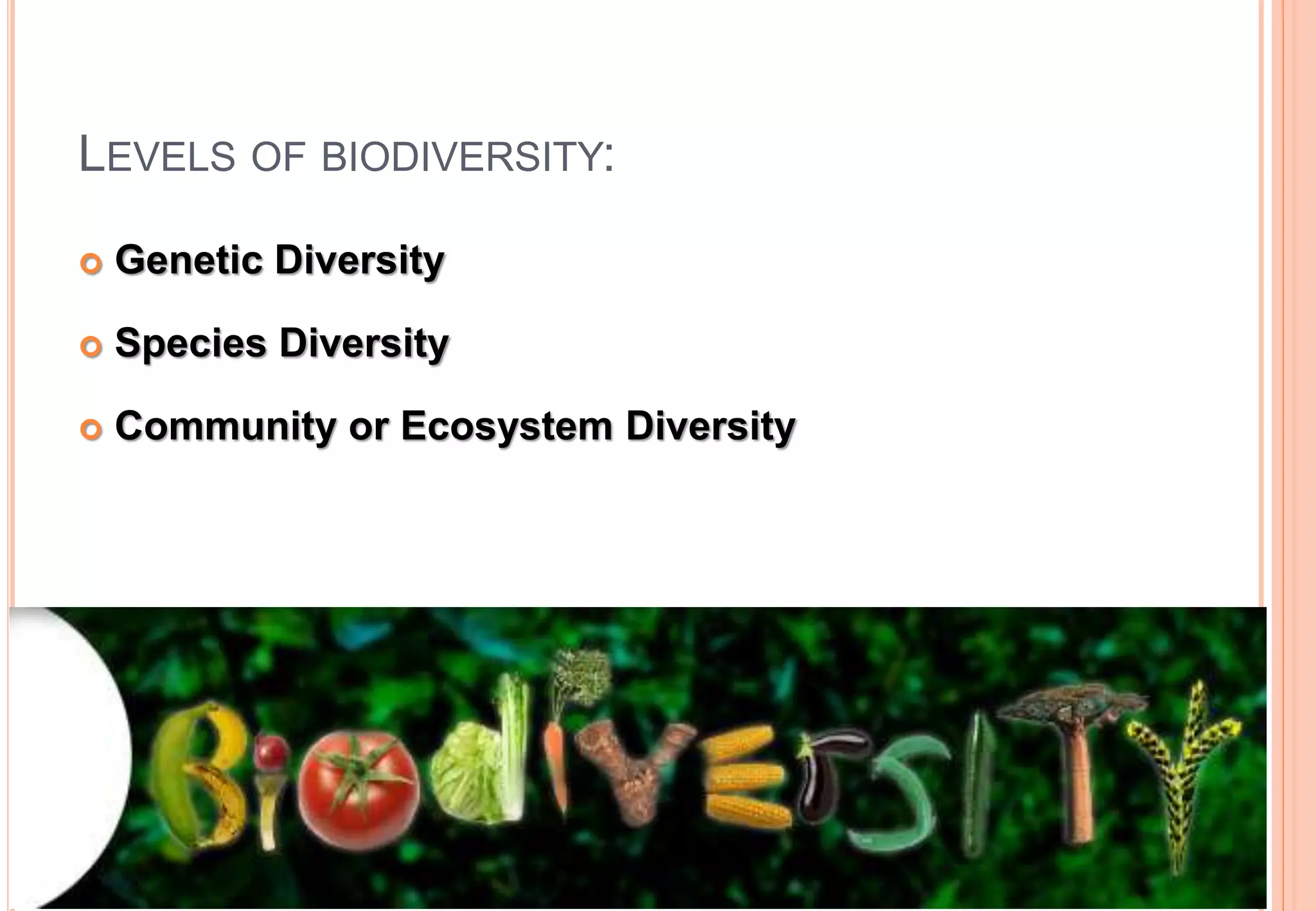
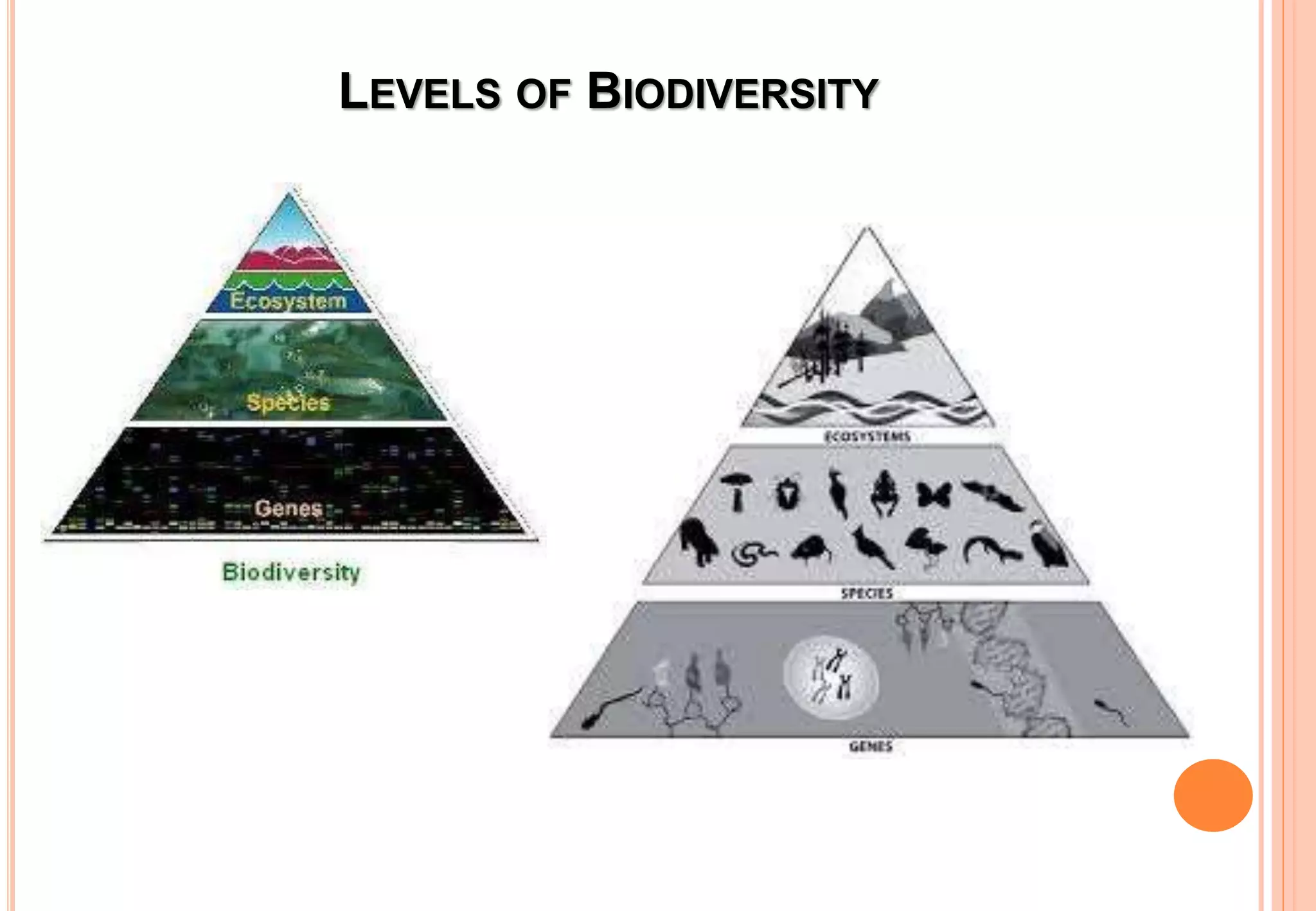
LEVELS OF BIODIVERSITY:
 Genetic Diversity
 Species Diversity
 Community or Ecosystem Diversity
GENETIC DIVERSITY:
 Species of different Genetic Characteristics
 Diversity within species i.e. Variations in genes with
species.
 Slight different between species
 Difference due to combination of genes
 Basic units of Hereditary transformed from one generation
to another.
Eg.: Rice varieties, teak wood varieties, etc,.
 Species Diversity:
 Discrete group of organisms of the same kind
 Diversity between species
 Sum of varieties of living organisms at species level
Eg.:
 Plant Species: Apple, mango, grapes, rice, wheat, etc.
 Animal Species: Lion, tiger, deer, etc.
 Community or Ecosystem Diversity:
 Diversity at ecological or habitat level
 Biotic components i.e. plants, animals and micro organisms
interact with Abiotic components i.e. environment – soil, air,
water, etc,.
 Difference in environmental type.
 Interaction between living organisms and physical environment
in an ecosystem.
Eg. River Ecosystem
LEVELS OF BIODIVERSITY
BIOGEOGRAPHICAL CLASSIFICATION OF INDIA:
 India is mega diversity country with different types of
climate and topography in different parts
 Variations due to the variability in flora and fauna
 It is important to study and know the distribution,
evolution and environmental relationship of plants and
animals.
 To know about the relationship of flora and fauna,
biogeographers classified India into ten biogeographic
zones
 Each zone has its own climate, soil and biodiversity.
INDIA’S MAJOR BIOGEOGRAPHICAL HABITATS:
 Trans – Himalayan region
 Himalayan mountain
 Desert
 Semi – Arid
 Western Ghats
 Deccan Peninsula
 Gangetic Plain
 North East
 Coasts
 Islands
VALUE OF BIODIVERSITY:
 Biosphere is supporting combination of different
organisms with its own significance.
 Biodiversity is stability and proper functioning of the
Biosphere.
 We get benefit from each organisms in biosphere.
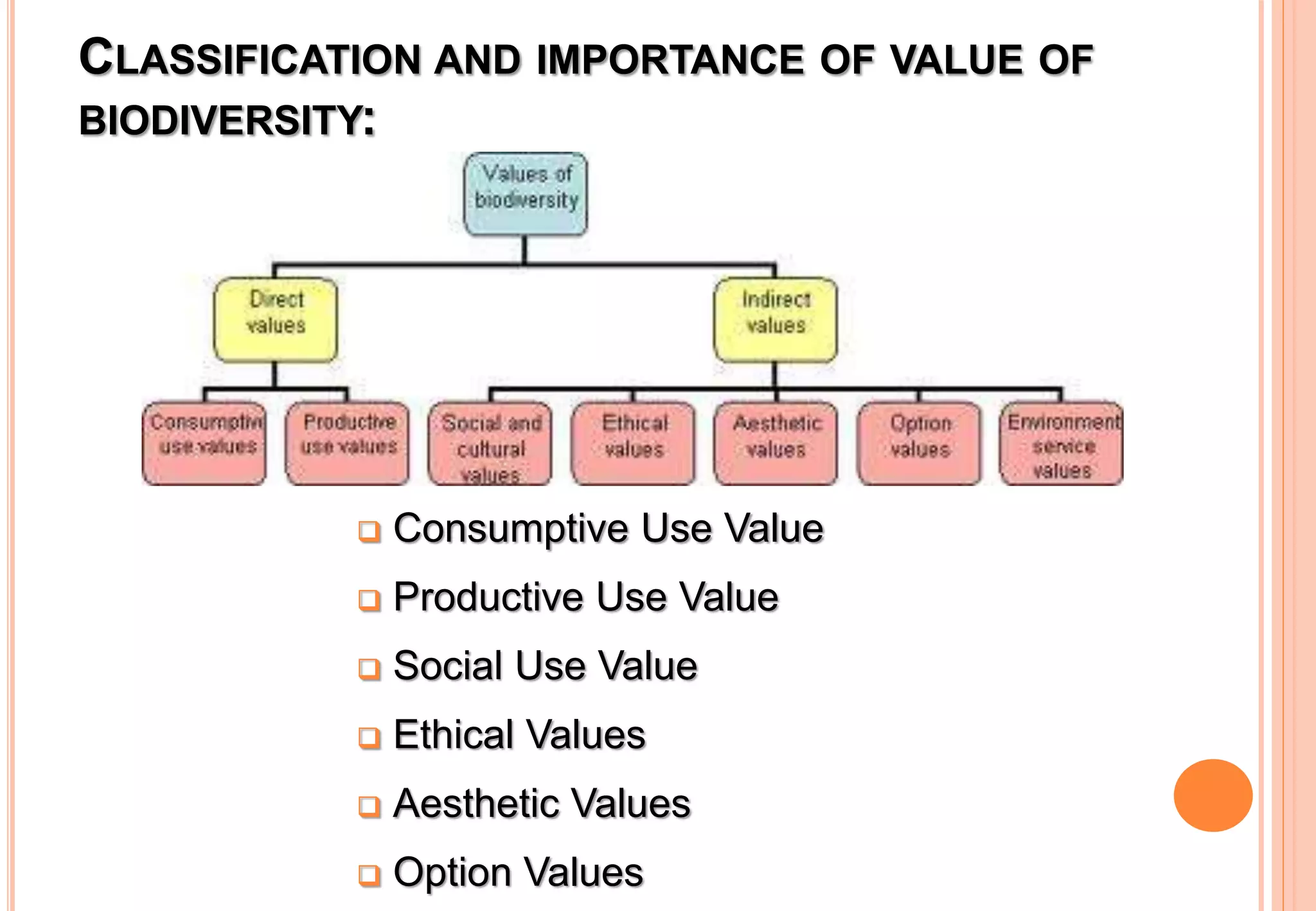
CLASSIFICATION AND IMPORTANCE OF VALUE OF
BIODIVERSITY:
 Consumptive Use Value
 Productive Use Value
 Social Use Value
 Ethical Values
 Aesthetic Values
 Option Values
CONSUMPTIVE USE VALUE:
 Direct use values
 Harvested and consumed directly
 Food – 80 – 90% tropical wild plants
 Ceropegia bulbosa
 Codonopisis
 Cicer microphyllum
 Drugs – 70% of modern medicines from plants
 Traditional systems – Ayurvedha and Sidha.
 Fuel – firewoods – fossil fuels like coal, petroleum and natural
gases
PRODUCTIVE USE VALUE:
 Obtain commercial value
 Products are marketed and sold
 Derived from animal and plants
Animal Animal Products
Silk - worm Silk
Sheep Wool
Elephants Tusk
Fish and animal Food
Plant & Animal Product Industry
Wood Paper and pulp industry
Cotton Textile industry
Fruits, vegetables Food industry
Leather Leather industry
SOCIAL USE VALUE:
 Bio – resources are used to society
 Value associated with social life, religion and spiritual
aspects.
 Holy Plants: Tulsi, lotus, etc.
 Holy animals: Cow, snake, bull, peacock, rat, etc,.
 Ethical issues must be preserved
 India has great cultural and religious basis
 May or may not be used but gives pleasure
 River Ganga
 Vembu, tulsi, etc,
 Kangaroo, zebra, giraffe,etc,.
ETHICAL VALUES:
AESTHETIC VALUES:
 Beautiful nature of plants and animals is the most
important value of biodiversity is eco – tourism.
OPTION VALUES:
 Biodiversity that are unknown and need to be known
 Suggested that any species maybe proved valuable
 Total number of living species in the world are about 20 million
but only 1.5 million species are found and given names.
 Tropical deforestation alone is reducing the biodiversity by
0.5% every year.
 Terrestrial biodiversity or Biomass
 Tropical rainforests
 Temperate forests
 Marine diversity
GLOBAL BIODIVERSITY:
TERRESTRIAL BIODIVERSITY OR BIOMASS:
 Largest ecological units present in different geographic areas.
1. Tropical rain forests:
 Earth’s largest storehouse of biodiversity
 Inhabited of millions of plants, insects, birds, amphibians and
mammals.
 About 50 – 70% of global diversity
 Medicinal plants: 25% of world drug is extracted here
 Flowering plants: nearly 1,30,000 flowering plants are found and 1
– 3% is known.
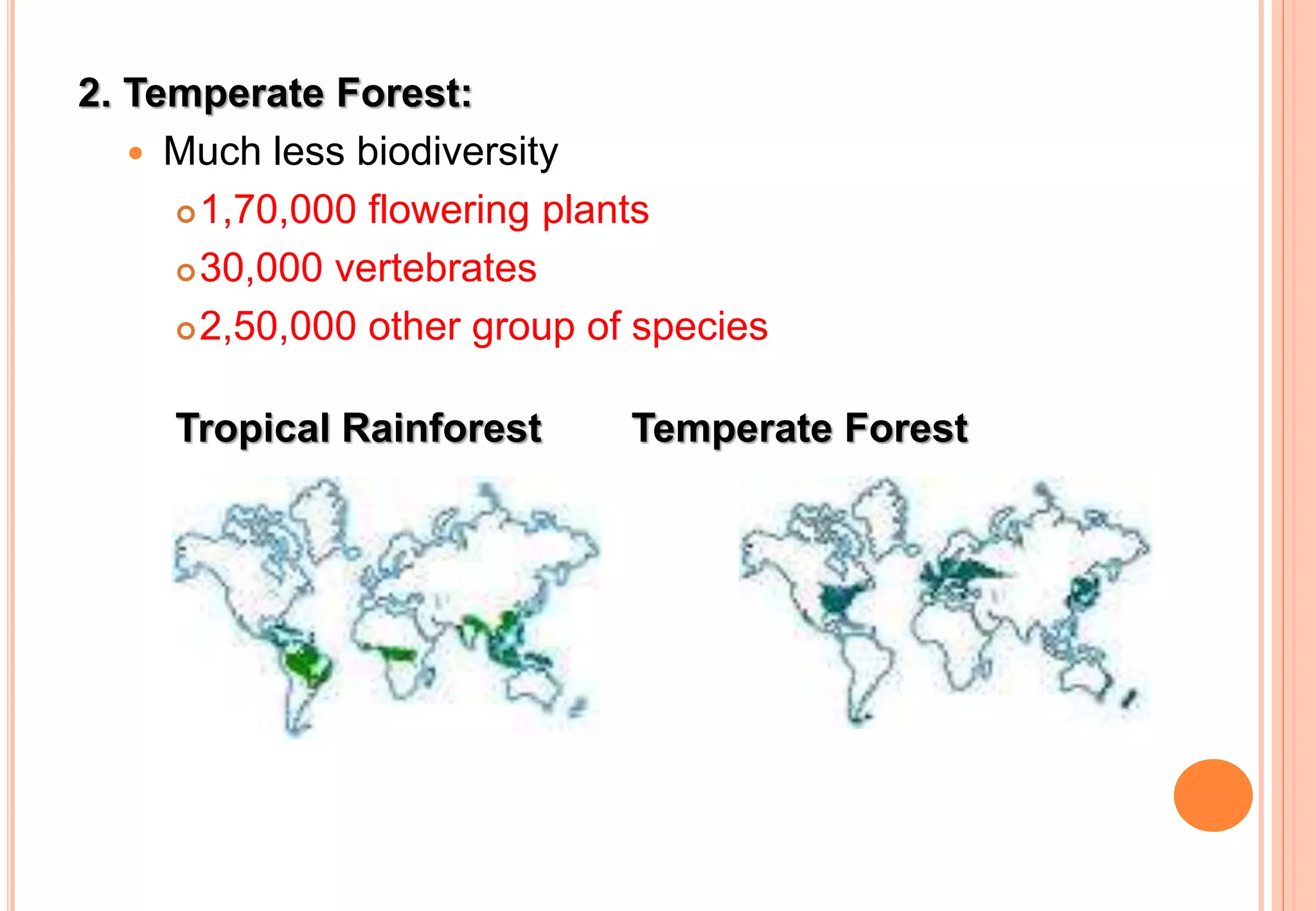
2. Temperate Forest:
 Much less biodiversity
1,70,000 flowering plants
30,000 vertebrates
2,50,000 other group of species
Tropical Rainforest Temperate Forest
MARINE DIVERSITY:
 It is much higher than terrestrial biodiversity but it is less
known and described.
 Estuaries, coastal waters and oceans are biologically diverse.
 Sea is a cradle of every known animal phylum
 35 existing phylum of multicellular animals
 34 marine
 16 exclusively marine
BIODIVERSITY AT NATIONAL LEVEL – INDIA:
 India is second largest nation containing 5% of world’s
biodiversity and 2% of the earth surface.
 Rank of India in biodiversity:
 10th rank among the plant rich
 11th rank among the endemic species of higher vertebrates
 6th rank among the centers of diversity and origin of agricultural
crops.
 India’s is an agricultural country and economic depends on
the production of crops
 India is considered as mega – diversity nation because of rich
in flora and fauna
 High demand in abroad for Indian species
 Medicinal Value:
 More than 2000 medicinal plants – cure many diseases
 Eg. Tulsi, neem, turmeric, etc.
 Commercial Value:
 Indian sandal wood
 Tobacco – nicotine
 Wild edible mushroom – exported
 Demand for ornamental plants, flowers and fruits
 More than 100 species developed and formulated in abroad.
BIODIVERSITY AT LOCAL LEVEL:
 Based on the spatial distribution the biodiversity at local level
is classified as follows,
1. Point richness
 Species found in single point in a given place
2. Alpha richness or Alpha diversity
 Number of species found in small homogeneous area
3. Beta richness or Beta diversity
 Rate of change of species increase as more heterogeneous
habitats
4. Gamma richness or Gamma diversity
 Changes across large landscape
BIODIVERSITY IN TAMILNADU:
 Distribution of plants and animals among different districts in
Tamil Nadu is uneven
 Dense forest in Salem
 Western Ghats has 1500 species of plants, 50 species of mammals
and 90 reptiles.
 Birds of several species in Vedanthangal
 Elephant sanctuaries at Anaimalai
 Tiger sanctuary at Mundanthurai
INDIA AS A MEGA – DIVERSITY NATION:
 Nearly 170 countries in this world and 12 of them contain 70%
of the earth’s biodiversity
 India is one among the 12 mega biodiversity countries
 The Ministry of Environment and Forests, Government of India
records
 47,000 species of plants
 81,000 species of animals
 Which is about the 7% and 6.5% of global flora and fauna
respectively
ENDEMISM OR ENDEMIC SPECIES:
 Species which are confined to a particular area are called as
Endemic Species.
 India is rich in endemic flora and fauna
 33% of flowering plants
 53% of fresh water fishes
 60% of amphibians
 36% of reptiles
 10% mammalians
 Plant Diversity: Nearly 5000 flowering plants and 166 crop
plant species.
 Marine Diversity: More than 340 coral species, several species
of mangrove plants and sea grasses are found.
 Agro – Biodiversity: 167 crop species and India is considered
to the centre of origin of 30,000 to 50,000 varieties of rice,
mango, turmeric, ginger, sugarcane, etc,.
 Animal Biodiversity: 75,000 animal species including 5,000
insects. India is a home of nearly 2,00,000 living organisms.
HOT SPOTS OF BIODIVERSITY:
 Areas which exhibit high species richness as well as high
species endemism are termed as Hot spots of Biodiversity.
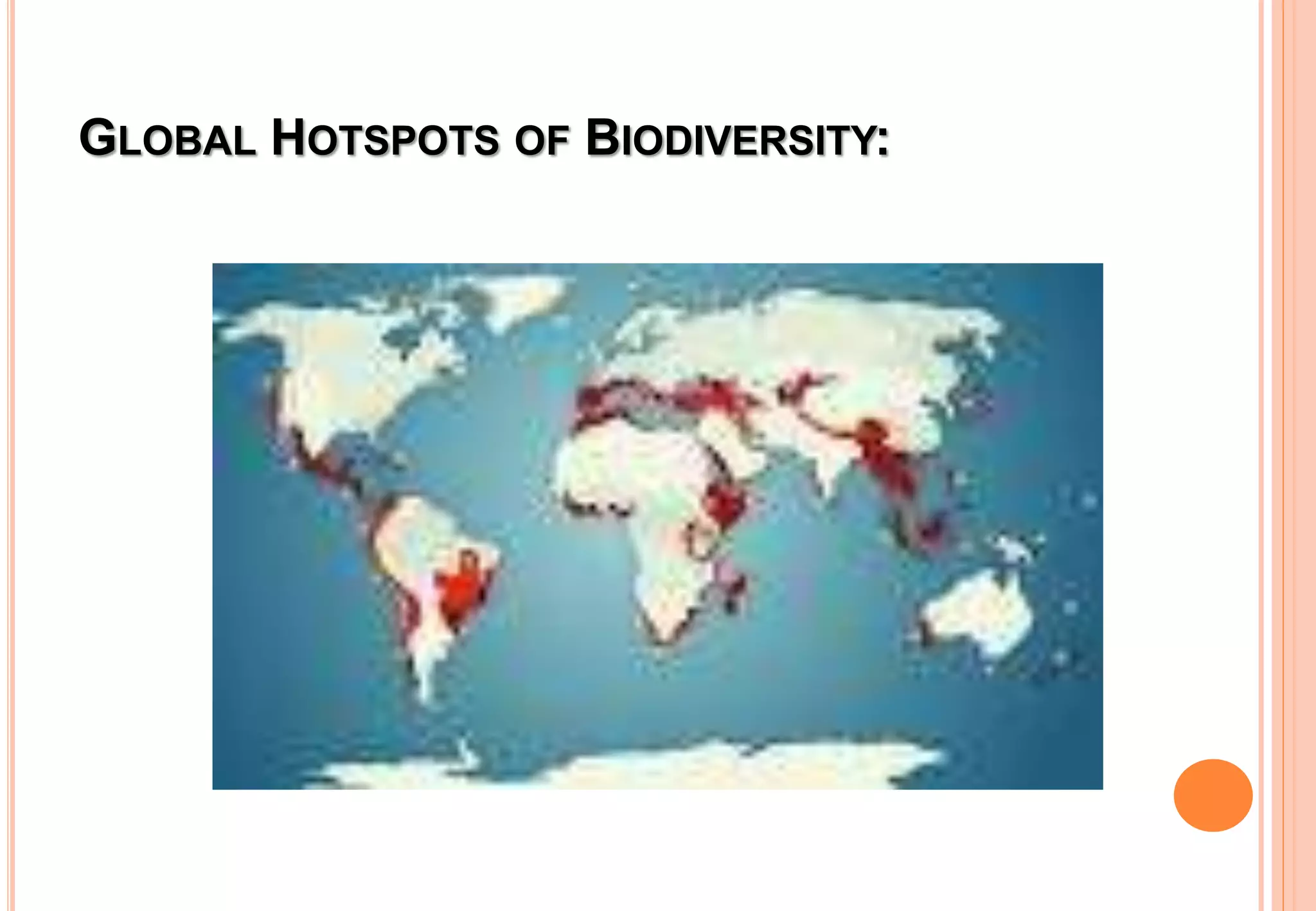
 There are 25 hot spots of biodiversity on a global level and two
are present in India i.e. Eastern Himalayas and Western
Ghats.
 At global level, these are the areas of high conservation
priority, if these species lost, they can never be replaced or
regenerated.
 Hotspot covering less than 2% of world’s land are found to
have 50% of terrestrial biodiversity.
 About 40% of terrestrial plants and 25% of vertebrate species
are endemic and found in hotspot.
GLOBAL HOTSPOTS OF BIODIVERSITY:
1. Tropical Andes
2. Mesoamerican Forest
3. Caribbean
4. brazil’s Atlantic Forest
5. Darien Panama Western
Ecuador
6. Brazil’s Cerrado
7. Central Chile
8. California Floristic Province
9. Madagascar
10. Eastern Arc and Coastal
Forest of Kenya
11. Western African Forest
12. Cape Floristic Province
13. Succulent Karoo
14. Mediterranean Basin
15. Caucasus
16. Sundaland
17. Wallacea
18. Phillipines
19. Indo – Burma Eastern
Himalayas
20. South – Central China
21. Western Ghats Sri Lanka
22. South – Western Australia
23. New Caledonia
24. New Zealand
25. Polynesia
GLOBAL HOTSPOTS OF BIODIVERSITY:
HOT SPOTS OF BIODIVERSITY IN INDIA:
 Eastern Himalayas – Indo Burma region
 Geographically comprises of Nepal, Bhutan and neighboring
state of Northern India
 35,000 plant species of which 30% are endemic
 63% mammals
 60% of the Indian Birds
 Western Ghats – Sri Lanka
 Geographically comprises of Maharashtra, Karnataka,
TamilNadu and Kerala
 1500 endemic, dicotyledonous plant species
 62% amphibians and 50% lizards
 It is reported that only 6.8% of the original forest are existing today and
the rest has been deforested of degraded.
HOT SPOTS OF BIODIVERSITY IN INDIA:
THREATS TO BIODIVERSITY:
 Extinction or elimination of the species is a natural process of
evolution
 During evolution, species have died and been replaced by
others
 The process of extinction has become particularly fast in the
recent years of human civilization
 Extinction of 10,000 species per year or 27 per day
 The waste generated due to the increase in human population
and industrialization, spoils the environment and lead to more
diversity in biological species
 Any change in the system leads to a major imbalance and
threatens the normal ecological cycle.
CAUSES AND ISSUES RELATED TO THREATS TO
BIODIVERSITY:
 Loss of Habitat:
 Destruction and loss of natural habitat is the single largest cause of
biodiversity loss
 Poaching (over harvesting):
 Illegal trading of wildlife products by killing prohibited endangered
species
 Man – Wildlife Conflicts:
 It arises when wildlife starts causing immense damage and danger
to man.
HABITAT LOSS:
FACTORS INFLUENCING HABITAT LOSS:
 Deforestation
 Destruction of wetlands
 Habitat fragmentation
 Raw materials
 Production of drugs
 Illegal trade
 Developmental activities
 With the current rate of loss of forest habitat, it is estimated that 20
– 25% of the global flora and fauna would be lost within few years.
POACHING:
1. Subsistence poaching – killing animal to provide enough
food for survival
2. Commercial poaching – hunting and killing animals to sell
their products
Factors influencing Poaching:
 Human population
 Commercial activities
Remedial Measures:
 Illegal hunting and trading should be stopped
 Not purchase fur coat, purse or bag made of crocodile or
python skin
 Bio – diversity laws should be strengthened
MAN – WILDLIFE CONFLICTS:
FACTORS INFLUENCING MAN – WILDLIFE CONFLICTS:
 Shrinking of forest cover
 Human encroachment
 Injured animals
 Cultivations of food and elephants search for food
 Electric wiring injure elephant and start violence
 Compensation is not enough and farmers kill wild animals
 Garbage near human settlement or food crops near forest
area attracts wild animals
REMEDIAL MEASURES FOR MAN – WILDLIFE
CONFLICTS:
 Crop and cattle compensation scheme must be started
 Solar powered fencing with electric current proof trenches
must be provided to prevent animals
 Crop patterns must be changed
 Adequate food and water should be available for wild animal
in the forest
 Developmental and construction work around the forest
must be stopped
ENDANGERED AND ENDEMIC SPECIES OF INDIA:
 According to International Union Conservation of Nature and
Natural Resources – IUCN the species are classified as
follows,
Extinct Species – No longer found
Endangered Species – Number of species has been
reduced to critical level
Vulnerable Species – Continuous decline due to habitat
destruction
Rare Species – Species located within a restricted area
or thinly scattered over a more extensive area.
ENDANGERED SPECIES OF INDIA:
 When the number of species has been reduced to a critical
level
 Unless it is protected and conserved, it is in immediate danger
of extinction
 In India the following species are endangered
 450 plant species
 100 mammals species
 150 birds species
 India’s biodiversity is threatened due to habitat destruction,
degradation and over exploitation of resources.
IMPORTANT ENDANGERED SPECIES:
 Reptiles – tortoise, green sea turtle, python, etc.
 Birds – peacock, Siberian white crane, etc.
 Mammals – Indian wolf, tiger, Indian lion, etc.
 Primates – capped monkey, golden monkey, etc.
 Plants – medicinal plants, sandal wood tree, etc.
FACTORS AFFECTING ENDANGERED SPECIES:
 Pollution
 Over – exploitation
 Climatic changes
ENDEMIC SPECIES:
 Species found only in particular region
 In India 47,000 species and 7000 plants are endemic
 62% of our endemic species are found in Himalayas and
Western Ghats
1. Fauna – Animals present in a particular region
1. 81,000 species of animals
2. Western Ghats is rich in 62% amphibians and 50% reptiles
2. Flora – Plants present in a particular region
FACTOR AFFECTING ENDEMIC SPECIES:
 Habitat loss and fragmentation
 Pollution
CONSERVATION OF BIODIVERSITY:
 Biodiversity is important for sustainable development
 Value of biodiversity is due to the commercial, medicinal,
genetic, aesthetic and ecological importance
 The management of biosphere for greater sustainable
benefits to the present and future generation
FACTORS AFFECTING BIODIVERSITY:
 Disturbed by human activities such as construction of dams in
forest, release industrial waste, using pesticides and
insecticides in crop fields, urbanization, etc.
 Poaching, over – exploitation and degradation
 Marine ecosystem is disturbed by oils spills and effluents
 Global warming, ozone layer depletion and acid rain
ADVANTAGES OR NEED OF BIODIVERSITY
CONSERVATION:
 Immediate benefits to society such as recreation and tourism
 Availability of raw materials
 Preserves genetic diversity
 Ensures sustainable utilization
 Conservation of ecological diversity
 Biodiversity loss result in ecological and environmental
deterioration, so it is essential to conserve biodiversity.
TYPES OF BIODIVERSITY CONSERVATION:
 In – situ Conservation : Involves protection of fauna and flora
within its natural habitat.
In – situ Conservation
Methods
Numbers available
Biosphere Reserves 7
National Parks 80
Wild – life Sanctuaries 420
Botanical Gardens 120
 Biosphere Reserves:
 Gulf of Mannar
 Nilgiri
 Nanda Devi
 National Park:
 Kaziranga – Assam
 Gir National Park – Gujarat
 Periyar – Kerala
 Bandipur - Karnataka
 Wildlife Sanctuaries:
 Mudumalai Wildlife Sanctuary – Tamil Nadu
 Vedanthangal Bird Sanctuary – Tamil Nadu
 Gene Sanctuaries or Botanical Gardens:
 Gene sanctuary for citrus
 Gene sanctuary for pitcher plant
MERITS OF IN – SITU CONSERVATION:
 Very cheap and convenient method
 Adjusted to natural disasters like drought, floods, forest fires,
etc.
LIMITATIONS OF IN – SITU CONSERVATION:
 Large surface area is required for preservation
 Maintenance is not proper due to shortage of staff and
pollution
EX – SITU CONSERVATION:
 Protection of flora and fauna outside the natural habitat
 Involves in maintenance and breeding of species in controlled
conditions
 Identify the species of risk and extinction
 Prefers the species which are more important to man future
 Botanical gardens
 Seed banks
 Microbial culture collections, tissue and cell cultures
 Museums
 Zoological gardens
METHODS OF EX – SITU CONSERVATION:
 National Bureau of Plant Genetic Resources (NBPGR) –
preserves agricultural and horticultural crops
 National Bureau of Animal Genetic Resources (NBAGR) –
preserves the semen of domesticated bovine animals
 National Facility for Plant Tissue Culture Repository
(NFPTCR) – conservation of varieties of crop plants or tree by
tissue culture
MERITS OF EX – SITU CONSERVATION:
 Survival increase due to special care and attention
 Longer life span due to assured food, water, shelter and
security
 It is carried in case of endangered species
LIMITATIONS OF EX – SITU CONSERVATION:
 Expensive method
 Freedom of wildlife is lost
 Animal cannot survive in natural environment
 Adopted only for few selected species
CONSERVATION OF
BIODIVERSITY LEADS TO………
THANK
YOU!!!!!
SAVE OUR EARTH FOR
THE NEXT GENERATION
TO KNOW ATLEAST OF
WHAT IS THE PLEASURE
OF NATURE!!!!!!

Biodiversity and its conservation

  • 1.
  • 2.
    BIODIVERSITY:  Introduction  Levelsof Biodiversity  Genetic Diversity  Species Diversity  Ecosystem Diversity  Biogeographical Classification in India  Value of Biodiversity  Consumptive Use Value  Productive Use Value  Social Use Value  Ethical Use Value  Aesthetic Use Value  Option Value  Biodiversity at Global, National and Local Level
  • 3.
    Cont……  India asa Mega – diversity Nation  Hot Spots of Biodiversity  Threats to Biodiversity  Habitat Loss  Poaching of Wildlife  Man – Wildlife conflicts  Endangered Species of India  Endemic species of India  CONSERVATION OF BIODIVERSITY  In – situ Conservation of Biodiversity  Ex – situ Conservation of Biodiversity
  • 4.
    BIODIVERSITY - INTRODUCTION Bio– Life Diversity – Variety Biodiversity is defined as, “the variety and variability among all groups of living organisms and the ecosystem in which they occur”.
  • 5.
    LEVELS OF BIODIVERSITY: Genetic Diversity  Species Diversity  Community or Ecosystem Diversity
  • 6.
    GENETIC DIVERSITY:  Speciesof different Genetic Characteristics  Diversity within species i.e. Variations in genes with species.  Slight different between species  Difference due to combination of genes  Basic units of Hereditary transformed from one generation to another. Eg.: Rice varieties, teak wood varieties, etc,.
  • 8.
     Species Diversity: Discrete group of organisms of the same kind  Diversity between species  Sum of varieties of living organisms at species level Eg.:  Plant Species: Apple, mango, grapes, rice, wheat, etc.  Animal Species: Lion, tiger, deer, etc.
  • 10.
     Community orEcosystem Diversity:  Diversity at ecological or habitat level  Biotic components i.e. plants, animals and micro organisms interact with Abiotic components i.e. environment – soil, air, water, etc,.  Difference in environmental type.  Interaction between living organisms and physical environment in an ecosystem. Eg. River Ecosystem
  • 12.
  • 13.
    BIOGEOGRAPHICAL CLASSIFICATION OFINDIA:  India is mega diversity country with different types of climate and topography in different parts  Variations due to the variability in flora and fauna  It is important to study and know the distribution, evolution and environmental relationship of plants and animals.  To know about the relationship of flora and fauna, biogeographers classified India into ten biogeographic zones  Each zone has its own climate, soil and biodiversity.
  • 14.
    INDIA’S MAJOR BIOGEOGRAPHICALHABITATS:  Trans – Himalayan region  Himalayan mountain  Desert  Semi – Arid  Western Ghats  Deccan Peninsula  Gangetic Plain  North East  Coasts  Islands
  • 15.
    VALUE OF BIODIVERSITY: Biosphere is supporting combination of different organisms with its own significance.  Biodiversity is stability and proper functioning of the Biosphere.  We get benefit from each organisms in biosphere.
  • 16.
    CLASSIFICATION AND IMPORTANCEOF VALUE OF BIODIVERSITY:  Consumptive Use Value  Productive Use Value  Social Use Value  Ethical Values  Aesthetic Values  Option Values
  • 17.
    CONSUMPTIVE USE VALUE: Direct use values  Harvested and consumed directly  Food – 80 – 90% tropical wild plants  Ceropegia bulbosa  Codonopisis  Cicer microphyllum  Drugs – 70% of modern medicines from plants  Traditional systems – Ayurvedha and Sidha.  Fuel – firewoods – fossil fuels like coal, petroleum and natural gases
  • 18.
    PRODUCTIVE USE VALUE: Obtain commercial value  Products are marketed and sold  Derived from animal and plants Animal Animal Products Silk - worm Silk Sheep Wool Elephants Tusk Fish and animal Food
  • 19.
    Plant & AnimalProduct Industry Wood Paper and pulp industry Cotton Textile industry Fruits, vegetables Food industry Leather Leather industry
  • 20.
    SOCIAL USE VALUE: Bio – resources are used to society  Value associated with social life, religion and spiritual aspects.  Holy Plants: Tulsi, lotus, etc.  Holy animals: Cow, snake, bull, peacock, rat, etc,.  Ethical issues must be preserved  India has great cultural and religious basis  May or may not be used but gives pleasure  River Ganga  Vembu, tulsi, etc,  Kangaroo, zebra, giraffe,etc,. ETHICAL VALUES:
  • 21.
    AESTHETIC VALUES:  Beautifulnature of plants and animals is the most important value of biodiversity is eco – tourism. OPTION VALUES:  Biodiversity that are unknown and need to be known  Suggested that any species maybe proved valuable
  • 22.
     Total numberof living species in the world are about 20 million but only 1.5 million species are found and given names.  Tropical deforestation alone is reducing the biodiversity by 0.5% every year.  Terrestrial biodiversity or Biomass  Tropical rainforests  Temperate forests  Marine diversity GLOBAL BIODIVERSITY:
  • 23.
    TERRESTRIAL BIODIVERSITY ORBIOMASS:  Largest ecological units present in different geographic areas. 1. Tropical rain forests:  Earth’s largest storehouse of biodiversity  Inhabited of millions of plants, insects, birds, amphibians and mammals.  About 50 – 70% of global diversity  Medicinal plants: 25% of world drug is extracted here  Flowering plants: nearly 1,30,000 flowering plants are found and 1 – 3% is known.
  • 24.
    2. Temperate Forest: Much less biodiversity 1,70,000 flowering plants 30,000 vertebrates 2,50,000 other group of species Tropical Rainforest Temperate Forest
  • 25.
    MARINE DIVERSITY:  Itis much higher than terrestrial biodiversity but it is less known and described.  Estuaries, coastal waters and oceans are biologically diverse.  Sea is a cradle of every known animal phylum  35 existing phylum of multicellular animals  34 marine  16 exclusively marine
  • 26.
    BIODIVERSITY AT NATIONALLEVEL – INDIA:  India is second largest nation containing 5% of world’s biodiversity and 2% of the earth surface.  Rank of India in biodiversity:  10th rank among the plant rich  11th rank among the endemic species of higher vertebrates  6th rank among the centers of diversity and origin of agricultural crops.  India’s is an agricultural country and economic depends on the production of crops  India is considered as mega – diversity nation because of rich in flora and fauna  High demand in abroad for Indian species
  • 27.
     Medicinal Value: More than 2000 medicinal plants – cure many diseases  Eg. Tulsi, neem, turmeric, etc.  Commercial Value:  Indian sandal wood  Tobacco – nicotine  Wild edible mushroom – exported  Demand for ornamental plants, flowers and fruits  More than 100 species developed and formulated in abroad.
  • 28.
    BIODIVERSITY AT LOCALLEVEL:  Based on the spatial distribution the biodiversity at local level is classified as follows, 1. Point richness  Species found in single point in a given place 2. Alpha richness or Alpha diversity  Number of species found in small homogeneous area 3. Beta richness or Beta diversity  Rate of change of species increase as more heterogeneous habitats 4. Gamma richness or Gamma diversity  Changes across large landscape
  • 29.
    BIODIVERSITY IN TAMILNADU: Distribution of plants and animals among different districts in Tamil Nadu is uneven  Dense forest in Salem  Western Ghats has 1500 species of plants, 50 species of mammals and 90 reptiles.  Birds of several species in Vedanthangal  Elephant sanctuaries at Anaimalai  Tiger sanctuary at Mundanthurai
  • 30.
    INDIA AS AMEGA – DIVERSITY NATION:  Nearly 170 countries in this world and 12 of them contain 70% of the earth’s biodiversity  India is one among the 12 mega biodiversity countries  The Ministry of Environment and Forests, Government of India records  47,000 species of plants  81,000 species of animals  Which is about the 7% and 6.5% of global flora and fauna respectively
  • 31.
    ENDEMISM OR ENDEMICSPECIES:  Species which are confined to a particular area are called as Endemic Species.  India is rich in endemic flora and fauna  33% of flowering plants  53% of fresh water fishes  60% of amphibians  36% of reptiles  10% mammalians
  • 32.
     Plant Diversity:Nearly 5000 flowering plants and 166 crop plant species.  Marine Diversity: More than 340 coral species, several species of mangrove plants and sea grasses are found.  Agro – Biodiversity: 167 crop species and India is considered to the centre of origin of 30,000 to 50,000 varieties of rice, mango, turmeric, ginger, sugarcane, etc,.  Animal Biodiversity: 75,000 animal species including 5,000 insects. India is a home of nearly 2,00,000 living organisms.
  • 33.
    HOT SPOTS OFBIODIVERSITY:  Areas which exhibit high species richness as well as high species endemism are termed as Hot spots of Biodiversity.  There are 25 hot spots of biodiversity on a global level and two are present in India i.e. Eastern Himalayas and Western Ghats.  At global level, these are the areas of high conservation priority, if these species lost, they can never be replaced or regenerated.  Hotspot covering less than 2% of world’s land are found to have 50% of terrestrial biodiversity.  About 40% of terrestrial plants and 25% of vertebrate species are endemic and found in hotspot.
  • 34.
    GLOBAL HOTSPOTS OFBIODIVERSITY: 1. Tropical Andes 2. Mesoamerican Forest 3. Caribbean 4. brazil’s Atlantic Forest 5. Darien Panama Western Ecuador 6. Brazil’s Cerrado 7. Central Chile 8. California Floristic Province 9. Madagascar 10. Eastern Arc and Coastal Forest of Kenya 11. Western African Forest 12. Cape Floristic Province 13. Succulent Karoo 14. Mediterranean Basin 15. Caucasus 16. Sundaland 17. Wallacea 18. Phillipines 19. Indo – Burma Eastern Himalayas 20. South – Central China 21. Western Ghats Sri Lanka 22. South – Western Australia 23. New Caledonia 24. New Zealand 25. Polynesia
  • 35.
    GLOBAL HOTSPOTS OFBIODIVERSITY:
  • 36.
    HOT SPOTS OFBIODIVERSITY IN INDIA:  Eastern Himalayas – Indo Burma region  Geographically comprises of Nepal, Bhutan and neighboring state of Northern India  35,000 plant species of which 30% are endemic  63% mammals  60% of the Indian Birds  Western Ghats – Sri Lanka  Geographically comprises of Maharashtra, Karnataka, TamilNadu and Kerala  1500 endemic, dicotyledonous plant species  62% amphibians and 50% lizards  It is reported that only 6.8% of the original forest are existing today and the rest has been deforested of degraded.
  • 37.
    HOT SPOTS OFBIODIVERSITY IN INDIA:
  • 38.
    THREATS TO BIODIVERSITY: Extinction or elimination of the species is a natural process of evolution  During evolution, species have died and been replaced by others  The process of extinction has become particularly fast in the recent years of human civilization  Extinction of 10,000 species per year or 27 per day  The waste generated due to the increase in human population and industrialization, spoils the environment and lead to more diversity in biological species  Any change in the system leads to a major imbalance and threatens the normal ecological cycle.
  • 39.
    CAUSES AND ISSUESRELATED TO THREATS TO BIODIVERSITY:  Loss of Habitat:  Destruction and loss of natural habitat is the single largest cause of biodiversity loss  Poaching (over harvesting):  Illegal trading of wildlife products by killing prohibited endangered species  Man – Wildlife Conflicts:  It arises when wildlife starts causing immense damage and danger to man.
  • 40.
    HABITAT LOSS: FACTORS INFLUENCINGHABITAT LOSS:  Deforestation  Destruction of wetlands  Habitat fragmentation  Raw materials  Production of drugs  Illegal trade  Developmental activities  With the current rate of loss of forest habitat, it is estimated that 20 – 25% of the global flora and fauna would be lost within few years.
  • 41.
    POACHING: 1. Subsistence poaching– killing animal to provide enough food for survival 2. Commercial poaching – hunting and killing animals to sell their products Factors influencing Poaching:  Human population  Commercial activities Remedial Measures:  Illegal hunting and trading should be stopped  Not purchase fur coat, purse or bag made of crocodile or python skin  Bio – diversity laws should be strengthened
  • 42.
    MAN – WILDLIFECONFLICTS: FACTORS INFLUENCING MAN – WILDLIFE CONFLICTS:  Shrinking of forest cover  Human encroachment  Injured animals  Cultivations of food and elephants search for food  Electric wiring injure elephant and start violence  Compensation is not enough and farmers kill wild animals  Garbage near human settlement or food crops near forest area attracts wild animals
  • 43.
    REMEDIAL MEASURES FORMAN – WILDLIFE CONFLICTS:  Crop and cattle compensation scheme must be started  Solar powered fencing with electric current proof trenches must be provided to prevent animals  Crop patterns must be changed  Adequate food and water should be available for wild animal in the forest  Developmental and construction work around the forest must be stopped
  • 44.
    ENDANGERED AND ENDEMICSPECIES OF INDIA:  According to International Union Conservation of Nature and Natural Resources – IUCN the species are classified as follows, Extinct Species – No longer found Endangered Species – Number of species has been reduced to critical level Vulnerable Species – Continuous decline due to habitat destruction Rare Species – Species located within a restricted area or thinly scattered over a more extensive area.
  • 45.
    ENDANGERED SPECIES OFINDIA:  When the number of species has been reduced to a critical level  Unless it is protected and conserved, it is in immediate danger of extinction  In India the following species are endangered  450 plant species  100 mammals species  150 birds species  India’s biodiversity is threatened due to habitat destruction, degradation and over exploitation of resources.
  • 46.
    IMPORTANT ENDANGERED SPECIES: Reptiles – tortoise, green sea turtle, python, etc.  Birds – peacock, Siberian white crane, etc.  Mammals – Indian wolf, tiger, Indian lion, etc.  Primates – capped monkey, golden monkey, etc.  Plants – medicinal plants, sandal wood tree, etc. FACTORS AFFECTING ENDANGERED SPECIES:  Pollution  Over – exploitation  Climatic changes
  • 47.
    ENDEMIC SPECIES:  Speciesfound only in particular region  In India 47,000 species and 7000 plants are endemic  62% of our endemic species are found in Himalayas and Western Ghats 1. Fauna – Animals present in a particular region 1. 81,000 species of animals 2. Western Ghats is rich in 62% amphibians and 50% reptiles 2. Flora – Plants present in a particular region FACTOR AFFECTING ENDEMIC SPECIES:  Habitat loss and fragmentation  Pollution
  • 48.
    CONSERVATION OF BIODIVERSITY: Biodiversity is important for sustainable development  Value of biodiversity is due to the commercial, medicinal, genetic, aesthetic and ecological importance  The management of biosphere for greater sustainable benefits to the present and future generation
  • 49.
    FACTORS AFFECTING BIODIVERSITY: Disturbed by human activities such as construction of dams in forest, release industrial waste, using pesticides and insecticides in crop fields, urbanization, etc.  Poaching, over – exploitation and degradation  Marine ecosystem is disturbed by oils spills and effluents  Global warming, ozone layer depletion and acid rain
  • 50.
    ADVANTAGES OR NEEDOF BIODIVERSITY CONSERVATION:  Immediate benefits to society such as recreation and tourism  Availability of raw materials  Preserves genetic diversity  Ensures sustainable utilization  Conservation of ecological diversity  Biodiversity loss result in ecological and environmental deterioration, so it is essential to conserve biodiversity.
  • 51.
    TYPES OF BIODIVERSITYCONSERVATION:  In – situ Conservation : Involves protection of fauna and flora within its natural habitat. In – situ Conservation Methods Numbers available Biosphere Reserves 7 National Parks 80 Wild – life Sanctuaries 420 Botanical Gardens 120
  • 52.
     Biosphere Reserves: Gulf of Mannar  Nilgiri  Nanda Devi  National Park:  Kaziranga – Assam  Gir National Park – Gujarat  Periyar – Kerala  Bandipur - Karnataka  Wildlife Sanctuaries:  Mudumalai Wildlife Sanctuary – Tamil Nadu  Vedanthangal Bird Sanctuary – Tamil Nadu  Gene Sanctuaries or Botanical Gardens:  Gene sanctuary for citrus  Gene sanctuary for pitcher plant
  • 53.
    MERITS OF IN– SITU CONSERVATION:  Very cheap and convenient method  Adjusted to natural disasters like drought, floods, forest fires, etc. LIMITATIONS OF IN – SITU CONSERVATION:  Large surface area is required for preservation  Maintenance is not proper due to shortage of staff and pollution
  • 54.
    EX – SITUCONSERVATION:  Protection of flora and fauna outside the natural habitat  Involves in maintenance and breeding of species in controlled conditions  Identify the species of risk and extinction  Prefers the species which are more important to man future  Botanical gardens  Seed banks  Microbial culture collections, tissue and cell cultures  Museums  Zoological gardens
  • 55.
    METHODS OF EX– SITU CONSERVATION:  National Bureau of Plant Genetic Resources (NBPGR) – preserves agricultural and horticultural crops  National Bureau of Animal Genetic Resources (NBAGR) – preserves the semen of domesticated bovine animals  National Facility for Plant Tissue Culture Repository (NFPTCR) – conservation of varieties of crop plants or tree by tissue culture
  • 56.
    MERITS OF EX– SITU CONSERVATION:  Survival increase due to special care and attention  Longer life span due to assured food, water, shelter and security  It is carried in case of endangered species LIMITATIONS OF EX – SITU CONSERVATION:  Expensive method  Freedom of wildlife is lost  Animal cannot survive in natural environment  Adopted only for few selected species
  • 57.
  • 58.
    THANK YOU!!!!! SAVE OUR EARTHFOR THE NEXT GENERATION TO KNOW ATLEAST OF WHAT IS THE PLEASURE OF NATURE!!!!!!