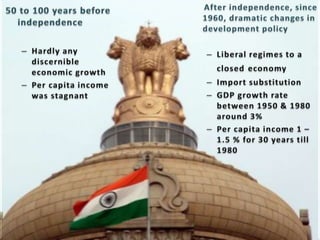
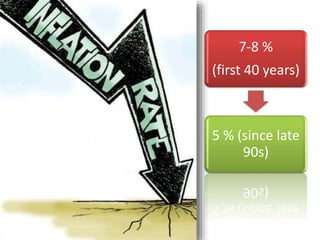
7-8 %
(first 40 years)
5 % (since late
90s)
+ -
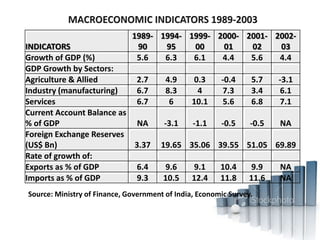
INDICATORS
1989-
90
1994-
95
1999-
00
2000-
01
2001-
02
2002-
03
Growth of GDP (%) 5.6 6.3 6.1 4.4 5.6 4.4
GDP Growth by Sectors:
Agriculture & Allied 2.7 4.9 0.3 -0.4 5.7 -3.1
Industry (manufacturing) 6.7 8.3 4 7.3 3.4 6.1
Services 6.7 6 10.1 5.6 6.8 7.1
Current Account Balance as
% of GDP NA -3.1 -1.1 -0.5 -0.5 NA
Foreign Exchange Reserves
(US$ Bn) 3.37 19.65 35.06 39.55 51.05 69.89
Rate of growth of:
Exports as % of GDP 6.4 9.6 9.1 10.4 9.9 NA
Imports as % of GDP 9.3 10.5 12.4 11.8 11.6 NA
Source: Ministry of Finance, Government of India, Economic Survey.
Year
Per Capita Income
(at 1993-94
prices)Rs
Poverty
(%)
Literacy
(%)
Life
Expectancy
(years)
Power
Capacity
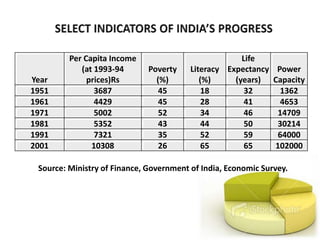
1951 3687 45 18 32 1362
1961 4429 45 28 41 4653
1971 5002 52 34 46 14709
1981 5352 43 44 50 30214
1991 7321 35 52 59 64000
2001 10308 26 65 65 102000
Source: Ministry of Finance, Government of India, Economic Survey.
Quality of
Assets
Extent of Competition (Percentage
share in Total Bank Assets)
Net
NPL/Assets
Foreign
Banks
Private
Sector
Banks
Public
Sector
Banks
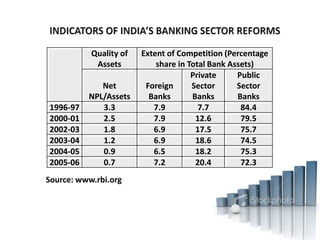
1996-97 3.3 7.9 7.7 84.4
2000-01 2.5 7.9 12.6 79.5
2002-03 1.8 6.9 17.5 75.7
2003-04 1.2 6.9 18.6 74.5
2004-05 0.9 6.5 18.2 75.3
2005-06 0.7 7.2 20.4 72.3
Source: www.rbi.org
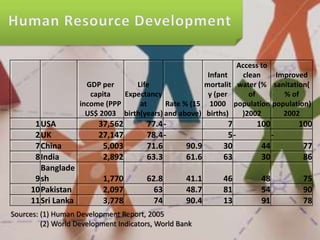
GDP per
capita
income (PPP
US$ 2003
Life
Expectancy
at
birth(years)
Rate % (15
and above)
Infant
mortalit
y (per
1000
births)
Access to
clean
water (%
of
population
)2002
Improved
sanitation(
% of
population)
2002
1USA 37,562 77.4- 7 100 100
2UK 27,147 78.4- 5- -
7China 5,003 71.6 90.9 30 44 77
8India 2,892 63.3 61.6 63 30 86
9
Banglade
sh 1,770 62.8 41.1 46 48 75
10Pakistan 2,097 63 48.7 81 54 90
11Sri Lanka 3,778 74 90.4 13 91 78
Sources: (1) Human Development Report, 2005
(2) World Development Indicators, World Bank
Economic Reforms  Project

Economic Reforms Project

  • 11.
    7-8 % (first 40years) 5 % (since late 90s)
  • 23.
  • 24.
    INDICATORS 1989- 90 1994- 95 1999- 00 2000- 01 2001- 02 2002- 03 Growth of GDP(%) 5.6 6.3 6.1 4.4 5.6 4.4 GDP Growth by Sectors: Agriculture & Allied 2.7 4.9 0.3 -0.4 5.7 -3.1 Industry (manufacturing) 6.7 8.3 4 7.3 3.4 6.1 Services 6.7 6 10.1 5.6 6.8 7.1 Current Account Balance as % of GDP NA -3.1 -1.1 -0.5 -0.5 NA Foreign Exchange Reserves (US$ Bn) 3.37 19.65 35.06 39.55 51.05 69.89 Rate of growth of: Exports as % of GDP 6.4 9.6 9.1 10.4 9.9 NA Imports as % of GDP 9.3 10.5 12.4 11.8 11.6 NA Source: Ministry of Finance, Government of India, Economic Survey.
  • 25.
    Year Per Capita Income (at1993-94 prices)Rs Poverty (%) Literacy (%) Life Expectancy (years) Power Capacity 1951 3687 45 18 32 1362 1961 4429 45 28 41 4653 1971 5002 52 34 46 14709 1981 5352 43 44 50 30214 1991 7321 35 52 59 64000 2001 10308 26 65 65 102000 Source: Ministry of Finance, Government of India, Economic Survey.
  • 26.
    Quality of Assets Extent ofCompetition (Percentage share in Total Bank Assets) Net NPL/Assets Foreign Banks Private Sector Banks Public Sector Banks 1996-97 3.3 7.9 7.7 84.4 2000-01 2.5 7.9 12.6 79.5 2002-03 1.8 6.9 17.5 75.7 2003-04 1.2 6.9 18.6 74.5 2004-05 0.9 6.5 18.2 75.3 2005-06 0.7 7.2 20.4 72.3 Source: www.rbi.org
  • 31.
    GDP per capita income (PPP US$2003 Life Expectancy at birth(years) Rate % (15 and above) Infant mortalit y (per 1000 births) Access to clean water (% of population )2002 Improved sanitation( % of population) 2002 1USA 37,562 77.4- 7 100 100 2UK 27,147 78.4- 5- - 7China 5,003 71.6 90.9 30 44 77 8India 2,892 63.3 61.6 63 30 86 9 Banglade sh 1,770 62.8 41.1 46 48 75 10Pakistan 2,097 63 48.7 81 54 90 11Sri Lanka 3,778 74 90.4 13 91 78 Sources: (1) Human Development Report, 2005 (2) World Development Indicators, World Bank

Editor's Notes

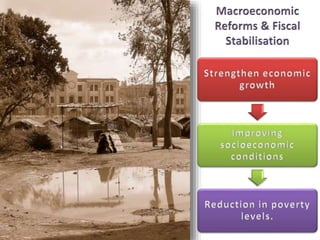
  • #5 Objectives were to: Strengthen economic growth which should translate into improving socioeconomic conditions of the poor Thus reduction in poverty levels.
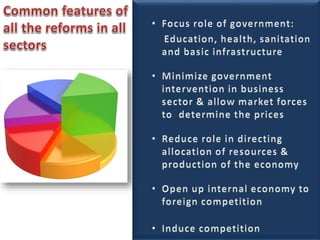
  • #6 The most common features of all the reforms in all sectors has been Minimize government intervention in business sector a& allow market forces to determine the prices Focusing the role of government in providing basic facilities like: education, health, sanitation and basic infrastructure Considerably reduce the role of government in directing the allocation of resources and production of the economy Open up the internal economy to foreign competition Induce competition by allowing private sector to play a great role.
  • #7 macro reforms can be divided into fiscal policy, monetary policy, (c) trade policy, and exchange rate management.
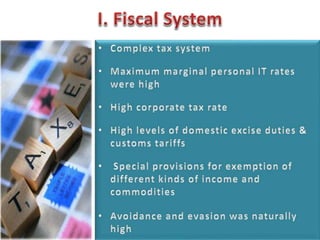
  • #8 Complex tax system Maximum marginal personal income tax rates were high High corporate tax rate High levels of domestic excise duties & customs tariffs, with a myriad of rates for different commodities a number of special provisions for exemption of different kinds of income and commodities avoidance and evasion was naturally high
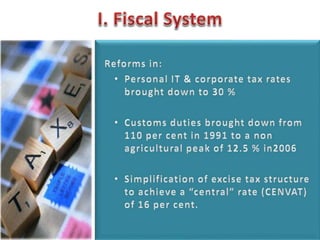
  • #9 personal IT & corporate tax rates gradually been brought down to 30 per cent considerable simplification customs duties brought down from an average of 110 per cent in 1991 (with highs over 400 percent) to a non agricultural peak of 12.5 per cent in 2006. massive simplification of the excise tax structure to achieve a “central” rate (CENVAT) of 16 per cent (apart from a few exceptions like food products, textiles and some optical fibres that attract lower tax rates).
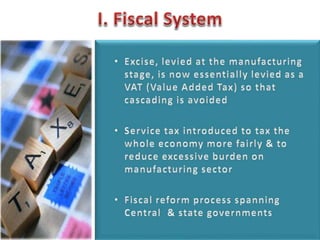
  • #10 Excise, which is levied at the manufacturing stage, is now essentially levied as a VAT (Value Added Tax) so that cascading is avoided. the service tax has been introduced in order to tax the whole economy more fairly and to reduce the excessive burden on one sector, the manufacturing sector. the fiscal reform process spanning both the central and state governments has been truly wide ranging
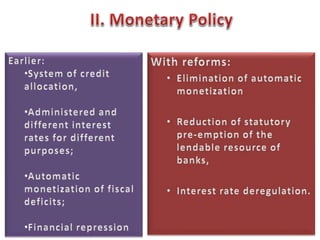
  • #11 Independence of monetary policy and Central bank has been restored.
  • #12 7-8(average) per cent during the first forty five years fallen to around 5 per cent(average) in the recent period since the late 1990s
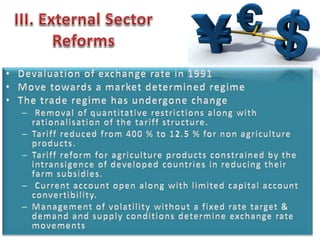
  • #13 Devaluation of exchange rate in 1991 move of the exchange rate regime towards a market determined one The trade regime has undergone massive change removal of quantitative restrictions along with rationalisation of the tariff structure. tariff has been reduced from around 400 per cent to 12.5 per cent for non agriculture products. Tariff reform for agriculture products has been constrained by the intransigence of developed countries in reducing their farm subsidies. current account is now open along with limited capital account convertibility. The exchange rate regime focuses on management of volatility without a fixed rate target and the underlying demand and supply conditions determine the exchange rate movements in an orderly way.
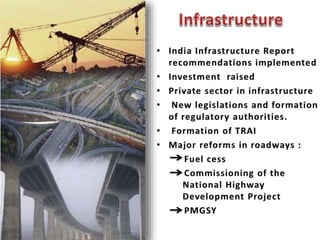
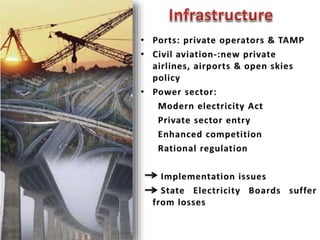
  • #17 India Infrastructure Report recommendations implemented infrastructure investment had to be raised and suggested introduction of the private sector in infrastructure which had been restricted earlier. necessitated wide ranging reforms including new legislations and formation of regulatory authorities. formation of the Telecom Regulatory Authority of India (TRAI), telecom is indeed a success story. The major reforms in roadways were: imposition of a fuel cess to finance highway construction; the commissioning of the National Highway Development Project and PMGSY (Prime Minister's Gram Sadak Yojana or the Rural Roads Programme).
  • #18 India Infrastructure Report recommendations implemented infrastructure investment had to be raised and suggested introduction of the private sector in infrastructure which had been restricted earlier. necessitated wide ranging reforms including new legislations and formation of regulatory authorities. formation of the Telecom Regulatory Authority of India (TRAI), telecom is indeed a success story. The major reforms in roadways were: imposition of a fuel cess to finance highway construction; the commissioning of the National Highway Development Project and PMGSY (Prime Minister's Gram Sadak Yojana or the Rural Roads Programme).
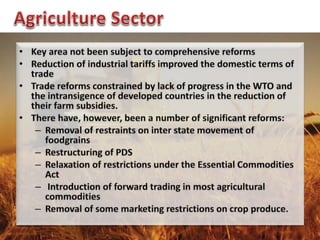
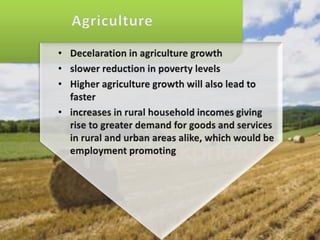
  • #21 There is no doubt, however, that agricultural development needs much more focused attention in order to revive the somewhat stagnating agricultural economy.