•
CHAPTER OUTLINE
• Pre – reforms scenario or economic scenario in 1991
• The need for economic reforms
• Roots of the crisis
• New Economic Policy or Economic Reforms since 1991-
meaning and objectives

• Components of New Economic Policy – measures

taken
Liberalization
Privatizing
Globalization
• Impact of LPG policies on the Indian Economy
Pre – reforms scenario
• Large scale investment in Public sector and
comparatively lesser role of the private sector
• The economic scenario in the country in year
1991 was, thus very much depressing as the
economy was on the brink of collapse.
The nature of economic crisis and the
need for economic reforms
• A continuous and increasing fiscal deficit- during
1990-91 the fiscal deficits were as high as 8.4 per
cent of GDP
• high rate of inflation especially sharp rise in the
prices of essential goods- in 1991 with annual
rate of inflation at 12.1 percent had reached a
peak level of 16.7 percent in August 1991
• A high trade deficit and balance of payment crisis
• Gulf crisis leading to high external debt
• Poor performance of PSUs
Roots of the crisis
• Control and subsidies- license-permit-control
raj was bad.
• Inward- looking policy
• Burden of foreign debts
• Non developmental expenditure of the
government
• In order to overcome this cries, the
government of India approached the World
Bank and IMF. They gave the loan to manage
the crisis but imposed the conditions that
India should liberalize the economy and
private sector should be given more freedom
to operate. India accepted these conditions
and consequently announced NEP New
Economic Policy
NEP
The main objectives of NEP
• To reduce the rate of inflation in domestic
territory
• To reduce fiscal deficit.
• To improve the balance of payment situation
• To encourage foreign capital investment
• To improve efficiency and productivity of the
economy
• To put the economy back on the path of
sustainable growth with social justice.
Broad directions
• Reducing the extent of government controls
over various areas of the domestic economy.
• Increasing the role of the private sector
• Redirecting scarce public sector resource to
areas where the private sector is unlikely to
enter.
• Opening up of the economy to trade and
foreign investments and thus integrating it
with the global economy.
NEP can be classified
• Stabilization Measures
• Structural reforms measures
Components of NEP
• Liberalization
• Privatization
• Globalization
liberalization
• An economic policy which gives relaxations to
entrepreneurs to enable them to make their
decisions and give freedom to undertake
economic activities at all levels is termed as
policy of economic liberalization
Objectives of liberalization
• To unshackle the Indian industry form needless
and irksome controls
• To release the growth promoting entrepreneurial
energies
• To get rid of costly delays
• To enhance production of a verity of goods
• To upgrade technology
• To develop international competitiveness and
integrate the Indian economy with the world
economy.
Liberalization measures
1.Industrial policy reforms
• Reduction in industrial licensing – industrial
licensing had been abolished for all items
except a short list of 5 industries Alcoholic,
Cigarettes, Specific hazardous chemicals,
Industrial explosive, Electronic aerospace and
defense equipment.
• De-reservation of industries for public sector _ at
present only tow industries are reserved for
operations of public sector Atomic energy
generation, Railway operations.
• Reforms in small scale sector- the investment
celling on plant and machinery for micro, small
and medium undertakings was enhanced.
• Expansion of production capacity- what to
produce and how to produce would now be
decided by the market forces
2.Financial sector reforms
• Movement to market determined interest rate structure
• Capital market development
• Reduction in the statutory liquidity ratio
• Increase in the foreign investment limit in banks up to 50 per cent
• Foreign institutional investors such as merchant bankers, mutual
fund and pension funds to be allowed to invest in Indian financial
markets
• Establishment of private sector banks, Indian as well as foreign
• Freedom to certain selected banks to set up new branches and to
rationalize existing branch networks without the approval of the RBI
• Banks have been permitted to generate resources form India and
abroad. However some regulatory power has been retained by the
RBI to safeguard the interests of the country.
3.Trade and investment policy reforms
• Abolition of import licensing system
• Removal of quantitative restriction on
imports.
• Reduction in tariff rates
• Strengthening the exports promotion
structure by removing export duties.
4. Tax reforms
• Reduction in the rates of income tax and
corporate tax so that tax evasion could be
reduced
• Reforms are also made in indirect taxes so
that common national markets of goods and
services can be established
• Simplification of tax structure.
5.Foreign Exchange Reforms
• In order to overcome balance of payments
crisis, an important measures that was
adopted was the devolution of the rupee.
Privatization
Transfer of ownership and control form the
public sector to private sector by two ways
• Withdrawal of the government ownership and
management form jointly owned enterprises.
• Sale of all or some of the assets of public
enterprises to private entrepreneur.
Disinvestment
• Every year government fixes a target for
disinvestment of public sector undertakings
• In the year 1991-92 government was able to
mobiles ₹ 3038 crores from disinvestment
proceeds as against the target at ₹2500 crores.
• In the year 2017-18 the target of ₹100000 crores
was set up and the achievement was about
₹100057 crores
• The government has set up a target of ₹80000
crores for the year 2018-19
Objectives of disinvestment
• To release the public resources for the use of high
priority areas
• To reduce day-to-day interference and to give
greater autonomy to the PSUs for their
management in order to restructure and
strengthen the public sector enterprises which
are potentially viable.
• To reduce public debt
• Modernization and upgradation to increase
efficiency and competitiveness of PSUs
• To reduce the losses of PSUs.
Rational behind privatization
• Privatization will promote competition and
efficiency
• Privatization will also attract FDI and promote
diversification of production.
• Privatization promotes consumer sovereignty
thereby implying a wider choice for
consumers.
Case against of Privatization
• Private sector is guided by profit motive
• It does not take interest in the projects which
take long time to complete and have low
profitability.
• Privatization encourages production of goods
for those who have the means to buy them
• Privatization without completion only results
in inefficient private sector
Obstacles to Privatization
• The greatest obstacle in the process of
privatization has been the resistance of
workers through their unions.
• There is a danger of fraudulent practice on the
part of the state to use book value of net
assets.
Navratnas and Maharatnas
• BHEL
• BPCL
• HPCL
• IOC
• NTPC
• ONGC
• SAIL
• VSNL
• IPCL
• At present there are 17 navratnas
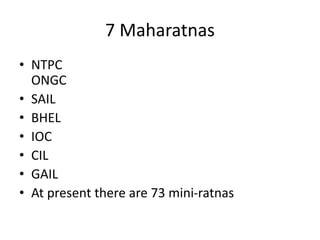
7 Maharatnas
• NTPC
ONGC
• SAIL
• BHEL
• IOC
• CIL
• GAIL
• At present there are 73 mini-ratnas
Globalisation
• Globalisation refers to the growing economic
inter-dependence of countries worldwide
through the cross-border transactions in
goods and services, international capital flows
and also through the more rapid and
widespread diffusing of technology
Components of gobalisation
• Reduction of trade barriers to permit free flow
of goods across national frontiers
• Free flow of capital among nation states
• Free flow of technology
• Free movement of labour among different
countries of the world
Influence of globalization in India
• FDI was promoted
• Partial convertibility of rupee was allowed. Sale
and purchase of foreign currency at market price
was allowed for current account transactions like
import and export of goods and services,
payment of interest or dividends on investment
and remittances to meet family expenses.
• Tariff barriers on goods traded between India and
other nations were reduced and quantity
restriction on imports were withdrawn.
Outsourcing
• Outsourcing implies hiring business services
on contract form the outside world
• India has become an important destination for
global outsourcing because
1) India has a large pool of skilled and young
manpower available at relatively low wage rates.
2) Growth of Indian IT industry which has
proved its competitive strength in the world.
W.T.O
• Established on 1st January, 1995 after the
conclusion of Uruguay found in place of
GATT(1947) . India was a founder member of
both the GATT .
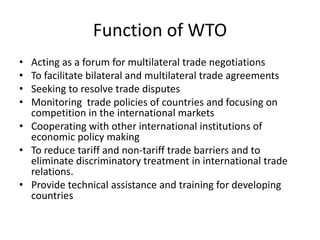
Function of WTO
• Acting as a forum for multilateral trade negotiations
• To facilitate bilateral and multilateral trade agreements
• Seeking to resolve trade disputes
• Monitoring trade policies of countries and focusing on
competition in the international markets
• Cooperating with other international institutions of
economic policy making
• To reduce tariff and non-tariff trade barriers and to
eliminate discriminatory treatment in international trade
relations.
• Provide technical assistance and training for developing
countries
Impact of LPG
• 1.Economic growth
Growth rate of different sectors (%)
Sector 2002-07 2007-12 2015-16 2016-17
Agriculture 2.13 3.6 0.7 4.9
Industry 8.9 7.56 8.8 5.6
Services 9.3 9.6 9.7 7.7
GDP 7.5 8.0 8.0 7.1
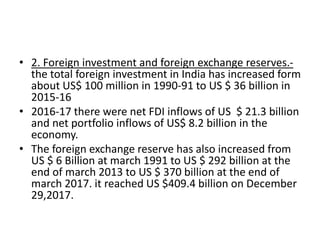
• 2. Foreign investment and foreign exchange reserves.-
the total foreign investment in India has increased form
about US$ 100 million in 1990-91 to US $ 36 billion in
2015-16
• 2016-17 there were net FDI inflows of US $ 21.3 billion
and net portfolio inflows of US$ 8.2 billion in the
economy.
• The foreign exchange reserve has also increased from
US $ 6 Billion at march 1991 to US $ 292 billion at the
end of march 2013 to US $ 370 billion at the end of
march 2017. it reached US $409.4 billion on December
29,2017.
• 3.Export sector
• 4.A transition from monopoly to competitive
market structure
• 5.Check on fiscal deficit
• 6.Check on inflation
Negative impact of LPG
• Neglect of agriculture – the share of
agriculture sector has declined in the GDP
from 29% in 1991-92 to 17.4% in 2014-15
• Economic colonialism
• Spread of consumerism
• Non-inclusive growth
• Jobless growth
• disinvestment
Any questions ?
Liberlisation privatisation and globalisation - an apprraisal

Liberlisation privatisation and globalisation - an apprraisal

  • 1.
  • 2.
    CHAPTER OUTLINE • Pre– reforms scenario or economic scenario in 1991 • The need for economic reforms • Roots of the crisis • New Economic Policy or Economic Reforms since 1991- meaning and objectives • Components of New Economic Policy – measures taken Liberalization Privatizing Globalization • Impact of LPG policies on the Indian Economy
  • 3.
    Pre – reformsscenario • Large scale investment in Public sector and comparatively lesser role of the private sector • The economic scenario in the country in year 1991 was, thus very much depressing as the economy was on the brink of collapse.
  • 4.
    The nature ofeconomic crisis and the need for economic reforms • A continuous and increasing fiscal deficit- during 1990-91 the fiscal deficits were as high as 8.4 per cent of GDP • high rate of inflation especially sharp rise in the prices of essential goods- in 1991 with annual rate of inflation at 12.1 percent had reached a peak level of 16.7 percent in August 1991 • A high trade deficit and balance of payment crisis • Gulf crisis leading to high external debt • Poor performance of PSUs
  • 5.
    Roots of thecrisis • Control and subsidies- license-permit-control raj was bad. • Inward- looking policy • Burden of foreign debts • Non developmental expenditure of the government
  • 6.
    • In orderto overcome this cries, the government of India approached the World Bank and IMF. They gave the loan to manage the crisis but imposed the conditions that India should liberalize the economy and private sector should be given more freedom to operate. India accepted these conditions and consequently announced NEP New Economic Policy
  • 7.
    NEP The main objectivesof NEP • To reduce the rate of inflation in domestic territory • To reduce fiscal deficit. • To improve the balance of payment situation • To encourage foreign capital investment • To improve efficiency and productivity of the economy • To put the economy back on the path of sustainable growth with social justice.
  • 8.
    Broad directions • Reducingthe extent of government controls over various areas of the domestic economy. • Increasing the role of the private sector • Redirecting scarce public sector resource to areas where the private sector is unlikely to enter. • Opening up of the economy to trade and foreign investments and thus integrating it with the global economy.
  • 9.
    NEP can beclassified • Stabilization Measures • Structural reforms measures
  • 10.
    Components of NEP •Liberalization • Privatization • Globalization
  • 11.
    liberalization • An economicpolicy which gives relaxations to entrepreneurs to enable them to make their decisions and give freedom to undertake economic activities at all levels is termed as policy of economic liberalization
  • 12.
    Objectives of liberalization •To unshackle the Indian industry form needless and irksome controls • To release the growth promoting entrepreneurial energies • To get rid of costly delays • To enhance production of a verity of goods • To upgrade technology • To develop international competitiveness and integrate the Indian economy with the world economy.
  • 13.
    Liberalization measures 1.Industrial policyreforms • Reduction in industrial licensing – industrial licensing had been abolished for all items except a short list of 5 industries Alcoholic, Cigarettes, Specific hazardous chemicals, Industrial explosive, Electronic aerospace and defense equipment.
  • 14.
    • De-reservation ofindustries for public sector _ at present only tow industries are reserved for operations of public sector Atomic energy generation, Railway operations. • Reforms in small scale sector- the investment celling on plant and machinery for micro, small and medium undertakings was enhanced. • Expansion of production capacity- what to produce and how to produce would now be decided by the market forces
  • 15.
    2.Financial sector reforms •Movement to market determined interest rate structure • Capital market development • Reduction in the statutory liquidity ratio • Increase in the foreign investment limit in banks up to 50 per cent • Foreign institutional investors such as merchant bankers, mutual fund and pension funds to be allowed to invest in Indian financial markets • Establishment of private sector banks, Indian as well as foreign • Freedom to certain selected banks to set up new branches and to rationalize existing branch networks without the approval of the RBI • Banks have been permitted to generate resources form India and abroad. However some regulatory power has been retained by the RBI to safeguard the interests of the country.
  • 16.
    3.Trade and investmentpolicy reforms • Abolition of import licensing system • Removal of quantitative restriction on imports. • Reduction in tariff rates • Strengthening the exports promotion structure by removing export duties.
  • 17.
    4. Tax reforms •Reduction in the rates of income tax and corporate tax so that tax evasion could be reduced • Reforms are also made in indirect taxes so that common national markets of goods and services can be established • Simplification of tax structure.
  • 18.
    5.Foreign Exchange Reforms •In order to overcome balance of payments crisis, an important measures that was adopted was the devolution of the rupee.
  • 19.
    Privatization Transfer of ownershipand control form the public sector to private sector by two ways • Withdrawal of the government ownership and management form jointly owned enterprises. • Sale of all or some of the assets of public enterprises to private entrepreneur.
  • 20.
    Disinvestment • Every yeargovernment fixes a target for disinvestment of public sector undertakings • In the year 1991-92 government was able to mobiles ₹ 3038 crores from disinvestment proceeds as against the target at ₹2500 crores. • In the year 2017-18 the target of ₹100000 crores was set up and the achievement was about ₹100057 crores • The government has set up a target of ₹80000 crores for the year 2018-19
  • 21.
    Objectives of disinvestment •To release the public resources for the use of high priority areas • To reduce day-to-day interference and to give greater autonomy to the PSUs for their management in order to restructure and strengthen the public sector enterprises which are potentially viable. • To reduce public debt • Modernization and upgradation to increase efficiency and competitiveness of PSUs • To reduce the losses of PSUs.
  • 22.
    Rational behind privatization •Privatization will promote competition and efficiency • Privatization will also attract FDI and promote diversification of production. • Privatization promotes consumer sovereignty thereby implying a wider choice for consumers.
  • 23.
    Case against ofPrivatization • Private sector is guided by profit motive • It does not take interest in the projects which take long time to complete and have low profitability. • Privatization encourages production of goods for those who have the means to buy them • Privatization without completion only results in inefficient private sector
  • 24.
    Obstacles to Privatization •The greatest obstacle in the process of privatization has been the resistance of workers through their unions. • There is a danger of fraudulent practice on the part of the state to use book value of net assets.
  • 25.
    Navratnas and Maharatnas •BHEL • BPCL • HPCL • IOC • NTPC • ONGC • SAIL • VSNL • IPCL • At present there are 17 navratnas
  • 26.
    7 Maharatnas • NTPC ONGC •SAIL • BHEL • IOC • CIL • GAIL • At present there are 73 mini-ratnas
  • 27.
    Globalisation • Globalisation refersto the growing economic inter-dependence of countries worldwide through the cross-border transactions in goods and services, international capital flows and also through the more rapid and widespread diffusing of technology
  • 28.
    Components of gobalisation •Reduction of trade barriers to permit free flow of goods across national frontiers • Free flow of capital among nation states • Free flow of technology • Free movement of labour among different countries of the world
  • 29.
    Influence of globalizationin India • FDI was promoted • Partial convertibility of rupee was allowed. Sale and purchase of foreign currency at market price was allowed for current account transactions like import and export of goods and services, payment of interest or dividends on investment and remittances to meet family expenses. • Tariff barriers on goods traded between India and other nations were reduced and quantity restriction on imports were withdrawn.
  • 30.
    Outsourcing • Outsourcing implieshiring business services on contract form the outside world • India has become an important destination for global outsourcing because 1) India has a large pool of skilled and young manpower available at relatively low wage rates. 2) Growth of Indian IT industry which has proved its competitive strength in the world.
  • 31.
    W.T.O • Established on1st January, 1995 after the conclusion of Uruguay found in place of GATT(1947) . India was a founder member of both the GATT .
  • 32.
    Function of WTO •Acting as a forum for multilateral trade negotiations • To facilitate bilateral and multilateral trade agreements • Seeking to resolve trade disputes • Monitoring trade policies of countries and focusing on competition in the international markets • Cooperating with other international institutions of economic policy making • To reduce tariff and non-tariff trade barriers and to eliminate discriminatory treatment in international trade relations. • Provide technical assistance and training for developing countries
  • 33.
    Impact of LPG •1.Economic growth Growth rate of different sectors (%) Sector 2002-07 2007-12 2015-16 2016-17 Agriculture 2.13 3.6 0.7 4.9 Industry 8.9 7.56 8.8 5.6 Services 9.3 9.6 9.7 7.7 GDP 7.5 8.0 8.0 7.1
  • 34.
    • 2. Foreigninvestment and foreign exchange reserves.- the total foreign investment in India has increased form about US$ 100 million in 1990-91 to US $ 36 billion in 2015-16 • 2016-17 there were net FDI inflows of US $ 21.3 billion and net portfolio inflows of US$ 8.2 billion in the economy. • The foreign exchange reserve has also increased from US $ 6 Billion at march 1991 to US $ 292 billion at the end of march 2013 to US $ 370 billion at the end of march 2017. it reached US $409.4 billion on December 29,2017.
  • 35.
    • 3.Export sector •4.A transition from monopoly to competitive market structure • 5.Check on fiscal deficit • 6.Check on inflation
  • 36.
    Negative impact ofLPG • Neglect of agriculture – the share of agriculture sector has declined in the GDP from 29% in 1991-92 to 17.4% in 2014-15 • Economic colonialism • Spread of consumerism • Non-inclusive growth • Jobless growth • disinvestment
  • 37.