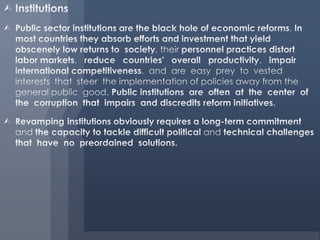
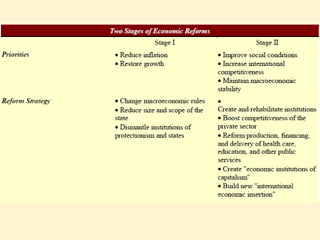
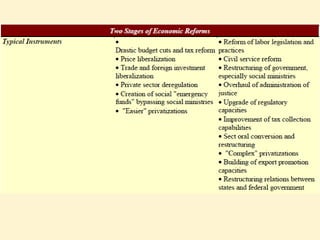
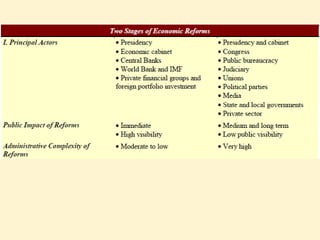
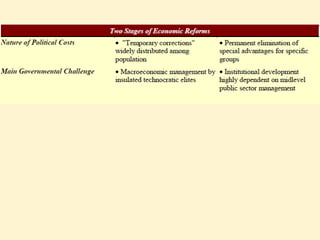
Two stages of Economic Reforms
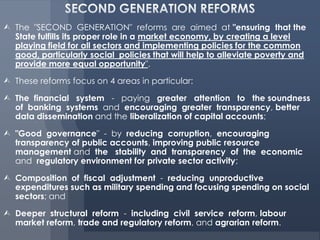
 The "SECOND GENERATION" reforms are aimed at "ensuring that the
  State fulfills its proper role in a market economy, by creating a level
  playing field for all sectors and implementing policies for the common
  good, particularly social policies that will help to alleviate poverty and
  provide more equal opportunity".

 These reforms focus on 4 areas in particular:

 The financial system - paying greater attention to the soundness
  of banking systems and encouraging greater transparency, better
  data dissemination and the liberalization of capital accounts;

 "Good governance" - by reducing corruption, encouraging
  transparency of public accounts, improving public resource
  management and the stability and transparency of the economic
  and regulatory environment for private sector activity;

 Composition of fiscal adjustment - reducing unproductive
  expenditures such as military spending and focusing spending on social
  sectors; and

 Deeper structural reform - including civil service reform, labour
  market reform, trade and regulatory reform, and agrarian reform.
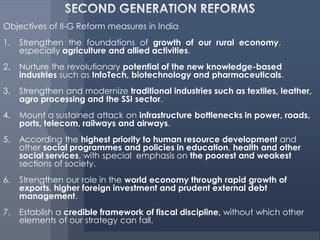
Objectives of II-G Reform measures in India
1.   Strengthen the foundations of growth of our rural economy,
     especially agriculture and allied activities.
2.   Nurture the revolutionary potential of the new knowledge-based
     industries such as InfoTech, biotechnology and pharmaceuticals.
3.   Strengthen and modernize traditional industries such as textiles, leather,
     agro processing and the SSI sector.
4.   Mount a sustained attack on infrastructure bottlenecks in power, roads,
     ports, telecom, railways and airways.
5.   According the highest priority to human resource development and
     other social programmes and policies in education, health and other
     social services, with special emphasis on the poorest and weakest
     sections of society.
6.   Strengthen our role in the world economy through rapid growth of
     exports, higher foreign investment and prudent external debt
     management.
7.   Establish a credible framework of fiscal discipline, without which other
     elements of our strategy can fall.
http://www.youtube.com/watch?v=CuRJ
WZ5GXag

http://www.youtube.com/watch?v=GI0oV
dDfg88

http://www.youtube.com/watch?v=HkkWz
weEibM

http://www.youtube.com/watch?v=RA5IfL
URB8Y

Economic reforms of india

  • 20.
    Two stages ofEconomic Reforms
  • 42.
     The "SECONDGENERATION" reforms are aimed at "ensuring that the State fulfills its proper role in a market economy, by creating a level playing field for all sectors and implementing policies for the common good, particularly social policies that will help to alleviate poverty and provide more equal opportunity".  These reforms focus on 4 areas in particular:  The financial system - paying greater attention to the soundness of banking systems and encouraging greater transparency, better data dissemination and the liberalization of capital accounts;  "Good governance" - by reducing corruption, encouraging transparency of public accounts, improving public resource management and the stability and transparency of the economic and regulatory environment for private sector activity;  Composition of fiscal adjustment - reducing unproductive expenditures such as military spending and focusing spending on social sectors; and  Deeper structural reform - including civil service reform, labour market reform, trade and regulatory reform, and agrarian reform.
  • 44.
    Objectives of II-GReform measures in India 1. Strengthen the foundations of growth of our rural economy, especially agriculture and allied activities. 2. Nurture the revolutionary potential of the new knowledge-based industries such as InfoTech, biotechnology and pharmaceuticals. 3. Strengthen and modernize traditional industries such as textiles, leather, agro processing and the SSI sector. 4. Mount a sustained attack on infrastructure bottlenecks in power, roads, ports, telecom, railways and airways. 5. According the highest priority to human resource development and other social programmes and policies in education, health and other social services, with special emphasis on the poorest and weakest sections of society. 6. Strengthen our role in the world economy through rapid growth of exports, higher foreign investment and prudent external debt management. 7. Establish a credible framework of fiscal discipline, without which other elements of our strategy can fall.
  • 49.