The term economic reform broadly indicates
necessary structural adjustments to external
events. It include the function of country’s
spending to the level parallel to its income
and thereby reducing fiscal deficits.
This requires gradual reduction in import and
increase in export. These adjustments also
requires market change in order to make
economy flexible.
The present process of economic reforms was
born out of the crisis in the economy, which
climaxed in 1991. The crisis compelled the
government to adopt a new path-breaking
economic policy under which a series of
economic reform measures were initiated
with the objective to deal with the crisis and
to take the economy on a high-growth path.
 Increase in Fiscal Deficit
 Increase in adverse balance of Payment
 Gulf Crisis
 Fall in foreign Exchange Reserve
 Rise in Prices
 Poor Performance of Public Sector
The top and immediate priority of the
government was to stabilize the economy,
bring the growth of the economy to its
normal track and to win back confidence of
masses in the country and the international
financial community.
The crisis management measures focussed
largely on fiscal correction, industrial
decontrol and balance of payments.
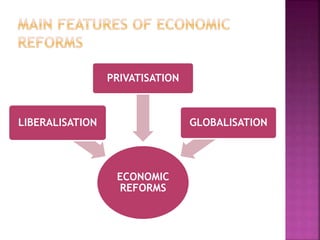
ECONOMIC
REFORMS
LIBERALISATION
PRIVATISATION
GLOBALISATION
It means to free the economy from direct or
physical controls imposed by the
government. Prior 1991, government had
imposed several types of controls on Indian
economy e.g. industrial licensing system,
price control or financial control on goods,
import license, foreign exchange control,
restriction on investment by big business
houses, etc. These controls leads to fall in
economy growth. Economic reforms were
based on the assumption that market
forces could guide the economy in a more
effective manner than government control.
 Abolition of industrial licensing and
Registration : According to new industrial
policy , with the exception of 6 sectors,
industrial licensing has been removed.
 Concession from MRTP Act
 Freedom from Expansion and Production to
Industries
 Increase in the Investment Limit of the Small
Industries: It has been raised to Rs 1crore &
Investment limit has been raised to Rs 25
lakh.
 Freedom to import capital goods
 Freedom to import technology
 Action plan for information Technology and
software development.
Privatisation means allowing the private
sector to set up more and more of industries
that were previously reserved for public
sector.
It can take in three in forms:
a. Change in ownership: Degree of
privatisation judged by the extent of
ownership transferred from public to
private sector. This can have four forms:
i) Total Nationalisation
ii) Joint Venture
iii) Liquidation
IV) Workers Co-operative
b. Organizational Measures: It includes variety
of measures to limit state control.
i) A holding Company Structure
ii) Leasing
c. Operational Measures: Autonomy to the
operators of the enterprise.
 To increase efficiency & competitive power
of the enterprises
 To strengthen industrial management.
 To earn more & more Foreign currency.
 To make optimum use of resources
 To achieve rapid industrial development of
the country.
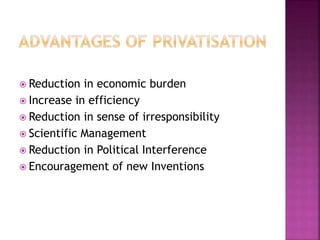
 Reduction in economic burden
 Increase in efficiency
 Reduction in sense of irresponsibility
 Scientific Management
 Reduction in Political Interference
 Encouragement of new Inventions
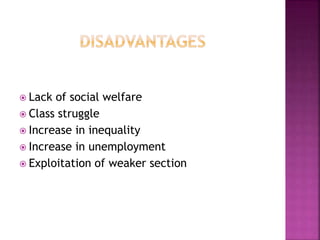
 Lack of social welfare
 Class struggle
 Increase in inequality
 Increase in unemployment
 Exploitation of weaker section
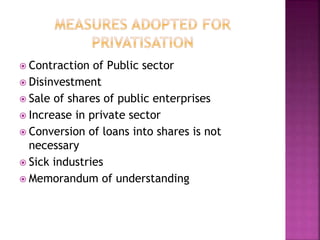
 Contraction of Public sector
 Disinvestment
 Sale of shares of public enterprises
 Increase in private sector
 Conversion of loans into shares is not
necessary
 Sick industries
 Memorandum of understanding
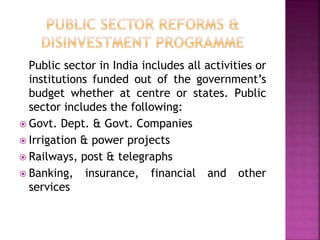
Public sector in India includes all activities or
institutions funded out of the government’s
budget whether at centre or states. Public
sector includes the following:
 Govt. Dept. & Govt. Companies
 Irrigation & power projects
 Railways, post & telegraphs
 Banking, insurance, financial and other
services
 Conflict between the financial and social
objectives
 Problem of losses or low rate of return on
investment
 Lack of professionalism in management
 Time & cost overruns in new projects
 Underutilization of capacity
 Operational inefficiency
 PSU Refocussing
 Memorandum-of-Understanding (MOU)
System of PSE
 Financial & operational autonomy
 Restructuring of sick units
 Privatisation through disinvestment
 Protection of PSU workers’ Interest
The disinvestment programme towards
greater privatization of the economy was
launched in the year 1991-1992 with the
announcement of the new industrial policy in
August 1991 and is an ongoing process even
today. It involves sale of minority stake in a
few PSU, strategic sales, initial public
offering and rights offer. Between August
1991 and March 2003, in all 48 companies
underwent the disinvestment process.
 Valuation of public sector unit
 Method of disinvestment
 The extent of disinvestment
 Issues concerning labour
It is defined as a process associated with
increasing openness, growing economic
independence and Deeping economic
integration in the world economy.
 Reduction of trade barriers
 Free flow of capital
 Free flow of technology
 Free movement of technology
 Stage I: Domestic company exports to foreign
countries through the dealers or distributors of home
country
 Stage II: The domestic company exports to foreign
countries directly on its own.
 Stage III: The domestic company becomes an
international company by establishing production and
marketing operations in various key foreign countries.
 Stage IV: The company replicates a foreign company
in the foreign country by having all the facilities
including R&D, full fledged human resources, etc.
 Stage V: The company becomes a true foreign
company by serving the needs of foreign customers
just like the host country’s company serves.
Globalisation of markets
Globalisation of Production
Globalisation of Technology
Globalisation of Investment
Reduction of import duties
Encouragement of foreign
investment
Reducing custom duty
Devaluation of currency
Partial convertibility

Economic reforms

  • 2.
    The term economicreform broadly indicates necessary structural adjustments to external events. It include the function of country’s spending to the level parallel to its income and thereby reducing fiscal deficits. This requires gradual reduction in import and increase in export. These adjustments also requires market change in order to make economy flexible.
  • 3.
    The present processof economic reforms was born out of the crisis in the economy, which climaxed in 1991. The crisis compelled the government to adopt a new path-breaking economic policy under which a series of economic reform measures were initiated with the objective to deal with the crisis and to take the economy on a high-growth path.
  • 4.
     Increase inFiscal Deficit  Increase in adverse balance of Payment  Gulf Crisis  Fall in foreign Exchange Reserve  Rise in Prices  Poor Performance of Public Sector
  • 5.
    The top andimmediate priority of the government was to stabilize the economy, bring the growth of the economy to its normal track and to win back confidence of masses in the country and the international financial community. The crisis management measures focussed largely on fiscal correction, industrial decontrol and balance of payments.
  • 6.
  • 7.
    It means tofree the economy from direct or physical controls imposed by the government. Prior 1991, government had imposed several types of controls on Indian economy e.g. industrial licensing system, price control or financial control on goods, import license, foreign exchange control, restriction on investment by big business houses, etc. These controls leads to fall in economy growth. Economic reforms were based on the assumption that market forces could guide the economy in a more effective manner than government control.
  • 8.
     Abolition ofindustrial licensing and Registration : According to new industrial policy , with the exception of 6 sectors, industrial licensing has been removed.  Concession from MRTP Act  Freedom from Expansion and Production to Industries  Increase in the Investment Limit of the Small Industries: It has been raised to Rs 1crore & Investment limit has been raised to Rs 25 lakh.
  • 9.
     Freedom toimport capital goods  Freedom to import technology  Action plan for information Technology and software development.
  • 10.
    Privatisation means allowingthe private sector to set up more and more of industries that were previously reserved for public sector. It can take in three in forms: a. Change in ownership: Degree of privatisation judged by the extent of ownership transferred from public to private sector. This can have four forms: i) Total Nationalisation ii) Joint Venture
  • 11.
    iii) Liquidation IV) WorkersCo-operative b. Organizational Measures: It includes variety of measures to limit state control. i) A holding Company Structure ii) Leasing c. Operational Measures: Autonomy to the operators of the enterprise.
  • 12.
     To increaseefficiency & competitive power of the enterprises  To strengthen industrial management.  To earn more & more Foreign currency.  To make optimum use of resources  To achieve rapid industrial development of the country.
  • 13.
     Reduction ineconomic burden  Increase in efficiency  Reduction in sense of irresponsibility  Scientific Management  Reduction in Political Interference  Encouragement of new Inventions
  • 14.
     Lack ofsocial welfare  Class struggle  Increase in inequality  Increase in unemployment  Exploitation of weaker section
  • 15.
     Contraction ofPublic sector  Disinvestment  Sale of shares of public enterprises  Increase in private sector  Conversion of loans into shares is not necessary  Sick industries  Memorandum of understanding
  • 16.
    Public sector inIndia includes all activities or institutions funded out of the government’s budget whether at centre or states. Public sector includes the following:  Govt. Dept. & Govt. Companies  Irrigation & power projects  Railways, post & telegraphs  Banking, insurance, financial and other services
  • 17.
     Conflict betweenthe financial and social objectives  Problem of losses or low rate of return on investment  Lack of professionalism in management  Time & cost overruns in new projects  Underutilization of capacity  Operational inefficiency
  • 18.
     PSU Refocussing Memorandum-of-Understanding (MOU) System of PSE  Financial & operational autonomy  Restructuring of sick units  Privatisation through disinvestment  Protection of PSU workers’ Interest
  • 19.
    The disinvestment programmetowards greater privatization of the economy was launched in the year 1991-1992 with the announcement of the new industrial policy in August 1991 and is an ongoing process even today. It involves sale of minority stake in a few PSU, strategic sales, initial public offering and rights offer. Between August 1991 and March 2003, in all 48 companies underwent the disinvestment process.
  • 20.
     Valuation ofpublic sector unit  Method of disinvestment  The extent of disinvestment  Issues concerning labour
  • 21.
    It is definedas a process associated with increasing openness, growing economic independence and Deeping economic integration in the world economy.  Reduction of trade barriers  Free flow of capital  Free flow of technology  Free movement of technology
  • 22.
     Stage I:Domestic company exports to foreign countries through the dealers or distributors of home country  Stage II: The domestic company exports to foreign countries directly on its own.  Stage III: The domestic company becomes an international company by establishing production and marketing operations in various key foreign countries.  Stage IV: The company replicates a foreign company in the foreign country by having all the facilities including R&D, full fledged human resources, etc.  Stage V: The company becomes a true foreign company by serving the needs of foreign customers just like the host country’s company serves.
  • 23.
    Globalisation of markets Globalisationof Production Globalisation of Technology Globalisation of Investment
  • 24.
    Reduction of importduties Encouragement of foreign investment Reducing custom duty Devaluation of currency Partial convertibility