SEC – A  Date: 29th Dec 2011 M. C. Mehta (Taj Trapezium Matter) Vs Union of India and Others  Presented By:Ashutosh Kumar JhaRoshanSonthaliaStuti GuptaMohd. Faraz KhanNishant SinghSmriti Gupta
Prevent Air pollution and Save TajMahalPetition was filed by ShriM.C.Mehta, Advocate as a public interest litigation Taj Trapezium Zone: area of 10,400 sq km around the TajMahal to protect the monument from pollution.
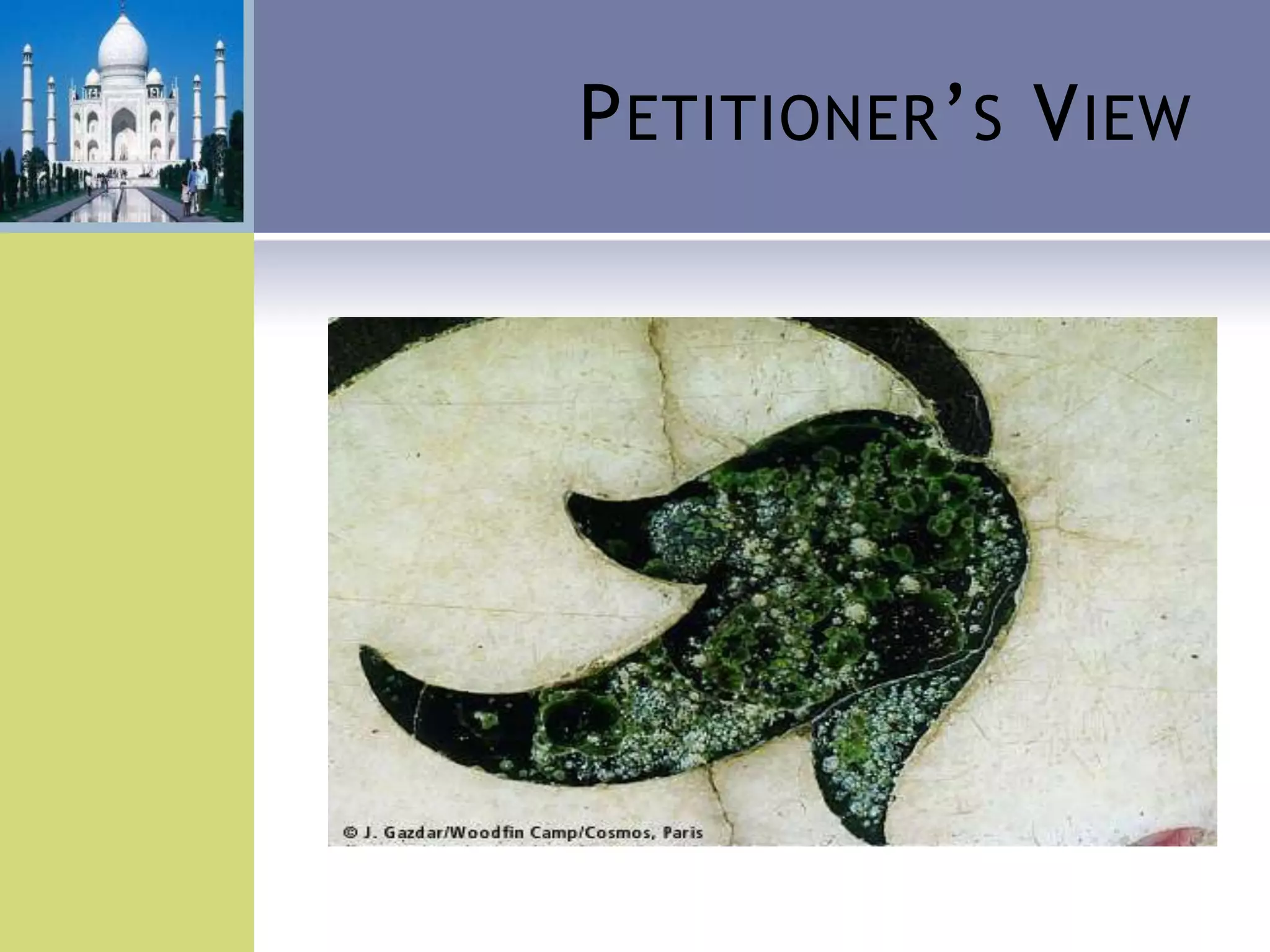
Petitioner’s ViewCauses of Damages - Foundries, Chemical / Hazardous industries and Mathura Refinery Marble Cancer – Yellowing of marbleMonument of International reputeNo degradation due to pollutionPreventive steps
Sources Of Air pollutionMathura refineryFerozabad Bangles & Glass IndustryOthersIron Foundries
 Ferro-alloys
Rubber Processing
Lime Processing
Chemical Industries
 Brick Kilns
 Refractory Units
AutomobilesReports Referred“Report on Environmental Impact of Mathura Refinery” - Varadharajan Committee
“Inventory and Assessment of Pollution Emission: In and Around Agra-Mathura Region (Abridged)” – CPCB
"Over-View Report"  - NEERIVardharajan CommitteeNo new industries on the north west of TajRelocation of existing industries to south eastEIA Study for big industry in Agra regionAuthority for monitoring emissions by industries & air quality in Agra on continuous basisTime-bound ProgrammeExplore the possibility of protecting the monuments by the provision of a green belt
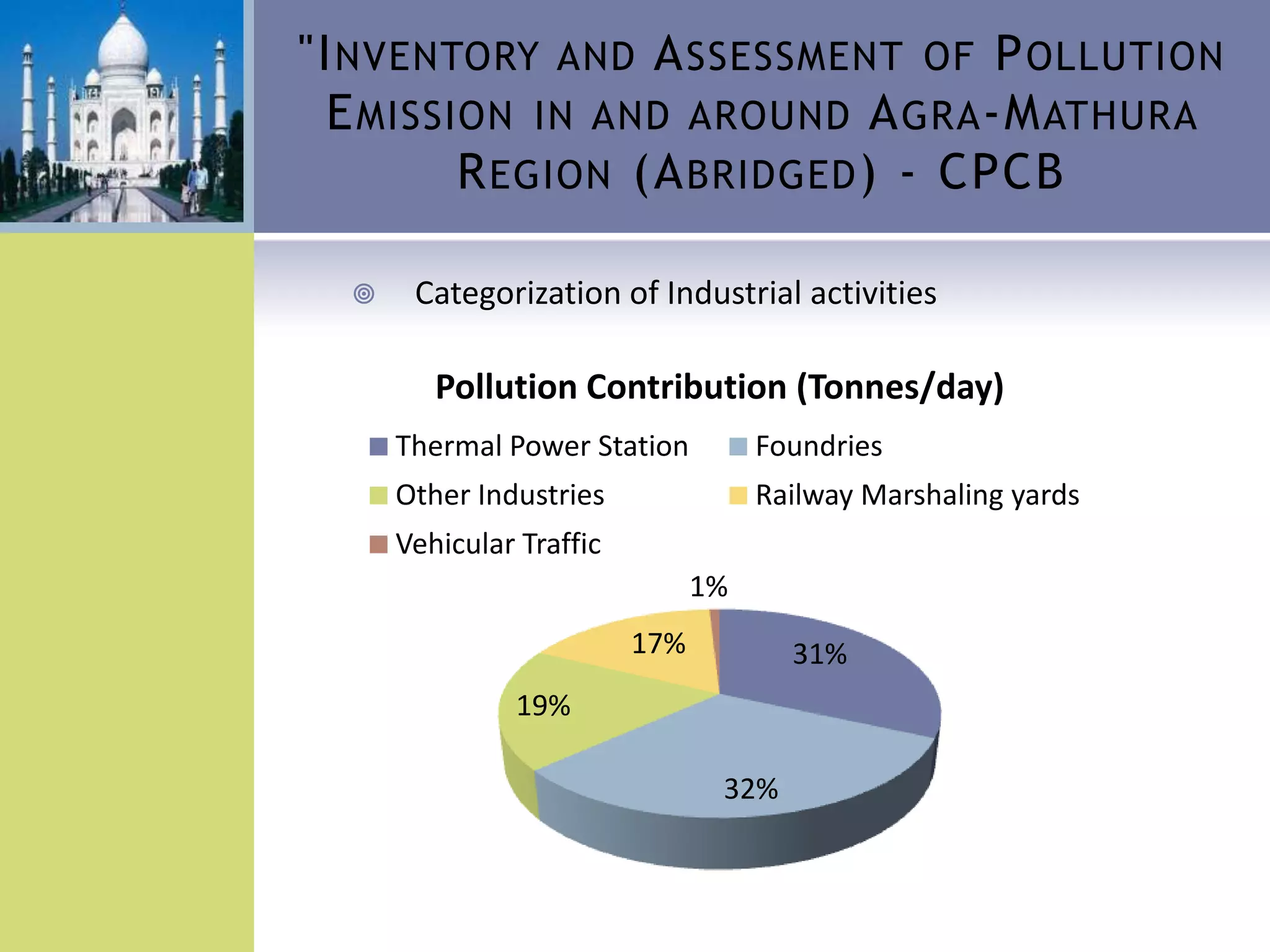
"Inventory and Assessment of Pollution Emission in and around Agra-Mathura Region (Abridged) - CPCBCategorization of Industrial activities
Contribution of Sulphur Dioxide from the 5 recognised distinct discrete sources in tonnes per day 2.28, 2.28, 1.36, 1.21 and 0.065 from (i) two thermal power stations, (ii) foundries, (iii) other industries in Agra, (iv) two railway marshaling yards and (v) vehicular traffic respectivelyElimination of the first and the fourth sources - by closing down the two thermal power stations and replacing coal-fired steam engines by diesel engines in the two railway marshalling yards - about 50 per cent (48.9 to be exact) cut-down of Sulphur Dioxide emission is expected.
NEERI ReportSources of Pollution includes SMEsHigh Air Pollution is pumped into the Taj air shedLevel of pollution was 10  folds than the CPCB Standards on 4 occasions during 5 year monitoringSoot  & Quartz were main causes for black coatingAmbient air round TajMahal is polluted primarily from point/line sources and has adverse impacts on building material by alteration of marble and sandstone structures at micro-crystalline level 
"Issue Associated with Fuel Supply Alternative for Industries in Agra-Mathura Region“ - NEERI Issues raisedNeed for relocation of industries; Availability of cleaner fuel (present and future); Environmental benefits from alternate fuels; Safety considerationsRecommendations Shifting of small-scale polluting industries outside the Taj Trapezium on industrial estate sites to be identified by the Government of Uttar Pradesh;Provision of natural gas to the industries in Agra-Mathura region and Mathura Refinery.
Court’s ViewCultural heritageTourism Industry ( > 2 mn tourists per year)Objective of Litigation: to stop pollution while encouraging development of industryUse of coke/ coal results into pollutionAnswer is “Sustainable Development”       Court: “The development of industry is essential for the economy of the country, but at the same time the environment and the ecosystems have to be protected”
Cases ReferredSustainable DevelopmentPolluter’s Pay PrinciplePrecautionary Principle
Sustainable DevelopmentThe Brundtland Commission – Sustainable development is “development that meets the needs of the present without compromising the ability of future generations to meet their own needs.” India says “Sustainable development means what type or extent of development can take place, which can be sustained by nature/ecology with or without mitigation” in Narmada BachaoAdolan Vs UOI
Precautionary Principle (PP)This Court in Vellore Citizens` Welfare Forum v. Union of India [(1996) 5 SCC 647 : JT (1996) 7 SC 375] has defined "the Precautionary Principle” asEnvironmental measures - by the State Government and the statutory authorities - must anticipate, prevent and attack the causes of environmental degradation.
 Where there are threats of serious and irreversible damage, lack of scientific certainty should not be used as a reason for postponing measures to prevent environmental degradationPolluter’s Pay Enviro-Legal Action v. Union of India [(1996) 3 SCC 212 : JT (1996) 2 SC 196] The `Polluter Pays Principle` as interpreted by this Court means that the absolute liability for harm to the environment extends not only to compensate the victims of pollution but also the cost of restoring the environmental degradation.Remediation of the damaged environment is part of the process of `Sustainable Development
Constitutional provisionsPP & PPP have been accepted as Law of LandArticle 21 of the Constitution provides protection of life and personal libertyArticles 47Duty of the State to raise the level of nutrition and the standard of living and to improve public health. - The State shall regard the raising of the level of nutrition and the standard of living of its people and the improvement of public health as among its primary duties and in particular, the State shall endeavour to bring about prohibition of the consumption except for medicinal purposes of intoxicating drinks and of drugs which are injurious to health
Constitutional provisions contd...Article 48-A. Protection and improvement of environment and safeguarding of forests and wildlife. -The State shall endeavour to protect and improve the environment and to safeguard the forests and wildlife of the country.Article 51-A. (g) to protect and improve the natural environment including forests, lakes, rivers and wildlife, and to have compassion for living creatures.JudgmentThe atmospheric pollution in TTZ has to be eliminated at any cost. Not even one per cent chance can be taken when - human life apart - the preservation of a prestigious monument like the Taj is involved.In view of the precautionary principle as defined by this Court, the environmental measures must anticipate, prevent and attack the causes of environmental degradation. The "onus of proof" is on an industry to show that its operation with the aid of coke/coal is environmental benign. It is, rather, proved beyond doubt that the emissions generated by the use of coke/coal by the industries in TTZ are the main polluters of the ambient air. The mentioned 292 industries shall change over to the National Gas as an industrial fuel. The industries which are not in a position to obtain gas connections - for any reason - shall stop functioning with the aid of coke/coal in the TTZ and may relocate themselves
 Constitution of Mahajan Committee: Constituted by the orders of the Hon’ble Supreme Court on 5.2.1996. Objective  -  inspect the progress of the green belt developed around the TajMahal every three months and submit progress report in the Court for the period of next three years.Supreme Court accepted and directed the installment of 4 Ambient Air Quality Monitoring Stations in Agra region working 24*7 for 1 year Monitoring reports are being submitted to the Hon’ble Court on regular basis since February, 2002.

Taj Trapezium

  • 1.
    SEC – A Date: 29th Dec 2011 M. C. Mehta (Taj Trapezium Matter) Vs Union of India and Others  Presented By:Ashutosh Kumar JhaRoshanSonthaliaStuti GuptaMohd. Faraz KhanNishant SinghSmriti Gupta
  • 2.
    Prevent Air pollutionand Save TajMahalPetition was filed by ShriM.C.Mehta, Advocate as a public interest litigation Taj Trapezium Zone: area of 10,400 sq km around the TajMahal to protect the monument from pollution.
  • 3.
    Petitioner’s ViewCauses ofDamages - Foundries, Chemical / Hazardous industries and Mathura Refinery Marble Cancer – Yellowing of marbleMonument of International reputeNo degradation due to pollutionPreventive steps
  • 4.
    Sources Of AirpollutionMathura refineryFerozabad Bangles & Glass IndustryOthersIron Foundries
  • 5.
  • 6.
  • 7.
  • 8.
  • 9.
  • 10.
  • 11.
    AutomobilesReports Referred“Report onEnvironmental Impact of Mathura Refinery” - Varadharajan Committee
  • 12.
    “Inventory and Assessmentof Pollution Emission: In and Around Agra-Mathura Region (Abridged)” – CPCB
  • 13.
    "Over-View Report" - NEERIVardharajan CommitteeNo new industries on the north west of TajRelocation of existing industries to south eastEIA Study for big industry in Agra regionAuthority for monitoring emissions by industries & air quality in Agra on continuous basisTime-bound ProgrammeExplore the possibility of protecting the monuments by the provision of a green belt
  • 14.
    "Inventory and Assessmentof Pollution Emission in and around Agra-Mathura Region (Abridged) - CPCBCategorization of Industrial activities
  • 15.
    Contribution of SulphurDioxide from the 5 recognised distinct discrete sources in tonnes per day 2.28, 2.28, 1.36, 1.21 and 0.065 from (i) two thermal power stations, (ii) foundries, (iii) other industries in Agra, (iv) two railway marshaling yards and (v) vehicular traffic respectivelyElimination of the first and the fourth sources - by closing down the two thermal power stations and replacing coal-fired steam engines by diesel engines in the two railway marshalling yards - about 50 per cent (48.9 to be exact) cut-down of Sulphur Dioxide emission is expected.
  • 16.
    NEERI ReportSources ofPollution includes SMEsHigh Air Pollution is pumped into the Taj air shedLevel of pollution was 10 folds than the CPCB Standards on 4 occasions during 5 year monitoringSoot & Quartz were main causes for black coatingAmbient air round TajMahal is polluted primarily from point/line sources and has adverse impacts on building material by alteration of marble and sandstone structures at micro-crystalline level 
  • 17.
    "Issue Associated withFuel Supply Alternative for Industries in Agra-Mathura Region“ - NEERI Issues raisedNeed for relocation of industries; Availability of cleaner fuel (present and future); Environmental benefits from alternate fuels; Safety considerationsRecommendations Shifting of small-scale polluting industries outside the Taj Trapezium on industrial estate sites to be identified by the Government of Uttar Pradesh;Provision of natural gas to the industries in Agra-Mathura region and Mathura Refinery.
  • 18.
    Court’s ViewCultural heritageTourismIndustry ( > 2 mn tourists per year)Objective of Litigation: to stop pollution while encouraging development of industryUse of coke/ coal results into pollutionAnswer is “Sustainable Development” Court: “The development of industry is essential for the economy of the country, but at the same time the environment and the ecosystems have to be protected”
  • 19.
    Cases ReferredSustainable DevelopmentPolluter’sPay PrinciplePrecautionary Principle
  • 20.
    Sustainable DevelopmentThe BrundtlandCommission – Sustainable development is “development that meets the needs of the present without compromising the ability of future generations to meet their own needs.” India says “Sustainable development means what type or extent of development can take place, which can be sustained by nature/ecology with or without mitigation” in Narmada BachaoAdolan Vs UOI
  • 21.
    Precautionary Principle (PP)ThisCourt in Vellore Citizens` Welfare Forum v. Union of India [(1996) 5 SCC 647 : JT (1996) 7 SC 375] has defined "the Precautionary Principle” asEnvironmental measures - by the State Government and the statutory authorities - must anticipate, prevent and attack the causes of environmental degradation.
  • 22.
    Where thereare threats of serious and irreversible damage, lack of scientific certainty should not be used as a reason for postponing measures to prevent environmental degradationPolluter’s Pay Enviro-Legal Action v. Union of India [(1996) 3 SCC 212 : JT (1996) 2 SC 196] The `Polluter Pays Principle` as interpreted by this Court means that the absolute liability for harm to the environment extends not only to compensate the victims of pollution but also the cost of restoring the environmental degradation.Remediation of the damaged environment is part of the process of `Sustainable Development
  • 23.
    Constitutional provisionsPP &PPP have been accepted as Law of LandArticle 21 of the Constitution provides protection of life and personal libertyArticles 47Duty of the State to raise the level of nutrition and the standard of living and to improve public health. - The State shall regard the raising of the level of nutrition and the standard of living of its people and the improvement of public health as among its primary duties and in particular, the State shall endeavour to bring about prohibition of the consumption except for medicinal purposes of intoxicating drinks and of drugs which are injurious to health
  • 24.
    Constitutional provisions contd...Article48-A. Protection and improvement of environment and safeguarding of forests and wildlife. -The State shall endeavour to protect and improve the environment and to safeguard the forests and wildlife of the country.Article 51-A. (g) to protect and improve the natural environment including forests, lakes, rivers and wildlife, and to have compassion for living creatures.JudgmentThe atmospheric pollution in TTZ has to be eliminated at any cost. Not even one per cent chance can be taken when - human life apart - the preservation of a prestigious monument like the Taj is involved.In view of the precautionary principle as defined by this Court, the environmental measures must anticipate, prevent and attack the causes of environmental degradation. The "onus of proof" is on an industry to show that its operation with the aid of coke/coal is environmental benign. It is, rather, proved beyond doubt that the emissions generated by the use of coke/coal by the industries in TTZ are the main polluters of the ambient air. The mentioned 292 industries shall change over to the National Gas as an industrial fuel. The industries which are not in a position to obtain gas connections - for any reason - shall stop functioning with the aid of coke/coal in the TTZ and may relocate themselves
  • 25.
    Constitution ofMahajan Committee: Constituted by the orders of the Hon’ble Supreme Court on 5.2.1996. Objective - inspect the progress of the green belt developed around the TajMahal every three months and submit progress report in the Court for the period of next three years.Supreme Court accepted and directed the installment of 4 Ambient Air Quality Monitoring Stations in Agra region working 24*7 for 1 year Monitoring reports are being submitted to the Hon’ble Court on regular basis since February, 2002.
  • 26.
    Outcome - ActionPlanAs on Oct 2003
  • 27.
  • 28.
    Findings of ActionplanSO2 levels are with the prescribed National Ambient Air Quality Standards for sensitive areas.Trend in annual average concentration of SO2 , NO2, RSPM and SPMSO2 levels were lower than the annual average during all the monitored yearsControl of acidic anthropogenic pollution
  • 29.
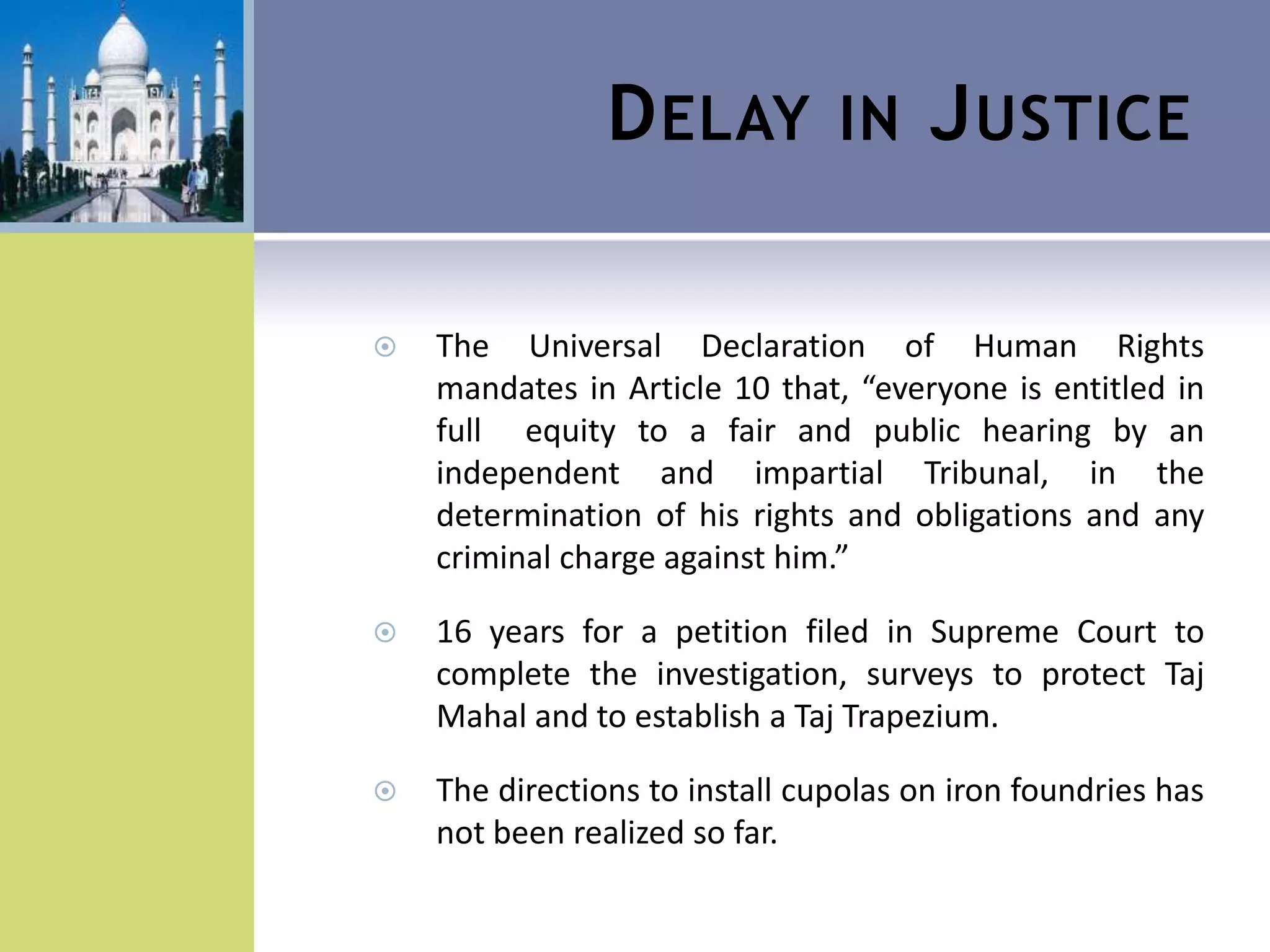
    Delay in JusticeThe Universal Declaration of Human Rights mandates in Article 10 that, “everyone is entitled in full equity to a fair and public hearing by an independent and impartial Tribunal, in the determination of his rights and obligations and any criminal charge against him.”16 years for a petition filed in Supreme Court to complete the investigation, surveys to protect TajMahal and to establish a Taj Trapezium. The directions to install cupolas on iron foundries has not been realized so far.
  • 30.
    RecommendationsEstablishing of EnvironmentCourtsInvolvement of Corporate Inc.