Meaning of Economic Reform
• The term economic reform broadly indicates
necessary structural adjustments to external
events.
• It includes the function of country’s spending to
the level parallel to its income and thereby
reducing fiscal deficits.
• This requires gradual reduction in import and
increase in export.
• These adjustments also require market change
in order to make economy flexible.
The Crisis of June 1991
• The present process of economic reforms
was born out of the crisis in the economy,
which climaxed in 1991.
• The crisis compelled the government to
adopt a new path-breaking economic policy
under which a series of economic reform
measures were initiated with the objective
to deal with the crisis and to take the
economy on a high-growth path.
Need of Economic Reforms
• Increase in Fiscal Deficit
• Increase in adverse balance of Payment
• Gulf Crisis
• Fall in foreign Exchange Reserve
• Rise in Prices
• Poor Performance of Public Sector
Early Crisis Management Measures as
Trend Setters to The Reform Process
• The top and immediate priority of the
government was to stabilize the economy, bring
the growth of the economy to its normal track
and to win back confidence of masses in the
country and the international financial
community.
• The crisis management measures focussed
largely on fiscal correction, industrial decontrol
and balance of payments.
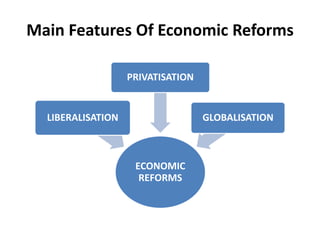
Main Features Of Economic Reforms
ECONOMIC
REFORMS
LIBERALISATION
PRIVATISATION
GLOBALISATION
Liberalisation
• It means to free the economy from direct or physical
controls imposed by the government.
• Prior 1991, government had imposed several types of
controls on Indian economy e.g. industrial licensing
system, price control or financial control on goods,
import license, foreign exchange control, restriction
on investment by big business houses, etc.
• These controls leads to fall in economy growth.
• Economic reforms were based on the assumption that
market forces could guide the economy in a more
effective manner than government control.
Measures taken for Liberalisation
• Abolition of industrial licensing and
Registration: According to new industrial
policy , with the exception of 6 sectors,
industrial licensing has been removed.
• Concession from MRTP Act
• Freedom from Expansion and Production to
Industries
Contd…
Measures taken for Liberalisation
• Increase in the Investment Limit of the Small
Industries
– It has been raised to Rs.1crore &
– Investment limit has been raised to Rs.25 lakh.
• Freedom to import capital goods
• Freedom to import technology
• Action plan for information Technology and
software development.
Economic reforms

Economic reforms

  • 2.
    Meaning of EconomicReform • The term economic reform broadly indicates necessary structural adjustments to external events. • It includes the function of country’s spending to the level parallel to its income and thereby reducing fiscal deficits. • This requires gradual reduction in import and increase in export. • These adjustments also require market change in order to make economy flexible.
  • 3.
    The Crisis ofJune 1991 • The present process of economic reforms was born out of the crisis in the economy, which climaxed in 1991. • The crisis compelled the government to adopt a new path-breaking economic policy under which a series of economic reform measures were initiated with the objective to deal with the crisis and to take the economy on a high-growth path.
  • 4.
    Need of EconomicReforms • Increase in Fiscal Deficit • Increase in adverse balance of Payment • Gulf Crisis • Fall in foreign Exchange Reserve • Rise in Prices • Poor Performance of Public Sector
  • 5.
    Early Crisis ManagementMeasures as Trend Setters to The Reform Process • The top and immediate priority of the government was to stabilize the economy, bring the growth of the economy to its normal track and to win back confidence of masses in the country and the international financial community. • The crisis management measures focussed largely on fiscal correction, industrial decontrol and balance of payments.
  • 6.
    Main Features OfEconomic Reforms ECONOMIC REFORMS LIBERALISATION PRIVATISATION GLOBALISATION
  • 7.
    Liberalisation • It meansto free the economy from direct or physical controls imposed by the government. • Prior 1991, government had imposed several types of controls on Indian economy e.g. industrial licensing system, price control or financial control on goods, import license, foreign exchange control, restriction on investment by big business houses, etc. • These controls leads to fall in economy growth. • Economic reforms were based on the assumption that market forces could guide the economy in a more effective manner than government control.
  • 8.
    Measures taken forLiberalisation • Abolition of industrial licensing and Registration: According to new industrial policy , with the exception of 6 sectors, industrial licensing has been removed. • Concession from MRTP Act • Freedom from Expansion and Production to Industries Contd…
  • 9.
    Measures taken forLiberalisation • Increase in the Investment Limit of the Small Industries – It has been raised to Rs.1crore & – Investment limit has been raised to Rs.25 lakh. • Freedom to import capital goods • Freedom to import technology • Action plan for information Technology and software development.