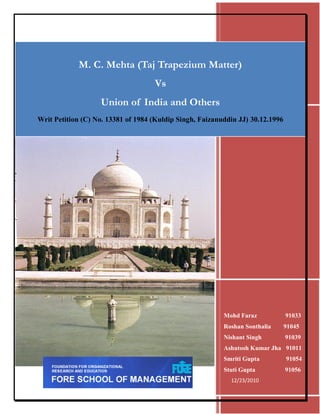
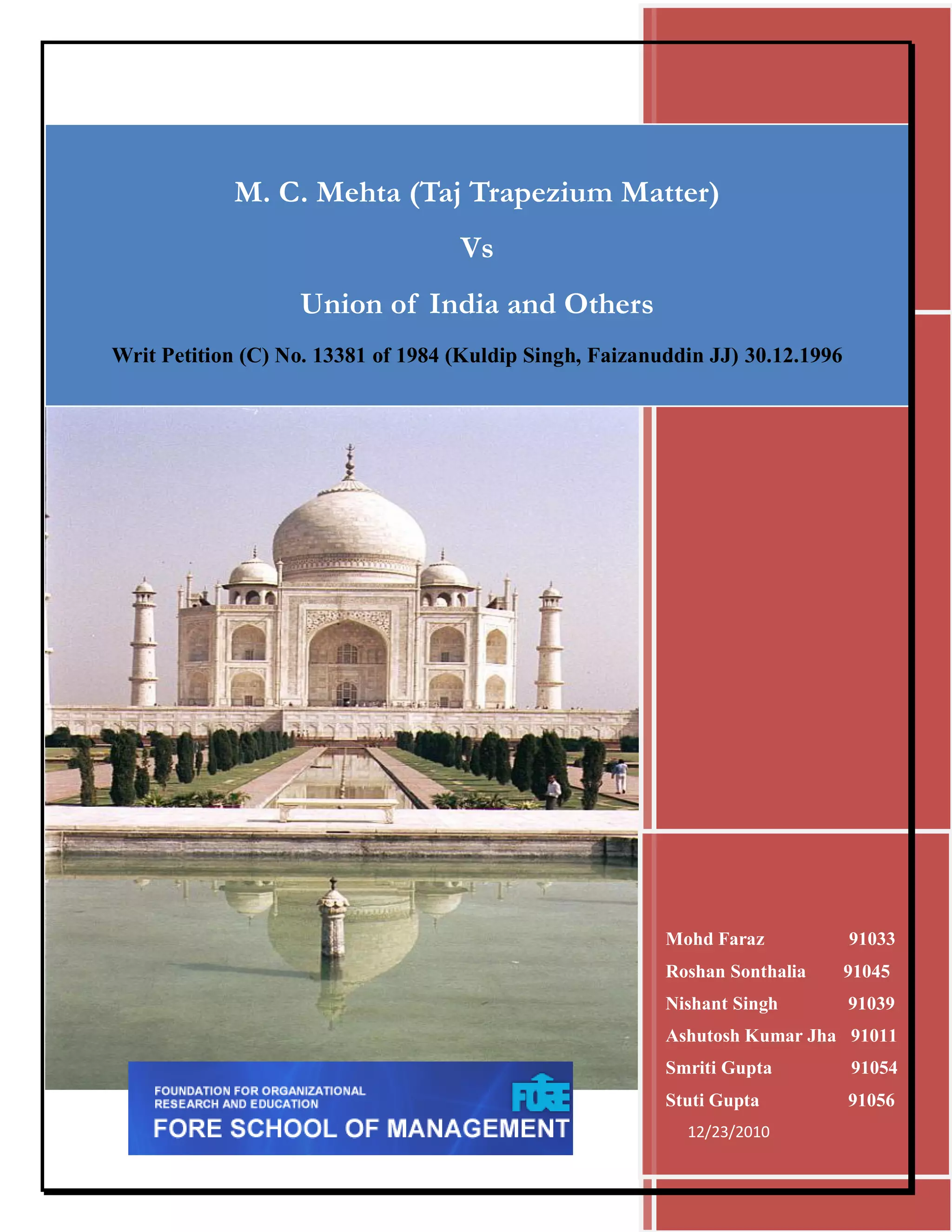
M. C. Mehta (Taj Trapezium Matter)
                                    Vs                      2010
                   Union of India and Others
Writ Petition (C) No. 13381 of 1984 (Kuldip Singh, Faizanuddin JJ) 30.12.1996


                                                          Mohd Faraz            91033
                                                          Roshan Sonthalia      91045
                                                          Nishant Singh         91039
                                                          Ashutosh Kumar Jha 91011
                                                          Smriti Gupta          91054
                                                          Stuti Gupta           91056
                                                            12/23/2010
Table of Contents
Acknowledgement................................................................................................................................... 4
Introduction ............................................................................................................................................ 5
Background of the case ........................................................................................................................... 5
Sources of Air Pollution ........................................................................................................................... 7
Judgment in the main & related cases ..................................................................................................... 7
M.C. Mehta v. Union of India & Ors. [Taj Trapezium case] (1996) 8 SCC 462 ............................................ 8
M.C. Mehta v. Union of India & Ors. [Follow up of Taj Trapezium case I] (1998) 9 SCC 93........................ 8
M.C. Mehta v. Union of India & Ors. [Follow up of Taj Trapezium case II] (2002) 9 SCC 534 ..................... 9
ORDER OF MINISTRY OF ENVIRONMENT AND FORESTS ........................................................................... 9
Doctrines Involved in TTZ ...................................................................................................................... 10
   Sustainable Development and Inter-generational Equity in TTZ ......................................................... 10
Polluter Pays Principle ........................................................................................................................... 12
Analysis of the Case ............................................................................................................................... 12
   Problems faced By Taj Mahal: Court expressed its views ................................................................... 12
   Petitioner‘s View: .............................................................................................................................. 13
   Recommendations by Vardharajan Committee: ................................................................................. 13
Reports by Central Board for the Prevention and Control of Water Pollution, New Delhi ....................... 14
The National Environment Engineering Research Institute (NEERI) gave an "Overview Report ............... 15
The NEERI Report indicates the air-pollution effect on the Taj in the following words:........................... 15
Brief of the Technical Report: ................................................................................................................ 16
Court’s View about Taj Mahal: ............................................................................................................... 16
Cases Referred: ..................................................................................................................................... 17
   The Precautionary Principle and the "Polluter Pays Principle ............................................................. 17
   The Polluter Pays Principle ................................................................................................................ 17
   Constitutional Provisions: .................................................................................................................. 18
   Court Held:........................................................................................................................................ 18
   Constitution of Mahajan Committee: ................................................................................................. 19
Action Plan for the Control of Air Pollution for the city of Agra ( As on October 2003) ........................... 20
   (a) Industrial Pollution ....................................................................................................................... 20
   (b) Vehicular Pollution ...................................................................................................................... 21

                                                                                                                                                              2
Scheme for switching over to LPG/CNG ........................................................................................... 22
Findings of the Action Plan ................................................................................................................... 22
   Air Quality Trends in Agra ................................................................................................................ 22
   Meteorological Issues ........................................................................................................................ 22
   Present Status of pollution at TTZ...................................................................................................... 23
   Delay in Justice ................................................................................................................................. 23
Recommendation .................................................................................................................................. 23
References ............................................................................................................................................ 25
Annexure............................................................................................................................................... 26


                                                                                                                                                             3
Acknowledgement

We are immensely overjoyed to acknowledge our sincere thanks to my faculty
guide Dr. K.L. Chawala, Professor, FORE School of Management for providing
necessary guidance during our project.

We would also like to thank him for his invaluable advice and inputs throughout
the duration of the project. He ensured that we were always at ease with what we
were doing and constantly provided me with the macro perspective to any issues
that we faced so that we was able to move in the right direction.

Group


                                                                                   4
Introduction
Taj Trapezium Zone (TTZ) is a defined area of 10,400 sq km around the Taj Mahal to protect the
monument from pollution. It is in the form of trapezoid between 27030‘N &77030‘E to 27045‘N
& 77015‘E and 26045‘N & 77015‘E to 27000‘N & 78030‘E,. This was notified by the
Government of India for intensifying efforts prevention and control of pollution. In 1999, , the
Ministry of Environment and Forest, Government of India has notified the Taj Trapezium Zone
(Pollution Prevention and Control) Authority for protection and improvement of the environment
in the Trapezium.
The Supreme Court of India delivered a ruling on December 30, 1996 regarding industries
covered under the TTZ, in response to a PIL seeking to protect the Taj Mahal from
environmental pollution. It banned the use of coal/ coke in industries located in the TTZ with a
mandate for switching over from coal/ coke to natural gas, and relocating them outside the TTZ
or shutting down. The TTZ comprises over 40 protected monuments including three World
Heritage Sites — the Taj Mahal, Agra Fort and Fatehpur Sikri. TTZ is so named since it is
located around the Taj Mahal and is shaped like a trapezoid.


Background of the case
This writ Petition was filed by Shri M.C.Mehta, Advocate as a public interest litigation regarding
pollution caused to the Taj Mahal in Agra. The sources of air pollution in Agra region were
particularly iron foundries, Ferro-alloys industries, rubber processing, lime processing,
engineering, chemical industries, brick kilns, refractory units and automobiles. The Petitioner
also alleged that distant sources of pollution were the Mathura Refinery and Firozabad bangles
and glass industries. It was also stated that the sulphur dioxide emitted by the Mathura Refinery
and the industries located in Agra and Firozabad when combined with moisture in the
atmosphere forms sulphuric acid and causes "acid rain" which has a corroding effect on the
gleaming white marble. According to the petitioner, the white marble has become yellowish and
at places it has blackened and hence he made request to the court that appropriate orders may be
issued and immediate steps may be taken to prevent air pollution and save the Taj.
The industrial and refinery emissions from brick kilns, vehicular traffic and generator sets were
alleged primarily responsible for polluting the ambient air in and around Taj Trapezium Zone
(TTZ) as identified by the Central Pollution Control Board. The Petitioner also referred the
"Report on Environmental Impact of Mathura Refinery" (Varadharajan Committee) published by
the Government of India in the year 1978. Subsequently, the reports of the Central Pollution
Control Board under the title "Inventory and Assessment of Pollution Emission: In and Around
Agra-Mathura Region (Abridged)" and the report of the National Environmental Engineering
Research Institute (NEERI) entitled "Over-View Report" regarding status of air pollution around
the Taj published in the year 1990 were also referred. On the directions of the Hon‘ble Supreme
Court, the NEERI and the Ministry of Environment & Forests had undertaken an extensive study
                                                                                                     5
for re-defining the TTZ (Taj Trapezium Zone) and re-alienating the area management
environmental plan.
The NEERI in its report had observed that the industries in the TTZ (Districts of Agra Mathura,
Firozabad and Bharatpur) were the main sources of air pollution in the area and suggested that
the air polluting industries in the area be shifted outside the TTZ. The Hon‘ble Supreme Court
after examining all the reports viz, four reports from NEERI, two reports from Varadarajan and
several reports by the Central Pollution Control Board and U.P.Board, on 31.12.1996 directed
that the industries in the TTZ were the active contributors to the air pollution in the said area. All
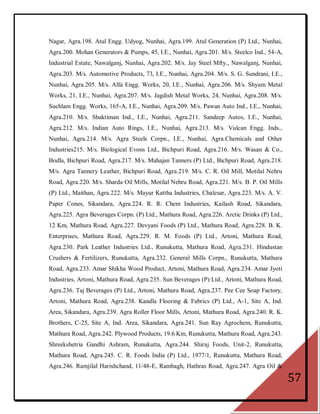
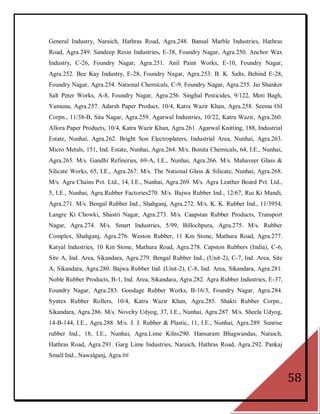
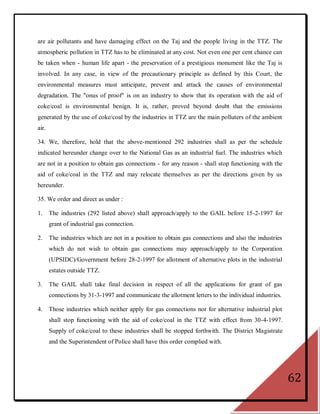
the 292 industries were to approach/apply to the GAIL before 15.2.1997 for grant of industrial
gas-connection. The industries which were not in a position to obtain gas-connections, to
approach UPSIDC/U.P.Government before 28.2.1997, for allotment of alternative plots in the
industrial estates outside TTZ. Those industries, which neither applied for gas-connection nor for
alternate industrial plots should stop functioning using coke/coal as fuel in the TTZ w.e.f.
30.4.1997. The supply of coke/coal to these industries shall be stopped forthwith. The GAIL
should commence supply of gas to the industries by 30.6.1997, with these directions the issue
relating to 292 industries was disposed off.
Now, none of the 292 industries is using coal/coke as fuel. As per the information given by the
Government of Uttar Pradesh to the Hon‘ble Supreme Court, the present operational status of
those industries is as follows:


Units closed                               : 187
Units based on electricity                : 53
Units based on CNG/LPG/Electricity        : 42
Units not using any fuel                    : 03
Units not found                             : 07
                                  Total     :292


                                                                                                         6
Sources of Air Pollution
The sources of pollutants in the city are domestic, industrial, vehicular, DG Sets and natural
sources.
(a) Industrial Air Pollution

The air pollution from the industries is mainly due to fuel used by them. The majority of
industries in Agra comprise of foundries. Besides a number of petha industries are operating in
the city, which mainly use coal as fuel. In foundries, the principal source of emission is cupola.
The volume of gas exhausted and its concentration depends on the cupola, operations, melting
rates, characteristic of charging material and the coke. Gases escape while drawing the hot metal
and during casting. In the pit type of cupola, emissions are fugitive type. The main pollutants are
SPM, sulphur dioxide and carbon monoxide.
Agra is famous for ‗petha‘ (a type of sweet). There is large number of petha manufacturing units.
Besides these, there are halwaiis, kumhars and bharbhujas who usecoal, cow dung and wood.
Kumhars have to use cow dung because of the type of firing adopted by them.
(b) Vehicular Air Pollution

The vehicular emissions are one of the major sources of air pollution affecting the urban
population in Agra. Unlike industrial emissions, vehicular pollutants are released aground level
and hence the impact on recipient population will be more. The vehicular growth in the city is
high and with high growth, the impact of the air pollution from vehicular growth would be
tremendous.
(c) DG Sets

Due to power breaks daily, a number of DG sets are used in the city. The fuel consumed by the
DG Sets by different sectors and the average consumption of diesel varies as per the capacity of
the generators.

Judgment in the main & related cases
The Court observed that the Taj, apart from being cultural heritage, is an industry by itself, More
than two million tourists visit the Taj every year. It is a source of revenue for the country. The
Court took into consideration the recommendations of the Varadarajan Committee. Amongst its
several recommendations, it stated that studies should be undertaken by competent agencies to
explore the possibility of protecting the Taj monuments by measures such as provision of a green
belt. Through its final judgment in this case, the green belt became a reality. However, it was
only in its subsequent orders that the Court was able to draw up the exact framework i.e. in terms
of area to qualify within the green belt.


                                                                                                      7
   The court came to the conclusion that the emission generated by the coke/coal consuming
       industries are air pollutants and have damaging effect on the Taj and the people living in
       the Taj Trapezium. This has to be eliminated at any cost.
      It was further held that 292 industries located and operating in Agra must change over
       within time schedule to natural gas as industrial fuel or stop functioning with coal/coke
       and get relocated.
      The industries going to be shifted shall be given incentives according to Agra Master
       Plan and also the incentives normally extended to new industrial units.
      It was further ordered that all emporia and shops functioning within the Taj premises be
       closed.
      The government of India was directed to decide issue, pertaining to declaration of Agra
       as ‗Heritage‘ city within two months.
      The Pollution Control Boards [State and Central] were asked to monitor any further
       deterioration in the quality of air and report the same to the Court.
M.C. Mehta v. Union of India & Ors. [Taj Trapezium case] (1996) 8 SCC 462
      Facts: Petition for the relocation of industries from Taj Trapezium (TTZ) to prevent
       damage to Taj from air pollution through emissions generated by coke or coal consuming
       industries. It is contended that these air pollutants and have damaging effect on Taj and
       people living in TTZ.
      Judgment: The Court took into consideration the recommendations of the Varadarajan
       Committee. Amongst its several recommendations, it stated that studies should be
       undertaken by competent agencies to explore the possibility of protecting the Taj
       monuments by measures such as provision of a green belt. Even NEERI, in its report,
       suggested the setting up of a green belt around the Mathura Refinery. It is to be noted that
       this was the first time, that the Court conceptualized a green belt as an effective mode of
       environmental protection. Through its final judgment in this case, the green belt became a
       reality. However, it was only in its subsequent orders that the Court was able to draw up
       the exact framework i.e. in terms of area to qualify within the green belt.
M.C. Mehta v. Union of India & Ors. [Follow up of Taj Trapezium case I] (1998) 9 SCC
93
      This was an application seeking various directions pertaining to taking action against the
       authorities responsible for damaging and destroying the green belt within 500 meters of
       Taj Mahal, use of vehicles, generators or sound equipments within 500 meters etc. As a
       result of this order, presently there is no access into the green belt for the visitors.


                                                                                                      8
M.C. Mehta v. Union of India & Ors. [Follow up of Taj Trapezium case II] (2002) 9 SCC
534
      This order given by the Court pertained to the maintenance of cultural heritage and
       historical importance within the Taj trapezium. It was found that despite the presence of
       monitoring stations, the air quality had still not improved. In consequence with this, a
       direction was given to State Govt. to find out whether unauthorized factories were still
       functioning within 20 kms radial circle of Taj monuments. Though there was no direct
       reference to ?green-belt?, this case marked an attempt to curb encroachment and illegal
       construction which had still not stopped, resulting in serious damage to the ecology and
       cultural heritage of the place.
      Derivation: Therefore, it can be inferred that green belt is a highly feasible technique not
       only as a precautionary method in environmental protection, but also in restoring
       ecological balance after destructive commercial activities are restrained.


ORDER OF MINISTRY OF ENVIRONMENT AND FORESTS
 In exercise of the powers conferred by sub-sections (1) and (3) of section 3 of the Environment
(Protection) Act, 1986(29 of 1986) (hereinafter referred to as the said Act), the Central
Government hereby constitutes an authority to be known as the Taj Trapezium Zone Pollution
(Prevention and Control) Authority (herein referred to as the Authority) for a period of two years
with effect from the date of publication of this notification in the Official Gazette.
The authority shall, within the geographical limits of Agra Division in the Taj Trapezium Zone
in the State of Uttar Pradesh, have the power to -
   1. Monitor progress of the implementation of various schemes for protection of the Taj
      Mahal and programmes for protection and improvement of the environment in the above
      said area.
   2. Exercise powers under section 5 of the said act;
   3. Take all necessary steps to ensure Compliance of specified emission-standards by motor
      vehicles and ensuring compliance of fuel quality standards;
   4. Deal with any environmental issue which may be referred to it by the Central
      Government or the State Government of Uttar Pradesh relating to the above said area;
   5. The foregoing powers and functions of the Authority shall be subject to the overall
      supervision and control of the Central Government.
   6. The Authority shall be authorized to exercise the powers under section 19 of the said Act.
   7. The Authority may co-opt experts for facilitating the work assigned to it.
                                                                                                      9
8. The Authority shall furnish a report about its activities at least once in two months to the
      Central Government in the Ministry of Environment and Forests.
   9. The Authority shall have its headquarters at Agra in the State of Uttar Pradesh.


Doctrines Involved in TTZ
Sustainable Development and Inter-generational Equity in TTZ
What is meant by the phrase ―sustainable development‖? The definition which is used most
often comes from the report of the Brundtland Commission, in which it was suggested that the
phrase covered ―development that meets the needs of the present without compromising the
ability of future generations to meet their own needs.‖ However, different levels of societies
have their own concept of sustainable development and the object that is to be achieved by it.
For instance, for rich countries, sustainable development may mean steady reductions in wasteful
levels of consumption of energy and other natural resources through improvements in efficiency,
and through changes in life style, while in poorer countries, sustainable development would
mean the commitment of resources toward continued improvement in living standards.
 Sustainable development means that the richness of the earth‘s biodiversity would be conserved
for future generations by greatly slowing and, if possible, halting extinctions, habitat and
ecosystem destruction, and also by not risking significant alternations of the global environment
that might – by an increase in sea level or changing rainfall and vegetation patterns or increasing
ultraviolet radiation – alter the opportunities available for future generations.
 But in India this definition is a bit different. The meaning of this phrase lies in the decision of
the Supreme Court in Narmada Bachao Andolan vs. Union of India wherein it was observed that
―Sustainable development means what type or extent of development can take place, which can
be sustained by nature/ecology with or without mitigation.‖ In this context, development
primarily meant material or economic progress.
Being a developing country, economic progress is essential; at the same time, care has to be
taken of the environment
 The courts have attempted to provide a balanced view of priorities while deciding environmental
matters. As India is a developing country, certain ecological sacrifices are deemed necessary,
while keeping in mind the nature of the environment in that area, and its criticality to the
community. This is in order that future generations may benefit from policies and laws that
further environmental as well as developmental goals. This ethical mix is termed sustainable
development, and has also been recognized by the Supreme Court in the Taj Trapezium case.
The United Nations Conference on Environment and Development in the wake of awareness of
the major challenges emerging both as regards development and with reference to the
environment has made possible a consensus on the concept of "sustainable and environmentally
sound development" which the "Earth Summit", meeting in Rio from 3 to 14 June 1992,
                                                                                                       10
endeavoured to focus by defining an ambitious programme of action, Agenda 21, clarified by a
Declaration of 27 principles solemnly adopted on that occasion. , Working towards international
agreements which respect the interests of all and protect the integrity of the global environmental
and developmental system, recognizing the integral and interdependent nature of the Earth, our
home.
There are 27 principles under this Rio Declaration and the Principle 3 is applicable in the case of
Taj Trapezium. Principle 3 states:
“The right to development must be fulfilled so as to equitably meet developmental and
environmental needs of present and future generations.”
We can also refer to the content of the Declaration on International Economic Cooperation
adopted by the General Assembly in May 1990, which clearly recognizes that "Economic
development must be environmentally sound and sustainable."
The concept of sustainable development contains three basic components or
principles. First among these is the PRECAUTIONARY PRINCIPLE (PP), whereby the state
must anticipate, prevent and attack the cause of environmental degradation. The Rio Declaration
affirms the principle by stating that where ever ―there are threats of serious or irreversible
damage, lack of full scientific certainty shall not be used as a reason for postponing cost-
effective measures to prevent environmental degradation.‖ Most of the cases of the 1990‘s deal
with the definition of the principle. In 1996, the Supreme Court stated that environmental
measures, adopted by the State Government and the statutory authorities, must anticipate,
prevent and attack the causes of environmental degradation. Following the definition provided in
the Rio Declaration, the Court stated that where there are threats of serious and irreversible
damage, lack of scientific certainty should not be used as a reason for postponing measures
to prevent environmental degradation. The essential ingredients of the precautionary principle
are:
   i.   Environmental measures- by the state government and the statutory authorities- must
        anticipate, prevent and attack the causes of environment degradation.
  ii.   When there are threats of serious and irreversible damage, lack of scientific certainty
        should not be used as a reason for postponing measure to prevent environmental
        degradation.
 iii.   The ―Onus of Proof‖ is on the actor or the developer/industrialist to show that his   action
        is environmentally benign.
 iv.    Precautionary duties must not only be triggered by the suspicion of concrete danger but
        also by concern or risk potential.
In 1996, the Indian court laid down the meaning of precautionary principle. The Supreme Court
has accepted the principle and applied it on several occasions. In Taj Trapezium Case the
precautionary approach has been applied by the Supreme Court and ordered a number of
                                                                                                       11
industries in the area surrounding the Taj Mahal to relocate or introduce pollution abatement
measures in order to protect the Taj from deterioration and damage.
The precautionary principle was invoked to prevent construction within one kilometer of two
lakes located near Delhi and the principle was accepted as a part of the law of the land.
Thereafter, in the Taj Trapezium Case, the Supreme Court ordered a number of industries in the
area surrounding the Taj Mahal to relocate or introduce pollution abatement measures in order to
protect the Taj from deterioration and damage. Following the decision of Vellore Citizen's
Case and Indian Council for Environs-Legal Action Case, the Supreme Court described the PP
as environmental measures which must 'anticipate, prevent and attack' the causes of
environmental degradation.


Polluter Pays Principle
―Polluter should bear the cost of pollution as the polluter is responsible for pollution‖.
The object of this principle is to make the polluter liable for the compensation to the victims as
also for the cost of restoring of environmental degradation. The principle demands that financial
costs of preventing or remedying damage caused by pollution should lie with the undertakings
which cause pollution. As per this, it is not the role of government to bear the costs involved in
either prevention of such damages, or in carrying out remedial action, because the effect of this
would be to shift the financial burden of the pollution incident to the taxpayers.


Analysis of the Case
Problems faced By Taj Mahal: Court expressed its views
The Taj is threatened with deterioration and damage not only by the traditional causes of decay,
but also by changing social and economic conditions which aggravate the situation with even
more formidable phenomena of damage or destruction. A private sector preservation
organization called "World Monuments Fund" (American Express Company) has published a list
of 100 most endangered sits (1996) in the World. The Taj has been included in the list by stating
as under:
The Taj Mahal - Agra – India
―The Taj Mahal, marble tomb for Mumtaz Mahal, wife of Emperor Shah Jahan, is considered the
epitome of Mughal monumental domed tombs set in a garden. The environment of Agra is today
beset with problems relating to the inadequacy of its urban infrastructure for transportation,
water and electricity. The densest pollution near the Taj Mahal is caused by residential fuel
combustion, diesel trains and buses, and back-up generators. Constitution of the proposed Agra
Ring Road and Bypass that would divert the estimated daily 6,50,000 tons of trans-India truck
traffic financing. Strict controls on industrial pollution established in 1982 are being intensively
                                                                                                       12
enforced following a 1993 Supreme Court Order. The Asian Development Bank`s proposed
$300 million loan to the Indian Government to finance infrastructure improvements would
provide the opportunity to solve the chronic problems. Agra contains three World Heritage Sites,
including the Taj Mahal."
Petitioner’s View:
According to the petitioner, the foundries, chemical/hazardous industries and the refinery at
Mathura are the major sources of damages to the Taj. The Sulphur Dioxide emitted by the
Mathura Refinery and the industries when combined with Oxygen - with the aid of moisture - in
the atmosphere forms sulphuric acid called "Acid rain" which has a corroding effect on the
gleaming white marble. Industrial/Refinery emissions, brick-kilns, vehicular traffic and
generator-sets are primarily responsible for polluting the ambient air around Taj Trapezium
(TTZ). The petition states that the white marble has yellowed and blackened in places. It is inside
the Taj that the decay is more apparent. Yellow pallor pervades the entire monument. In places
the yellow hue is magnified by ugly brown and black spots. Fungal deterioration is worst in the
inner chamber where the original graves of Shah Jahan and Mumtaz Mahal lie. According to the
petitioner the Taj - a monument of international repute - is no its way to degradation due to
atmosphere pollution and it is imperative that preventive steps are taken and soon. The petitioner
has finally sought appropriate directions to the authorities concerned to take immediate steps to
stop air pollution in the TTZ and save the Taj.

Recommendations by Vardharajan Committee:
"Steps may be taken to ensure that no new industries including small industries or other units
which can cause pollution are located north-west of the Taj Mahal. ... Efforts may be made to
relocate the existing small industries particularly the foundries, in an area south-east of Agra
beyond the Taj Mahal so that emissions from these industries will not be in the direction of the
monuments. .... Similar considerations may apply to large industries such as Fertilizer and
Petrochemicals. Such industries which are likely to cause environmental pollution may not be
located in the neighborhood of the refinery.
The Committee further recommends that no large industry in the Agra region and its
neighborhood be established without conducting appropriate detailed studies to assess the
environmental effect of such industries on the monuments. Location should be so chosen as to
exclude any increase in environmental pollution in the area. ...
The Committee wishes to record its deep concern regarding the existing level of pollution in
Agra. It recommends that an appropriate authority be created which could monitor emissions by
industries as well as air quality at Agra on a continuous basis. This authority should be vested
with powers to direct industries causing pollution to limit the level of emission and specify such
measures as are necessary to reduce the emissions whenever the pollutant level at the monuments
exceeds acceptable limits.

                                                                                                      13
The Committee particularly desires that recommendations made in regard to reduction of
existing pollution levels at Agra should be covered to a time-bound programme and should be
implemented with utmost speed. ...
. The Committee also recommends that studies should be undertaken by competent agencies to
explore the possibility of protecting the monuments by measures such as provision of a green
belt around Agra in the region between Mathura and Agra. ... Even though assurances have been
obtained from IOC that adequate precautions would be taken to contain the pollution on account
of using coal in the power plant, the Committee is of the opinion that till such time this problem
is studies in depth and suitable technologies have been found to be satisfactorily in use elsewhere
the use of coal in the refinery power plant should be deferred."


Reports by Central Board for the Prevention and Control of
Water Pollution, New Delhi
The Central Board for the Prevention and Control of Water Pollution, New Delhi, published a
report (Control of Urban Pollution Series CUPS/7/1981-82) under the title "Inventory and
Assessment of Pollution Emission in and around Agra-Mathura Region (Abridged)". The
relevant findings are as under :
"Industrial activities which are in operation in Agra City and its outskirts could be categorized as
(i) Ferrous Metal Casting using Cupolas (Foundry); (ii) Ferro-alloy and Non-Ferrous Castings
using Crucibles, Rotary Furnaces etc.; (iii) Rubber Processing; (iv) Lime Oxidation and
Pulverizing; (v) Engineering; (vi) Chemical; and (vii) Brick and Refractory Kilns (Table 4-1). ...
The contribution of Sulphur Dioxide through emission primarily from the combustion from the
fuels comprising hard coke, steam coal, wood and fuel oil is estimated at 3.64 tonnes per day
from industrial activities in Agra City and its outskirts (Table 5-3). The vehicular contribution as
estimated from traffic census in 6 road crossing is only 65 kgs a day or 0.065 tonnes a day and
should be considered negligible for the present (Para 7.4).
The contribution of Sulphur Dioxide from the 5 recognized distinct discrete sources in tonnes per
day 2.28, 2.28, 1.36, 1.21 and 0.065 from (i) two thermal power stations, (ii) foundries, (iii) other
industries in Agra, (iv) two railway marshaling yards and (v) vehicular traffic respectively.
Omitting contribution from vehicular traffic as because it is considered negligible, the relative
contributions from the other 4 distinct sources are 32, 32, 19, and 16.9 per cent. With the
elimination of the first and the fourth sources - by closing down the two thermal power stations
and replacing coal-fired steam engines by diesel engines in the two railway marshalling yards -
about 50 per cent (48.9 to be exact) cut-down of Sulphur Dioxide emission is expected."


                                                                                                        14
The National Environment Engineering Research Institute
(NEERI) gave an "Overview Report
The National Environment Engineering Research Institute (NEERI) gave an "Overview Report"
regarding status of air pollution around the Taj in 1990. Relevant part of the report is as under :
"The sources of pollution, including small and medium-scale industrial units, are scattered all
around Taj Mahal. High air pollution load is thus pumped into the Taj air-shed. Sudden rises in
concentration level are often recorded in all directions in gaseous as well as particulate pollutant
depending upon the local micro climatic conditions. .... On four occasions during the five-year
air quality monitoring, the 4 hourly average values of SO2 at Taj Mahal were observed to be
higher than 300 ug/m3, i.e. 10 folds of the promulgated CPCB standard of 30 ug/m3 for sensitive
areas. The values exceeded even the standard of 120 ug/m3 set for industrial zones. Statistical
analysis of the recorded data indicates that 40% (cumulative percentage level) has crossed the
standard set for sensitive receptors/zones. ... The SPM levels at Taj Mahal were invariably high
(more than 200 ug/m3) and exceeded the national ambient air quality standard of 100 ug/m3 for
SPM for sensitive locations barring a few days in monsoon months. ... Another study during
1985-87 brought to fore that the overall status of the ambient air quality within the trapezium has
significantly deteriorated over this period.


The NEERI Report indicates the air-pollution effect on the Taj in
the following words:
"The Taj Mahal marble samples analyzed by NEERI in 1993 reveal that the black soot on certain
protected surfaces contains 0.6% Calcium and traces of Sulphate. X-ray diffraction studies
indicated that soot and quartz (Silicon Dioxide) and the major constituents of the black coating at
Taj Mahal (Lal and Holden, ES & T, April 1981). The origin of soot can be traced back to the
fuel consumption around the sensitive receptor, while quartz is derived from geocrystal origin
and causes surface abrasion. Soot in itself is not chemically destructive, but with tar it acts as a
soiling agent. Absorption of the acidic gases is enhanced due to the presence of soot/smoky
matter resulting in long-term effects. Further, the presence of soot reduces the aesthetic value of
the monument. Ambient air round Taj Mahal is polluted primarily from point/line sources and
has adverse impacts on building material by alteration of marble and sandstone structures at
micro-crystalline level. The earlier studies have revealed that the concentrations of gaseous
pollutants and SPM (predominantly soot and carbon particles) are relatively high during winter
months due to the frequent inversion conditions restricting vertical dispersion. During monsoon
seasons, suspended particles are washed away and this cycle of pollutant builds up and
subsequent removal continues exposing fresh surface of the monument to the pollutant.


                                                                                                       15
Brief of the Technical Report:
The NEERI submitted a Technical Report dated 7-3-1994 pertaining to "Issue Associated with
Fuel Supply Alternative for Industries in Agra-Mathura Region". Para 2.4.1. and Para 3 of the
Report are as under :
2.4 Safety Requirements
―2.4.1. NG : The use of NG involves the defining of No Gas Zone for safe distribution. The new
sites in Agra and Firozabad industries being identified by the Government of Uttar Pradesh shall
minimize this hazard as the industrial estates shall be suitably designed for NG distribution.
The new industrial sites should preferably be out of the Taj Trapezium. The incentives for
industries to shift to new industrial estates need to be established to ensure speedy
implementation.
3.0 Summary
The various issues raised in this report pertaining to the fuel supply alternatives to the industries
in Agra-Firozabad region and the Mathura Refinery, can be summarized as :
    Need for relocation of industries
    Availability of cleaner fuel (present and future)
    Environmental benefits from alternate fuels
    Safety considerations
The recommendations are summarized hereunder :
    Shifting of small-scale polluting industries outside the Taj Trapezium on industrial estate
     sites to be identified by the Government of Uttar Pradesh;
    Provision of natural gas to the industries in Agra-Mathura region and Mathura Refinery."


Court’s View about Taj Mahal:
The Taj, apart from being a cultural heritage, is an industry by itself. More than two million
tourists visit the Taj every year. It is a source of revenue for the country. This Court has
monitored this petition for over three years with the sole object of preserving and protecting the
Taj from deterioration and damage due to atmospheric and environmental pollution. It cannot be
disputed that the use of coke/coal by the industries emits pollution in the ambient air. The
objective behind this litigation is to stop pollution while encouraging development of industry.
The old concept that development and ecology cannot go together is no longer acceptable.
Sustainable development is the answer. The development of industry is essential for the economy
of the country, but at the same time the environment and the ecosystems have to be protected.

                                                                                                        16
The pollution created as a consequence of development must be commensurate with the carrying
capacity of our ecosystems


Cases Referred:
The Precautionary Principle and the "Polluter Pays Principle
This Court in Vellore Citizens` Welfare Forum v. Union of India [(1996) 5 SCC 647 : JT (1996)
7 SC 375] has defined "the Precautionary Principle" and the "Polluter Pays Principle" as under :
(SCC pp. 658-60, para 11-14)
"11. .. We are, however, of the view that "The Precautionary Principle` and `The Polluter Pays
Principle` are essential features of `Sustainable Development`. The `Precautionary Principle` - in
the context of the municipal law - means :
  i.   Environmental measures - by the State Government and the statutory authorities - must
       anticipate, prevent and attack the causes of environmental degradation.
 ii.   Where there are threats of serious and irreversible damage, lack of scientific certainty
       should not be used as a reason for postponing measures to prevent environmental
       degradation.
The Polluter Pays Principle
`The Polluter Pays Principle` has been held to be a sound principle by this Court in Indian
Council for Environs-Legal Action v. Union of India [(1996) 3 SCC 212 : JT (1996) 2 SC 196].
The Court observed : (SCC p. 246, Para 65)
`... we are of the opinion that any principle evolved in this behalf should be simple, practical and
suited to the conditions obtaining in this country`.
The Court ruled that : (SCC p. 246, Para 65)
`.... once the activity carried on is hazardous or inherently dangerous, the person carrying on such
activity is liable to make good the loss caused to any other person by his activity irrespective of
the fact whether he took reasonable care while carrying on his activity. The rule is premised
upon the very nature of the activity carried on`.
Consequently the polluting industries are `absolutely liable to compensate for the harm caused
by them to villagers in the affected area, to the soil and to the underground water and hence, they
are bound to take all necessary measures to remove sludge and other pollutants lying in the
affected areas`. The `Polluter Pays Principle` as interpreted by this Court means that the absolute
liability for harm to the environment extends not only to compensate the victims of pollution but
also the cost of restoring the environmental degradation. Remediation of the damaged
environment is part of the process of `Sustainable Development ` and as such the polluter is


                                                                                                       17
liable to pay the cost to the individual sufferers as well as the cost of reversing the damaged
ecology.


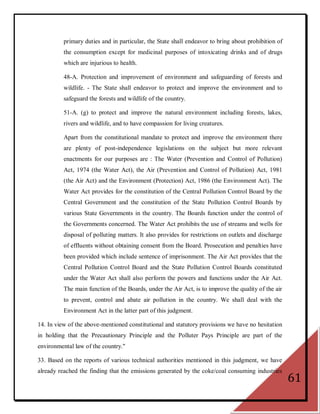
Constitutional Provisions:
The Precautionary Principle and the Polluter Pays Principle have been accepted as part of the law
of the land. Article 21 of the Constitution of India guarantees protection of life and personal
liberty. Articles 47, 48-A and 51-A(g) of the Constitution are as under :
Duty of the State to raise the level of nutrition and the standard of living and to improve public
health. - The State shall regard the raising of the level of nutrition and the standard of living of its
people and the improvement of public health as among its primary duties and in particular, the
State shall endeavor to bring about prohibition of the consumption except for medicinal purposes
of intoxicating drinks and of drugs which are injurious to health.
48-A. Protection and improvement of environment and safeguarding of forests and wildlife. -
The State shall endeavor to protect and improve the environment and to safeguard the forests and
wildlife of the country.
51-A. (g) to protect and improve the natural environment including forests, lakes, rivers and

wildlife, and to have compassion for living creatures.
Court Held:
In view of the above-mentioned constitutional and statutory provisions we have no hesitation in
holding that the Precautionary Principle and the Polluter Pays Principle are part of the
environmental law of the country."
Based on the reports of various technical authorities mentioned in this judgment, we have
already reached the finding that the emissions generated by the coke/coal consuming industries
are air pollutants and have damaging effect on the Taj and the people living in the TTZ. The
atmospheric pollution in TTZ has to be eliminated at any cost. Not even one per cent chance can
be taken when - human life apart - the preservation of a prestigious monument like the Taj is
involved. In any case, in view of the precautionary principle as defined by this Court, the
environmental measures must anticipate, prevent and attack the causes of environmental
degradation. The "onus of proof" is on an industry to show that its operation with the aid of
coke/coal is environmental benign. It is, rather, proved beyond doubt that the emissions
generated by the use of coke/coal by the industries in TTZ are the main polluters of the ambient
air.
We, therefore, hold that the above-mentioned 292 industries shall as per the schedule indicated
hereunder change over to the National Gas as an industrial fuel. The industries which are not in a
position to obtain gas connections - for any reason - shall stop functioning with the aid of
coke/coal in the TTZ and may relocate themselves as per the directions given by us hereunder.

                                                                                                           18
Constitution of Mahajan Committee:
The Mahajan Committee was constituted by the orders of the Hon‘ble Supreme Court dated
5.2.1996. The Mahajan Committee was consisted of Shri Krishan Mahajan, Advocate and two
senior scientists of the Central Pollution Control Board. The Hon‘ble Supreme Court on
30.8.1996 directed the Mahajan Committee to inspect the progress of the green belt developed
around the Taj Mahal every three months and submit progress report in the Court for the period
of next three years.
Earlier, on the basis of the report submitted by the NEERI regarding development of green belt
around Taj Mahal, the Hon‘ble Supreme Court on 30.8.1996 and 3.12.1996 directed the Ministry
of Environment & Forests, Government of India for monitoring and maintenance of the trees
planted in the green belt. The officials of the Central Pollution Control Board were also directed
for inspection of the Green Belt area in every three months. The Central Pollution Control Board
had submitted so far 35 reports in compliance of the Hon‘ble Supreme Court orders.
On the directions of the Hon‘ble Supreme Court, dated 13.9.2000 the Central Pollution Control
Board inspected the Foundry Nagar Industrial area, Agra and the premises of the Taj and
submitted its report with its recommendations. The Hon‘ble Court on 7.11.2000 while accepting
the recommendations of the Central Board directed that the four Ambient Air Quality
Monitoring Stations be installed in Agra region and these stations be run continuously for one
year all the seven days in a week. These air quality monitoring stations are to be run by the
Central Pollution Control Board and monitoring report of these stations be submitted in the Court
every month. The Central Pollution Control Board submitted a detailed proposal for establishing
four air quality monitoring stations in Agra region before the Court. The Hon‘ble court
considered the proposal of the Central Board and accepted the recommendations of the Mahajan
Committee in the matter on 4.5.2001 and directed that the full cost towards the hardware for
monitoring stations and hardware for Central Laboratory would be provided by the Mission
Management Board (MMB) (functioning under the Ministry of Environment, Government of
Uttar Pradesh and is located in Lucknow) and with regard to the remaining amount of
operational cost would be made available by the Central Government to the Central Pollution
Control Board within four weeks from the date of the order. The Central Board has established
four ambient air quality monitoring stations in Agra and these stations have been commissioned
in the month of January, 2002. Monitoring reports are being submitted to the Hon‘ble Court on
regular basis since February, 2002.
Apart from the establishment and operation of four monitoring stations in Agra, the Hon‘ble
Supreme Court, is monitoring several other important issues which were directly related to the
pollution problems of Agra and TTZ area. The following issues are under active consideration of
the Hon‘ble Supreme Court:
   1. industries located in Agra including foundry units;


                                                                                                     19
2. compliance of direction of the Hon‘ble Supreme Court by the Mission Management
      Board;
   3. traffic management & encroachment within the 500 meter zone of the Taj Mahal;
   4. slaughter house;
   5. Agra Heritage Fund;
   6. opening of Taj Mahal in the night;
   7. unauthorized construction within 100 meter from the southern gate of the Taj Mahal;
   8. booking window at Taj Mahal for collection of Toll Tax;
   9. supply of gas to the industries located in Firozabad;
   10. brick kilns located 20 km away from Taj Mahal or any other significant monument in the
       TTZ area including Bharatpur Bird Sanctuary ;
   11. promotion of Non-Conventional Energy Source; and
   12. security of Taj Mahal.


Action Plan for the Control of Air Pollution for the city of Agra (
As on October 2003)
The city of Agra has been divided into five different zones & action plan has been proposed in a
zone wise manner.
(a) Industrial Pollution
The salient features of actions taken to control industrial pollution are as follows:
   1. In zone I,II & III, 114 industries are drawing natural gas for use in production processes.
   2. Strict vigil on compliance of 292 industries that were directed by the Supreme Court not
      to use coal or coke. Out of 292 industries 87 has been connection for CNG by GAIL.
   3. All the brick kilns within the radius of 20 kms of significant monuments of Agra city
      have been closed.
   4. New Industries using coal and coke are not being allowed to set up in Agra Trapezium
      zone in Uttar Pradesh.
   5. Regular monitoring of ambient air quality in the Agra city. Currently four monitoring
      stations are there in the Agra city
   6. It is proposed to supply CNG as fuel for processing /production & it is also proposed to
      replace DG sets with Gas generators. It is proposed to implement the same in different
      zone in the following manner:
                                                                                                    20
Zone-I : Already started.
       Zone-II & III : By Sept‘02layingof pipe lines expected & by supply expected by Oct
       2002.
       Zone-IV: If gas is available then one year from the date of approval
       Zone-V: As per GAIL it is a no gas zone due to safety reasons.
   7. Restriction on supply and usage of coal. Coke, wood, rice husk, baggase to the industries
      situated in the city limit of Agra.
   8. D.G sets installed by Industries/ commercial establishments in no gas zones shall be fitted
      with wet scrubber 7 acoustic enclosures.
   9. Only small scale Service & Business related Enterprises (SSSBE) that are essentially
      required within the city, should be allowed in the designated commercial areas authorized
      markets/ authorized shopping plaza.
   10. Petha Industries operating in the city shall be shifted to Kalindi Vihar site identified for
       this industry and shall operate by CNG/LPG only.
(b) Vehicular Pollution
The salient features of actions taken to control vehicular pollution are as follows:
Vehicular Pollution
The salient features of actions plan to control vehicular pollution is as follows:
   1. Setting up of CNG/LPG retail outlets within Agra City for supplying CNG/LPG to the
      vehicles in a phased manner. For the establishment of CNG station for vehicles and piped
      natural gas at Agra the total project cost will be around Rs.102 crores.
   2. One Auto LPG dispensing stations already stationed and is expected to be operational by
      October 2003.
   3. Phasing out grossly polluting vehicles plying within the city in a phased manner.
   4. Commercial vehicles including 3 wheelers, Tempo, Auto Rickshaws, Taxis, and Buses
      etc being used for public transport are proposed to be converted to clean fuel like CNG/
      LPG etc in a phased manner. Till; such time these vehicles shall be-fitted with wet
      scrubber /filter and a notification for compulsory wet scrubber /dry filter shall be made.
   5. Stop plying diesel driven tempo-taxis and auto rickshaws on MG road and prohibition of
      all type of commercial vehicles within the radius of 500 mts of Taj Mahal.
   6. Notification and compliance for fitting of filter/wet scrubber in tempo, Taxi, 3-wheeler,
      city buses diesel ambassador taxi, commercial jeeps, light / medium goods vehicles heavy
      goods vehicles registered in Agra.
   7. Supply of ultra low sulphur diesel (0.05%) and premixed petrol in Agra.
                                                                                                      21
8. Ban on supply of loose 2T oil at petrol pumps and supply of only premixed 2T oil
      gasoline in all petrol pump.
Scheme for switching over to LPG/CNG
      For CNG two online stations and 5 daughter stations are proposed to be commissioned by
       GAIL within 15 months after approval .In zone –I CNG is already being supplied, Zone-
       II & III it is proposed to supply CNG by Oct‘02while in Zone-IV supply will be ensured
       within one year after approval. While zone-V is no gas zone.
      For LPG work has been initiated for establishment of one Auto LPG stations by IOC.
       One workstation has been established by IOC and supply is expected within one month
Findings of the Action Plan
       SO2 levels are with the prescribed National Ambient Air Quality Standards for sensitive
       areas. The reason for low levels of SO2 may be various measures taken such as reduction
       of sulphur in diesel, implementation of stricter emission norms and commensurate fuel
       quality. NO2, RSPM and SPM levels exceed the prescribed National Ambient Air
       Quality Standards for sensitive areas. The reason for high particulate matter levels may
       be vehicles, engine gensets, small scale industries, biomass incineration, boilers,
       resuspension of traffic dust, commercial and domestic use of fuels, etc
Air Quality Trends in Agra
Trend in annual average concentration of SO2 , NO2, RSPM and SPMSO2 levels were lower
than the NAAQS (annual average) during all the monitored years.NO2 levels exceeded the
NAAQS (annual average).RSPM levels exceeded the National Ambient Air Quality Standard
(Annual Average). SPM levels exceeded the National Ambient Air Quality Standard (Annual
Average).
Meteorological Issues
Meteorological factors play a important role in air pollution studies particularly in pollutant
transport irrespective of their entry into the environment. Seasonal variation in RSPM levels is
depicted in Figure 4.3. The concentrations are maximum in winter months and are lower during
summer and monsoon months. The monsoons results in large amount of precipitation, high wind
velocities and changes in general wind direction. The large amounts of precipitation reduce
atmospheric pollution via associated wet deposition processes. Further wind velocities will allow
for pollutant transport away from sources and increase mixing processes. During winter, there is
increased atmospheric stability, which in turn allows for less general circulation and thus more
stagnant air masses. Stagnant air masses allow more accumulation of pollutants in any given
area. During the winter, atmospheric dispersion is typically at a minimum and therefore the
pollutants will not be as widely dispersed. The winter months of are relatively much calm than
other months. The prevailing calm conditions facilitate more stability to atmosphere and


                                                                                                    22
consequently slow dispersion of pollutants generated and helps in buildup of pollutants in
vicinity of the pollutant sources.
Present Status of pollution at TTZ
Pursuant to the directions of the Hon‘ble Supreme Court the Central Pollution Control Board had
established four air quality monitoring stations and one Central Analytical-cum-Calibration
Laboratory at Agra. The Central Pollution Control Board monitoring the ambient air quality at
Taj Mahal, Edmad-Ud-Daula, Rambag and Nunhai. The air quality data so generated from these
monitoring stations in Agra are being displayed at Taj Mahal.
As per the data obtained by CPCB the least pollutant profile was observed at Taj Mahal among
all the monitoring stations at Agra.
Air Quality Data generated from the monitoring station at Taj Mahal, Agra since year 1991 have
been compared and analyzed for trend analyses. There has been declining trend of SPM,
practically no change in the RSPM since year 2002 (monitoring initiated in year 2002), steady
decrease in SO2 concentrations attributed to supply of Ultra Low Sulphur Diesel (0.005%) and
initiation of other measures including ban on the use of coke / coal towards prevention and
control of acidic anthropogenic pollution at Agra and continuation of no-change trend of NO2
due to increased number of CNG vehicles and industries around the city.
Delay in Justice
The right of access to justice is characterized as the most fundamental of all the fundamental
rights. The Universal Declaration of Human Rights mandates in Article 10 that, ―everyone is
entitled in full equity to a fair and public hearing by an independent and impartial Tribunal, in
the determination of his rights and obligations and any criminal charge against him.‖
Considering the gravity of the case as it not only involved a World Heritage Site but it took more
than 10 years for the Central Government to constitute authorities under the Environmental
(Protection) Act, 1986 and that too only after the reminders given by the Supreme Court in
Vellore Citizens Welfare Forum case. It took 16 years for a petition filed in Supreme Court to
complete the investigation, surveys to protect Taj Mahal and to establish a Taj Trapezium. The
direction to install cupolas on iron foundries has not been realized so far.


Recommendation
The environmental justice is part of socio-economic development of the society. The superior
judiciary has made tremendous progress in distributing environmental justice. The orders
passed by the Supreme Court have provided healing touch to many and even those, who are
residing in remote places in hills, coastal areas and forests. The Courts, however, are not the
forum to solve all environmental related challenges in the country. Judiciary has to be equipped
with creation of additional capacities to deal with the whole gamut of environment related issues.
Only the trained and motivated judges can take correctional measures and help in distributing
                                                                                                     23
environmental justice with human element, fairness and compassion. To that extent every court
in the country should be turned into environmental court, for environmental actions.
The above judgments of the Supreme Court of India will show the wide range of cases relating to
environment which came to be decided by the said Court from time to time. The Court has been
and is still monitoring a number of cases. It will be noted that the Court constantly referred
environmental issues to experts, and the Court has been framing schemes, issuing directions and
continuously monitoring them. Some of these 52judgments of the Supreme Court were given in
original writ petitions filed under Art. 32 while the others were decided in appeals filed under
Art 136 against judgments of the High Courts rendered in writ petitions filed under Art 226.
These cases have added tremendous burden on the High Courts and the Supreme Court. The
proposal for Environmental Courts is intended to lessen this burden, as already stated. But that as
it may, the Supreme Court has, in the various cases referred to above, laid down the basic
foundation for environmental jurisprudence in the country.
Australia and New Zealand have taken the lead in establishing Environmental Courts which are
manned by Judges and Commissioners.


                                                                                                      24
References
     Pg 21 Issue 6 May 2001 of ―Law Journal‖ – Queen Mary& Westfield College –
      University of London.
      http://www.law.qmul.ac.uk/docs/qmlj_issue6.pdf

     India -- M.C. Mehta v. Union of India, WP 13381/1984 (2003.02.20) (Taj Trapezium
      Case)
      http://www.elaw.org/node/2531

      India -- M.C. Mehta v. Union of India, WP 13381/1984 (1996.12.30) (Taj Trapezium
      Case)
      http://www.elaw.org/node/2718

     Judgments in all MC Mehta Vs UOI cases
      http://www.legalserviceindia.com/articles/greeneco.htm

     Human Rights and the Environment, by YK Sabharwal -CJI
      http://www.nlsenlaw.org/environmental-protection/articles/human-rights-and-the-
      environment/

     ―Human Rights        and    the    Environment:    the    national    experience   in
      South Asia and Africa‖, by Dr Jona Razzaque
      http://www2.ohchr.org/english/issues/environment/environ/bp4.htm
     Annual Report 2008-09 of Centre Pollution Control Board

      http://cpcb.nic.in/upload/AnnualReports/AnnualReport_37_ANNUAL_REPORT-08-
      09.pdf

     M. C Mehta v Union Of India AIR 1997 SC 734, The National Law School of India
      University
      http://www.nlsenlaw.org/air-noise/case-laws/supreme-court/search


                                                                                              25
Annexure
M. C. Mehta (Taj Trapezium Matter)

Vs

Union of India and Others

Writ Petition (C) No. 13381 of 1984

(Kuldip Singh, Faizanuddin JJ)

30.12.1996

JUDGMENT

KULDIP SINGH; J. –

     1. Taj Mahal - The Taj - is the "King Emperor" amongst the World Wonders. The Taj is the
          final achievement and acme of the Moghul Art. It represents the most refined aesthetic
          values. It is a fantasy-like grandeur. It is the perfect culmination and artistic interplay of
          the architects' skill the jewellers' inspiration. The marble in-lay walls of the Taj are
          amongst the most outstanding examples of decorative workmanship. The elegant
          symmetry of its exterior and the aerial grace of its domes and minarets impress the
          beholder in a manner never to be forgotten. It stands out as one of the most priceless
          national monuments, of surpassing beauty and worth, a glorious tribute to man's
          achievement in Architecture and Engineering.

     2.   Lord Robert in his work "Forty-one years in India" describes the Taj as under :

            "Neither words nor could pencil give to the most imaginative reader the slightest idea
            of all the satisfying beauty and purity of this glorious conception. To those who have
            not seen it, I would say, - Go to India; the Taj alone is well worth the journey."

A poet describes the Taj as under :

            "It is too pure, too holy to be the work of human hands. Angles must have brought it
            from heaven and a glass case should be thrown over it to preserve it from each breath
            of air."

          Sammuel Smith in his book about the Taj explains the impact as under :

                                                                                                           26
"We stood spellbound for a few minutes at this lovely apparition; it hardly seems of
      the earth. It is more like a dream of celestial beauty, no words can describe it. We felt
      that all previous sights were damned in comparison. No such effect is produced by the
      first view of St. Peter's or Milan or Cologne Cathedrals. They are all majestic, but this
      is enchantment itself. So perfect is its form that all other structures seem clumsy."

3. The Taj is threatened with deterioration and damage not only by the traditional causes of
   decay, but also by changing social and economic conditions which aggravate the situation
   with even more formidable phenomena of damage or destruction. A private sector
   preservation organization called "World Monuments Fund" (American Express
   Company) has published a list of 100 most endangered sits (1996) in the World. The Taj
   has been included in the list by stating as under :

      "The Taj Mahal - Agra - India

      The Taj Mahal, marble tomb for Mumtaz Mahal, wife of Emperor Shah Jahan, is
      considered the epitome of Mughal monumental domed tombs set in a garden. The
      environment of Agra is today beset with problems relating to the inadequacy of its
      urban infrastructure for transportation, water and electricity. The densest pollution
      near the Taj Mahal is caused by residential fuel combustion, diesel trains and buses,
      and back-up generators. Constitution of the proposed Agra Ring Road and Bypass that
      would divert the estimated daily 6,50,000 tons of trans-India truck traffic financing.
      Strict controls on industrial pollution established in 1982 are being intensively
      enforced following a 1993 Supreme Court Order. The Asian Development Bank's
      proposed $300 million loan to the Indian Government to finance infrastructure
      improvements would provide the opportunity to solve the chronic problems. Agra
      contains three World Heritage Sites, including the Taj Mahal."

4. According to the petitioner, the foundries, chemical/hazardous industries and the refinery
   at Mathura are the major sources of damages to the Taj. The Sulphur Dioxide emitted by
   the Mathura Refinery and the industries when combined with Oxygen - with the aid of
   moisture - in the atmosphere forms sulphuric acid called "Acid rain" which has a
   corroding effect on the gleaming white marble. Industrial/Refinery emissions, brick-kilns,
   vehicular traffic and generator-sets are primarily responsible for polluting the ambient air
                                                                                                  27
around Taj Trapezium (TTZ). The petition states that the white marble has yellowed and
      blackened in places. It is inside the Taj that the decay is more apparent. Yellow pallor
      pervades the entire monument. In places the yellow hue is magnified by ugly brown and
      black spots. Fungal deterioration is worst in the inner chamber where the original graves
      of Shah Jahan and Mumtaz Mahal lie. According to the petitioner the Taj - a monument
      of international repute - is no its way to degradation due to atmosphere pollution and it is
      imperative that preventive steps are taken and soon. The petitioner has finally sought
      appropriate directions to the authorities concerned to take immediate steps to stop air
      pollution in the TTZ and save the Taj.

   5. The Report of the Expert Committee called "Robert Environmental Impact of Mathura
      Refinery" (Varadharajan Committee) published by the Government of India in 1978 has
      been annexed along with the writ petition. Para 4.1 of the conclusions therein are as
      under :

         "There is substantial level of pollution of Sulphur Dioxide and particulate matter in the
         Agra region. The possible sources are all coal users consisting of two Power Plants, a
         number of small industries mainly foundries (approximately 250) and a Railway
         Shunting Yard. As far as suspended particulate matters are concerned, because of use
         of coal, contribution will be substantial. Even though the total amount of emission of
         Sulphur Dioxide from these sources may be small, on account of their proximity to the
         monuments, their contribution to the air quality of the zone will be considerably high."

Varadharajan Committee made, among others, the following recommendations :

         "Steps may be taken to ensure that no new industries including small industries or
         other units which can cause pollution are located north-west of the Taj Mahal. ...
         Efforts may be made to relocate the existing small industries particularly the foundries,
         in an area south-east of Agra beyond the Taj Mahal so that emissions from these
         industries will not be in the direction of the monuments. .... Similar considerations
         may apply to large industries such as Fertilizer and Petrochemicals. Such industries
         which are likely to cause environmental pollution may not be located in the
         neighborhood of the refinery. The Committee further recommends that no large
         industry in the Agra region and its neighborhood be established without conducting
                                                                                                     28
appropriate detailed studies to assess the environmental effect of such industries on the
     monuments. Location should be so chosen as to exclude any increase in environmental
     pollution in the area. ... The Committee wishes to record its deep concern regarding
     the existing level of pollution in Agra. It recommends that an appropriate authority be
     created which could monitor emissions by industries as well as air quality at Agra on a
     continuous basis. This authority should be vested with powers to direct industries
     causing pollution to limit the level of emission and specify such measures as are
     necessary to reduce the emissions whenever the pollutant level at the monuments
     exceeds acceptable limits. The Committee particularly desires that recommendations
     made in regard to reduction of existing pollution levels at Agra should be covered to a
     time-bound programme and should be implemented with utmost speed. .... The
     Committee also recommends that studies should be undertaken by competent agencies
     to explore the possibility of protecting the monuments by measures such as provision
     of a green belt around Agra in the region between Mathura and Agra. ... Even though
     assurances have been obtained from IOC that adequate precautions would be taken to
     contain the pollution on account of using coal in the power plant, the Committee is of
     the opinion that till such time this problem is studies in depth and suitable technologies
     have been found to be satisfactorily in use elsewhere the use of coal in the refinery
     power plant should be deferred."

6. The Central Board for the Prevention and Control of Water Pollution, New Delhi,
   published a report (Control of Urban Pollution Series CUPS/7/1981-82) under the title
   "Inventory and Assessment of Pollution Emission in and around Agra-Mathura Region
   (Abridged)". The relevant findings are as under :

     "Industrial activities which are in operation in Agra City and its outskirts could be
     categorized as (i) Ferrous Metal Casting using Cupolas (Foundry); (ii) Ferro-alloy and
     Non-Ferrous Castings using Crucibles, Rotary Furnaces etc.; (iii) Rubber Processing;
     (iv) Lime Oxidation and Pulverizing; (v) Engineering; (vi) Chemical; and (vii) Brick
     and Refractory Kilns (Table 4-1). ... The contribution of Sulphur Dioxide through
     emission primarily from the combustion from the fuels comprising hard coke, steam
     coal, wood and fuel oil is estimated at 3.64 tonnes per day from industrial activities in
     Agra City and its outskirts (Table 5-3). The vehicular contribution as estimated from
                                                                                                  29
traffic census in 6 road crossing is only 65 kgs a day or 0.065 tonnes a day and should
      be considered negligible for the present (Para 7.4). ... The contribution of Sulphur
      Dioxide from the 5 recognized distinct discrete sources in tonnes per day 2.28, 2.28,
      1.36, 1.21 and 0.065 from (i) two thermal power stations, (ii) foundries, (iii) other
      industries in Agra, (iv) two railway marshaling yards and (v) vehicular traffic
      respectively. Omitting contribution from vehicular traffic as because it is considered
      negligible, the relative contributions from the other 4 distinct sources are 32, 32, 19,
      and 16.9 per cent. With the elimination of the first and the fourth sources - by closing
      down the two thermal power stations and replacing coal-fired steam engines by diesel
      engines in the two railway marshalling yards - about 50 per cent (48.9 to be exact) cut-
      down of Sulphur Dioxide emission is expected."

7. The National Environment Engineering Research Institute (NEERI) gave an "Overview
   Report" regarding status of air pollution around the Taj in 1990. Relevant part of the
   report is as under :

      "The sources of pollution, including small and medium-scale industrial units, are
      scattered all around Taj Mahal. High air pollution load is thus pumped into the Taj air-
      shed. Sudden rises in concentration level are often recorded in all directions in gaseous
      as well as particulate pollutant depending upon the local micro climatic conditions. ....
      On four occasions during the five-year air quality monitoring, the 4 hourly average
      values of SO2 at Taj Mahal were observed to be higher than 300 ug/m3, i.e. 10 folds
      of the promulgated CPCB standard of 30 ug/m3 for sensitive areas. The values
      exceeded even the standard of 120 ug/m3 set for industrial zones. Statistical analysis
      of the recorded data indicates that 40% (cumulative percentage level) has crossed the
      standard set for sensitive receptors/zones. ... The SPM levels at Taj Mahal were
      invariably high (more than 200 ug/m3) and exceeded the national ambient air quality
      standard of 100 ug/m3 for SPM for sensitive locations barring a few days in monsoon
      months. ... Another study during 1985-87 brought to fore that the overall status of the
      ambient air quality within the trapezium has significantly deteriorated over this
      period."

   The impact of the air quality on the Taj has been stared as under :

                                                                                                  30
"The period industrial development of Agra-Mathura region has resulted in acidic
   emissions into the atmosphere at an alarming rate. This causes serious concern on the
   well-being of Taj Mahal. ... The gaseous pollutants being acidic in nature, significantly
   both the as well as the biotic components of the ecosystem like plants and building
   material like marble and red stone."

This Court on 8-1-1993 passed the following order :

   "We have heard Mr. M. C. Mehta, the petitioner in person. According to him, the
   sources of pollution in Agra region as per the report of the Central Pollution Control
   Board are iron foundries, Ferro-alloyed industries, rubber processing, lime processing,
   engineering, chemical industry, brick refractory and vehicles. He further states that
   distant sources of pollution are the Mathura Refinery and Firozabad Glass Industry. It
   is necessary to have a detailed survey done of the area to find out the actual industries
   and foundries which are working in the region. We direct the U.P. Pollution Control
   Board to get a survey done of the area and prepare a list of all the industries and
   foundries which are the sources of pollution in the area. The Pollution Board after
   having the survey done shall issue notices to all the foundries and industries in that
   region to satisfy the Board that necessary anti-pollution measures have been
   undertaken by the said industries/foundries. The Pollution Board after doing this
   exercise shall submit a report to this Court on or before 5-5-1993. A copy of this order
   be sent to the Chairman and Secretary, U.P. Pollution Control Board for compliance
   and report as directed."

Pursuant to the above-quoted order the U.P. Pollution Control Board (the Board) filed an
affidavit dated 3-5-1993. It is stated in the affidavit that as per survey report furnished by
the Regional Office of the U.P. Board the industries of Agra region were categorized as
under :

   # Nature of Industry Number of Industries (i) Foundries 168 (ii) Rubber Factories 20
   (iii) Engineering Industries 46 (vi) Chemical and other Industries 55 (v) Lime Kilns 03
   (vi) Refinery (situated at Mathura) 01 (vii) Glass Industries (situated at Firozabad) 49
   (viii) Brick Refractories and Poultries 09 (ix) Bangle Industries (situated at Firozabad)
   120 (x) Block Glass Industries 40 ------ TOTAL 511 ------##
                                                                                                 31
The affidavit further states that notices were issued to the aforesaid 511
   industries/foundries as directed by this Court. Although Mathura Refinery is included in
   the list of 511 industries but we are not dealing with the Refinery in this judgment. The
   Mathura Refinery is being dealt with separately. All the foundries/industries are
   represented before us through the National Chamber of Industries and Commerce, U.P.,
   Agra, U.P. Chamber of Commerce and the Glass Industries Syndicate. Some of the
   individual industries have also been represented through their learned counsel.

8. This Court considered the affidavit filed by the Board and passed the following order on
   5-5-1993 :

      "Pursuant to this Court's order dated 8-1-1993, an affidavit has been filed by the U.P.
      Pollution Control Board. It has been stated therein that in terms of this Court's order
      dated 8-1-1993, notices have been issued by the Board to 511 industries in Agra
      region. The names and addresses of the said industries have been enclosed along with
      the affidavit. The industries are required to file their replies to the notices by 5-5-1993
      (today). ... We direct the U.P. Pollution Control Board to issue a public notice by
      getting the same published in two local newspapers and two national newspaper
      calling upon all the 511 industries to install anti-pollution mechanism/effluent
      treatment plants if they have not already done so. All the 511 industries be called upon
      to file replies to the notices already issued by the Board within further time of eight
      weeks from the date of the publication of the notices in the newspapers. This
      publication shall be done within two weeks from today. After the replies from the
      industries are received and processed by the Board, the Board may, if it so desires,
      inspect any of the industries in order to find out the correctness of the replies filed by
      the industries. The matter be listed on 10-8-1993."

   Pursuant to this Court's order (quoted above) the Board filed affidavit dated 5-8-1993
   wherein it is stated that public notice was published in two local newspapers of Agra on
   17-5-1993 and two national newspapers on 18-5-1993 calling upon the industries to file
   their replies during the extended time. The affidavit states that all the listed industries
   were polluting industries and 507 out of them had not even installed any air pollution
   control device. The 212 industries that did not respond to the notice and failed to take any

                                                                                                    32
step towards installing the pollution control devices were closed by the order dated 27-8-
   1993 with immediate effect. The closure order was to operate till the time necessary
   pollution control devices were to be set up by the industries concerned.

9. Meanwhile, NEERI submitted its report dated 16-10-1993/18-10-1993 regarding Sulphur
   Dioxide emission control measures at Mathura Refinery. Since the Mathura Refinery
   matter is being dealt with separately it is not necessary to go into the details of the report.
   Suffice it to say that apart from short-term strategy, the NEERI recommended the use of
   natural gas, setting up of Hydro-cracking unit, improved Sulfur recovery unit, Chemo-
   biochemical Sulphur recovery and the setting up of green belt around the Refinery. The
   NEERI Report examined in detail the decay mechanism and status of the Taj marble.
   How the deterioration of marble occurs, is stated by NEERI as under :

      "The deterioration of marble occurs in two modes. In the first mode, weathering takes
      place if the marble is sheltered under domes and cornices, and protected from direct
      impact of rain. Here a crust is formed, which after some period, exfoliates due to
      mechanical stresses. In case of marble exposed to rain, gradual reduction of material
      occurs, as the reaction products are washed away be rainfall and fresh marble is
      exposed. The crusts are formed due to Sulphur Dioxide, but the cumulative effect of
      all pollutants is more damaging. It is also observed that trace metals present in fly ash
      and suspended particulate matter, e.g. Manganese, Iron and Vanadium act as catalysts
      for oxidation of Sulphur Dioxide, and in turn enhance degradation of marble calcite to
      gypsum."

   The NEERI Report indicates the air-pollution effect on the Taj in the following words :

     "The Taj Mahal marble samples analyzed by NEERI in 1993 reveal that the black soot
      on certain protected surfaces contains 0.6% Calcium and traces of Sulphate. X-ray
      diffraction studies indicated that soot and quartz (Silicon Dioxide) and the major
      constituents of the black coating at Taj Mahal (Lal and Holden, ES & T, April 1981).
      The origin of soot can be traced back to the fuel consumption around the sensitive
      receptor, while quartz is derived from geocrystal origin and causes surface abrasion.
      Soot in itself is not chemically destructive, but with tar it acts as a soiling agent.
      Absorption of the acidic gases is enhanced due to the presence of soot/smoky matter
                                                                                                     33
resulting in long-term effects. Further, the presence of soot reduces the aesthetic value
  of the monument. Ambient air round Taj Mahal is polluted primarily from point/line
  sources and has adverse impacts on building material by alteration of marble and
  sandstone structures at micro-crystalline level. The earlier studies have revealed that
  the concentrations of gaseous pollutants and SPM (predominantly soot and carbon
  particles) are relatively high during winter months due to the frequent inversion
  conditions restricting vertical dispersion. During monsoon seasons, suspended
  particles are washed away and this cycle of pollutant builds up and subsequent
  removal continues exposing fresh surface of the monument to the pollutant."

On 19-11-1993, this Court passed the following order :

  "On 5-11-1993, we suggested to Mr. N. N. Goswami, learned Senior Advocate,
  appearing on behalf of the Union of India to find out the possibility of providing gas as
  fuel to the Glass Industries and the foundries around Agra. Mr. Goswamy states that
  he is already in touch with the authorities concerned and needs little more time. We
  give him time till 26-11-1993. He must file concrete proposal before the next date of
  hearing. Meanwhile, we also issue notice to the Secretary, Ministry of Petroleum,
  Government of India and the Chairman, Gas Authority of India, returnable on 26-11-
  1993."

This Court on 26-11-1993 examined the affidavit filed by the Gas Authority of India Ltd.
(GAIL) regarding supply of natural gas to the industries operating in TTZ and passed the
following order :

  "Pursuant to this Court's order dated 19-11-1993, Mr. R. P. Sharma, General Manager,
  Marketing and Planning, Gas Authority of India Ltd. has filed an affidavit dated 25-
  11-1993. Mr. Sharma is also present in Court. It has been stated in the affidavit and
  also orally by Mr. Sharma that without undertaking the detailed survey with regard to
  the assessment of demand and other technical requirements it would not be possible to
  proceeds further in this matter.

  Dr. Khanna, Director, NEERI states that some sort of survey in this respect has already
  been done by the State of U.P. He further states that so far as Mathura Refinery is
  concerned. NEERI has done the survey under the directions of this Court. According
                                                                                              34
to him, the work of doing further survey on behalf of the Gas Authority of India Ltd.
      can be undertaken by NEERI if the terms are suitable. Mr. R. P. Sharma, General
      Manager, Gas Authority of India Ltd. states that the Gas Authority shall send their
      terms of reference to the NEERI within ten days. Let this be done. Dr. Khanna states
      that they will respond to the terms within a week thereafter.

      Mr. Pradeep Misra, learned counsel appearing on behalf of the U.P. State Pollution
      Control Board, states that whenever data in this matter is available with the State of
      U.P. shall be supplied to NEERI within a week.

      To be listed on 17-12-1993. We request Dr. Khanna, Director, NEERI and Mr. R. P.
      Sharma, General Manager, Gas Authority of India Ltd. (or any other officer on his
      behalf) to be present in Court on 17-12-1993."

10. The NEERI in its project proposal dated 19-12-1993 regarding feasibility of utilization of
   natural gas as replacement of conventional fuel in the industrial sectors of Agra, Mathura
   and Firozabad stated as under :

      "The Ministry of Environment and Forests (MEF), retained the National
      Environmental Engineering Research Institute (NEERI) in December 1992 to redefine
      the Taj Trapezium. The study was completed in July 1993. Stringent pollution control
      regulations have been stipulated by the Government of India but the industries within
      Agra area are not meeting the prescribed emission standards. One of the reasons is that
      the industries use coal and coke for their fuel requirements. Amongst the options
      proposed in the Air Environment Management Plan in Taj Trapezium Report, NEERI
      has suggested change over to cleaner fuel like ONG for mitigation of air pollution in
      the region. As per the directives of the Hon'ble Supreme Court of India, NEERI
      proposed a study on techno-economic feasibility of utilization of Compressed Natural
      Gas (CNG) as a replacement of solid/liquid fuels (e.g. Coal, FO, LSHS etc.) in the
      industrial sectors of Agra, Mathura and Firozabad region, based on the Terms of
      Reference formulated by the Gas Authority of India Ltd. (GAIL).

      The existing HBJ pipeline laid by GAIL for transmission and distribution of CNG
      from the Western Offshore Region passing through Gujarat, Madhya Pradesh,
      Rajasthan, Uttar Pradesh, Delhi and Haryana can be tapped to serve this sensitive area.
                                                                                                 35
Auraiya in Uttar Pradesh is the nearest possible tapping point which is at an
      approximate distance of 170 kilometers from Agra. Presently the total availability of
      CNG ex-Hazira is of the order of 20 MMSCMD, and is expected to increase to 38-39
      MMSCMD in 1998-99 as projected by GAIL. Based on the existing energy demand,
      NEERI has projected approximately 1.00 MMSCMD CNG requirements for Agra,
      Mathura and Firozabad region.

      The price of CNG at Auraiya (exclusive of tax) ranges from Rs. 2500-2700/1000 m3
      which will be further altered by Government of India after 1995 (GAIL's projection)."

11. This Court by the order dated 11-2-1994 asked the NEERI to examine the possibility of
   using Propane or any other fuel instead of coal/coke by the industries in the TTZ. This
   Court also directed the U.P. State Industrial Development Corporation (the Corporation)
   to locate sufficient areas outside the TTZ to relocate the industries. The operative part of
   the order is as under :

      "We requested Mr. V. R. Reddy, learned Additional Solicitor General on 14-1-1994 to
      have discussion with the authorities concerned and assist us in probing the possibility
      of providing some safe fuel to the foundries and other industries situated in the Taj
      Trapezium. We are thankful to Mr. Reddy for doing a good job and placing before us
      various suggestions in that direction. Mr. Reddy has suggested that NEERI be asked to
      examine the possible effects of the use of Propane as a safe fuel from the point of view
      of atmospheric pollution. We accept the suggestion and request Dr. P. Khanna to
      examine the feasibility of Propane as a possible alternative to the present fuel which is
      being used by the foundries and other industries in the Taj Trapezium. This may be
      done within 2 weeks from today. Copy of this order be sent to the Director, NEERI
      within 2 days from today. Government of India, Ministry of Environment shall pay the
      charges of NEERI in this respect.

      We further direct the U.P. State Industrial Development Corporation through its
      Managing Director to locate sufficient landed area possibly outside the Taj Trapezium
      where the foundries and other industries located within the Taj Trapezium can be
      ultimately shifted. The Corporation shall also indicate the various incentives which the
      Government/UPSIDC might offer to the shifting industries. The Managing Director of
                                                                                                  36
the UPSIDC shall file an affidavit before this Court on or before 4-3-1994 indicating
          the steps taken by the Corporation in this respect. We also direct the Gas Authority of
          India to indicate the price of Propane which they might have to ultimately supply to
          the industries within the Taj Trapezium or the industries which are to be shifted from
          within the Taj Trapezium. This may be done within 4 weeks from today. We place the
          statement of the outcome of discussion held by Mr. Reddy with the authorities
          concerned on record."

       This Court on 25-2-1994 examined the issue relating to supply of natural gas to the
       Mathura Refinery and the industries in the TTZ and passed the following order :

          "With a view to save time and red-tape we are of the view that it would be useful to
          have direct talk with the highest authorities who can take instant decision in the matter.
          We, therefore, request the Chairman of the Oil and Natural Gas Commission, the
          Chairman of the Indian Oil Corporation and the Chairman of the Gas Authority of
          India to be personally present in this court on 8-3-1994 at 2.00 p.m.

          We further direct the Secretary, Ministry of Petroleum, to depute a responsible officer
          to be present in the Court on 8-3-1994 at 2 p.m."

     The Corporation filed an affidavit dated 3-3-1994 indicating the location/area of various
     industrial estates which were available for relocation of the industries from TTZ. After
     examining the contents of the affidavit, this Court on 4-3-1994 passed the following order :

          "Mr. K. K. Venugopal, learned Senior Advocate appears for the U.P. State Industrial
          Corporation Limited. The Corporation has filed an affidavit wherein it is stated that
          the Corporation has 220 acres of developed land in industrial area, Kosi (Kotwa)
          where 151 plots are available for immediate allotment. It is further stated that
          undeveloped land measuring 330 acres is available in Salimpur in Aligarh District.
          Both these places are about 60/65 kms away from Agra and are outside the Taj
          Environment Trapezium. It is also stated that 85 acres of undeveloped land is also
          available at Etah, which is about 80 kms away from Agra.

Before we issue any directions regarding the development of area or allotment of land to various
industries, it is necessary to know the exact number of air polluting industries which are

                                                                                                       37
operating within the Taj Trapezium which are to be shifted outside the trapezium. Mr. Pradeep
Misra, learned counsel for the U.P. State Pollution Control Board, fairly states that he would
direct the Board Secretariat to prepare a list on the basis of their record and survey, and submit
the same in this Court within a week from today.

Mr. S. K. Jain and Mr. Sanjay Parikh, Advocates have been appearing for various industries.
They also undertake to get the information in this respect and give a list to the U.P. Pollution
Control Board. We further direct the Secretary, Department of Industries, Government of Uttar
Pradesh, to file/cause to file a list of all the air polluting industries within the Taj Trapezium in
this Court within a week from today."

On    8-3-1994    the   Chairmen,     General    Manager      and     other   officers   of   various
commissions/corporations and departments were present in Court. After hearing them, the Court
passed the following order :

          "Pursuant to this Court's order dated 25-2-1994, Shri S. K. Manglik, Chairman and
          Managing Director, Oil and Natural Gas Commission along with Shri Atul Chandra,
          Group General Manager (Operation), Shri K. K. Kapur, Chairman and Managing
          Director, Gas Authority of India along with Shri R. P. Sharma, General Manager
          (Marketing), Shri B. K. Bakshi, Chairman and Managing Director, Indian Oil
          Corporation along with Shri A. P. Choudhary and Shri S. R. Shah, Joint Secretary,
          Ministry of Petroleum, are present in Court. We place on record our appreciation for
          having responded to our request.

          We have discussed our viewpoint with Shri Manglik, Shri Kapur, Shri Shah and Shri
          Bakshi. We have requested them to file in this Court a note each with regard to the
          discussion we have had with them in the Court. This may be done within five days."

When the matter came up for consideration on 31-3-1994, this Court while examining the
question of relocating the industries, passed the following order :

          "... Mr. Venugopal, learned Senior Counsel appearing for the UPSIDC, states that the
          UPSIDC would examine the demand of each of the industry and thereafter locate the
          requisite area outside the Taj Trapezium for shifting these industries. We propose to
          issue public/individual notices inviting objections/suggestions from the industries

                                                                                                        38
concerned. Mr. Venugopal states that he would prepare and file the format of the said
      notice. This matter to come up for further consideration on 8-4-1994."

12. This Court on 11-4-1994 examined the NEERI Report dated July 1993. The Ministry of
   Environment and Forests retained NEERI in January, 1993 to undertake an extensive
   study with a view to redefining the TTZ (Taj Trapezium) and realienating (sic) the area
   management environment plan. The NEERI submitted its final report to the Government
   of India in July 1993. A copy of the report was placed on the record of this Court. The
   report was prepared under the guidance of Dr. P. Khanna, NEERI and the project leaders
   were Dr. A. N. Aggarwal and Dr. (Mrs.) Thakra. In addition, there was a team of about
   30 scientists participating in the project. The NEERI in its report has found as a fact that
   the industries in the TTZ (Districts of Agra, Mathura, Firozabad and Bharatpur) are the
   main source of pollution causing damage to the Taj. The NEERI has suggested various
   measures for controlling the pollution in the area. One of the suggestions made is the
   shifting of the polluting industries to an area outside the TTZ. The other notable
   recommendation is the setting up of the Green Belt Development Plan around the Taj to
   save it from the effect of pollution. Under the directions of this Court, the green belt as
   suggested by NEERI is already in the process of being planted/grown around the Taj. The
   matter is being processed separately.

13. This Court on 11-4-1994 after hearing the learned counsel for the parties, passed the
   order indicating that as a first phase the industries stated in Agra be relocated out of TTZ.
   While the industries have being heard on the issue of relocation, this Court on 29-4-1994
   passed the following order :

      "... Efforts are being made to free the prestigious Taj from pollution, is there is any,
      because of the industries located in and around Agra. It is further clear from our order
      that the basis of the action initiated by this Court is the NEERI's Report which was
      submitted to the Government of India in July 1993.

      We are of the view that it would be in the interest of justice to have another
      investigation/report from a reputed technical/Engineering authority. Ministry of
      Environment and Forests, Government of India may examine this aspect and appoint
      an expert authority (from India or abroad) to undertake the survey of the Taj
                                                                                                   39
Trapezium Environmental Area and make a report regarding the source of pollution in
          the Trapezium and the measures to be adopted to control the same. The authority can
          also identify the polluting industries in the Taj Trapezium. We, therefore, request Mr.
          Kamal Nath, Minister-in-charge, Department of Environment and Forests, to
          personally look into this matter and identify the authority that is to be entrusted with
          this job. This must be done within three weeks from the receipt of this order. A
          responsible officer of the Ministry shall file an affidavit in this Court within two weeks
          indicating the progress made by the Ministry in this respect. Registry to send copy of
          the above-quoted order to the Secretary, Ministry of Environment and Forests and also
          to Mr. Kamal Nath, personally, within three days from today."

Pursuant to the above-quoted order, the Government of India, Ministry of Environment and
Forests, by the order dated 18-5-1994 appointed an expert committee under the chairmanship of
Dr. S. Varadharajan.

   14. Meanwhile the Indian Oil Corporation placed on record its report on the feasibility study
       regarding the use of safe alternate fuel by the Mathura Refinery. The report suggested the
       use of natural gas as the most optimum fuel. Once the natural gas in brought to Mathura
       there would be no difficulty in providing the same to the other industries in TTZ and
       outside TTZ. This Court on 5-8-1994 passed the following order :

          "Pursuant to this Court's order dated 31-3-1994 the Indian Oil Corporation has placed
          on record the final report on the feasibility study for using alternate fuel at Mathura
          Refinery. In the beginning of the Report summary along with Indian Oil Corporation's
          experience on the subject is given. The conclusion of the summary is as under :

          'Out of the various alternate fuels (viz. Natural Gas, Propane, LPG and Naphtha)
          studied for use in process-fired heaters and boilers in Mathura Refinery, Natural Gas is
          the most optimum fuel in view of wide international experience, safety and minimum
          implementation time-frame. Other alternate fuels Propane, LPG and Naphtha are
          valuable saleable products and therefore scarcely used in the world as a fuel for
          process-fired heaters. Liquid Naphtha forms vapor clouds from possible leakages from
          burner flanges on underside of fired heater. In view of this, it may not be prudent to


                                                                                                       40
recommend use of Naphtha in large-size heaters (e.g. AVU furnaces) and boilers of
          Mathura Refinery with air preheaters."

The feasibility study report specifically suggests that natural gas is the most economical and
appropriate alternate fuel for the Mathura Refinery. The question for consideration, is : By what
method/route the natural gas is to reach Mathura and made available to the Refinery at Agra. The
summary of the report in Para 4.4 in this respect states as under :

          'A new loop line of 36 inch diameter from Bijapur to Dadri is being laid by Gas
          Authority of India Limited (GAIL) under the Gas Rehabilitation and Expansion
          Project and is scheduled to be commissioned by June 1996. Supply of Natural Gas to
          Mathura Refinery will require laying a new 10 inch diameter 13 kms long branch line
          tapped off from the above expansion project at Shahpur. The proposed branch line to
          Mathura Refinery can be completed within the time schedule of commissioning the
          new loop line as above.'

          Mr. M. C. Mehta, the petitioner-in-person herein has, however, suggested that instead
          of laying the pipeline from Bijapur to Dadri via Mathura, it would be economical and
          time-saving exercise to lay down the lines from Auraiya or Babrala to Mathura.
          According to him, this would be in conformity to the Report already submitted by
          NEERI in this respect. He has further submitted that if the pipeline is drawn from
          Auraiya, it would also serve the industries at Firozabad and Agra. Learned counsel for
          the Indian Oil Corporation states that he would place the suggestion before the experts
          of the Corporation and assist this Court on 8-8-1994. He may do so. Learned counsel
          for the Corporation may also ask a responsible officer, who can explain the whole
          situation to the Court, to be present in Court on 8-8-1994 at 2.00 p.m."

The matter came up for further consideration on 8-8-1994 when this Court passed the following
order :

          "Mr. B. B. Chakravarty, General Manager, Safety and Environment Protection, Indian
          Oil Corporation, is present before us. According to him the pipeline suggested by Mr.
          M. C. Mehta (from Auraiya to Mathura or from Babrala to Mathura) is not feasible.
          According to him the scheme of laying down the pipeline from Bijapur to Dadri via
          Mathura has already been sanctioned and is being implemented. He further states that
                                                                                                    41
apart from supplying gas to Dadri, the line when laid down, shall also be in a position
          to carry the supplied required for the Mathura Refinery.

          In the final report dated 12-7-1994, submitted by the Indian Oil Corporation it has
          been stated that the new pipeline of 36" diameter from Babrala to Dadri is being laid
          under the Gas Rehabilitation and Expansion Project and is scheduled to be
          commissioned by June 1996. It is further stated that a new 10" diameter 13 kms long
          branch line tapped of from the above expansion project would also be completed
          within the above time schedule. We direct the Gas Authority of India to file an
          affidavit through some responsible officer, within two weeks from the receipt of this
          order, showing the progress made till date in the project of laying down the pipeline
          from Babrala to Dadri. The affidavit shall also state as to whether it is possible to
          prepone the date of commissioning of the project from June 1996 to December 1995.

          Copy of the order be sent to Gas Authority of India and the Indian Oil Corporation."

Pursuant to this Court's order dated 21-10-1994 the GAIL filed an affidavit indicating the
progress regarding the laying of pipeline for the supply of natural gas to Mathura Refinery and
the industries in the TTZ. It is stated in the affidavit that all efforts were being made to complete
the project by December 1996.

   15. The Varadharajan Committee submitted its report regarding preservation of Taj Mahal
       and Agra monuments in two volumes. After hearing the learned counsel for the parties,
       this Court on 3-8-1995 passed the following order :

          "The Varadharajan Committee appointed by the Ministry of Environment and Forests,
          Government of India has submitted its report regarding preservation of Taj Mahal and
          Agra monuments in two volumes. Mr. M. C. Mehta and Mr. Krishan Mahajan have
          taken us through some parts of the report. There are now two major reports on the
          subject. There is a NEERI Report to which we have referred to in our various orders
          from time to time. NEERI Report was submitted sometime in July 1993. In its reports,
          NEERI suggested that in order to preserve Taj it is necessary to relocate various
          industries located in Taj Trapezium. The Varadharajan Committee Report now
          received also suggests the relocation of the industries situated in Taj Trapezium. The
          Varadharajan Committee has also given various other useful suggestions for
                                                                                                        42
improving the atmosphere environmental quality around Taj and also for preservation
      of Taj Mahal. It is the primary duty of the Government of India, Ministry of
      Environment and Forests to safeguard Taj Mahal from getting deteriorated. We direct
      the Ministry through Secretary, Ministry of Environment and Forests to examine the
      NEERI Report and also the Varadharajan Report and indicate in positive terms the
      measures which the Ministry is intending to take to preserve the Taj Mahal.

      We are further prima facie of the view that in view of the two reports (NEERI and
      Varadharajan), the polluting industries in Taj Trapezium shall have to be relocated. It
      cannot be done without there being positive assistance from the Ministry of
      Environment and Forests, Government of India and the State of Uttar Pradesh. We
      direct these two authorities to come out with reallocation scheme so that all the
      polluting industries situated in Taj Trapezium are shifted to the new place in a phased
      manner. Keeping in view the importance and urgency of the matter we request Mr.
      Kamal Nath, the Minister of Environment and Forests to personally look into the
      matter and have the response of the Ministry and the reallocation scheme prepared
      within four weeks from the receipt of this order.

      An affidavit of the Secretary, Ministry of Environment and Forests shall be filed in
      this Court within a period of four weeks."

16. Pursuant to the above-quoted order, Additional Secretary in the National River
   Conversation Directorate, Ministry of Environment and Forests, New Delhi filed an
   affidavit before this Court. After examining the affidavit, this Court passed the following
   order :

      "Pursuant to the above-quoted order an affidavit dated 3-8-1995 has been filed by Shri
      Vishwanath Anand, Additional Secretary in the National River Conservation
      Directorate, Ministry of Environment and Forests, New Delhi. Various aspects have
      been dealt with in the said affidavit. So far the question of relocation of the industries
      from Taj Trapezium is concerned no positive stand has been indicated by the Ministry
      of Environment, Government of India. As indicated by us in our order quoted above
      two expert reports are before the Government of India. 'NEERI' gave its report as back
      as July 1993 and Varadharajan Committee Report was submitted to the Government in
                                                                                                   43
April 1995. Although this Court was prima facie of the view that the polluting
      industries in Taj Trapezium would have to be relocated but this Court finally left it to
      the Ministry of Environment and Forests to examine the two reports and give its
      response to this Court. We personally requested Mr. Kamal Nath the then Minister of
      Environment and Forests to examine the matter and have the scheme for relocation of
      industries from Taj Trapezium framed within the time indicated by this Court. Nothing
      positive has come before us. We have today discussed this aspect at length with the
      learned Solicitor General, Mr. Dipankar Gupta. Once again we request Mr. Rajesh
      Pilot, Minister of Environment and Forests, Government of India to have the two
      reports examined expeditiously. It is of utmost importance that the pollution in the Taj
      Trapezium be controlled. We want positive response from the Ministry."

17. There being no helpful response from the Government of India, we finally heard the
   matter at length for several days and are disposing of the issues raised before us by this
   judgment.

18. This Court on 14-3-1996 directed the GAIL, Indian Oil corporation and the U.P. State
   Industrial Development Corporation to indicate the industrial areas outside the TTZ
   which would be connected with the gas supply network. The order passed was as under :

      "Mr. Reddy, the learned Additional Solicitor General after consulting Mr. C. P. Jain,
      the Chief Environmental Manager, New Delhi has stated that mechanical process for
      bringing gas near Mathura Refinery shall be completed by December 1996. He further
      stated that the commissioning would be done by January 1997. We have on record the
      undertaking of the Gas Authority of India that while the pipeline is being constructed
      the branch pipeline for supplying gas to Mathura Refinery and to the industries shall
      also be completed side by side. We direct the Gas Authority of India, Indian Oil
      Corporation and the U.P. State Industrial Development Corporation to file an affidavit
      in this Court within two weeks of the receipt of this order indicating as to which of the
      industrial areas outside the Taj Trapezium would be connected with the gas supply
      network. We may mention that the PSCDC has already filed affidavit in this Court
      indicating various industrial estates which can be developed outside the Taj
      Trapezium."

                                                                                                  44
19. Pursuant to the above-quoted order of this Court, the General Manager, GAIL filed
   affidavit dated 2-4-1996. After examining the contents of the affidavit, this Court on 10-
   4-1996 passed the following order :

     "Pursuant to this Court's order dated 14-3-1996 Mr. P. C. Gupta, General Manager
     (Civil), Gas Authority of India has filed affidavit dated 2-4-1996. It is stated in the
     affidavit that the Ministry of Petroleum and Natural Gas has already allocated 0.60
     MMSCMD for distribution to the industrial units in Agra and Firozabad. It is stated
     that as per the time-schedule already filed in this Court, the two pipelines shall be
     completed by December, 1996. It is further stated that the quantity of gas as mentioned
     above is only for the purposes of supplying the same to the industries located within
     the Taj Trapezium. We have no doubt that while laying down the supply line within
     the city of Agra, the safety of Taj and also the people living in the city of Agra shall
     have to be taken into consideration. We are told that expertise in this respect is
     available with the GAIL. If necessary, the opinion of NEERI, which has been
     associated by this Court in Taj Trapezium matter, can also be obtained by the GAIL.

     We have already heard arguments regarding relocation of industries from Taj
     Trapezium. Some of the industries which are not in a position to get gas connections
     or which are otherwise polluting may have to be relocated outside Taj Trapezium. The
     GAIL may also examine whether in the event of availability of more quantity of gas,
     the same can be supplied to the industries outside the Taj Trapezium which are located
     in the vicinity from where the gas pipe is passing.

     Mr. Gupta has further stated that for the purposes of laying distribution network within
     the Taj Trapezium, GAIL is establishing a joint venture company. However, pending
     formation of the joint venture company, the required functions are being performed by
     GAIL. It is stated that GAIL had advertised comparative prices and heat equivalent of
     various fuels in the newspapers circulated in Agra and Firozabad to enable the
     industries, who are prospective consumers of gas to evaluate the economics of
     conversion to gas. So far 214 parties from Agra and 364 parties from Firozabad have
     responded. According to the affidavit these responses are being processed. Mr. Reddy,
     on our asking, states that he would have the matter examined and file an affidavit on

                                                                                                45
this Court within two weeks indicating the time-frame regarding the laying of
      distribution network within the Taj Trapezium. Mr. Reddy further states that some
      land shall have to be acquired for the purposes of constructing City Gate Stations at
      Agra and Firozabad. He states that the cooperation of the U.P. Government is required
      for acquiring the land. We direct the Collector, Agra as well as Collector, Firozabad to
      render all assistance to GAIL in acquiring land for setting up the two stations for the
      public purposes."

20. This Court on 12-9-1996 passed the following order regarding the safety measures to be
   taken during the construction and operation of the gas network in the Taj Trapezium. The
   Court also recorded the undertaking by the learned counsel for the industries that the
   industries in TTZ are taking steps to approach the Gas Authority of India for gas
   connections :

      "Pursuant to this Court's order dated 10-4-1996 and subsequent order dated 10-5-1996,
      Mr. P. C. Gupta, General Manager, Gas Authority of India has filed an affidavit. It is
      stated in the affidavit that necessary directions in the pipeline design, corrosion, and
      protection during construction and during operations have been taken by the Gas
      Authority of India. It is for the Central Pollution Control Board or the State Pollution
      Control Board concerned to examine the legal position and do the needful, if anything
      is to be done under the law. Mr. Gupta, in Para 5, has further stated as under :

      'However, in its endeavor GAIL has not received sufficient response from the
      industrialists in the city of Agra, where prospective industrial consumers of gas have
      not yet worked out how to convert the cupola furnaces to gas-fired ones. Hence, GAIL
      apprehends that after it has undertaken provisioning such an expensive infrastructure
      exercise, it may not have enough consumers for the gas supplies in Agra at least
      during the near future of commencement of the supply. This Hon'ble Court may
      therefore, direct the prospective consumers to inform this Hon'ble Court of their
      willingness to convert to gas.'

      Mr. Sibal and Mr. Parikh, learned counsel appearing for most of the industries have
      informed us that the industries are taking steps to approach the GAIL for gas
      connection. Mr. Parikh further states that most of them have already done it. This is a
                                                                                                 46
matter between the industries and GAIL. It is for their benefits that the industries
      should approach the GAIL for gas connection."

21. The NEERI submitted a Technical Report dated 7-3-1994 pertaining to "Issue Associated
   with Fuel Supply Alternative for Industries in Agra-Mathura Region". Para 2.4.1. and
   Para 3 of the Report are as under :

      "2.4 Safety Requirements

      2.4.1. NG : The use of NG involves the defining of No Gas Zone for safe distribution.
      The new sites in Agra and Firozabad industries being identified by the Government of
      Uttar Pradesh shall minimize this hazard as the industrial estates shall be suitably
      designed for NG distribution.

      The new industrial sites should preferably be out of the Taj Trapezium. The incentives
      for industries to shift to new industrial estates need to be established to ensure speedy
      implementation.

      3.0 Summary

      The various issues raised in this report pertaining to the fuel supply alternatives to the
      industries in Agra-Firozabad region and the Mathura Refinery, can be summarized as :

          Need for relocation of industries

          Availability of cleaner fuel (present and future)

          Environmental benefits from alternate fuels

          Safety considerations

      The recommendations are summarized hereunder :

       Shifting of small-scale polluting industries outside the Taj Trapezium on industrial
         estate sites to be identified by the Government of Uttar Pradesh;

       Provision of natural gas to the industries in Agra-Mathura region and Mathura
         Refinery."


                                                                                                   47
22. Mr. M. C. Mehta, Mr. Kapil Sibal and other learned counsel representing the Agra
       industries took us through the April 1995 Varadharajan Committee Report. Relevant
       paragraphs of the Report are reproduced hereunder :

          "4. ... The Expert Committee's recommendation that steps may be taken to ensure that
          no new industry, including small industries or other units, which can cause pollution
          are located north-west of the Taj Mahal, has been enforced. However, efforts to
          relocated existing small industries, particularly the foundries, in an area south-east of
          Agra beyond the Taj Mahal, have not been successful."

   23. The Report clearly shows that the level of Suspended Particulate Matter (SPM) in the Taj
       Mahal area is high. The relevant part of the Report in this respect is as under :

          "SPM (Period 1981-1993)

        i. The level of SPM at Taj Mahal is generally quite high, the monthly mean values
            being above 200 micrograms/cubic meter for all the months during 1981-1985 except
            for the monsoon months.

        ii. There is an increasing trend in the monthly mean SPM concentrations from about
            380 micrograms/cubic meter to 620 micrograms/cubic meter during the period 1987-
            1991, and the trend reverses thereafter till 1993. There is a decrease in monthly mean
            SPM levels from 620 micrograms/cubic               meter in 1991 to            about   425
            micrograms/cubic meter in 1993."

   24. Para 71 of the Report deals with the consumption of coal in the Agra areas. The relevant
       part is as under :

          "... These do cause pollution of the atmosphere. Industries in Agra are situated north-
          west, north and north-east of the Taj Mahal, several of them being located across the
          river. These are the major sources of concern as they are not far away, and much of the
          time winds blow from their location towards Taj Mahal."

Para 78 relating to the use of Natural Gas is as under :

          ".... Natural Gas distribution to industries in existing locations in Agra would need
          installation of pipelines and meters. This may be expensive and in addition not ensure
          safety, as accidental leakage in pipeline network may lead to explosions and fires. It
                                                                                                         48
may however be possible to use LPG or HSD with suitable precautions, after careful
          review."

Relevant part of Para 79 is as under :

          "..... NEERI Report dated 7-3-1994 on Fuel Supply alternatives (Annexure) suggests
          Natural Gas can be considered for use only in new industrial sites."

The industries in Agra have been dealt in Para 92, 93, 95 and 96 which are as under :

          "92. Industries in Agra and Firozabad have been asked to install APCD to reduce
          essentially SPM level in air emissions. The UPPCB has the authority to monitor their
          performance to meet standards outlined for different industries by CPCB nothing their
          capacities. These regulations should be fully enforced. NEERI has suggested suitable
          sites in Agra and Firozabad which could be identified and developed as industrial
          estates with facilities, separated from residential area. If such sites are developed,
          Natural Gas supply in the industrial estate would be possible with safety, and the
          industrial units could be shifted.

93. There is need for a single authority in such estate to coordinate all maintenance and repair
work on electrical supply, telecommunications, water, sewage, drains, roads and construction.
Any industrial estate in Agra with Natural Gas will have to be located at a substantial distance
from monuments to ensure full safety.

95. When industrial units are relocated, it would be appropriate to modernize technology
equipment and buildings. Most of the units will need very substantial financial assistance. The
value of the present sites and their future use has to be determined. It would not be desirable to
promote residential colonies and commercial establishments in such vacated areas as they may in
turn add to the problems of water supply and atmospheric quality by excessive use of energy.
Major changes of this nature would need a clear development planning strategy and resources,
and will also take several years for implementation.

       96. There is urgent need for quicker measures which could lead to better environment,
       especially in the Taj Mahal. For this purpose, it is necessary to effect overall reduction in
       coal/coke consumption by industries and others in Agra and in Taj Trapezium Zone
       generally. The present level of consumption of 129 metric tonnes per day by industry can

                                                                                                       49
be substantially reduced by new technology and by use of LPG and HSD of low sulphur.
   Stricter standards for emissions may be evolved when such technological and fuel
   changes are effected. Support for development of modifications in design and operation
   and demonstration should be provided. Some assistance it industries for adoption of these
   may be considered after careful examination of the costs and benefits to the industry and
   to society. All those industries not responding for action for feasible changes and
   contributing disproportionately to atmosphere pollution have to face action."

25. The Taj being a monument on the World Heritage List, the Government of India sought
   the expert advice through UNESCO on the structural and chemical preservation aspects
   of the monument. Accordingly, two experts, namely, Dr. Mentrizio Marbeilli and Dr. M.
   Larze Tabasso visited the Taj Mahal between 17-1-1987 to 30-1-1987 to study the
   problems pertaining to the conservation of marble and sandstones in the Taj and
   recommended remedial measures. According to them, the yellowishness of the marble is
   due to (a) SPM and (b) dust fall impinging on the surface. Opinions of the Archaeological
   Survey of India and other scientists annexed to the Varadharajan Report unanimously say
   that the yellow shadow of the marble on different parts of the Taj including four minarets
   is mainly due to SPM and the dust fall impinging on the surface. The comments of the
   Archaeological Survey of India as noticed in the Varadharajan Report are as under :

      "On the structural side, the Taj Mahal is in a sound state of preservation and the
      studies conducted so far also confirm the same. The only threat to the Taj Mahal is
      from the environmental pollution.

      The Science wing of the ASI is continuously monitoring the level of suspended
      particulate matter, Sulphur Dioxide concentration and sulphation rate. The studies
      made in this regard show that suspended particulate matter level has been found to be
      higher than the maximum permissible level 100 kg/m3. This has imparted a yellowish
      appearance on the surface of the Taj Mahal."

26. After careful examination of two Varadharajan Reports (1978) and 1995) and the various
   NEERI Reports placed on record, we are of the view that there is no contradiction
   between the two sets of reports. In the 1978 Report, Varadharajan found substantial level
   of air pollution because of Sulphur Dioxide and SPM in the Agra region. The source,
                                                                                                50
according to the report, was the coal-users including approximately 250 small industries
       mainly foundries. The excess of SPM was because of the use of coal. The Report
       specifically recommended in Para 5.4 for the relocation of the existing small industries
       particularly the foundries. The 1995 Varadharajan Report clearly shows that the standard
       of atmospheric pollution is much higher than the 1981-85 period which according to the
       Report is also because of heavy traffic and operation of generating sets. NEERI Reports
       have clearly recommended the relocation of the industries from the TTZ.

   27. This Court on 11-4-1994, passed the following order :

          "... We are of the view that the shifting of the industries from the Taj Trapezium has to
          be made in a phased manner. NEERI's Report indicates that the maximum pollution to
          the ambient air around Taj Mahal is caused by the industries located in Agra. We,
          therefore, as a first phase, take up the industries situated in Agra for the purposes of
          the proposed shifting outside Taj Trapezium.

We, therefore, direct the U.P. State Pollution Control Board to issue public notices in the two
national English daily newspapers and also two vernacular newspapers for three consecutive
days indicating that the Supreme Court of India is processing the proposal for shifting of the air
polluting industries such as Foundries, Pit Furnaces, Rubber Sole, Chemical, Refractory Brick,
Engineering and Lime Processing from Agra to outside Taj Trapezium at a suitable place to be
selected after hearing the parties including the industry owners. The individual industries shall be
asked to supply the following information :

          1. Name, Registration Number, Location and the ownership/status of the industry.

          2. Total land/including built-up area which is at present under the possession of the
             industry.

          3. Nature/quantum of the fuel which is being used.

          4. Number of the workers/other staff employed.

          5. Total capital investment/turnover of the industry.

          6. Extent of the land required by the industry in the new industrial area outside the Taj
             Trapezium.

                                                                                                       51
7. The product of the industry and the raw material used for such production.

      8. The nature/extent of the alternate safe fuel, if required.

      9. Financial assistance in the shape of loan etc. if required, and to what extent.

      Apart from the public notice, individual notices to all the industries which are situated
      in Agra shall also be served by the U.P. State Pollution Control Board, to the air
      polluting industries. We further direct the Union of India to have a gist of the above
      public notice announced on local television as well as on local radio in Agra/Mathura
      for three consecutive days.

      The publication of the notice in the National Newspapers shall be got done by the U.P.
      Pollution Control Board on 29-4-1994/30-4-1994 and 1-5-1994. Thereafter, the notices
      shall be got published in the local newspapers on 6-5-1994, 7-5-1994 and 8-5-1994.
      The individual notices shall be served on the industries before 8-5-1994. The Union of
      India shall also have the notice broadcast as directed by us between 1-5-1994 and 10-
      5-1994. Mr. N. N. Goswamy, learned Senior Counsel fairly states that he will prepare
      the gist of the notice and send it to the Government of India."

28. The chronology of the orders quoted by us in this judgment shows that this Court took
   cognizance of this matter in January 1993. There are four NEERI reports, two
   Varadharajan reports and several reports by the Board. After examining all the reports
   and taking into consideration other material on the record, we have also hesitation in
   holding that the industries in the TTZ are active contributors to the air pollution in the
   said areas. NEERI and Varadharajan (1978) Reports have specifically recommended the
   relocation of industries from the TTZ. Although the Board has placed on record list of
   510 industries which are responsible for air pollution but in view of our order dated 11-4-
   1994 (quoted above), we are confining this order only to 292 industries located and
   operating in Agra. These industries are listed hereunder :


                                                                                                  52
Foundries (District Agra)

    #1. Mr. Gulab Rai Chottey Lal 21/16, Freeganj, Agra.2. M/s. Gulab Rai Chottey Lal 27/65,
    Pathwari, Agra.3. M/s. Krishna Iron Foundry, Freeganj, Agra.4. M/s. B. C. Iron Foundry,
    Sultanganj, Agra.5. M/s. Kajeco Industries, Sultanganj, Agra.6. M/s. National Iron Foundry,
    Motilal Nehru Road, Agra.7. Raj Pattern Makers & Founders, Motilal Nehru Road, Agra.8.
    M/s. Miraz Iron Foundry, 1290, Bhairon Bazar, Agra.9. M/s. Mudgal Iron Industry, 7/6,
    Pathwari, Agra.10. M/s. Prabhat Iron Foundry, Freeganj Road, Agra.11. M/s. Raghav Engg.
    Co., 21/60, Freeganj, Agra.12. M/s. Raj Iron Foundry, (Unit-I) 26/1, Sultanganj, Agra.13.
    M/s. Agrawal Tin Mfg. Co., Sultanganj, Agra.14. M/s. Moti Lal Agrawal & Co., 21/33,
    Freeganj, Agra.15. M/s. Anil Metal Ind., (Foundry Division) Bichpuri Road, Amarpura,
    Agra.16. M/s. Shree Durga Laxmi Iron Foundry, Langre Ki Chowki, Agra.17. M/s. S. S. &
    Iron Foundry, Jeoni Mandi, Agra.18. M/s. Randhir Chand Khoob Chand Iron Foundry,
    Masta Ki Bagichi, Langre Ki Chowki, Agra.19. M/s. Shree Ram Metal Ind., 31/24-D,
    Langre Ki Chowki, Agra.20. M/s. Indian Iron Ind., Langre Ki Chowki, Agra.21. M/s. Suresh
    Iron Foundry & Engg. Works, Langre Ki Chowki, Agra.22. M/s. Suresh Industries, Bypass
    Road, Near Waterworks, Agra.23. M/s. Mahajan Iron Foundry, Transport Nagar, Agra.24.
    M/s. Taj Iron Foundry, Aboolala Dargah, New Agra.25. M/s. Himalaya Ind., Transport
    Nagar, Agra.26. M/s. Laxmi Metal Ind., Indira Mill Compound, Jeoni Mandi, Agra.27. M/s.
    Shree Durga Bhagwati Industries & Iron Foundry, Langre Ki Chowki, Agra.28. M/s. India
    Casting Co., C-1, Balkeshwar Road, Agra.29. M/s. Indian Iron Foundry, Sultanganj,
    Agra.30. Shanker Iron Foundry, Balkeshwar, Agra.31. Jagannath Dewan Chandra Jain,
    Freeganj, Agra.32. Agarwal Wire Ind., C-30, Site A, Ind. Area, Sikandara, Agra.33. Super
    Chem. Ind., D-1, Sector A, Ind, Area, Sikandara, Agra.34. Uttam Lah Udyog, 10 Km Stone,
    Mathura Road, Agra.35. Mahajan Ispat Udyog, Runukutta, Mathura Road, Agra.36. G. M.
    Industries Corpn., Kailash Road, Sikandara, Agra.37. Satya Deep Udyog, Mathura Road,
    Agra.38. Arbaria Iron Foundry, Runukutta, Mathura Road, Agra.39. Allied Iron & Steel
    Works, Runukutta, Mathura Road, Agra.40. Singh Industries, Mathura Road, Artoni,
    Agra.41. Kalyan Steel Products (P) Ltd., Artoni, Mathura Road, Agra.42. B. K. Steels,
    Artoni, Mathura Road, Agra.43. Anand Industry, Artoni, Mathura Road, Agra.44. Arbaria
    Steels, Artoni, Mathura Road, Agra.45. Luthura Engineering, 15 km., Artoni, Mathura Road,
    Agra.46. Satya Ind. Coprn., Unit-2, Rambagh, Agra.47. A. R. Iron Foundry, Rambagh,
                                                                                                  53
Agra.48. S. A. Iron Foundry, 11/42, Rambagh, Agra.49. S. K. Iron Foundry & Engg. Co.,
Unit-1, Rambagh, Agra.50. S. K. Iron Foundry & Engg. Co., Unit-2, Rambagh, Agra.51. S.
G. Industries, Rambagh, Agra.52. Golden Engg. Corpn., 4/45, Rambagh, Agra.53. Paliwal
Iron Foundry & Metal Works, Rambagh, Agra.54. Jain Foundry & Engg. Works, Rambagh,
Agra.55. Castwel Foundry, Naraich, Hathras Road, Agra.56. Oswal Iron Foundry, Rambagh,
Agra.57. Ganga Engineers, Rambagh, Agra.58. S. S. Iron Foundry, 11/111, Rambagh,
Agra.59. Suraj Foundry, 11/45, Rambagh, Agra.60. Dewan Chand Suraj Prakash Jain, 11/43,
Rambagh, Agra.61. Parolia Engg. Works, 11/47-C, Rambagh, Agra.62. S. B. Iron Foundry,
11/18-B, Rambagh, Agra.63. Reliable Industry, Rambagh, Agra.64. Sarla & Co., Rambagh,
Agra.65. Shree Ram Iron Foundry & Engg. Works, 4248/2, Rambagh, Agra.66. Jagdish
Industrial Corpn., Naraich, Hathras Road, Agra.67. R. K. Engineers & Founders, Hathras
Road, Agra.68. Goyal Iron & Steel Works, Naraich, Hathras Road, Agra.69. R. R. Iron
Foundry, Rambagh, Agra.70. Sharad Industries, Foundry Nagar, Hathras Road, Agra.71.
Kansal Iron Foundry, 11/48/6/C, Naraich, Hathras Road, Agra.72. Goyal Metal Industries,
Foundry Nagar, Hathras Rd., Agra.73. Fatechand Sehgal & Sons, Naraich, Hathras Road,
Agra.74. Adesh Kumar Jain, C-69, Foundry Nagar, Agra.75. Deepak Chemical Works,
11B/103, Naraich, Hathras Road, Agra.76. Devki Nandan, 11B/103, Naraich, Hathras Road,
Agra.77. Prakash Iron Foundry, Hathras Road, Agra.78. Ravi Agricultural Ind., Hathras
Road, Agra.79. V. K. Enterprises, C-48, Foundry Nagar, Agra.80. Manik Chand Garg &
Co., C-50, Foundry Nagar, Agra.81. Bombay Engg. & Moulding Works, 3994, Nagla
Kishanlal, Hathras Road, Agra.82. Gopal Iron Foundry, D-38, Foundry Nagar, Agra.83.
Sterling Machine Tools, C-38, Foundry Nagar, Agra.84. Bharat Ind., Unit-2, B-12, Foundry
Nagar, Agra.85. Kajeco Industries, Unit-2, B-9/10, Foundry Nagar, Agra.86. Devi
Enterprises, Hathras Road, Agra.87. Techno Industries, 2919, Naraich, Hathras Road,
Agra.88. Goyal Iron & Steel Works, (India) Nagla Kishanlal, Hathras Road, Agra.89. G. C.
Industries, Naraich, Hathras Road, Agra.90. K. J. Industries, B-5, Foundry Nagar, Agra.91.
Bajrang Iron Industry, B-4, Foundry Nagar, Agra.92. Agra Loh Udyog, 1167, Foundry
Nagar, Agra.93. Singhal Industries, B-2, Foundry Nagar, Agra.94. Raj Iron Foundry, Unit-
II, B-3, Foundry Nagar, Agra.95. Agrico Enterprises, E-60/E-61, Foundry Nagar, Agra.96.
Tantan Auto Industry, E-72, Foundry Nagar, Agra.97. Naresh Iron Foundry, D-62, Foundry
Nagar, Agra.98. A. B. Auto Works (P) Ltd., C-32, Foundry Nagar, Agra.99. Shri Ram Engg.

                                                                                             54
Works, D-19, Foundry Nagar, Agra.100. Britania Engg. Co., C-31, Foundry Nagar,
Agra.101. Expert Founders & Engg., C-29, Foundry Nagar, Agra.102. Basal Casting Co., D-
17, Foundry Nagar, Agra.103. Maharaja Agrasen Iron Foundry, D-15, Foundry Nagar,
Agra.104. Ajanta Industries, D-20, Foundry Nagar, Agra.105. Accurate Ferro Castings, B-
18/B, Foundry Nagar, Agra.106. Shiraj Industry, D-68, Foundry Nagar, Agra.107. Shinning
Engg. Works, B-19, Foundry Nagar, Agra.108. Mittal Iron Founders & Engg., Foundry
Nagar, Agra.109. Shivam Industries, C-23, Foundry Nagar, Agra.110. Mercury Engg. &
Steel, E-16, Foundry Nagar, Agra.111. Arya Sons, B-17/2, Foundry Nagar, Agra.112.
Agrawal Metal Industries, C-70, Foundry Nagar, Agra.113. Kamal Engg. Works, Unit-II, C-
25, Foundry Nagar, Agra.114. Kamal Engg. Works, Unit-I, D-48, Foundry Nagar, Agra.115.
Power Field India, E-4, Foundry Nagar, Agra.116. Shyam Metal Industries, E-3, Foundry
Nagar, Agra.117. Narayan Brothers Factory, E-3, Foundry Nagar, Agra.118. Shaktiman
Industries, E-25, Foundry Nagar, Agra.119. Jain Ambey Piston King Industry, E-14,
Foundry Nagar, Agra.120. Monark India, E-13/E-14, Foundry Nagar, Agra.121. Gopal Iron
Foundry, D-43, Foundry Nagar, Agra.122. Natraj Iron Foundry, E-18, Foundry Nagar,
Agra.123. Bhagwati Iron Foundry, D-2, Foundry Nagar, Agra.124. Chinar Foundry, E-1, 2,
Foundry Nagar, Agra.125. Modern Industries, II-B, 76-A, Foundry Nagar, Agra.126. Devi
Sahai Gopaldas, Iron Foundry, C-15, Foundry Nagar, Agra.127. Mittal Industries, C-18,
Foundry Nagar, Agra.128. B. K. Castings, C-6, Foundry Nagar, Agra.129. N. K. Iron
Foundry, C-3, Foundry Nagar, Agra.130. Metal Products, C-33, Foundry Nagar, Agra.131.
Shanti Vrat & Sons, B-7, Foundry Nagar, Agra.132. Mr. Sushil Kr. Danoria, B-14/1,
Foundry Nagar, Agra.133. BSA Agricultural Ind., 17/15, Nunhai Road, Nawalganj,
Agra.134. Indu Engg. & Textile Ltd., 12/16-A, Nawalganj, Agra.135. Vijay Iron Foundry,
1250, Nawajganj, Agra.136. Kaushal Industries, Nawalganj, Agra.137. Standard Pumps,
Nunhai, Agra.138. Doneria Pvt. Ltd., 10/4, Hathras Road, Agra.139. Doneria Iron & Steels,
11/28, Chini Ka Roza, Agra.140. Ratan Industries (P) Ltd., 10/12, Katra Wazir Khan,
Hathras Road, Agra.141. Bharat Iron & Steel Foundry, 10/10, Katra Wazir Khan, Agra.142.
Shri Bankey Bihari Udyog, 10/9, Katra Wazir Khan, Agra.143. Balaji Udyog, 10/22, Katra
Wazir Khan, Agra.144. Nav Durga Dhalai, 1014-A, Katra Wazir Khan, Agra.145. Ess Jay
Steels (P) Ltd., 10/4-A Hathras Road, Agra.146. Girdharlal Thakurdas Agencies (P) Ltd.,
11/38, Hathras Road, Agra.147. Kumar Steel Udyog, 11/24, Chini Ka Roza, Agra.148. G. T.

                                                                                            55
Iron Industries, 11/38, A-3, Hathras Road, Agra.149. Munnalal Mistri, 11/124, Chini Ka
Roza, Arga.150. Metal Cast India, 3-Ind. Estate, Nunhai, Agra.151. M/s. Printing Machine
Mfg. Co., I, Ind. Estate, Nunhai, Agra.152. M/s. Amar Enterprises, 2, I.E., Nunhai,
Agra.153. M/s. Northern India Tools Co., 62, I.E., Nunhai, Agra.154. M/s. Meghdoot
Pistons (P) Ltd., 6, I.E., Nunhai, Agra.155. M/s. Mehra Casting Works, 32, I.E., Nunhai,
Agra.156. M/s. Mahaveer Iron Foundry, 12/15, Nawajganj, Agra.157. M/s. Paras Foundry,
68, I.E., Nunhai, Agra.158. Mahaveer Iron Foundry, 67, I.E., Nunhai, Agra.159. M/s.
Maharshi Dayanand Iron Foundry, 71, I.E., Nunhai Agra.160. M/s. Basant Industries,
Nunhai, Agra.161. M/s. A. V. Engineering Works, 160, I.E., Nunhai, Agra.162. M/s. Ess
Bee Iron Foundry, 134, I.E., Nunhai, Agra.163. M/s. Tracko International, 56, I.E., Nunhai,
Agra.164. M/s. Metafam Engg. Associate, 19, I.E., Nunhai, Agra.165. M/s. Vinay Iron
Foundry, 75, I.E., Nunhai, Agra.166. M/s. Samta Trading Corpn., 136, I.E., Nunhai,
Agra.167. M/s. Mahaveer Engg. Works, 82, I.E., Nunhai, Agra.168. M/s. Universal Steel
Ind., 69, I.E., Nunhai, Agra.Engineering169. Anil Metal Industry, Bodla Road, Agra.170.
Agra Engg. Industries, Artoni, Agra.171. Profile Furnaces & Heat Treatment, Kailash Road,
Sikandara, Agra.172. Aay Jay Udyog, B-6, Site B, Ind. Area, Sikandara, Agra.173. Krishi
Seva Udyog, D-41, Foundry Nagar, Agra.174. Paragon Industries, D-7, Foundry Nagar,
Agra.175. Usha Martin Ind. Ltd., Nawalganj, Agra.176. Mercury Engg., Chini Ka Roza,
Agra.177. Shivam Industries, 10/4-A, Katra Wazir Khan, Agra.178. Donaria Industries,
10/4-A, Hathras Road, Agra.179. Rahul Diesels (India), Rambagh, Agra.180. K. J. Diesels
(P) Ltd., Naraich, Hathras Road, Agra.181. Prakash Agricultural Ind., Foundry Nagar,
Agra.182. Anil Agricultural Ind., B-25, Foundry Nagar, Agra.183. Singhal Industries
Corpn., C-49, Foundry Nagar, Agra.184. Gangotri Diesels (P) Ltd., Hathras Road, Agra.185.
Shivas Industries, C-36, Foundry Nagar, Agra.186. Olympic Diesels, E-53, Foundry Nagar,
Agra.187. Shri Ram Diesels (India), C-56, Foundry Nagar, Agra.188. Minerva Diesel Eng.
(P) Ltd., C-67, Foundry Nagar, Agra.189. A. K. Enterprises, B-20, Foundry Nagar,
Agra.190. Kalyan Engg. Works, E-8, Foundry Nagar, Agra.191. Chandra Metal Enterprises,
E-24, Foundry Nagar, Agra.192. Rajendra Industries, E-31, Foundry Nagar, Agra.193.
Bright Engg. Works, E-19, Foundry Nagar, Agra.194. K. G. Electro Techniques, E-17,
Foundry Nagar, Agra.195. Satya Udyog, Unit-2, C-11, Foundry Nagar, Agra.196. Doneria
Engg. Co., C-5, Foundry Nagar, Agra.197. Basant Ispat Udyog (P) Ltd., C-34, Foundry

                                                                                              56
Nagar, Agra.198. Atul Engg. Udyog, Nunhai, Agra.199. Atul Generation (P) Ltd., Nunhai,
Agra.200. Mohan Generators & Pumps, 45, I.E., Nunhai, Agra.201. M/s. Steelco Ind., 54-A,
Industrial Estate, Nawalganj, Nunhai, Agra.202. M/s. Jay Steel Mfty., Nawalganj, Nunhai,
Agra.203. M/s. Automotive Products, 73, I.E., Nunhai, Agra.204. M/s. S. G. Sundrani, I.E.,
Nunhai, Agra.205. M/s. Alfa Engg. Works, 20, I.E., Nunhai, Agra.206. M/s. Shyam Metal
Works, 21, I.E., Nunhai, Agra.207. M/s. Jagdish Metal Works, 24, Nunhai, Agra.208. M/s.
Suchlam Engg. Works, 165-A, I.E., Nunhai, Agra.209. M/s. Pawan Auto Ind., I.E., Nunhai,
Agra.210. M/s. Shaktiman Ind., I.E., Nunhai, Agra.211. Sandeep Autos, I.E., Nunhai,
Agra.212. M/s. Indian Auto Rings, I.E., Nunhai, Agra.213. M/s. Vulcan Engg. Inds.,
Nunhai, Agra.214. M/s. Agra Steels Corpn., I.E., Nunhai, Agra.Chemicals and Other
Industries215. M/s. Biological Evons Ltd., Bichpuri Road, Agra.216. M/s. Wasan & Co.,
Bodla, Bichpuri Road, Agra.217. M/s. Mahajan Tanners (P) Ltd., Bichpuri Road, Agra.218.
M/s. Agra Tannery Leather, Bichpuri Road, Agra.219. M/s. C. R. Oil Mill, Motilal Nehru
Road, Agra.220. M/s. Sharda Oil Mills, Motilal Nehru Road, Agra.221. M/s. B. P. Oil Mills
(P) Ltd., Maithan, Agra.222. M/s. Mayur Kattha Industries, Chalesar, Agra.223. M/s. A. V.
Paper Cones, Sikandara, Agra.224. R. R. Chem Industries, Kailash Road, Sikandara,
Agra.225. Agra Beverages Corpn. (P) Ltd., Mathura Road, Agra.226. Arctic Drinks (P) Ltd.,
12 Km, Mathura Road, Agra.227. Devyani Foods (P) Ltd., Mathura Road, Agra.228. B. K.
Enterprises, Mathura Road, Agra.229. R. M. Foods (P) Ltd., Artoni, Mathura Road,
Agra.230. Park Leather Industries Ltd., Runukutta, Mathura Road, Agra.231. Hindustan
Crushers & Fertilizers, Runukutta, Agra.232. General Mills Corpn., Runukutta, Mathura
Road, Agra.233. Amar Shikha Wood Product, Artoni, Mathura Road, Agra.234. Amar Jyoti
Industries, Artoni, Mathura Road, Agra.235. Sun Beverages (P) Ltd., Artoni, Mathura Road,
Agra.236. Taj Beverages (P) Ltd., Artoni, Mathura Road, Agra.237. Pee Cee Soap Factory,
Artoni, Mathura Road, Agra.238. Kandla Flooring & Fabrics (P) Ltd., A-1, Site A, Ind.
Area, Sikandara, Agra.239. Agra Roller Floor Mills, Artoni, Mathura Road, Agra.240. R. K.
Brothers, C-25, Site A, Ind. Area, Sikandara, Agra.241. Sun Ray Agrochem, Runukutta,
Mathura Road, Agra.242. Plywood Products, 19.6 Km, Runukutta, Mathura Road, Agra.243.
Shreekshetria Gandhi Ashram, Runukutta, Agra.244. Shiraj Foods, Unit-2, Runukutta,
Mathura Road, Agra.245. C. R. Foods India (P) Ltd., 1977/1, Runukutta, Mathura Road,
Agra.246. Ramjilal Harishchand, 11/48-E, Rambagh, Hathras Road, Agra.247. Agra Oil &

                                                                                             57
General Industry, Naraich, Hathras Road, Agra.248. Bansal Marble Industries, Hathras
Road, Agra.249. Sandeep Resin Industries, E-38, Foundry Nagar, Agra.250. Anchor Wax
Industry, C-26, Foundry Nagar, Agra.251. Anil Paint Works, E-10, Foundry Nagar,
Agra.252. Bee Kay Industry, E-28, Foundry Nagar, Agra.253. B. K. Salts, Behind E-28,
Foundry Nagar, Agra.254. National Chemicals, C-9, Foundry Nagar, Agra.255. Jai Shanker
Salt Peter Works, A-8, Foundry Nagar, Agra.256. Singhal Pesticides, 9/122, Moti Bagh,
Yamuna, Agra.257. Adarsh Paper Product, 10/4, Katra Wazir Khan, Agra.258. Seema Oil
Corpn., 11/38-B, Sita Nagar, Agra.259. Agarwal Industries, 10/22, Katra Wazir, Agra.260.
Allora Paper Products, 10/4, Katra Wazir Khan, Agra.261. Agarwal Knitting, 188, Industrial
Estate, Nunhai, Agra.262. Bright Son Electroplaters, Industrial Area, Nunhai, Agra.263.
Micro Metals, 151, Ind. Estate, Nunhai, Agra.264. M/s. Bonita Chemicals, 64, I.E., Nunhai,
Agra.265. M/s. Gandhi Refineries, 69-A, I.E., Nunhai, Agra.266. M/s. Mahaveer Glass &
Silicate Works, 65, I.E., Agra.267. M/s. The National Glass & Silicate, Nunhai, Agra.268.
M/s. Agra Chains Pvt. Ltd., 14, I.E., Nunhai, Agra.269. M/s. Agra Leather Board Pvt. Ltd.,
5, I.E., Nunhai, Agra.Rubber Factories270. M/s. Bajwa Rubber Ind., 12/67, Rui Ki Mandi,
Agra.271. M/s. Bengal Rubber Ind., Shahganj, Agra.272. M/s. K. K. Rubber Ind., 11/3954,
Langre Ki Chowki, Shastri Nagar, Agra.273. M/s. Caapstan Rubber Products, Transport
Nagar, Agra.274. M/s. Smart Industries, 5/99, Billochpura, Agra.275. M/s. Rubber
Complex, Shahganj, Agra.276. Weston Rubber, 11 Km Stone, Mathura Road, Agra.277.
Katyal Industries, 10 Km Stone, Mathura Road, Agra.278. Capston Rubbers (India), C-6,
Site A, Ind. Area, Sikandara, Agra.279. Bengal Rubber Ind., (Unit-2), C-7, Ind. Area, Site
A, Sikandara, Agra.280. Bajwa Rubber Ind. (Unit-2), C-8, Ind. Area, Sikandara, Agra.281.
Noble Rubber Products, B-1, Ind. Area, Sikandara, Agra.282. Agra Rubber Industries, E-37,
Foundry Nagar, Agra.283. Goodage Rubber Works, B-16/3, Foundry Nagar, Agra.284.
Syntex Rubber Rollers, 10/4, Katra Wazir Khan, Agra.285. Shakti Rubber Corpn.,
Sikandara, Agra.286. M/s. Novelty Udyog, 37, I.E., Nunhai, Agra.287. M/s. Sheela Udyog,
14-B-144, I.E., Agra.288. M/s. J. J. Rubber & Plastic, 11, I.E., Nunhai, Agra.289. Sunrise
rubber Ind., 18, I.E., Nunhai, Agra.Lime Kilns290. Hansaram Bhagwandas, Naraich,
Hathras Road, Agra.291. Garg Lime Industries, Naraich, Hathras Road, Agra.292. Pankaj
Small Ind., Nawalganj, Agra.##


                                                                                             58
29. The Taj, apart from being a cultural heritage, is an industry by itself. More than two
   million tourists visit the Taj every year. It is a source of revenue for the country. This
   Court has monitored this petition for over three years with the sole object of preserving
   and protecting the Taj from deterioration and damage due to atmospheric and
   environmental pollution. It cannot be disputed that the use of coke/coal by the industries
   emits pollution in the ambient air. The objective behind this litigation is to stop pollution
   while encouraging development of industry. The old concept that development and
   ecology cannot go together is no longer acceptable. Sustainable development is the
   answer. The development of industry is essential for the economy of the country, but at
   the same time the environment and the ecosystems have to be protected. The pollution
   created as a consequence of development must be commensurate with the carrying
   capacity of our ecosystems.

30. Various orders passed by this Court from time to time (quoted above) clearly indicate that
   the relocation of the industries from TTZ is to be resorted to only if the Natural Gas
   which has been brought at the doorstep of TTZ is not acceptable/available by/to the
   industries as a substitute for coke/coal. The GAIL has already invited the industries in
   TTZ to apply for gas connection. Before us Mr. Kapil Sibal and Mr. Sanjay Parikh,
   learned counsels for the industries have clearly stated that all the industries would accept
   gas as an industrial fuel. The industries operating in TTZ which are given gas
   connections to run the industries need not relocate. The whole purpose is to stop air
   pollution by banishing coke/ coal from TTZ.

31. This Court in Vellore Citizens' Welfare Forum v. Union of India [(1996) 5 SCC 647 : JT
   (1996) 7 SC 375] has defined "the Precautionary Principle" and the "Polluter Pays
   Principle" as under : (SCC pp. 658-60, Para 11-14)

      "11. .. We are, however, of the view that "The Precautionary Principle' and 'The
      Polluter Pays Principle' are essential features of 'Sustainable Development'. The
      'Precautionary Principle' - in the context of the municipal law - means :

     i. Environmental measures - by the State Government and the statutory authorities -
        must anticipate, prevent and attack the causes of environmental degradation.


                                                                                                   59
ii. Where there are threats of serious and irreversible damage, lack of scientific certainty
            should not be used as a reason for postponing measures to prevent environmental
            degradation.

       iii. The 'onus of proof' is on the actor or the developer/industrialist to show that his
            action is environmentally benign.

12. 'The Polluter Pays Principle' has been held to be a sound principle by this Court in Indian
Council for Environ-Legal Action v. Union of India [(1996) 3 SCC 212 : JT (1996) 2 SC 196].
The Court observed : (SCC p. 246, Para 65)

          '... we are of the opinion that any principle evolved in this behalf should be simple,
          practical and suited to the conditions obtaining in this country'.

          The Court ruled that : (SCC p. 246, Para 65)

          '.... once the activity carried on is hazardous or inherently dangerous, the person
          carrying on such activity is liable to make good the loss caused to any other person by
          his activity irrespective of the fact whether he took reasonable care while carrying on
          his activity. The rule is premised upon the very nature of the activity carried on'.

Consequently the polluting industries are 'absolutely liable to compensate for the harm caused by
them to villagers in the affected area, to the soil and to the underground water and hence, they
are bound to take all necessary measures to remove sludge and other pollutants lying in the
affected areas'. The 'Polluter Pays Principle' as interpreted by this Court means that the absolute
liability for harm to the environment extends not only to compensate the victims of pollution but
also the cost of restoring the environmental degradation. Remediation of the damaged
environment is part of the process of 'Sustainable Development ' and as such the polluter is liable
to pay the cost to the individual sufferers as well as the cost of reversing the damaged ecology.

13. The Precautionary Principle and the Polluter Pays Principle have been accepted as part of the
law of the land. Article 21 of the Constitution of India guarantees protection of life and personal
liberty. Articles 47, 48-A and 51-A(g) of the Constitution are as under :

          '47. Duty of the State to raise the level of nutrition and the standard of living and to
          improve public health. - The State shall regard the raising of the level of nutrition and
          the standard of living of its people and the improvement of public health as among its
                                                                                                       60
primary duties and in particular, the State shall endeavor to bring about prohibition of
          the consumption except for medicinal purposes of intoxicating drinks and of drugs
          which are injurious to health.

          48-A. Protection and improvement of environment and safeguarding of forests and
          wildlife. - The State shall endeavor to protect and improve the environment and to
          safeguard the forests and wildlife of the country.

          51-A. (g) to protect and improve the natural environment including forests, lakes,
          rivers and wildlife, and to have compassion for living creatures.

          Apart from the constitutional mandate to protect and improve the environment there
          are plenty of post-independence legislations on the subject but more relevant
          enactments for our purposes are : The Water (Prevention and Control of Pollution)
          Act, 1974 (the Water Act), the Air (Prevention and Control of Pollution) Act, 1981
          (the Air Act) and the Environment (Protection) Act, 1986 (the Environment Act). The
          Water Act provides for the constitution of the Central Pollution Control Board by the
          Central Government and the constitution of the State Pollution Control Boards by
          various State Governments in the country. The Boards function under the control of
          the Governments concerned. The Water Act prohibits the use of streams and wells for
          disposal of polluting matters. It also provides for restrictions on outlets and discharge
          of effluents without obtaining consent from the Board. Prosecution and penalties have
          been provided which include sentence of imprisonment. The Air Act provides that the
          Central Pollution Control Board and the State Pollution Control Boards constituted
          under the Water Act shall also perform the powers and functions under the Air Act.
          The main function of the Boards, under the Air Act, is to improve the quality of the air
          to prevent, control and abate air pollution in the country. We shall deal with the
          Environment Act in the latter part of this judgment.

14. In view of the above-mentioned constitutional and statutory provisions we have no hesitation
in holding that the Precautionary Principle and the Polluter Pays Principle are part of the
environmental law of the country."

33. Based on the reports of various technical authorities mentioned in this judgment, we have
already reached the finding that the emissions generated by the coke/coal consuming industries
                                                                                                      61
are air pollutants and have damaging effect on the Taj and the people living in the TTZ. The
atmospheric pollution in TTZ has to be eliminated at any cost. Not even one per cent chance can
be taken when - human life apart - the preservation of a prestigious monument like the Taj is
involved. In any case, in view of the precautionary principle as defined by this Court, the
environmental measures must anticipate, prevent and attack the causes of environmental
degradation. The "onus of proof" is on an industry to show that its operation with the aid of
coke/coal is environmental benign. It is, rather, proved beyond doubt that the emissions
generated by the use of coke/coal by the industries in TTZ are the main polluters of the ambient
air.

34. We, therefore, hold that the above-mentioned 292 industries shall as per the schedule
indicated hereunder change over to the National Gas as an industrial fuel. The industries which
are not in a position to obtain gas connections - for any reason - shall stop functioning with the
aid of coke/coal in the TTZ and may relocate themselves as per the directions given by us
hereunder.

35. We order and direct as under :

1.     The industries (292 listed above) shall approach/apply to the GAIL before 15-2-1997 for
       grant of industrial gas connection.

2.     The industries which are not in a position to obtain gas connections and also the industries
       which do not wish to obtain gas connections may approach/apply to the Corporation
       (UPSIDC)/Government before 28-2-1997 for allotment of alternative plots in the industrial
       estates outside TTZ.

3.     The GAIL shall take final decision in respect of all the applications for grant of gas
       connections by 31-3-1997 and communicate the allotment letters to the individual industries.

4.     Those industries which neither apply for gas connections nor for alternative industrial plot
       shall stop functioning with the aid of coke/coal in the TTZ with effect from 30-4-1997.
       Supply of coke/coal to these industries shall be stopped forthwith. The District Magistrate
       and the Superintendent of Police shall have this order complied with.


                                                                                                      62
5.   The GAIL shall commence supply of gas to the industries by 30-6-1997. As soon as the gas
     supply to an industry commences, the supply of coke/coal to the said industry shall be
     stopped with immediate effect.

6.   The Corporation/Government shall finally decide and allot alternative plots, before 31-3-
     1997, to the industries which are seeking relocation.

7.   The relocating industries shall set up their respective units in the new industrial estates
     outside TTZ. The relocating shall not function and operate in TTZ beyond 31-12-1997. The
     closure by 31-12-1997 is unconditional and irrespective of the fact whether the new unit
     outside TTZ is completely set up or not.

8.   The Deputy Commissioner, Agra and the Superintendent (Police), Agra shall effect the
     closure of all the industries on 31-12-1997 which are to be relocated by that date as directed
     by us.

9.   The U.P. State Government/Corporation shall render all assistance to the industries in the
     process of relocation. The allotment of plots, construction of factory buildings, etc., and
     issuance of any licence/permissions, etc., shall be expedited and granted on priority basis.

10. In order to facilitate shifting of industries from TTZ, the State Government and all other
     authorities shall set up unified single agency consisting of all the departments concerned to
     act as a nodal agency to sort out all the problems of such industries. The singe window
     facility shall be set up by the U.P. State Government within one month from today. The
     Registry shall communicate this direction separately to the Chief Secretary, Secretary
     (Industries) and Chairman/Managing Director, UPSIDC along with a copy of this judgment.
     We make it clear that no further time shall be allowed to set up the single window facility.

11. The State Government shall frame a scheme for the use of the land which would become
     available on account of shifting/relocation of the industries before 30-6-1997. The State
     Government may seek guidance in this respect from the order of this Court in M. C. Mehta
     v. Union of India [(1996) 4 SCC 351].

12. The shifting industries on the relocation in the new industrial estates shall be given
     incentives in terms of the provisions of the Agra Master Plan and also the incentives which
     are normally extended to new industries in new industrial estates.

                                                                                                      63
13. The workmen employed in the above-mentioned 292 industries shall be entitled to the rights
    and benefits as indicated hereunder :

          a. The workmen shall have continuity of employment at the new town and place
             where the industry is shifted. The terms and conditions of their employment shall
             not be altered to their detriment.

          b. The period between the closure of the industry in Agra and its restart at the place of
             relocation shall be treated as active employment and the workmen shall be paid
             their full wages with continuity of service.

          c. All those workmen who agree to shift with the industry shall be given one year's
             wages as "shifting bonus" to help them settle at the new location. The said bonus
             shall be paid before 31-1-1998.

          d. The workmen employed in the industries who do not intend to relocate/obtain
             Natural Gas and opt for closure, shall be deemed to have been retrenched by 31-5-
             1997, provided they have been in continuous service (as defined in Section 25-B of
             the Industrial Disputes Act, 1947) for not less than one year in the industries
             concerned before the said date. They shall be paid compensation in terms of Section
             25-F(b) of the Industrial Disputes Act. These workmen shall also be paid, in
             addition, six years' wages as additional compensation.

          e. The compensation payable to the workmen in terms of this judgment shall be paid
             by management within two months of the retrenchment.

          f. The gratuity amount payable to any workman shall be paid in addition.

36. Before parting with this judgment, we may indicate that the industries in the TTZ other than
292 industries shall be dealt with separately. We direct the Board to issue individual notices and
also public notice to the remaining industries in the TTZ to apply for gas connection/relocation
within one month of the notice by the Board. The Board shall issue notice within one month
from today. The matter to come up for further monitoring in this aspect before this Court on 4-4-
1997.

37. We may also indicate that this Court by order dated 10-5-1996 has stopped the operation of
all the brick kilns in the TTZ with effect from 15-8-1996. This Court by order dated 4-9-1996.
                                                                                                      64
This Court by order dated 4-9-1996 has directed that the fly-ash produced in the process of the
functioning of thermal plants may be supplied to the brick kilns for the construction of bricks.
This would be a useful step to eliminate the pollution caused by fly-ash.

38. This Court is separately monitoring the following issues for controlling air pollution in TTZ :

          a. The setting up of hydro-cracker unit and various other devices by the Mathura
             Refinery.

          b. The setting up of a 50-bed hospital and two mobile dispensaries by the Mathura
             Refinery to provide medical aid to the people living in the surrounding areas (Court
             order dated 7-8-1996).

          c. Construction of Agra bypass to divert all the traffic which passes through the city.
             Under direction of this Court, 24 kms' stretch of the bypass shall be completed by
             the end of December 1996 (Court order dated 10-4-1996).

          d. Additional amount of Rs. 99.54 crores sanctioned by the Planning Commission to
             be utilized by the State Government for the construction of electricity supply
             projects to ensure 100 per cent uninterrupted electricity to the TTZ. This is
             necessary to stop the operation of generating sets which are major source of air
             pollution in the TTZ (Court orders dated 10-4-1996, 10-5-1996, 30-8-1996, 4-9-
             1996 and 10-9-1996).

          e. The construction of Gokul Barrage, water supply work of Gokul Barrage, roads
             around Gokul Barrage, Agra Barrage and water supply of Agra Barrage, have also
             been undertaken on a time-schedule basis to supply drinking water to the residents
             of Agra and to bring life into River Yamuna which is next to the Taj (Court order
             dated 10-5-1996 and 30-8-1996).

          f. Green belt as recommended by NEERI has been set up around Taj. Pursuant to
             continuous monitoring of this Court, the Green Belt has become a reality.

          g. This Court suggested to the Planning Commission by order dated 4-9-1996 to
             consider sanctioning separate allocation for the city of Agra and the creation of
             separate cell under the control of Central Government to safeguard and preserve the
             Taj, the city of Agra and other national heritage monuments in the TTZ.
                                                                                                      65
h. All emporia and shops functioning within the Taj premises have been directed to be
             closed.

          i. Directions have been issued to the Government of India to decide the issue,
             pertaining to declaration of Agra as heritage city within two months.

39. We are mentioning these issues dealt with by this Court because it may be necessary to
monitor some of these matters to take them to a logical extent. This Court may look into these
matters on 4-4-1997.

40. The issue relating to 292 industries is thus disposed of.


                                                                                                  66

Taj trapezium

  • 1.
    M. C. Mehta(Taj Trapezium Matter) Vs 2010 Union of India and Others Writ Petition (C) No. 13381 of 1984 (Kuldip Singh, Faizanuddin JJ) 30.12.1996 Mohd Faraz 91033 Roshan Sonthalia 91045 Nishant Singh 91039 Ashutosh Kumar Jha 91011 Smriti Gupta 91054 Stuti Gupta 91056 12/23/2010
  • 2.
    Table of Contents Acknowledgement...................................................................................................................................4 Introduction ............................................................................................................................................ 5 Background of the case ........................................................................................................................... 5 Sources of Air Pollution ........................................................................................................................... 7 Judgment in the main & related cases ..................................................................................................... 7 M.C. Mehta v. Union of India & Ors. [Taj Trapezium case] (1996) 8 SCC 462 ............................................ 8 M.C. Mehta v. Union of India & Ors. [Follow up of Taj Trapezium case I] (1998) 9 SCC 93........................ 8 M.C. Mehta v. Union of India & Ors. [Follow up of Taj Trapezium case II] (2002) 9 SCC 534 ..................... 9 ORDER OF MINISTRY OF ENVIRONMENT AND FORESTS ........................................................................... 9 Doctrines Involved in TTZ ...................................................................................................................... 10 Sustainable Development and Inter-generational Equity in TTZ ......................................................... 10 Polluter Pays Principle ........................................................................................................................... 12 Analysis of the Case ............................................................................................................................... 12 Problems faced By Taj Mahal: Court expressed its views ................................................................... 12 Petitioner‘s View: .............................................................................................................................. 13 Recommendations by Vardharajan Committee: ................................................................................. 13 Reports by Central Board for the Prevention and Control of Water Pollution, New Delhi ....................... 14 The National Environment Engineering Research Institute (NEERI) gave an "Overview Report ............... 15 The NEERI Report indicates the air-pollution effect on the Taj in the following words:........................... 15 Brief of the Technical Report: ................................................................................................................ 16 Court’s View about Taj Mahal: ............................................................................................................... 16 Cases Referred: ..................................................................................................................................... 17 The Precautionary Principle and the "Polluter Pays Principle ............................................................. 17 The Polluter Pays Principle ................................................................................................................ 17 Constitutional Provisions: .................................................................................................................. 18 Court Held:........................................................................................................................................ 18 Constitution of Mahajan Committee: ................................................................................................. 19 Action Plan for the Control of Air Pollution for the city of Agra ( As on October 2003) ........................... 20 (a) Industrial Pollution ....................................................................................................................... 20 (b) Vehicular Pollution ...................................................................................................................... 21 2
  • 3.
    Scheme for switchingover to LPG/CNG ........................................................................................... 22 Findings of the Action Plan ................................................................................................................... 22 Air Quality Trends in Agra ................................................................................................................ 22 Meteorological Issues ........................................................................................................................ 22 Present Status of pollution at TTZ...................................................................................................... 23 Delay in Justice ................................................................................................................................. 23 Recommendation .................................................................................................................................. 23 References ............................................................................................................................................ 25 Annexure............................................................................................................................................... 26 3
  • 4.
    Acknowledgement We are immenselyoverjoyed to acknowledge our sincere thanks to my faculty guide Dr. K.L. Chawala, Professor, FORE School of Management for providing necessary guidance during our project. We would also like to thank him for his invaluable advice and inputs throughout the duration of the project. He ensured that we were always at ease with what we were doing and constantly provided me with the macro perspective to any issues that we faced so that we was able to move in the right direction. Group 4
  • 5.
    Introduction Taj Trapezium Zone(TTZ) is a defined area of 10,400 sq km around the Taj Mahal to protect the monument from pollution. It is in the form of trapezoid between 27030‘N &77030‘E to 27045‘N & 77015‘E and 26045‘N & 77015‘E to 27000‘N & 78030‘E,. This was notified by the Government of India for intensifying efforts prevention and control of pollution. In 1999, , the Ministry of Environment and Forest, Government of India has notified the Taj Trapezium Zone (Pollution Prevention and Control) Authority for protection and improvement of the environment in the Trapezium. The Supreme Court of India delivered a ruling on December 30, 1996 regarding industries covered under the TTZ, in response to a PIL seeking to protect the Taj Mahal from environmental pollution. It banned the use of coal/ coke in industries located in the TTZ with a mandate for switching over from coal/ coke to natural gas, and relocating them outside the TTZ or shutting down. The TTZ comprises over 40 protected monuments including three World Heritage Sites — the Taj Mahal, Agra Fort and Fatehpur Sikri. TTZ is so named since it is located around the Taj Mahal and is shaped like a trapezoid. Background of the case This writ Petition was filed by Shri M.C.Mehta, Advocate as a public interest litigation regarding pollution caused to the Taj Mahal in Agra. The sources of air pollution in Agra region were particularly iron foundries, Ferro-alloys industries, rubber processing, lime processing, engineering, chemical industries, brick kilns, refractory units and automobiles. The Petitioner also alleged that distant sources of pollution were the Mathura Refinery and Firozabad bangles and glass industries. It was also stated that the sulphur dioxide emitted by the Mathura Refinery and the industries located in Agra and Firozabad when combined with moisture in the atmosphere forms sulphuric acid and causes "acid rain" which has a corroding effect on the gleaming white marble. According to the petitioner, the white marble has become yellowish and at places it has blackened and hence he made request to the court that appropriate orders may be issued and immediate steps may be taken to prevent air pollution and save the Taj. The industrial and refinery emissions from brick kilns, vehicular traffic and generator sets were alleged primarily responsible for polluting the ambient air in and around Taj Trapezium Zone (TTZ) as identified by the Central Pollution Control Board. The Petitioner also referred the "Report on Environmental Impact of Mathura Refinery" (Varadharajan Committee) published by the Government of India in the year 1978. Subsequently, the reports of the Central Pollution Control Board under the title "Inventory and Assessment of Pollution Emission: In and Around Agra-Mathura Region (Abridged)" and the report of the National Environmental Engineering Research Institute (NEERI) entitled "Over-View Report" regarding status of air pollution around the Taj published in the year 1990 were also referred. On the directions of the Hon‘ble Supreme Court, the NEERI and the Ministry of Environment & Forests had undertaken an extensive study 5
  • 6.
    for re-defining theTTZ (Taj Trapezium Zone) and re-alienating the area management environmental plan. The NEERI in its report had observed that the industries in the TTZ (Districts of Agra Mathura, Firozabad and Bharatpur) were the main sources of air pollution in the area and suggested that the air polluting industries in the area be shifted outside the TTZ. The Hon‘ble Supreme Court after examining all the reports viz, four reports from NEERI, two reports from Varadarajan and several reports by the Central Pollution Control Board and U.P.Board, on 31.12.1996 directed that the industries in the TTZ were the active contributors to the air pollution in the said area. All the 292 industries were to approach/apply to the GAIL before 15.2.1997 for grant of industrial gas-connection. The industries which were not in a position to obtain gas-connections, to approach UPSIDC/U.P.Government before 28.2.1997, for allotment of alternative plots in the industrial estates outside TTZ. Those industries, which neither applied for gas-connection nor for alternate industrial plots should stop functioning using coke/coal as fuel in the TTZ w.e.f. 30.4.1997. The supply of coke/coal to these industries shall be stopped forthwith. The GAIL should commence supply of gas to the industries by 30.6.1997, with these directions the issue relating to 292 industries was disposed off. Now, none of the 292 industries is using coal/coke as fuel. As per the information given by the Government of Uttar Pradesh to the Hon‘ble Supreme Court, the present operational status of those industries is as follows: Units closed : 187 Units based on electricity : 53 Units based on CNG/LPG/Electricity : 42 Units not using any fuel : 03 Units not found : 07 Total :292 6
  • 7.
    Sources of AirPollution The sources of pollutants in the city are domestic, industrial, vehicular, DG Sets and natural sources. (a) Industrial Air Pollution The air pollution from the industries is mainly due to fuel used by them. The majority of industries in Agra comprise of foundries. Besides a number of petha industries are operating in the city, which mainly use coal as fuel. In foundries, the principal source of emission is cupola. The volume of gas exhausted and its concentration depends on the cupola, operations, melting rates, characteristic of charging material and the coke. Gases escape while drawing the hot metal and during casting. In the pit type of cupola, emissions are fugitive type. The main pollutants are SPM, sulphur dioxide and carbon monoxide. Agra is famous for ‗petha‘ (a type of sweet). There is large number of petha manufacturing units. Besides these, there are halwaiis, kumhars and bharbhujas who usecoal, cow dung and wood. Kumhars have to use cow dung because of the type of firing adopted by them. (b) Vehicular Air Pollution The vehicular emissions are one of the major sources of air pollution affecting the urban population in Agra. Unlike industrial emissions, vehicular pollutants are released aground level and hence the impact on recipient population will be more. The vehicular growth in the city is high and with high growth, the impact of the air pollution from vehicular growth would be tremendous. (c) DG Sets Due to power breaks daily, a number of DG sets are used in the city. The fuel consumed by the DG Sets by different sectors and the average consumption of diesel varies as per the capacity of the generators. Judgment in the main & related cases The Court observed that the Taj, apart from being cultural heritage, is an industry by itself, More than two million tourists visit the Taj every year. It is a source of revenue for the country. The Court took into consideration the recommendations of the Varadarajan Committee. Amongst its several recommendations, it stated that studies should be undertaken by competent agencies to explore the possibility of protecting the Taj monuments by measures such as provision of a green belt. Through its final judgment in this case, the green belt became a reality. However, it was only in its subsequent orders that the Court was able to draw up the exact framework i.e. in terms of area to qualify within the green belt. 7
  • 8.
    The court came to the conclusion that the emission generated by the coke/coal consuming industries are air pollutants and have damaging effect on the Taj and the people living in the Taj Trapezium. This has to be eliminated at any cost.  It was further held that 292 industries located and operating in Agra must change over within time schedule to natural gas as industrial fuel or stop functioning with coal/coke and get relocated.  The industries going to be shifted shall be given incentives according to Agra Master Plan and also the incentives normally extended to new industrial units.  It was further ordered that all emporia and shops functioning within the Taj premises be closed.  The government of India was directed to decide issue, pertaining to declaration of Agra as ‗Heritage‘ city within two months.  The Pollution Control Boards [State and Central] were asked to monitor any further deterioration in the quality of air and report the same to the Court. M.C. Mehta v. Union of India & Ors. [Taj Trapezium case] (1996) 8 SCC 462  Facts: Petition for the relocation of industries from Taj Trapezium (TTZ) to prevent damage to Taj from air pollution through emissions generated by coke or coal consuming industries. It is contended that these air pollutants and have damaging effect on Taj and people living in TTZ.  Judgment: The Court took into consideration the recommendations of the Varadarajan Committee. Amongst its several recommendations, it stated that studies should be undertaken by competent agencies to explore the possibility of protecting the Taj monuments by measures such as provision of a green belt. Even NEERI, in its report, suggested the setting up of a green belt around the Mathura Refinery. It is to be noted that this was the first time, that the Court conceptualized a green belt as an effective mode of environmental protection. Through its final judgment in this case, the green belt became a reality. However, it was only in its subsequent orders that the Court was able to draw up the exact framework i.e. in terms of area to qualify within the green belt. M.C. Mehta v. Union of India & Ors. [Follow up of Taj Trapezium case I] (1998) 9 SCC 93  This was an application seeking various directions pertaining to taking action against the authorities responsible for damaging and destroying the green belt within 500 meters of Taj Mahal, use of vehicles, generators or sound equipments within 500 meters etc. As a result of this order, presently there is no access into the green belt for the visitors. 8
  • 9.
    M.C. Mehta v.Union of India & Ors. [Follow up of Taj Trapezium case II] (2002) 9 SCC 534  This order given by the Court pertained to the maintenance of cultural heritage and historical importance within the Taj trapezium. It was found that despite the presence of monitoring stations, the air quality had still not improved. In consequence with this, a direction was given to State Govt. to find out whether unauthorized factories were still functioning within 20 kms radial circle of Taj monuments. Though there was no direct reference to ?green-belt?, this case marked an attempt to curb encroachment and illegal construction which had still not stopped, resulting in serious damage to the ecology and cultural heritage of the place.  Derivation: Therefore, it can be inferred that green belt is a highly feasible technique not only as a precautionary method in environmental protection, but also in restoring ecological balance after destructive commercial activities are restrained. ORDER OF MINISTRY OF ENVIRONMENT AND FORESTS In exercise of the powers conferred by sub-sections (1) and (3) of section 3 of the Environment (Protection) Act, 1986(29 of 1986) (hereinafter referred to as the said Act), the Central Government hereby constitutes an authority to be known as the Taj Trapezium Zone Pollution (Prevention and Control) Authority (herein referred to as the Authority) for a period of two years with effect from the date of publication of this notification in the Official Gazette. The authority shall, within the geographical limits of Agra Division in the Taj Trapezium Zone in the State of Uttar Pradesh, have the power to - 1. Monitor progress of the implementation of various schemes for protection of the Taj Mahal and programmes for protection and improvement of the environment in the above said area. 2. Exercise powers under section 5 of the said act; 3. Take all necessary steps to ensure Compliance of specified emission-standards by motor vehicles and ensuring compliance of fuel quality standards; 4. Deal with any environmental issue which may be referred to it by the Central Government or the State Government of Uttar Pradesh relating to the above said area; 5. The foregoing powers and functions of the Authority shall be subject to the overall supervision and control of the Central Government. 6. The Authority shall be authorized to exercise the powers under section 19 of the said Act. 7. The Authority may co-opt experts for facilitating the work assigned to it. 9
  • 10.
    8. The Authorityshall furnish a report about its activities at least once in two months to the Central Government in the Ministry of Environment and Forests. 9. The Authority shall have its headquarters at Agra in the State of Uttar Pradesh. Doctrines Involved in TTZ Sustainable Development and Inter-generational Equity in TTZ What is meant by the phrase ―sustainable development‖? The definition which is used most often comes from the report of the Brundtland Commission, in which it was suggested that the phrase covered ―development that meets the needs of the present without compromising the ability of future generations to meet their own needs.‖ However, different levels of societies have their own concept of sustainable development and the object that is to be achieved by it. For instance, for rich countries, sustainable development may mean steady reductions in wasteful levels of consumption of energy and other natural resources through improvements in efficiency, and through changes in life style, while in poorer countries, sustainable development would mean the commitment of resources toward continued improvement in living standards. Sustainable development means that the richness of the earth‘s biodiversity would be conserved for future generations by greatly slowing and, if possible, halting extinctions, habitat and ecosystem destruction, and also by not risking significant alternations of the global environment that might – by an increase in sea level or changing rainfall and vegetation patterns or increasing ultraviolet radiation – alter the opportunities available for future generations. But in India this definition is a bit different. The meaning of this phrase lies in the decision of the Supreme Court in Narmada Bachao Andolan vs. Union of India wherein it was observed that ―Sustainable development means what type or extent of development can take place, which can be sustained by nature/ecology with or without mitigation.‖ In this context, development primarily meant material or economic progress. Being a developing country, economic progress is essential; at the same time, care has to be taken of the environment The courts have attempted to provide a balanced view of priorities while deciding environmental matters. As India is a developing country, certain ecological sacrifices are deemed necessary, while keeping in mind the nature of the environment in that area, and its criticality to the community. This is in order that future generations may benefit from policies and laws that further environmental as well as developmental goals. This ethical mix is termed sustainable development, and has also been recognized by the Supreme Court in the Taj Trapezium case. The United Nations Conference on Environment and Development in the wake of awareness of the major challenges emerging both as regards development and with reference to the environment has made possible a consensus on the concept of "sustainable and environmentally sound development" which the "Earth Summit", meeting in Rio from 3 to 14 June 1992, 10
  • 11.
    endeavoured to focusby defining an ambitious programme of action, Agenda 21, clarified by a Declaration of 27 principles solemnly adopted on that occasion. , Working towards international agreements which respect the interests of all and protect the integrity of the global environmental and developmental system, recognizing the integral and interdependent nature of the Earth, our home. There are 27 principles under this Rio Declaration and the Principle 3 is applicable in the case of Taj Trapezium. Principle 3 states: “The right to development must be fulfilled so as to equitably meet developmental and environmental needs of present and future generations.” We can also refer to the content of the Declaration on International Economic Cooperation adopted by the General Assembly in May 1990, which clearly recognizes that "Economic development must be environmentally sound and sustainable." The concept of sustainable development contains three basic components or principles. First among these is the PRECAUTIONARY PRINCIPLE (PP), whereby the state must anticipate, prevent and attack the cause of environmental degradation. The Rio Declaration affirms the principle by stating that where ever ―there are threats of serious or irreversible damage, lack of full scientific certainty shall not be used as a reason for postponing cost- effective measures to prevent environmental degradation.‖ Most of the cases of the 1990‘s deal with the definition of the principle. In 1996, the Supreme Court stated that environmental measures, adopted by the State Government and the statutory authorities, must anticipate, prevent and attack the causes of environmental degradation. Following the definition provided in the Rio Declaration, the Court stated that where there are threats of serious and irreversible damage, lack of scientific certainty should not be used as a reason for postponing measures to prevent environmental degradation. The essential ingredients of the precautionary principle are: i. Environmental measures- by the state government and the statutory authorities- must anticipate, prevent and attack the causes of environment degradation. ii. When there are threats of serious and irreversible damage, lack of scientific certainty should not be used as a reason for postponing measure to prevent environmental degradation. iii. The ―Onus of Proof‖ is on the actor or the developer/industrialist to show that his action is environmentally benign. iv. Precautionary duties must not only be triggered by the suspicion of concrete danger but also by concern or risk potential. In 1996, the Indian court laid down the meaning of precautionary principle. The Supreme Court has accepted the principle and applied it on several occasions. In Taj Trapezium Case the precautionary approach has been applied by the Supreme Court and ordered a number of 11
  • 12.
    industries in thearea surrounding the Taj Mahal to relocate or introduce pollution abatement measures in order to protect the Taj from deterioration and damage. The precautionary principle was invoked to prevent construction within one kilometer of two lakes located near Delhi and the principle was accepted as a part of the law of the land. Thereafter, in the Taj Trapezium Case, the Supreme Court ordered a number of industries in the area surrounding the Taj Mahal to relocate or introduce pollution abatement measures in order to protect the Taj from deterioration and damage. Following the decision of Vellore Citizen's Case and Indian Council for Environs-Legal Action Case, the Supreme Court described the PP as environmental measures which must 'anticipate, prevent and attack' the causes of environmental degradation. Polluter Pays Principle ―Polluter should bear the cost of pollution as the polluter is responsible for pollution‖. The object of this principle is to make the polluter liable for the compensation to the victims as also for the cost of restoring of environmental degradation. The principle demands that financial costs of preventing or remedying damage caused by pollution should lie with the undertakings which cause pollution. As per this, it is not the role of government to bear the costs involved in either prevention of such damages, or in carrying out remedial action, because the effect of this would be to shift the financial burden of the pollution incident to the taxpayers. Analysis of the Case Problems faced By Taj Mahal: Court expressed its views The Taj is threatened with deterioration and damage not only by the traditional causes of decay, but also by changing social and economic conditions which aggravate the situation with even more formidable phenomena of damage or destruction. A private sector preservation organization called "World Monuments Fund" (American Express Company) has published a list of 100 most endangered sits (1996) in the World. The Taj has been included in the list by stating as under: The Taj Mahal - Agra – India ―The Taj Mahal, marble tomb for Mumtaz Mahal, wife of Emperor Shah Jahan, is considered the epitome of Mughal monumental domed tombs set in a garden. The environment of Agra is today beset with problems relating to the inadequacy of its urban infrastructure for transportation, water and electricity. The densest pollution near the Taj Mahal is caused by residential fuel combustion, diesel trains and buses, and back-up generators. Constitution of the proposed Agra Ring Road and Bypass that would divert the estimated daily 6,50,000 tons of trans-India truck traffic financing. Strict controls on industrial pollution established in 1982 are being intensively 12
  • 13.
    enforced following a1993 Supreme Court Order. The Asian Development Bank`s proposed $300 million loan to the Indian Government to finance infrastructure improvements would provide the opportunity to solve the chronic problems. Agra contains three World Heritage Sites, including the Taj Mahal." Petitioner’s View: According to the petitioner, the foundries, chemical/hazardous industries and the refinery at Mathura are the major sources of damages to the Taj. The Sulphur Dioxide emitted by the Mathura Refinery and the industries when combined with Oxygen - with the aid of moisture - in the atmosphere forms sulphuric acid called "Acid rain" which has a corroding effect on the gleaming white marble. Industrial/Refinery emissions, brick-kilns, vehicular traffic and generator-sets are primarily responsible for polluting the ambient air around Taj Trapezium (TTZ). The petition states that the white marble has yellowed and blackened in places. It is inside the Taj that the decay is more apparent. Yellow pallor pervades the entire monument. In places the yellow hue is magnified by ugly brown and black spots. Fungal deterioration is worst in the inner chamber where the original graves of Shah Jahan and Mumtaz Mahal lie. According to the petitioner the Taj - a monument of international repute - is no its way to degradation due to atmosphere pollution and it is imperative that preventive steps are taken and soon. The petitioner has finally sought appropriate directions to the authorities concerned to take immediate steps to stop air pollution in the TTZ and save the Taj. Recommendations by Vardharajan Committee: "Steps may be taken to ensure that no new industries including small industries or other units which can cause pollution are located north-west of the Taj Mahal. ... Efforts may be made to relocate the existing small industries particularly the foundries, in an area south-east of Agra beyond the Taj Mahal so that emissions from these industries will not be in the direction of the monuments. .... Similar considerations may apply to large industries such as Fertilizer and Petrochemicals. Such industries which are likely to cause environmental pollution may not be located in the neighborhood of the refinery. The Committee further recommends that no large industry in the Agra region and its neighborhood be established without conducting appropriate detailed studies to assess the environmental effect of such industries on the monuments. Location should be so chosen as to exclude any increase in environmental pollution in the area. ... The Committee wishes to record its deep concern regarding the existing level of pollution in Agra. It recommends that an appropriate authority be created which could monitor emissions by industries as well as air quality at Agra on a continuous basis. This authority should be vested with powers to direct industries causing pollution to limit the level of emission and specify such measures as are necessary to reduce the emissions whenever the pollutant level at the monuments exceeds acceptable limits. 13
  • 14.
    The Committee particularlydesires that recommendations made in regard to reduction of existing pollution levels at Agra should be covered to a time-bound programme and should be implemented with utmost speed. ... . The Committee also recommends that studies should be undertaken by competent agencies to explore the possibility of protecting the monuments by measures such as provision of a green belt around Agra in the region between Mathura and Agra. ... Even though assurances have been obtained from IOC that adequate precautions would be taken to contain the pollution on account of using coal in the power plant, the Committee is of the opinion that till such time this problem is studies in depth and suitable technologies have been found to be satisfactorily in use elsewhere the use of coal in the refinery power plant should be deferred." Reports by Central Board for the Prevention and Control of Water Pollution, New Delhi The Central Board for the Prevention and Control of Water Pollution, New Delhi, published a report (Control of Urban Pollution Series CUPS/7/1981-82) under the title "Inventory and Assessment of Pollution Emission in and around Agra-Mathura Region (Abridged)". The relevant findings are as under : "Industrial activities which are in operation in Agra City and its outskirts could be categorized as (i) Ferrous Metal Casting using Cupolas (Foundry); (ii) Ferro-alloy and Non-Ferrous Castings using Crucibles, Rotary Furnaces etc.; (iii) Rubber Processing; (iv) Lime Oxidation and Pulverizing; (v) Engineering; (vi) Chemical; and (vii) Brick and Refractory Kilns (Table 4-1). ... The contribution of Sulphur Dioxide through emission primarily from the combustion from the fuels comprising hard coke, steam coal, wood and fuel oil is estimated at 3.64 tonnes per day from industrial activities in Agra City and its outskirts (Table 5-3). The vehicular contribution as estimated from traffic census in 6 road crossing is only 65 kgs a day or 0.065 tonnes a day and should be considered negligible for the present (Para 7.4). The contribution of Sulphur Dioxide from the 5 recognized distinct discrete sources in tonnes per day 2.28, 2.28, 1.36, 1.21 and 0.065 from (i) two thermal power stations, (ii) foundries, (iii) other industries in Agra, (iv) two railway marshaling yards and (v) vehicular traffic respectively. Omitting contribution from vehicular traffic as because it is considered negligible, the relative contributions from the other 4 distinct sources are 32, 32, 19, and 16.9 per cent. With the elimination of the first and the fourth sources - by closing down the two thermal power stations and replacing coal-fired steam engines by diesel engines in the two railway marshalling yards - about 50 per cent (48.9 to be exact) cut-down of Sulphur Dioxide emission is expected." 14
  • 15.
    The National EnvironmentEngineering Research Institute (NEERI) gave an "Overview Report The National Environment Engineering Research Institute (NEERI) gave an "Overview Report" regarding status of air pollution around the Taj in 1990. Relevant part of the report is as under : "The sources of pollution, including small and medium-scale industrial units, are scattered all around Taj Mahal. High air pollution load is thus pumped into the Taj air-shed. Sudden rises in concentration level are often recorded in all directions in gaseous as well as particulate pollutant depending upon the local micro climatic conditions. .... On four occasions during the five-year air quality monitoring, the 4 hourly average values of SO2 at Taj Mahal were observed to be higher than 300 ug/m3, i.e. 10 folds of the promulgated CPCB standard of 30 ug/m3 for sensitive areas. The values exceeded even the standard of 120 ug/m3 set for industrial zones. Statistical analysis of the recorded data indicates that 40% (cumulative percentage level) has crossed the standard set for sensitive receptors/zones. ... The SPM levels at Taj Mahal were invariably high (more than 200 ug/m3) and exceeded the national ambient air quality standard of 100 ug/m3 for SPM for sensitive locations barring a few days in monsoon months. ... Another study during 1985-87 brought to fore that the overall status of the ambient air quality within the trapezium has significantly deteriorated over this period. The NEERI Report indicates the air-pollution effect on the Taj in the following words: "The Taj Mahal marble samples analyzed by NEERI in 1993 reveal that the black soot on certain protected surfaces contains 0.6% Calcium and traces of Sulphate. X-ray diffraction studies indicated that soot and quartz (Silicon Dioxide) and the major constituents of the black coating at Taj Mahal (Lal and Holden, ES & T, April 1981). The origin of soot can be traced back to the fuel consumption around the sensitive receptor, while quartz is derived from geocrystal origin and causes surface abrasion. Soot in itself is not chemically destructive, but with tar it acts as a soiling agent. Absorption of the acidic gases is enhanced due to the presence of soot/smoky matter resulting in long-term effects. Further, the presence of soot reduces the aesthetic value of the monument. Ambient air round Taj Mahal is polluted primarily from point/line sources and has adverse impacts on building material by alteration of marble and sandstone structures at micro-crystalline level. The earlier studies have revealed that the concentrations of gaseous pollutants and SPM (predominantly soot and carbon particles) are relatively high during winter months due to the frequent inversion conditions restricting vertical dispersion. During monsoon seasons, suspended particles are washed away and this cycle of pollutant builds up and subsequent removal continues exposing fresh surface of the monument to the pollutant. 15
  • 16.
    Brief of theTechnical Report: The NEERI submitted a Technical Report dated 7-3-1994 pertaining to "Issue Associated with Fuel Supply Alternative for Industries in Agra-Mathura Region". Para 2.4.1. and Para 3 of the Report are as under : 2.4 Safety Requirements ―2.4.1. NG : The use of NG involves the defining of No Gas Zone for safe distribution. The new sites in Agra and Firozabad industries being identified by the Government of Uttar Pradesh shall minimize this hazard as the industrial estates shall be suitably designed for NG distribution. The new industrial sites should preferably be out of the Taj Trapezium. The incentives for industries to shift to new industrial estates need to be established to ensure speedy implementation. 3.0 Summary The various issues raised in this report pertaining to the fuel supply alternatives to the industries in Agra-Firozabad region and the Mathura Refinery, can be summarized as :  Need for relocation of industries  Availability of cleaner fuel (present and future)  Environmental benefits from alternate fuels  Safety considerations The recommendations are summarized hereunder :  Shifting of small-scale polluting industries outside the Taj Trapezium on industrial estate sites to be identified by the Government of Uttar Pradesh;  Provision of natural gas to the industries in Agra-Mathura region and Mathura Refinery." Court’s View about Taj Mahal: The Taj, apart from being a cultural heritage, is an industry by itself. More than two million tourists visit the Taj every year. It is a source of revenue for the country. This Court has monitored this petition for over three years with the sole object of preserving and protecting the Taj from deterioration and damage due to atmospheric and environmental pollution. It cannot be disputed that the use of coke/coal by the industries emits pollution in the ambient air. The objective behind this litigation is to stop pollution while encouraging development of industry. The old concept that development and ecology cannot go together is no longer acceptable. Sustainable development is the answer. The development of industry is essential for the economy of the country, but at the same time the environment and the ecosystems have to be protected. 16
  • 17.
    The pollution createdas a consequence of development must be commensurate with the carrying capacity of our ecosystems Cases Referred: The Precautionary Principle and the "Polluter Pays Principle This Court in Vellore Citizens` Welfare Forum v. Union of India [(1996) 5 SCC 647 : JT (1996) 7 SC 375] has defined "the Precautionary Principle" and the "Polluter Pays Principle" as under : (SCC pp. 658-60, para 11-14) "11. .. We are, however, of the view that "The Precautionary Principle` and `The Polluter Pays Principle` are essential features of `Sustainable Development`. The `Precautionary Principle` - in the context of the municipal law - means : i. Environmental measures - by the State Government and the statutory authorities - must anticipate, prevent and attack the causes of environmental degradation. ii. Where there are threats of serious and irreversible damage, lack of scientific certainty should not be used as a reason for postponing measures to prevent environmental degradation. The Polluter Pays Principle `The Polluter Pays Principle` has been held to be a sound principle by this Court in Indian Council for Environs-Legal Action v. Union of India [(1996) 3 SCC 212 : JT (1996) 2 SC 196]. The Court observed : (SCC p. 246, Para 65) `... we are of the opinion that any principle evolved in this behalf should be simple, practical and suited to the conditions obtaining in this country`. The Court ruled that : (SCC p. 246, Para 65) `.... once the activity carried on is hazardous or inherently dangerous, the person carrying on such activity is liable to make good the loss caused to any other person by his activity irrespective of the fact whether he took reasonable care while carrying on his activity. The rule is premised upon the very nature of the activity carried on`. Consequently the polluting industries are `absolutely liable to compensate for the harm caused by them to villagers in the affected area, to the soil and to the underground water and hence, they are bound to take all necessary measures to remove sludge and other pollutants lying in the affected areas`. The `Polluter Pays Principle` as interpreted by this Court means that the absolute liability for harm to the environment extends not only to compensate the victims of pollution but also the cost of restoring the environmental degradation. Remediation of the damaged environment is part of the process of `Sustainable Development ` and as such the polluter is 17
  • 18.
    liable to paythe cost to the individual sufferers as well as the cost of reversing the damaged ecology. Constitutional Provisions: The Precautionary Principle and the Polluter Pays Principle have been accepted as part of the law of the land. Article 21 of the Constitution of India guarantees protection of life and personal liberty. Articles 47, 48-A and 51-A(g) of the Constitution are as under : Duty of the State to raise the level of nutrition and the standard of living and to improve public health. - The State shall regard the raising of the level of nutrition and the standard of living of its people and the improvement of public health as among its primary duties and in particular, the State shall endeavor to bring about prohibition of the consumption except for medicinal purposes of intoxicating drinks and of drugs which are injurious to health. 48-A. Protection and improvement of environment and safeguarding of forests and wildlife. - The State shall endeavor to protect and improve the environment and to safeguard the forests and wildlife of the country. 51-A. (g) to protect and improve the natural environment including forests, lakes, rivers and wildlife, and to have compassion for living creatures. Court Held: In view of the above-mentioned constitutional and statutory provisions we have no hesitation in holding that the Precautionary Principle and the Polluter Pays Principle are part of the environmental law of the country." Based on the reports of various technical authorities mentioned in this judgment, we have already reached the finding that the emissions generated by the coke/coal consuming industries are air pollutants and have damaging effect on the Taj and the people living in the TTZ. The atmospheric pollution in TTZ has to be eliminated at any cost. Not even one per cent chance can be taken when - human life apart - the preservation of a prestigious monument like the Taj is involved. In any case, in view of the precautionary principle as defined by this Court, the environmental measures must anticipate, prevent and attack the causes of environmental degradation. The "onus of proof" is on an industry to show that its operation with the aid of coke/coal is environmental benign. It is, rather, proved beyond doubt that the emissions generated by the use of coke/coal by the industries in TTZ are the main polluters of the ambient air. We, therefore, hold that the above-mentioned 292 industries shall as per the schedule indicated hereunder change over to the National Gas as an industrial fuel. The industries which are not in a position to obtain gas connections - for any reason - shall stop functioning with the aid of coke/coal in the TTZ and may relocate themselves as per the directions given by us hereunder. 18
  • 19.
    Constitution of MahajanCommittee: The Mahajan Committee was constituted by the orders of the Hon‘ble Supreme Court dated 5.2.1996. The Mahajan Committee was consisted of Shri Krishan Mahajan, Advocate and two senior scientists of the Central Pollution Control Board. The Hon‘ble Supreme Court on 30.8.1996 directed the Mahajan Committee to inspect the progress of the green belt developed around the Taj Mahal every three months and submit progress report in the Court for the period of next three years. Earlier, on the basis of the report submitted by the NEERI regarding development of green belt around Taj Mahal, the Hon‘ble Supreme Court on 30.8.1996 and 3.12.1996 directed the Ministry of Environment & Forests, Government of India for monitoring and maintenance of the trees planted in the green belt. The officials of the Central Pollution Control Board were also directed for inspection of the Green Belt area in every three months. The Central Pollution Control Board had submitted so far 35 reports in compliance of the Hon‘ble Supreme Court orders. On the directions of the Hon‘ble Supreme Court, dated 13.9.2000 the Central Pollution Control Board inspected the Foundry Nagar Industrial area, Agra and the premises of the Taj and submitted its report with its recommendations. The Hon‘ble Court on 7.11.2000 while accepting the recommendations of the Central Board directed that the four Ambient Air Quality Monitoring Stations be installed in Agra region and these stations be run continuously for one year all the seven days in a week. These air quality monitoring stations are to be run by the Central Pollution Control Board and monitoring report of these stations be submitted in the Court every month. The Central Pollution Control Board submitted a detailed proposal for establishing four air quality monitoring stations in Agra region before the Court. The Hon‘ble court considered the proposal of the Central Board and accepted the recommendations of the Mahajan Committee in the matter on 4.5.2001 and directed that the full cost towards the hardware for monitoring stations and hardware for Central Laboratory would be provided by the Mission Management Board (MMB) (functioning under the Ministry of Environment, Government of Uttar Pradesh and is located in Lucknow) and with regard to the remaining amount of operational cost would be made available by the Central Government to the Central Pollution Control Board within four weeks from the date of the order. The Central Board has established four ambient air quality monitoring stations in Agra and these stations have been commissioned in the month of January, 2002. Monitoring reports are being submitted to the Hon‘ble Court on regular basis since February, 2002. Apart from the establishment and operation of four monitoring stations in Agra, the Hon‘ble Supreme Court, is monitoring several other important issues which were directly related to the pollution problems of Agra and TTZ area. The following issues are under active consideration of the Hon‘ble Supreme Court: 1. industries located in Agra including foundry units; 19
  • 20.
    2. compliance ofdirection of the Hon‘ble Supreme Court by the Mission Management Board; 3. traffic management & encroachment within the 500 meter zone of the Taj Mahal; 4. slaughter house; 5. Agra Heritage Fund; 6. opening of Taj Mahal in the night; 7. unauthorized construction within 100 meter from the southern gate of the Taj Mahal; 8. booking window at Taj Mahal for collection of Toll Tax; 9. supply of gas to the industries located in Firozabad; 10. brick kilns located 20 km away from Taj Mahal or any other significant monument in the TTZ area including Bharatpur Bird Sanctuary ; 11. promotion of Non-Conventional Energy Source; and 12. security of Taj Mahal. Action Plan for the Control of Air Pollution for the city of Agra ( As on October 2003) The city of Agra has been divided into five different zones & action plan has been proposed in a zone wise manner. (a) Industrial Pollution The salient features of actions taken to control industrial pollution are as follows: 1. In zone I,II & III, 114 industries are drawing natural gas for use in production processes. 2. Strict vigil on compliance of 292 industries that were directed by the Supreme Court not to use coal or coke. Out of 292 industries 87 has been connection for CNG by GAIL. 3. All the brick kilns within the radius of 20 kms of significant monuments of Agra city have been closed. 4. New Industries using coal and coke are not being allowed to set up in Agra Trapezium zone in Uttar Pradesh. 5. Regular monitoring of ambient air quality in the Agra city. Currently four monitoring stations are there in the Agra city 6. It is proposed to supply CNG as fuel for processing /production & it is also proposed to replace DG sets with Gas generators. It is proposed to implement the same in different zone in the following manner: 20
  • 21.
    Zone-I : Alreadystarted. Zone-II & III : By Sept‘02layingof pipe lines expected & by supply expected by Oct 2002. Zone-IV: If gas is available then one year from the date of approval Zone-V: As per GAIL it is a no gas zone due to safety reasons. 7. Restriction on supply and usage of coal. Coke, wood, rice husk, baggase to the industries situated in the city limit of Agra. 8. D.G sets installed by Industries/ commercial establishments in no gas zones shall be fitted with wet scrubber 7 acoustic enclosures. 9. Only small scale Service & Business related Enterprises (SSSBE) that are essentially required within the city, should be allowed in the designated commercial areas authorized markets/ authorized shopping plaza. 10. Petha Industries operating in the city shall be shifted to Kalindi Vihar site identified for this industry and shall operate by CNG/LPG only. (b) Vehicular Pollution The salient features of actions taken to control vehicular pollution are as follows: Vehicular Pollution The salient features of actions plan to control vehicular pollution is as follows: 1. Setting up of CNG/LPG retail outlets within Agra City for supplying CNG/LPG to the vehicles in a phased manner. For the establishment of CNG station for vehicles and piped natural gas at Agra the total project cost will be around Rs.102 crores. 2. One Auto LPG dispensing stations already stationed and is expected to be operational by October 2003. 3. Phasing out grossly polluting vehicles plying within the city in a phased manner. 4. Commercial vehicles including 3 wheelers, Tempo, Auto Rickshaws, Taxis, and Buses etc being used for public transport are proposed to be converted to clean fuel like CNG/ LPG etc in a phased manner. Till; such time these vehicles shall be-fitted with wet scrubber /filter and a notification for compulsory wet scrubber /dry filter shall be made. 5. Stop plying diesel driven tempo-taxis and auto rickshaws on MG road and prohibition of all type of commercial vehicles within the radius of 500 mts of Taj Mahal. 6. Notification and compliance for fitting of filter/wet scrubber in tempo, Taxi, 3-wheeler, city buses diesel ambassador taxi, commercial jeeps, light / medium goods vehicles heavy goods vehicles registered in Agra. 7. Supply of ultra low sulphur diesel (0.05%) and premixed petrol in Agra. 21
  • 22.
    8. Ban onsupply of loose 2T oil at petrol pumps and supply of only premixed 2T oil gasoline in all petrol pump. Scheme for switching over to LPG/CNG  For CNG two online stations and 5 daughter stations are proposed to be commissioned by GAIL within 15 months after approval .In zone –I CNG is already being supplied, Zone- II & III it is proposed to supply CNG by Oct‘02while in Zone-IV supply will be ensured within one year after approval. While zone-V is no gas zone.  For LPG work has been initiated for establishment of one Auto LPG stations by IOC. One workstation has been established by IOC and supply is expected within one month Findings of the Action Plan SO2 levels are with the prescribed National Ambient Air Quality Standards for sensitive areas. The reason for low levels of SO2 may be various measures taken such as reduction of sulphur in diesel, implementation of stricter emission norms and commensurate fuel quality. NO2, RSPM and SPM levels exceed the prescribed National Ambient Air Quality Standards for sensitive areas. The reason for high particulate matter levels may be vehicles, engine gensets, small scale industries, biomass incineration, boilers, resuspension of traffic dust, commercial and domestic use of fuels, etc Air Quality Trends in Agra Trend in annual average concentration of SO2 , NO2, RSPM and SPMSO2 levels were lower than the NAAQS (annual average) during all the monitored years.NO2 levels exceeded the NAAQS (annual average).RSPM levels exceeded the National Ambient Air Quality Standard (Annual Average). SPM levels exceeded the National Ambient Air Quality Standard (Annual Average). Meteorological Issues Meteorological factors play a important role in air pollution studies particularly in pollutant transport irrespective of their entry into the environment. Seasonal variation in RSPM levels is depicted in Figure 4.3. The concentrations are maximum in winter months and are lower during summer and monsoon months. The monsoons results in large amount of precipitation, high wind velocities and changes in general wind direction. The large amounts of precipitation reduce atmospheric pollution via associated wet deposition processes. Further wind velocities will allow for pollutant transport away from sources and increase mixing processes. During winter, there is increased atmospheric stability, which in turn allows for less general circulation and thus more stagnant air masses. Stagnant air masses allow more accumulation of pollutants in any given area. During the winter, atmospheric dispersion is typically at a minimum and therefore the pollutants will not be as widely dispersed. The winter months of are relatively much calm than other months. The prevailing calm conditions facilitate more stability to atmosphere and 22
  • 23.
    consequently slow dispersionof pollutants generated and helps in buildup of pollutants in vicinity of the pollutant sources. Present Status of pollution at TTZ Pursuant to the directions of the Hon‘ble Supreme Court the Central Pollution Control Board had established four air quality monitoring stations and one Central Analytical-cum-Calibration Laboratory at Agra. The Central Pollution Control Board monitoring the ambient air quality at Taj Mahal, Edmad-Ud-Daula, Rambag and Nunhai. The air quality data so generated from these monitoring stations in Agra are being displayed at Taj Mahal. As per the data obtained by CPCB the least pollutant profile was observed at Taj Mahal among all the monitoring stations at Agra. Air Quality Data generated from the monitoring station at Taj Mahal, Agra since year 1991 have been compared and analyzed for trend analyses. There has been declining trend of SPM, practically no change in the RSPM since year 2002 (monitoring initiated in year 2002), steady decrease in SO2 concentrations attributed to supply of Ultra Low Sulphur Diesel (0.005%) and initiation of other measures including ban on the use of coke / coal towards prevention and control of acidic anthropogenic pollution at Agra and continuation of no-change trend of NO2 due to increased number of CNG vehicles and industries around the city. Delay in Justice The right of access to justice is characterized as the most fundamental of all the fundamental rights. The Universal Declaration of Human Rights mandates in Article 10 that, ―everyone is entitled in full equity to a fair and public hearing by an independent and impartial Tribunal, in the determination of his rights and obligations and any criminal charge against him.‖ Considering the gravity of the case as it not only involved a World Heritage Site but it took more than 10 years for the Central Government to constitute authorities under the Environmental (Protection) Act, 1986 and that too only after the reminders given by the Supreme Court in Vellore Citizens Welfare Forum case. It took 16 years for a petition filed in Supreme Court to complete the investigation, surveys to protect Taj Mahal and to establish a Taj Trapezium. The direction to install cupolas on iron foundries has not been realized so far. Recommendation The environmental justice is part of socio-economic development of the society. The superior judiciary has made tremendous progress in distributing environmental justice. The orders passed by the Supreme Court have provided healing touch to many and even those, who are residing in remote places in hills, coastal areas and forests. The Courts, however, are not the forum to solve all environmental related challenges in the country. Judiciary has to be equipped with creation of additional capacities to deal with the whole gamut of environment related issues. Only the trained and motivated judges can take correctional measures and help in distributing 23
  • 24.
    environmental justice withhuman element, fairness and compassion. To that extent every court in the country should be turned into environmental court, for environmental actions. The above judgments of the Supreme Court of India will show the wide range of cases relating to environment which came to be decided by the said Court from time to time. The Court has been and is still monitoring a number of cases. It will be noted that the Court constantly referred environmental issues to experts, and the Court has been framing schemes, issuing directions and continuously monitoring them. Some of these 52judgments of the Supreme Court were given in original writ petitions filed under Art. 32 while the others were decided in appeals filed under Art 136 against judgments of the High Courts rendered in writ petitions filed under Art 226. These cases have added tremendous burden on the High Courts and the Supreme Court. The proposal for Environmental Courts is intended to lessen this burden, as already stated. But that as it may, the Supreme Court has, in the various cases referred to above, laid down the basic foundation for environmental jurisprudence in the country. Australia and New Zealand have taken the lead in establishing Environmental Courts which are manned by Judges and Commissioners. 24
  • 25.
    References  Pg 21 Issue 6 May 2001 of ―Law Journal‖ – Queen Mary& Westfield College – University of London. http://www.law.qmul.ac.uk/docs/qmlj_issue6.pdf  India -- M.C. Mehta v. Union of India, WP 13381/1984 (2003.02.20) (Taj Trapezium Case) http://www.elaw.org/node/2531  India -- M.C. Mehta v. Union of India, WP 13381/1984 (1996.12.30) (Taj Trapezium Case) http://www.elaw.org/node/2718  Judgments in all MC Mehta Vs UOI cases http://www.legalserviceindia.com/articles/greeneco.htm  Human Rights and the Environment, by YK Sabharwal -CJI http://www.nlsenlaw.org/environmental-protection/articles/human-rights-and-the- environment/  ―Human Rights and the Environment: the national experience in South Asia and Africa‖, by Dr Jona Razzaque http://www2.ohchr.org/english/issues/environment/environ/bp4.htm  Annual Report 2008-09 of Centre Pollution Control Board http://cpcb.nic.in/upload/AnnualReports/AnnualReport_37_ANNUAL_REPORT-08- 09.pdf  M. C Mehta v Union Of India AIR 1997 SC 734, The National Law School of India University http://www.nlsenlaw.org/air-noise/case-laws/supreme-court/search 25
  • 26.
    Annexure M. C. Mehta(Taj Trapezium Matter) Vs Union of India and Others Writ Petition (C) No. 13381 of 1984 (Kuldip Singh, Faizanuddin JJ) 30.12.1996 JUDGMENT KULDIP SINGH; J. – 1. Taj Mahal - The Taj - is the "King Emperor" amongst the World Wonders. The Taj is the final achievement and acme of the Moghul Art. It represents the most refined aesthetic values. It is a fantasy-like grandeur. It is the perfect culmination and artistic interplay of the architects' skill the jewellers' inspiration. The marble in-lay walls of the Taj are amongst the most outstanding examples of decorative workmanship. The elegant symmetry of its exterior and the aerial grace of its domes and minarets impress the beholder in a manner never to be forgotten. It stands out as one of the most priceless national monuments, of surpassing beauty and worth, a glorious tribute to man's achievement in Architecture and Engineering. 2. Lord Robert in his work "Forty-one years in India" describes the Taj as under : "Neither words nor could pencil give to the most imaginative reader the slightest idea of all the satisfying beauty and purity of this glorious conception. To those who have not seen it, I would say, - Go to India; the Taj alone is well worth the journey." A poet describes the Taj as under : "It is too pure, too holy to be the work of human hands. Angles must have brought it from heaven and a glass case should be thrown over it to preserve it from each breath of air." Sammuel Smith in his book about the Taj explains the impact as under : 26
  • 27.
    "We stood spellboundfor a few minutes at this lovely apparition; it hardly seems of the earth. It is more like a dream of celestial beauty, no words can describe it. We felt that all previous sights were damned in comparison. No such effect is produced by the first view of St. Peter's or Milan or Cologne Cathedrals. They are all majestic, but this is enchantment itself. So perfect is its form that all other structures seem clumsy." 3. The Taj is threatened with deterioration and damage not only by the traditional causes of decay, but also by changing social and economic conditions which aggravate the situation with even more formidable phenomena of damage or destruction. A private sector preservation organization called "World Monuments Fund" (American Express Company) has published a list of 100 most endangered sits (1996) in the World. The Taj has been included in the list by stating as under : "The Taj Mahal - Agra - India The Taj Mahal, marble tomb for Mumtaz Mahal, wife of Emperor Shah Jahan, is considered the epitome of Mughal monumental domed tombs set in a garden. The environment of Agra is today beset with problems relating to the inadequacy of its urban infrastructure for transportation, water and electricity. The densest pollution near the Taj Mahal is caused by residential fuel combustion, diesel trains and buses, and back-up generators. Constitution of the proposed Agra Ring Road and Bypass that would divert the estimated daily 6,50,000 tons of trans-India truck traffic financing. Strict controls on industrial pollution established in 1982 are being intensively enforced following a 1993 Supreme Court Order. The Asian Development Bank's proposed $300 million loan to the Indian Government to finance infrastructure improvements would provide the opportunity to solve the chronic problems. Agra contains three World Heritage Sites, including the Taj Mahal." 4. According to the petitioner, the foundries, chemical/hazardous industries and the refinery at Mathura are the major sources of damages to the Taj. The Sulphur Dioxide emitted by the Mathura Refinery and the industries when combined with Oxygen - with the aid of moisture - in the atmosphere forms sulphuric acid called "Acid rain" which has a corroding effect on the gleaming white marble. Industrial/Refinery emissions, brick-kilns, vehicular traffic and generator-sets are primarily responsible for polluting the ambient air 27
  • 28.
    around Taj Trapezium(TTZ). The petition states that the white marble has yellowed and blackened in places. It is inside the Taj that the decay is more apparent. Yellow pallor pervades the entire monument. In places the yellow hue is magnified by ugly brown and black spots. Fungal deterioration is worst in the inner chamber where the original graves of Shah Jahan and Mumtaz Mahal lie. According to the petitioner the Taj - a monument of international repute - is no its way to degradation due to atmosphere pollution and it is imperative that preventive steps are taken and soon. The petitioner has finally sought appropriate directions to the authorities concerned to take immediate steps to stop air pollution in the TTZ and save the Taj. 5. The Report of the Expert Committee called "Robert Environmental Impact of Mathura Refinery" (Varadharajan Committee) published by the Government of India in 1978 has been annexed along with the writ petition. Para 4.1 of the conclusions therein are as under : "There is substantial level of pollution of Sulphur Dioxide and particulate matter in the Agra region. The possible sources are all coal users consisting of two Power Plants, a number of small industries mainly foundries (approximately 250) and a Railway Shunting Yard. As far as suspended particulate matters are concerned, because of use of coal, contribution will be substantial. Even though the total amount of emission of Sulphur Dioxide from these sources may be small, on account of their proximity to the monuments, their contribution to the air quality of the zone will be considerably high." Varadharajan Committee made, among others, the following recommendations : "Steps may be taken to ensure that no new industries including small industries or other units which can cause pollution are located north-west of the Taj Mahal. ... Efforts may be made to relocate the existing small industries particularly the foundries, in an area south-east of Agra beyond the Taj Mahal so that emissions from these industries will not be in the direction of the monuments. .... Similar considerations may apply to large industries such as Fertilizer and Petrochemicals. Such industries which are likely to cause environmental pollution may not be located in the neighborhood of the refinery. The Committee further recommends that no large industry in the Agra region and its neighborhood be established without conducting 28
  • 29.
    appropriate detailed studiesto assess the environmental effect of such industries on the monuments. Location should be so chosen as to exclude any increase in environmental pollution in the area. ... The Committee wishes to record its deep concern regarding the existing level of pollution in Agra. It recommends that an appropriate authority be created which could monitor emissions by industries as well as air quality at Agra on a continuous basis. This authority should be vested with powers to direct industries causing pollution to limit the level of emission and specify such measures as are necessary to reduce the emissions whenever the pollutant level at the monuments exceeds acceptable limits. The Committee particularly desires that recommendations made in regard to reduction of existing pollution levels at Agra should be covered to a time-bound programme and should be implemented with utmost speed. .... The Committee also recommends that studies should be undertaken by competent agencies to explore the possibility of protecting the monuments by measures such as provision of a green belt around Agra in the region between Mathura and Agra. ... Even though assurances have been obtained from IOC that adequate precautions would be taken to contain the pollution on account of using coal in the power plant, the Committee is of the opinion that till such time this problem is studies in depth and suitable technologies have been found to be satisfactorily in use elsewhere the use of coal in the refinery power plant should be deferred." 6. The Central Board for the Prevention and Control of Water Pollution, New Delhi, published a report (Control of Urban Pollution Series CUPS/7/1981-82) under the title "Inventory and Assessment of Pollution Emission in and around Agra-Mathura Region (Abridged)". The relevant findings are as under : "Industrial activities which are in operation in Agra City and its outskirts could be categorized as (i) Ferrous Metal Casting using Cupolas (Foundry); (ii) Ferro-alloy and Non-Ferrous Castings using Crucibles, Rotary Furnaces etc.; (iii) Rubber Processing; (iv) Lime Oxidation and Pulverizing; (v) Engineering; (vi) Chemical; and (vii) Brick and Refractory Kilns (Table 4-1). ... The contribution of Sulphur Dioxide through emission primarily from the combustion from the fuels comprising hard coke, steam coal, wood and fuel oil is estimated at 3.64 tonnes per day from industrial activities in Agra City and its outskirts (Table 5-3). The vehicular contribution as estimated from 29
  • 30.
    traffic census in6 road crossing is only 65 kgs a day or 0.065 tonnes a day and should be considered negligible for the present (Para 7.4). ... The contribution of Sulphur Dioxide from the 5 recognized distinct discrete sources in tonnes per day 2.28, 2.28, 1.36, 1.21 and 0.065 from (i) two thermal power stations, (ii) foundries, (iii) other industries in Agra, (iv) two railway marshaling yards and (v) vehicular traffic respectively. Omitting contribution from vehicular traffic as because it is considered negligible, the relative contributions from the other 4 distinct sources are 32, 32, 19, and 16.9 per cent. With the elimination of the first and the fourth sources - by closing down the two thermal power stations and replacing coal-fired steam engines by diesel engines in the two railway marshalling yards - about 50 per cent (48.9 to be exact) cut- down of Sulphur Dioxide emission is expected." 7. The National Environment Engineering Research Institute (NEERI) gave an "Overview Report" regarding status of air pollution around the Taj in 1990. Relevant part of the report is as under : "The sources of pollution, including small and medium-scale industrial units, are scattered all around Taj Mahal. High air pollution load is thus pumped into the Taj air- shed. Sudden rises in concentration level are often recorded in all directions in gaseous as well as particulate pollutant depending upon the local micro climatic conditions. .... On four occasions during the five-year air quality monitoring, the 4 hourly average values of SO2 at Taj Mahal were observed to be higher than 300 ug/m3, i.e. 10 folds of the promulgated CPCB standard of 30 ug/m3 for sensitive areas. The values exceeded even the standard of 120 ug/m3 set for industrial zones. Statistical analysis of the recorded data indicates that 40% (cumulative percentage level) has crossed the standard set for sensitive receptors/zones. ... The SPM levels at Taj Mahal were invariably high (more than 200 ug/m3) and exceeded the national ambient air quality standard of 100 ug/m3 for SPM for sensitive locations barring a few days in monsoon months. ... Another study during 1985-87 brought to fore that the overall status of the ambient air quality within the trapezium has significantly deteriorated over this period." The impact of the air quality on the Taj has been stared as under : 30
  • 31.
    "The period industrialdevelopment of Agra-Mathura region has resulted in acidic emissions into the atmosphere at an alarming rate. This causes serious concern on the well-being of Taj Mahal. ... The gaseous pollutants being acidic in nature, significantly both the as well as the biotic components of the ecosystem like plants and building material like marble and red stone." This Court on 8-1-1993 passed the following order : "We have heard Mr. M. C. Mehta, the petitioner in person. According to him, the sources of pollution in Agra region as per the report of the Central Pollution Control Board are iron foundries, Ferro-alloyed industries, rubber processing, lime processing, engineering, chemical industry, brick refractory and vehicles. He further states that distant sources of pollution are the Mathura Refinery and Firozabad Glass Industry. It is necessary to have a detailed survey done of the area to find out the actual industries and foundries which are working in the region. We direct the U.P. Pollution Control Board to get a survey done of the area and prepare a list of all the industries and foundries which are the sources of pollution in the area. The Pollution Board after having the survey done shall issue notices to all the foundries and industries in that region to satisfy the Board that necessary anti-pollution measures have been undertaken by the said industries/foundries. The Pollution Board after doing this exercise shall submit a report to this Court on or before 5-5-1993. A copy of this order be sent to the Chairman and Secretary, U.P. Pollution Control Board for compliance and report as directed." Pursuant to the above-quoted order the U.P. Pollution Control Board (the Board) filed an affidavit dated 3-5-1993. It is stated in the affidavit that as per survey report furnished by the Regional Office of the U.P. Board the industries of Agra region were categorized as under : # Nature of Industry Number of Industries (i) Foundries 168 (ii) Rubber Factories 20 (iii) Engineering Industries 46 (vi) Chemical and other Industries 55 (v) Lime Kilns 03 (vi) Refinery (situated at Mathura) 01 (vii) Glass Industries (situated at Firozabad) 49 (viii) Brick Refractories and Poultries 09 (ix) Bangle Industries (situated at Firozabad) 120 (x) Block Glass Industries 40 ------ TOTAL 511 ------## 31
  • 32.
    The affidavit furtherstates that notices were issued to the aforesaid 511 industries/foundries as directed by this Court. Although Mathura Refinery is included in the list of 511 industries but we are not dealing with the Refinery in this judgment. The Mathura Refinery is being dealt with separately. All the foundries/industries are represented before us through the National Chamber of Industries and Commerce, U.P., Agra, U.P. Chamber of Commerce and the Glass Industries Syndicate. Some of the individual industries have also been represented through their learned counsel. 8. This Court considered the affidavit filed by the Board and passed the following order on 5-5-1993 : "Pursuant to this Court's order dated 8-1-1993, an affidavit has been filed by the U.P. Pollution Control Board. It has been stated therein that in terms of this Court's order dated 8-1-1993, notices have been issued by the Board to 511 industries in Agra region. The names and addresses of the said industries have been enclosed along with the affidavit. The industries are required to file their replies to the notices by 5-5-1993 (today). ... We direct the U.P. Pollution Control Board to issue a public notice by getting the same published in two local newspapers and two national newspaper calling upon all the 511 industries to install anti-pollution mechanism/effluent treatment plants if they have not already done so. All the 511 industries be called upon to file replies to the notices already issued by the Board within further time of eight weeks from the date of the publication of the notices in the newspapers. This publication shall be done within two weeks from today. After the replies from the industries are received and processed by the Board, the Board may, if it so desires, inspect any of the industries in order to find out the correctness of the replies filed by the industries. The matter be listed on 10-8-1993." Pursuant to this Court's order (quoted above) the Board filed affidavit dated 5-8-1993 wherein it is stated that public notice was published in two local newspapers of Agra on 17-5-1993 and two national newspapers on 18-5-1993 calling upon the industries to file their replies during the extended time. The affidavit states that all the listed industries were polluting industries and 507 out of them had not even installed any air pollution control device. The 212 industries that did not respond to the notice and failed to take any 32
  • 33.
    step towards installingthe pollution control devices were closed by the order dated 27-8- 1993 with immediate effect. The closure order was to operate till the time necessary pollution control devices were to be set up by the industries concerned. 9. Meanwhile, NEERI submitted its report dated 16-10-1993/18-10-1993 regarding Sulphur Dioxide emission control measures at Mathura Refinery. Since the Mathura Refinery matter is being dealt with separately it is not necessary to go into the details of the report. Suffice it to say that apart from short-term strategy, the NEERI recommended the use of natural gas, setting up of Hydro-cracking unit, improved Sulfur recovery unit, Chemo- biochemical Sulphur recovery and the setting up of green belt around the Refinery. The NEERI Report examined in detail the decay mechanism and status of the Taj marble. How the deterioration of marble occurs, is stated by NEERI as under : "The deterioration of marble occurs in two modes. In the first mode, weathering takes place if the marble is sheltered under domes and cornices, and protected from direct impact of rain. Here a crust is formed, which after some period, exfoliates due to mechanical stresses. In case of marble exposed to rain, gradual reduction of material occurs, as the reaction products are washed away be rainfall and fresh marble is exposed. The crusts are formed due to Sulphur Dioxide, but the cumulative effect of all pollutants is more damaging. It is also observed that trace metals present in fly ash and suspended particulate matter, e.g. Manganese, Iron and Vanadium act as catalysts for oxidation of Sulphur Dioxide, and in turn enhance degradation of marble calcite to gypsum." The NEERI Report indicates the air-pollution effect on the Taj in the following words : "The Taj Mahal marble samples analyzed by NEERI in 1993 reveal that the black soot on certain protected surfaces contains 0.6% Calcium and traces of Sulphate. X-ray diffraction studies indicated that soot and quartz (Silicon Dioxide) and the major constituents of the black coating at Taj Mahal (Lal and Holden, ES & T, April 1981). The origin of soot can be traced back to the fuel consumption around the sensitive receptor, while quartz is derived from geocrystal origin and causes surface abrasion. Soot in itself is not chemically destructive, but with tar it acts as a soiling agent. Absorption of the acidic gases is enhanced due to the presence of soot/smoky matter 33
  • 34.
    resulting in long-termeffects. Further, the presence of soot reduces the aesthetic value of the monument. Ambient air round Taj Mahal is polluted primarily from point/line sources and has adverse impacts on building material by alteration of marble and sandstone structures at micro-crystalline level. The earlier studies have revealed that the concentrations of gaseous pollutants and SPM (predominantly soot and carbon particles) are relatively high during winter months due to the frequent inversion conditions restricting vertical dispersion. During monsoon seasons, suspended particles are washed away and this cycle of pollutant builds up and subsequent removal continues exposing fresh surface of the monument to the pollutant." On 19-11-1993, this Court passed the following order : "On 5-11-1993, we suggested to Mr. N. N. Goswami, learned Senior Advocate, appearing on behalf of the Union of India to find out the possibility of providing gas as fuel to the Glass Industries and the foundries around Agra. Mr. Goswamy states that he is already in touch with the authorities concerned and needs little more time. We give him time till 26-11-1993. He must file concrete proposal before the next date of hearing. Meanwhile, we also issue notice to the Secretary, Ministry of Petroleum, Government of India and the Chairman, Gas Authority of India, returnable on 26-11- 1993." This Court on 26-11-1993 examined the affidavit filed by the Gas Authority of India Ltd. (GAIL) regarding supply of natural gas to the industries operating in TTZ and passed the following order : "Pursuant to this Court's order dated 19-11-1993, Mr. R. P. Sharma, General Manager, Marketing and Planning, Gas Authority of India Ltd. has filed an affidavit dated 25- 11-1993. Mr. Sharma is also present in Court. It has been stated in the affidavit and also orally by Mr. Sharma that without undertaking the detailed survey with regard to the assessment of demand and other technical requirements it would not be possible to proceeds further in this matter. Dr. Khanna, Director, NEERI states that some sort of survey in this respect has already been done by the State of U.P. He further states that so far as Mathura Refinery is concerned. NEERI has done the survey under the directions of this Court. According 34
  • 35.
    to him, thework of doing further survey on behalf of the Gas Authority of India Ltd. can be undertaken by NEERI if the terms are suitable. Mr. R. P. Sharma, General Manager, Gas Authority of India Ltd. states that the Gas Authority shall send their terms of reference to the NEERI within ten days. Let this be done. Dr. Khanna states that they will respond to the terms within a week thereafter. Mr. Pradeep Misra, learned counsel appearing on behalf of the U.P. State Pollution Control Board, states that whenever data in this matter is available with the State of U.P. shall be supplied to NEERI within a week. To be listed on 17-12-1993. We request Dr. Khanna, Director, NEERI and Mr. R. P. Sharma, General Manager, Gas Authority of India Ltd. (or any other officer on his behalf) to be present in Court on 17-12-1993." 10. The NEERI in its project proposal dated 19-12-1993 regarding feasibility of utilization of natural gas as replacement of conventional fuel in the industrial sectors of Agra, Mathura and Firozabad stated as under : "The Ministry of Environment and Forests (MEF), retained the National Environmental Engineering Research Institute (NEERI) in December 1992 to redefine the Taj Trapezium. The study was completed in July 1993. Stringent pollution control regulations have been stipulated by the Government of India but the industries within Agra area are not meeting the prescribed emission standards. One of the reasons is that the industries use coal and coke for their fuel requirements. Amongst the options proposed in the Air Environment Management Plan in Taj Trapezium Report, NEERI has suggested change over to cleaner fuel like ONG for mitigation of air pollution in the region. As per the directives of the Hon'ble Supreme Court of India, NEERI proposed a study on techno-economic feasibility of utilization of Compressed Natural Gas (CNG) as a replacement of solid/liquid fuels (e.g. Coal, FO, LSHS etc.) in the industrial sectors of Agra, Mathura and Firozabad region, based on the Terms of Reference formulated by the Gas Authority of India Ltd. (GAIL). The existing HBJ pipeline laid by GAIL for transmission and distribution of CNG from the Western Offshore Region passing through Gujarat, Madhya Pradesh, Rajasthan, Uttar Pradesh, Delhi and Haryana can be tapped to serve this sensitive area. 35
  • 36.
    Auraiya in UttarPradesh is the nearest possible tapping point which is at an approximate distance of 170 kilometers from Agra. Presently the total availability of CNG ex-Hazira is of the order of 20 MMSCMD, and is expected to increase to 38-39 MMSCMD in 1998-99 as projected by GAIL. Based on the existing energy demand, NEERI has projected approximately 1.00 MMSCMD CNG requirements for Agra, Mathura and Firozabad region. The price of CNG at Auraiya (exclusive of tax) ranges from Rs. 2500-2700/1000 m3 which will be further altered by Government of India after 1995 (GAIL's projection)." 11. This Court by the order dated 11-2-1994 asked the NEERI to examine the possibility of using Propane or any other fuel instead of coal/coke by the industries in the TTZ. This Court also directed the U.P. State Industrial Development Corporation (the Corporation) to locate sufficient areas outside the TTZ to relocate the industries. The operative part of the order is as under : "We requested Mr. V. R. Reddy, learned Additional Solicitor General on 14-1-1994 to have discussion with the authorities concerned and assist us in probing the possibility of providing some safe fuel to the foundries and other industries situated in the Taj Trapezium. We are thankful to Mr. Reddy for doing a good job and placing before us various suggestions in that direction. Mr. Reddy has suggested that NEERI be asked to examine the possible effects of the use of Propane as a safe fuel from the point of view of atmospheric pollution. We accept the suggestion and request Dr. P. Khanna to examine the feasibility of Propane as a possible alternative to the present fuel which is being used by the foundries and other industries in the Taj Trapezium. This may be done within 2 weeks from today. Copy of this order be sent to the Director, NEERI within 2 days from today. Government of India, Ministry of Environment shall pay the charges of NEERI in this respect. We further direct the U.P. State Industrial Development Corporation through its Managing Director to locate sufficient landed area possibly outside the Taj Trapezium where the foundries and other industries located within the Taj Trapezium can be ultimately shifted. The Corporation shall also indicate the various incentives which the Government/UPSIDC might offer to the shifting industries. The Managing Director of 36
  • 37.
    the UPSIDC shallfile an affidavit before this Court on or before 4-3-1994 indicating the steps taken by the Corporation in this respect. We also direct the Gas Authority of India to indicate the price of Propane which they might have to ultimately supply to the industries within the Taj Trapezium or the industries which are to be shifted from within the Taj Trapezium. This may be done within 4 weeks from today. We place the statement of the outcome of discussion held by Mr. Reddy with the authorities concerned on record." This Court on 25-2-1994 examined the issue relating to supply of natural gas to the Mathura Refinery and the industries in the TTZ and passed the following order : "With a view to save time and red-tape we are of the view that it would be useful to have direct talk with the highest authorities who can take instant decision in the matter. We, therefore, request the Chairman of the Oil and Natural Gas Commission, the Chairman of the Indian Oil Corporation and the Chairman of the Gas Authority of India to be personally present in this court on 8-3-1994 at 2.00 p.m. We further direct the Secretary, Ministry of Petroleum, to depute a responsible officer to be present in the Court on 8-3-1994 at 2 p.m." The Corporation filed an affidavit dated 3-3-1994 indicating the location/area of various industrial estates which were available for relocation of the industries from TTZ. After examining the contents of the affidavit, this Court on 4-3-1994 passed the following order : "Mr. K. K. Venugopal, learned Senior Advocate appears for the U.P. State Industrial Corporation Limited. The Corporation has filed an affidavit wherein it is stated that the Corporation has 220 acres of developed land in industrial area, Kosi (Kotwa) where 151 plots are available for immediate allotment. It is further stated that undeveloped land measuring 330 acres is available in Salimpur in Aligarh District. Both these places are about 60/65 kms away from Agra and are outside the Taj Environment Trapezium. It is also stated that 85 acres of undeveloped land is also available at Etah, which is about 80 kms away from Agra. Before we issue any directions regarding the development of area or allotment of land to various industries, it is necessary to know the exact number of air polluting industries which are 37
  • 38.
    operating within theTaj Trapezium which are to be shifted outside the trapezium. Mr. Pradeep Misra, learned counsel for the U.P. State Pollution Control Board, fairly states that he would direct the Board Secretariat to prepare a list on the basis of their record and survey, and submit the same in this Court within a week from today. Mr. S. K. Jain and Mr. Sanjay Parikh, Advocates have been appearing for various industries. They also undertake to get the information in this respect and give a list to the U.P. Pollution Control Board. We further direct the Secretary, Department of Industries, Government of Uttar Pradesh, to file/cause to file a list of all the air polluting industries within the Taj Trapezium in this Court within a week from today." On 8-3-1994 the Chairmen, General Manager and other officers of various commissions/corporations and departments were present in Court. After hearing them, the Court passed the following order : "Pursuant to this Court's order dated 25-2-1994, Shri S. K. Manglik, Chairman and Managing Director, Oil and Natural Gas Commission along with Shri Atul Chandra, Group General Manager (Operation), Shri K. K. Kapur, Chairman and Managing Director, Gas Authority of India along with Shri R. P. Sharma, General Manager (Marketing), Shri B. K. Bakshi, Chairman and Managing Director, Indian Oil Corporation along with Shri A. P. Choudhary and Shri S. R. Shah, Joint Secretary, Ministry of Petroleum, are present in Court. We place on record our appreciation for having responded to our request. We have discussed our viewpoint with Shri Manglik, Shri Kapur, Shri Shah and Shri Bakshi. We have requested them to file in this Court a note each with regard to the discussion we have had with them in the Court. This may be done within five days." When the matter came up for consideration on 31-3-1994, this Court while examining the question of relocating the industries, passed the following order : "... Mr. Venugopal, learned Senior Counsel appearing for the UPSIDC, states that the UPSIDC would examine the demand of each of the industry and thereafter locate the requisite area outside the Taj Trapezium for shifting these industries. We propose to issue public/individual notices inviting objections/suggestions from the industries 38
  • 39.
    concerned. Mr. Venugopalstates that he would prepare and file the format of the said notice. This matter to come up for further consideration on 8-4-1994." 12. This Court on 11-4-1994 examined the NEERI Report dated July 1993. The Ministry of Environment and Forests retained NEERI in January, 1993 to undertake an extensive study with a view to redefining the TTZ (Taj Trapezium) and realienating (sic) the area management environment plan. The NEERI submitted its final report to the Government of India in July 1993. A copy of the report was placed on the record of this Court. The report was prepared under the guidance of Dr. P. Khanna, NEERI and the project leaders were Dr. A. N. Aggarwal and Dr. (Mrs.) Thakra. In addition, there was a team of about 30 scientists participating in the project. The NEERI in its report has found as a fact that the industries in the TTZ (Districts of Agra, Mathura, Firozabad and Bharatpur) are the main source of pollution causing damage to the Taj. The NEERI has suggested various measures for controlling the pollution in the area. One of the suggestions made is the shifting of the polluting industries to an area outside the TTZ. The other notable recommendation is the setting up of the Green Belt Development Plan around the Taj to save it from the effect of pollution. Under the directions of this Court, the green belt as suggested by NEERI is already in the process of being planted/grown around the Taj. The matter is being processed separately. 13. This Court on 11-4-1994 after hearing the learned counsel for the parties, passed the order indicating that as a first phase the industries stated in Agra be relocated out of TTZ. While the industries have being heard on the issue of relocation, this Court on 29-4-1994 passed the following order : "... Efforts are being made to free the prestigious Taj from pollution, is there is any, because of the industries located in and around Agra. It is further clear from our order that the basis of the action initiated by this Court is the NEERI's Report which was submitted to the Government of India in July 1993. We are of the view that it would be in the interest of justice to have another investigation/report from a reputed technical/Engineering authority. Ministry of Environment and Forests, Government of India may examine this aspect and appoint an expert authority (from India or abroad) to undertake the survey of the Taj 39
  • 40.
    Trapezium Environmental Areaand make a report regarding the source of pollution in the Trapezium and the measures to be adopted to control the same. The authority can also identify the polluting industries in the Taj Trapezium. We, therefore, request Mr. Kamal Nath, Minister-in-charge, Department of Environment and Forests, to personally look into this matter and identify the authority that is to be entrusted with this job. This must be done within three weeks from the receipt of this order. A responsible officer of the Ministry shall file an affidavit in this Court within two weeks indicating the progress made by the Ministry in this respect. Registry to send copy of the above-quoted order to the Secretary, Ministry of Environment and Forests and also to Mr. Kamal Nath, personally, within three days from today." Pursuant to the above-quoted order, the Government of India, Ministry of Environment and Forests, by the order dated 18-5-1994 appointed an expert committee under the chairmanship of Dr. S. Varadharajan. 14. Meanwhile the Indian Oil Corporation placed on record its report on the feasibility study regarding the use of safe alternate fuel by the Mathura Refinery. The report suggested the use of natural gas as the most optimum fuel. Once the natural gas in brought to Mathura there would be no difficulty in providing the same to the other industries in TTZ and outside TTZ. This Court on 5-8-1994 passed the following order : "Pursuant to this Court's order dated 31-3-1994 the Indian Oil Corporation has placed on record the final report on the feasibility study for using alternate fuel at Mathura Refinery. In the beginning of the Report summary along with Indian Oil Corporation's experience on the subject is given. The conclusion of the summary is as under : 'Out of the various alternate fuels (viz. Natural Gas, Propane, LPG and Naphtha) studied for use in process-fired heaters and boilers in Mathura Refinery, Natural Gas is the most optimum fuel in view of wide international experience, safety and minimum implementation time-frame. Other alternate fuels Propane, LPG and Naphtha are valuable saleable products and therefore scarcely used in the world as a fuel for process-fired heaters. Liquid Naphtha forms vapor clouds from possible leakages from burner flanges on underside of fired heater. In view of this, it may not be prudent to 40
  • 41.
    recommend use ofNaphtha in large-size heaters (e.g. AVU furnaces) and boilers of Mathura Refinery with air preheaters." The feasibility study report specifically suggests that natural gas is the most economical and appropriate alternate fuel for the Mathura Refinery. The question for consideration, is : By what method/route the natural gas is to reach Mathura and made available to the Refinery at Agra. The summary of the report in Para 4.4 in this respect states as under : 'A new loop line of 36 inch diameter from Bijapur to Dadri is being laid by Gas Authority of India Limited (GAIL) under the Gas Rehabilitation and Expansion Project and is scheduled to be commissioned by June 1996. Supply of Natural Gas to Mathura Refinery will require laying a new 10 inch diameter 13 kms long branch line tapped off from the above expansion project at Shahpur. The proposed branch line to Mathura Refinery can be completed within the time schedule of commissioning the new loop line as above.' Mr. M. C. Mehta, the petitioner-in-person herein has, however, suggested that instead of laying the pipeline from Bijapur to Dadri via Mathura, it would be economical and time-saving exercise to lay down the lines from Auraiya or Babrala to Mathura. According to him, this would be in conformity to the Report already submitted by NEERI in this respect. He has further submitted that if the pipeline is drawn from Auraiya, it would also serve the industries at Firozabad and Agra. Learned counsel for the Indian Oil Corporation states that he would place the suggestion before the experts of the Corporation and assist this Court on 8-8-1994. He may do so. Learned counsel for the Corporation may also ask a responsible officer, who can explain the whole situation to the Court, to be present in Court on 8-8-1994 at 2.00 p.m." The matter came up for further consideration on 8-8-1994 when this Court passed the following order : "Mr. B. B. Chakravarty, General Manager, Safety and Environment Protection, Indian Oil Corporation, is present before us. According to him the pipeline suggested by Mr. M. C. Mehta (from Auraiya to Mathura or from Babrala to Mathura) is not feasible. According to him the scheme of laying down the pipeline from Bijapur to Dadri via Mathura has already been sanctioned and is being implemented. He further states that 41
  • 42.
    apart from supplyinggas to Dadri, the line when laid down, shall also be in a position to carry the supplied required for the Mathura Refinery. In the final report dated 12-7-1994, submitted by the Indian Oil Corporation it has been stated that the new pipeline of 36" diameter from Babrala to Dadri is being laid under the Gas Rehabilitation and Expansion Project and is scheduled to be commissioned by June 1996. It is further stated that a new 10" diameter 13 kms long branch line tapped of from the above expansion project would also be completed within the above time schedule. We direct the Gas Authority of India to file an affidavit through some responsible officer, within two weeks from the receipt of this order, showing the progress made till date in the project of laying down the pipeline from Babrala to Dadri. The affidavit shall also state as to whether it is possible to prepone the date of commissioning of the project from June 1996 to December 1995. Copy of the order be sent to Gas Authority of India and the Indian Oil Corporation." Pursuant to this Court's order dated 21-10-1994 the GAIL filed an affidavit indicating the progress regarding the laying of pipeline for the supply of natural gas to Mathura Refinery and the industries in the TTZ. It is stated in the affidavit that all efforts were being made to complete the project by December 1996. 15. The Varadharajan Committee submitted its report regarding preservation of Taj Mahal and Agra monuments in two volumes. After hearing the learned counsel for the parties, this Court on 3-8-1995 passed the following order : "The Varadharajan Committee appointed by the Ministry of Environment and Forests, Government of India has submitted its report regarding preservation of Taj Mahal and Agra monuments in two volumes. Mr. M. C. Mehta and Mr. Krishan Mahajan have taken us through some parts of the report. There are now two major reports on the subject. There is a NEERI Report to which we have referred to in our various orders from time to time. NEERI Report was submitted sometime in July 1993. In its reports, NEERI suggested that in order to preserve Taj it is necessary to relocate various industries located in Taj Trapezium. The Varadharajan Committee Report now received also suggests the relocation of the industries situated in Taj Trapezium. The Varadharajan Committee has also given various other useful suggestions for 42
  • 43.
    improving the atmosphereenvironmental quality around Taj and also for preservation of Taj Mahal. It is the primary duty of the Government of India, Ministry of Environment and Forests to safeguard Taj Mahal from getting deteriorated. We direct the Ministry through Secretary, Ministry of Environment and Forests to examine the NEERI Report and also the Varadharajan Report and indicate in positive terms the measures which the Ministry is intending to take to preserve the Taj Mahal. We are further prima facie of the view that in view of the two reports (NEERI and Varadharajan), the polluting industries in Taj Trapezium shall have to be relocated. It cannot be done without there being positive assistance from the Ministry of Environment and Forests, Government of India and the State of Uttar Pradesh. We direct these two authorities to come out with reallocation scheme so that all the polluting industries situated in Taj Trapezium are shifted to the new place in a phased manner. Keeping in view the importance and urgency of the matter we request Mr. Kamal Nath, the Minister of Environment and Forests to personally look into the matter and have the response of the Ministry and the reallocation scheme prepared within four weeks from the receipt of this order. An affidavit of the Secretary, Ministry of Environment and Forests shall be filed in this Court within a period of four weeks." 16. Pursuant to the above-quoted order, Additional Secretary in the National River Conversation Directorate, Ministry of Environment and Forests, New Delhi filed an affidavit before this Court. After examining the affidavit, this Court passed the following order : "Pursuant to the above-quoted order an affidavit dated 3-8-1995 has been filed by Shri Vishwanath Anand, Additional Secretary in the National River Conservation Directorate, Ministry of Environment and Forests, New Delhi. Various aspects have been dealt with in the said affidavit. So far the question of relocation of the industries from Taj Trapezium is concerned no positive stand has been indicated by the Ministry of Environment, Government of India. As indicated by us in our order quoted above two expert reports are before the Government of India. 'NEERI' gave its report as back as July 1993 and Varadharajan Committee Report was submitted to the Government in 43
  • 44.
    April 1995. Althoughthis Court was prima facie of the view that the polluting industries in Taj Trapezium would have to be relocated but this Court finally left it to the Ministry of Environment and Forests to examine the two reports and give its response to this Court. We personally requested Mr. Kamal Nath the then Minister of Environment and Forests to examine the matter and have the scheme for relocation of industries from Taj Trapezium framed within the time indicated by this Court. Nothing positive has come before us. We have today discussed this aspect at length with the learned Solicitor General, Mr. Dipankar Gupta. Once again we request Mr. Rajesh Pilot, Minister of Environment and Forests, Government of India to have the two reports examined expeditiously. It is of utmost importance that the pollution in the Taj Trapezium be controlled. We want positive response from the Ministry." 17. There being no helpful response from the Government of India, we finally heard the matter at length for several days and are disposing of the issues raised before us by this judgment. 18. This Court on 14-3-1996 directed the GAIL, Indian Oil corporation and the U.P. State Industrial Development Corporation to indicate the industrial areas outside the TTZ which would be connected with the gas supply network. The order passed was as under : "Mr. Reddy, the learned Additional Solicitor General after consulting Mr. C. P. Jain, the Chief Environmental Manager, New Delhi has stated that mechanical process for bringing gas near Mathura Refinery shall be completed by December 1996. He further stated that the commissioning would be done by January 1997. We have on record the undertaking of the Gas Authority of India that while the pipeline is being constructed the branch pipeline for supplying gas to Mathura Refinery and to the industries shall also be completed side by side. We direct the Gas Authority of India, Indian Oil Corporation and the U.P. State Industrial Development Corporation to file an affidavit in this Court within two weeks of the receipt of this order indicating as to which of the industrial areas outside the Taj Trapezium would be connected with the gas supply network. We may mention that the PSCDC has already filed affidavit in this Court indicating various industrial estates which can be developed outside the Taj Trapezium." 44
  • 45.
    19. Pursuant tothe above-quoted order of this Court, the General Manager, GAIL filed affidavit dated 2-4-1996. After examining the contents of the affidavit, this Court on 10- 4-1996 passed the following order : "Pursuant to this Court's order dated 14-3-1996 Mr. P. C. Gupta, General Manager (Civil), Gas Authority of India has filed affidavit dated 2-4-1996. It is stated in the affidavit that the Ministry of Petroleum and Natural Gas has already allocated 0.60 MMSCMD for distribution to the industrial units in Agra and Firozabad. It is stated that as per the time-schedule already filed in this Court, the two pipelines shall be completed by December, 1996. It is further stated that the quantity of gas as mentioned above is only for the purposes of supplying the same to the industries located within the Taj Trapezium. We have no doubt that while laying down the supply line within the city of Agra, the safety of Taj and also the people living in the city of Agra shall have to be taken into consideration. We are told that expertise in this respect is available with the GAIL. If necessary, the opinion of NEERI, which has been associated by this Court in Taj Trapezium matter, can also be obtained by the GAIL. We have already heard arguments regarding relocation of industries from Taj Trapezium. Some of the industries which are not in a position to get gas connections or which are otherwise polluting may have to be relocated outside Taj Trapezium. The GAIL may also examine whether in the event of availability of more quantity of gas, the same can be supplied to the industries outside the Taj Trapezium which are located in the vicinity from where the gas pipe is passing. Mr. Gupta has further stated that for the purposes of laying distribution network within the Taj Trapezium, GAIL is establishing a joint venture company. However, pending formation of the joint venture company, the required functions are being performed by GAIL. It is stated that GAIL had advertised comparative prices and heat equivalent of various fuels in the newspapers circulated in Agra and Firozabad to enable the industries, who are prospective consumers of gas to evaluate the economics of conversion to gas. So far 214 parties from Agra and 364 parties from Firozabad have responded. According to the affidavit these responses are being processed. Mr. Reddy, on our asking, states that he would have the matter examined and file an affidavit on 45
  • 46.
    this Court withintwo weeks indicating the time-frame regarding the laying of distribution network within the Taj Trapezium. Mr. Reddy further states that some land shall have to be acquired for the purposes of constructing City Gate Stations at Agra and Firozabad. He states that the cooperation of the U.P. Government is required for acquiring the land. We direct the Collector, Agra as well as Collector, Firozabad to render all assistance to GAIL in acquiring land for setting up the two stations for the public purposes." 20. This Court on 12-9-1996 passed the following order regarding the safety measures to be taken during the construction and operation of the gas network in the Taj Trapezium. The Court also recorded the undertaking by the learned counsel for the industries that the industries in TTZ are taking steps to approach the Gas Authority of India for gas connections : "Pursuant to this Court's order dated 10-4-1996 and subsequent order dated 10-5-1996, Mr. P. C. Gupta, General Manager, Gas Authority of India has filed an affidavit. It is stated in the affidavit that necessary directions in the pipeline design, corrosion, and protection during construction and during operations have been taken by the Gas Authority of India. It is for the Central Pollution Control Board or the State Pollution Control Board concerned to examine the legal position and do the needful, if anything is to be done under the law. Mr. Gupta, in Para 5, has further stated as under : 'However, in its endeavor GAIL has not received sufficient response from the industrialists in the city of Agra, where prospective industrial consumers of gas have not yet worked out how to convert the cupola furnaces to gas-fired ones. Hence, GAIL apprehends that after it has undertaken provisioning such an expensive infrastructure exercise, it may not have enough consumers for the gas supplies in Agra at least during the near future of commencement of the supply. This Hon'ble Court may therefore, direct the prospective consumers to inform this Hon'ble Court of their willingness to convert to gas.' Mr. Sibal and Mr. Parikh, learned counsel appearing for most of the industries have informed us that the industries are taking steps to approach the GAIL for gas connection. Mr. Parikh further states that most of them have already done it. This is a 46
  • 47.
    matter between theindustries and GAIL. It is for their benefits that the industries should approach the GAIL for gas connection." 21. The NEERI submitted a Technical Report dated 7-3-1994 pertaining to "Issue Associated with Fuel Supply Alternative for Industries in Agra-Mathura Region". Para 2.4.1. and Para 3 of the Report are as under : "2.4 Safety Requirements 2.4.1. NG : The use of NG involves the defining of No Gas Zone for safe distribution. The new sites in Agra and Firozabad industries being identified by the Government of Uttar Pradesh shall minimize this hazard as the industrial estates shall be suitably designed for NG distribution. The new industrial sites should preferably be out of the Taj Trapezium. The incentives for industries to shift to new industrial estates need to be established to ensure speedy implementation. 3.0 Summary The various issues raised in this report pertaining to the fuel supply alternatives to the industries in Agra-Firozabad region and the Mathura Refinery, can be summarized as :  Need for relocation of industries  Availability of cleaner fuel (present and future)  Environmental benefits from alternate fuels  Safety considerations The recommendations are summarized hereunder :  Shifting of small-scale polluting industries outside the Taj Trapezium on industrial estate sites to be identified by the Government of Uttar Pradesh;  Provision of natural gas to the industries in Agra-Mathura region and Mathura Refinery." 47
  • 48.
    22. Mr. M.C. Mehta, Mr. Kapil Sibal and other learned counsel representing the Agra industries took us through the April 1995 Varadharajan Committee Report. Relevant paragraphs of the Report are reproduced hereunder : "4. ... The Expert Committee's recommendation that steps may be taken to ensure that no new industry, including small industries or other units, which can cause pollution are located north-west of the Taj Mahal, has been enforced. However, efforts to relocated existing small industries, particularly the foundries, in an area south-east of Agra beyond the Taj Mahal, have not been successful." 23. The Report clearly shows that the level of Suspended Particulate Matter (SPM) in the Taj Mahal area is high. The relevant part of the Report in this respect is as under : "SPM (Period 1981-1993) i. The level of SPM at Taj Mahal is generally quite high, the monthly mean values being above 200 micrograms/cubic meter for all the months during 1981-1985 except for the monsoon months. ii. There is an increasing trend in the monthly mean SPM concentrations from about 380 micrograms/cubic meter to 620 micrograms/cubic meter during the period 1987- 1991, and the trend reverses thereafter till 1993. There is a decrease in monthly mean SPM levels from 620 micrograms/cubic meter in 1991 to about 425 micrograms/cubic meter in 1993." 24. Para 71 of the Report deals with the consumption of coal in the Agra areas. The relevant part is as under : "... These do cause pollution of the atmosphere. Industries in Agra are situated north- west, north and north-east of the Taj Mahal, several of them being located across the river. These are the major sources of concern as they are not far away, and much of the time winds blow from their location towards Taj Mahal." Para 78 relating to the use of Natural Gas is as under : ".... Natural Gas distribution to industries in existing locations in Agra would need installation of pipelines and meters. This may be expensive and in addition not ensure safety, as accidental leakage in pipeline network may lead to explosions and fires. It 48
  • 49.
    may however bepossible to use LPG or HSD with suitable precautions, after careful review." Relevant part of Para 79 is as under : "..... NEERI Report dated 7-3-1994 on Fuel Supply alternatives (Annexure) suggests Natural Gas can be considered for use only in new industrial sites." The industries in Agra have been dealt in Para 92, 93, 95 and 96 which are as under : "92. Industries in Agra and Firozabad have been asked to install APCD to reduce essentially SPM level in air emissions. The UPPCB has the authority to monitor their performance to meet standards outlined for different industries by CPCB nothing their capacities. These regulations should be fully enforced. NEERI has suggested suitable sites in Agra and Firozabad which could be identified and developed as industrial estates with facilities, separated from residential area. If such sites are developed, Natural Gas supply in the industrial estate would be possible with safety, and the industrial units could be shifted. 93. There is need for a single authority in such estate to coordinate all maintenance and repair work on electrical supply, telecommunications, water, sewage, drains, roads and construction. Any industrial estate in Agra with Natural Gas will have to be located at a substantial distance from monuments to ensure full safety. 95. When industrial units are relocated, it would be appropriate to modernize technology equipment and buildings. Most of the units will need very substantial financial assistance. The value of the present sites and their future use has to be determined. It would not be desirable to promote residential colonies and commercial establishments in such vacated areas as they may in turn add to the problems of water supply and atmospheric quality by excessive use of energy. Major changes of this nature would need a clear development planning strategy and resources, and will also take several years for implementation. 96. There is urgent need for quicker measures which could lead to better environment, especially in the Taj Mahal. For this purpose, it is necessary to effect overall reduction in coal/coke consumption by industries and others in Agra and in Taj Trapezium Zone generally. The present level of consumption of 129 metric tonnes per day by industry can 49
  • 50.
    be substantially reducedby new technology and by use of LPG and HSD of low sulphur. Stricter standards for emissions may be evolved when such technological and fuel changes are effected. Support for development of modifications in design and operation and demonstration should be provided. Some assistance it industries for adoption of these may be considered after careful examination of the costs and benefits to the industry and to society. All those industries not responding for action for feasible changes and contributing disproportionately to atmosphere pollution have to face action." 25. The Taj being a monument on the World Heritage List, the Government of India sought the expert advice through UNESCO on the structural and chemical preservation aspects of the monument. Accordingly, two experts, namely, Dr. Mentrizio Marbeilli and Dr. M. Larze Tabasso visited the Taj Mahal between 17-1-1987 to 30-1-1987 to study the problems pertaining to the conservation of marble and sandstones in the Taj and recommended remedial measures. According to them, the yellowishness of the marble is due to (a) SPM and (b) dust fall impinging on the surface. Opinions of the Archaeological Survey of India and other scientists annexed to the Varadharajan Report unanimously say that the yellow shadow of the marble on different parts of the Taj including four minarets is mainly due to SPM and the dust fall impinging on the surface. The comments of the Archaeological Survey of India as noticed in the Varadharajan Report are as under : "On the structural side, the Taj Mahal is in a sound state of preservation and the studies conducted so far also confirm the same. The only threat to the Taj Mahal is from the environmental pollution. The Science wing of the ASI is continuously monitoring the level of suspended particulate matter, Sulphur Dioxide concentration and sulphation rate. The studies made in this regard show that suspended particulate matter level has been found to be higher than the maximum permissible level 100 kg/m3. This has imparted a yellowish appearance on the surface of the Taj Mahal." 26. After careful examination of two Varadharajan Reports (1978) and 1995) and the various NEERI Reports placed on record, we are of the view that there is no contradiction between the two sets of reports. In the 1978 Report, Varadharajan found substantial level of air pollution because of Sulphur Dioxide and SPM in the Agra region. The source, 50
  • 51.
    according to thereport, was the coal-users including approximately 250 small industries mainly foundries. The excess of SPM was because of the use of coal. The Report specifically recommended in Para 5.4 for the relocation of the existing small industries particularly the foundries. The 1995 Varadharajan Report clearly shows that the standard of atmospheric pollution is much higher than the 1981-85 period which according to the Report is also because of heavy traffic and operation of generating sets. NEERI Reports have clearly recommended the relocation of the industries from the TTZ. 27. This Court on 11-4-1994, passed the following order : "... We are of the view that the shifting of the industries from the Taj Trapezium has to be made in a phased manner. NEERI's Report indicates that the maximum pollution to the ambient air around Taj Mahal is caused by the industries located in Agra. We, therefore, as a first phase, take up the industries situated in Agra for the purposes of the proposed shifting outside Taj Trapezium. We, therefore, direct the U.P. State Pollution Control Board to issue public notices in the two national English daily newspapers and also two vernacular newspapers for three consecutive days indicating that the Supreme Court of India is processing the proposal for shifting of the air polluting industries such as Foundries, Pit Furnaces, Rubber Sole, Chemical, Refractory Brick, Engineering and Lime Processing from Agra to outside Taj Trapezium at a suitable place to be selected after hearing the parties including the industry owners. The individual industries shall be asked to supply the following information : 1. Name, Registration Number, Location and the ownership/status of the industry. 2. Total land/including built-up area which is at present under the possession of the industry. 3. Nature/quantum of the fuel which is being used. 4. Number of the workers/other staff employed. 5. Total capital investment/turnover of the industry. 6. Extent of the land required by the industry in the new industrial area outside the Taj Trapezium. 51
  • 52.
    7. The productof the industry and the raw material used for such production. 8. The nature/extent of the alternate safe fuel, if required. 9. Financial assistance in the shape of loan etc. if required, and to what extent. Apart from the public notice, individual notices to all the industries which are situated in Agra shall also be served by the U.P. State Pollution Control Board, to the air polluting industries. We further direct the Union of India to have a gist of the above public notice announced on local television as well as on local radio in Agra/Mathura for three consecutive days. The publication of the notice in the National Newspapers shall be got done by the U.P. Pollution Control Board on 29-4-1994/30-4-1994 and 1-5-1994. Thereafter, the notices shall be got published in the local newspapers on 6-5-1994, 7-5-1994 and 8-5-1994. The individual notices shall be served on the industries before 8-5-1994. The Union of India shall also have the notice broadcast as directed by us between 1-5-1994 and 10- 5-1994. Mr. N. N. Goswamy, learned Senior Counsel fairly states that he will prepare the gist of the notice and send it to the Government of India." 28. The chronology of the orders quoted by us in this judgment shows that this Court took cognizance of this matter in January 1993. There are four NEERI reports, two Varadharajan reports and several reports by the Board. After examining all the reports and taking into consideration other material on the record, we have also hesitation in holding that the industries in the TTZ are active contributors to the air pollution in the said areas. NEERI and Varadharajan (1978) Reports have specifically recommended the relocation of industries from the TTZ. Although the Board has placed on record list of 510 industries which are responsible for air pollution but in view of our order dated 11-4- 1994 (quoted above), we are confining this order only to 292 industries located and operating in Agra. These industries are listed hereunder : 52
  • 53.
    Foundries (District Agra) #1. Mr. Gulab Rai Chottey Lal 21/16, Freeganj, Agra.2. M/s. Gulab Rai Chottey Lal 27/65, Pathwari, Agra.3. M/s. Krishna Iron Foundry, Freeganj, Agra.4. M/s. B. C. Iron Foundry, Sultanganj, Agra.5. M/s. Kajeco Industries, Sultanganj, Agra.6. M/s. National Iron Foundry, Motilal Nehru Road, Agra.7. Raj Pattern Makers & Founders, Motilal Nehru Road, Agra.8. M/s. Miraz Iron Foundry, 1290, Bhairon Bazar, Agra.9. M/s. Mudgal Iron Industry, 7/6, Pathwari, Agra.10. M/s. Prabhat Iron Foundry, Freeganj Road, Agra.11. M/s. Raghav Engg. Co., 21/60, Freeganj, Agra.12. M/s. Raj Iron Foundry, (Unit-I) 26/1, Sultanganj, Agra.13. M/s. Agrawal Tin Mfg. Co., Sultanganj, Agra.14. M/s. Moti Lal Agrawal & Co., 21/33, Freeganj, Agra.15. M/s. Anil Metal Ind., (Foundry Division) Bichpuri Road, Amarpura, Agra.16. M/s. Shree Durga Laxmi Iron Foundry, Langre Ki Chowki, Agra.17. M/s. S. S. & Iron Foundry, Jeoni Mandi, Agra.18. M/s. Randhir Chand Khoob Chand Iron Foundry, Masta Ki Bagichi, Langre Ki Chowki, Agra.19. M/s. Shree Ram Metal Ind., 31/24-D, Langre Ki Chowki, Agra.20. M/s. Indian Iron Ind., Langre Ki Chowki, Agra.21. M/s. Suresh Iron Foundry & Engg. Works, Langre Ki Chowki, Agra.22. M/s. Suresh Industries, Bypass Road, Near Waterworks, Agra.23. M/s. Mahajan Iron Foundry, Transport Nagar, Agra.24. M/s. Taj Iron Foundry, Aboolala Dargah, New Agra.25. M/s. Himalaya Ind., Transport Nagar, Agra.26. M/s. Laxmi Metal Ind., Indira Mill Compound, Jeoni Mandi, Agra.27. M/s. Shree Durga Bhagwati Industries & Iron Foundry, Langre Ki Chowki, Agra.28. M/s. India Casting Co., C-1, Balkeshwar Road, Agra.29. M/s. Indian Iron Foundry, Sultanganj, Agra.30. Shanker Iron Foundry, Balkeshwar, Agra.31. Jagannath Dewan Chandra Jain, Freeganj, Agra.32. Agarwal Wire Ind., C-30, Site A, Ind. Area, Sikandara, Agra.33. Super Chem. Ind., D-1, Sector A, Ind, Area, Sikandara, Agra.34. Uttam Lah Udyog, 10 Km Stone, Mathura Road, Agra.35. Mahajan Ispat Udyog, Runukutta, Mathura Road, Agra.36. G. M. Industries Corpn., Kailash Road, Sikandara, Agra.37. Satya Deep Udyog, Mathura Road, Agra.38. Arbaria Iron Foundry, Runukutta, Mathura Road, Agra.39. Allied Iron & Steel Works, Runukutta, Mathura Road, Agra.40. Singh Industries, Mathura Road, Artoni, Agra.41. Kalyan Steel Products (P) Ltd., Artoni, Mathura Road, Agra.42. B. K. Steels, Artoni, Mathura Road, Agra.43. Anand Industry, Artoni, Mathura Road, Agra.44. Arbaria Steels, Artoni, Mathura Road, Agra.45. Luthura Engineering, 15 km., Artoni, Mathura Road, Agra.46. Satya Ind. Coprn., Unit-2, Rambagh, Agra.47. A. R. Iron Foundry, Rambagh, 53
  • 54.
    Agra.48. S. A.Iron Foundry, 11/42, Rambagh, Agra.49. S. K. Iron Foundry & Engg. Co., Unit-1, Rambagh, Agra.50. S. K. Iron Foundry & Engg. Co., Unit-2, Rambagh, Agra.51. S. G. Industries, Rambagh, Agra.52. Golden Engg. Corpn., 4/45, Rambagh, Agra.53. Paliwal Iron Foundry & Metal Works, Rambagh, Agra.54. Jain Foundry & Engg. Works, Rambagh, Agra.55. Castwel Foundry, Naraich, Hathras Road, Agra.56. Oswal Iron Foundry, Rambagh, Agra.57. Ganga Engineers, Rambagh, Agra.58. S. S. Iron Foundry, 11/111, Rambagh, Agra.59. Suraj Foundry, 11/45, Rambagh, Agra.60. Dewan Chand Suraj Prakash Jain, 11/43, Rambagh, Agra.61. Parolia Engg. Works, 11/47-C, Rambagh, Agra.62. S. B. Iron Foundry, 11/18-B, Rambagh, Agra.63. Reliable Industry, Rambagh, Agra.64. Sarla & Co., Rambagh, Agra.65. Shree Ram Iron Foundry & Engg. Works, 4248/2, Rambagh, Agra.66. Jagdish Industrial Corpn., Naraich, Hathras Road, Agra.67. R. K. Engineers & Founders, Hathras Road, Agra.68. Goyal Iron & Steel Works, Naraich, Hathras Road, Agra.69. R. R. Iron Foundry, Rambagh, Agra.70. Sharad Industries, Foundry Nagar, Hathras Road, Agra.71. Kansal Iron Foundry, 11/48/6/C, Naraich, Hathras Road, Agra.72. Goyal Metal Industries, Foundry Nagar, Hathras Rd., Agra.73. Fatechand Sehgal & Sons, Naraich, Hathras Road, Agra.74. Adesh Kumar Jain, C-69, Foundry Nagar, Agra.75. Deepak Chemical Works, 11B/103, Naraich, Hathras Road, Agra.76. Devki Nandan, 11B/103, Naraich, Hathras Road, Agra.77. Prakash Iron Foundry, Hathras Road, Agra.78. Ravi Agricultural Ind., Hathras Road, Agra.79. V. K. Enterprises, C-48, Foundry Nagar, Agra.80. Manik Chand Garg & Co., C-50, Foundry Nagar, Agra.81. Bombay Engg. & Moulding Works, 3994, Nagla Kishanlal, Hathras Road, Agra.82. Gopal Iron Foundry, D-38, Foundry Nagar, Agra.83. Sterling Machine Tools, C-38, Foundry Nagar, Agra.84. Bharat Ind., Unit-2, B-12, Foundry Nagar, Agra.85. Kajeco Industries, Unit-2, B-9/10, Foundry Nagar, Agra.86. Devi Enterprises, Hathras Road, Agra.87. Techno Industries, 2919, Naraich, Hathras Road, Agra.88. Goyal Iron & Steel Works, (India) Nagla Kishanlal, Hathras Road, Agra.89. G. C. Industries, Naraich, Hathras Road, Agra.90. K. J. Industries, B-5, Foundry Nagar, Agra.91. Bajrang Iron Industry, B-4, Foundry Nagar, Agra.92. Agra Loh Udyog, 1167, Foundry Nagar, Agra.93. Singhal Industries, B-2, Foundry Nagar, Agra.94. Raj Iron Foundry, Unit- II, B-3, Foundry Nagar, Agra.95. Agrico Enterprises, E-60/E-61, Foundry Nagar, Agra.96. Tantan Auto Industry, E-72, Foundry Nagar, Agra.97. Naresh Iron Foundry, D-62, Foundry Nagar, Agra.98. A. B. Auto Works (P) Ltd., C-32, Foundry Nagar, Agra.99. Shri Ram Engg. 54
  • 55.
    Works, D-19, FoundryNagar, Agra.100. Britania Engg. Co., C-31, Foundry Nagar, Agra.101. Expert Founders & Engg., C-29, Foundry Nagar, Agra.102. Basal Casting Co., D- 17, Foundry Nagar, Agra.103. Maharaja Agrasen Iron Foundry, D-15, Foundry Nagar, Agra.104. Ajanta Industries, D-20, Foundry Nagar, Agra.105. Accurate Ferro Castings, B- 18/B, Foundry Nagar, Agra.106. Shiraj Industry, D-68, Foundry Nagar, Agra.107. Shinning Engg. Works, B-19, Foundry Nagar, Agra.108. Mittal Iron Founders & Engg., Foundry Nagar, Agra.109. Shivam Industries, C-23, Foundry Nagar, Agra.110. Mercury Engg. & Steel, E-16, Foundry Nagar, Agra.111. Arya Sons, B-17/2, Foundry Nagar, Agra.112. Agrawal Metal Industries, C-70, Foundry Nagar, Agra.113. Kamal Engg. Works, Unit-II, C- 25, Foundry Nagar, Agra.114. Kamal Engg. Works, Unit-I, D-48, Foundry Nagar, Agra.115. Power Field India, E-4, Foundry Nagar, Agra.116. Shyam Metal Industries, E-3, Foundry Nagar, Agra.117. Narayan Brothers Factory, E-3, Foundry Nagar, Agra.118. Shaktiman Industries, E-25, Foundry Nagar, Agra.119. Jain Ambey Piston King Industry, E-14, Foundry Nagar, Agra.120. Monark India, E-13/E-14, Foundry Nagar, Agra.121. Gopal Iron Foundry, D-43, Foundry Nagar, Agra.122. Natraj Iron Foundry, E-18, Foundry Nagar, Agra.123. Bhagwati Iron Foundry, D-2, Foundry Nagar, Agra.124. Chinar Foundry, E-1, 2, Foundry Nagar, Agra.125. Modern Industries, II-B, 76-A, Foundry Nagar, Agra.126. Devi Sahai Gopaldas, Iron Foundry, C-15, Foundry Nagar, Agra.127. Mittal Industries, C-18, Foundry Nagar, Agra.128. B. K. Castings, C-6, Foundry Nagar, Agra.129. N. K. Iron Foundry, C-3, Foundry Nagar, Agra.130. Metal Products, C-33, Foundry Nagar, Agra.131. Shanti Vrat & Sons, B-7, Foundry Nagar, Agra.132. Mr. Sushil Kr. Danoria, B-14/1, Foundry Nagar, Agra.133. BSA Agricultural Ind., 17/15, Nunhai Road, Nawalganj, Agra.134. Indu Engg. & Textile Ltd., 12/16-A, Nawalganj, Agra.135. Vijay Iron Foundry, 1250, Nawajganj, Agra.136. Kaushal Industries, Nawalganj, Agra.137. Standard Pumps, Nunhai, Agra.138. Doneria Pvt. Ltd., 10/4, Hathras Road, Agra.139. Doneria Iron & Steels, 11/28, Chini Ka Roza, Agra.140. Ratan Industries (P) Ltd., 10/12, Katra Wazir Khan, Hathras Road, Agra.141. Bharat Iron & Steel Foundry, 10/10, Katra Wazir Khan, Agra.142. Shri Bankey Bihari Udyog, 10/9, Katra Wazir Khan, Agra.143. Balaji Udyog, 10/22, Katra Wazir Khan, Agra.144. Nav Durga Dhalai, 1014-A, Katra Wazir Khan, Agra.145. Ess Jay Steels (P) Ltd., 10/4-A Hathras Road, Agra.146. Girdharlal Thakurdas Agencies (P) Ltd., 11/38, Hathras Road, Agra.147. Kumar Steel Udyog, 11/24, Chini Ka Roza, Agra.148. G. T. 55
  • 56.
    Iron Industries, 11/38,A-3, Hathras Road, Agra.149. Munnalal Mistri, 11/124, Chini Ka Roza, Arga.150. Metal Cast India, 3-Ind. Estate, Nunhai, Agra.151. M/s. Printing Machine Mfg. Co., I, Ind. Estate, Nunhai, Agra.152. M/s. Amar Enterprises, 2, I.E., Nunhai, Agra.153. M/s. Northern India Tools Co., 62, I.E., Nunhai, Agra.154. M/s. Meghdoot Pistons (P) Ltd., 6, I.E., Nunhai, Agra.155. M/s. Mehra Casting Works, 32, I.E., Nunhai, Agra.156. M/s. Mahaveer Iron Foundry, 12/15, Nawajganj, Agra.157. M/s. Paras Foundry, 68, I.E., Nunhai, Agra.158. Mahaveer Iron Foundry, 67, I.E., Nunhai, Agra.159. M/s. Maharshi Dayanand Iron Foundry, 71, I.E., Nunhai Agra.160. M/s. Basant Industries, Nunhai, Agra.161. M/s. A. V. Engineering Works, 160, I.E., Nunhai, Agra.162. M/s. Ess Bee Iron Foundry, 134, I.E., Nunhai, Agra.163. M/s. Tracko International, 56, I.E., Nunhai, Agra.164. M/s. Metafam Engg. Associate, 19, I.E., Nunhai, Agra.165. M/s. Vinay Iron Foundry, 75, I.E., Nunhai, Agra.166. M/s. Samta Trading Corpn., 136, I.E., Nunhai, Agra.167. M/s. Mahaveer Engg. Works, 82, I.E., Nunhai, Agra.168. M/s. Universal Steel Ind., 69, I.E., Nunhai, Agra.Engineering169. Anil Metal Industry, Bodla Road, Agra.170. Agra Engg. Industries, Artoni, Agra.171. Profile Furnaces & Heat Treatment, Kailash Road, Sikandara, Agra.172. Aay Jay Udyog, B-6, Site B, Ind. Area, Sikandara, Agra.173. Krishi Seva Udyog, D-41, Foundry Nagar, Agra.174. Paragon Industries, D-7, Foundry Nagar, Agra.175. Usha Martin Ind. Ltd., Nawalganj, Agra.176. Mercury Engg., Chini Ka Roza, Agra.177. Shivam Industries, 10/4-A, Katra Wazir Khan, Agra.178. Donaria Industries, 10/4-A, Hathras Road, Agra.179. Rahul Diesels (India), Rambagh, Agra.180. K. J. Diesels (P) Ltd., Naraich, Hathras Road, Agra.181. Prakash Agricultural Ind., Foundry Nagar, Agra.182. Anil Agricultural Ind., B-25, Foundry Nagar, Agra.183. Singhal Industries Corpn., C-49, Foundry Nagar, Agra.184. Gangotri Diesels (P) Ltd., Hathras Road, Agra.185. Shivas Industries, C-36, Foundry Nagar, Agra.186. Olympic Diesels, E-53, Foundry Nagar, Agra.187. Shri Ram Diesels (India), C-56, Foundry Nagar, Agra.188. Minerva Diesel Eng. (P) Ltd., C-67, Foundry Nagar, Agra.189. A. K. Enterprises, B-20, Foundry Nagar, Agra.190. Kalyan Engg. Works, E-8, Foundry Nagar, Agra.191. Chandra Metal Enterprises, E-24, Foundry Nagar, Agra.192. Rajendra Industries, E-31, Foundry Nagar, Agra.193. Bright Engg. Works, E-19, Foundry Nagar, Agra.194. K. G. Electro Techniques, E-17, Foundry Nagar, Agra.195. Satya Udyog, Unit-2, C-11, Foundry Nagar, Agra.196. Doneria Engg. Co., C-5, Foundry Nagar, Agra.197. Basant Ispat Udyog (P) Ltd., C-34, Foundry 56
  • 57.
    Nagar, Agra.198. AtulEngg. Udyog, Nunhai, Agra.199. Atul Generation (P) Ltd., Nunhai, Agra.200. Mohan Generators & Pumps, 45, I.E., Nunhai, Agra.201. M/s. Steelco Ind., 54-A, Industrial Estate, Nawalganj, Nunhai, Agra.202. M/s. Jay Steel Mfty., Nawalganj, Nunhai, Agra.203. M/s. Automotive Products, 73, I.E., Nunhai, Agra.204. M/s. S. G. Sundrani, I.E., Nunhai, Agra.205. M/s. Alfa Engg. Works, 20, I.E., Nunhai, Agra.206. M/s. Shyam Metal Works, 21, I.E., Nunhai, Agra.207. M/s. Jagdish Metal Works, 24, Nunhai, Agra.208. M/s. Suchlam Engg. Works, 165-A, I.E., Nunhai, Agra.209. M/s. Pawan Auto Ind., I.E., Nunhai, Agra.210. M/s. Shaktiman Ind., I.E., Nunhai, Agra.211. Sandeep Autos, I.E., Nunhai, Agra.212. M/s. Indian Auto Rings, I.E., Nunhai, Agra.213. M/s. Vulcan Engg. Inds., Nunhai, Agra.214. M/s. Agra Steels Corpn., I.E., Nunhai, Agra.Chemicals and Other Industries215. M/s. Biological Evons Ltd., Bichpuri Road, Agra.216. M/s. Wasan & Co., Bodla, Bichpuri Road, Agra.217. M/s. Mahajan Tanners (P) Ltd., Bichpuri Road, Agra.218. M/s. Agra Tannery Leather, Bichpuri Road, Agra.219. M/s. C. R. Oil Mill, Motilal Nehru Road, Agra.220. M/s. Sharda Oil Mills, Motilal Nehru Road, Agra.221. M/s. B. P. Oil Mills (P) Ltd., Maithan, Agra.222. M/s. Mayur Kattha Industries, Chalesar, Agra.223. M/s. A. V. Paper Cones, Sikandara, Agra.224. R. R. Chem Industries, Kailash Road, Sikandara, Agra.225. Agra Beverages Corpn. (P) Ltd., Mathura Road, Agra.226. Arctic Drinks (P) Ltd., 12 Km, Mathura Road, Agra.227. Devyani Foods (P) Ltd., Mathura Road, Agra.228. B. K. Enterprises, Mathura Road, Agra.229. R. M. Foods (P) Ltd., Artoni, Mathura Road, Agra.230. Park Leather Industries Ltd., Runukutta, Mathura Road, Agra.231. Hindustan Crushers & Fertilizers, Runukutta, Agra.232. General Mills Corpn., Runukutta, Mathura Road, Agra.233. Amar Shikha Wood Product, Artoni, Mathura Road, Agra.234. Amar Jyoti Industries, Artoni, Mathura Road, Agra.235. Sun Beverages (P) Ltd., Artoni, Mathura Road, Agra.236. Taj Beverages (P) Ltd., Artoni, Mathura Road, Agra.237. Pee Cee Soap Factory, Artoni, Mathura Road, Agra.238. Kandla Flooring & Fabrics (P) Ltd., A-1, Site A, Ind. Area, Sikandara, Agra.239. Agra Roller Floor Mills, Artoni, Mathura Road, Agra.240. R. K. Brothers, C-25, Site A, Ind. Area, Sikandara, Agra.241. Sun Ray Agrochem, Runukutta, Mathura Road, Agra.242. Plywood Products, 19.6 Km, Runukutta, Mathura Road, Agra.243. Shreekshetria Gandhi Ashram, Runukutta, Agra.244. Shiraj Foods, Unit-2, Runukutta, Mathura Road, Agra.245. C. R. Foods India (P) Ltd., 1977/1, Runukutta, Mathura Road, Agra.246. Ramjilal Harishchand, 11/48-E, Rambagh, Hathras Road, Agra.247. Agra Oil & 57
  • 58.
    General Industry, Naraich,Hathras Road, Agra.248. Bansal Marble Industries, Hathras Road, Agra.249. Sandeep Resin Industries, E-38, Foundry Nagar, Agra.250. Anchor Wax Industry, C-26, Foundry Nagar, Agra.251. Anil Paint Works, E-10, Foundry Nagar, Agra.252. Bee Kay Industry, E-28, Foundry Nagar, Agra.253. B. K. Salts, Behind E-28, Foundry Nagar, Agra.254. National Chemicals, C-9, Foundry Nagar, Agra.255. Jai Shanker Salt Peter Works, A-8, Foundry Nagar, Agra.256. Singhal Pesticides, 9/122, Moti Bagh, Yamuna, Agra.257. Adarsh Paper Product, 10/4, Katra Wazir Khan, Agra.258. Seema Oil Corpn., 11/38-B, Sita Nagar, Agra.259. Agarwal Industries, 10/22, Katra Wazir, Agra.260. Allora Paper Products, 10/4, Katra Wazir Khan, Agra.261. Agarwal Knitting, 188, Industrial Estate, Nunhai, Agra.262. Bright Son Electroplaters, Industrial Area, Nunhai, Agra.263. Micro Metals, 151, Ind. Estate, Nunhai, Agra.264. M/s. Bonita Chemicals, 64, I.E., Nunhai, Agra.265. M/s. Gandhi Refineries, 69-A, I.E., Nunhai, Agra.266. M/s. Mahaveer Glass & Silicate Works, 65, I.E., Agra.267. M/s. The National Glass & Silicate, Nunhai, Agra.268. M/s. Agra Chains Pvt. Ltd., 14, I.E., Nunhai, Agra.269. M/s. Agra Leather Board Pvt. Ltd., 5, I.E., Nunhai, Agra.Rubber Factories270. M/s. Bajwa Rubber Ind., 12/67, Rui Ki Mandi, Agra.271. M/s. Bengal Rubber Ind., Shahganj, Agra.272. M/s. K. K. Rubber Ind., 11/3954, Langre Ki Chowki, Shastri Nagar, Agra.273. M/s. Caapstan Rubber Products, Transport Nagar, Agra.274. M/s. Smart Industries, 5/99, Billochpura, Agra.275. M/s. Rubber Complex, Shahganj, Agra.276. Weston Rubber, 11 Km Stone, Mathura Road, Agra.277. Katyal Industries, 10 Km Stone, Mathura Road, Agra.278. Capston Rubbers (India), C-6, Site A, Ind. Area, Sikandara, Agra.279. Bengal Rubber Ind., (Unit-2), C-7, Ind. Area, Site A, Sikandara, Agra.280. Bajwa Rubber Ind. (Unit-2), C-8, Ind. Area, Sikandara, Agra.281. Noble Rubber Products, B-1, Ind. Area, Sikandara, Agra.282. Agra Rubber Industries, E-37, Foundry Nagar, Agra.283. Goodage Rubber Works, B-16/3, Foundry Nagar, Agra.284. Syntex Rubber Rollers, 10/4, Katra Wazir Khan, Agra.285. Shakti Rubber Corpn., Sikandara, Agra.286. M/s. Novelty Udyog, 37, I.E., Nunhai, Agra.287. M/s. Sheela Udyog, 14-B-144, I.E., Agra.288. M/s. J. J. Rubber & Plastic, 11, I.E., Nunhai, Agra.289. Sunrise rubber Ind., 18, I.E., Nunhai, Agra.Lime Kilns290. Hansaram Bhagwandas, Naraich, Hathras Road, Agra.291. Garg Lime Industries, Naraich, Hathras Road, Agra.292. Pankaj Small Ind., Nawalganj, Agra.## 58
  • 59.
    29. The Taj,apart from being a cultural heritage, is an industry by itself. More than two million tourists visit the Taj every year. It is a source of revenue for the country. This Court has monitored this petition for over three years with the sole object of preserving and protecting the Taj from deterioration and damage due to atmospheric and environmental pollution. It cannot be disputed that the use of coke/coal by the industries emits pollution in the ambient air. The objective behind this litigation is to stop pollution while encouraging development of industry. The old concept that development and ecology cannot go together is no longer acceptable. Sustainable development is the answer. The development of industry is essential for the economy of the country, but at the same time the environment and the ecosystems have to be protected. The pollution created as a consequence of development must be commensurate with the carrying capacity of our ecosystems. 30. Various orders passed by this Court from time to time (quoted above) clearly indicate that the relocation of the industries from TTZ is to be resorted to only if the Natural Gas which has been brought at the doorstep of TTZ is not acceptable/available by/to the industries as a substitute for coke/coal. The GAIL has already invited the industries in TTZ to apply for gas connection. Before us Mr. Kapil Sibal and Mr. Sanjay Parikh, learned counsels for the industries have clearly stated that all the industries would accept gas as an industrial fuel. The industries operating in TTZ which are given gas connections to run the industries need not relocate. The whole purpose is to stop air pollution by banishing coke/ coal from TTZ. 31. This Court in Vellore Citizens' Welfare Forum v. Union of India [(1996) 5 SCC 647 : JT (1996) 7 SC 375] has defined "the Precautionary Principle" and the "Polluter Pays Principle" as under : (SCC pp. 658-60, Para 11-14) "11. .. We are, however, of the view that "The Precautionary Principle' and 'The Polluter Pays Principle' are essential features of 'Sustainable Development'. The 'Precautionary Principle' - in the context of the municipal law - means : i. Environmental measures - by the State Government and the statutory authorities - must anticipate, prevent and attack the causes of environmental degradation. 59
  • 60.
    ii. Where thereare threats of serious and irreversible damage, lack of scientific certainty should not be used as a reason for postponing measures to prevent environmental degradation. iii. The 'onus of proof' is on the actor or the developer/industrialist to show that his action is environmentally benign. 12. 'The Polluter Pays Principle' has been held to be a sound principle by this Court in Indian Council for Environ-Legal Action v. Union of India [(1996) 3 SCC 212 : JT (1996) 2 SC 196]. The Court observed : (SCC p. 246, Para 65) '... we are of the opinion that any principle evolved in this behalf should be simple, practical and suited to the conditions obtaining in this country'. The Court ruled that : (SCC p. 246, Para 65) '.... once the activity carried on is hazardous or inherently dangerous, the person carrying on such activity is liable to make good the loss caused to any other person by his activity irrespective of the fact whether he took reasonable care while carrying on his activity. The rule is premised upon the very nature of the activity carried on'. Consequently the polluting industries are 'absolutely liable to compensate for the harm caused by them to villagers in the affected area, to the soil and to the underground water and hence, they are bound to take all necessary measures to remove sludge and other pollutants lying in the affected areas'. The 'Polluter Pays Principle' as interpreted by this Court means that the absolute liability for harm to the environment extends not only to compensate the victims of pollution but also the cost of restoring the environmental degradation. Remediation of the damaged environment is part of the process of 'Sustainable Development ' and as such the polluter is liable to pay the cost to the individual sufferers as well as the cost of reversing the damaged ecology. 13. The Precautionary Principle and the Polluter Pays Principle have been accepted as part of the law of the land. Article 21 of the Constitution of India guarantees protection of life and personal liberty. Articles 47, 48-A and 51-A(g) of the Constitution are as under : '47. Duty of the State to raise the level of nutrition and the standard of living and to improve public health. - The State shall regard the raising of the level of nutrition and the standard of living of its people and the improvement of public health as among its 60
  • 61.
    primary duties andin particular, the State shall endeavor to bring about prohibition of the consumption except for medicinal purposes of intoxicating drinks and of drugs which are injurious to health. 48-A. Protection and improvement of environment and safeguarding of forests and wildlife. - The State shall endeavor to protect and improve the environment and to safeguard the forests and wildlife of the country. 51-A. (g) to protect and improve the natural environment including forests, lakes, rivers and wildlife, and to have compassion for living creatures. Apart from the constitutional mandate to protect and improve the environment there are plenty of post-independence legislations on the subject but more relevant enactments for our purposes are : The Water (Prevention and Control of Pollution) Act, 1974 (the Water Act), the Air (Prevention and Control of Pollution) Act, 1981 (the Air Act) and the Environment (Protection) Act, 1986 (the Environment Act). The Water Act provides for the constitution of the Central Pollution Control Board by the Central Government and the constitution of the State Pollution Control Boards by various State Governments in the country. The Boards function under the control of the Governments concerned. The Water Act prohibits the use of streams and wells for disposal of polluting matters. It also provides for restrictions on outlets and discharge of effluents without obtaining consent from the Board. Prosecution and penalties have been provided which include sentence of imprisonment. The Air Act provides that the Central Pollution Control Board and the State Pollution Control Boards constituted under the Water Act shall also perform the powers and functions under the Air Act. The main function of the Boards, under the Air Act, is to improve the quality of the air to prevent, control and abate air pollution in the country. We shall deal with the Environment Act in the latter part of this judgment. 14. In view of the above-mentioned constitutional and statutory provisions we have no hesitation in holding that the Precautionary Principle and the Polluter Pays Principle are part of the environmental law of the country." 33. Based on the reports of various technical authorities mentioned in this judgment, we have already reached the finding that the emissions generated by the coke/coal consuming industries 61
  • 62.
    are air pollutantsand have damaging effect on the Taj and the people living in the TTZ. The atmospheric pollution in TTZ has to be eliminated at any cost. Not even one per cent chance can be taken when - human life apart - the preservation of a prestigious monument like the Taj is involved. In any case, in view of the precautionary principle as defined by this Court, the environmental measures must anticipate, prevent and attack the causes of environmental degradation. The "onus of proof" is on an industry to show that its operation with the aid of coke/coal is environmental benign. It is, rather, proved beyond doubt that the emissions generated by the use of coke/coal by the industries in TTZ are the main polluters of the ambient air. 34. We, therefore, hold that the above-mentioned 292 industries shall as per the schedule indicated hereunder change over to the National Gas as an industrial fuel. The industries which are not in a position to obtain gas connections - for any reason - shall stop functioning with the aid of coke/coal in the TTZ and may relocate themselves as per the directions given by us hereunder. 35. We order and direct as under : 1. The industries (292 listed above) shall approach/apply to the GAIL before 15-2-1997 for grant of industrial gas connection. 2. The industries which are not in a position to obtain gas connections and also the industries which do not wish to obtain gas connections may approach/apply to the Corporation (UPSIDC)/Government before 28-2-1997 for allotment of alternative plots in the industrial estates outside TTZ. 3. The GAIL shall take final decision in respect of all the applications for grant of gas connections by 31-3-1997 and communicate the allotment letters to the individual industries. 4. Those industries which neither apply for gas connections nor for alternative industrial plot shall stop functioning with the aid of coke/coal in the TTZ with effect from 30-4-1997. Supply of coke/coal to these industries shall be stopped forthwith. The District Magistrate and the Superintendent of Police shall have this order complied with. 62
  • 63.
    5. The GAIL shall commence supply of gas to the industries by 30-6-1997. As soon as the gas supply to an industry commences, the supply of coke/coal to the said industry shall be stopped with immediate effect. 6. The Corporation/Government shall finally decide and allot alternative plots, before 31-3- 1997, to the industries which are seeking relocation. 7. The relocating industries shall set up their respective units in the new industrial estates outside TTZ. The relocating shall not function and operate in TTZ beyond 31-12-1997. The closure by 31-12-1997 is unconditional and irrespective of the fact whether the new unit outside TTZ is completely set up or not. 8. The Deputy Commissioner, Agra and the Superintendent (Police), Agra shall effect the closure of all the industries on 31-12-1997 which are to be relocated by that date as directed by us. 9. The U.P. State Government/Corporation shall render all assistance to the industries in the process of relocation. The allotment of plots, construction of factory buildings, etc., and issuance of any licence/permissions, etc., shall be expedited and granted on priority basis. 10. In order to facilitate shifting of industries from TTZ, the State Government and all other authorities shall set up unified single agency consisting of all the departments concerned to act as a nodal agency to sort out all the problems of such industries. The singe window facility shall be set up by the U.P. State Government within one month from today. The Registry shall communicate this direction separately to the Chief Secretary, Secretary (Industries) and Chairman/Managing Director, UPSIDC along with a copy of this judgment. We make it clear that no further time shall be allowed to set up the single window facility. 11. The State Government shall frame a scheme for the use of the land which would become available on account of shifting/relocation of the industries before 30-6-1997. The State Government may seek guidance in this respect from the order of this Court in M. C. Mehta v. Union of India [(1996) 4 SCC 351]. 12. The shifting industries on the relocation in the new industrial estates shall be given incentives in terms of the provisions of the Agra Master Plan and also the incentives which are normally extended to new industries in new industrial estates. 63
  • 64.
    13. The workmenemployed in the above-mentioned 292 industries shall be entitled to the rights and benefits as indicated hereunder : a. The workmen shall have continuity of employment at the new town and place where the industry is shifted. The terms and conditions of their employment shall not be altered to their detriment. b. The period between the closure of the industry in Agra and its restart at the place of relocation shall be treated as active employment and the workmen shall be paid their full wages with continuity of service. c. All those workmen who agree to shift with the industry shall be given one year's wages as "shifting bonus" to help them settle at the new location. The said bonus shall be paid before 31-1-1998. d. The workmen employed in the industries who do not intend to relocate/obtain Natural Gas and opt for closure, shall be deemed to have been retrenched by 31-5- 1997, provided they have been in continuous service (as defined in Section 25-B of the Industrial Disputes Act, 1947) for not less than one year in the industries concerned before the said date. They shall be paid compensation in terms of Section 25-F(b) of the Industrial Disputes Act. These workmen shall also be paid, in addition, six years' wages as additional compensation. e. The compensation payable to the workmen in terms of this judgment shall be paid by management within two months of the retrenchment. f. The gratuity amount payable to any workman shall be paid in addition. 36. Before parting with this judgment, we may indicate that the industries in the TTZ other than 292 industries shall be dealt with separately. We direct the Board to issue individual notices and also public notice to the remaining industries in the TTZ to apply for gas connection/relocation within one month of the notice by the Board. The Board shall issue notice within one month from today. The matter to come up for further monitoring in this aspect before this Court on 4-4- 1997. 37. We may also indicate that this Court by order dated 10-5-1996 has stopped the operation of all the brick kilns in the TTZ with effect from 15-8-1996. This Court by order dated 4-9-1996. 64
  • 65.
    This Court byorder dated 4-9-1996 has directed that the fly-ash produced in the process of the functioning of thermal plants may be supplied to the brick kilns for the construction of bricks. This would be a useful step to eliminate the pollution caused by fly-ash. 38. This Court is separately monitoring the following issues for controlling air pollution in TTZ : a. The setting up of hydro-cracker unit and various other devices by the Mathura Refinery. b. The setting up of a 50-bed hospital and two mobile dispensaries by the Mathura Refinery to provide medical aid to the people living in the surrounding areas (Court order dated 7-8-1996). c. Construction of Agra bypass to divert all the traffic which passes through the city. Under direction of this Court, 24 kms' stretch of the bypass shall be completed by the end of December 1996 (Court order dated 10-4-1996). d. Additional amount of Rs. 99.54 crores sanctioned by the Planning Commission to be utilized by the State Government for the construction of electricity supply projects to ensure 100 per cent uninterrupted electricity to the TTZ. This is necessary to stop the operation of generating sets which are major source of air pollution in the TTZ (Court orders dated 10-4-1996, 10-5-1996, 30-8-1996, 4-9- 1996 and 10-9-1996). e. The construction of Gokul Barrage, water supply work of Gokul Barrage, roads around Gokul Barrage, Agra Barrage and water supply of Agra Barrage, have also been undertaken on a time-schedule basis to supply drinking water to the residents of Agra and to bring life into River Yamuna which is next to the Taj (Court order dated 10-5-1996 and 30-8-1996). f. Green belt as recommended by NEERI has been set up around Taj. Pursuant to continuous monitoring of this Court, the Green Belt has become a reality. g. This Court suggested to the Planning Commission by order dated 4-9-1996 to consider sanctioning separate allocation for the city of Agra and the creation of separate cell under the control of Central Government to safeguard and preserve the Taj, the city of Agra and other national heritage monuments in the TTZ. 65
  • 66.
    h. All emporiaand shops functioning within the Taj premises have been directed to be closed. i. Directions have been issued to the Government of India to decide the issue, pertaining to declaration of Agra as heritage city within two months. 39. We are mentioning these issues dealt with by this Court because it may be necessary to monitor some of these matters to take them to a logical extent. This Court may look into these matters on 4-4-1997. 40. The issue relating to 292 industries is thus disposed of. 66