CH-3 PPTBy: Anika GuptaHarmanpreet SinghMadhurChawlaSimranjit SinghSoumyaAgarwal
DETERMINING THE SCOPE OF THE INITIAL LEAN MANUFACTURING IMPLEMENTATION AREATeam members assigned to participate in the implementation project are rarely individual contributors who have no other responsibilitiesThe project must be large enough to generate a sufficient return on the investment of time, funds, and the human resources required to make the transformation
Determining the ideal project size must be based on a consideration of the benefits identified during the strategic benefits assessment. “Rule of thumb” is 25 products and no more than 50 processesThe project that never ends will eventually exhaust the energy of the implementation teamsDETERMINING THE SCOPE OF THE INITIAL LEAN MANUFACTURING IMPLEMENTATION AREA
SELECTING PARENT PARTS FOR THE LEAN LINEManufacturer with thousands of unique products scope its project so it fits into the range of a manageable project?Products chosen should be representative of all products producedTwo methods-Perform Pareto analysis based on historical sales of these products. Confirm that the products selected include all manufacturing processes for all productsParent part number consolidation
 ADVANTAGESCorrectly represents all the processes used to produce all the products required to meet potential customer demandScopes the implementation project to a manageable project size while still assuring a sufficient return on investment for the Lean implementation
ESTABLISHING THE CAPACITY TO MEET DEMAND VOLUME OF THE LEAN IMPLEMENTATION AREAQuantity is important because it determines:Capacity of the Lean line, and the amount of resources required A Lean manufacturing line should be designed with the capacity to support demand one to 3 years in the future
SOURCES FOR DETERMINING DEMANDHistory  	An obvious place to start is to use the same demand used for the Pareto analysis when establishing parent part numbers for the Lean line Intuitive Knowledge The manufacturing group is often the best source of this information, as during the course of production they can often spot trends in product demand based on the quantities running down its lines before sales and marketing see them
SOURCES FOR DETERMINING DEMANDForecasting Instead of relyingsolelyonhistory and intutiveknowledge, forecastershavevaluableempirical data onwhichtheyrely. Forecasting is inaccurate due to: Countless end-item product permutations available for saleLong lead timeMarketing IntelligenceMarketing has more visibility onto the future than any group in the organization
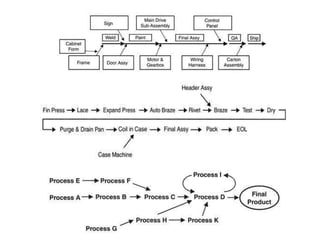
DOCUMENTING THE PROCESS FLOW AND ESTABLISHING MIXED PRODUCT FAMILIESProcessA process is a physical location where a logical grouping of resources performs sequential work tasksProcess Flow DiagramPFD is a graphic depiction of processes documenting the sequence and the timed input of those processes into another required for the completion of a productDo not consider purchased materialsDocument the processes where labor or machine time is consumed in the manufacture of the product
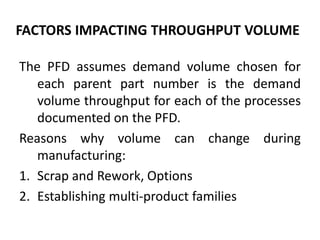
The PFD assumes demand volume chosen for each parent part number is the demand volume throughput for each of the processes documented on the PFD.Reasons why volume can change during manufacturing:Scrap and Rework, OptionsEstablishing multi-product familiesFACTORS IMPACTING THROUGHPUT VOLUME
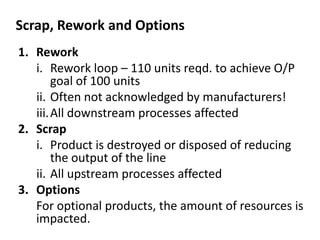
Scrap, Rework and OptionsReworkRework loop – 110 units reqd. to achieve O/P goal of 100 unitsOften not acknowledged by manufacturers!All downstream processes affectedScrapProduct is destroyed or disposed of reducing the output of the lineAll upstream processes affectedOptions	For optional products, the amount of resources is impacted.
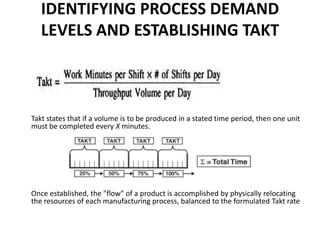
IDENTIFYING PROCESS DEMAND LEVELS AND ESTABLISHING TAKT 	.  Taktstates that if a volume is to be produced in a stated time period, then one unit must be completed every X minutes.  	Once established, the "flow" of a product is accomplished by physically relocating the resources of each manufacturing process, balanced to the formulated Taktrate
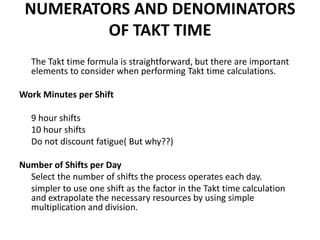
NUMERATORS AND DENOMINATORS OF TAKT TIME	The Takt time formula is straightforward, but there are important elements to consider when performing Takt time calculations. Work Minutes per Shift	9 hour shifts	10 hour shifts	Do not discount fatigue( But why??)	 Number of Shifts per Day	Select the number of shifts the process operates each day. 	simpler to use one shift as the factor in the Takt time calculation and extrapolate the necessary resources by using simple multiplication and division. 
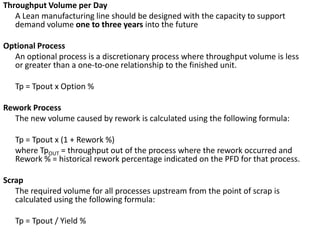
Throughput Volume per Day	A Lean manufacturing line should be designed with the capacity to support demand volume one to three years into the future Optional Process	An optional process is a discretionary process where throughput volume is less or greater than a one-to-one relationship to the finished unit.	 Tp = Tpout x Option % Rework Process	The new volume caused by rework is calculated using the following formula: Tp = Tpout x (1 + Rework %)	where TpOUT = throughput out of the process where the rework occurred and Rework % = historical rework percentage indicated on the PFD for that process. Scrap	The required volume for all processes upstream from the point of scrap is calculated using the following formula: Tp = Tpout / Yield %

Lean manufacturing

  • 1.
    CH-3 PPTBy: AnikaGuptaHarmanpreet SinghMadhurChawlaSimranjit SinghSoumyaAgarwal
  • 2.
    DETERMINING THE SCOPEOF THE INITIAL LEAN MANUFACTURING IMPLEMENTATION AREATeam members assigned to participate in the implementation project are rarely individual contributors who have no other responsibilitiesThe project must be large enough to generate a sufficient return on the investment of time, funds, and the human resources required to make the transformation
  • 3.
    Determining the idealproject size must be based on a consideration of the benefits identified during the strategic benefits assessment. “Rule of thumb” is 25 products and no more than 50 processesThe project that never ends will eventually exhaust the energy of the implementation teamsDETERMINING THE SCOPE OF THE INITIAL LEAN MANUFACTURING IMPLEMENTATION AREA
  • 4.
    SELECTING PARENT PARTSFOR THE LEAN LINEManufacturer with thousands of unique products scope its project so it fits into the range of a manageable project?Products chosen should be representative of all products producedTwo methods-Perform Pareto analysis based on historical sales of these products. Confirm that the products selected include all manufacturing processes for all productsParent part number consolidation
  • 5.
     ADVANTAGESCorrectly represents allthe processes used to produce all the products required to meet potential customer demandScopes the implementation project to a manageable project size while still assuring a sufficient return on investment for the Lean implementation
  • 6.
    ESTABLISHING THE CAPACITYTO MEET DEMAND VOLUME OF THE LEAN IMPLEMENTATION AREAQuantity is important because it determines:Capacity of the Lean line, and the amount of resources required A Lean manufacturing line should be designed with the capacity to support demand one to 3 years in the future
  • 7.
    SOURCES FOR DETERMININGDEMANDHistory   An obvious place to start is to use the same demand used for the Pareto analysis when establishing parent part numbers for the Lean line Intuitive Knowledge The manufacturing group is often the best source of this information, as during the course of production they can often spot trends in product demand based on the quantities running down its lines before sales and marketing see them
  • 8.
    SOURCES FOR DETERMININGDEMANDForecasting Instead of relyingsolelyonhistory and intutiveknowledge, forecastershavevaluableempirical data onwhichtheyrely. Forecasting is inaccurate due to: Countless end-item product permutations available for saleLong lead timeMarketing IntelligenceMarketing has more visibility onto the future than any group in the organization
  • 9.
    DOCUMENTING THE PROCESSFLOW AND ESTABLISHING MIXED PRODUCT FAMILIESProcessA process is a physical location where a logical grouping of resources performs sequential work tasksProcess Flow DiagramPFD is a graphic depiction of processes documenting the sequence and the timed input of those processes into another required for the completion of a productDo not consider purchased materialsDocument the processes where labor or machine time is consumed in the manufacture of the product
  • 11.
    The PFD assumesdemand volume chosen for each parent part number is the demand volume throughput for each of the processes documented on the PFD.Reasons why volume can change during manufacturing:Scrap and Rework, OptionsEstablishing multi-product familiesFACTORS IMPACTING THROUGHPUT VOLUME
  • 12.
    Scrap, Rework andOptionsReworkRework loop – 110 units reqd. to achieve O/P goal of 100 unitsOften not acknowledged by manufacturers!All downstream processes affectedScrapProduct is destroyed or disposed of reducing the output of the lineAll upstream processes affectedOptions For optional products, the amount of resources is impacted.
  • 13.
    IDENTIFYING PROCESS DEMANDLEVELS AND ESTABLISHING TAKT  .  Taktstates that if a volume is to be produced in a stated time period, then one unit must be completed every X minutes.   Once established, the "flow" of a product is accomplished by physically relocating the resources of each manufacturing process, balanced to the formulated Taktrate
  • 14.
    NUMERATORS AND DENOMINATORSOF TAKT TIME The Takt time formula is straightforward, but there are important elements to consider when performing Takt time calculations. Work Minutes per Shift 9 hour shifts 10 hour shifts Do not discount fatigue( But why??)  Number of Shifts per Day Select the number of shifts the process operates each day. simpler to use one shift as the factor in the Takt time calculation and extrapolate the necessary resources by using simple multiplication and division. 
  • 15.
    Throughput Volume perDay A Lean manufacturing line should be designed with the capacity to support demand volume one to three years into the future Optional Process An optional process is a discretionary process where throughput volume is less or greater than a one-to-one relationship to the finished unit.  Tp = Tpout x Option % Rework Process The new volume caused by rework is calculated using the following formula: Tp = Tpout x (1 + Rework %) where TpOUT = throughput out of the process where the rework occurred and Rework % = historical rework percentage indicated on the PFD for that process. Scrap The required volume for all processes upstream from the point of scrap is calculated using the following formula: Tp = Tpout / Yield %