

What is meant by Efficiency?
Topic 3.3.5
What is meant by Efficiency?
Topic 3.3.5
Students should be able to:
• Understand and distinguish between productive and
allocative efficiency
• Know that the minimum point on the average total cost is
the most productively efficient point and that allocative
efficiency occurs where price is equal to marginal cost
• Understand the meaning of inefficiency e.g. X-inefficiency
Google and Apple’s RevenueWhat is Economic Efficiency?
• Efficiency is about a society
making optimal use of scarce
resources to help satisfy
changing wants & needs
• There are several meanings of
efficiency but they all link to
how well a market system
allocates our scarce resources to
satisfy consumers
• Normally the market mechanism
is good at allocating these
inputs, but there are occasions
when the market can fail
How well are our scarce resources used? This is what is discussed
when economists talk about and analyse economic efficiency
Allocative Productive
Dynamic Social
Google and Apple’s RevenueBasics of Allocative Efficiency
Economic efficiency means making optimum use of scarce resources
Price
Quantity
Demand
Supply
P
Q
R
S
T
O
Producer
surplus
Consumer
surplus
Allocative efficiency is at
an output which
maximizes total consumer
welfare
At the market equilibrium
price, consumer and
producer surplus is
maximized – at this
output, economic welfare
is maximized.
Google and Apple’s RevenueBasics of Allocative Efficiency
• Allocative efficiency is reached
when no one can be made better
off without making someone
else worse off. This is also known
as Pareto efficiency
• Allocative efficiency occurs when
the value that consumers place
on a good or service (reflected in
the price they are willing and able
to pay) equals the cost of the
factor resources used up in
production.
• The main condition required for
allocative efficiency in a given
market is that market price =
marginal cost of supply
A
B
C
Output
of Beer
Output of Cheese
X1
X2
X3
Y1 Y2 Y3
All points that lie on the PPF are allocatively
efficient because we cannot produce more of
one product without affecting the amount of
all other products available.
Google and Apple’s RevenueBasics of Productive Efficiency
• Productive efficiency exists
when producers minimize the
wastage of resources
• Productive efficiency also
relates to when an economy is
on their production
possibility frontier
• An economy is productively
efficient if it can produce
more of one good only by
producing less of another.
A firm is productively efficient when it is operating at the lowest
point on its average cost curve i.e. unit costs have been minimised
Cost
Per
Unit
Output
Productive efficiency is
achieved when the long run
unit cost of production is at a
minimum
Average
Cost
Google and Apple’s RevenueBasics of Social Efficiency
• The socially efficient level of
output and/or consumption
occurs when marginal
social benefit (MSB) =
marginal social cost (MSC)
• The existence of negative
and positive externalities
means that the private level
of consumption or
production differs from
social optimum
• The free market price
mechanism does not always
take into account social
costs and benefits
Output
P1
Q1
MPC
MSC
MPB
MSB
P2
Q2
Costs,
Benefits
Social optimum
output is where
MSC = MSB
Google and Apple’s RevenueBasics of Dynamic Efficiency
Innovation is putting a new idea or approach into action. Innovation
is 'the commercially successful exploitation of ideas'
• Product innovation
• Small-scale and frequent subtle
changes to the characteristics
and performance of a good or a
service
• Process innovation
• Changes to the way in which
production takes place or is
organised
• Changes in business models and
pricing strategies
• Innovation has demand and supply-
side effects in markets and the
economy as a whole
Austrian economist
Joseph Schumpeter
(pictured) coined the
term creative
destruction which
refers to the
upheaval of the
established order in
the pursuit of
innovation.
Smaller disruptive
businesses often
challenge existing
firms with market
power!
Examples of Dynamic Efficiency
• Dec 2015: Porsche to make electric sports car in €700m
project - aimed at challenging Tesla's dominance of the
battery-powered sports car market
• Dec 2015: Ford says it will invest $4.5bn (£3bn) to
expand its fleet of plug-in and hybrid electric vehicles,
and will start selling 13 new electric models by 2020.
• Nov 2015: Huawei reveals a new quick-charge battery
• Nov 2015: The doctor will text you now: Will mobile
devices change healthcare? – new app allows doctors to
process their patients electronically and remotely
Competition Policy in the News
• Dec 2015: Cloud storage providers to face investigation
by regulators - investigation is to be launched into
whether internet users are being charged unfairly when
they use internet cloud storage services
• Nov 2015: Shell-BG deal to win green light –
competition regulators in China and Australia likely to
support move to create Britain’s biggest company
Key Concepts – Innovation in Markets
Cost-reducing innovation
Cost reducing innovations causing an
outward shift in supply. They allow
businesses to enjoy higher profit
margins with a given level of demand
Creative destruction
First introduced economist Joseph
Schumpeter. It refers to the dynamic
effects of innovation – with new products
or business models, some jobs are lost
but new ones are created.
Google and Apple’s RevenueMonopoly and Allocative Inefficiency
Price
Cost
Output
Demand
Supply
Q1Q2
P1
P2
• Main case against a monopoly is
that it makes higher profits at the
expense of a loss of allocative
efficiency.
• The monopolist will seek to
extract a price from consumers
above the cost of resources used
in making the product.
• Higher prices mean that
consumers’ needs and wants are
not being satisfied, as the
product is being under-
consumed.
• Higher prices cause a loss of
consumer surplus & welfare and
will disproportionately affect
lower income families.
Monopoly price
(P2) leads to
higher revenue +
producer surplus
The competitive
equilibrium price
Google and Apple’s RevenueMarket Failure and Lost Efficiency
Market failure is when the price mechanism leads to an inefficient
allocation of resources and a deadweight loss of economic welfare
Negative
externalities
Positive
externalities
Public goods Merit goods
De-merit goods Information
failures
Monopolies Immobility of
factor inputs
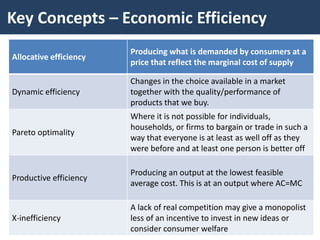
Key Concepts – Economic Efficiency
Allocative efficiency
Producing what is demanded by consumers at a
price that reflect the marginal cost of supply
Dynamic efficiency
Changes in the choice available in a market
together with the quality/performance of
products that we buy.
Pareto optimality
Where it is not possible for individuals,
households, or firms to bargain or trade in such a
way that everyone is at least as well off as they
were before and at least one person is better off
Productive efficiency
Producing an output at the lowest feasible
average cost. This is at an output where AC=MC
X-inefficiency
A lack of real competition may give a monopolist
less of an incentive to invest in new ideas or
consider consumer welfare
What is meant by Efficiency?
Topic 3.3.5

Economic Efficiency

  • 1.
    What is meantby Efficiency? Topic 3.3.5
  • 2.
    What is meantby Efficiency? Topic 3.3.5 Students should be able to: • Understand and distinguish between productive and allocative efficiency • Know that the minimum point on the average total cost is the most productively efficient point and that allocative efficiency occurs where price is equal to marginal cost • Understand the meaning of inefficiency e.g. X-inefficiency
  • 3.
    Google and Apple’sRevenueWhat is Economic Efficiency? • Efficiency is about a society making optimal use of scarce resources to help satisfy changing wants & needs • There are several meanings of efficiency but they all link to how well a market system allocates our scarce resources to satisfy consumers • Normally the market mechanism is good at allocating these inputs, but there are occasions when the market can fail How well are our scarce resources used? This is what is discussed when economists talk about and analyse economic efficiency Allocative Productive Dynamic Social
  • 4.
    Google and Apple’sRevenueBasics of Allocative Efficiency Economic efficiency means making optimum use of scarce resources Price Quantity Demand Supply P Q R S T O Producer surplus Consumer surplus Allocative efficiency is at an output which maximizes total consumer welfare At the market equilibrium price, consumer and producer surplus is maximized – at this output, economic welfare is maximized.
  • 5.
    Google and Apple’sRevenueBasics of Allocative Efficiency • Allocative efficiency is reached when no one can be made better off without making someone else worse off. This is also known as Pareto efficiency • Allocative efficiency occurs when the value that consumers place on a good or service (reflected in the price they are willing and able to pay) equals the cost of the factor resources used up in production. • The main condition required for allocative efficiency in a given market is that market price = marginal cost of supply A B C Output of Beer Output of Cheese X1 X2 X3 Y1 Y2 Y3 All points that lie on the PPF are allocatively efficient because we cannot produce more of one product without affecting the amount of all other products available.
  • 6.
    Google and Apple’sRevenueBasics of Productive Efficiency • Productive efficiency exists when producers minimize the wastage of resources • Productive efficiency also relates to when an economy is on their production possibility frontier • An economy is productively efficient if it can produce more of one good only by producing less of another. A firm is productively efficient when it is operating at the lowest point on its average cost curve i.e. unit costs have been minimised Cost Per Unit Output Productive efficiency is achieved when the long run unit cost of production is at a minimum Average Cost
  • 7.
    Google and Apple’sRevenueBasics of Social Efficiency • The socially efficient level of output and/or consumption occurs when marginal social benefit (MSB) = marginal social cost (MSC) • The existence of negative and positive externalities means that the private level of consumption or production differs from social optimum • The free market price mechanism does not always take into account social costs and benefits Output P1 Q1 MPC MSC MPB MSB P2 Q2 Costs, Benefits Social optimum output is where MSC = MSB
  • 8.
    Google and Apple’sRevenueBasics of Dynamic Efficiency Innovation is putting a new idea or approach into action. Innovation is 'the commercially successful exploitation of ideas' • Product innovation • Small-scale and frequent subtle changes to the characteristics and performance of a good or a service • Process innovation • Changes to the way in which production takes place or is organised • Changes in business models and pricing strategies • Innovation has demand and supply- side effects in markets and the economy as a whole Austrian economist Joseph Schumpeter (pictured) coined the term creative destruction which refers to the upheaval of the established order in the pursuit of innovation. Smaller disruptive businesses often challenge existing firms with market power!
  • 9.
    Examples of DynamicEfficiency • Dec 2015: Porsche to make electric sports car in €700m project - aimed at challenging Tesla's dominance of the battery-powered sports car market • Dec 2015: Ford says it will invest $4.5bn (£3bn) to expand its fleet of plug-in and hybrid electric vehicles, and will start selling 13 new electric models by 2020. • Nov 2015: Huawei reveals a new quick-charge battery • Nov 2015: The doctor will text you now: Will mobile devices change healthcare? – new app allows doctors to process their patients electronically and remotely
  • 10.
    Competition Policy inthe News • Dec 2015: Cloud storage providers to face investigation by regulators - investigation is to be launched into whether internet users are being charged unfairly when they use internet cloud storage services • Nov 2015: Shell-BG deal to win green light – competition regulators in China and Australia likely to support move to create Britain’s biggest company
  • 11.
    Key Concepts –Innovation in Markets Cost-reducing innovation Cost reducing innovations causing an outward shift in supply. They allow businesses to enjoy higher profit margins with a given level of demand Creative destruction First introduced economist Joseph Schumpeter. It refers to the dynamic effects of innovation – with new products or business models, some jobs are lost but new ones are created.
  • 12.
    Google and Apple’sRevenueMonopoly and Allocative Inefficiency Price Cost Output Demand Supply Q1Q2 P1 P2 • Main case against a monopoly is that it makes higher profits at the expense of a loss of allocative efficiency. • The monopolist will seek to extract a price from consumers above the cost of resources used in making the product. • Higher prices mean that consumers’ needs and wants are not being satisfied, as the product is being under- consumed. • Higher prices cause a loss of consumer surplus & welfare and will disproportionately affect lower income families. Monopoly price (P2) leads to higher revenue + producer surplus The competitive equilibrium price
  • 13.
    Google and Apple’sRevenueMarket Failure and Lost Efficiency Market failure is when the price mechanism leads to an inefficient allocation of resources and a deadweight loss of economic welfare Negative externalities Positive externalities Public goods Merit goods De-merit goods Information failures Monopolies Immobility of factor inputs
  • 14.
    Key Concepts –Economic Efficiency Allocative efficiency Producing what is demanded by consumers at a price that reflect the marginal cost of supply Dynamic efficiency Changes in the choice available in a market together with the quality/performance of products that we buy. Pareto optimality Where it is not possible for individuals, households, or firms to bargain or trade in such a way that everyone is at least as well off as they were before and at least one person is better off Productive efficiency Producing an output at the lowest feasible average cost. This is at an output where AC=MC X-inefficiency A lack of real competition may give a monopolist less of an incentive to invest in new ideas or consider consumer welfare
  • 15.
    What is meantby Efficiency? Topic 3.3.5