1.5.10 Market Structure, Static Efficiency, Dynamic
Efficiency and Resource Allocation
AQA 1.5: PERFECT COMPETITION,
IMPERFECTLY COMPETITIVE MARKETS AND
MONOPOLY
Recap
What is meant by:
• Productive efficiency
• Allocative efficiency
• Economic efficiency?
1.5.10 WHAT YOU NEED TO KNOW
 The difference between static efficiency and dynamic
efficiency
 The conditions required for productive efficiency
(minimising average total costs) and allocative efficiency
(price = marginal cost)
 Dynamic efficiency is influenced by, for example,
research and development, investment in human and
non-human capital and technological change
 Students should be able to apply efficiency concepts
when comparing the performance of firms in markets
with different structures. They should understand how
conduct and performance indicators can be used to
compare market structures
PRODUCTIVE AND ALLOCATIVE EFFICIENCY
 Productive efficiency occurs where no additional (or
maximum) output can be produced from the factor inputs
available at the lowest possible average or unit cost. Thus,
average costs are minimised
 Average cost = total cost/output
 Allocative efficiency occurs where consumer satisfaction is
maximised in the production of goods and services
 At this point quantity supplied will equal quantity
demanded and P = MC
 Economic efficiency occurs where we have allocative and
productive efficiency at the same time:
 P = MC = minimum point on the AC curve
 Both productive and allocative efficiency can be illustrated
using a PPC
Efficiency is important for
economists and there are
a variety of efficiencies
that come under the
umbrella heading
economic efficiency.
Economic efficiency
occurs when the
maximum amount of
products are produced at
their minimum cost whilst
maximising their benefit
to society.
Productive efficiency
occurs when an economy
uses the minimum inputs
to produce the maximum
output at lowest cost.
Allocative efficiency
occurs when society is
producing goods to match
the needs of consumers.
PRODUCTIVE AND ALLOCATIVE EFFICIENCY
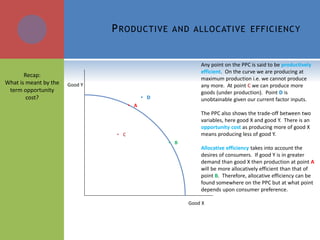
Any point on the PPC is said to be productively
efficient. On the curve we are producing at
maximum production i.e. we cannot produce
any more. At point C we can produce more
goods (under production). Point D is
unobtainable given our current factor inputs.
The PPC also shows the trade-off between two
variables, here good X and good Y. There is an
opportunity cost as producing more of good X
means producing less of good Y.
Allocative efficiency takes into account the
desires of consumers. If good Y is in greater
demand than good X then production at point A
will be more allocatively efficient than that of
point B. Therefore, allocative efficiency can be
found somewhere on the PPC but at what point
depends upon consumer preference.
Good Y
Good X
• A
• B
• D
• C
Recap:
What is meant by the
term opportunity
cost?
WHEN IS ALLOCATIVE
EFFICIENCY ACHIEVED?
 Allocative efficiency is difficult to identify as we need to
match consumer preferences to producer output
 Put another way, we need to match demand and supply
 Markets do not always operate at the market clearing price
due to:
 Excess supply (S>D)
 Excess demand (D>S)
 Market forces do push prices towards equilibrium where
quantity demanded will equal quantity supplied
 Therefore, it is likely that competitive markets help in
achieving allocative efficiency
Price
Quantity
D
P1
S
P2
Q1
Q2
A B
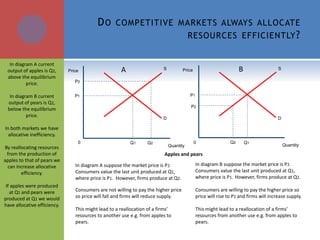
In diagram A current
output of apples is Q2,
above the equilibrium
price.
In diagram B current
output of pears is Q2,
below the equilibrium
price.
In both markets we have
allocative inefficiency.
By reallocating resources
from the production of
apples to that of pears we
can increase allocative
efficiency.
If apples were produced
at Q1 and pears were
produced at Q1 we would
have allocative efficiency.
In diagram A suppose the market price is P2.
Consumers value the last unit produced at Q1,
where price is P1. However, firms produce at Q2.
Consumers are not willing to pay the higher price
so price will fall and firms will reduce supply.
This might lead to a reallocation of a firms’
resources to another use e.g. from apples to
pears.
Price
Quantity
D
P1
Q1
S
P2
Q2
0 0
In diagram B suppose the market price is P2.
Consumers value the last unit produced at Q1,
where price is P1. However, firms produce at Q2.
Consumers are willing to pay the higher price so
price will rise to P2 and firms will increase supply.
This might lead to a reallocation of a firms’
resources from another use e.g. from apples to
pears.
DO COMPETITIVE MARKETS ALWAYS ALLOCATE
RESOURCES EFFICIENTLY?
Apples and pears
STATIC AND DYNAMIC EFFICIENCY
 Static efficiency occurs when all resources are
being used in the most efficient manner at a point
in time
 Dynamic efficiency occurs where firms improve
technology and production methods over a period
of time
INFLUENCES ON DYNAMIC EFFICIENCY
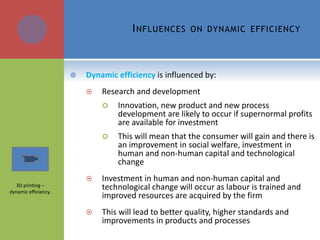
 Dynamic efficiency is influenced by:
 Research and development
 Innovation, new product and new process
development are likely to occur if supernormal profits
are available for investment
 This will mean that the consumer will gain and there is
an improvement in social welfare, investment in
human and non-human capital and technological
change
 Investment in human and non-human capital and
technological change will occur as labour is trained and
improved resources are acquired by the firm
 This will lead to better quality, higher standards and
improvements in products and processes
3D printing –
dynamic efficiency.
PERFECT COMPETITION AND THE
EFFICIENT ALLOCATION OF RESOURCES
P
D
S
Q
D = AR = MR
Price
Output
0
MC
AC
P
0
Q
Firm Industry
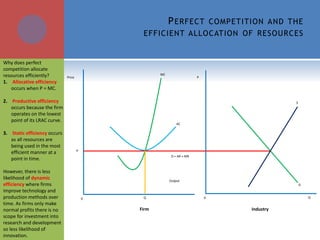
Why does perfect
competition allocate
resources efficiently?
1. Allocative efficiency
occurs when P = MC.
2. Productive efficiency
occurs because the firm
operates on the lowest
point of its LRAC curve.
3. Static efficiency occurs
as all resources are
being used in the most
efficient manner at a
point in time.
However, there is less
likelihood of dynamic
efficiency where firms
improve technology and
production methods over
time. As firms only make
normal profits there is no
scope for investment into
research and development
so less likelihood of
innovation.
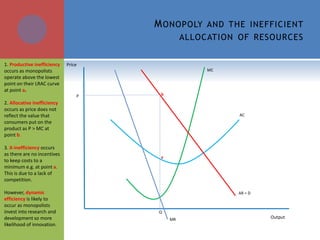
MONOPOLY AND THE INEFFICIENT
ALLOCATION OF RESOURCES
Price
Output
AR = D
MR
MC
AC
a
1. Productive inefficiency
occurs as monopolists
operate above the lowest
point on their LRAC curve
at point a.
2. Allocative inefficiency
occurs as price does not
reflect the value that
consumers put on the
product as P > MC at
point b.
3. X-inefficiency occurs
as there are no incentives
to keep costs to a
minimum e.g. at point a.
This is due to a lack of
competition.
However, dynamic
efficiency is likely to
occur as monopolists
invest into research and
development so more
likelihood of innovation.
Q
b
P
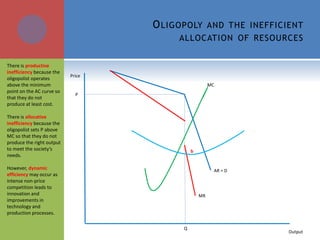
OLIGOPOLY AND THE INEFFICIENT
ALLOCATION OF RESOURCES
There is productive
inefficiency because the
oligopolist operates
above the minimum
point on the AC curve so
that they do not
produce at least cost.
There is allocative
inefficiency because the
oligopolist sets P above
MC so that they do not
produce the right output
to meet the society’s
needs.
However, dynamic
efficiency may occur as
intense non-price
competition leads to
innovation and
improvements in
technology and
production processes.
Price
Output
P
Q
MR
MC
AR = D
b
CLASS ACTIVITY
 Monopoly
 Oligopoly
 Barriers to entry
 Degree of concentration
 Product differentiation
 Price makers
 Price takers
 Monopoly power
 Supernormal profits
 Collusive oligopoly
 Non-collusive oligopoly
 Cartels
 Interdependence
 Uncertainty
 Price discrimination
 Consumer surplus
 Producer surplus
 Contestable markets
 Non-contestable markets
 Static efficiency
 Dynamic efficiency
Opposite are 21
terms you have
studied.
Take it in turns to
select one term and
explain it to the rest
of the class. Where
appropriate use
diagrams to support
your explanations.

1.5.10 Market structure, static efficiency, dynamic efficiency and resource allocation.pptx

  • 1.
    1.5.10 Market Structure,Static Efficiency, Dynamic Efficiency and Resource Allocation AQA 1.5: PERFECT COMPETITION, IMPERFECTLY COMPETITIVE MARKETS AND MONOPOLY Recap What is meant by: • Productive efficiency • Allocative efficiency • Economic efficiency?
  • 2.
    1.5.10 WHAT YOUNEED TO KNOW  The difference between static efficiency and dynamic efficiency  The conditions required for productive efficiency (minimising average total costs) and allocative efficiency (price = marginal cost)  Dynamic efficiency is influenced by, for example, research and development, investment in human and non-human capital and technological change  Students should be able to apply efficiency concepts when comparing the performance of firms in markets with different structures. They should understand how conduct and performance indicators can be used to compare market structures
  • 3.
    PRODUCTIVE AND ALLOCATIVEEFFICIENCY  Productive efficiency occurs where no additional (or maximum) output can be produced from the factor inputs available at the lowest possible average or unit cost. Thus, average costs are minimised  Average cost = total cost/output  Allocative efficiency occurs where consumer satisfaction is maximised in the production of goods and services  At this point quantity supplied will equal quantity demanded and P = MC  Economic efficiency occurs where we have allocative and productive efficiency at the same time:  P = MC = minimum point on the AC curve  Both productive and allocative efficiency can be illustrated using a PPC Efficiency is important for economists and there are a variety of efficiencies that come under the umbrella heading economic efficiency. Economic efficiency occurs when the maximum amount of products are produced at their minimum cost whilst maximising their benefit to society. Productive efficiency occurs when an economy uses the minimum inputs to produce the maximum output at lowest cost. Allocative efficiency occurs when society is producing goods to match the needs of consumers.
  • 4.
    PRODUCTIVE AND ALLOCATIVEEFFICIENCY Any point on the PPC is said to be productively efficient. On the curve we are producing at maximum production i.e. we cannot produce any more. At point C we can produce more goods (under production). Point D is unobtainable given our current factor inputs. The PPC also shows the trade-off between two variables, here good X and good Y. There is an opportunity cost as producing more of good X means producing less of good Y. Allocative efficiency takes into account the desires of consumers. If good Y is in greater demand than good X then production at point A will be more allocatively efficient than that of point B. Therefore, allocative efficiency can be found somewhere on the PPC but at what point depends upon consumer preference. Good Y Good X • A • B • D • C Recap: What is meant by the term opportunity cost?
  • 5.
    WHEN IS ALLOCATIVE EFFICIENCYACHIEVED?  Allocative efficiency is difficult to identify as we need to match consumer preferences to producer output  Put another way, we need to match demand and supply  Markets do not always operate at the market clearing price due to:  Excess supply (S>D)  Excess demand (D>S)  Market forces do push prices towards equilibrium where quantity demanded will equal quantity supplied  Therefore, it is likely that competitive markets help in achieving allocative efficiency
  • 6.
    Price Quantity D P1 S P2 Q1 Q2 A B In diagramA current output of apples is Q2, above the equilibrium price. In diagram B current output of pears is Q2, below the equilibrium price. In both markets we have allocative inefficiency. By reallocating resources from the production of apples to that of pears we can increase allocative efficiency. If apples were produced at Q1 and pears were produced at Q1 we would have allocative efficiency. In diagram A suppose the market price is P2. Consumers value the last unit produced at Q1, where price is P1. However, firms produce at Q2. Consumers are not willing to pay the higher price so price will fall and firms will reduce supply. This might lead to a reallocation of a firms’ resources to another use e.g. from apples to pears. Price Quantity D P1 Q1 S P2 Q2 0 0 In diagram B suppose the market price is P2. Consumers value the last unit produced at Q1, where price is P1. However, firms produce at Q2. Consumers are willing to pay the higher price so price will rise to P2 and firms will increase supply. This might lead to a reallocation of a firms’ resources from another use e.g. from apples to pears. DO COMPETITIVE MARKETS ALWAYS ALLOCATE RESOURCES EFFICIENTLY? Apples and pears
  • 7.
    STATIC AND DYNAMICEFFICIENCY  Static efficiency occurs when all resources are being used in the most efficient manner at a point in time  Dynamic efficiency occurs where firms improve technology and production methods over a period of time
  • 8.
    INFLUENCES ON DYNAMICEFFICIENCY  Dynamic efficiency is influenced by:  Research and development  Innovation, new product and new process development are likely to occur if supernormal profits are available for investment  This will mean that the consumer will gain and there is an improvement in social welfare, investment in human and non-human capital and technological change  Investment in human and non-human capital and technological change will occur as labour is trained and improved resources are acquired by the firm  This will lead to better quality, higher standards and improvements in products and processes 3D printing – dynamic efficiency.
  • 9.
    PERFECT COMPETITION ANDTHE EFFICIENT ALLOCATION OF RESOURCES P D S Q D = AR = MR Price Output 0 MC AC P 0 Q Firm Industry Why does perfect competition allocate resources efficiently? 1. Allocative efficiency occurs when P = MC. 2. Productive efficiency occurs because the firm operates on the lowest point of its LRAC curve. 3. Static efficiency occurs as all resources are being used in the most efficient manner at a point in time. However, there is less likelihood of dynamic efficiency where firms improve technology and production methods over time. As firms only make normal profits there is no scope for investment into research and development so less likelihood of innovation.
  • 10.
    MONOPOLY AND THEINEFFICIENT ALLOCATION OF RESOURCES Price Output AR = D MR MC AC a 1. Productive inefficiency occurs as monopolists operate above the lowest point on their LRAC curve at point a. 2. Allocative inefficiency occurs as price does not reflect the value that consumers put on the product as P > MC at point b. 3. X-inefficiency occurs as there are no incentives to keep costs to a minimum e.g. at point a. This is due to a lack of competition. However, dynamic efficiency is likely to occur as monopolists invest into research and development so more likelihood of innovation. Q b P
  • 11.
    OLIGOPOLY AND THEINEFFICIENT ALLOCATION OF RESOURCES There is productive inefficiency because the oligopolist operates above the minimum point on the AC curve so that they do not produce at least cost. There is allocative inefficiency because the oligopolist sets P above MC so that they do not produce the right output to meet the society’s needs. However, dynamic efficiency may occur as intense non-price competition leads to innovation and improvements in technology and production processes. Price Output P Q MR MC AR = D b
  • 12.
    CLASS ACTIVITY  Monopoly Oligopoly  Barriers to entry  Degree of concentration  Product differentiation  Price makers  Price takers  Monopoly power  Supernormal profits  Collusive oligopoly  Non-collusive oligopoly  Cartels  Interdependence  Uncertainty  Price discrimination  Consumer surplus  Producer surplus  Contestable markets  Non-contestable markets  Static efficiency  Dynamic efficiency Opposite are 21 terms you have studied. Take it in turns to select one term and explain it to the rest of the class. Where appropriate use diagrams to support your explanations.

Editor's Notes

  • #9 http://www.economist.com/blogs/economist-explains/2014/07/economist-explains-13