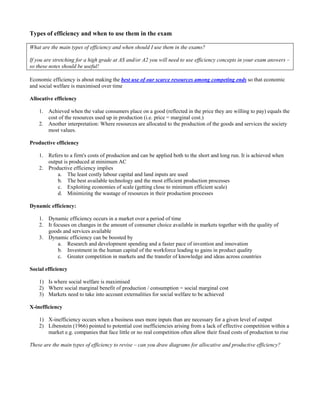
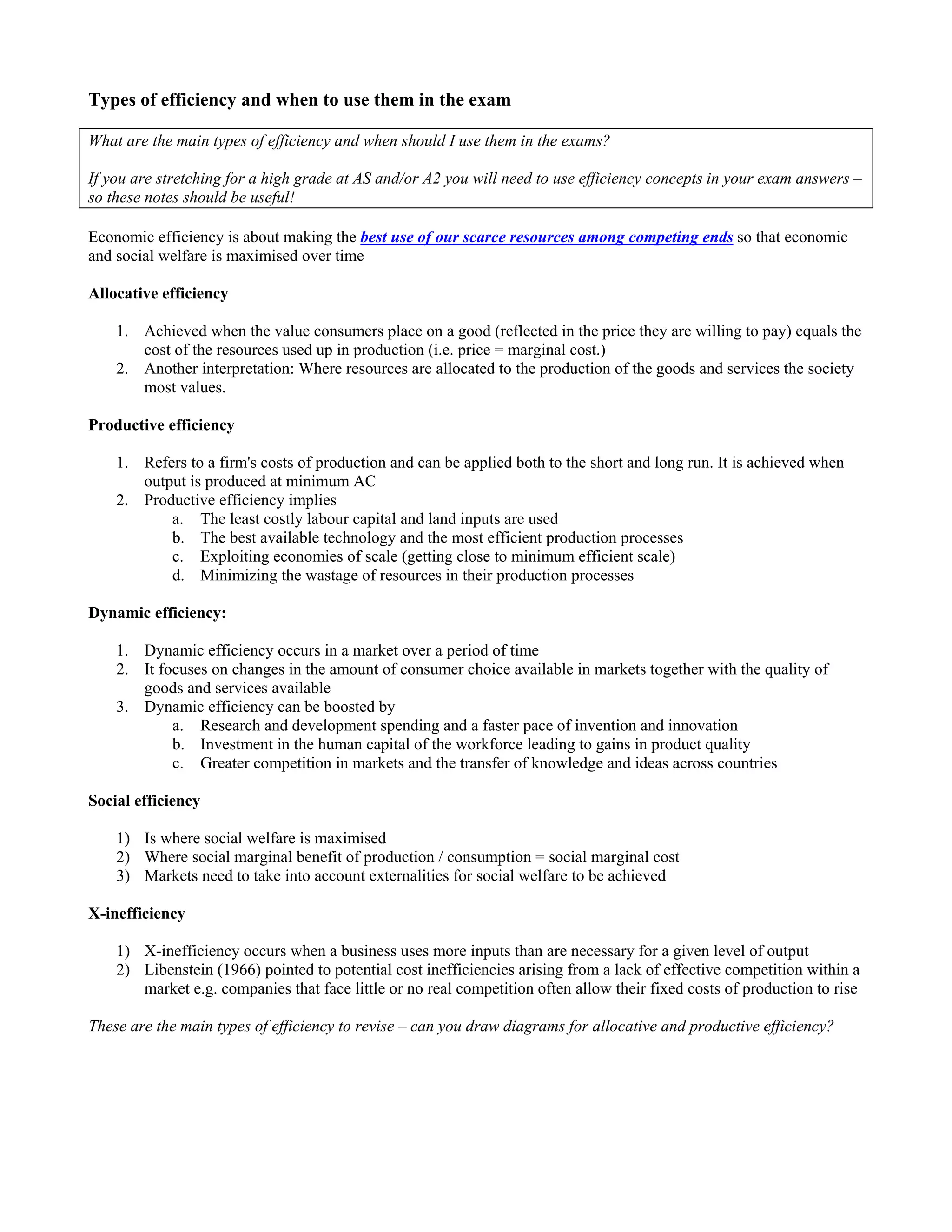
Types of efficiency and when to use them in the exam

What are the main types of efficiency and when should I use them in the exams?

If you are stretching for a high grade at AS and/or A2 you will need to use efficiency concepts in your exam answers –
so these notes should be useful!

Economic efficiency is about making the best use of our scarce resources among competing ends so that economic
and social welfare is maximised over time

Allocative efficiency

    1. Achieved when the value consumers place on a good (reflected in the price they are willing to pay) equals the
       cost of the resources used up in production (i.e. price = marginal cost.)
    2. Another interpretation: Where resources are allocated to the production of the goods and services the society
       most values.

Productive efficiency

    1. Refers to a firm's costs of production and can be applied both to the short and long run. It is achieved when
       output is produced at minimum AC
    2. Productive efficiency implies
           a. The least costly labour capital and land inputs are used
           b. The best available technology and the most efficient production processes
           c. Exploiting economies of scale (getting close to minimum efficient scale)
           d. Minimizing the wastage of resources in their production processes

Dynamic efficiency:

    1. Dynamic efficiency occurs in a market over a period of time
    2. It focuses on changes in the amount of consumer choice available in markets together with the quality of
       goods and services available
    3. Dynamic efficiency can be boosted by
            a. Research and development spending and a faster pace of invention and innovation
            b. Investment in the human capital of the workforce leading to gains in product quality
            c. Greater competition in markets and the transfer of knowledge and ideas across countries

Social efficiency

    1) Is where social welfare is maximised
    2) Where social marginal benefit of production / consumption = social marginal cost
    3) Markets need to take into account externalities for social welfare to be achieved

X-inefficiency

    1) X-inefficiency occurs when a business uses more inputs than are necessary for a given level of output
    2) Libenstein (1966) pointed to potential cost inefficiencies arising from a lack of effective competition within a
       market e.g. companies that face little or no real competition often allow their fixed costs of production to rise

These are the main types of efficiency to revise – can you draw diagrams for allocative and productive efficiency?
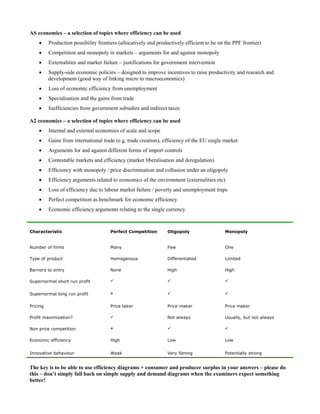
AS economics – a selection of topics where efficiency can be used
    •     Production possibility frontiers (allocatively and productively efficient to be on the PPF frontier)
    •     Competition and monopoly in markets – arguments for and against monopoly
    •     Externalities and market failure – justifications for government intervention
    •     Supply-side economic policies – designed to improve incentives to raise productivity and research and
          development (good way of linking micro to macroeconomics)
    •     Loss of economic efficiency from unemployment
    •     Specialisation and the gains from trade
    •     Inefficiencies from government subsidies and indirect taxes

A2 economics – a selection of topics where efficiency can be used
    •     Internal and external economies of scale and scope
    •     Gains from international trade (e.g. trade creation), efficiency of the EU single market
    •     Arguments for and against different forms of import controls
    •     Contestable markets and efficiency (market liberalisation and deregulation)
    •     Efficiency with monopoly / price discrimination and collusion under an oligopoly
    •     Efficiency arguments related to economics of the environment (externalities etc)
    •     Loss of efficiency due to labour market failure / poverty and unemployment traps
    •     Perfect competition as benchmark for economic efficiency
    •     Economic efficiency arguments relating to the single currency


Characteristic                         Perfect Competition       Oligopoly                   Monopoly


Number of firms                        Many                      Few                         One

Type of product                        Homogenous                Differentiated              Limited

Barriers to entry                      None                      High                        High

Supernormal short run profit


Supernormal long run profit

Pricing                                Price taker               Price maker                 Price maker

Profit maximization?                                             Not always                  Usually, but not always

Non price competition

Economic efficiency                    High                      Low                         Low


Innovative behaviour                   Weak                      Very Strong                 Potentially strong


The key is to be able to use efficiency diagrams + consumer and producer surplus in your answers – please do
this – don’t simply fall back on simple supply and demand diagrams when the examiners expect something
better!

Revision Efficiency: types & exam uses

  • 1.
    Types of efficiencyand when to use them in the exam What are the main types of efficiency and when should I use them in the exams? If you are stretching for a high grade at AS and/or A2 you will need to use efficiency concepts in your exam answers – so these notes should be useful! Economic efficiency is about making the best use of our scarce resources among competing ends so that economic and social welfare is maximised over time Allocative efficiency 1. Achieved when the value consumers place on a good (reflected in the price they are willing to pay) equals the cost of the resources used up in production (i.e. price = marginal cost.) 2. Another interpretation: Where resources are allocated to the production of the goods and services the society most values. Productive efficiency 1. Refers to a firm's costs of production and can be applied both to the short and long run. It is achieved when output is produced at minimum AC 2. Productive efficiency implies a. The least costly labour capital and land inputs are used b. The best available technology and the most efficient production processes c. Exploiting economies of scale (getting close to minimum efficient scale) d. Minimizing the wastage of resources in their production processes Dynamic efficiency: 1. Dynamic efficiency occurs in a market over a period of time 2. It focuses on changes in the amount of consumer choice available in markets together with the quality of goods and services available 3. Dynamic efficiency can be boosted by a. Research and development spending and a faster pace of invention and innovation b. Investment in the human capital of the workforce leading to gains in product quality c. Greater competition in markets and the transfer of knowledge and ideas across countries Social efficiency 1) Is where social welfare is maximised 2) Where social marginal benefit of production / consumption = social marginal cost 3) Markets need to take into account externalities for social welfare to be achieved X-inefficiency 1) X-inefficiency occurs when a business uses more inputs than are necessary for a given level of output 2) Libenstein (1966) pointed to potential cost inefficiencies arising from a lack of effective competition within a market e.g. companies that face little or no real competition often allow their fixed costs of production to rise These are the main types of efficiency to revise – can you draw diagrams for allocative and productive efficiency?
  • 2.
    AS economics –a selection of topics where efficiency can be used • Production possibility frontiers (allocatively and productively efficient to be on the PPF frontier) • Competition and monopoly in markets – arguments for and against monopoly • Externalities and market failure – justifications for government intervention • Supply-side economic policies – designed to improve incentives to raise productivity and research and development (good way of linking micro to macroeconomics) • Loss of economic efficiency from unemployment • Specialisation and the gains from trade • Inefficiencies from government subsidies and indirect taxes A2 economics – a selection of topics where efficiency can be used • Internal and external economies of scale and scope • Gains from international trade (e.g. trade creation), efficiency of the EU single market • Arguments for and against different forms of import controls • Contestable markets and efficiency (market liberalisation and deregulation) • Efficiency with monopoly / price discrimination and collusion under an oligopoly • Efficiency arguments related to economics of the environment (externalities etc) • Loss of efficiency due to labour market failure / poverty and unemployment traps • Perfect competition as benchmark for economic efficiency • Economic efficiency arguments relating to the single currency Characteristic Perfect Competition Oligopoly Monopoly Number of firms Many Few One Type of product Homogenous Differentiated Limited Barriers to entry None High High Supernormal short run profit Supernormal long run profit Pricing Price taker Price maker Price maker Profit maximization? Not always Usually, but not always Non price competition Economic efficiency High Low Low Innovative behaviour Weak Very Strong Potentially strong The key is to be able to use efficiency diagrams + consumer and producer surplus in your answers – please do this – don’t simply fall back on simple supply and demand diagrams when the examiners expect something better!