










Efficiency
GCE	A-LEVEL	&	IB ECONOMICS
Lesson	Structure
◦Efficiency
◦ Productive	Efficiency	Definition	&	Concept
◦ Allocative	Efficiency	Definition	&	Concept
◦ Efficiency	in	Perfect	Competition
◦ Efficiency	in	Monopoly	
◦ Efficiency	in	Monopolistic	Competition	
◦ Summary	&	Evaluation
What	is	Productive	Efficiency?
Productive	efficiency	occurs	when	the	level	of	production	reaches	the	lowest	
possible	average	total	cost	(i.e.	lowest	total	cost).	
Productive	efficiency	refers	more	specifically	to	the	input	combinations	to	optimise	production	
at	the	lowest	possible	cost;	whereas	technical	efficiency	refers	to	being	able	to	maximise	output	
with	a	given	set	of	inputs	(e.g.	max.	output	from	a	machine).
Formal	definition:	point	of	production	where	no	additional	(or	maximum)	output	can	be	
produced	from	the	factor	inputs	available	at	the	lowest	possible	average	or	unit	cost.	Thus,	
average	costs	are	minimised.
◦ Average	(total)	cost	=	total	cost/output
What	is	Productive	Efficiency?
Any	point	on	the	PPC	is	said	to	be	
productively	efficient.		On	the	curve	
we	are	producing	at	maximum	
production	i.e.	we	cannot	produce	
any	more.		
If	we	go	from	point	C	to	point	A,	the	
economy	is	becoming	more	
productively	efficient,	as	we	are	able	
to	produce	more	at	a lower	cost,	
assuming	we	are	using	the	same	
amount	of	resources.
Anime
PS4	Games
• A
• B
• C
What	is	Productive	Efficiency?
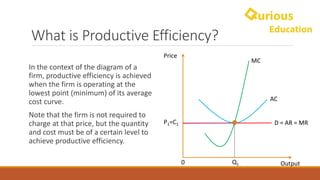
In	the	context	of	the	diagram	of	a	
firm,	productive	efficiency	is	achieved	
when	the	firm	is	operating	at	the	
lowest	point	(minimum)	of	its	average	
cost	curve.
Note	that	the	firm	is	not	required	to	
charge	at	that	price,	but	the	quantity	
and	cost	must	be	of	a	certain	level	to	
achieve	productive	efficiency.
Price
Output0
MC
AC
P1=C1
Q1
D	=	AR	=	MR
What	is	Productive	Efficiency?
Do	you	think	the	firm	is	productively	
efficient	from	the	diagram	on	the	right?
Why?	When	may	this	happen?
Price
Output0
MC
AC
D	=	AR	=	MR
P1
Q1
C1
What	is	Productive	Efficiency?
Do	you	think	the	firm	is	productively	
efficient	from	the	diagram	on	the	right?
Why?	When	may	this	happen?
Price
Output0
MC
AC
D	=	AR	=	MR
P1
Q1
C1
What	is	Allocative	Efficiency?
Allocative	efficiency	occurs	where	consumer	satisfaction	is	maximised	in	the	
production	of	goods	and	services.
At	this	point	quantity	supplied	will	equal	quantity	demanded,	and	price	
equals	marginal	cost	(P=MC)
What	is	Allocative	Efficiency?
Allocative	efficiency takes	into	
account	the	desires	of	consumers.	
In	this	PPF,	if	Anime	is	in	greater	
demand	than	PS4	Games,	then	
production	at	point	A will	be	more	
allocatively efficient	than	that	of	
point	B.		Therefore,	which	point	
allocative	efficiency	is	will	depend	on	
consumer	preference.	
Anime
PS4	Games
• A
• B
• D
• C
What	is	Allocative	Efficiency?
In	the	diagram	of	a	firm,	allocative	
efficiency	happens	when	the	firm	is	
charging	a	price	equal	to	the	marginal	
cost	(P=MC).	
In	the	diagram,	the	firm	is	not	
allocatively efficient	when	they	are	
maximizing	profits	by	producing	at	
Q1,	as	P1 is	not	equal	to	MC.	(i.e.	the	
vertical	line	touches	the	MC	curve	at	
a	different	price	level	than	the	price	
charged) AR=D
MR
Price
OutputQ1
P1
0
MC=S
AC
MC
What	is	Allocative	Efficiency?
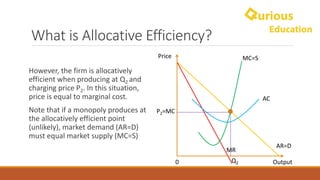
However,	the	firm	is	allocatively
efficient	when	producing	at	Q2	and	
charging	price	P2.	In	this	situation,	
price	is	equal	to	marginal	cost.
Note	that	if	a	monopoly	produces	at	
the	allocatively efficient	point	
(unlikely),	market	demand	(AR=D)	
must	equal	market	supply	(MC=S)
AR=D
MR
Price
Output0
MC=S
AC
P2=MC
Q2
What	is	Allocative	Efficiency?
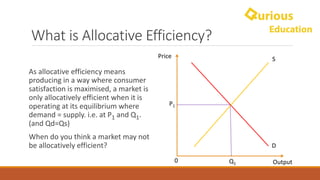
As	allocative	efficiency	means	
producing	in	a	way	where	consumer	
satisfaction	is	maximised,	a	market	is	
only	allocatively efficient	when	it	is	
operating	at	its	equilibrium	where	
demand	=	supply.	i.e.	at	P1 and	Q1.	
(and	Qd=Qs)
When	do	you	think	a	market	may	not	
be	allocatively efficient? D
Price
Output
P1
0
S
Q1
What	is	Allocative	Efficiency?
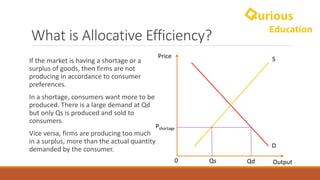
If	the	market	is	having	a	shortage	or	a	
surplus	of	goods,	then	firms	are	not	
producing	in	accordance	to	consumer	
preferences.
In	a	shortage,	consumers	want	more	to	be	
produced.	There	is	a	large	demand	at	Qd
but	only	Qs	is	produced	and	sold	to	
consumers.
Vice	versa,	firms	are	producing	too	much	
in	a	surplus,	more	than	the	actual	quantity	
demanded	by	the	consumer.
D
Price
Output0
S
Qs
Pshortage
Qd
What	is	Allocative	Efficiency?
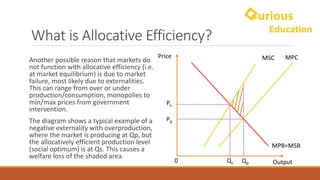
Another	possible	reason	that	markets	do	
not	function	with	allocative	efficiency	(i.e.	
at	market	equilibrium)	is	due	to	market	
failure,	most	likely	due	to	externalities.	
This	can	range	from	over	or	under	
production/consumption,	monopolies	to	
min/max	prices	from	government	
intervention.
The	diagram	shows	a	typical	example	of	a	
negative	externality	with	overproduction,	
where	the	market	is	producing	at	Qp,	but	
the	allocatively efficient	production	level	
(social	optimum)	is	at	Qs.	This	causes	a	
welfare	loss	of	the	shaded	area.
MPB=MSB
Price
Output0
MSC
Pp
Qp
MPC
Ps
Qs
Efficiency	Under	Different	Market	Structures
---
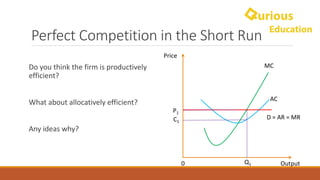
Perfect	Competition	in	the	Short	Run
Do	you	think	the	firm	is	productively	
efficient?
What	about	allocatively efficient?
Any	ideas	why?
Price
Output0
MC
AC
D	=	AR	=	MR
P1
Q1
C1
Perfect	Competition	in	the	Short	Run
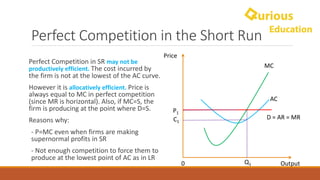
Perfect	Competition	in	SR	may	not	be	
productively	efficient. The	cost	incurred	by	
the	firm	is	not	at	the	lowest	of	the	AC	curve.
However	it	is	allocatively efficient.	Price	is	
always	equal	to	MC	in	perfect	competition	
(since	MR	is	horizontal).	Also,	if	MC=S,	the	
firm	is	producing	at	the	point	where	D=S.
Reasons	why:
- P=MC	even	when	firms	are	making	
supernormal	profits	in	SR
- Not	enough	competition	to	force	them	to	
produce	at	the	lowest	point	of	AC	as	in	LR
Price
Output0
MC
AC
D	=	AR	=	MR
P1
Q1
C1
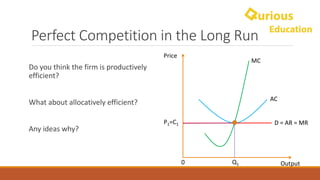
Perfect	Competition	in	the	Long	Run
Do	you	think	the	firm	is	productively	
efficient?
What	about	allocatively efficient?
Any	ideas	why?
Price
Output0
MC
AC
P1=C1
Q1
D	=	AR	=	MR
Perfect	Competition	in	the	Long	Run
Price
Output0
MC
AC
P1=C1
Q1
D	=	AR	=	MR
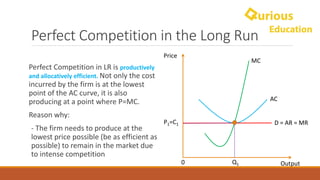
Perfect	Competition	in	LR	is	productively	
and	allocatively efficient.	Not	only	the	cost	
incurred	by	the	firm	is	at	the	lowest	
point	of	the	AC	curve,	it	is	also	
producing	at	a	point	where	P=MC.
Reason	why:
- The	firm	needs	to	produce	at	the	
lowest	price	possible	(be	as	efficient	as	
possible)	to	remain	in	the	market	due	
to	intense	competition
Monopoly	&	Monopolistic	Competition	
(Short-Run)
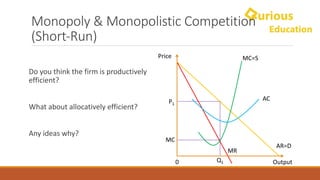
Do	you	think	the	firm	is	productively	
efficient?
What	about	allocatively efficient?
Any	ideas	why?
AR=D
MR
Price
OutputQ1
P1
0
MC=S
AC
MC
Monopoly	&	Monopolistic	Competition	
(Short-Run)
AR=D
MR
Price
OutputQ1
P1
0
MC=S
AC
MC
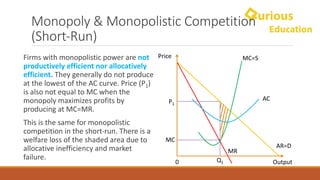
Firms	with	monopolistic	power	are	not	
productively	efficient	nor	allocatively
efficient.	They	generally	do not	produce	
at	the	lowest	of	the	AC	curve.	Price	(P1)	
is	also	not	equal	to	MC	when	the	
monopoly	maximizes	profits	by	
producing	at	MC=MR.	
This	is	the	same	for	monopolistic	
competition	in	the	short-run.	There	is	a	
welfare	loss	of	the	shaded	area	due	to	
allocative	inefficiency	and	market	
failure.
Monopoly	&	Monopolistic	Competition	
(Short-Run)
AR=D
MR
Price
OutputQ1
P1
0
MC=S
AC
MC
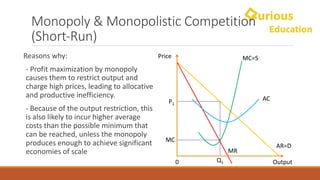
Reasons	why:
- Profit	maximization	by	monopoly	
causes	them	to	restrict	output	and	
charge	high	prices,	leading	to	allocative	
and	productive	inefficiency.
- Because	of	the	output	restriction,	this	
is	also	likely	to	incur	higher	average	
costs	than	the	possible	minimum	that	
can	be	reached,	unless	the	monopoly	
produces	enough	to	achieve	significant	
economies	of	scale
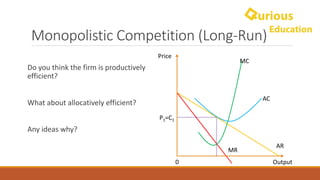
Monopolistic	Competition	(Long-Run)
AR
MR
Price
Output0
MC
AC
Do	you	think	the	firm	is	productively	
efficient?
What	about	allocatively efficient?
Any	ideas	why?
P1=C1
Monopolistic	Competition	(Long-Run)
AR
MR
Price
Output0
MC
AC
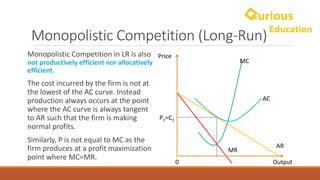
Monopolistic	Competition	in	LR	is	also	
not	productively	efficient	nor	allocatively
efficient.
The	cost	incurred	by	the	firm	is	not	at	
the	lowest	of	the	AC	curve.	Instead	
production	always	occurs	at	the	point	
where	the	AC	curve	is	always	tangent	
to	AR	such	that	the	firm	is	making	
normal	profits.
Similarly,	P	is	not	equal	to	MC	as	the	
firm	produces	at	a	profit	maximization	
point	where	MC=MR.
P1=C1
Monopolistic	Competition	(Long-Run)
AR
MR
Price
Output0
MC
AC
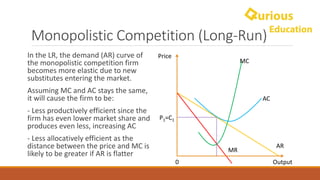
In	the	LR,	the	demand	(AR)	curve	of	
the	monopolistic	competition	firm	
becomes	more	elastic	due	to	new	
substitutes	entering	the	market.	
Assuming	MC	and	AC	stays	the	same,	
it	will	cause	the	firm	to	be:
- Less	productively	efficient	since	the	
firm	has	even	lower	market	share	and	
produces	even	less,	increasing	AC
- Less	allocatively efficient	as	the	
distance	between	the	price	and	MC	is	
likely	to	be	greater	if	AR	is	flatter
P1=C1
Summary
Market	
Structure	&	
Efficiency
Perfect	
Competition
(Short-Run)
Perfect	
Competition
(Long-Run)
Monopolistic	
Competition
(Short-Run)
Monopolistic	
Competition
(Long-Run)
Monopoly
Productively	
Efficient?
Not	necessarily Yes No No
(even	less)
No	
(unless	EOS)
Allocatively
Efficient?
Yes Yes No No No	
(market	failure)
Note	that	efficiency	is	a	very	important	way	to	evaluate	different	market	structures	and	compare	
their	pros	and	cons.	Usually	you	can	consider	firms	with	more	market	power	as	more	inefficient.	
Achieving	efficiency	is	almost	always	considered	‘good’.	Most	of	the	time	it	is	illustrated	via	
diagrammatic	analysis	with	a simple	explanation.	
It	is	a	useful	concept	when	answering	exam	questions,	and	can	be	asked	upon	directly.

Market Efficiency Notes - A-level & IB Economics