
ECOLOGY & ECOSYSTEMS
Prepared By:- Dasani Yash R (Assi. Prof.)
Civil Engineering Department, DRVRGCET
ECOLOGY
◉The word ecology is derived from two greek words
“oikos” meaning house, habitation or place of living and
“logos” meanings ‘study’.
◉Ecology is the study of interrelationship between living
organisms and their physical and biological environment
◉Physical environment includes light and heat or solar
radiation, moisture, wind, oxygen, carbon dioxide,
nutrients is in soil, water and atmosphere.
◉The biological environment includes organisms of all kind
as well as plants and animals.
2
OBJECTIVE OF ECOLOGY
◉The interrelationship between organisms in population and
diverse communities.
◉The temporal (sequential) changes (seasonal, annual,
successional etc)
◉The behavior under natural condition
◉The structural adaptations and functional adjustments of
organisms to their physical environment.
◉The development in the course of evolution.
◉The biological productivity and energy flow in natural
system
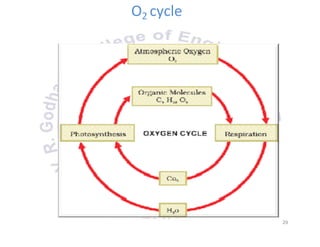
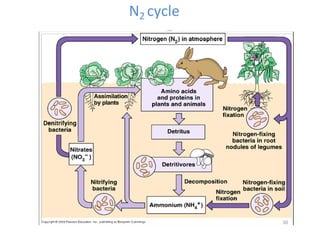
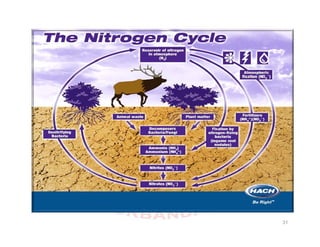
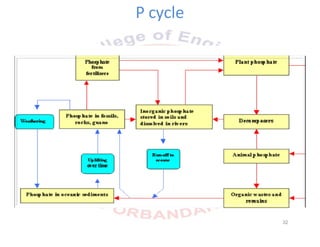
◉The development of mathematical models relate interaction
of parameters and to predict the effects.
3
SCOPE OF ECOLOGY
◉Ecology helps to tackles of problems of pollution:
1. Air, water, land erosion.
2. Floods.
3. Famine variation in seasonal patterns.
4. Green house effects.
5. Ozone layer depletion.
6. Ice melting of poles.
7. Acid rains.
8. Deforestation.
9. Provide people knowledge of environment protection.
◉Maintain ecological balance.
◉Understanding different cycle like N2, C, P, O2, H2O.
◉Helps protecting flora and fauna.
4
◉Ecology plays important role in:
1. Human welfare.
2. Agriculture.
3. Management of grass lands.
4. Forestry.
5. Biological survey.
6. Pest control and in conservation of wild life.
◉The international problem of environment pollution also
needs ecological assistance.
5
CLASSIFICATION OF ECOLOGY
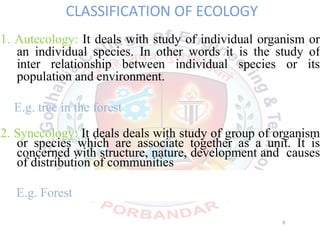
1. Autecology: It deals with study of individual organism or
an individual species. In other words it is the study of
inter relationship between individual species or its
population and environment.
E.g. tree in the forest
2. Synecology: It deals deals with study of group of organism
or species which are associate together as a unit. It is
concerned with structure, nature, development and causes
of distribution of communities
E.g. Forest
6
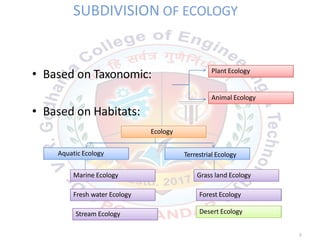
SUBDIVISION OF ECOLOGY
• Based on Taxonomic: Plant Ecology
Animal Ecology
• Based on Habitats:
Ecology
Aquatic Ecology Terrestrial Ecology
Marine Ecology
Fresh water Ecology
Grass land Ecology
Forest Ecology
Stream Ecology Desert Ecology
7
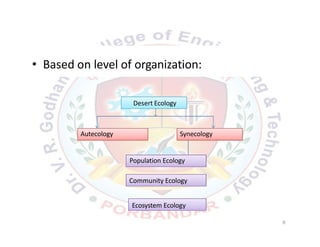
• Based on level of organization:
Desert Ecology
Autecology Synecology
Population Ecology
Community Ecology
Ecosystem Ecology
8
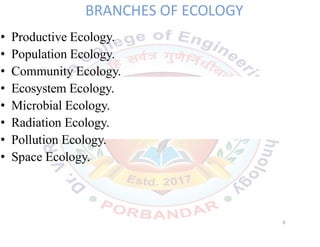
BRANCHES OF ECOLOGY
• Productive Ecology.
• Population Ecology.
• Community Ecology.
• Ecosystem Ecology.
• Microbial Ecology.
• Radiation Ecology.
• Pollution Ecology.
• Space Ecology.
9
ECOSYSTEM
◉Ecosystem is made up of two words “eco” and “system”.
Eco means environment and system means an interacting
and interdependent complex.
Definition of Ecosystem
1. It is a community of interdependent organisms together
with the environment.
2. Any unit that includes all of the organisms in a given area
interacting with the physical environment, so that a flow
of energy leads to clearly defined trophic structure, biotic
diversity and material cycles within the system.
10
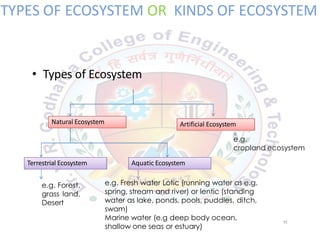
TYPES OF ECOSYSTEM OR KINDS OF ECOSYSTEM
• Types of Ecosystem
Natural Ecosystem
Terrestrial Ecosystem Aquatic Ecosystem
Artificial Ecosystem
e.g.
cropland ecosystem
e.g. Forest,
grass land,
Desert
e.g. Fresh water Lotic (running water as e.g.
spring, stream and river) or lentic (standing
water as lake, ponds, pools, puddles, ditch,
swam)
Marine water (e.g deep body ocean,
shallow one seas or estuary)
11
IMPORTANCE OF STUDYING ECOSYSTEM
◉Provides information about the amount of solar energy in
an area.
◉Provides data about the availability of mineral elements
their utilization and recycling.
◉Provides information about relation between organisms
as well as between organism and abiotic environment.
◉Provides information of productivity and number of
producers and consumers.
12
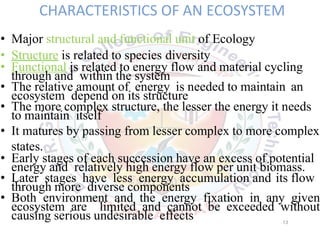
CHARACTERISTICS OF AN ECOSYSTEM
• Major structural and functional unit of Ecology
• Structure is related to species diversity
• Functional is related to energy flow and material cycling
through and within the system
• The relative amount of energy is needed to maintain an
ecosystem depend on its structure
• The more complex structure, the lesser the energy it needs
to maintain itself
• It matures by passing from lesser complex to more complex
states.
• Early stages of each succession have an excess of potential
energy and relatively high energy flow per unit biomass.
• Later stages have less energy accumulation and its flow
through more diverse components
• Both environment and the energy fixation in any given
ecosystem are limited and cannot be exceeded without
causing serious undesirable effects 13
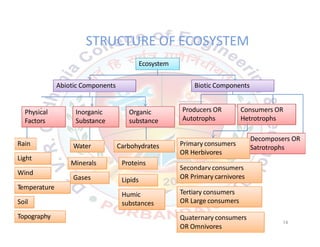
STRUCTURE OF ECOSYSTEM
Ecosystem
Abiotic Components Biotic Components
Physical
Factors
Inorganic
Substance
Organic
substance
Producers OR
Autotrophs
Consumers OR
Hetrotrophs
Decomposers OR
Satrotrophs
Rain
Light
Water
Minerals
Carbohydrates
Proteins
Primary consumers
OR Herbivores
Secondary consumers
Wind
Temperature
Gases Lipids OR Primary carnivores
Soil
Topography
Tertiary consumers
OR Large consumers
Quaternary consumers
Humic
substances
OR Omnivores
14
ECOLOGICAL BALANCE
◉In the natural environment there exists a perfect balance or
equilibrium between the various organisms, this balance is
called as ecological balance.
◉Definition: “A state of dynamic equilibrium within a
community of organisms in which genetic, species and
eco system diversity remains stable, subject to stable,
subject to gradual changes through natural succession”.
15
ECOLOGICAL BALANCE
◉The ecological balance may however get distributed due to
introduction of new species, sudden death of some species,
natural hazard or man made causes like deforestation,
pollution etc.
◉If the numerical ratio balance between different organisms
is distributed, then naturally, there will be shortage of food
for certain species which may ultimately lead to large scale
mortality of that species.
◉A new equilibrium is finally reestablish in the changed
condition
◉In an ecosystem if there is large number of species of a
particular type, there will be shortage of food for that
species and after some time due to shortage of food death
rate of that particular species will increase.
◉This will also effects the species which feeds on that
particular species, this would effect the species of next
trophic level and so on, as in an ecosystem every species
are interconnected. So ultimately the whole ecosystem gets
disturb or becomes unstable.
16
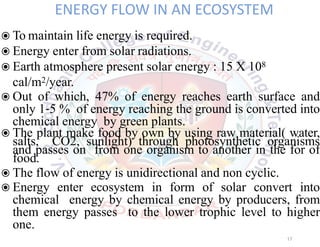
ENERGY FLOW IN AN ECOSYSTEM
◉To maintain life energy is required.
◉Energy enter from solar radiations.
◉Earth atmosphere present solar energy : 15 X 108
cal/m2/year.
◉Out of which, 47% of energy reaches earth surface and
only 1 5 % of energy reaching the ground is converted into
chemical energy by green plants.
◉The plant make food by own by using raw material( water,
salts, CO2, sunlight) through photosynthetic organisms
and passes on from one organism to another in the for of
food.
◉The flow of energy is unidirectional and non cyclic.
◉Energy enter ecosystem in form of solar convert into
chemical energy by chemical energy by producers, from
them energy passes to the lower trophic level to higher
one.
17
ENERGY FLOW IN AN ECOSYSTEM
◉This is the way energy is governed by laws of
thermodynamics which state that:
1. Energy is neither created nor destroyed but may be
transferred from one from to another.
2. During energy transfer there is degradation of energy
from a concentrated form (mechanical,chemical or
electrical etc) to dispersed form(heat).
◉No energy transformation is 100% efficient.
◉It is always accompanied by some dispersion or loss of
energy in form of heat.
18
MODEL FOR ENERGY FLOW IN ECOSYSTEM
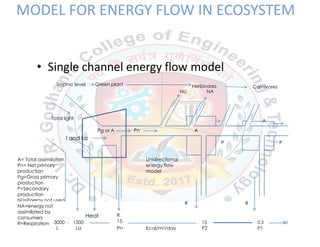
• Single channel energy flow model
NU
Trophic level Green plant Herbivores
NA
Carnivores
Total light
I and La
A
APg or A Pn
PP
A= Total assimilation
Pn= Net primary
production
Pg=Gross primary
production
P=Secondary
production
NU=Energy not used
Unidirectional
energy flow
model
Heat
R R
3000 - 1500
L La
15
P2
0.3
P1
NA=energy not
assimilated by
consumers
R=Respiration
R
15
Pn Kcal/m2/day
19
Y SHAPED OR DOUBLE CHANNEL ENERGY FLOW
MODEL
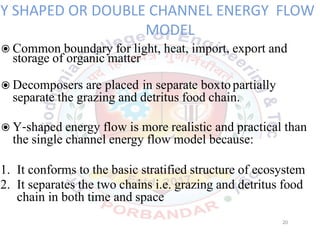
◉Common boundary for light, heat, import, export and
storage of organic matter
◉Decomposers are placed in separate boxtopartially
separate the grazing and detritus food chain.
◉Y shaped energy flow is more realistic and practical than
the single channel energy flow model because:
1. It conforms to the basic stratified structure of ecosystem
2. It separates the two chains i.e. grazing and detritus food
chain in both time and space
20
UNIVERSAL ENERGY FLOW MODEL
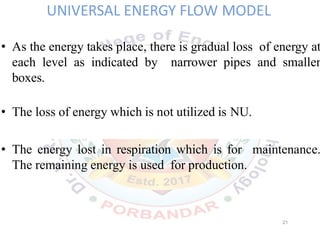
• As the energy takes place, there is gradual loss of energy at
each level as indicated by narrower pipes and smaller
boxes.
• The loss of energy which is not utilized is NU.
• The energy lost in respiration which is for maintenance.
The remaining energy is used for production.
21
ECOLOGICAL PYRAMIDS
• Graphical representation of trophic structure and function
of ecosystem, starting with producers at the base and
successive trophic levels forming the apex is known as
ecological pyramid.
• Types
1. Pyramids of numbers.
2. Pyramids of Biomass.
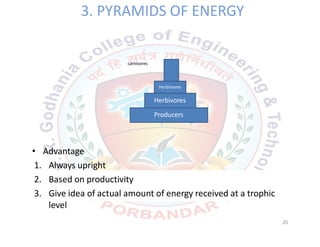
3. Pyramids of energy.
22
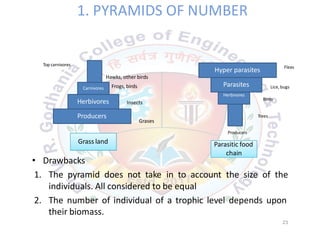
1. PYRAMIDS OF NUMBER
Top carnivores
Hyper parasites Fleas
Hawks, other birds
Frogs, birds
InsectsHerbivores
Carnivores
Parasites
Herbivores
Lice, bugs
Birds
Grases
Producers
Producers
Trees
Grass land Parasitic food
chain
• Drawbacks
1. The pyramid does not take in to account the size of the
individuals. All considered to be equal
2. The number of individual of a trophic level depends upon
23
their biomass.
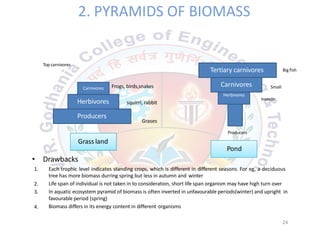
2. PYRAMIDS OF BIOMASS
Top carnivores
Tertiary carnivores Big fish
Frogs, birds,snakes
squirrl, rabbitHerbivores
Carnivores
Carnivores
Herbivores
Small
Insects
Grases
Producers
Producers
Grass land
Pond
• Drawbacks
1. Each trophic level indicates standing crops, which is different in different seasons. For eg, a deciduous
2.
3.
4.
24
tree has more biomass durring spring but less in autumn and winter
Life span of individual is not taken in to consideration, short life span organism may have high turn over
In aquatic ecosystem pyramid of biomass is often inverted in unfavourable periods(winter) and upright in
favourable period (spring)
Biomass differs in its energy content in different organisms
3. PYRAMIDS OF ENERGY
carnivores
Herbiivores
Herbivores
Producers
• Advantage
1. Always upright
2. Based on productivity
3. Give idea of actual amount of energy received at a trophic
level
25
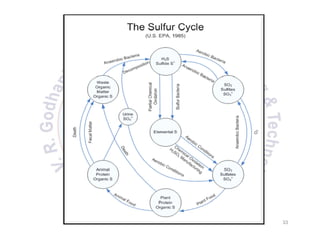
BIOGEOCHEMICAL CYCLES
• The cyclic exchange of nutrient materials between living
organisms and their non living environment is called as
biogeochemical cycles.
• It includes
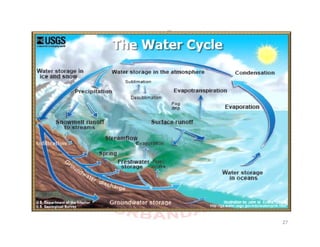
1. Hydrologic or water cycle
2. Gaseous cycle (include O2 cycle, N2 cycle)
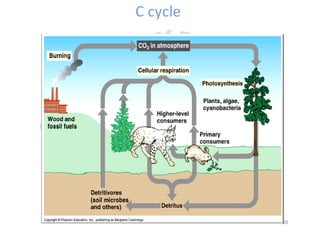
3. Sedimentary cycles( includes S, P, C)
26
27
C cycle
28
O2 cycle
29
N2 cycle
30
31
P cycle
32
33
FOOD CHAIN
• In food chain each organism eats the smaller organisms and is
eaten by larger one. All those organisms which are interlinked
with each other through food together constitute the
ecosystem
• There are mainly 3 trophic levels: Producers level, consumers
level, decomposer level.
• Sunlight ‐‐‐‐> Producers (grass)‐‐ primary consumers(rabbit)
‐‐‐ Secondary consumers(Fox)‐‐
consumers(Wolf)‐‐‐ Quaternary consumers
Tertiary
(tiger)‐‐‐
death‐‐ decomposers (bacteria, fungi etc. )‐‐‐‐ inorganic
substances‐ grass
• 10% loss energy every stage
• Food chain depend on number of trophic level.
• Shorter food chain more available energy 34
TYPES OF FOOD CHAIN
1. Predator food chain or Grazing food chain : start from
producers and end with higher consumer levels. In energy
trophic level, the size of the organism increase while their
number decreases.
• E.g : Grass--- Grasshopper---Toad- - -Snake
35
2. Parasitic food chain: This type of food chain starts from
big hosts and ends with parasitic organisms
• Cow---worm--- Protozoa
3. Saprophytic food chain or detritus food chain: Start from
dead organisms and end with decomposers such as bacteria
• Leaf litter---algae---crabs---Small fish---Large fish
36
SIGNIFICANCE OF FOOD CHAIN
understand• Food chain
relationship
help to
and interaction
feeding
between
organisms in any ecosystem
understand
37
• It helps to
mechanisms and circulation
the energy
of
flow
toxic
substances in the ecosystem and the problem
of biological magnification
BIOLOGICAL MAGNIFICATION
• Definition: It is tendency of pollutants to concentrated in
successive tropic levels. Large concentration of pollutants
could be detrimental if they are toxic.
• Biomagnifications occurs when organisms at the bottom of
the food chain accumulate the toxic materials greater than
that available in the environment around it.
• As DDT, heavy metal resemble inorganic nutrients these
will taken up by plants along with the essential nutrients.
• If there is shortage of essential nutrients accumulation of
these toxic material will be more and more
38
• The second type of biomagnifaction occurs when producers
are eaten by consumers. The energy availability decreases
from one trophic level to other. Thus successive trophic
level consumes more and more toxic materials.
• This toxic material are not broken down in the body easily
but they get quickely accumulated in the tissues.
• For e.g. toxic material like DDT soluble in fat easily.
• When consumers eat another consumers fat is digested and
the pollutants move fats of another consumers.
39
• Man is omnivores and has all trophic level of food, he
receives toxic substances large amount. Secondary and
tertiary consumers at the top of the food chain also
accumulate toxic materials in their body.
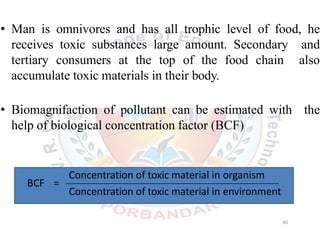
• Biomagnifaction of pollutant can be estimated with the
help of biological concentration factor (BCF)
BCF =
40
Concentration of toxic material in organism
Concentration of toxic material in environment
TROPHIC LEVEL
• All organisms feeding their food from plant. And plant
make their food by own so plant is a first trophic level.
• Then plant is eaten by another primary consumers
so it is called second trophic level.
• Like this successive trophic level is occur.
• E.g
1. Wheat-- Man
2. Algae--- Insects---Fish--- Man
41
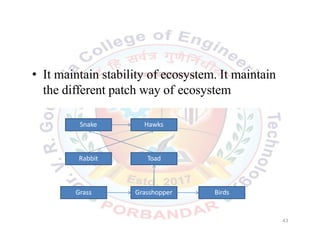
FOOD WEB
• DEFINATION: Various food chain are often interlinked at
different trophic levels to form a complex interaction
between different species from the point of view of food.
This network like interaction is called as food web.
• It provides more than alternative of food, therefore
increases their chances of survival.
• Charles Elton, a British ecologist, concluded that number
of links a chain rarely exceeds five because in this process
loss of energy occur.
• It maintain stability of ecosystem. It maintain
the different patch way of ecosystem
Snake Hawks
ToadRabbit
Grass Grasshopper Birds
43
FOREST ECOSYSTEM
• Forest ecosystem includes trees, shrubs, algae and variety
of animals, plants and birds.
• Forest found moderate to high rain fall area
Function of forest ecosystem
• Enhance water resources both quantity and quality.
Hydrological cycle depend on it
• It gives shelter to wild life
• It acts as sink for reducing CO2 content in to
atmosphere
44
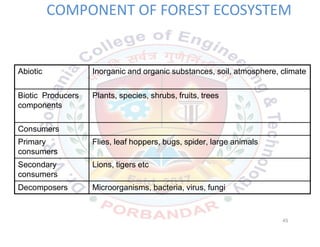
COMPONENT OF FOREST ECOSYSTEM
Abiotic Inorganic and organic substances, soil, atmosphere, climate
Biotic Producers
components
Plants, species, shrubs, fruits, trees
Consumers
Primary
consumers
Flies, leaf hoppers, bugs, spider, large animals
Secondary
consumers
Lions, tigers etc
Decomposers Microorganisms, bacteria, virus, fungi
45
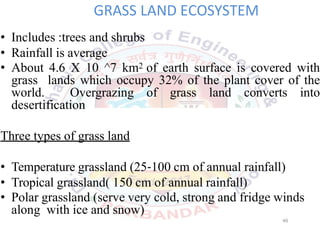
GRASS LAND ECOSYSTEM
• Includes :trees and shrubs
• Rainfall is average
• About 4.6 X 10 ^7 km2 of earth surface is covered with
grass lands which occupy 32% of the plant cover of the
world. Overgrazing of grass land converts into
desertification
Three types of grass land
• Temperature grassland (25 100 cm of annual rainfall)
• Tropical grassland( 150 cm of annual rainfall)
• Polar grassland (serve very cold, strong and fridge winds
along with ice and snow)
46
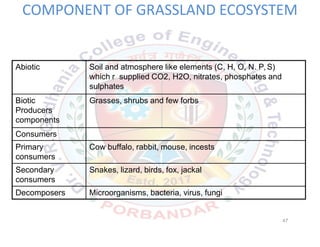
COMPONENT OF GRASSLAND ECOSYSTEM
Abiotic Soil and atmosphere like elements (C, H, O, N. P, S)
which r supplied CO2, H2O, nitrates, phosphates and
sulphates
Biotic
Producers
components
Grasses, shrubs and few forbs
Consumers
Primary
consumers
Cow buffalo, rabbit, mouse, incests
Secondary
consumers
Snakes, lizard, birds, fox, jackal
Decomposers Microorganisms, bacteria, virus, fungi
47
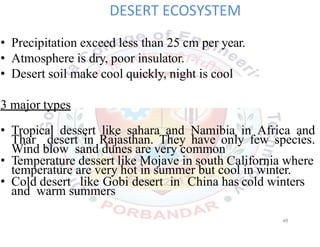
DESERT ECOSYSTEM
• Precipitation exceed less than 25 cm per year.
• Atmosphere is dry, poor insulator.
• Desert soil make cool quickly, night is cool
3 major types
• Tropical dessert like sahara and Namibia in Africa and
Thar desert in Rajasthan. They have only few species.
Wind blow sand dunes are very common
• Temperature dessert like Mojave in south California where
temperature are very hot in summer but cool in winter.
• Cold desert like Gobi desert in China has cold winters
and warm summers
48
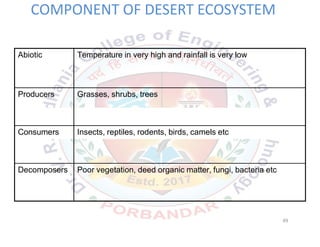
COMPONENT OF DESERT ECOSYSTEM
Abiotic Temperature in very high and rainfall is very low
Producers Grasses, shrubs, trees
Consumers Insects, reptiles, rodents, birds, camels etc
Decomposers Poor vegetation, deed organic matter, fungi, bacteria etc
49
AQUATIC ECOSYSTEM
• Pond Ecosystem
• Lake Ecosystem
• Marine Ecosystem
• Estuarine Ecosystem
50
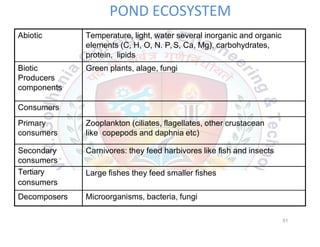
POND ECOSYSTEM
Abiotic Temperature, light, water several inorganic and organic
elements (C, H, O, N. P, S, Ca, Mg), carbohydrates,
protein, lipids
Biotic
Producers
components
Green plants, alage, fungi
Consumers
Primary
consumers
Zooplankton (ciliates, flagellates, other crustacean
like copepods and daphnia etc)
Secondary
consumers
Carnivores: they feed harbivores like fish and insects
Tertiary
consumers
Large fishes they feed smaller fishes
Decomposers Microorganisms, bacteria, fungi
51
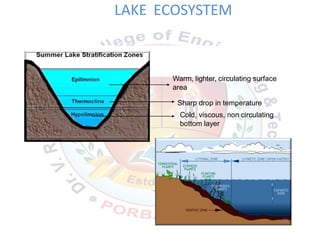
LAKE ECOSYSTEM
Warm, lighter, circulating surface
area
Sharp drop in temperature
Cold, viscous, non circulating
bottom layer
52
RIVER ECOSYSTEM
• Large stream flow down wards.
3 phase of river
• The mountain high land part has cold clear water rushing
down as water dalls with large amount of DO. The plants
are attached to rocks and fishes are cold water, high O2
requiring.
• In second phase gentle slopes, the water warmer and
support a growtth of plants and less O2 requiring fishes
• Inthird phases, river eater are very rich in biotic diversity.
Moving down the hills, river shape the lands.
53
MARINE ECOSYSTEM
• It includes ocean, estuaries and coral reef ecosystem
OCEAN ECOSYSTEM
• Covers 70 71 % earth surface.
• Survive 2,50,000 species.Serve food for human and
other organisms, huge variety of sea products and drugs.
• Ocean provides us iron, phosphorus, magnesium, oil,
natural gas, sand and gravel
• Major sinks of CO2 play importantrole in biogeochemical
cycles
54
OCEAN 2 MAJOR ZONE
• COASTAL ZONE : warm, reach shallow water, high
nutrients, sunlight, high primary productivity
• OPEN SEA: deeper part of ocean.
Further divide in 3 parts
• Euphotic zone
• Benthic zone
• Abyssal zone
55
OCEAN ECOSYSTEM
Abiotic Salt, Ca, Mg, K salts water is buffered, dissolved nutrients
Biotic
Producers
components
Phytoplankton, marine plants
Consumers
Fish, molluscs, crustanceansPrimary
consumers
Secondary
consumers
Carnivores fishes (herring, shad, Mackerels)
Tertiary
consumers
Top consumers like fishes (Cod, Haddock)
Decomposers Fungi, dead organic compound
56
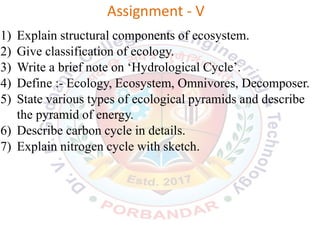
Assignment ‐ V
1) Explain structural components of ecosystem.
2) Give classification of ecology.
3) Write a brief note on ‘Hydrological Cycle’.
4) Define :- Ecology, Ecosystem, Omnivores, Decomposer.
5) State various types of ecological pyramids and describe
the pyramid of energy.
6) Describe carbon cycle in details.
7) Explain nitrogen cycle with sketch.
Es ch.2 ECOLOGY & ECOSYSTEMS

Es ch.2 ECOLOGY & ECOSYSTEMS

  • 1.
    ECOLOGY & ECOSYSTEMS PreparedBy:- Dasani Yash R (Assi. Prof.) Civil Engineering Department, DRVRGCET
  • 2.
    ECOLOGY ◉The word ecologyis derived from two greek words “oikos” meaning house, habitation or place of living and “logos” meanings ‘study’. ◉Ecology is the study of interrelationship between living organisms and their physical and biological environment ◉Physical environment includes light and heat or solar radiation, moisture, wind, oxygen, carbon dioxide, nutrients is in soil, water and atmosphere. ◉The biological environment includes organisms of all kind as well as plants and animals. 2
  • 3.
    OBJECTIVE OF ECOLOGY ◉Theinterrelationship between organisms in population and diverse communities. ◉The temporal (sequential) changes (seasonal, annual, successional etc) ◉The behavior under natural condition ◉The structural adaptations and functional adjustments of organisms to their physical environment. ◉The development in the course of evolution. ◉The biological productivity and energy flow in natural system ◉The development of mathematical models relate interaction of parameters and to predict the effects. 3
  • 4.
    SCOPE OF ECOLOGY ◉Ecologyhelps to tackles of problems of pollution: 1. Air, water, land erosion. 2. Floods. 3. Famine variation in seasonal patterns. 4. Green house effects. 5. Ozone layer depletion. 6. Ice melting of poles. 7. Acid rains. 8. Deforestation. 9. Provide people knowledge of environment protection. ◉Maintain ecological balance. ◉Understanding different cycle like N2, C, P, O2, H2O. ◉Helps protecting flora and fauna. 4
  • 5.
    ◉Ecology plays importantrole in: 1. Human welfare. 2. Agriculture. 3. Management of grass lands. 4. Forestry. 5. Biological survey. 6. Pest control and in conservation of wild life. ◉The international problem of environment pollution also needs ecological assistance. 5
  • 6.
    CLASSIFICATION OF ECOLOGY 1.Autecology: It deals with study of individual organism or an individual species. In other words it is the study of inter relationship between individual species or its population and environment. E.g. tree in the forest 2. Synecology: It deals deals with study of group of organism or species which are associate together as a unit. It is concerned with structure, nature, development and causes of distribution of communities E.g. Forest 6
  • 7.
    SUBDIVISION OF ECOLOGY •Based on Taxonomic: Plant Ecology Animal Ecology • Based on Habitats: Ecology Aquatic Ecology Terrestrial Ecology Marine Ecology Fresh water Ecology Grass land Ecology Forest Ecology Stream Ecology Desert Ecology 7
  • 8.
    • Based onlevel of organization: Desert Ecology Autecology Synecology Population Ecology Community Ecology Ecosystem Ecology 8
  • 9.
    BRANCHES OF ECOLOGY •Productive Ecology. • Population Ecology. • Community Ecology. • Ecosystem Ecology. • Microbial Ecology. • Radiation Ecology. • Pollution Ecology. • Space Ecology. 9
  • 10.
    ECOSYSTEM ◉Ecosystem is madeup of two words “eco” and “system”. Eco means environment and system means an interacting and interdependent complex. Definition of Ecosystem 1. It is a community of interdependent organisms together with the environment. 2. Any unit that includes all of the organisms in a given area interacting with the physical environment, so that a flow of energy leads to clearly defined trophic structure, biotic diversity and material cycles within the system. 10
  • 11.
    TYPES OF ECOSYSTEMOR KINDS OF ECOSYSTEM • Types of Ecosystem Natural Ecosystem Terrestrial Ecosystem Aquatic Ecosystem Artificial Ecosystem e.g. cropland ecosystem e.g. Forest, grass land, Desert e.g. Fresh water Lotic (running water as e.g. spring, stream and river) or lentic (standing water as lake, ponds, pools, puddles, ditch, swam) Marine water (e.g deep body ocean, shallow one seas or estuary) 11
  • 12.
    IMPORTANCE OF STUDYINGECOSYSTEM ◉Provides information about the amount of solar energy in an area. ◉Provides data about the availability of mineral elements their utilization and recycling. ◉Provides information about relation between organisms as well as between organism and abiotic environment. ◉Provides information of productivity and number of producers and consumers. 12
  • 13.
    CHARACTERISTICS OF ANECOSYSTEM • Major structural and functional unit of Ecology • Structure is related to species diversity • Functional is related to energy flow and material cycling through and within the system • The relative amount of energy is needed to maintain an ecosystem depend on its structure • The more complex structure, the lesser the energy it needs to maintain itself • It matures by passing from lesser complex to more complex states. • Early stages of each succession have an excess of potential energy and relatively high energy flow per unit biomass. • Later stages have less energy accumulation and its flow through more diverse components • Both environment and the energy fixation in any given ecosystem are limited and cannot be exceeded without causing serious undesirable effects 13
  • 14.
    STRUCTURE OF ECOSYSTEM Ecosystem AbioticComponents Biotic Components Physical Factors Inorganic Substance Organic substance Producers OR Autotrophs Consumers OR Hetrotrophs Decomposers OR Satrotrophs Rain Light Water Minerals Carbohydrates Proteins Primary consumers OR Herbivores Secondary consumers Wind Temperature Gases Lipids OR Primary carnivores Soil Topography Tertiary consumers OR Large consumers Quaternary consumers Humic substances OR Omnivores 14
  • 15.
    ECOLOGICAL BALANCE ◉In thenatural environment there exists a perfect balance or equilibrium between the various organisms, this balance is called as ecological balance. ◉Definition: “A state of dynamic equilibrium within a community of organisms in which genetic, species and eco system diversity remains stable, subject to stable, subject to gradual changes through natural succession”. 15
  • 16.
    ECOLOGICAL BALANCE ◉The ecologicalbalance may however get distributed due to introduction of new species, sudden death of some species, natural hazard or man made causes like deforestation, pollution etc. ◉If the numerical ratio balance between different organisms is distributed, then naturally, there will be shortage of food for certain species which may ultimately lead to large scale mortality of that species. ◉A new equilibrium is finally reestablish in the changed condition ◉In an ecosystem if there is large number of species of a particular type, there will be shortage of food for that species and after some time due to shortage of food death rate of that particular species will increase. ◉This will also effects the species which feeds on that particular species, this would effect the species of next trophic level and so on, as in an ecosystem every species are interconnected. So ultimately the whole ecosystem gets disturb or becomes unstable. 16
  • 17.
    ENERGY FLOW INAN ECOSYSTEM ◉To maintain life energy is required. ◉Energy enter from solar radiations. ◉Earth atmosphere present solar energy : 15 X 108 cal/m2/year. ◉Out of which, 47% of energy reaches earth surface and only 1 5 % of energy reaching the ground is converted into chemical energy by green plants. ◉The plant make food by own by using raw material( water, salts, CO2, sunlight) through photosynthetic organisms and passes on from one organism to another in the for of food. ◉The flow of energy is unidirectional and non cyclic. ◉Energy enter ecosystem in form of solar convert into chemical energy by chemical energy by producers, from them energy passes to the lower trophic level to higher one. 17
  • 18.
    ENERGY FLOW INAN ECOSYSTEM ◉This is the way energy is governed by laws of thermodynamics which state that: 1. Energy is neither created nor destroyed but may be transferred from one from to another. 2. During energy transfer there is degradation of energy from a concentrated form (mechanical,chemical or electrical etc) to dispersed form(heat). ◉No energy transformation is 100% efficient. ◉It is always accompanied by some dispersion or loss of energy in form of heat. 18
  • 19.
    MODEL FOR ENERGYFLOW IN ECOSYSTEM • Single channel energy flow model NU Trophic level Green plant Herbivores NA Carnivores Total light I and La A APg or A Pn PP A= Total assimilation Pn= Net primary production Pg=Gross primary production P=Secondary production NU=Energy not used Unidirectional energy flow model Heat R R 3000 - 1500 L La 15 P2 0.3 P1 NA=energy not assimilated by consumers R=Respiration R 15 Pn Kcal/m2/day 19
  • 20.
    Y SHAPED ORDOUBLE CHANNEL ENERGY FLOW MODEL ◉Common boundary for light, heat, import, export and storage of organic matter ◉Decomposers are placed in separate boxtopartially separate the grazing and detritus food chain. ◉Y shaped energy flow is more realistic and practical than the single channel energy flow model because: 1. It conforms to the basic stratified structure of ecosystem 2. It separates the two chains i.e. grazing and detritus food chain in both time and space 20
  • 21.
    UNIVERSAL ENERGY FLOWMODEL • As the energy takes place, there is gradual loss of energy at each level as indicated by narrower pipes and smaller boxes. • The loss of energy which is not utilized is NU. • The energy lost in respiration which is for maintenance. The remaining energy is used for production. 21
  • 22.
    ECOLOGICAL PYRAMIDS • Graphicalrepresentation of trophic structure and function of ecosystem, starting with producers at the base and successive trophic levels forming the apex is known as ecological pyramid. • Types 1. Pyramids of numbers. 2. Pyramids of Biomass. 3. Pyramids of energy. 22
  • 23.
    1. PYRAMIDS OFNUMBER Top carnivores Hyper parasites Fleas Hawks, other birds Frogs, birds InsectsHerbivores Carnivores Parasites Herbivores Lice, bugs Birds Grases Producers Producers Trees Grass land Parasitic food chain • Drawbacks 1. The pyramid does not take in to account the size of the individuals. All considered to be equal 2. The number of individual of a trophic level depends upon 23 their biomass.
  • 24.
    2. PYRAMIDS OFBIOMASS Top carnivores Tertiary carnivores Big fish Frogs, birds,snakes squirrl, rabbitHerbivores Carnivores Carnivores Herbivores Small Insects Grases Producers Producers Grass land Pond • Drawbacks 1. Each trophic level indicates standing crops, which is different in different seasons. For eg, a deciduous 2. 3. 4. 24 tree has more biomass durring spring but less in autumn and winter Life span of individual is not taken in to consideration, short life span organism may have high turn over In aquatic ecosystem pyramid of biomass is often inverted in unfavourable periods(winter) and upright in favourable period (spring) Biomass differs in its energy content in different organisms
  • 25.
    3. PYRAMIDS OFENERGY carnivores Herbiivores Herbivores Producers • Advantage 1. Always upright 2. Based on productivity 3. Give idea of actual amount of energy received at a trophic level 25
  • 26.
    BIOGEOCHEMICAL CYCLES • Thecyclic exchange of nutrient materials between living organisms and their non living environment is called as biogeochemical cycles. • It includes 1. Hydrologic or water cycle 2. Gaseous cycle (include O2 cycle, N2 cycle) 3. Sedimentary cycles( includes S, P, C) 26
  • 27.
  • 28.
  • 29.
  • 30.
  • 31.
  • 32.
  • 33.
  • 34.
    FOOD CHAIN • Infood chain each organism eats the smaller organisms and is eaten by larger one. All those organisms which are interlinked with each other through food together constitute the ecosystem • There are mainly 3 trophic levels: Producers level, consumers level, decomposer level. • Sunlight ‐‐‐‐> Producers (grass)‐‐ primary consumers(rabbit) ‐‐‐ Secondary consumers(Fox)‐‐ consumers(Wolf)‐‐‐ Quaternary consumers Tertiary (tiger)‐‐‐ death‐‐ decomposers (bacteria, fungi etc. )‐‐‐‐ inorganic substances‐ grass • 10% loss energy every stage • Food chain depend on number of trophic level. • Shorter food chain more available energy 34
  • 35.
    TYPES OF FOODCHAIN 1. Predator food chain or Grazing food chain : start from producers and end with higher consumer levels. In energy trophic level, the size of the organism increase while their number decreases. • E.g : Grass--- Grasshopper---Toad- - -Snake 35
  • 36.
    2. Parasitic foodchain: This type of food chain starts from big hosts and ends with parasitic organisms • Cow---worm--- Protozoa 3. Saprophytic food chain or detritus food chain: Start from dead organisms and end with decomposers such as bacteria • Leaf litter---algae---crabs---Small fish---Large fish 36
  • 37.
    SIGNIFICANCE OF FOODCHAIN understand• Food chain relationship help to and interaction feeding between organisms in any ecosystem understand 37 • It helps to mechanisms and circulation the energy of flow toxic substances in the ecosystem and the problem of biological magnification
  • 38.
    BIOLOGICAL MAGNIFICATION • Definition:It is tendency of pollutants to concentrated in successive tropic levels. Large concentration of pollutants could be detrimental if they are toxic. • Biomagnifications occurs when organisms at the bottom of the food chain accumulate the toxic materials greater than that available in the environment around it. • As DDT, heavy metal resemble inorganic nutrients these will taken up by plants along with the essential nutrients. • If there is shortage of essential nutrients accumulation of these toxic material will be more and more 38
  • 39.
    • The secondtype of biomagnifaction occurs when producers are eaten by consumers. The energy availability decreases from one trophic level to other. Thus successive trophic level consumes more and more toxic materials. • This toxic material are not broken down in the body easily but they get quickely accumulated in the tissues. • For e.g. toxic material like DDT soluble in fat easily. • When consumers eat another consumers fat is digested and the pollutants move fats of another consumers. 39
  • 40.
    • Man isomnivores and has all trophic level of food, he receives toxic substances large amount. Secondary and tertiary consumers at the top of the food chain also accumulate toxic materials in their body. • Biomagnifaction of pollutant can be estimated with the help of biological concentration factor (BCF) BCF = 40 Concentration of toxic material in organism Concentration of toxic material in environment
  • 41.
    TROPHIC LEVEL • Allorganisms feeding their food from plant. And plant make their food by own so plant is a first trophic level. • Then plant is eaten by another primary consumers so it is called second trophic level. • Like this successive trophic level is occur. • E.g 1. Wheat-- Man 2. Algae--- Insects---Fish--- Man 41
  • 42.
    FOOD WEB • DEFINATION:Various food chain are often interlinked at different trophic levels to form a complex interaction between different species from the point of view of food. This network like interaction is called as food web. • It provides more than alternative of food, therefore increases their chances of survival. • Charles Elton, a British ecologist, concluded that number of links a chain rarely exceeds five because in this process loss of energy occur.
  • 43.
    • It maintainstability of ecosystem. It maintain the different patch way of ecosystem Snake Hawks ToadRabbit Grass Grasshopper Birds 43
  • 44.
    FOREST ECOSYSTEM • Forestecosystem includes trees, shrubs, algae and variety of animals, plants and birds. • Forest found moderate to high rain fall area Function of forest ecosystem • Enhance water resources both quantity and quality. Hydrological cycle depend on it • It gives shelter to wild life • It acts as sink for reducing CO2 content in to atmosphere 44
  • 45.
    COMPONENT OF FORESTECOSYSTEM Abiotic Inorganic and organic substances, soil, atmosphere, climate Biotic Producers components Plants, species, shrubs, fruits, trees Consumers Primary consumers Flies, leaf hoppers, bugs, spider, large animals Secondary consumers Lions, tigers etc Decomposers Microorganisms, bacteria, virus, fungi 45
  • 46.
    GRASS LAND ECOSYSTEM •Includes :trees and shrubs • Rainfall is average • About 4.6 X 10 ^7 km2 of earth surface is covered with grass lands which occupy 32% of the plant cover of the world. Overgrazing of grass land converts into desertification Three types of grass land • Temperature grassland (25 100 cm of annual rainfall) • Tropical grassland( 150 cm of annual rainfall) • Polar grassland (serve very cold, strong and fridge winds along with ice and snow) 46
  • 47.
    COMPONENT OF GRASSLANDECOSYSTEM Abiotic Soil and atmosphere like elements (C, H, O, N. P, S) which r supplied CO2, H2O, nitrates, phosphates and sulphates Biotic Producers components Grasses, shrubs and few forbs Consumers Primary consumers Cow buffalo, rabbit, mouse, incests Secondary consumers Snakes, lizard, birds, fox, jackal Decomposers Microorganisms, bacteria, virus, fungi 47
  • 48.
    DESERT ECOSYSTEM • Precipitationexceed less than 25 cm per year. • Atmosphere is dry, poor insulator. • Desert soil make cool quickly, night is cool 3 major types • Tropical dessert like sahara and Namibia in Africa and Thar desert in Rajasthan. They have only few species. Wind blow sand dunes are very common • Temperature dessert like Mojave in south California where temperature are very hot in summer but cool in winter. • Cold desert like Gobi desert in China has cold winters and warm summers 48
  • 49.
    COMPONENT OF DESERTECOSYSTEM Abiotic Temperature in very high and rainfall is very low Producers Grasses, shrubs, trees Consumers Insects, reptiles, rodents, birds, camels etc Decomposers Poor vegetation, deed organic matter, fungi, bacteria etc 49
  • 50.
    AQUATIC ECOSYSTEM • PondEcosystem • Lake Ecosystem • Marine Ecosystem • Estuarine Ecosystem 50
  • 51.
    POND ECOSYSTEM Abiotic Temperature,light, water several inorganic and organic elements (C, H, O, N. P, S, Ca, Mg), carbohydrates, protein, lipids Biotic Producers components Green plants, alage, fungi Consumers Primary consumers Zooplankton (ciliates, flagellates, other crustacean like copepods and daphnia etc) Secondary consumers Carnivores: they feed harbivores like fish and insects Tertiary consumers Large fishes they feed smaller fishes Decomposers Microorganisms, bacteria, fungi 51
  • 52.
    LAKE ECOSYSTEM Warm, lighter,circulating surface area Sharp drop in temperature Cold, viscous, non circulating bottom layer 52
  • 53.
    RIVER ECOSYSTEM • Largestream flow down wards. 3 phase of river • The mountain high land part has cold clear water rushing down as water dalls with large amount of DO. The plants are attached to rocks and fishes are cold water, high O2 requiring. • In second phase gentle slopes, the water warmer and support a growtth of plants and less O2 requiring fishes • Inthird phases, river eater are very rich in biotic diversity. Moving down the hills, river shape the lands. 53
  • 54.
    MARINE ECOSYSTEM • Itincludes ocean, estuaries and coral reef ecosystem OCEAN ECOSYSTEM • Covers 70 71 % earth surface. • Survive 2,50,000 species.Serve food for human and other organisms, huge variety of sea products and drugs. • Ocean provides us iron, phosphorus, magnesium, oil, natural gas, sand and gravel • Major sinks of CO2 play importantrole in biogeochemical cycles 54
  • 55.
    OCEAN 2 MAJORZONE • COASTAL ZONE : warm, reach shallow water, high nutrients, sunlight, high primary productivity • OPEN SEA: deeper part of ocean. Further divide in 3 parts • Euphotic zone • Benthic zone • Abyssal zone 55
  • 56.
    OCEAN ECOSYSTEM Abiotic Salt,Ca, Mg, K salts water is buffered, dissolved nutrients Biotic Producers components Phytoplankton, marine plants Consumers Fish, molluscs, crustanceansPrimary consumers Secondary consumers Carnivores fishes (herring, shad, Mackerels) Tertiary consumers Top consumers like fishes (Cod, Haddock) Decomposers Fungi, dead organic compound 56
  • 57.
    Assignment ‐ V 1)Explain structural components of ecosystem. 2) Give classification of ecology. 3) Write a brief note on ‘Hydrological Cycle’. 4) Define :- Ecology, Ecosystem, Omnivores, Decomposer. 5) State various types of ecological pyramids and describe the pyramid of energy. 6) Describe carbon cycle in details. 7) Explain nitrogen cycle with sketch.