TERM PAPER –
CARRYING CAPACITY
Submitted by –
• Priyanka Saikia
• 1ST Semester
Urban & Regional Planning
Term Paper _ Carrying Capacity 2021AMP003_PriyankaSaikia
WHAT IS CARRYING CAPACITY?
Carrying capacity of an area can be defined as the maximum number of population that can
be supported by the environment of that area through optimum utilization of the available
resources.
WHAT IS POPULATION?
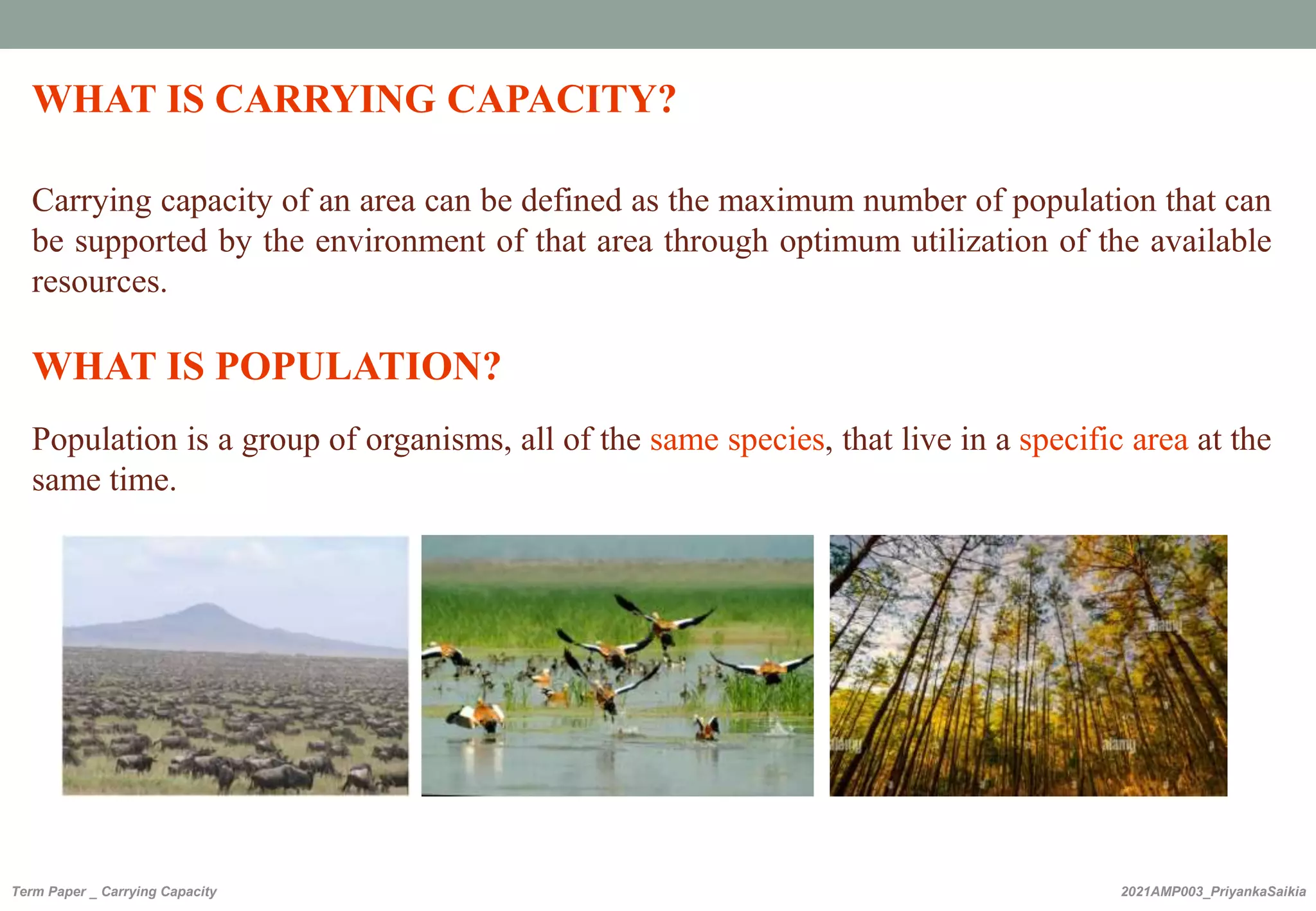
Population is a group of organisms, all of the same species, that live in a specific area at the
same time.
Term Paper _ Carrying Capacity 2021AMP003_PriyankaSaikia
Source: https://www.google.com/
WHAT CAUSES POPULATION CHANGE?
FOUR FACTORS
Birth Rate : Number of births
Immigration : Movement into the population
Death Rate : Number of deaths
Emigration : Movement out of the population
Term Paper _ Carrying Capacity 2021AMP003_PriyankaSaikia
WHAT IS CARRYING CAPACITY?
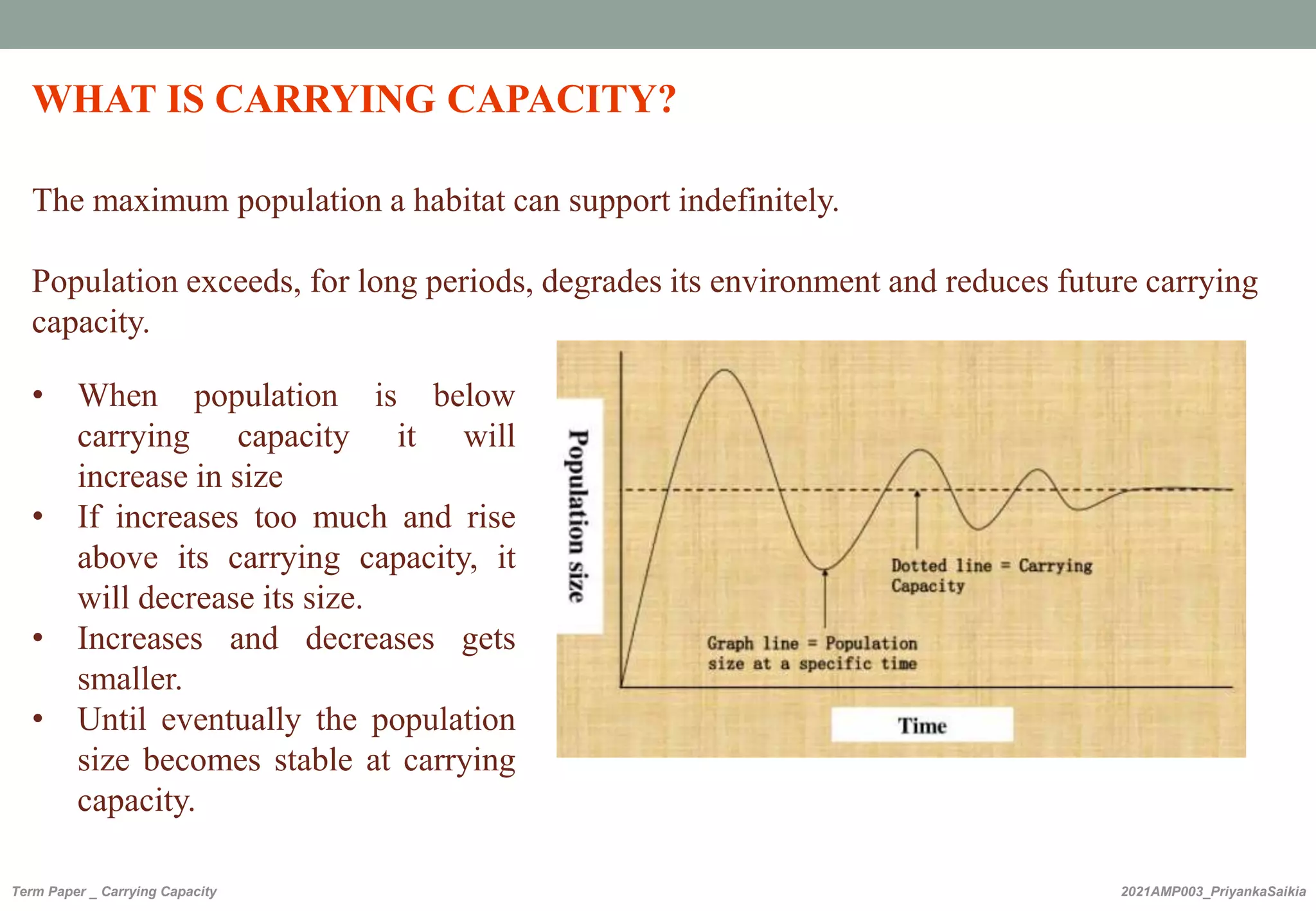
The maximum population a habitat can support indefinitely.
Population exceeds, for long periods, degrades its environment and reduces future carrying
capacity.
• When population is below
carrying capacity it will
increase in size
• If increases too much and rise
above its carrying capacity, it
will decrease its size.
• Increases and decreases gets
smaller.
• Until eventually the population
size becomes stable at carrying
capacity.
Term Paper _ Carrying Capacity 2021AMP003_PriyankaSaikia
WHAT AFFECTS CARRYING CAPACITY?
LIMITING FACTOR
Factors that affect the size of a population.
• Competition over resources
• Predation and Herbivore
• Parasitism and Diseases
• Natural Disasters
• Weather
• Presence of invasive species
Term Paper _ Carrying Capacity 2021AMP003_PriyankaSaikia
POPULATION GROWTH
LINEAR GROWTH
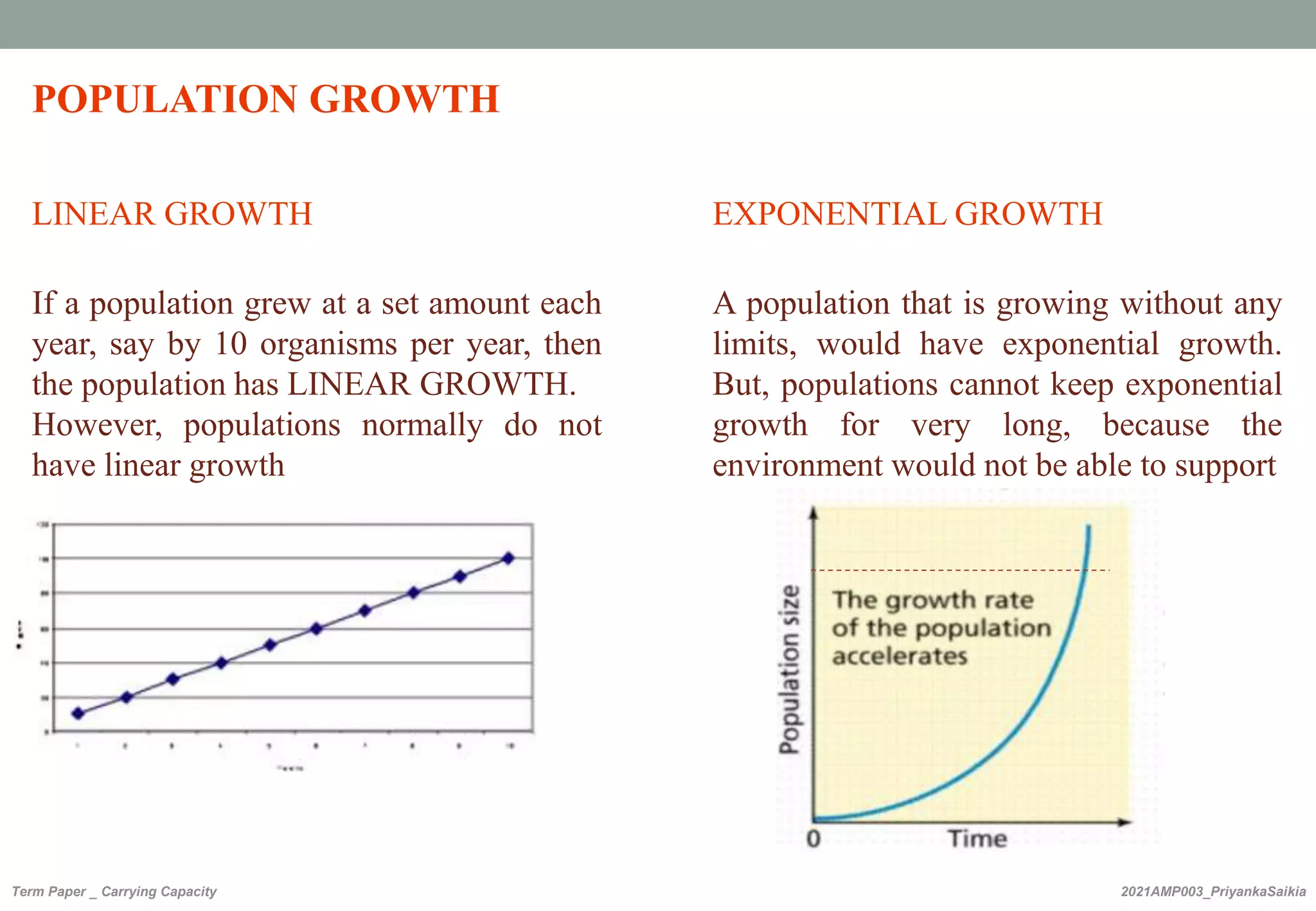
If a population grew at a set amount each
year, say by 10 organisms per year, then
the population has LINEAR GROWTH.
However, populations normally do not
have linear growth
EXPONENTIAL GROWTH
A population that is growing without any
limits, would have exponential growth.
But, populations cannot keep exponential
growth for very long, because the
environment would not be able to support
Term Paper _ Carrying Capacity 2021AMP003_PriyankaSaikia
POPULATION GROWTH
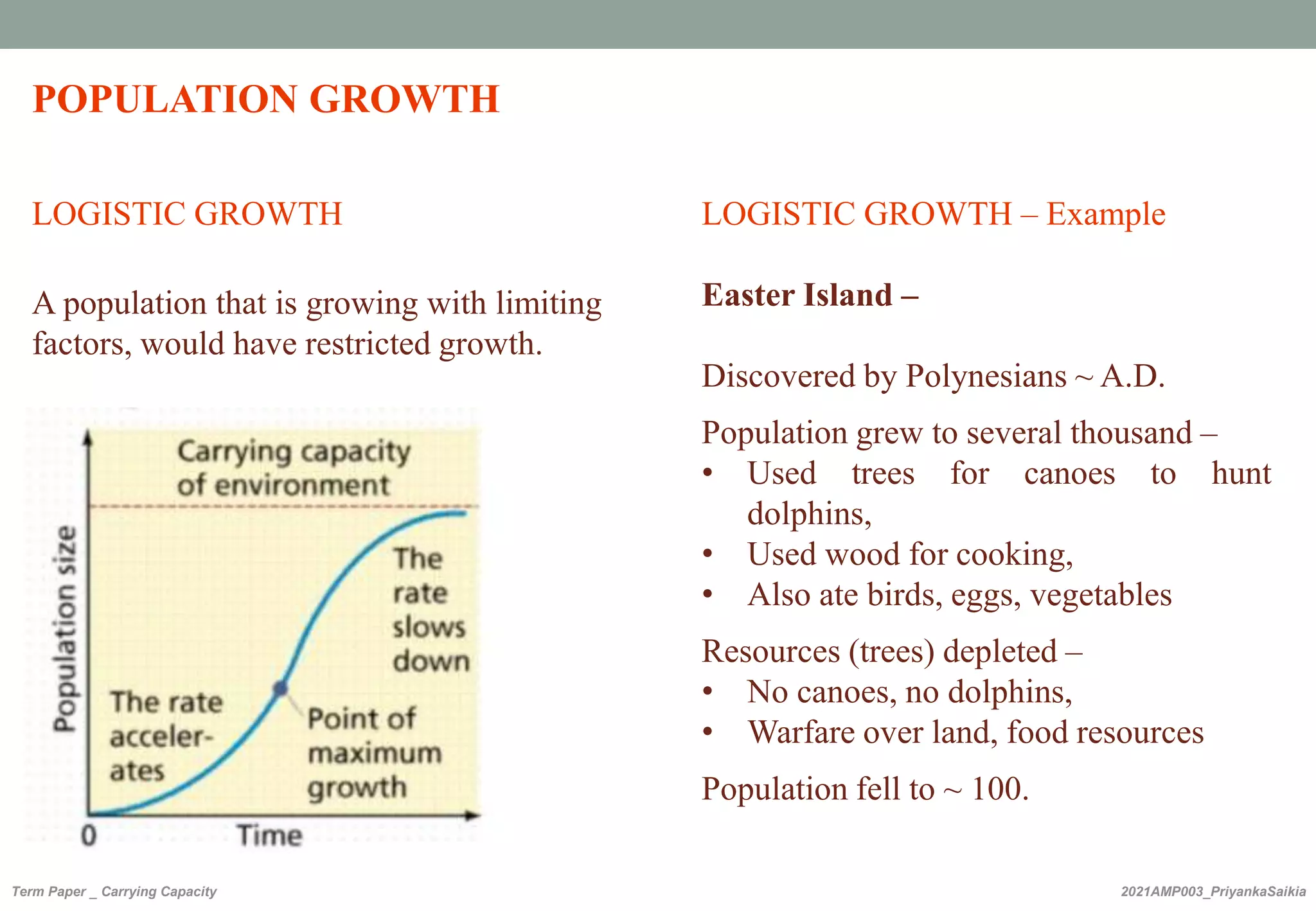
LOGISTIC GROWTH
A population that is growing with limiting
factors, would have restricted growth.
LOGISTIC GROWTH – Example
Easter Island –
Discovered by Polynesians ~ A.D.
Population grew to several thousand –
• Used trees for canoes to hunt
dolphins,
• Used wood for cooking,
• Also ate birds, eggs, vegetables
Resources (trees) depleted –
• No canoes, no dolphins,
• Warfare over land, food resources
Population fell to ~ 100.
Term Paper _ Carrying Capacity 2021AMP003_PriyankaSaikia
CARRYING CAPACITY
Term Paper _ Carrying Capacity 2021AMP003_PriyankaSaikia
CARRYING CAPACITY
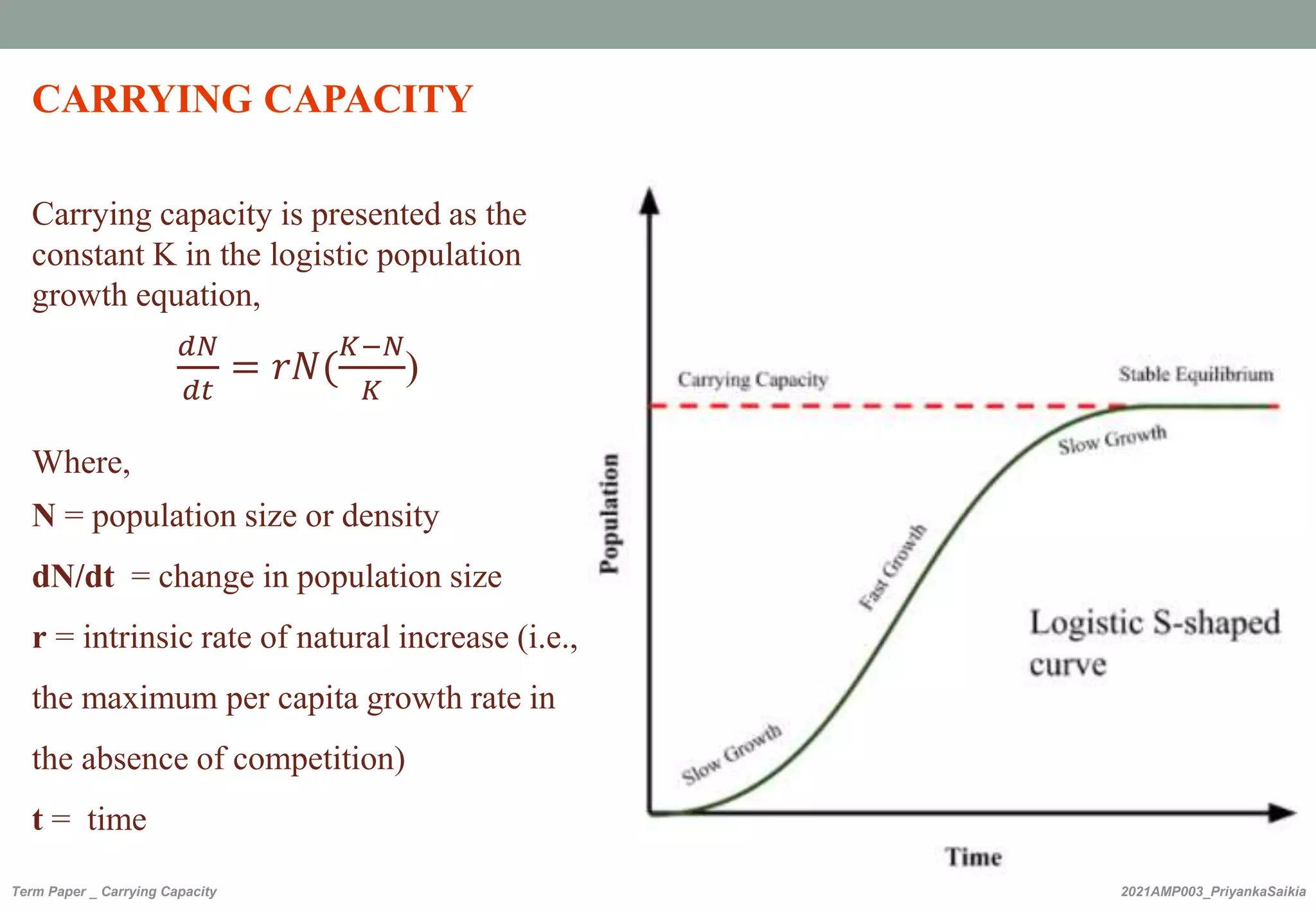
The S-shape logistic growth forms
when the growth rate is slow at first (lag
phase) and next speeds up (exponential
phase). Then, the rate slows down again
as the population size reaches carrying
capacity.
It coincides with the stable equilibrium,
which refers to the population size that
has reached a steady-state as it aligns
with the carrying capacity.
This point indicates “zero-growth”.
Term Paper _ Carrying Capacity 2021AMP003_PriyankaSaikia
CARRYING CAPACITY
Carrying capacity is presented as the
constant K in the logistic population
growth equation,
𝑑𝑁
𝑑𝑡
= 𝑟𝑁(
𝐾−𝑁
𝐾
)
Where,
N = population size or density
dN/dt = change in population size
r = intrinsic rate of natural increase (i.e.,
the maximum per capita growth rate in
the absence of competition)
t = time
Term Paper _ Carrying Capacity 2021AMP003_PriyankaSaikia
CARRYING CAPACITY
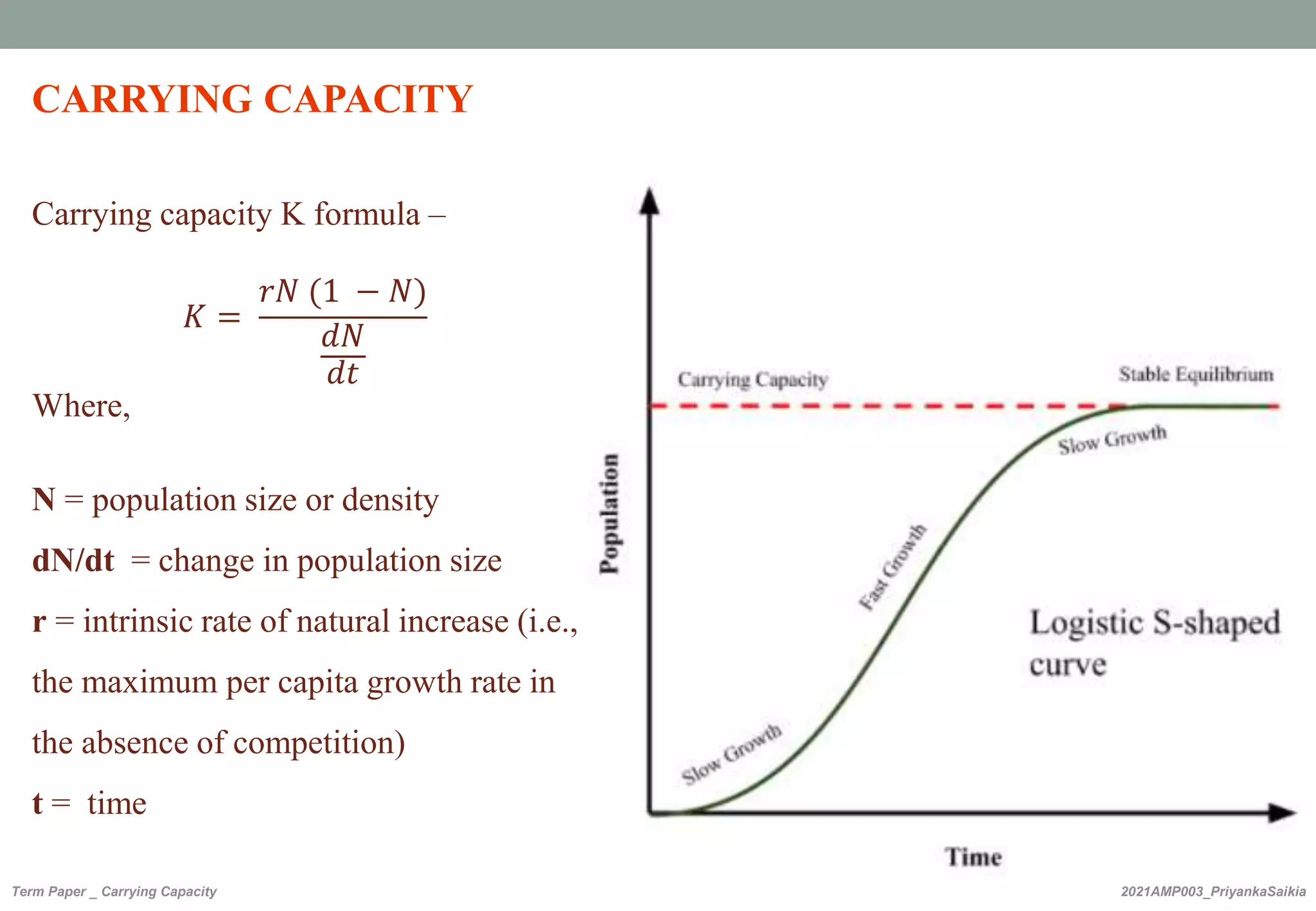
Carrying capacity K formula –
𝐾 =
𝑟𝑁 (1 − 𝑁)
𝑑𝑁
𝑑𝑡
Where,
N = population size or density
dN/dt = change in population size
r = intrinsic rate of natural increase (i.e.,
the maximum per capita growth rate in
the absence of competition)
t = time
Term Paper _ Carrying Capacity 2021AMP003_PriyankaSaikia
CARRYING CAPACITY EXAMPLE
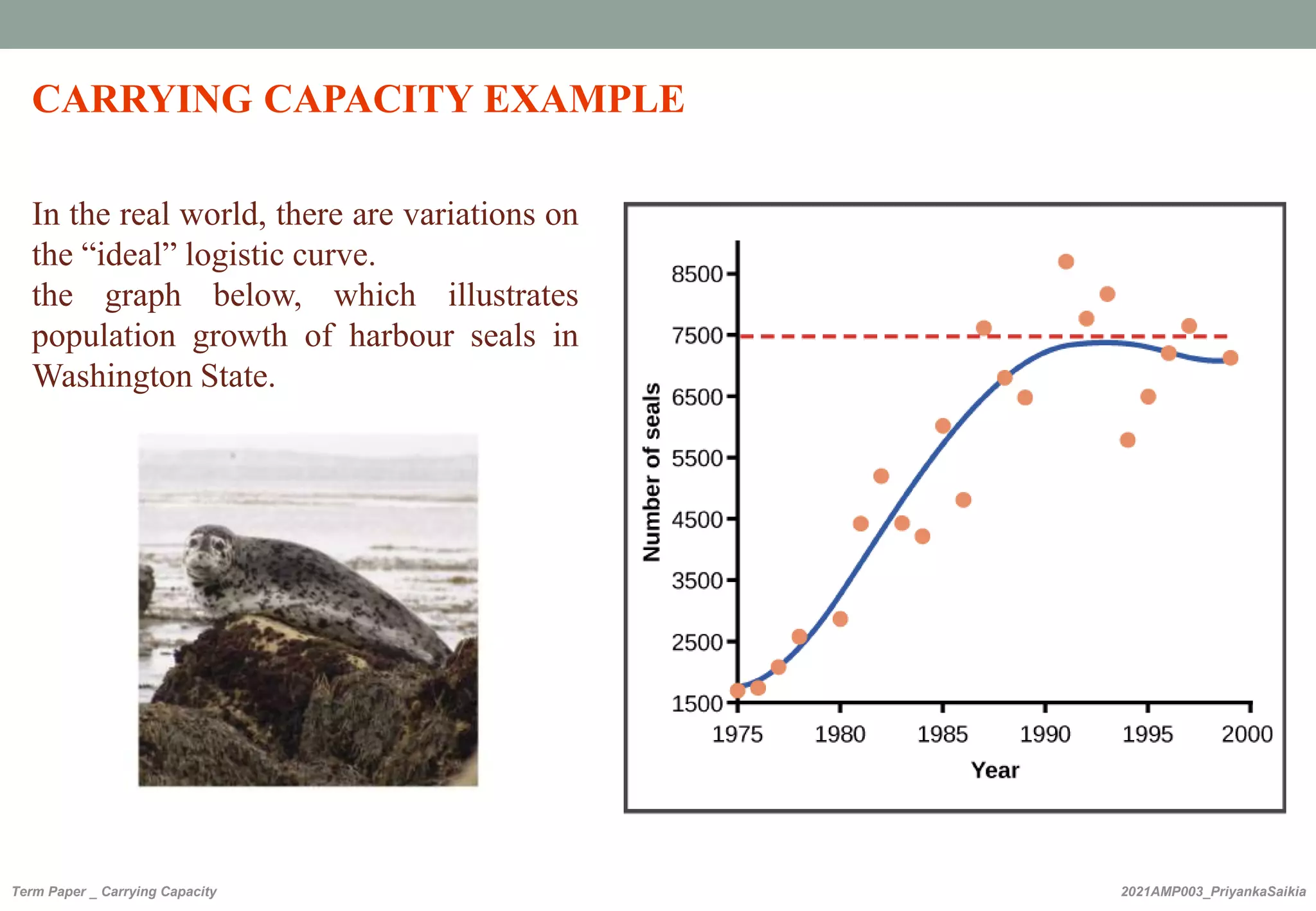
In the real world, there are variations on
the “ideal” logistic curve.
the graph below, which illustrates
population growth of harbour seals in
Washington State.
Term Paper _ Carrying Capacity 2021AMP003_PriyankaSaikia
CARRYING CAPACITY IN URBAN PLANNING
Planners usually define carrying capacity as the ability of the natural or artificial system
that can absorb the population growth or physical development without considerable
degradation or damage
The evaluation of urban carrying capacity is a complex process as it is determined from
basic needs such as food requirements, various kinds of resources consumed and the many
kinds of wastes generated, different kinds of land use conversions leading to ecological
imbalance and the great variability in technology, institutions and lifestyles created.
Infrastructure Capacity Level
Environmental Capacity Level
Sustainable Capacity Level
DEFINITION
CONCEPT
INDICATOR
Term Paper _ Carrying Capacity 2021AMP003_PriyankaSaikia
APPLYING CARRYING CAPACITY
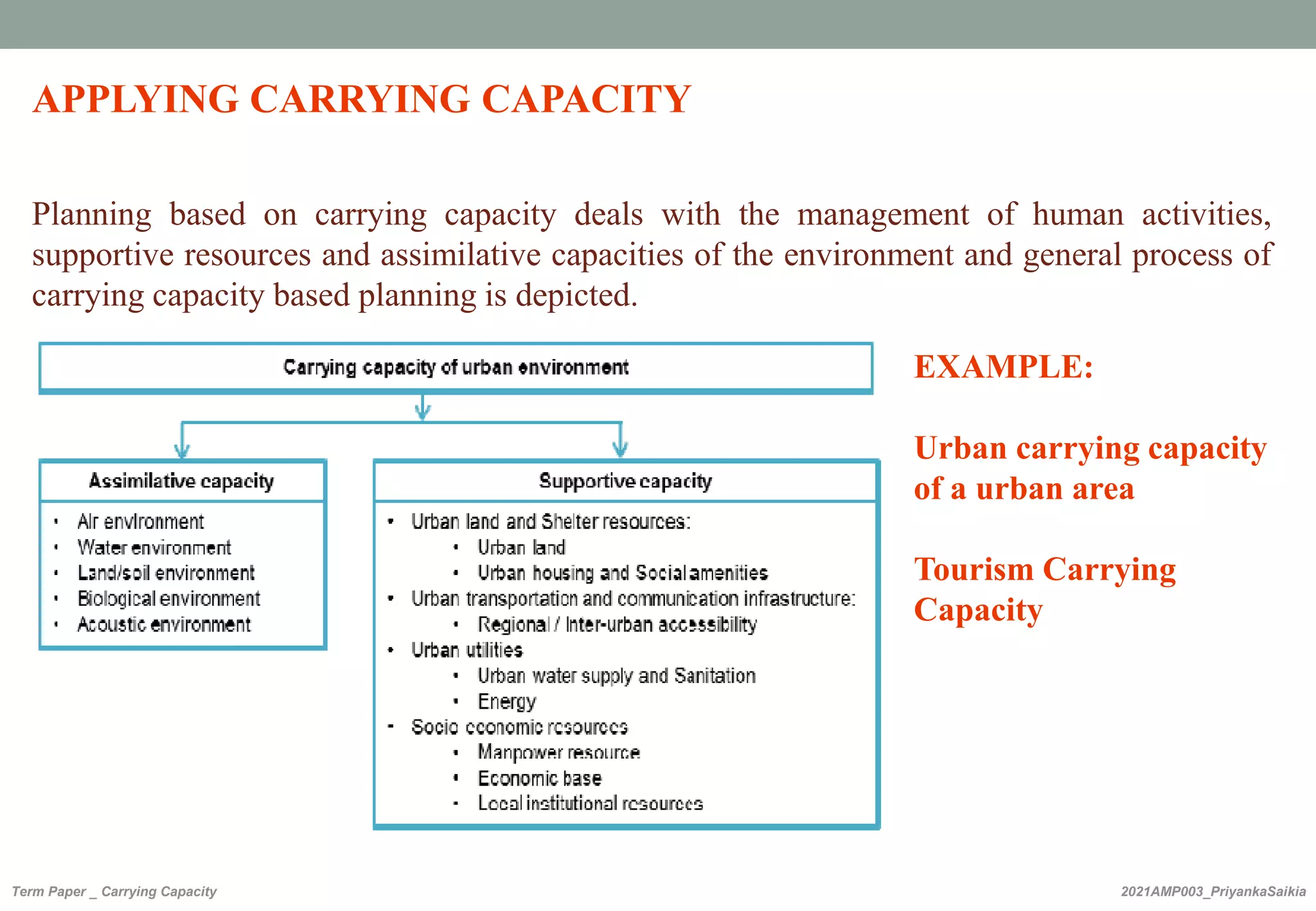
Planning based on carrying capacity deals with the management of human activities,
supportive resources and assimilative capacities of the environment and general process of
carrying capacity based planning is depicted.
EXAMPLE:
Urban carrying capacity
of a urban area
Tourism Carrying
Capacity
Term Paper _ Carrying Capacity 2021AMP003_PriyankaSaikia
REFERENCES
URDPFI
https://www.slideshare.net/DharmasenaPb/lesson-7-environmental-carrying-capacity
https://www.biologyonline.com/dictionary/carrying-capacity
https://www.sciencedirect.com/topics/agricultural-and-biological-sciences/carrying-
capacity
https://www.youtube.com/watch?v=zHNh5gYH780
https://www.researchgate.net/publication/288219162
https://www.khanacademy.org/science/ap-biology/ecology-ap/population-ecology-
ap/a/exponential-logistic-growth

Carrying Capacity.pptx

  • 1.
    TERM PAPER – CARRYINGCAPACITY Submitted by – • Priyanka Saikia • 1ST Semester Urban & Regional Planning
  • 2.
    Term Paper _Carrying Capacity 2021AMP003_PriyankaSaikia WHAT IS CARRYING CAPACITY? Carrying capacity of an area can be defined as the maximum number of population that can be supported by the environment of that area through optimum utilization of the available resources. WHAT IS POPULATION? Population is a group of organisms, all of the same species, that live in a specific area at the same time.
  • 3.
    Term Paper _Carrying Capacity 2021AMP003_PriyankaSaikia Source: https://www.google.com/ WHAT CAUSES POPULATION CHANGE? FOUR FACTORS Birth Rate : Number of births Immigration : Movement into the population Death Rate : Number of deaths Emigration : Movement out of the population
  • 4.
    Term Paper _Carrying Capacity 2021AMP003_PriyankaSaikia WHAT IS CARRYING CAPACITY? The maximum population a habitat can support indefinitely. Population exceeds, for long periods, degrades its environment and reduces future carrying capacity. • When population is below carrying capacity it will increase in size • If increases too much and rise above its carrying capacity, it will decrease its size. • Increases and decreases gets smaller. • Until eventually the population size becomes stable at carrying capacity.
  • 5.
    Term Paper _Carrying Capacity 2021AMP003_PriyankaSaikia WHAT AFFECTS CARRYING CAPACITY? LIMITING FACTOR Factors that affect the size of a population. • Competition over resources • Predation and Herbivore • Parasitism and Diseases • Natural Disasters • Weather • Presence of invasive species
  • 6.
    Term Paper _Carrying Capacity 2021AMP003_PriyankaSaikia POPULATION GROWTH LINEAR GROWTH If a population grew at a set amount each year, say by 10 organisms per year, then the population has LINEAR GROWTH. However, populations normally do not have linear growth EXPONENTIAL GROWTH A population that is growing without any limits, would have exponential growth. But, populations cannot keep exponential growth for very long, because the environment would not be able to support
  • 7.
    Term Paper _Carrying Capacity 2021AMP003_PriyankaSaikia POPULATION GROWTH LOGISTIC GROWTH A population that is growing with limiting factors, would have restricted growth. LOGISTIC GROWTH – Example Easter Island – Discovered by Polynesians ~ A.D. Population grew to several thousand – • Used trees for canoes to hunt dolphins, • Used wood for cooking, • Also ate birds, eggs, vegetables Resources (trees) depleted – • No canoes, no dolphins, • Warfare over land, food resources Population fell to ~ 100.
  • 8.
    Term Paper _Carrying Capacity 2021AMP003_PriyankaSaikia CARRYING CAPACITY
  • 9.
    Term Paper _Carrying Capacity 2021AMP003_PriyankaSaikia CARRYING CAPACITY The S-shape logistic growth forms when the growth rate is slow at first (lag phase) and next speeds up (exponential phase). Then, the rate slows down again as the population size reaches carrying capacity. It coincides with the stable equilibrium, which refers to the population size that has reached a steady-state as it aligns with the carrying capacity. This point indicates “zero-growth”.
  • 10.
    Term Paper _Carrying Capacity 2021AMP003_PriyankaSaikia CARRYING CAPACITY Carrying capacity is presented as the constant K in the logistic population growth equation, 𝑑𝑁 𝑑𝑡 = 𝑟𝑁( 𝐾−𝑁 𝐾 ) Where, N = population size or density dN/dt = change in population size r = intrinsic rate of natural increase (i.e., the maximum per capita growth rate in the absence of competition) t = time
  • 11.
    Term Paper _Carrying Capacity 2021AMP003_PriyankaSaikia CARRYING CAPACITY Carrying capacity K formula – 𝐾 = 𝑟𝑁 (1 − 𝑁) 𝑑𝑁 𝑑𝑡 Where, N = population size or density dN/dt = change in population size r = intrinsic rate of natural increase (i.e., the maximum per capita growth rate in the absence of competition) t = time
  • 12.
    Term Paper _Carrying Capacity 2021AMP003_PriyankaSaikia CARRYING CAPACITY EXAMPLE In the real world, there are variations on the “ideal” logistic curve. the graph below, which illustrates population growth of harbour seals in Washington State.
  • 13.
    Term Paper _Carrying Capacity 2021AMP003_PriyankaSaikia CARRYING CAPACITY IN URBAN PLANNING Planners usually define carrying capacity as the ability of the natural or artificial system that can absorb the population growth or physical development without considerable degradation or damage The evaluation of urban carrying capacity is a complex process as it is determined from basic needs such as food requirements, various kinds of resources consumed and the many kinds of wastes generated, different kinds of land use conversions leading to ecological imbalance and the great variability in technology, institutions and lifestyles created. Infrastructure Capacity Level Environmental Capacity Level Sustainable Capacity Level DEFINITION CONCEPT INDICATOR
  • 14.
    Term Paper _Carrying Capacity 2021AMP003_PriyankaSaikia APPLYING CARRYING CAPACITY Planning based on carrying capacity deals with the management of human activities, supportive resources and assimilative capacities of the environment and general process of carrying capacity based planning is depicted. EXAMPLE: Urban carrying capacity of a urban area Tourism Carrying Capacity
  • 15.
    Term Paper _Carrying Capacity 2021AMP003_PriyankaSaikia REFERENCES URDPFI https://www.slideshare.net/DharmasenaPb/lesson-7-environmental-carrying-capacity https://www.biologyonline.com/dictionary/carrying-capacity https://www.sciencedirect.com/topics/agricultural-and-biological-sciences/carrying- capacity https://www.youtube.com/watch?v=zHNh5gYH780 https://www.researchgate.net/publication/288219162 https://www.khanacademy.org/science/ap-biology/ecology-ap/population-ecology- ap/a/exponential-logistic-growth