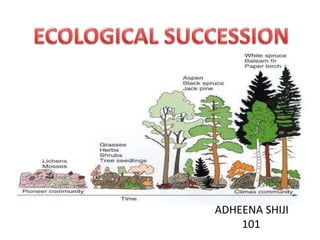
ADHEENA SHIJI
101
The concept, definition and reasons of
succession.
Classification of succession.
Retrogressive changes.
Concept of stable or climax community.
Resilience of community.
“Ecologicalsuccessionis thesteady
andgradualchangeinaspeciesofa
givenareawithrespecttothe
changingenvironment”
Thetermwascoinedby Hult
“Change in community composition over
time”
(Odum,1969)
“Succession refers to the directional predictable
changes in community structure over time”
(Smith,1987)
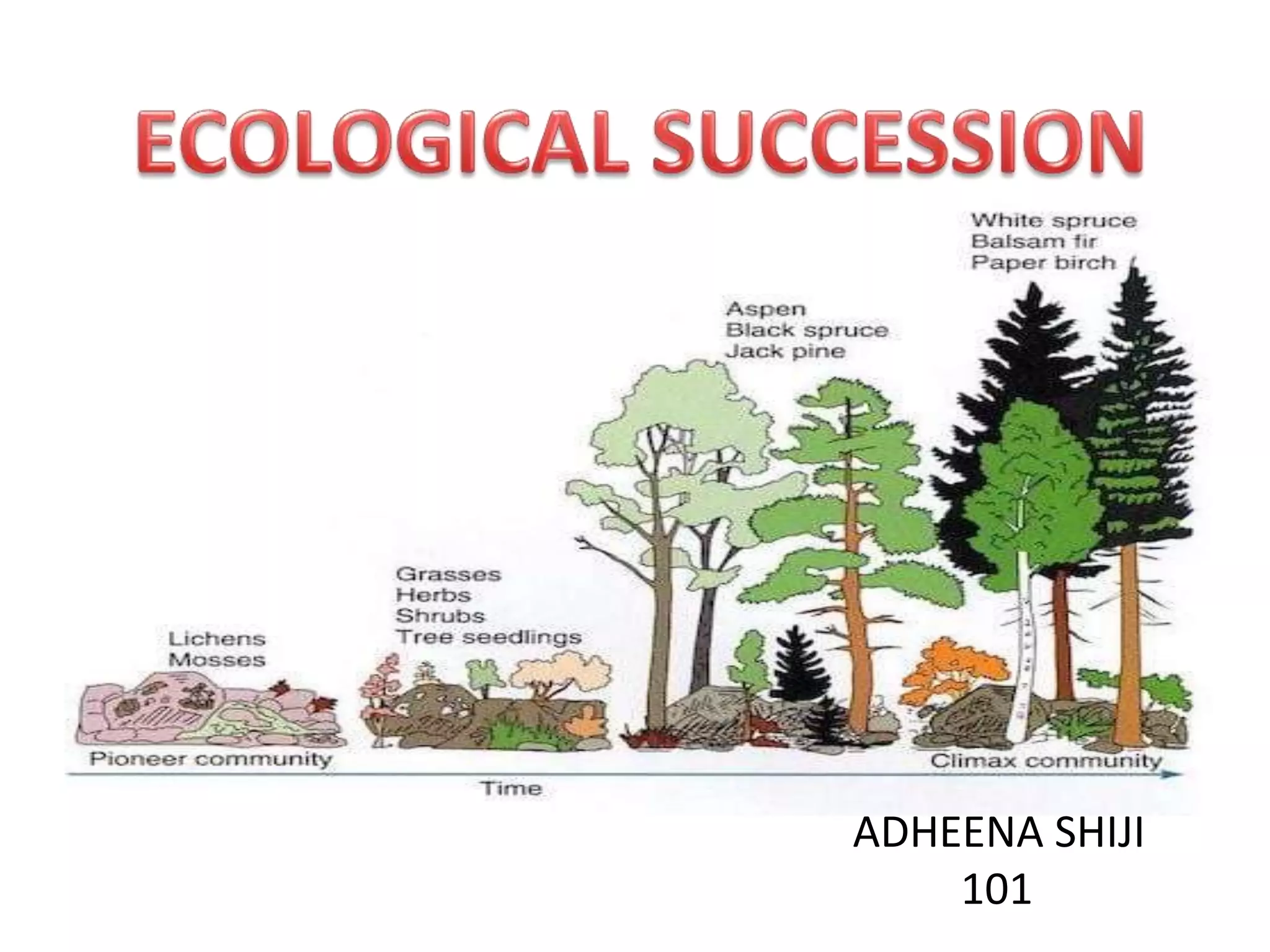
1. Succession is orderly sequence of changes in the
vegetation of previously bare area. It is
directional hence predictable.
2. The rate of change , the pattern of change and
the limit of development are determined by the
alteration brought about in physical
environment by the existing community.
3. It produce climax community , which is in
dynamic equilibrium with the climate.
4. The final or climax community determined by
climate . (Phenomenon of convergence)
1. Primary and secondary succession (Based on
starting)
2. Autogenic and Allogenic succession ( Based
on cause)
3. Autotrophic and heterotrophic (Based on
community)
4. Hydrosere and xerosere ( Based on
substratum)
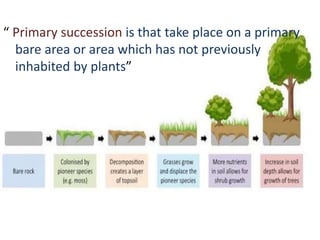
“ Primary succession is that take place on a primary
bare area or area which has not previously
inhabited by plants”
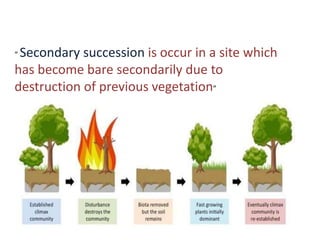
“ Secondary succession is occur in a site which
has become bare secondarily due to
destruction of previous vegetation”
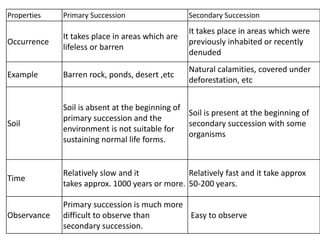
Properties Primary Succession Secondary Succession
Occurrence
It takes place in areas which are
lifeless or barren
It takes place in areas which were
previously inhabited or recently
denuded
Example Barren rock, ponds, desert ,etc
Natural calamities, covered under
deforestation, etc
Soil
Soil is absent at the beginning of
primary succession and the
environment is not suitable for
sustaining normal life forms.
Soil is present at the beginning of
secondary succession with some
organisms
Time
Relatively slow and it
takes approx. 1000 years or more.
Relatively fast and it take approx
50-200 years.
Observance
Primary succession is much more
difficult to observe than
secondary succession.
Easy to observe
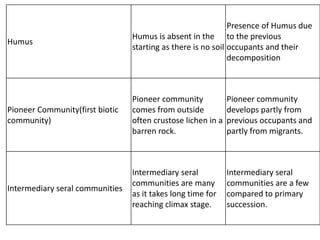
Humus
Humus is absent in the
starting as there is no soil
Presence of Humus due
to the previous
occupants and their
decomposition
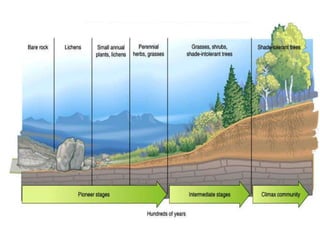
Pioneer Community(first biotic
community)
Pioneer community
comes from outside
often crustose lichen in a
barren rock.
Pioneer community
develops partly from
previous occupants and
partly from migrants.
Intermediary seral communities
Intermediary seral
communities are many
as it takes long time for
reaching climax stage.
Intermediary seral
communities are a few
compared to primary
succession.
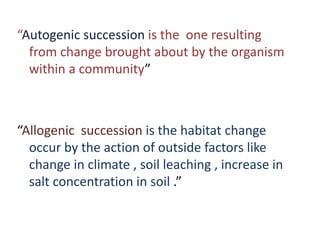
“Autogenic succession is the one resulting
from change brought about by the organism
within a community”
“Allogenic succession is the habitat change
occur by the action of outside factors like
change in climate , soil leaching , increase in
salt concentration in soil .”
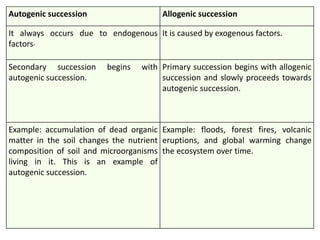
Autogenic succession Allogenic succession
It always occurs due to endogenous
factors.
It is caused by exogenous factors.
Secondary succession begins with
autogenic succession.
Primary succession begins with allogenic
succession and slowly proceeds towards
autogenic succession.
Example: accumulation of dead organic
matter in the soil changes the nutrient
composition of soil and microorganisms
living in it. This is an example of
autogenic succession.
Example: floods, forest fires, volcanic
eruptions, and global warming change
the ecosystem over time.
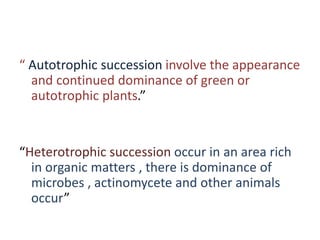
“ Autotrophic succession involve the appearance
and continued dominance of green or
autotrophic plants.”
“Heterotrophic succession occur in an area rich
in organic matters , there is dominance of
microbes , actinomycete and other animals
occur”
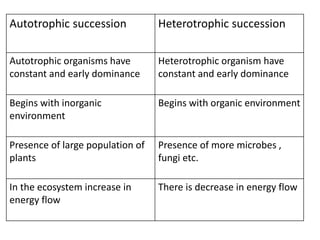
Autotrophic succession Heterotrophic succession
Autotrophic organisms have
constant and early dominance
Heterotrophic organism have
constant and early dominance
Begins with inorganic
environment
Begins with organic environment
Presence of large population of
plants
Presence of more microbes ,
fungi etc.
In the ecosystem increase in
energy flow
There is decrease in energy flow
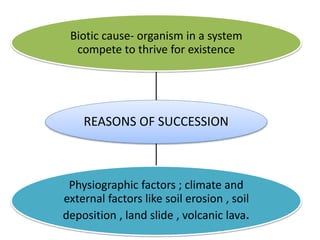
REASONS OF SUCCESSION
Biotic cause- organism in a system
compete to thrive for existence
Physiographic factors ; climate and
external factors like soil erosion , soil
deposition , land slide , volcanic lava.
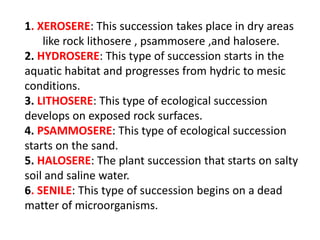
1. XEROSERE: This succession takes place in dry areas
like rock lithosere , psammosere ,and halosere.
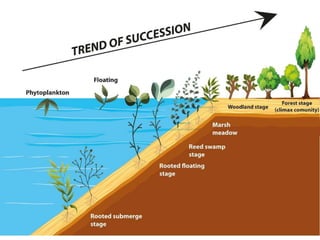
2. HYDROSERE: This type of succession starts in the
aquatic habitat and progresses from hydric to mesic
conditions.
3. LITHOSERE: This type of ecological succession
develops on exposed rock surfaces.
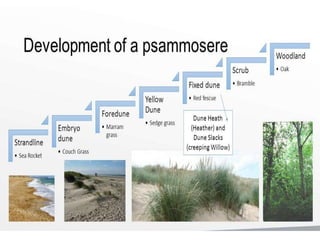
4. PSAMMOSERE: This type of ecological succession
starts on the sand.
5. HALOSERE: The plant succession that starts on salty
soil and saline water.
6. SENILE: This type of succession begins on a dead
matter of microorganisms.
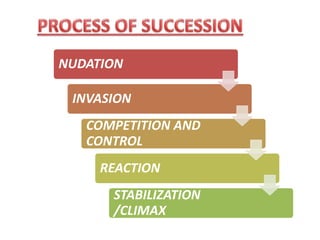
NUDATION
INVASION
COMPETITION AND
CONTROL
REACTION
STABILIZATION
/CLIMAX
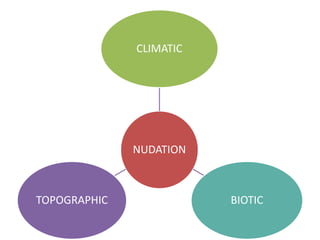
NUDATION
CLIMATIC
BIOTIC
TOPOGRAPHIC
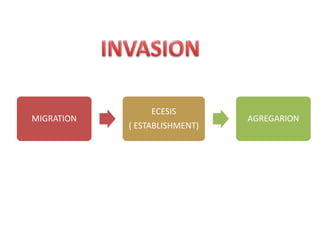
MIGRATION
ECESIS
( ESTABLISHMENT)
AGREGARION
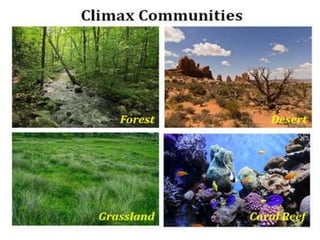
“The climax community of an area
during succession is the stabilized
community which forms equilibrium
with the environment”
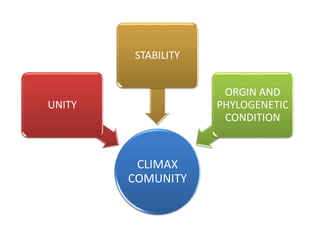
CLIMAX
COMUNITY
UNITY
STABILITY
ORGIN AND
PHYLOGENETIC
CONDITION
Monoclimax theory
The theory explains that similar type of
community is present at climax stage in the
given land area. In other words, succession
begins in diverse areas like pond, rock and
river will finally converge into a same single
climax community decided by their regional
climate
Polyclimax theory
Climax is controlled by not a single factor but by
several other factors. Various climax
communities can be expected in the area which
is under the control of different abiotic
component such as moisture, soil, temperature
and activities of different biotic factors.
Existence of a number of climax communities,
forming a mosaic correspond to the mosaic of
habitat.
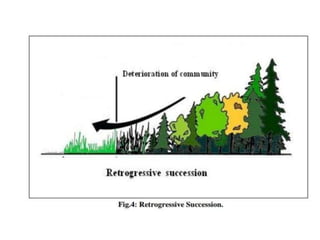
“Retrogressive succession or concept of
degradation , it is the succession in which
community become more simplistic and contain
fewer species and less biomass over time .
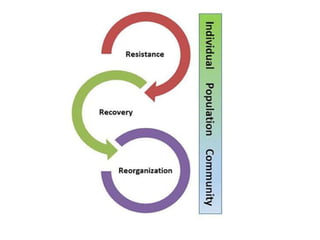
“Community resilience is broadly defined as a
community's collective capacity to function
in, respond to, and potentially influence an
environment characterized by continuous
change, uncertainty, and crisis “.
1. Odum, E P .The strategy of ecosystem development .Science
164, (262-270).
2. Clement , F E. Nature and structure of climax. Journal of
ecology 24, (252-284).
3. Clerk G L. Elements of Ecology. Harvard university, 1959.
(425-438).
4. Sharma P D. Environmental Biology. University of Delhi, 2004
(136-144)
5. http://epgp.inflibnet.ac.in
ecological succession.pptx

ecological succession.pptx

  • 1.
  • 2.
    The concept, definitionand reasons of succession. Classification of succession. Retrogressive changes. Concept of stable or climax community. Resilience of community.
  • 3.
  • 4.
    “Change in communitycomposition over time” (Odum,1969) “Succession refers to the directional predictable changes in community structure over time” (Smith,1987)
  • 5.
    1. Succession isorderly sequence of changes in the vegetation of previously bare area. It is directional hence predictable. 2. The rate of change , the pattern of change and the limit of development are determined by the alteration brought about in physical environment by the existing community. 3. It produce climax community , which is in dynamic equilibrium with the climate. 4. The final or climax community determined by climate . (Phenomenon of convergence)
  • 6.
    1. Primary andsecondary succession (Based on starting) 2. Autogenic and Allogenic succession ( Based on cause) 3. Autotrophic and heterotrophic (Based on community) 4. Hydrosere and xerosere ( Based on substratum)
  • 7.
    “ Primary successionis that take place on a primary bare area or area which has not previously inhabited by plants”
  • 8.
    “ Secondary successionis occur in a site which has become bare secondarily due to destruction of previous vegetation”
  • 9.
    Properties Primary SuccessionSecondary Succession Occurrence It takes place in areas which are lifeless or barren It takes place in areas which were previously inhabited or recently denuded Example Barren rock, ponds, desert ,etc Natural calamities, covered under deforestation, etc Soil Soil is absent at the beginning of primary succession and the environment is not suitable for sustaining normal life forms. Soil is present at the beginning of secondary succession with some organisms Time Relatively slow and it takes approx. 1000 years or more. Relatively fast and it take approx 50-200 years. Observance Primary succession is much more difficult to observe than secondary succession. Easy to observe
  • 10.
    Humus Humus is absentin the starting as there is no soil Presence of Humus due to the previous occupants and their decomposition Pioneer Community(first biotic community) Pioneer community comes from outside often crustose lichen in a barren rock. Pioneer community develops partly from previous occupants and partly from migrants. Intermediary seral communities Intermediary seral communities are many as it takes long time for reaching climax stage. Intermediary seral communities are a few compared to primary succession.
  • 12.
    “Autogenic succession isthe one resulting from change brought about by the organism within a community” “Allogenic succession is the habitat change occur by the action of outside factors like change in climate , soil leaching , increase in salt concentration in soil .”
  • 13.
    Autogenic succession Allogenicsuccession It always occurs due to endogenous factors. It is caused by exogenous factors. Secondary succession begins with autogenic succession. Primary succession begins with allogenic succession and slowly proceeds towards autogenic succession. Example: accumulation of dead organic matter in the soil changes the nutrient composition of soil and microorganisms living in it. This is an example of autogenic succession. Example: floods, forest fires, volcanic eruptions, and global warming change the ecosystem over time.
  • 14.
    “ Autotrophic successioninvolve the appearance and continued dominance of green or autotrophic plants.” “Heterotrophic succession occur in an area rich in organic matters , there is dominance of microbes , actinomycete and other animals occur”
  • 15.
    Autotrophic succession Heterotrophicsuccession Autotrophic organisms have constant and early dominance Heterotrophic organism have constant and early dominance Begins with inorganic environment Begins with organic environment Presence of large population of plants Presence of more microbes , fungi etc. In the ecosystem increase in energy flow There is decrease in energy flow
  • 16.
    REASONS OF SUCCESSION Bioticcause- organism in a system compete to thrive for existence Physiographic factors ; climate and external factors like soil erosion , soil deposition , land slide , volcanic lava.
  • 17.
    1. XEROSERE: Thissuccession takes place in dry areas like rock lithosere , psammosere ,and halosere. 2. HYDROSERE: This type of succession starts in the aquatic habitat and progresses from hydric to mesic conditions. 3. LITHOSERE: This type of ecological succession develops on exposed rock surfaces. 4. PSAMMOSERE: This type of ecological succession starts on the sand. 5. HALOSERE: The plant succession that starts on salty soil and saline water. 6. SENILE: This type of succession begins on a dead matter of microorganisms.
  • 21.
  • 22.
  • 23.
  • 24.
    “The climax communityof an area during succession is the stabilized community which forms equilibrium with the environment”
  • 25.
  • 26.
    Monoclimax theory The theoryexplains that similar type of community is present at climax stage in the given land area. In other words, succession begins in diverse areas like pond, rock and river will finally converge into a same single climax community decided by their regional climate
  • 27.
    Polyclimax theory Climax iscontrolled by not a single factor but by several other factors. Various climax communities can be expected in the area which is under the control of different abiotic component such as moisture, soil, temperature and activities of different biotic factors. Existence of a number of climax communities, forming a mosaic correspond to the mosaic of habitat.
  • 29.
    “Retrogressive succession orconcept of degradation , it is the succession in which community become more simplistic and contain fewer species and less biomass over time .
  • 31.
    “Community resilience isbroadly defined as a community's collective capacity to function in, respond to, and potentially influence an environment characterized by continuous change, uncertainty, and crisis “.
  • 33.
    1. Odum, EP .The strategy of ecosystem development .Science 164, (262-270). 2. Clement , F E. Nature and structure of climax. Journal of ecology 24, (252-284). 3. Clerk G L. Elements of Ecology. Harvard university, 1959. (425-438). 4. Sharma P D. Environmental Biology. University of Delhi, 2004 (136-144) 5. http://epgp.inflibnet.ac.in