IMPACT OF CLIMATE CHANGE ON
BIODIVERSITY, VEGETATION AND
AGRICULTURE
PRESENTED BY:
Srutisudha
Rajni
Subhash Chand
Rajashree
SUBMITTED TO :
Dr. Alok Kumar
What is climate change ?
• Climate change in IPCC usage refers to a change in
the state of the climate that can be identified (e.g.
using statistical tests) by changes in the mean and/or
the variability of its properties, and that persists for
an extended period, typically decades or longer. It
refers to any change in climate over time, whether
due to natural variability or as a result of human
activity.
What is biodiversity ?
• According to Convention on Biological
Diversity,
"Biological diversity" means the variability
among living organisms from all sources
including, inter alia, terrestrial, marine and
other aquatic ecosystems and the ecological
complexes of which they are part; this includes
diversity within species, between species and of
ecosystems.
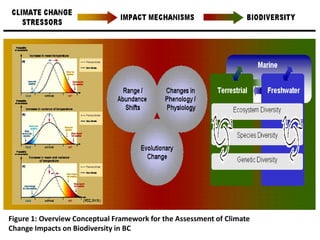
• Climate change is one of many possible stressors
on biodiversity.
• Climate change may manifest itself as a shift in
mean conditions, or as changes in the variance
and frequency of extremes of climatic variables.
• The changing climate will stimulate species-level
changes in range and abundance, life cycle and
behaviour, and, over time, genetic evolutionary
responses.
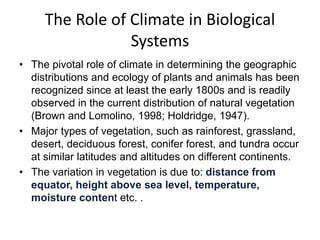
The Role of Climate in Biological
Systems
• The pivotal role of climate in determining the geographic
distributions and ecology of plants and animals has been
recognized since at least the early 1800s and is readily
observed in the current distribution of natural vegetation
(Brown and Lomolino, 1998; Holdridge, 1947).
• Major types of vegetation, such as rainforest, grassland,
desert, deciduous forest, conifer forest, and tundra occur
at similar latitudes and altitudes on different continents.
• The variation in vegetation is due to: distance from
equator, height above sea level, temperature,
moisture content etc. .
Factors
• The key climate-related ecosystem services supported by
biodiversity are all regulating by certain factors ,which
include :
 Macroclimatic regulation (through carbon sequestration and
the management of albedo effects)
 Microclimatic regulation (through local canopy effects)
 Hydrological regulation (mitigation of the hydrological impacts
of climate change through watershed protection)
 Soil regulation (mitigation of the consequences of climate
change for erosion through vegetation cover)
 Maintenance of adaptive capacity (through in situ
conservation of the diversity of functional groups—
including land races and wild relatives)
Figure 1: Overview Conceptual Framework for the Assessment of Climate
Change Impacts on Biodiversity in BC
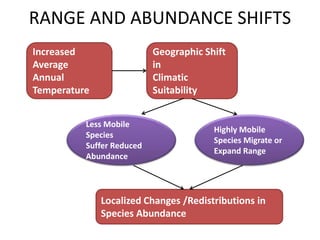
RANGE AND ABUNDANCE SHIFTS
Increased
Average
Annual
Temperature
Geographic Shift
in
Climatic
Suitability
Less Mobile
Species
Suffer Reduced
Abundance
Highly Mobile
Species Migrate or
Expand Range
Localized Changes /Redistributions in
Species Abundance
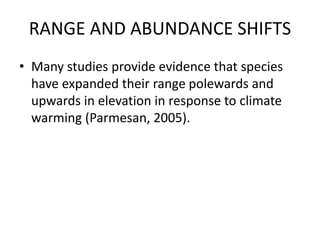
• Many studies provide evidence that species
have expanded their range polewards and
upwards in elevation in response to climate
warming (Parmesan, 2005).
RANGE AND ABUNDANCE SHIFTS
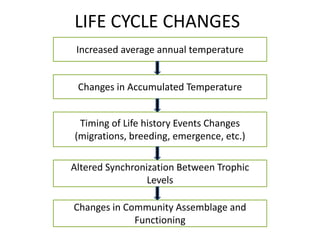
LIFE CYCLE CHANGES
Increased average annual temperature
Changes in Accumulated Temperature
Timing of Life history Events Changes
(migrations, breeding, emergence, etc.)
Altered Synchronization Between Trophic
Levels
Changes in Community Assemblage and
Functioning
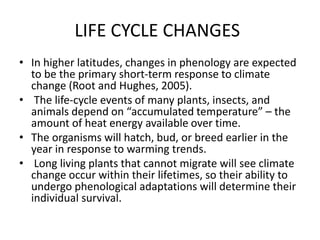
• In higher latitudes, changes in phenology are expected
to be the primary short-term response to climate
change (Root and Hughes, 2005).
• The life-cycle events of many plants, insects, and
animals depend on “accumulated temperature” – the
amount of heat energy available over time.
• The organisms will hatch, bud, or breed earlier in the
year in response to warming trends.
• Long living plants that cannot migrate will see climate
change occur within their lifetimes, so their ability to
undergo phenological adaptations will determine their
individual survival.
LIFE CYCLE CHANGES
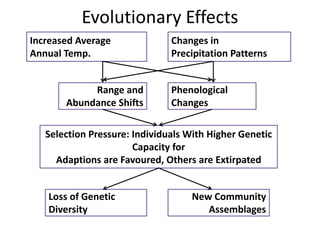
Evolutionary Effects
Increased Average
Annual Temp.
Selection Pressure: Individuals With Higher Genetic
Capacity for
Adaptions are Favoured, Others are Extirpated
Loss of Genetic
Diversity
Changes in
Precipitation Patterns
Phenological
Changes
Range and
Abundance Shifts
New Community
Assemblages
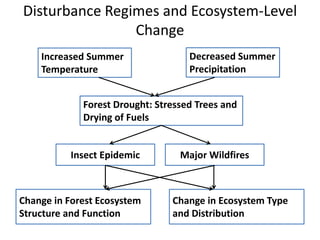
Disturbance Regimes and Ecosystem-Level
Change
Increased Summer
Temperature
Decreased Summer
Precipitation
Forest Drought: Stressed Trees and
Drying of Fuels
Insect Epidemic Major Wildfires
Change in Forest Ecosystem
Structure and Function
Change in Ecosystem Type
and Distribution
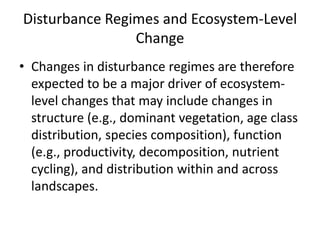
• Changes in disturbance regimes are therefore
expected to be a major driver of ecosystem-
level changes that may include changes in
structure (e.g., dominant vegetation, age class
distribution, species composition), function
(e.g., productivity, decomposition, nutrient
cycling), and distribution within and across
landscapes.
Disturbance Regimes and Ecosystem-Level
Change
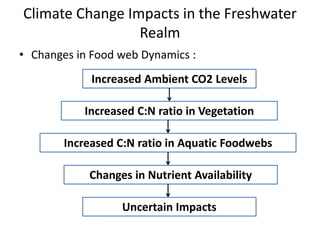
Climate Change Impacts in the Freshwater
Realm
• Changes in Food web Dynamics :
Increased Ambient CO2 Levels
Increased C:N ratio in Vegetation
Increased C:N ratio in Aquatic Foodwebs
Changes in Nutrient Availability
Uncertain Impacts
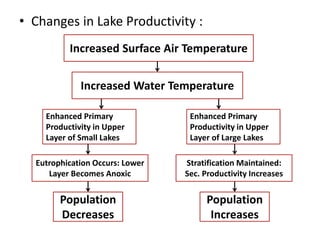
• Changes in Lake Productivity :
Increased Surface Air Temperature
Increased Water Temperature
Enhanced Primary
Productivity in Upper
Layer of Small Lakes
Enhanced Primary
Productivity in Upper
Layer of Large Lakes
Eutrophication Occurs: Lower
Layer Becomes Anoxic
Stratification Maintained:
Sec. Productivity Increases
Population
Decreases
Population
Increases
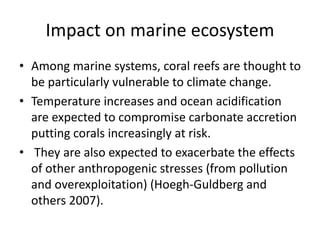
Impact on marine ecosystem
• Among marine systems, coral reefs are thought to
be particularly vulnerable to climate change.
• Temperature increases and ocean acidification
are expected to compromise carbonate accretion
putting corals increasingly at risk.
• They are also expected to exacerbate the effects
of other anthropogenic stresses (from pollution
and overexploitation) (Hoegh-Guldberg and
others 2007).
Impact on disease vectors
• The IPCC’s fourth assessment report highlighted the impact of
climate change on the distribution of a number of infectious
disease vectors, and the seasonal distribution of some
allergenic pollen species (Confalonieri and others 2007).
• For example, the climatic basis for changes in the distribution
of the main dengue fever vector Stegomyia has been
modeled, and turns out to map well into the observed disease
distribution (Hopp and Foley 2003).
• Diseases that were previously limited to low latitudes have
spread to higher latitudes.
• Other diseases affected by climate change include
leishmaniasis, cryptosporidiosis, giardiasis, schistosomiasis,
lariasis, onchocerciasis, and loiasis (Patz and others 2000,
Jones and others 2008).
Impact of climate change on Arctic
vegetation
• Biological processes in the Arctic are considerably
hampered by temperature and permafrost.
• The soil from which the plants obtain their
nutrients for growth is thin, and most plant
species are therefore limited to the nutrients
available in this thin layer of soil.
• A general increase in temperature in the Arctic as
a result of global warming would increase the
decomposition of the large quantities of organic
materials that are frozen in arctic soil.
• Combined with increased concentrations of
CO2 in the atmosphere there would be an
increase in the production of plant biomass as
a result of increased photosynthesis.
• Consequently, there would be an increase in
the production of arctic vegetation, but at the
same time it is anticipated that there would
be a substantial change in the combination of
species in plant communities.
Changes in plant communities
• Species that are specially adapted to an arctic
climate (and are thus only found in such
areas) will be suppressed by species with a
wider distribution, resulting in an overall
reduction in biodiversity.
• Such changes in the diversity of species in
plant communities could in turn have a major
impact on the animal groups that live off or
use the plants for other purposes.
Geographical distribution
• Most plant species living in the Arctic have
adapted in order to carry out their biological
processes, such as growth and propagation,
just above or below or below 0°C.
• In a warmer climate this competitive
advantage would no longer apply and the
southern species would start to migrate
northwards where they could suppress the
local arctic species.
• Genetic studies show that when the last ice age
was over, many plant species migrated from both
Russia and Greenland.
• This migration depended on whether or not a
species was dependent on wind dispersal
(mountain avens and dwarf birch) or bird
dispersal (bog bilberry and crowberry).
• Some species are dispersed by ocean currents
and changes due to a warmer climate would also
affect the migration of species to Svalbard.
The growth Season
• Arctic plants are exposed to extremely low
temperatures and experience a very short growth
season.
• In order to ensure reproduction, it is therefore
important for these plants to flower and seed as
early as possible before the onset of frost in the
autumn.
• Many species form flower buds during the
previous year so that they can start flowering as
soon as the conditions are right during the spring.
Contd.
• In a warmer climate the growth season in the
Arctic would be extended
• Spring would arrive earlier and autumn would
start later than at present
• This would have a major impact on the
phenological development of the plants.
Phenological changes
• Phenology refers to the timing and duration of biological
phenomena.
• For plants the relevant times are when plants come into
leaf, when buds are formed and when they flower and seed
• In the Arctic the length of the growth season is a limiting
factor for the spread of species so that the earlier a plant
develops and seeds the more likely it is that its seeds will
set before the onset of frost in the autumn.
• In the long term, phenological changes can contribute
towards changing the composition of plant communities.
For animals that are dependent on following the
phenological development of plants, a change in the time
when plants flower could be significant.
Contd
• Several species of insects have a symbiotic
relationship with flowering plants due to
pollination biology.
• Several species of insects have a symbiotic
relationship with flowering plants due to
pollination biology
• This relationship could be upset if the plants were
to flower earlier than usual, and this could have
an impact on both plants and insects
Reproduction
• A warmer climate generally has a positive impact
on plant reproduction and the effects are more
marked in the high Arctic than in the lowand sub-
Arctic.
• At the same time, some studies have shown that
a warmer climate has little or no negative impact
on the reproduction of some plants
• Such species-specific differences in reproduction
can result in major consequences for the
competitive relationship between species and the
composition of plant communities
Contd.
• For example, purple saxifrage (Saxifraga
oppositifolia), the glacier buttercup (Ranunculus
glacialis) and alpine mouse-ear (Cerastium
alpinum) have shown little response to a warmer
climate, while canescent whitlow grass (Draba
cana) suffers from reduced fertility in a warmer
climate.
• In places where these species co-exist, the
whitlow grass would probably lose out in
competition against the other species.
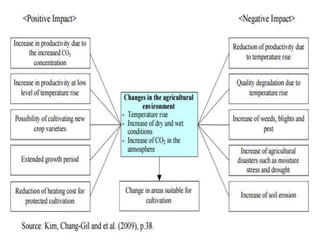
Impact of Climate Change in
Agriculture
CO2
(Sources: USDA Global Change Task Force, 2010; Walthall et al, 2012)
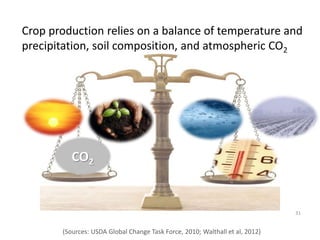
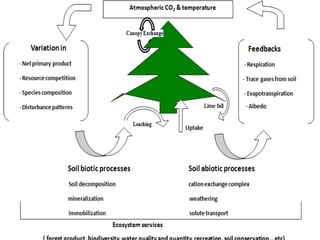
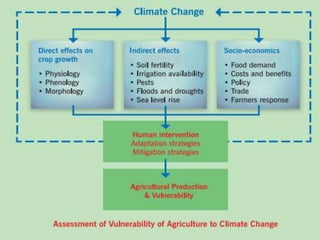
Crop production relies on a balance of temperature and
precipitation, soil composition, and atmospheric CO2
31
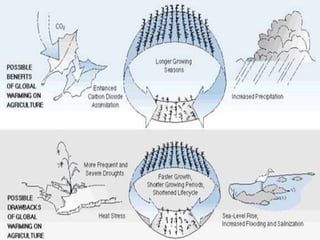
• Warming condition directly effected rate of
plant respiration, photosynthesis and other
biological processes.
• Increase of GHGs from agriculture
• Increase CO2
• Increase CH4
• Increase N2O
(a) It is variable and difficult to mention specific atmospheric
lifetime for CO2, but mostly around 100 years is accepted.
(b) The current level of GHGs in the atmosphere is mentioned
in parts per million (ppm), parts per billion (ppb), and parts
per trillion (ppt).
(c) GWP (Global warming potential) refers to the amount of
heat trapped by GHGs in the atmosphere. For instance
when we say a 100 years GWP of CH4 is 25, we mean that if
we expose the same amount of CH4 and CO2 in the
atmosphere, CH4 will have 25 times higher potential in
trapping heat than CO2 within 100 years interval.
Climate change impact
• Biophysical impact
the physical impacts caused by climate change
directly in physical environment; drought and
flooding, causes an effect on physical environment
a) effects on quality and quantity of crops, pasture,
forest and livestock.
b) Change in natural resources quality and quantity of
soil, land and water resources.
c) Increased weed and insect pest challenges due to
climate change.
d) Shift in spatial and temporal distribution of impacts,
(sea level rise, change in ocean salinity, and sea
temperature rise causing fish to inhabit different ranges).
• Socio economic impacts:
• following the first biophysical impacts on
environment there will be a secondary effect on
socio economic systems.
• E.g. decline in yield and production, reduced
marginal GDP from agriculture sector,
• fluctuation of world market price, change in
geographical distribution of trade regimes,
• due to shortage of food in quality and quantity
the number of people in hunger and risk
increased, and cause migration.
Agriculture in India
• There are two major crop growing season in India
as for climate point of view.
• The summer or ‘kharif’ crop growing season (June–
September) coincides with southwest monsoon.
• Monsoon accounts for more than 50% of the food-
grain production
• 65% of the oilseeds production in the country.
• The winter or ‘rabi’ crop-growing season (October-
November)starts after the summer monsoon,
• The summer monsoon therefore, is responsible for
both kharif and rabi crop production in India.
Change of Monsoon pattern
• There is trend of 0.57◦C increase per hundred years
• Rainfall fluctuations in India with no systematic change
detectable in summer monsoon season.
• Areas of increasing trend in the seasonal rainfall have been
found along the West Coast, North Andhra Pradesh and
Northwest India
• Decreasing trend over East Madhya Pradesh, Orissa and
Northeast India during recent years
• During the years of deficit monsoon (1966, 1972, 1974, 1979,
1982 and 1987) the foodgrain production declined,
• during the years of excess rainfall (1970, 1975, 1978, 1983
and 1988) it was higher.
Trends of change in agriculture
• In India 40% of the total cropped area being irrigated,
• 60% is still rainfed and dependent on uncertainties of
monsoon.
• more nutrients have been removed than added
through the fertilizers,
• farmers have to apply more fertilizers to get the same
yield, they were getting with less fertilizers 20–30 years
ago.
• there is decline in the yield of rice-wheat cropping
system
• more adverse effect in rabi crops than kharif crops by
2050
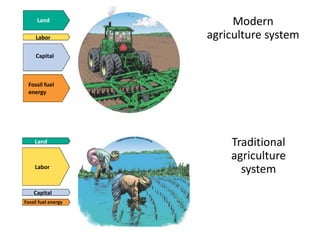
Modern
agriculture system
Traditional
agriculture
system
Land
Labor
Capital
Fossil fuel
energy
Land
Labor
Capital
Fossil fuel energy
Reasons for Crop Increases
• Longer growing season
• Warmer spring soil temperatures
• Modest or no increase in summer daily
maximum temperatures
• Increase in night time temperatures
• Reduced risk of late frost in spring or early
frost in fall
• More freeze-thaw cycles that will recharge soil
moisture in winter
Reasons for Crop Decreases
• More precipitation extremes
– More rain events bring heavy rain
– More droughts
– More floods
• More over-wintering pests
• More pathogens due to higher humidity
• More vigorous weed growth
• More efficient water use => less cooling
Soil Productivity
• Soil temperature influences the rates at which organic matter
decomposes,
• nutrients are released and taken up, and plant metabolic
processes proceed.
• Chemical reactions,occuring within soil are strongly
influenced by increased temperature.
• Soil productivity and nutrient cycling are influenced by the
amount and activity of soil microorganisms.
• Soil microorganisms fulfill two major functions:-
• they act as agents of nutrient element transportation
• store carbon and mineral nutrients in their own living
biomass
• In general, Indian agricultural soils are low in organic carbon
content,
• for achieving higher agricultural production, we depend on
the fertilizers
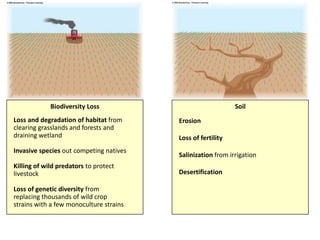
Biodiversity Loss
Loss and degradation of habitat from
clearing grasslands and forests and
draining wetland
Invasive species out competing natives
Killing of wild predators to protect
livestock
Loss of genetic diversity from
replacing thousands of wild crop
strains with a few monoculture strains
Soil
Erosion
Loss of fertility
Salinization from irrigation
Desertification
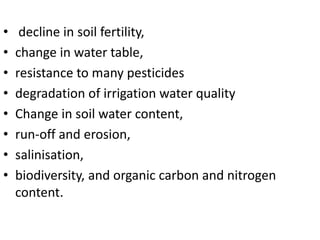
• decline in soil fertility,
• change in water table,
• resistance to many pesticides
• degradation of irrigation water quality
• Change in soil water content,
• run-off and erosion,
• salinisation,
• biodiversity, and organic carbon and nitrogen
content.
• increased evapotranspiration
• reduced crop duration
• increased crop respiration,
• new equilibrium between crops and pests
• hasten nutrient mineralisation in soils,
• decrease fertilizer use efficiency,
• effects on land use pattern due to availability of
irrigation water,
• frequency and intensity of inter- and intra-
seasonal droughts and floods,
Impact on Rice
• The rice blast, caused by Pyricularia grisea, is most
prominent disease across the eco-systems.
• Traditional diseases:
• rice blast,
• brown spot and
• stem rot, were the serious diseases.
• Modern diseases;
• bacterial leaf blight,
• sheath blight,
• sheath rot,
• tungro virus (transmitted by Nephotettix spp.) and
• bacterial leaf streak
List of diseases of wheat
Traditional diseases: stem rot,
• sheath rot
• false smut,
• blast,
• Modern diseases:
• brown spot,
• bacterial leaf blight
• rice tungro virus
Mitigation methods
• adjustment in sowing dates,
• breeding of plants that are more resilient to variability of climate,
• improvement in agronomic practices
• Changes in the cropping sequence
• adaptation by farmers of their cropping patterns and inputs
• need to be identify agroclimatic regions vulnerable to climate
change
• advanced strategies include altered crops and cropping systems
• maintain soil fertility in sustainable manner
• improved management practices.
• Use of modern technologies
• Government to encourage farmers to shift towards newer
technologies.
• The government should also encourage research on developing
crop varieties that can withstand in the climate.
• aerobic degradation through composting or incorporating
into soil during off-season drained period,
• application of fermented manure, like biogas slurry,
reduces the emission of methane
• nitrification inhibitors have been shown to inhibit methane
emission.
• selection of low CH4 emitting rice cultivars,
• small root system,
• high root oxidative activity
• and high harvest index are ideal for mitigating methane
emission from rice fields
References
• Major impacts:Climate change;CRM
• Biodiversity,Ecosystem services and climate
change:Charles Perrings
• FAO report of Food and agriculture
• UNEP report on Climate change