ACLS Rhythms for the ACLS Algorithms
A p p e n d i x 3
253
Posterior division
Anterior division
Purkinje fibers
Sinus node
Bachmann’s bundle
AV node
Bundle
of His
Right bundle
branch
Left bundle
branch
Internodal
pathways
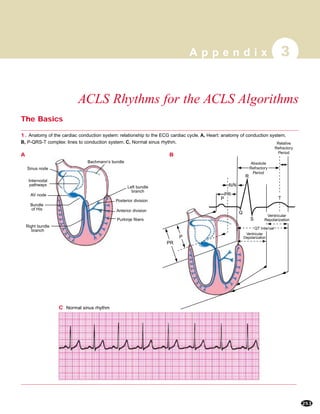
1. Anatomy of the cardiac conduction system: relationship to the ECG cardiac cycle. A, Heart: anatomy of conduction system.
B, P-QRS-T complex: lines to conduction system. C, Normal sinus rhythm.
A
The Basics
B
AVN
P
Q
S
R
Absolute
Refractory
Period
Relative
Refractory
Period
Ventricular
Repolarization
PR
PR
QT Interval
T
Ventricular
DepolarizationP
PR
C Normal sinus rhythm
2. Ventricular Fibrillation/Pulseless Ventricular Tachycardia
Defining Criteria per ECG
Clinical Manifestations s Pulse disappears with onset of VF
s Collapse, unconsciousness
s Agonal breaths ➔ apnea in <5 min
s Onset of reversible death
Common Etiologies s Acute coronary syndromes leading to ischemic areas of myocardium
s Stable-to-unstable VT, untreated
s PVCs with R-on-T phenomenon
s Multiple drug, electrolyte, or acid-base abnormalities that prolong the relative refractory period
s Primary or secondary QT prolongation
s Electrocution, hypoxia, many others
Recommended Therapy
Comprehensive ECC algorithm,
page 10; VF/pulseless VT algo-
rithm, page 77
s Early defibrillation is essential
s Agents given to prolong period of reversible death (oxygen, CPR, intubation, epinephrine,
vasopressin)
s Agents given to prevent refibrillation after a shock causes defibrillation (lidocaine, amiodarone,
procainamide, β-blockers)
s Agents given to adjust metabolic milieu (sodium bicarbonate, magnesium)
254
A p p e n d i x 3
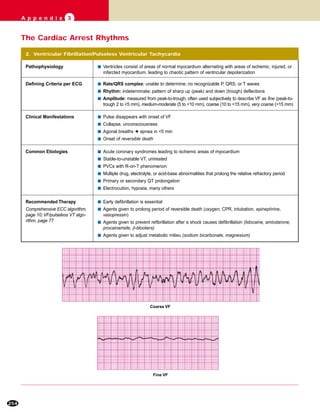
Coarse VF
Fine VF
The Cardiac Arrest Rhythms
Pathophysiology s Ventricles consist of areas of normal myocardium alternating with areas of ischemic, injured, or
infarcted myocardium, leading to chaotic pattern of ventricular depolarization
s Rate/QRS complex: unable to determine; no recognizable P, QRS, or T waves
s Rhythm: indeterminate; pattern of sharp up (peak) and down (trough) deflections
s Amplitude: measured from peak-to-trough; often used subjectively to describe VF as fine (peak-to-
trough 2 to <5 mm), medium-moderate (5 to <10 mm), coarse (10 to <15 mm), very coarse (>15 mm)
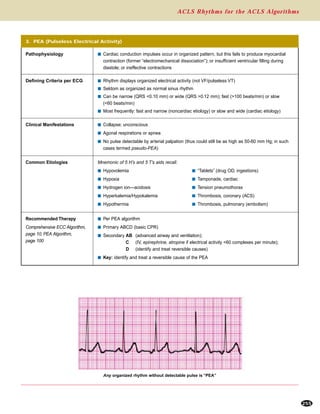
Any organized rhythm without detectable pulse is “PEA”
ACLS Rhythms for the ACLS Algorithms
255
3. PEA (Pulseless Electrical Activity)
Defining Criteria per ECG s Rhythm displays organized electrical activity (not VF/pulseless VT)
s Seldom as organized as normal sinus rhythm
s Can be narrow (QRS <0.10 mm) or wide (QRS >0.12 mm); fast (>100 beats/min) or slow
(<60 beats/min)
s Most frequently: fast and narrow (noncardiac etiology) or slow and wide (cardiac etiology)
Clinical Manifestations s Collapse; unconscious
s Agonal respirations or apnea
s No pulse detectable by arterial palpation (thus could still be as high as 50-60 mm Hg; in such
cases termed pseudo-PEA)
Common Etiologies Mnemonic of 5 H’s and 5 T’s aids recall:
s Hypovolemia s “Tablets” (drug OD, ingestions)
s Hypoxia s Tamponade, cardiac
s Hydrogen ion—acidosis s Tension pneumothorax
s Hyperkalemia/Hypokalemia s Thrombosis, coronary (ACS)
s Hypothermia s Thrombosis, pulmonary (embolism)
Recommended Therapy
Comprehensive ECC Algorithm,
page 10; PEA Algorithm,
page 100
s Per PEA algorithm
s Primary ABCD (basic CPR)
s Secondary AB (advanced airway and ventilation);
C (IV, epinephrine, atropine if electrical activity <60 complexes per minute);
D (identify and treat reversible causes)
s Key: identify and treat a reversible cause of the PEA
Pathophysiology s Cardiac conduction impulses occur in organized pattern, but this fails to produce myocardial
contraction (former “electromechanical dissociation”); or insufficient ventricular filling during
diastole; or ineffective contractions
256
A p p e n d i x 3
4. Asystole
Defining Criteria per ECG
Classically asystole presents
as a “flat line”; any defining
criteria are virtually nonexistent
s Rate: no ventricular activity seen or ≤6/min; so-called “P-wave asystole” occurs with only atrial
impulses present to form P waves
s Rhythm: no ventricular activity seen; or ≤6/min
s PR: cannot be determined; occasionally P wave seen, but by definition R wave must be absent
s QRS complex: no deflections seen that are consistent with a QRS complex
Clinical Manifestations s Early may see agonal respirations; unconscious; unresponsive
s No pulse; no blood pressure
s Cardiac arrest
Common Etiologies s End of life (death)
s Ischemia/hypoxia from many causes
s Acute respiratory failure (no oxygen; apnea; asphyxiation)
s Massive electrical shock: electrocution; lightning strike
s Postdefibrillatory shocks
Recommended Therapy
Comprehensive ECC
Algorithm, page 10; Asystole
Algorithm, page 112
s Always check for DNAR status
s Primary ABCD survey (basic CPR)
s Secondary ABCD survey
Asystole: agonal complexes too slow to make this rhythm “PEA”
ACLS Rhythms for the ACLS Algorithms
257
5. Sinus Tachycardia
Defining Criteria and ECG
Features
s Rate: >100 beats/min
s Rhythm: sinus
s PR: ≤0.20 sec
s QRS complex: normal
Clinical Manifestations s None specific for the tachycardia
s Symptoms may be present due to the cause of the tachycardia (fever, hypovolemia, etc)
Common Etiologies s Normal exercise
s Fever
s Hypovolemia
s Adrenergic stimulation; anxiety
s Hyperthyroidism
Recommended Therapy
No specific treatment for sinus
tachycardia
s Never treat the tachycardia per se
s Treat only the causes of the tachycardia
s Never countershock
Pathophysiology s None—more a physical sign than an arrhythmia or pathologic condition
s Normal impulse formation and conduction
Sinus tachycardia
258
A p p e n d i x 3
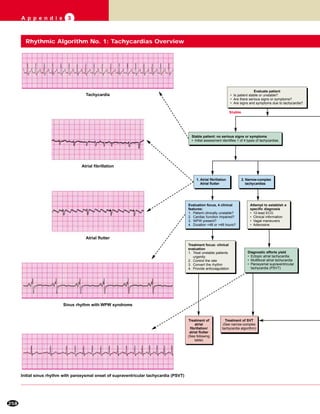
Evaluate patient
• Is patient stable or unstable?
• Are there serious signs or symptoms?
• Are signs and symptoms due to tachycardia?
Stable patient: no serious signs or symptoms
• Initial assessment identifies 1 of 4 types of tachycardias
1. Atrial fibrillation
Atrial flutter
2. Narrow-complex
tachycardias
Attempt to establish a
specific diagnosis
• 12-lead ECG
• Clinical information
• Vagal maneuvers
• Adenosine
Treatment focus: clinical
evaluation
1. Treat unstable patients
urgently
2. Control the rate
3. Convert the rhythm
4. Provide anticoagulation
Diagnostic efforts yield
• Ectopic atrial tachycardia
• Multifocal atrial tachycardia
• Paroxysmal supraventricular
tachycardia (PSVT)
Evaluation focus, 4 clinical
features:
1. Patient clinically unstable?
2. Cardiac function impaired?
3. WPW present?
4. Duration <48 or >48 hours?
Treatment of
atrial
fibrillation/
atrial flutter
(See following
table)
Treatment of SVT
(See narrow-complex
tachycardia algorithm)
Stable
Tachycardia
Atrial fibrillation
Atrial flutter
Sinus rhythm with WPW syndrome
Initial sinus rhythm with paroxysmal onset of supraventricular tachycardia (PSVT)
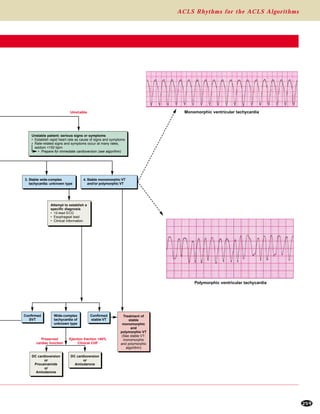
Rhythmic Algorithm No. 1: Tachycardias Overview
ACLS Rhythms for the ACLS Algorithms
259
3. Stable wide-complex
tachycardia: unknown type
DC cardioversion
or
Procainamide
or
Amiodarone
DC cardioversion
or
Amiodarone
4. Stable monomorphic VT
and/or polymorphic VT
Confirmed
SVT
Confirmed
stable VT
Wide-complex
tachycardia of
unknown type
Attempt to establish a
specific diagnosis
• 12-lead ECG
• Esophageal lead
• Clinical information
Treatment of
stable
monomorphic
and
polymorphic VT
(See stable VT:
monomorphic
and polymorphic
algorithm)
Unstable patient: serious signs or symptoms
• Establish rapid heart rate as cause of signs and symptoms
• Rate-related signs and symptoms occur at many rates,
seldom <150 bpm
• Prepare for immediate cardioversion (see algorithm)
Unstable
Preserved
cardiac function
Ejection fraction <40%
Clinical CHF
Monomorphic ventricular tachycardia
Polymorphic ventricular tachycardia
260
A p p e n d i x 3
A
B2 One-Way Block
D2
D3
C3 Slow Conduction
C1
D1
C1B1
C2
Muscle Fiber
Purkinje Fiber
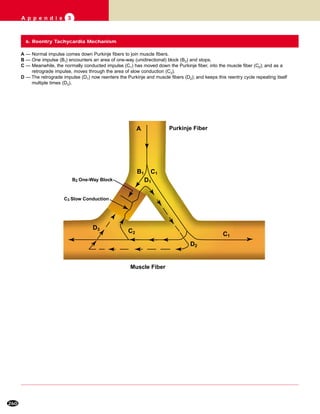
A — Normal impulse comes down Purkinje fibers to join muscle fibers.
B — One impulse (B1) encounters an area of one-way (unidirectional) block (B2) and stops.
C — Meanwhile, the normally conducted impulse (C1) has moved down the Purkinje fiber, into the muscle fiber (C2); and as a
retrograde impulse, moves through the area of slow conduction (C3).
D — The retrograde impulse (D1) now reenters the Purkinje and muscle fibers (D2); and keeps this reentry cycle repeating itself
multiple times (D3).
6. Reentry Tachycardia Mechanism
ACLS Rhythms for the ACLS Algorithms
261
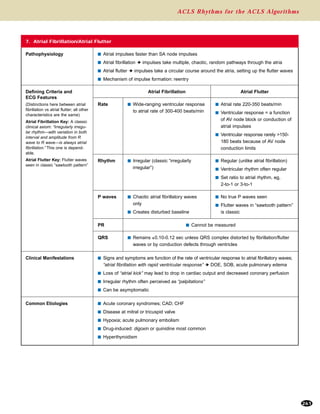
7. Atrial Fibrillation/Atrial Flutter
Rhythm
Pathophysiology s Atrial impulses faster than SA node impulses
s Atrial fibrillation ➔ impulses take multiple, chaotic, random pathways through the atria
s Atrial flutter ➔ impulses take a circular course around the atria, setting up the flutter waves
s Mechanism of impulse formation: reentry
Defining Criteria and
ECG Features
(Distinctions here between atrial
fibrillation vs atrial flutter; all other
characteristics are the same)
Atrial Fibrillation Key: A classic
clinical axiom: “Irregularly irregu-
lar rhythm—with variation in both
interval and amplitude from R
wave to R wave—is always atrial
fibrillation.” This one is depend-
able.
Atrial Flutter Key: Flutter waves
seen in classic “sawtooth pattern”
Rate
Atrial Fibrillation
s Wide-ranging ventricular response
to atrial rate of 300-400 beats/min
Atrial Flutter
s Atrial rate 220-350 beats/min
s Ventricular response = a function
of AV node block or conduction of
atrial impulses
s Ventricular response rarely >150-
180 beats because of AV node
conduction limits
s Irregular (classic “irregularly
irregular”)
s Regular (unlike atrial fibrillation)
s Ventricular rhythm often regular
s Set ratio to atrial rhythm, eg,
2-to-1 or 3-to-1
s Chaotic atrial fibrillatory waves
only
s Creates disturbed baseline
s No true P waves seen
s Flutter waves in “sawtooth pattern”
is classic
s Cannot be measured
Clinical Manifestations s Signs and symptoms are function of the rate of ventricular response to atrial fibrillatory waves;
“atrial fibrillation with rapid ventricular response” ➔ DOE, SOB, acute pulmonary edema
s Loss of “atrial kick” may lead to drop in cardiac output and decreased coronary perfusion
s Irregular rhythm often perceived as “palpitations”
s Can be asymptomatic
s Acute coronary syndromes; CAD; CHF
s Disease at mitral or tricuspid valve
s Hypoxia; acute pulmonary embolism
s Drug-induced: digoxin or quinidine most common
s Hyperthyroidism
Common Etiologies
P waves
PR
QRS s Remains ≤0.10-0.12 sec unless QRS complex distorted by fibrillation/flutter
waves or by conduction defects through ventricles
262
A p p e n d i x 3
Recommended Therapy Control Rate
Evaluation Focus: Treatment Focus:
1. Patient clinically unsta-
ble?
2. Cardiac function
impaired?
3. WPW present?
4. Duration ≤48 or >48 hr?
1. Treat unstable
patients urgently
2. Control the rate
3. Convert the rhythm
4. Provide anticoagulation
Normal Heart Impaired Heart
s Diltiazem or another calcium
channel blocker or meto-
prolol or another β-blocker
s Digoxin or diltiazem or amio-
darone
Impaired Heart
s If ≤48 hours:
— DC Cardioversion or
amiodarone
s If >48 hours:
— Anticoagulate × 3 wk,
then
— DC cardioversion, then
— Anticoagulate × 4 more wk
Normal Heart
7. Atrial Fibrillation/Atrial Flutter (continued)
Atrial fibrillation
Atrial flutter
s If ≤48 hours:
— DC cardioversion or
amiodarone or others
s If >48 hours:
— Anticoagulate × 3 wk, then
— DC cardioversion, then
— Anticoagulate × 4 wk
or
s IV heparin and TEE to rule
out atrial clot, then
s DC cardioversion within
24 hours, then
s Anticoagulation × 4 more wk
TEE indicates transesophageal echocardiogram.
Convert Rhythm
ACLS Rhythms for the ACLS Algorithms
263
8. WPW (Wolff-Parkinson-White) Syndrome
Pathophysiology s The prototypical pre-excitation syndrome: congenital mal-
formation; strands of conducting myocardial tissue between
atria and ventricles
s When persistent after birth strands can form an accessory
pathway (eg, bundle of Kent)
Defining Criteria and ECG Features
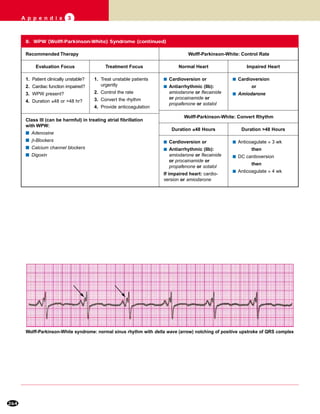
Key: QRS complex is classically distorted by delta wave
(upwards deflection of QRS is slurred)
s Rate: most often 60-100 beats/min as usual rhythm is sinus
s Rhythm: normal sinus except during pre-excitation tachycardia
s PR: shorter since conduction through accessory pathway is
faster than through AV node
s P waves: normal conformation
s QRS complex: classically distorted by delta wave (upwards
deflection of QRS is slurred)
Clinical Manifestations s A person with WPW may never have symptoms
s People with WPW have same annual incidence of atrial
fibrillation as age- and gender-matched population
s Onset of atrial fibrillation for WPW patients, however, poses
risk of rapid ventricular response through the accessory
pathway
s This rapid ventricular response can lead to all signs and
symptoms of stable and unstable tachycardias
Common Etiology s The accessory pathway in WPW is a congenital malformation
264
A p p e n d i x 3
8. WPW (Wolff-Parkinson-White) Syndrome (continued)
Recommended Therapy Wolff-Parkinson-White: Control Rate
Evaluation Focus Treatment Focus
1. Patient clinically unstable?
2. Cardiac function impaired?
3. WPW present?
4. Duration ≤48 or >48 hr?
Class III (can be harmful) in treating atrial fibrillation
with WPW:
s Adenosine
s β-Blockers
s Calcium channel blockers
s Digoxin
1. Treat unstable patients
urgently
2. Control the rate
3. Convert the rhythm
4. Provide anticoagulation
Normal Heart Impaired Heart
s Cardioversion or
s Antiarrhythmic (IIb):
amiodarone or flecainide
or procainamide or
propafenone or sotalol
s Cardioversion
or
s Amiodarone
Wolff-Parkinson-White: Convert Rhythm
Duration >48 HoursDuration ≤48 Hours
s Cardioversion or
s Antiarrhythmic (IIb):
amiodarone or flecainide
or procainamide or
propafenone or sotalol
If impaired heart: cardio-
version or amiodarone
s Anticoagulate × 3 wk
then
s DC cardioversion
then
s Anticoagulate × 4 wk
Wolff-Parkinson-White syndrome: normal sinus rhythm with delta wave (arrow) notching of positive upstroke of QRS complex
ACLS Rhythms for the ACLS Algorithms
265
Common Etiologies
Recommended Therapy
If specific diagnosis unknown,
attempt therapeutic/diagnostic
maneuver with
s Vagal stimulation
s Adenosine . . . THEN
Defining Criteria and
ECG Features
s Key: position of the P wave;
may show antegrade or
retrograde propagation
because origin is at the
junction; may arise before,
after, or with the QRS
9. Junctional Tachycardia
s Rate: 100 -180 beats/min
s Rhythm: regular atrial and ventricular firing
s PR: often not measurable unless P wave comes before QRS; then will be short (<0.12 secs)
s P waves: often obscured; may propagate antegrade or retrograde with origin at the junction;
may arise before, after, or with the QRS
s QRS complex: narrow; ≤0.10 secs in absence of intraventricular conduction defect
Clinical Manifestations s Patients may have clinical signs of a reduced ejection fraction because augmented flow from
atrium is lost
s Symptoms of unstable tachycardia may occur
s Digoxin toxicity
s Acute sequelae of acute coronary syndromes
Preserved heart function:
s β-Blocker
s Calcium channel blocker
s Amiodarone
s NO DC cardioversion!
If impaired heart function:
s Amiodarone
s NO DC cardioversion!
Pathophysiology s Area of automaticity (automatic impulse formation) develops in the AV node (“junction”)
s Both retrograde and antegrade transmission occurs
Junctional tachycardia: narrow QRS complexes at 130 bpm; P waves arise with QRS
266
A p p e n d i x 3
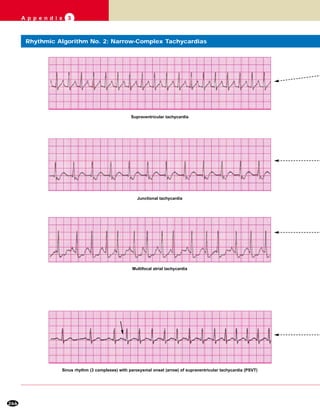
Supraventricular tachycardia
Junctional tachycardia
Multifocal atrial tachycardia
Sinus rhythm (3 complexes) with paroxysmal onset (arrow) of supraventricular tachycardia (PSVT)
Rhythmic Algorithm No. 2: Narrow-Complex Tachycardias
ACLS Rhythms for the ACLS Algorithms
267
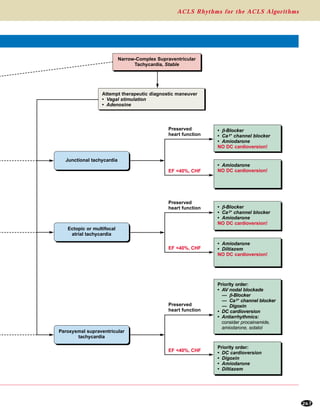
Narrow-Complex Supraventricular
Tachycardia, Stable
Attempt therapeutic diagnostic maneuver
• Vagal stimulation
• Adenosine
Junctional tachycardia
Ectopic or multifocal
atrial tachycardia
• ββ-Blocker
• Ca2+
channel blocker
• Amiodarone
NO DC cardioversion!
• Amiodarone
NO DC cardioversion!
• ββ-Blocker
• Ca2+
channel blocker
• Amiodarone
NO DC cardioversion!
• Amiodarone
• Diltiazem
NO DC cardioversion!
Preserved
heart function
Preserved
heart function
EF <40%, CHF
EF <40%, CHF
Paroxysmal supraventricular
tachycardia
Priority order:
• AV nodal blockade
— ββ-Blocker
— Ca2+
channel blocker
— Digoxin
• DC cardioversion
• Antiarrhythmics:
consider procainamide,
amiodarone, sotalol
Priority order:
• DC cardioversion
• Digoxin
• Amiodarone
• Diltiazem
Preserved
heart function
EF <40%, CHF
268
A p p e n d i x 3
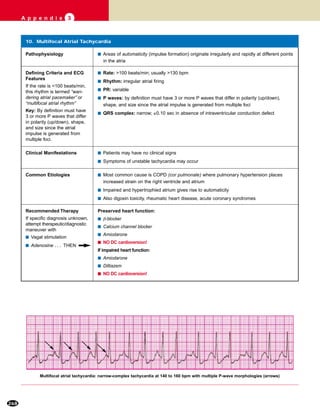
10. Multifocal Atrial Tachycardia
s Rate: >100 beats/min; usually >130 bpm
s Rhythm: irregular atrial firing
s PR: variable
s P waves: by definition must have 3 or more P waves that differ in polarity (up/down),
shape, and size since the atrial impulse is generated from multiple foci
s QRS complex: narrow; ≤0.10 sec in absence of intraventricular conduction defect
Clinical Manifestations s Patients may have no clinical signs
s Symptoms of unstable tachycardia may occur
Common Etiologies s Most common cause is COPD (cor pulmonale) where pulmonary hypertension places
increased strain on the right ventricle and atrium
s Impaired and hypertrophied atrium gives rise to automaticity
s Also digoxin toxicity, rheumatic heart disease, acute coronary syndromes
Recommended Therapy
If specific diagnosis unknown,
attempt therapeutic/diagnostic
maneuver with
s Vagal stimulation
s Adenosine . . . THEN
Preserved heart function:
s β-blocker
s Calcium channel blocker
s Amiodarone
s NO DC cardioversion!
If impaired heart function:
s Amiodarone
s Diltiazem
s NO DC cardioversion!
Pathophysiology s Areas of automaticity (impulse formation) originate irregularly and rapidly at different points
in the atria
Defining Criteria and ECG
Features
If the rate is <100 beats/min,
this rhythm is termed “wan-
dering atrial pacemaker” or
“multifocal atrial rhythm”
Key: By definition must have
3 or more P waves that differ
in polarity (up/down), shape,
and size since the atrial
impulse is generated from
multiple foci.
Multifocal atrial tachycardia: narrow-complex tachycardia at 140 to 160 bpm with multiple P-wave morphologies (arrows)
Defining Criteria and
ECG Features
Key: Regular, narrow-complex
tachycardia without P-waves,
and sudden, paroxysmal
onset or cessation, or both
Note: To merit the diagnosis
some experts require capture
of the paroxysmal onset or
cessation on a monitor strip
11. PSVT (Paroxysmal Supraventricular Tachycardia)
s Rate: exceeds upper limit of sinus tachycardia (>120 beats/min); seldom <150 beats/min;
up to 250 beats/min
s Rhythm: regular
s P waves: seldom seen because rapid rate causes P wave loss in preceding T waves or
because the origin is low in the atrium
s QRS complex: normal, narrow (≤0.10 sec usually)
Clinical Manifestations s Palpitations felt by patient at the paroxysmal onset; becomes anxious, uncomfortable
s Exercise tolerance low with very high rates
s Symptoms of unstable tachycardia may occur
Common Etiologies s Accessory conduction pathway in many PSVT patients
s For such otherwise healthy people many factors can provoke the paroxysm, such as
caffeine, hypoxia, cigarettes, stress, anxiety, sleep deprivation, numerous medications
s Also increased frequency of PSVT in unhealthy patients with CAD, COPD, CHF
Recommended Therapy
If specific diagnosis unknown,
attempt therapeutic/diagnos-
tic maneuver with
s Vagal stimulation
s Adenosine . . . THEN
Preserved heart function:
s AV nodal blockade
— β-Blocker
— Calcium channel blocker
— Digoxin
s DC cardioversion
s Parenteral antiarrhythmics:
— Procainamide
— Amiodarone
— Sotalol (not available in the United States)
Impaired heart function:
s DC cardioversion
s Digoxin
s Amiodarone
s Diltiazem
Pathophysiology s Reentry phenomenon (see page 260): impulses arise and recycle repeatedly in the AV
node because of areas of unidirectional block in the Purkinje fibers
ACLS Rhythms for the ACLS Algorithms
269
Sinus rhythm (3 complexes) with paroxysmal onset (arrow) of supraventricular tachycardia (PSVT)
270
A p p e n d i x 3
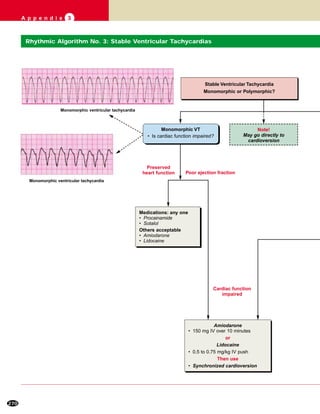
Stable Ventricular Tachycardia
Monomorphic or Polymorphic?
Amiodarone
• 150 mg IV over 10 minutes
or
Lidocaine
• 0.5 to 0.75 mg/kg IV push
Then use
• Synchronized cardioversion
Monomorphic VT
• Is cardiac function impaired?
Medications: any one
• Procainamide
• Sotalol
Others acceptable
• Amiodarone
• Lidocaine
Note!
May go directly to
cardioversion
Poor ejection fraction
Cardiac function
impaired
Preserved
heart function
Monomorphic ventricular tachycardia
Rhythmic Algorithm No. 3: Stable Ventricular Tachycardias
Monomorphic ventricular tachycardia
ACLS Rhythms for the ACLS Algorithms
271
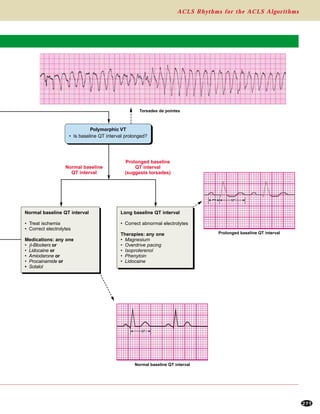
Long baseline QT interval
• Correct abnormal electrolytes
Therapies: any one
• Magnesium
• Overdrive pacing
• Isoproterenol
• Phenytoin
• Lidocaine
Normal baseline QT interval
• Treat ischemia
• Correct electrolytes
Medications: any one
• β-Blockers or
• Lidocaine or
• Amiodarone or
• Procainamide or
• Sotalol
Polymorphic VT
• Is baseline QT interval prolonged?
Normal baseline
QT interval
Prolonged baseline
QT interval
(suggests torsades)
Torsades de pointes
PR QT
Prolonged baseline QT interval
QT
Normal baseline QT interval
272
A p p e n d i x 3
12. Monomorphic Ventricular Tachycardia (Stable)
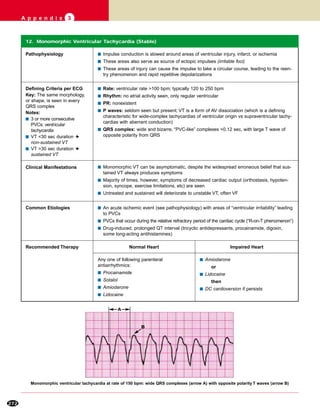
s Rate: ventricular rate >100 bpm; typically 120 to 250 bpm
s Rhythm: no atrial activity seen, only regular ventricular
s PR: nonexistent
s P waves: seldom seen but present; VT is a form of AV dissociation (which is a defining
characteristic for wide-complex tachycardias of ventricular origin vs supraventricular tachy-
cardias with aberrant conduction)
s QRS complex: wide and bizarre, “PVC-like” complexes >0.12 sec, with large T wave of
opposite polarity from QRS
Clinical Manifestations
Common Etiologies s An acute ischemic event (see pathophysiology) with areas of “ventricular irritability” leading
to PVCs
s PVCs that occur during the relative refractory period of the cardiac cycle (“R-on-T phenomenon”)
s Drug-induced, prolonged QT interval (tricyclic antidepressants, procainamide, digoxin,
some long-acting antihistamines)
Recommended Therapy Normal Heart
Pathophysiology s Impulse conduction is slowed around areas of ventricular injury, infarct, or ischemia
s These areas also serve as source of ectopic impulses (irritable foci)
s These areas of injury can cause the impulse to take a circular course, leading to the reen-
try phenomenon and rapid repetitive depolarizations
Impaired Heart
s Amiodarone
or
s Lidocaine
then
s DC cardioversion if persists
Defining Criteria per ECG
Key: The same morphology,
or shape, is seen in every
QRS complex
Notes:
s 3 or more consecutive
PVCs: ventricular
tachycardia
s VT <30 sec duration ➔
non-sustained VT
s VT >30 sec duration ➔
sustained VT
s Monomorphic VT can be asymptomatic, despite the widespread erroneous belief that sus-
tained VT always produces symptoms
s Majority of times, however, symptoms of decreased cardiac output (orthostasis, hypoten-
sion, syncope, exercise limitations, etc) are seen
s Untreated and sustained will deteriorate to unstable VT, often VF
Monomorphic ventricular tachycardia at rate of 150 bpm: wide QRS complexes (arrow A) with opposite polarity T waves (arrow B)
B
A
Any one of following parenteral
antiarrhythmics:
s Procainamide
s Sotalol
s Amiodarone
s Lidocaine
ACLS Rhythms for the ACLS Algorithms
273
13. Polymorphic Ventricular Tachycardia (Stable)
s Rate: ventricular rate >100 bpm; typically 120 to 250
s Rhythm: only regular ventricular
s PR: nonexistent
s P waves: seldom seen but present; VT is a form of AV dissociation
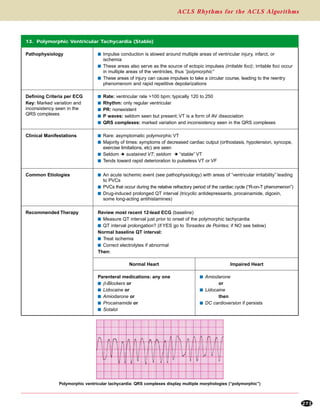
s QRS complexes: marked variation and inconsistency seen in the QRS complexes
Clinical Manifestations
Common Etiologies s An acute ischemic event (see pathophysiology) with areas of “ventricular irritability” leading
to PVCs
s PVCs that occur during the relative refractory period of the cardiac cycle (“R-on-T phenomenon”)
s Drug-induced prolonged QT interval (tricyclic antidepressants, procainamide, digoxin,
some long-acting antihistamines)
Recommended Therapy
Normal Heart
Pathophysiology s Impulse conduction is slowed around multiple areas of ventricular injury, infarct, or
ischemia
s These areas also serve as the source of ectopic impulses (irritable foci); irritable foci occur
in multiple areas of the ventricles, thus “polymorphic”
s These areas of injury can cause impulses to take a circular course, leading to the reentry
phenomenom and rapid repetitive depolarizations
Impaired Heart
Parenteral medications: any one
s β-Blockers or
s Lidocaine or
s Amiodarone or
s Procainamide or
s Sotalol
s Amiodarone
or
s Lidocaine
then
s DC cardioversion if persists
Defining Criteria per ECG
Key: Marked variation and
inconsistency seen in the
QRS complexes
s Rare: asymptomatic polymorphic VT
s Majority of times: symptoms of decreased cardiac output (orthostasis, hypotension, syncope,
exercise limitations, etc) are seen
s Seldom ➔ sustained VT; seldom ➔ “stable” VT
s Tends toward rapid deterioration to pulseless VT or VF
Review most recent 12-lead ECG (baseline)
s Measure QT interval just prior to onset of the polymorphic tachycardia
s QT interval prolongation? (if YES go to Torsades de Pointes; if NO see below)
Normal baseline QT interval:
s Treat ischemia
s Correct electrolytes if abnormal
Then:
Polymorphic ventricular tachycardia: QRS complexes display multiple morphologies (“polymorphic”)
274
A p p e n d i x 3
14. Torsades de Pointes (a Unique Subtype of Polymorphic Ventricular Tachycardia)
s Atrial Rate: cannot determine atrial rate
s Ventricular rate: 150-250 complexes/min
s Rhythm: only irregular ventricular rhythm
s PR: nonexistent
s P waves: nonexistent
s QRS complexes: display classic “spindle-node” pattern (see left column: “Key”)
Clinical Manifestations
Common Etiologies Most commonly occurs with prolonged QT interval, from many causes:
s Drug-induced: tricyclic antidepressants, procainamide, digoxin, some long-acting antihistamines
s Electrolyte and metabolic alterations (hypomagnesemia is the prototype)
s Inherited forms of long QT syndrome
s Acute ischemic events (see pathophysiology)
Recommended Therapy
Pathophysiology Specific pathophysiology for classic torsades:
s QT interval is abnormally long (see below for etiology of QT prolongation)
s Leads to increase in the relative refractory period (“vulnerable period”) of the cardiac cycle
s Increases probability that an irritable focus (PVC) will occur on the T-wave (“vulnerable
period” or “R-on-T phenomenon”)
s R-on-T phenomenon often induces VT
s Majority of times patients with torsades have symptoms of decreased cardiac output
(orthostasis, hypotension, syncope, exercise limitations, etc)
s Asymptomatic torsades, sustained torsades, or “stable” torsades is uncommon
s Tends toward sudden deterioration to pulseless VT or VF
Review most recent 12-lead ECG (baseline):
s Measure QT interval just before onset of the polymorphic tachycardia
s QT interval prolongation? (if YES see below; if NO go to the polymorphic VT algorithm)
Long baseline QT interval:
s Treat ischemia
s Correct electrolytes if abnormal
Then therapies (any one):
s Magnesium
s Overdrive pacing
s Isoproterenol (pharmacologic overdrive pacing)
s Phenytoin
s Lidocaine
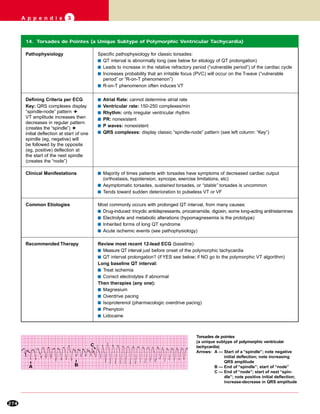
Defining Criteria per ECG
Key: QRS complexes display
“spindle-node” pattern ➔
VT amplitude increases then
decreases in regular pattern
(creates the “spindle”) ➔
initial deflection at start of one
spindle (eg, negative) will
be followed by the opposite
(eg, positive) deflection at
the start of the next spindle
(creates the “node”)
Torsades de pointes
(a unique subtype of polymorphic ventricular
tachycardia)
Arrows: A — Start of a “spindle”; note negative
initial deflection; note increasing
QRS amplitude
B — End of “spindle”; start of “node”
C — End of “node”; start of next “spin-
dle”; note positive initial deflection;
increase-decrease in QRS amplitude
A B
C
ACLS Rhythms for the ACLS Algorithms
275
QT
PR QT
15. Normal and Prolonged Baseline QT Interval
Normal baseline QT interval
Rate: 80 bpm
QT interval: 0.36 sec
(within QTc range of 0.32 – 0.39 sec
for a heart rate of 80 bpm)
Prolonged baseline QT interval
Due to drug toxicity
PR interval: >0.20 sec
Rate: 80 bpm
QT interval: prolonged, 0.45 sec
(above QTc range of 0.32 – 0.39 sec
for a heart rate of 80 bpm)
QRS complex: widened, >0.12 sec
276
A p p e n d i x 3
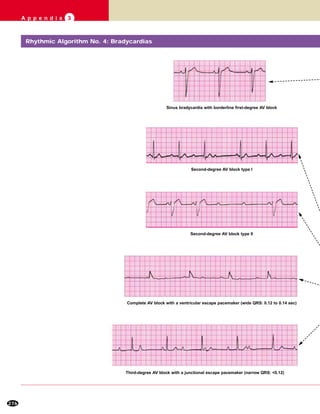
Sinus bradycardia with borderline first-degree AV block
Second-degree AV block type I
Second-degree AV block type II
Complete AV block with a ventricular escape pacemaker (wide QRS: 0.12 to 0.14 sec)
Third-degree AV block with a junctional escape pacemaker (narrow QRS: <0.12)
Rhythmic Algorithm No. 4: Bradycardias
ACLS Rhythms for the ACLS Algorithms
277
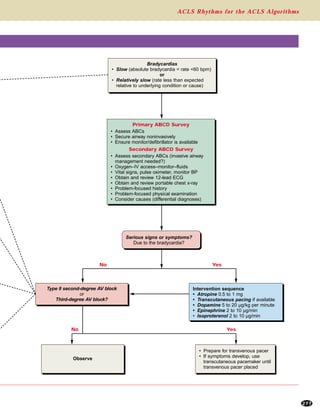
Intervention sequence
• Atropine 0.5 to 1 mg
• Transcutaneous pacing if available
• Dopamine 5 to 20 µg/kg per minute
• Epinephrine 2 to 10 µg/min
• Isoproterenol 2 to 10 µg/min
Observe
• Prepare for transvenous pacer
• If symptoms develop, use
transcutaneous pacemaker until
transvenous pacer placed
No Yes
YesNo
Type II second-degree AV block
or
Third-degree AV block?
Primary ABCD Survey
• Assess ABCs
• Secure airway noninvasively
• Ensure monitor/defibrillator is available
Secondary ABCD Survey
• Assess secondary ABCs (invasive airway
management needed?)
• Oxygen–IV access–monitor–fluids
• Vital signs, pulse oximeter, monitor BP
• Obtain and review 12-lead ECG
• Obtain and review portable chest x-ray
• Problem-focused history
• Problem-focused physical examination
• Consider causes (differential diagnoses)
Bradycardias
• Slow (absolute bradycardia = rate <60 bpm)
or
• Relatively slow (rate less than expected
relative to underlying condition or cause)
Serious signs or symptoms?
Due to the bradycardia?
278
A p p e n d i x 3
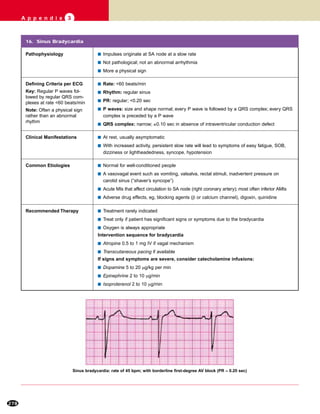
16. Sinus Bradycardia
s Rate: <60 beats/min
s Rhythm: regular sinus
s PR: regular; <0.20 sec
s P waves: size and shape normal; every P wave is followed by a QRS complex; every QRS
complex is preceded by a P wave
s QRS complex: narrow; ≤0.10 sec in absence of intraventricular conduction defect
Clinical Manifestations
Common Etiologies s Normal for well-conditioned people
s A vasovagal event such as vomiting, valsalva, rectal stimuli, inadvertent pressure on
carotid sinus (“shaver’s syncope”)
s Acute MIs that affect circulation to SA node (right coronary artery); most often inferior AMIs
s Adverse drug effects, eg, blocking agents (β or calcium channel), digoxin, quinidine
Recommended Therapy
Pathophysiology s Impulses originate at SA node at a slow rate
s Not pathological; not an abnormal arrhythmia
s More a physical sign
s At rest, usually asymptomatic
s With increased activity, persistent slow rate will lead to symptoms of easy fatigue, SOB,
dizziness or lightheadedness, syncope, hypotension
s Treatment rarely indicated
s Treat only if patient has significant signs or symptoms due to the bradycardia
s Oxygen is always appropriate
Intervention sequence for bradycardia
s Atropine 0.5 to 1 mg IV if vagal mechanism
s Transcutaneous pacing if available
If signs and symptoms are severe, consider catecholamine infusions:
s Dopamine 5 to 20 µg/kg per min
s Epinephrine 2 to 10 µg/min
s Isoproterenol 2 to 10 µg/min
Defining Criteria per ECG
Key: Regular P waves fol-
lowed by regular QRS com-
plexes at rate <60 beats/min
Note: Often a physical sign
rather than an abnormal
rhythm
Sinus bradycardia: rate of 45 bpm; with borderline first-degree AV block (PR ≈ 0.20 sec)
ACLS Rhythms for the ACLS Algorithms
279
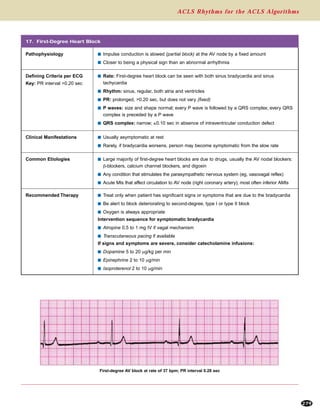
17. First-Degree Heart Block
s Rate: First-degree heart block can be seen with both sinus bradycardia and sinus
tachycardia
s Rhythm: sinus, regular, both atria and ventricles
s PR: prolonged, >0.20 sec, but does not vary (fixed)
s P waves: size and shape normal; every P wave is followed by a QRS complex; every QRS
complex is preceded by a P wave
s QRS complex: narrow; ≤0.10 sec in absence of intraventricular conduction defect
Clinical Manifestations
Common Etiologies s Large majority of first-degree heart blocks are due to drugs, usually the AV nodal blockers:
β-blockers, calcium channel blockers, and digoxin
s Any condition that stimulates the parasympathetic nervous system (eg, vasovagal reflex)
s Acute MIs that affect circulation to AV node (right coronary artery); most often inferior AMIs
Recommended Therapy
Pathophysiology s Impulse conduction is slowed (partial block) at the AV node by a fixed amount
s Closer to being a physical sign than an abnormal arrhythmia
s Usually asymptomatic at rest
s Rarely, if bradycardia worsens, person may become symptomatic from the slow rate
s Treat only when patient has significant signs or symptoms that are due to the bradycardia
s Be alert to block deteriorating to second-degree, type I or type II block
s Oxygen is always appropriate
Intervention sequence for symptomatic bradycardia
s Atropine 0.5 to 1 mg IV if vagal mechanism
s Transcutaneous pacing if available
If signs and symptoms are severe, consider catecholamine infusions:
s Dopamine 5 to 20 µg/kg per min
s Epinephrine 2 to 10 µg/min
s Isoproterenol 2 to 10 µg/min
Defining Criteria per ECG
Key: PR interval >0.20 sec
First-degree AV block at rate of 37 bpm; PR interval 0.28 sec
280
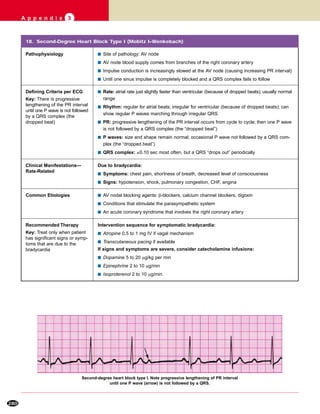
A p p e n d i x 3
18. Second-Degree Heart Block Type I (Mobitz I–Wenkebach)
s Rate: atrial rate just slightly faster than ventricular (because of dropped beats); usually normal
range
s Rhythm: regular for atrial beats; irregular for ventricular (because of dropped beats); can
show regular P waves marching through irregular QRS
s PR: progressive lengthening of the PR interval occurs from cycle to cycle; then one P wave
is not followed by a QRS complex (the “dropped beat”)
s P waves: size and shape remain normal; occasional P wave not followed by a QRS com-
plex (the “dropped beat”)
s QRS complex: ≤0.10 sec most often, but a QRS “drops out” periodically
Clinical Manifestations—
Rate-Related
Common Etiologies s AV nodal blocking agents: β-blockers, calcium channel blockers, digoxin
s Conditions that stimulate the parasympathetic system
s An acute coronary syndrome that involves the right coronary artery
Recommended Therapy
Key: Treat only when patient
has significant signs or symp-
toms that are due to the
bradycardia
Pathophysiology s Site of pathology: AV node
s AV node blood supply comes from branches of the right coronary artery
s Impulse conduction is increasingly slowed at the AV node (causing increasing PR interval)
s Until one sinus impulse is completely blocked and a QRS complex fails to follow
Due to bradycardia:
s Symptoms: chest pain, shortness of breath, decreased level of consciousness
s Signs: hypotension, shock, pulmonary congestion, CHF, angina
Intervention sequence for symptomatic bradycardia:
s Atropine 0.5 to 1 mg IV if vagal mechanism
s Transcutaneous pacing if available
If signs and symptoms are severe, consider catecholamine infusions:
s Dopamine 5 to 20 µg/kg per min
s Epinephrine 2 to 10 µg/min
s Isoproterenol 2 to 10 µg/min
Defining Criteria per ECG
Key: There is progressive
lengthening of the PR interval
until one P wave is not followed
by a QRS complex (the
dropped beat)
Second-degree heart block type I. Note progressive lengthening of PR interval
until one P wave (arrow) is not followed by a QRS.
ACLS Rhythms for the ACLS Algorithms
281
s Atrial Rate: usually 60-100 beats/min
s Ventricular rate: by definition (due to the blocked impulses) slower than atrial rate
s Rhythm: atrial = regular; ventricular = irregular (because of blocked impulses)
s PR: constant and set; no progressive prolongation as with type I—a distinguishing charac-
teristic.
s P waves: typical in size and shape; by definition some P waves will not be followed by a
QRS complex
s QRS complex: narrow (≤0.10 sec) implies high block relative to the AV node; wide
(>0.12 sec) implies low block relative to the AV node
s An acute coronary syndrome that involves branches of the left coronary artery
s The pathology, ie, the site of the block, is most often below the AV node (infranodal); at the
bundle of His (infrequent) or at the bundle branches
s Impulse conduction is normal through the node, thus no first-degree block and no prior PR
prolongation
Due to bradycardia:
s Symptoms: chest pain, shortness of breath, decreased level of consciousness
s Signs: hypotension, shock, pulmonary congestions, CHF, acute MI
Intervention sequence for bradycardia due to type II second-degree or third-degree
heart block:
s Prepare for transvenous pacer
s Atropine is seldom effective for infranodal block
s Use transcutaneous pacing if available as a bridge to transvenous pacing (verify patient
tolerance and mechanical capture. Use sedation and analgesia as needed.)
If signs/symptoms are severe and unresponsive to TCP, and transvenous pacing is
delayed, consider catecholamine infusions:
s Dopamine 5 to 20 µg/kg per min
s Epinephrine 2 to 10 µg/min
s Isoproterenol 2 to 10 µg/min
19. Second-Degree Heart Block Type II (Infranodal) (Mobitz II–Non-Wenkebach)
Clinical Manifestations—
Rate-Related
Common Etiologies
Recommended Therapy
Pearl: New onset type II
second-degree heart block in
clinical context of acute coro-
nary syndrome is indication
for transvenous pacemaker
insertion
Pathophysiology
Defining Criteria per ECG
Type II (high block): regular PR-QRS intervals until 2 dropped beats occur; borderline normal QRS complexes indicate high nodal or nodal block
Type II (low block): regular PR-QRS intervals until dropped beats; wide QRS complexes indicate infranodal block
282
A p p e n d i x 3
Defining Criteria per ECG
Key: The third-degree block
(see pathophysiology) causes
the atria and ventricles to
depolarize independently,
with no relationship between
the two (AV dissociation)
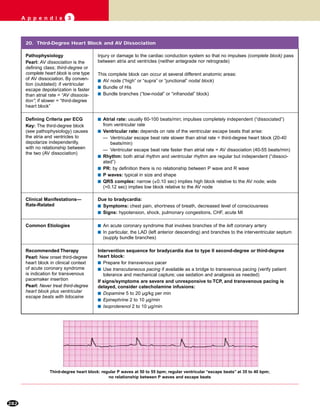
s Atrial rate: usually 60-100 beats/min; impulses completely independent (“dissociated”)
from ventricular rate
s Ventricular rate: depends on rate of the ventricular escape beats that arise:
— Ventricular escape beat rate slower than atrial rate = third-degree heart block (20-40
beats/min)
— Ventricular escape beat rate faster than atrial rate = AV dissociation (40-55 beats/min)
s Rhythm: both atrial rhythm and ventricular rhythm are regular but independent (“dissoci-
ated”)
s PR: by definition there is no relationship between P wave and R wave
s P waves: typical in size and shape
s QRS complex: narrow (≤0.10 sec) implies high block relative to the AV node; wide
(>0.12 sec) implies low block relative to the AV node
s An acute coronary syndrome that involves branches of the left coronary artery
s In particular, the LAD (left anterior descending) and branches to the interventricular septum
(supply bundle branches)
Injury or damage to the cardiac conduction system so that no impulses (complete block) pass
between atria and ventricles (neither antegrade nor retrograde)
This complete block can occur at several different anatomic areas:
s AV node (“high” or “supra” or “junctional” nodal block)
s Bundle of His
s Bundle branches (“low-nodal” or “infranodal” block)
Due to bradycardia:
s Symptoms: chest pain, shortness of breath, decreased level of consciousness
s Signs: hypotension, shock, pulmonary congestions, CHF, acute MI
Intervention sequence for bradycardia due to type II second-degree or third-degree
heart block:
s Prepare for transvenous pacer
s Use transcutaneous pacing if available as a bridge to transvenous pacing (verify patient
tolerance and mechanical capture; use sedation and analgesia as needed)
If signs/symptoms are severe and unresponsive to TCP, and transvenous pacing is
delayed, consider catecholamine infusions:
s Dopamine 5 to 20 µg/kg per min
s Epinephrine 2 to 10 µg/min
s Isoproterenol 2 to 10 µg/min
20. Third-Degree Heart Block and AV Dissociation
Clinical Manifestations—
Rate-Related
Common Etiologies
Recommended Therapy
Pearl: New onset third-degree
heart block in clinical context
of acute coronary syndrome
is indication for transvenous
pacemaker insertion
Pearl: Never treat third-degree
heart block plus ventricular
escape beats with lidocaine
Pathophysiology
Pearl: AV dissociation is the
defining class; third-degree or
complete heart block is one type
of AV dissociation. By conven-
tion (outdated): if ventricular
escape depolarization is faster
than atrial rate = “AV dissocia-
tion”; if slower = “third-degree
heart block”
Third-degree heart block: regular P waves at 50 to 55 bpm; regular ventricular “escape beats” at 35 to 40 bpm;
no relationship between P waves and escape beats
ACLS Rhythms for the ACLS Algorithms
283
C. Pacing current turned
up above threshold
(60 mA at 71 beats/min)
and “captures” the
myocardium
A. Bradycardia (third-degree
heart block): no pacing
(Note: Rates and intervals
slightly altered due to
monitor compensation for
pacing stimulus)
B. Transcutaneous pacing
initiated at low current
(35 mA) and slow rate
(50 beats/min).
Below the threshold
current needed to stimu-
late the myocardium
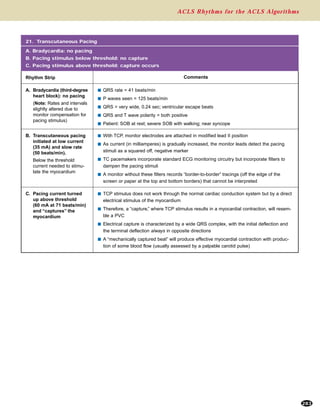
21. Transcutaneous Pacing
A. Bradycardia: no pacing
B. Pacing stimulus below threshold: no capture
C. Pacing stimulus above threshold: capture occurs
s With TCP, monitor electrodes are attached in modified lead II position
s As current (in milliamperes) is gradually increased, the monitor leads detect the pacing
stimuli as a squared off, negative marker
s TC pacemakers incorporate standard ECG monitoring circuitry but incorporate filters to
dampen the pacing stimuli
s A monitor without these filters records “border-to-border” tracings (off the edge of the
screen or paper at the top and bottom borders) that cannot be interpreted
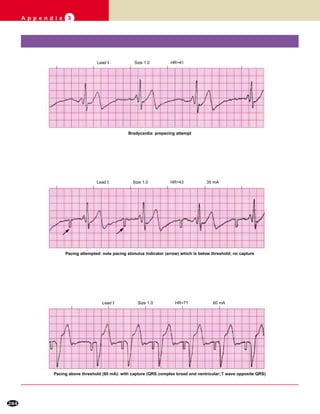
s QRS rate = 41 beats/min
s P waves seen = 125 beats/min
s QRS = very wide, 0.24 sec; ventricular escape beats
s QRS and T wave polarity = both positive
s Patient: SOB at rest; severe SOB with walking; near syncope
s TCP stimulus does not work through the normal cardiac conduction system but by a direct
electrical stimulus of the myocardium
s Therefore, a “capture,” where TCP stimulus results in a myocardial contraction, will resem-
ble a PVC
s Electrical capture is characterized by a wide QRS complex, with the initial deflection and
the terminal deflection always in opposite directions
s A “mechanically captured beat” will produce effective myocardial contraction with produc-
tion of some blood flow (usually assessed by a palpable carotid pulse)
Rhythm Strip Comments
284
A p p e n d i x 3
Lead I Size 1.0 HR=41
Lead I Size 1.0 HR=43 35 mA
Lead I Size 1.0 HR=71 60 mA
Bradycardia: prepacing attempt
Pacing attempted: note pacing stimulus indicator (arrow) which is below threshold; no capture
Pacing above threshold (60 mA): with capture (QRS complex broad and ventricular; T wave opposite QRS)

Ecg for acls

  • 1.
    ACLS Rhythms forthe ACLS Algorithms A p p e n d i x 3 253 Posterior division Anterior division Purkinje fibers Sinus node Bachmann’s bundle AV node Bundle of His Right bundle branch Left bundle branch Internodal pathways 1. Anatomy of the cardiac conduction system: relationship to the ECG cardiac cycle. A, Heart: anatomy of conduction system. B, P-QRS-T complex: lines to conduction system. C, Normal sinus rhythm. A The Basics B AVN P Q S R Absolute Refractory Period Relative Refractory Period Ventricular Repolarization PR PR QT Interval T Ventricular DepolarizationP PR C Normal sinus rhythm
  • 2.
    2. Ventricular Fibrillation/PulselessVentricular Tachycardia Defining Criteria per ECG Clinical Manifestations s Pulse disappears with onset of VF s Collapse, unconsciousness s Agonal breaths ➔ apnea in <5 min s Onset of reversible death Common Etiologies s Acute coronary syndromes leading to ischemic areas of myocardium s Stable-to-unstable VT, untreated s PVCs with R-on-T phenomenon s Multiple drug, electrolyte, or acid-base abnormalities that prolong the relative refractory period s Primary or secondary QT prolongation s Electrocution, hypoxia, many others Recommended Therapy Comprehensive ECC algorithm, page 10; VF/pulseless VT algo- rithm, page 77 s Early defibrillation is essential s Agents given to prolong period of reversible death (oxygen, CPR, intubation, epinephrine, vasopressin) s Agents given to prevent refibrillation after a shock causes defibrillation (lidocaine, amiodarone, procainamide, β-blockers) s Agents given to adjust metabolic milieu (sodium bicarbonate, magnesium) 254 A p p e n d i x 3 Coarse VF Fine VF The Cardiac Arrest Rhythms Pathophysiology s Ventricles consist of areas of normal myocardium alternating with areas of ischemic, injured, or infarcted myocardium, leading to chaotic pattern of ventricular depolarization s Rate/QRS complex: unable to determine; no recognizable P, QRS, or T waves s Rhythm: indeterminate; pattern of sharp up (peak) and down (trough) deflections s Amplitude: measured from peak-to-trough; often used subjectively to describe VF as fine (peak-to- trough 2 to <5 mm), medium-moderate (5 to <10 mm), coarse (10 to <15 mm), very coarse (>15 mm)
  • 3.
    Any organized rhythmwithout detectable pulse is “PEA” ACLS Rhythms for the ACLS Algorithms 255 3. PEA (Pulseless Electrical Activity) Defining Criteria per ECG s Rhythm displays organized electrical activity (not VF/pulseless VT) s Seldom as organized as normal sinus rhythm s Can be narrow (QRS <0.10 mm) or wide (QRS >0.12 mm); fast (>100 beats/min) or slow (<60 beats/min) s Most frequently: fast and narrow (noncardiac etiology) or slow and wide (cardiac etiology) Clinical Manifestations s Collapse; unconscious s Agonal respirations or apnea s No pulse detectable by arterial palpation (thus could still be as high as 50-60 mm Hg; in such cases termed pseudo-PEA) Common Etiologies Mnemonic of 5 H’s and 5 T’s aids recall: s Hypovolemia s “Tablets” (drug OD, ingestions) s Hypoxia s Tamponade, cardiac s Hydrogen ion—acidosis s Tension pneumothorax s Hyperkalemia/Hypokalemia s Thrombosis, coronary (ACS) s Hypothermia s Thrombosis, pulmonary (embolism) Recommended Therapy Comprehensive ECC Algorithm, page 10; PEA Algorithm, page 100 s Per PEA algorithm s Primary ABCD (basic CPR) s Secondary AB (advanced airway and ventilation); C (IV, epinephrine, atropine if electrical activity <60 complexes per minute); D (identify and treat reversible causes) s Key: identify and treat a reversible cause of the PEA Pathophysiology s Cardiac conduction impulses occur in organized pattern, but this fails to produce myocardial contraction (former “electromechanical dissociation”); or insufficient ventricular filling during diastole; or ineffective contractions
  • 4.
    256 A p pe n d i x 3 4. Asystole Defining Criteria per ECG Classically asystole presents as a “flat line”; any defining criteria are virtually nonexistent s Rate: no ventricular activity seen or ≤6/min; so-called “P-wave asystole” occurs with only atrial impulses present to form P waves s Rhythm: no ventricular activity seen; or ≤6/min s PR: cannot be determined; occasionally P wave seen, but by definition R wave must be absent s QRS complex: no deflections seen that are consistent with a QRS complex Clinical Manifestations s Early may see agonal respirations; unconscious; unresponsive s No pulse; no blood pressure s Cardiac arrest Common Etiologies s End of life (death) s Ischemia/hypoxia from many causes s Acute respiratory failure (no oxygen; apnea; asphyxiation) s Massive electrical shock: electrocution; lightning strike s Postdefibrillatory shocks Recommended Therapy Comprehensive ECC Algorithm, page 10; Asystole Algorithm, page 112 s Always check for DNAR status s Primary ABCD survey (basic CPR) s Secondary ABCD survey Asystole: agonal complexes too slow to make this rhythm “PEA”
  • 5.
    ACLS Rhythms forthe ACLS Algorithms 257 5. Sinus Tachycardia Defining Criteria and ECG Features s Rate: >100 beats/min s Rhythm: sinus s PR: ≤0.20 sec s QRS complex: normal Clinical Manifestations s None specific for the tachycardia s Symptoms may be present due to the cause of the tachycardia (fever, hypovolemia, etc) Common Etiologies s Normal exercise s Fever s Hypovolemia s Adrenergic stimulation; anxiety s Hyperthyroidism Recommended Therapy No specific treatment for sinus tachycardia s Never treat the tachycardia per se s Treat only the causes of the tachycardia s Never countershock Pathophysiology s None—more a physical sign than an arrhythmia or pathologic condition s Normal impulse formation and conduction Sinus tachycardia
  • 6.
    258 A p pe n d i x 3 Evaluate patient • Is patient stable or unstable? • Are there serious signs or symptoms? • Are signs and symptoms due to tachycardia? Stable patient: no serious signs or symptoms • Initial assessment identifies 1 of 4 types of tachycardias 1. Atrial fibrillation Atrial flutter 2. Narrow-complex tachycardias Attempt to establish a specific diagnosis • 12-lead ECG • Clinical information • Vagal maneuvers • Adenosine Treatment focus: clinical evaluation 1. Treat unstable patients urgently 2. Control the rate 3. Convert the rhythm 4. Provide anticoagulation Diagnostic efforts yield • Ectopic atrial tachycardia • Multifocal atrial tachycardia • Paroxysmal supraventricular tachycardia (PSVT) Evaluation focus, 4 clinical features: 1. Patient clinically unstable? 2. Cardiac function impaired? 3. WPW present? 4. Duration <48 or >48 hours? Treatment of atrial fibrillation/ atrial flutter (See following table) Treatment of SVT (See narrow-complex tachycardia algorithm) Stable Tachycardia Atrial fibrillation Atrial flutter Sinus rhythm with WPW syndrome Initial sinus rhythm with paroxysmal onset of supraventricular tachycardia (PSVT) Rhythmic Algorithm No. 1: Tachycardias Overview
  • 7.
    ACLS Rhythms forthe ACLS Algorithms 259 3. Stable wide-complex tachycardia: unknown type DC cardioversion or Procainamide or Amiodarone DC cardioversion or Amiodarone 4. Stable monomorphic VT and/or polymorphic VT Confirmed SVT Confirmed stable VT Wide-complex tachycardia of unknown type Attempt to establish a specific diagnosis • 12-lead ECG • Esophageal lead • Clinical information Treatment of stable monomorphic and polymorphic VT (See stable VT: monomorphic and polymorphic algorithm) Unstable patient: serious signs or symptoms • Establish rapid heart rate as cause of signs and symptoms • Rate-related signs and symptoms occur at many rates, seldom <150 bpm • Prepare for immediate cardioversion (see algorithm) Unstable Preserved cardiac function Ejection fraction <40% Clinical CHF Monomorphic ventricular tachycardia Polymorphic ventricular tachycardia
  • 8.
    260 A p pe n d i x 3 A B2 One-Way Block D2 D3 C3 Slow Conduction C1 D1 C1B1 C2 Muscle Fiber Purkinje Fiber A — Normal impulse comes down Purkinje fibers to join muscle fibers. B — One impulse (B1) encounters an area of one-way (unidirectional) block (B2) and stops. C — Meanwhile, the normally conducted impulse (C1) has moved down the Purkinje fiber, into the muscle fiber (C2); and as a retrograde impulse, moves through the area of slow conduction (C3). D — The retrograde impulse (D1) now reenters the Purkinje and muscle fibers (D2); and keeps this reentry cycle repeating itself multiple times (D3). 6. Reentry Tachycardia Mechanism
  • 9.
    ACLS Rhythms forthe ACLS Algorithms 261 7. Atrial Fibrillation/Atrial Flutter Rhythm Pathophysiology s Atrial impulses faster than SA node impulses s Atrial fibrillation ➔ impulses take multiple, chaotic, random pathways through the atria s Atrial flutter ➔ impulses take a circular course around the atria, setting up the flutter waves s Mechanism of impulse formation: reentry Defining Criteria and ECG Features (Distinctions here between atrial fibrillation vs atrial flutter; all other characteristics are the same) Atrial Fibrillation Key: A classic clinical axiom: “Irregularly irregu- lar rhythm—with variation in both interval and amplitude from R wave to R wave—is always atrial fibrillation.” This one is depend- able. Atrial Flutter Key: Flutter waves seen in classic “sawtooth pattern” Rate Atrial Fibrillation s Wide-ranging ventricular response to atrial rate of 300-400 beats/min Atrial Flutter s Atrial rate 220-350 beats/min s Ventricular response = a function of AV node block or conduction of atrial impulses s Ventricular response rarely >150- 180 beats because of AV node conduction limits s Irregular (classic “irregularly irregular”) s Regular (unlike atrial fibrillation) s Ventricular rhythm often regular s Set ratio to atrial rhythm, eg, 2-to-1 or 3-to-1 s Chaotic atrial fibrillatory waves only s Creates disturbed baseline s No true P waves seen s Flutter waves in “sawtooth pattern” is classic s Cannot be measured Clinical Manifestations s Signs and symptoms are function of the rate of ventricular response to atrial fibrillatory waves; “atrial fibrillation with rapid ventricular response” ➔ DOE, SOB, acute pulmonary edema s Loss of “atrial kick” may lead to drop in cardiac output and decreased coronary perfusion s Irregular rhythm often perceived as “palpitations” s Can be asymptomatic s Acute coronary syndromes; CAD; CHF s Disease at mitral or tricuspid valve s Hypoxia; acute pulmonary embolism s Drug-induced: digoxin or quinidine most common s Hyperthyroidism Common Etiologies P waves PR QRS s Remains ≤0.10-0.12 sec unless QRS complex distorted by fibrillation/flutter waves or by conduction defects through ventricles
  • 10.
    262 A p pe n d i x 3 Recommended Therapy Control Rate Evaluation Focus: Treatment Focus: 1. Patient clinically unsta- ble? 2. Cardiac function impaired? 3. WPW present? 4. Duration ≤48 or >48 hr? 1. Treat unstable patients urgently 2. Control the rate 3. Convert the rhythm 4. Provide anticoagulation Normal Heart Impaired Heart s Diltiazem or another calcium channel blocker or meto- prolol or another β-blocker s Digoxin or diltiazem or amio- darone Impaired Heart s If ≤48 hours: — DC Cardioversion or amiodarone s If >48 hours: — Anticoagulate × 3 wk, then — DC cardioversion, then — Anticoagulate × 4 more wk Normal Heart 7. Atrial Fibrillation/Atrial Flutter (continued) Atrial fibrillation Atrial flutter s If ≤48 hours: — DC cardioversion or amiodarone or others s If >48 hours: — Anticoagulate × 3 wk, then — DC cardioversion, then — Anticoagulate × 4 wk or s IV heparin and TEE to rule out atrial clot, then s DC cardioversion within 24 hours, then s Anticoagulation × 4 more wk TEE indicates transesophageal echocardiogram. Convert Rhythm
  • 11.
    ACLS Rhythms forthe ACLS Algorithms 263 8. WPW (Wolff-Parkinson-White) Syndrome Pathophysiology s The prototypical pre-excitation syndrome: congenital mal- formation; strands of conducting myocardial tissue between atria and ventricles s When persistent after birth strands can form an accessory pathway (eg, bundle of Kent) Defining Criteria and ECG Features Key: QRS complex is classically distorted by delta wave (upwards deflection of QRS is slurred) s Rate: most often 60-100 beats/min as usual rhythm is sinus s Rhythm: normal sinus except during pre-excitation tachycardia s PR: shorter since conduction through accessory pathway is faster than through AV node s P waves: normal conformation s QRS complex: classically distorted by delta wave (upwards deflection of QRS is slurred) Clinical Manifestations s A person with WPW may never have symptoms s People with WPW have same annual incidence of atrial fibrillation as age- and gender-matched population s Onset of atrial fibrillation for WPW patients, however, poses risk of rapid ventricular response through the accessory pathway s This rapid ventricular response can lead to all signs and symptoms of stable and unstable tachycardias Common Etiology s The accessory pathway in WPW is a congenital malformation
  • 12.
    264 A p pe n d i x 3 8. WPW (Wolff-Parkinson-White) Syndrome (continued) Recommended Therapy Wolff-Parkinson-White: Control Rate Evaluation Focus Treatment Focus 1. Patient clinically unstable? 2. Cardiac function impaired? 3. WPW present? 4. Duration ≤48 or >48 hr? Class III (can be harmful) in treating atrial fibrillation with WPW: s Adenosine s β-Blockers s Calcium channel blockers s Digoxin 1. Treat unstable patients urgently 2. Control the rate 3. Convert the rhythm 4. Provide anticoagulation Normal Heart Impaired Heart s Cardioversion or s Antiarrhythmic (IIb): amiodarone or flecainide or procainamide or propafenone or sotalol s Cardioversion or s Amiodarone Wolff-Parkinson-White: Convert Rhythm Duration >48 HoursDuration ≤48 Hours s Cardioversion or s Antiarrhythmic (IIb): amiodarone or flecainide or procainamide or propafenone or sotalol If impaired heart: cardio- version or amiodarone s Anticoagulate × 3 wk then s DC cardioversion then s Anticoagulate × 4 wk Wolff-Parkinson-White syndrome: normal sinus rhythm with delta wave (arrow) notching of positive upstroke of QRS complex
  • 13.
    ACLS Rhythms forthe ACLS Algorithms 265 Common Etiologies Recommended Therapy If specific diagnosis unknown, attempt therapeutic/diagnostic maneuver with s Vagal stimulation s Adenosine . . . THEN Defining Criteria and ECG Features s Key: position of the P wave; may show antegrade or retrograde propagation because origin is at the junction; may arise before, after, or with the QRS 9. Junctional Tachycardia s Rate: 100 -180 beats/min s Rhythm: regular atrial and ventricular firing s PR: often not measurable unless P wave comes before QRS; then will be short (<0.12 secs) s P waves: often obscured; may propagate antegrade or retrograde with origin at the junction; may arise before, after, or with the QRS s QRS complex: narrow; ≤0.10 secs in absence of intraventricular conduction defect Clinical Manifestations s Patients may have clinical signs of a reduced ejection fraction because augmented flow from atrium is lost s Symptoms of unstable tachycardia may occur s Digoxin toxicity s Acute sequelae of acute coronary syndromes Preserved heart function: s β-Blocker s Calcium channel blocker s Amiodarone s NO DC cardioversion! If impaired heart function: s Amiodarone s NO DC cardioversion! Pathophysiology s Area of automaticity (automatic impulse formation) develops in the AV node (“junction”) s Both retrograde and antegrade transmission occurs Junctional tachycardia: narrow QRS complexes at 130 bpm; P waves arise with QRS
  • 14.
    266 A p pe n d i x 3 Supraventricular tachycardia Junctional tachycardia Multifocal atrial tachycardia Sinus rhythm (3 complexes) with paroxysmal onset (arrow) of supraventricular tachycardia (PSVT) Rhythmic Algorithm No. 2: Narrow-Complex Tachycardias
  • 15.
    ACLS Rhythms forthe ACLS Algorithms 267 Narrow-Complex Supraventricular Tachycardia, Stable Attempt therapeutic diagnostic maneuver • Vagal stimulation • Adenosine Junctional tachycardia Ectopic or multifocal atrial tachycardia • ββ-Blocker • Ca2+ channel blocker • Amiodarone NO DC cardioversion! • Amiodarone NO DC cardioversion! • ββ-Blocker • Ca2+ channel blocker • Amiodarone NO DC cardioversion! • Amiodarone • Diltiazem NO DC cardioversion! Preserved heart function Preserved heart function EF <40%, CHF EF <40%, CHF Paroxysmal supraventricular tachycardia Priority order: • AV nodal blockade — ββ-Blocker — Ca2+ channel blocker — Digoxin • DC cardioversion • Antiarrhythmics: consider procainamide, amiodarone, sotalol Priority order: • DC cardioversion • Digoxin • Amiodarone • Diltiazem Preserved heart function EF <40%, CHF
  • 16.
    268 A p pe n d i x 3 10. Multifocal Atrial Tachycardia s Rate: >100 beats/min; usually >130 bpm s Rhythm: irregular atrial firing s PR: variable s P waves: by definition must have 3 or more P waves that differ in polarity (up/down), shape, and size since the atrial impulse is generated from multiple foci s QRS complex: narrow; ≤0.10 sec in absence of intraventricular conduction defect Clinical Manifestations s Patients may have no clinical signs s Symptoms of unstable tachycardia may occur Common Etiologies s Most common cause is COPD (cor pulmonale) where pulmonary hypertension places increased strain on the right ventricle and atrium s Impaired and hypertrophied atrium gives rise to automaticity s Also digoxin toxicity, rheumatic heart disease, acute coronary syndromes Recommended Therapy If specific diagnosis unknown, attempt therapeutic/diagnostic maneuver with s Vagal stimulation s Adenosine . . . THEN Preserved heart function: s β-blocker s Calcium channel blocker s Amiodarone s NO DC cardioversion! If impaired heart function: s Amiodarone s Diltiazem s NO DC cardioversion! Pathophysiology s Areas of automaticity (impulse formation) originate irregularly and rapidly at different points in the atria Defining Criteria and ECG Features If the rate is <100 beats/min, this rhythm is termed “wan- dering atrial pacemaker” or “multifocal atrial rhythm” Key: By definition must have 3 or more P waves that differ in polarity (up/down), shape, and size since the atrial impulse is generated from multiple foci. Multifocal atrial tachycardia: narrow-complex tachycardia at 140 to 160 bpm with multiple P-wave morphologies (arrows)
  • 17.
    Defining Criteria and ECGFeatures Key: Regular, narrow-complex tachycardia without P-waves, and sudden, paroxysmal onset or cessation, or both Note: To merit the diagnosis some experts require capture of the paroxysmal onset or cessation on a monitor strip 11. PSVT (Paroxysmal Supraventricular Tachycardia) s Rate: exceeds upper limit of sinus tachycardia (>120 beats/min); seldom <150 beats/min; up to 250 beats/min s Rhythm: regular s P waves: seldom seen because rapid rate causes P wave loss in preceding T waves or because the origin is low in the atrium s QRS complex: normal, narrow (≤0.10 sec usually) Clinical Manifestations s Palpitations felt by patient at the paroxysmal onset; becomes anxious, uncomfortable s Exercise tolerance low with very high rates s Symptoms of unstable tachycardia may occur Common Etiologies s Accessory conduction pathway in many PSVT patients s For such otherwise healthy people many factors can provoke the paroxysm, such as caffeine, hypoxia, cigarettes, stress, anxiety, sleep deprivation, numerous medications s Also increased frequency of PSVT in unhealthy patients with CAD, COPD, CHF Recommended Therapy If specific diagnosis unknown, attempt therapeutic/diagnos- tic maneuver with s Vagal stimulation s Adenosine . . . THEN Preserved heart function: s AV nodal blockade — β-Blocker — Calcium channel blocker — Digoxin s DC cardioversion s Parenteral antiarrhythmics: — Procainamide — Amiodarone — Sotalol (not available in the United States) Impaired heart function: s DC cardioversion s Digoxin s Amiodarone s Diltiazem Pathophysiology s Reentry phenomenon (see page 260): impulses arise and recycle repeatedly in the AV node because of areas of unidirectional block in the Purkinje fibers ACLS Rhythms for the ACLS Algorithms 269 Sinus rhythm (3 complexes) with paroxysmal onset (arrow) of supraventricular tachycardia (PSVT)
  • 18.
    270 A p pe n d i x 3 Stable Ventricular Tachycardia Monomorphic or Polymorphic? Amiodarone • 150 mg IV over 10 minutes or Lidocaine • 0.5 to 0.75 mg/kg IV push Then use • Synchronized cardioversion Monomorphic VT • Is cardiac function impaired? Medications: any one • Procainamide • Sotalol Others acceptable • Amiodarone • Lidocaine Note! May go directly to cardioversion Poor ejection fraction Cardiac function impaired Preserved heart function Monomorphic ventricular tachycardia Rhythmic Algorithm No. 3: Stable Ventricular Tachycardias Monomorphic ventricular tachycardia
  • 19.
    ACLS Rhythms forthe ACLS Algorithms 271 Long baseline QT interval • Correct abnormal electrolytes Therapies: any one • Magnesium • Overdrive pacing • Isoproterenol • Phenytoin • Lidocaine Normal baseline QT interval • Treat ischemia • Correct electrolytes Medications: any one • β-Blockers or • Lidocaine or • Amiodarone or • Procainamide or • Sotalol Polymorphic VT • Is baseline QT interval prolonged? Normal baseline QT interval Prolonged baseline QT interval (suggests torsades) Torsades de pointes PR QT Prolonged baseline QT interval QT Normal baseline QT interval
  • 20.
    272 A p pe n d i x 3 12. Monomorphic Ventricular Tachycardia (Stable) s Rate: ventricular rate >100 bpm; typically 120 to 250 bpm s Rhythm: no atrial activity seen, only regular ventricular s PR: nonexistent s P waves: seldom seen but present; VT is a form of AV dissociation (which is a defining characteristic for wide-complex tachycardias of ventricular origin vs supraventricular tachy- cardias with aberrant conduction) s QRS complex: wide and bizarre, “PVC-like” complexes >0.12 sec, with large T wave of opposite polarity from QRS Clinical Manifestations Common Etiologies s An acute ischemic event (see pathophysiology) with areas of “ventricular irritability” leading to PVCs s PVCs that occur during the relative refractory period of the cardiac cycle (“R-on-T phenomenon”) s Drug-induced, prolonged QT interval (tricyclic antidepressants, procainamide, digoxin, some long-acting antihistamines) Recommended Therapy Normal Heart Pathophysiology s Impulse conduction is slowed around areas of ventricular injury, infarct, or ischemia s These areas also serve as source of ectopic impulses (irritable foci) s These areas of injury can cause the impulse to take a circular course, leading to the reen- try phenomenon and rapid repetitive depolarizations Impaired Heart s Amiodarone or s Lidocaine then s DC cardioversion if persists Defining Criteria per ECG Key: The same morphology, or shape, is seen in every QRS complex Notes: s 3 or more consecutive PVCs: ventricular tachycardia s VT <30 sec duration ➔ non-sustained VT s VT >30 sec duration ➔ sustained VT s Monomorphic VT can be asymptomatic, despite the widespread erroneous belief that sus- tained VT always produces symptoms s Majority of times, however, symptoms of decreased cardiac output (orthostasis, hypoten- sion, syncope, exercise limitations, etc) are seen s Untreated and sustained will deteriorate to unstable VT, often VF Monomorphic ventricular tachycardia at rate of 150 bpm: wide QRS complexes (arrow A) with opposite polarity T waves (arrow B) B A Any one of following parenteral antiarrhythmics: s Procainamide s Sotalol s Amiodarone s Lidocaine
  • 21.
    ACLS Rhythms forthe ACLS Algorithms 273 13. Polymorphic Ventricular Tachycardia (Stable) s Rate: ventricular rate >100 bpm; typically 120 to 250 s Rhythm: only regular ventricular s PR: nonexistent s P waves: seldom seen but present; VT is a form of AV dissociation s QRS complexes: marked variation and inconsistency seen in the QRS complexes Clinical Manifestations Common Etiologies s An acute ischemic event (see pathophysiology) with areas of “ventricular irritability” leading to PVCs s PVCs that occur during the relative refractory period of the cardiac cycle (“R-on-T phenomenon”) s Drug-induced prolonged QT interval (tricyclic antidepressants, procainamide, digoxin, some long-acting antihistamines) Recommended Therapy Normal Heart Pathophysiology s Impulse conduction is slowed around multiple areas of ventricular injury, infarct, or ischemia s These areas also serve as the source of ectopic impulses (irritable foci); irritable foci occur in multiple areas of the ventricles, thus “polymorphic” s These areas of injury can cause impulses to take a circular course, leading to the reentry phenomenom and rapid repetitive depolarizations Impaired Heart Parenteral medications: any one s β-Blockers or s Lidocaine or s Amiodarone or s Procainamide or s Sotalol s Amiodarone or s Lidocaine then s DC cardioversion if persists Defining Criteria per ECG Key: Marked variation and inconsistency seen in the QRS complexes s Rare: asymptomatic polymorphic VT s Majority of times: symptoms of decreased cardiac output (orthostasis, hypotension, syncope, exercise limitations, etc) are seen s Seldom ➔ sustained VT; seldom ➔ “stable” VT s Tends toward rapid deterioration to pulseless VT or VF Review most recent 12-lead ECG (baseline) s Measure QT interval just prior to onset of the polymorphic tachycardia s QT interval prolongation? (if YES go to Torsades de Pointes; if NO see below) Normal baseline QT interval: s Treat ischemia s Correct electrolytes if abnormal Then: Polymorphic ventricular tachycardia: QRS complexes display multiple morphologies (“polymorphic”)
  • 22.
    274 A p pe n d i x 3 14. Torsades de Pointes (a Unique Subtype of Polymorphic Ventricular Tachycardia) s Atrial Rate: cannot determine atrial rate s Ventricular rate: 150-250 complexes/min s Rhythm: only irregular ventricular rhythm s PR: nonexistent s P waves: nonexistent s QRS complexes: display classic “spindle-node” pattern (see left column: “Key”) Clinical Manifestations Common Etiologies Most commonly occurs with prolonged QT interval, from many causes: s Drug-induced: tricyclic antidepressants, procainamide, digoxin, some long-acting antihistamines s Electrolyte and metabolic alterations (hypomagnesemia is the prototype) s Inherited forms of long QT syndrome s Acute ischemic events (see pathophysiology) Recommended Therapy Pathophysiology Specific pathophysiology for classic torsades: s QT interval is abnormally long (see below for etiology of QT prolongation) s Leads to increase in the relative refractory period (“vulnerable period”) of the cardiac cycle s Increases probability that an irritable focus (PVC) will occur on the T-wave (“vulnerable period” or “R-on-T phenomenon”) s R-on-T phenomenon often induces VT s Majority of times patients with torsades have symptoms of decreased cardiac output (orthostasis, hypotension, syncope, exercise limitations, etc) s Asymptomatic torsades, sustained torsades, or “stable” torsades is uncommon s Tends toward sudden deterioration to pulseless VT or VF Review most recent 12-lead ECG (baseline): s Measure QT interval just before onset of the polymorphic tachycardia s QT interval prolongation? (if YES see below; if NO go to the polymorphic VT algorithm) Long baseline QT interval: s Treat ischemia s Correct electrolytes if abnormal Then therapies (any one): s Magnesium s Overdrive pacing s Isoproterenol (pharmacologic overdrive pacing) s Phenytoin s Lidocaine Defining Criteria per ECG Key: QRS complexes display “spindle-node” pattern ➔ VT amplitude increases then decreases in regular pattern (creates the “spindle”) ➔ initial deflection at start of one spindle (eg, negative) will be followed by the opposite (eg, positive) deflection at the start of the next spindle (creates the “node”) Torsades de pointes (a unique subtype of polymorphic ventricular tachycardia) Arrows: A — Start of a “spindle”; note negative initial deflection; note increasing QRS amplitude B — End of “spindle”; start of “node” C — End of “node”; start of next “spin- dle”; note positive initial deflection; increase-decrease in QRS amplitude A B C
  • 23.
    ACLS Rhythms forthe ACLS Algorithms 275 QT PR QT 15. Normal and Prolonged Baseline QT Interval Normal baseline QT interval Rate: 80 bpm QT interval: 0.36 sec (within QTc range of 0.32 – 0.39 sec for a heart rate of 80 bpm) Prolonged baseline QT interval Due to drug toxicity PR interval: >0.20 sec Rate: 80 bpm QT interval: prolonged, 0.45 sec (above QTc range of 0.32 – 0.39 sec for a heart rate of 80 bpm) QRS complex: widened, >0.12 sec
  • 24.
    276 A p pe n d i x 3 Sinus bradycardia with borderline first-degree AV block Second-degree AV block type I Second-degree AV block type II Complete AV block with a ventricular escape pacemaker (wide QRS: 0.12 to 0.14 sec) Third-degree AV block with a junctional escape pacemaker (narrow QRS: <0.12) Rhythmic Algorithm No. 4: Bradycardias
  • 25.
    ACLS Rhythms forthe ACLS Algorithms 277 Intervention sequence • Atropine 0.5 to 1 mg • Transcutaneous pacing if available • Dopamine 5 to 20 µg/kg per minute • Epinephrine 2 to 10 µg/min • Isoproterenol 2 to 10 µg/min Observe • Prepare for transvenous pacer • If symptoms develop, use transcutaneous pacemaker until transvenous pacer placed No Yes YesNo Type II second-degree AV block or Third-degree AV block? Primary ABCD Survey • Assess ABCs • Secure airway noninvasively • Ensure monitor/defibrillator is available Secondary ABCD Survey • Assess secondary ABCs (invasive airway management needed?) • Oxygen–IV access–monitor–fluids • Vital signs, pulse oximeter, monitor BP • Obtain and review 12-lead ECG • Obtain and review portable chest x-ray • Problem-focused history • Problem-focused physical examination • Consider causes (differential diagnoses) Bradycardias • Slow (absolute bradycardia = rate <60 bpm) or • Relatively slow (rate less than expected relative to underlying condition or cause) Serious signs or symptoms? Due to the bradycardia?
  • 26.
    278 A p pe n d i x 3 16. Sinus Bradycardia s Rate: <60 beats/min s Rhythm: regular sinus s PR: regular; <0.20 sec s P waves: size and shape normal; every P wave is followed by a QRS complex; every QRS complex is preceded by a P wave s QRS complex: narrow; ≤0.10 sec in absence of intraventricular conduction defect Clinical Manifestations Common Etiologies s Normal for well-conditioned people s A vasovagal event such as vomiting, valsalva, rectal stimuli, inadvertent pressure on carotid sinus (“shaver’s syncope”) s Acute MIs that affect circulation to SA node (right coronary artery); most often inferior AMIs s Adverse drug effects, eg, blocking agents (β or calcium channel), digoxin, quinidine Recommended Therapy Pathophysiology s Impulses originate at SA node at a slow rate s Not pathological; not an abnormal arrhythmia s More a physical sign s At rest, usually asymptomatic s With increased activity, persistent slow rate will lead to symptoms of easy fatigue, SOB, dizziness or lightheadedness, syncope, hypotension s Treatment rarely indicated s Treat only if patient has significant signs or symptoms due to the bradycardia s Oxygen is always appropriate Intervention sequence for bradycardia s Atropine 0.5 to 1 mg IV if vagal mechanism s Transcutaneous pacing if available If signs and symptoms are severe, consider catecholamine infusions: s Dopamine 5 to 20 µg/kg per min s Epinephrine 2 to 10 µg/min s Isoproterenol 2 to 10 µg/min Defining Criteria per ECG Key: Regular P waves fol- lowed by regular QRS com- plexes at rate <60 beats/min Note: Often a physical sign rather than an abnormal rhythm Sinus bradycardia: rate of 45 bpm; with borderline first-degree AV block (PR ≈ 0.20 sec)
  • 27.
    ACLS Rhythms forthe ACLS Algorithms 279 17. First-Degree Heart Block s Rate: First-degree heart block can be seen with both sinus bradycardia and sinus tachycardia s Rhythm: sinus, regular, both atria and ventricles s PR: prolonged, >0.20 sec, but does not vary (fixed) s P waves: size and shape normal; every P wave is followed by a QRS complex; every QRS complex is preceded by a P wave s QRS complex: narrow; ≤0.10 sec in absence of intraventricular conduction defect Clinical Manifestations Common Etiologies s Large majority of first-degree heart blocks are due to drugs, usually the AV nodal blockers: β-blockers, calcium channel blockers, and digoxin s Any condition that stimulates the parasympathetic nervous system (eg, vasovagal reflex) s Acute MIs that affect circulation to AV node (right coronary artery); most often inferior AMIs Recommended Therapy Pathophysiology s Impulse conduction is slowed (partial block) at the AV node by a fixed amount s Closer to being a physical sign than an abnormal arrhythmia s Usually asymptomatic at rest s Rarely, if bradycardia worsens, person may become symptomatic from the slow rate s Treat only when patient has significant signs or symptoms that are due to the bradycardia s Be alert to block deteriorating to second-degree, type I or type II block s Oxygen is always appropriate Intervention sequence for symptomatic bradycardia s Atropine 0.5 to 1 mg IV if vagal mechanism s Transcutaneous pacing if available If signs and symptoms are severe, consider catecholamine infusions: s Dopamine 5 to 20 µg/kg per min s Epinephrine 2 to 10 µg/min s Isoproterenol 2 to 10 µg/min Defining Criteria per ECG Key: PR interval >0.20 sec First-degree AV block at rate of 37 bpm; PR interval 0.28 sec
  • 28.
    280 A p pe n d i x 3 18. Second-Degree Heart Block Type I (Mobitz I–Wenkebach) s Rate: atrial rate just slightly faster than ventricular (because of dropped beats); usually normal range s Rhythm: regular for atrial beats; irregular for ventricular (because of dropped beats); can show regular P waves marching through irregular QRS s PR: progressive lengthening of the PR interval occurs from cycle to cycle; then one P wave is not followed by a QRS complex (the “dropped beat”) s P waves: size and shape remain normal; occasional P wave not followed by a QRS com- plex (the “dropped beat”) s QRS complex: ≤0.10 sec most often, but a QRS “drops out” periodically Clinical Manifestations— Rate-Related Common Etiologies s AV nodal blocking agents: β-blockers, calcium channel blockers, digoxin s Conditions that stimulate the parasympathetic system s An acute coronary syndrome that involves the right coronary artery Recommended Therapy Key: Treat only when patient has significant signs or symp- toms that are due to the bradycardia Pathophysiology s Site of pathology: AV node s AV node blood supply comes from branches of the right coronary artery s Impulse conduction is increasingly slowed at the AV node (causing increasing PR interval) s Until one sinus impulse is completely blocked and a QRS complex fails to follow Due to bradycardia: s Symptoms: chest pain, shortness of breath, decreased level of consciousness s Signs: hypotension, shock, pulmonary congestion, CHF, angina Intervention sequence for symptomatic bradycardia: s Atropine 0.5 to 1 mg IV if vagal mechanism s Transcutaneous pacing if available If signs and symptoms are severe, consider catecholamine infusions: s Dopamine 5 to 20 µg/kg per min s Epinephrine 2 to 10 µg/min s Isoproterenol 2 to 10 µg/min Defining Criteria per ECG Key: There is progressive lengthening of the PR interval until one P wave is not followed by a QRS complex (the dropped beat) Second-degree heart block type I. Note progressive lengthening of PR interval until one P wave (arrow) is not followed by a QRS.
  • 29.
    ACLS Rhythms forthe ACLS Algorithms 281 s Atrial Rate: usually 60-100 beats/min s Ventricular rate: by definition (due to the blocked impulses) slower than atrial rate s Rhythm: atrial = regular; ventricular = irregular (because of blocked impulses) s PR: constant and set; no progressive prolongation as with type I—a distinguishing charac- teristic. s P waves: typical in size and shape; by definition some P waves will not be followed by a QRS complex s QRS complex: narrow (≤0.10 sec) implies high block relative to the AV node; wide (>0.12 sec) implies low block relative to the AV node s An acute coronary syndrome that involves branches of the left coronary artery s The pathology, ie, the site of the block, is most often below the AV node (infranodal); at the bundle of His (infrequent) or at the bundle branches s Impulse conduction is normal through the node, thus no first-degree block and no prior PR prolongation Due to bradycardia: s Symptoms: chest pain, shortness of breath, decreased level of consciousness s Signs: hypotension, shock, pulmonary congestions, CHF, acute MI Intervention sequence for bradycardia due to type II second-degree or third-degree heart block: s Prepare for transvenous pacer s Atropine is seldom effective for infranodal block s Use transcutaneous pacing if available as a bridge to transvenous pacing (verify patient tolerance and mechanical capture. Use sedation and analgesia as needed.) If signs/symptoms are severe and unresponsive to TCP, and transvenous pacing is delayed, consider catecholamine infusions: s Dopamine 5 to 20 µg/kg per min s Epinephrine 2 to 10 µg/min s Isoproterenol 2 to 10 µg/min 19. Second-Degree Heart Block Type II (Infranodal) (Mobitz II–Non-Wenkebach) Clinical Manifestations— Rate-Related Common Etiologies Recommended Therapy Pearl: New onset type II second-degree heart block in clinical context of acute coro- nary syndrome is indication for transvenous pacemaker insertion Pathophysiology Defining Criteria per ECG Type II (high block): regular PR-QRS intervals until 2 dropped beats occur; borderline normal QRS complexes indicate high nodal or nodal block Type II (low block): regular PR-QRS intervals until dropped beats; wide QRS complexes indicate infranodal block
  • 30.
    282 A p pe n d i x 3 Defining Criteria per ECG Key: The third-degree block (see pathophysiology) causes the atria and ventricles to depolarize independently, with no relationship between the two (AV dissociation) s Atrial rate: usually 60-100 beats/min; impulses completely independent (“dissociated”) from ventricular rate s Ventricular rate: depends on rate of the ventricular escape beats that arise: — Ventricular escape beat rate slower than atrial rate = third-degree heart block (20-40 beats/min) — Ventricular escape beat rate faster than atrial rate = AV dissociation (40-55 beats/min) s Rhythm: both atrial rhythm and ventricular rhythm are regular but independent (“dissoci- ated”) s PR: by definition there is no relationship between P wave and R wave s P waves: typical in size and shape s QRS complex: narrow (≤0.10 sec) implies high block relative to the AV node; wide (>0.12 sec) implies low block relative to the AV node s An acute coronary syndrome that involves branches of the left coronary artery s In particular, the LAD (left anterior descending) and branches to the interventricular septum (supply bundle branches) Injury or damage to the cardiac conduction system so that no impulses (complete block) pass between atria and ventricles (neither antegrade nor retrograde) This complete block can occur at several different anatomic areas: s AV node (“high” or “supra” or “junctional” nodal block) s Bundle of His s Bundle branches (“low-nodal” or “infranodal” block) Due to bradycardia: s Symptoms: chest pain, shortness of breath, decreased level of consciousness s Signs: hypotension, shock, pulmonary congestions, CHF, acute MI Intervention sequence for bradycardia due to type II second-degree or third-degree heart block: s Prepare for transvenous pacer s Use transcutaneous pacing if available as a bridge to transvenous pacing (verify patient tolerance and mechanical capture; use sedation and analgesia as needed) If signs/symptoms are severe and unresponsive to TCP, and transvenous pacing is delayed, consider catecholamine infusions: s Dopamine 5 to 20 µg/kg per min s Epinephrine 2 to 10 µg/min s Isoproterenol 2 to 10 µg/min 20. Third-Degree Heart Block and AV Dissociation Clinical Manifestations— Rate-Related Common Etiologies Recommended Therapy Pearl: New onset third-degree heart block in clinical context of acute coronary syndrome is indication for transvenous pacemaker insertion Pearl: Never treat third-degree heart block plus ventricular escape beats with lidocaine Pathophysiology Pearl: AV dissociation is the defining class; third-degree or complete heart block is one type of AV dissociation. By conven- tion (outdated): if ventricular escape depolarization is faster than atrial rate = “AV dissocia- tion”; if slower = “third-degree heart block” Third-degree heart block: regular P waves at 50 to 55 bpm; regular ventricular “escape beats” at 35 to 40 bpm; no relationship between P waves and escape beats
  • 31.
    ACLS Rhythms forthe ACLS Algorithms 283 C. Pacing current turned up above threshold (60 mA at 71 beats/min) and “captures” the myocardium A. Bradycardia (third-degree heart block): no pacing (Note: Rates and intervals slightly altered due to monitor compensation for pacing stimulus) B. Transcutaneous pacing initiated at low current (35 mA) and slow rate (50 beats/min). Below the threshold current needed to stimu- late the myocardium 21. Transcutaneous Pacing A. Bradycardia: no pacing B. Pacing stimulus below threshold: no capture C. Pacing stimulus above threshold: capture occurs s With TCP, monitor electrodes are attached in modified lead II position s As current (in milliamperes) is gradually increased, the monitor leads detect the pacing stimuli as a squared off, negative marker s TC pacemakers incorporate standard ECG monitoring circuitry but incorporate filters to dampen the pacing stimuli s A monitor without these filters records “border-to-border” tracings (off the edge of the screen or paper at the top and bottom borders) that cannot be interpreted s QRS rate = 41 beats/min s P waves seen = 125 beats/min s QRS = very wide, 0.24 sec; ventricular escape beats s QRS and T wave polarity = both positive s Patient: SOB at rest; severe SOB with walking; near syncope s TCP stimulus does not work through the normal cardiac conduction system but by a direct electrical stimulus of the myocardium s Therefore, a “capture,” where TCP stimulus results in a myocardial contraction, will resem- ble a PVC s Electrical capture is characterized by a wide QRS complex, with the initial deflection and the terminal deflection always in opposite directions s A “mechanically captured beat” will produce effective myocardial contraction with produc- tion of some blood flow (usually assessed by a palpable carotid pulse) Rhythm Strip Comments
  • 32.
    284 A p pe n d i x 3 Lead I Size 1.0 HR=41 Lead I Size 1.0 HR=43 35 mA Lead I Size 1.0 HR=71 60 mA Bradycardia: prepacing attempt Pacing attempted: note pacing stimulus indicator (arrow) which is below threshold; no capture Pacing above threshold (60 mA): with capture (QRS complex broad and ventricular; T wave opposite QRS)