ECG Basics-1ECG Basics-1
Dr. Md.Toufiqur Rahman
MBBS, FCPS, MD, FACC, FESC, FRCP, FSCAI,
FAPSC, FAPSIC, FAHA
Associate Professor of Cardiology
National Institute of Cardiovascular Diseases
Sher-e-Bangla Nagar, Dhaka-1207
Consultant, Medinova,
Malbagh branch.
The cone-shaped heart has its tip (apex) just above the diaphragm to the left of
the midline. This is why we may think of the heart as being on the left side—the
strongest beat can be heard or felt there.
Location of the heart.
Layers of the heart.
Valves of the heart The atria have been removed
in this superior view.
Heart chambers and great
vessels.
Coronary vessels. (A) Coronary vessels in anterior
view. (B) Coronary vessels in posterior view.
A protective feature of the coronary vessels is that many
interconnections, or anastomoses, exist between the arterioles of the
coronary arteries, allowing for development of collateral circulation, if
needed.
Blood vessel structures.
Arterial circulation.
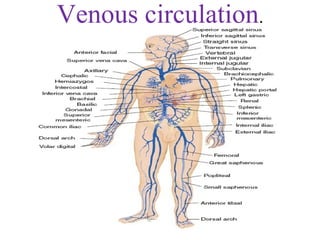
Venous circulation.
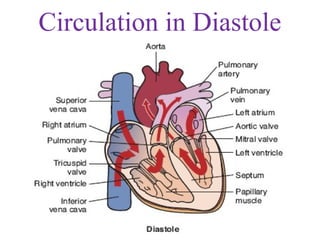
Circulation in Diastole
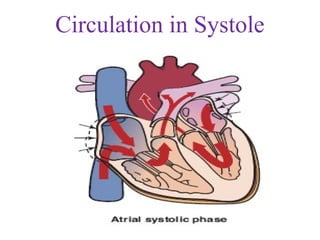
Circulation in Systole
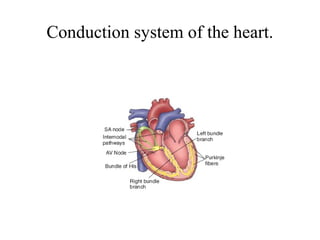
Conduction system of the heart.
The depolarization process
(A) A single cell has depolarized. (B) A wave propagates from cell to
cell (C) until all are depolarized. (D) Repolarization than restores each
cell’s normal polarity.
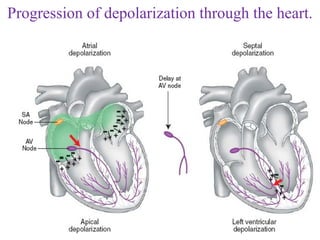
Progression of depolarization through the heart.
Progression of depolarization
through the heart.
Correlation of depolarization and
repolarization
with the ECG.
It is important to keep in mind
that the
ECG shows only electrical
activity; it tells
us nothing about how well the
heart is
working mechanically.
To obtain a 12-lead ECG, four wires are attached to each
limb and six wires are attached at different locations on the
chest. The total of ten wires provides 12 views (12 leads).
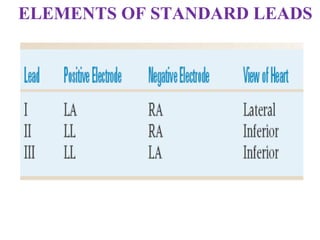
Standard limb lead electrode placement.
ELEMENTS OF STANDARD LEADS
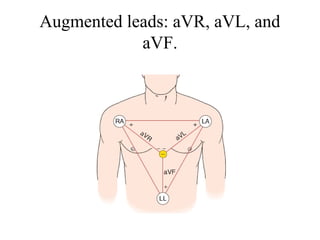
Augmented leads: aVR, aVL, and
aVF.
ELEMENTS OF AUGMENTED
LEADS
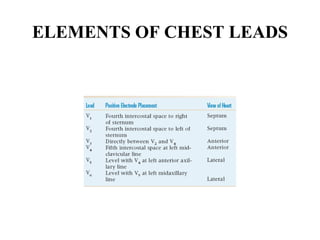
ELEMENTS OF CHEST LEADS
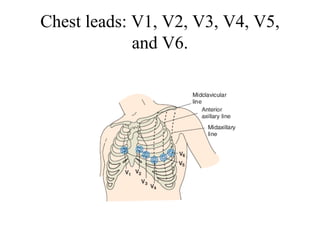
Chest leads: V1, V2, V3, V4, V5,
and V6.
MONITORING CABLE CONNECTIONS
Three-wire patient cable.
Lead II is commonly called a monitoring lead. It provides information on heart rate, regularity,
conduction time, and ectopic beats. The presence or location of an acute myocardial infarction
(MI) should be further diagnosed with a 12-lead ECG
Lead MCL1 electrode placement.
telemetry units are commonly used
to monitor leads I, II, III, aVR, aVL,
aVF, and V1
in critical care settings.
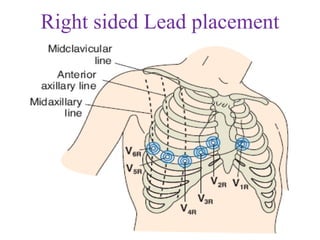
Right sided Lead placement
Electrode placement for V4R, V8, and V9
THE RIGHT-SIDED CHEST LEAD PLACEMENT
CHEST LEAD PLACEMENT FOR
A 15-LEAD ECG
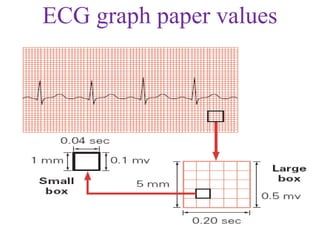
ECG graph paper values
The electrical pattern of the cardiac cycle
shows waves and intervals.
COMPONENTS OF AN ECG TRACING
• Wave: A deflection, either positive or negative, away from the baseline (isoelectric line)
of the ECG tracing
• Complex: Several waves
• Segment: A straight line between waves or complexes
• Interval: A segment and a wave during which a depolarization wave travels from
• the atria to the ventricles.
• QRS Complex: Three deflections following P wave. Indicates ventricular depolarization
(and contraction).
• Q WAVE: First negative deflection
• R WAVE: First positive deflection
• S WAVE: First negative deflection after R wave
• ST Segment: Distance between end of S wave and beginning of T wave. Measures time
between ventricular depolarization and beginning of repolarization.
• T Wave: Rounded, upright (positive) wave following QRS complex. Represents
ventricular repolarization.
• QT Interval: Measured from beginning of QRS complex to end of T wave. Represents
total ventricular activity.
• U Wave: Small, rounded, upright wave following T wave. Most easily seen with a slow
heart rate. Indicates repolarization of Purkinje fibers.
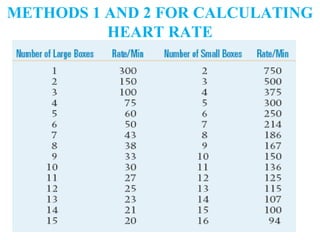
Counting large boxes for heart rate.
The rate is 60 bpm.
METHODS 1 AND 2 FOR CALCULATING
HEART RATE
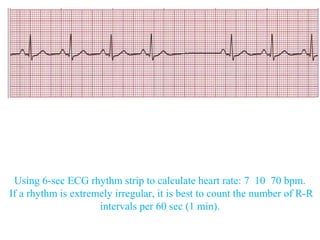
Using 6-sec ECG rhythm strip to calculate heart rate: 7 10 70 bpm.
If a rhythm is extremely irregular, it is best to count the number of R-R
intervals per 60 sec (1 min).
ANALYZING AN ECG RHYTHM
NORMAL SINUS RHYTHM (NSR)
Rate: Normal (60–100 bpm) Rhythm: Regular P Waves: Normal
(upright and uniform PR Interval: Normal (0.12–0.20 sec) QRS:
Normal (0.06–0.10 sec)
SINUS BRADYCARDIA
Rate: Slow (60 bpm) Rhythm: Regular P Waves: Normal (upright and
uniform ) PR Interval: Normal (0.12–0.20 sec) QRS:Normal (0.06–
0.10 sec)
Sinus bradycardia is normal in athletes and during sleep. In acute MI,
it may be protective and beneficial or the slow rate may compromise
cardiac output. Certain medications, such as beta blockers, may also
cause sinus bradycardia.
Thank you !Thank you !

Ecg basics 1

  • 1.
    ECG Basics-1ECG Basics-1 Dr.Md.Toufiqur Rahman MBBS, FCPS, MD, FACC, FESC, FRCP, FSCAI, FAPSC, FAPSIC, FAHA Associate Professor of Cardiology National Institute of Cardiovascular Diseases Sher-e-Bangla Nagar, Dhaka-1207 Consultant, Medinova, Malbagh branch.
  • 2.
    The cone-shaped hearthas its tip (apex) just above the diaphragm to the left of the midline. This is why we may think of the heart as being on the left side—the strongest beat can be heard or felt there. Location of the heart.
  • 3.
  • 4.
    Valves of theheart The atria have been removed in this superior view.
  • 5.
    Heart chambers andgreat vessels.
  • 6.
    Coronary vessels. (A)Coronary vessels in anterior view. (B) Coronary vessels in posterior view. A protective feature of the coronary vessels is that many interconnections, or anastomoses, exist between the arterioles of the coronary arteries, allowing for development of collateral circulation, if needed.
  • 7.
  • 8.
  • 9.
  • 10.
  • 11.
  • 13.
  • 14.
    The depolarization process (A)A single cell has depolarized. (B) A wave propagates from cell to cell (C) until all are depolarized. (D) Repolarization than restores each cell’s normal polarity.
  • 15.
  • 16.
  • 17.
    Correlation of depolarizationand repolarization with the ECG. It is important to keep in mind that the ECG shows only electrical activity; it tells us nothing about how well the heart is working mechanically.
  • 18.
    To obtain a12-lead ECG, four wires are attached to each limb and six wires are attached at different locations on the chest. The total of ten wires provides 12 views (12 leads).
  • 19.
    Standard limb leadelectrode placement.
  • 20.
  • 21.
    Augmented leads: aVR,aVL, and aVF.
  • 22.
  • 23.
  • 24.
    Chest leads: V1,V2, V3, V4, V5, and V6.
  • 25.
  • 26.
  • 27.
    Lead II iscommonly called a monitoring lead. It provides information on heart rate, regularity, conduction time, and ectopic beats. The presence or location of an acute myocardial infarction (MI) should be further diagnosed with a 12-lead ECG Lead MCL1 electrode placement.
  • 28.
    telemetry units arecommonly used to monitor leads I, II, III, aVR, aVL, aVF, and V1 in critical care settings.
  • 29.
  • 30.
    Electrode placement forV4R, V8, and V9
  • 31.
    THE RIGHT-SIDED CHESTLEAD PLACEMENT
  • 32.
    CHEST LEAD PLACEMENTFOR A 15-LEAD ECG
  • 33.
  • 34.
    The electrical patternof the cardiac cycle shows waves and intervals.
  • 35.
    COMPONENTS OF ANECG TRACING • Wave: A deflection, either positive or negative, away from the baseline (isoelectric line) of the ECG tracing • Complex: Several waves • Segment: A straight line between waves or complexes • Interval: A segment and a wave during which a depolarization wave travels from • the atria to the ventricles. • QRS Complex: Three deflections following P wave. Indicates ventricular depolarization (and contraction). • Q WAVE: First negative deflection • R WAVE: First positive deflection • S WAVE: First negative deflection after R wave • ST Segment: Distance between end of S wave and beginning of T wave. Measures time between ventricular depolarization and beginning of repolarization. • T Wave: Rounded, upright (positive) wave following QRS complex. Represents ventricular repolarization. • QT Interval: Measured from beginning of QRS complex to end of T wave. Represents total ventricular activity. • U Wave: Small, rounded, upright wave following T wave. Most easily seen with a slow heart rate. Indicates repolarization of Purkinje fibers.
  • 36.
    Counting large boxesfor heart rate. The rate is 60 bpm.
  • 37.
    METHODS 1 AND2 FOR CALCULATING HEART RATE
  • 38.
    Using 6-sec ECGrhythm strip to calculate heart rate: 7 10 70 bpm. If a rhythm is extremely irregular, it is best to count the number of R-R intervals per 60 sec (1 min).
  • 39.
  • 40.
  • 41.
    NORMAL SINUS RHYTHM(NSR) Rate: Normal (60–100 bpm) Rhythm: Regular P Waves: Normal (upright and uniform PR Interval: Normal (0.12–0.20 sec) QRS: Normal (0.06–0.10 sec)
  • 42.
    SINUS BRADYCARDIA Rate: Slow(60 bpm) Rhythm: Regular P Waves: Normal (upright and uniform ) PR Interval: Normal (0.12–0.20 sec) QRS:Normal (0.06– 0.10 sec) Sinus bradycardia is normal in athletes and during sleep. In acute MI, it may be protective and beneficial or the slow rate may compromise cardiac output. Certain medications, such as beta blockers, may also cause sinus bradycardia.
  • 43.

Editor's Notes

  • #2 Good morning ladies and gentlemen, it is my pleasure to be able to present and discuss with you this morning in such a prestigious international meeting. My presentation on Hypertension shall include the following aspects. I
  • #18 The following summarizes a basic ECG: • An ECG is a series of waves and deflections recording the heart’s electrical activity from a certain “view.” • Many views, each called a lead, monitor voltage changes between electrodes placed in different positions on the body. • Leads I, II, and III are bipolar leads, which consist of two electrodes of opposite polarity (positive and negative). The third (ground) electrode minimizes electrical activity from other sources. • Leads aVR, aVL, and aVF are unipolar leads and consist of a single positive electrode and a reference point (with zero electrical potential) that lies in the center of the heart’s electrical field. • Leads V1 through V6 are unipolar leads and consist of a single positive electrode with a negative reference point, found at the electrical center of the heart. • Voltage changes are amplified and visually displayed on an oscilloscope and graph paper. • An ECG tracing looks different in each lead because the recorded angle of electrical activity changes with each lead. Several different angles allow a more accurate perspective than a single one would. • The ECG machine can be adjusted to make any skin electrode positive or negative. The polarity depends on which lead the machine is recording. • A cable attached to the patient is divided into several different-colored wires: three, four, or five for monitoring purposes, or ten for a 12- lead ECG. • Incorrect placement of electrodes may turn a normal ECG tracing into an abnormal one.
  • #43 Sinus bradycardia is normal in athletes and during sleep. In acute MI, it may be protective and beneficial or the slow rate may compromise cardiac output. Certain medications, such as beta blockers, may also cause sinus bradycardia.