Fundamentals of ECG
interpretation
Part I
1
PART II
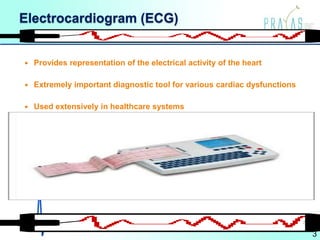
Electrocardiogram (ECG)
 Provides representation of the electrical activity of the heart
 Extremely important diagnostic tool for various cardiac dysfunctions
 Used extensively in healthcare systems
3
2
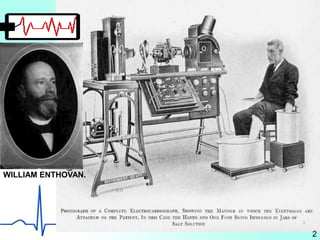
WILLIAM ENTHOVAN.
2
3
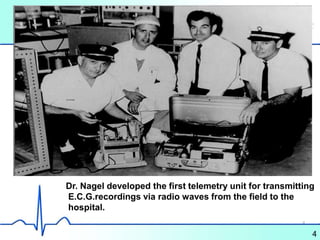
Dr. Nagel developed the first telemetry unit for transmitting
E.C.G.recordings via radio waves from the field to the
hospital.
4
4
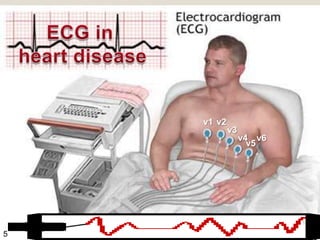
v1 v2
v3
v4
v5
v6
5
5
6
6
7
7
8
8
9
9
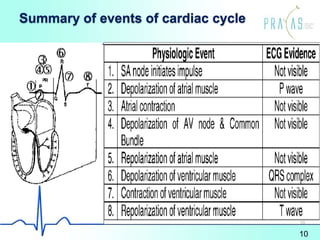
Summary of events of cardiac cycle
10
10
11
11
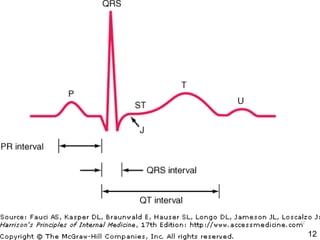
12
12
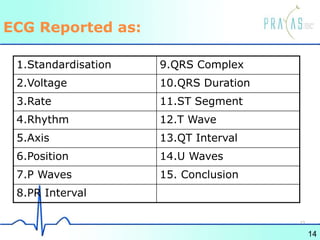
ECG Reported as:
1.Standardisation 9.QRS Complex
2.Voltage 10.QRS Duration
3.Rate 11.ST Segment
4.Rhythm 12.T Wave
5.Axis 13.QT Interval
6.Position 14.U Waves
7.P Waves 15. Conclusion
8.PR Interval
14
13
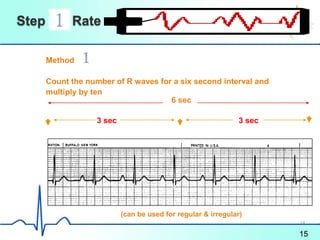
Step - Rate
Method
Count the number of R waves for a six second interval and
multiply by ten
3 sec 3 sec
6 sec
(can be used for regular & irregular)
15
14
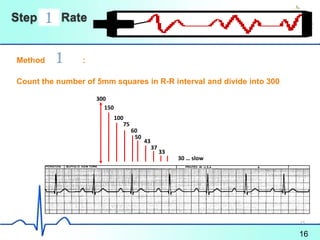
Step - Rate
Method :
Count the number of 5mm squares in R-R interval and divide into 300
300
150
100
75
60
50
43
37
33
30 … slow
16
15
Step 1 - Rate
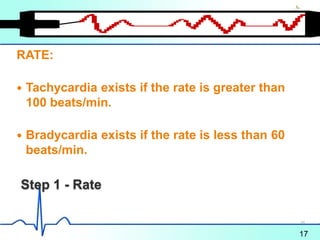
RATE:
 Tachycardia exists if the rate is greater than
100 beats/min.
 Bradycardia exists if the rate is less than 60
beats/min.
17
16
Step : Rhythm
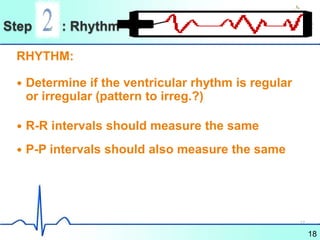
RHYTHM:
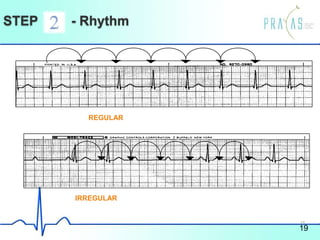
 Determine if the ventricular rhythm is regular
or irregular (pattern to irreg.?)
 R-R intervals should measure the same
 P-P intervals should also measure the same
18
17
STEP - Rhythm
IRREGULAR
REGULAR
19
18
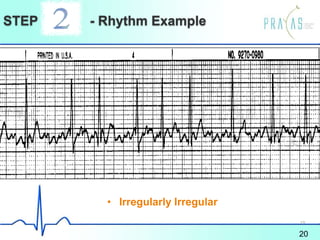
STEP - Rhythm Example
• Irregularly Irregular
20
19
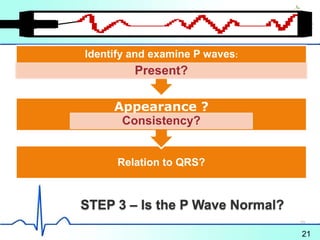
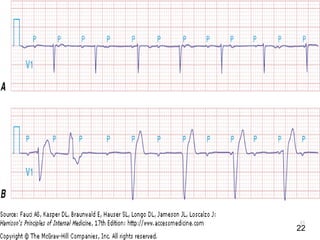
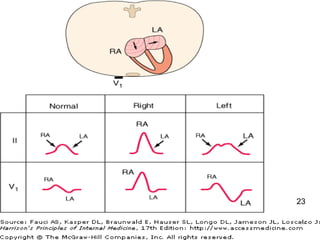
STEP 3 – Is the P Wave Normal?
Relation to QRS?
Appearance ?
Consistency?
Identify and examine P waves:
Present?
21
20
22
21
23
22
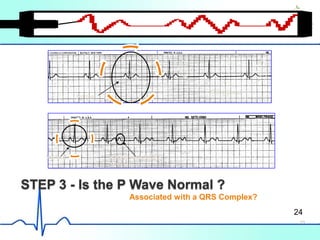
STEP 3 - Is the P Wave Normal ?
Normal P wave with no QRS
complex
Normal
Same Shape
Associated with a QRS Complex?
24
23
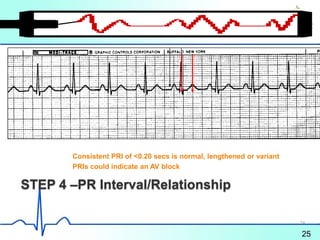
STEP 4 –PR Interval/Relationship
Consistent PRI of <0.20 secs is normal, lengthened or variant
PRIs could indicate an AV block
25
24
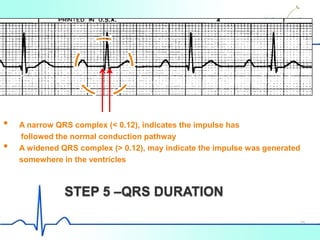
STEP 5 –QRS DURATION
• A narrow QRS complex (< 0.12), indicates the impulse has
followed the normal conduction pathway
• A widened QRS complex (> 0.12), may indicate the impulse was generated
somewhere in the ventricles
25
26
26
27
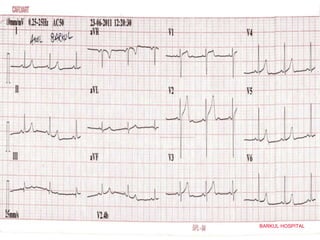
BARKUL HOSPITAL
28
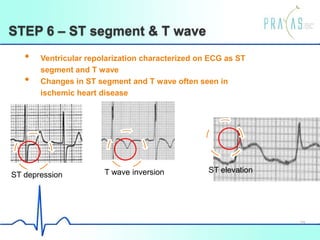
STEP 6 – ST segment & T wave
• Ventricular repolarization characterized on ECG as ST
segment and T wave
• Changes in ST segment and T wave often seen in
ischemic heart disease
ST depression T wave inversion ST elevation
29
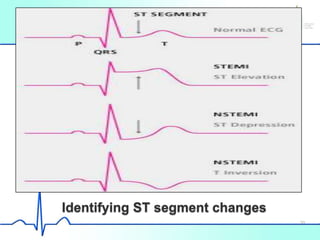
Identifying ST segment changes
30
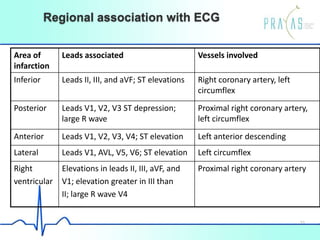
Regional association with ECG
Area of
infarction
Leads associated Vessels involved
Inferior Leads II, III, and aVF; ST elevations Right coronary artery, left
circumflex
Posterior Leads V1, V2, V3 ST depression;
large R wave
Proximal right coronary artery,
left circumflex
Anterior Leads V1, V2, V3, V4; ST elevation Left anterior descending
Lateral Leads V1, AVL, V5, V6; ST elevation Left circumflex
Right
ventricular
Elevations in leads II, III, aVF, and
V1; elevation greater in III than
II; large R wave V4
Proximal right coronary artery
31
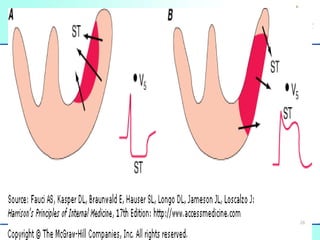
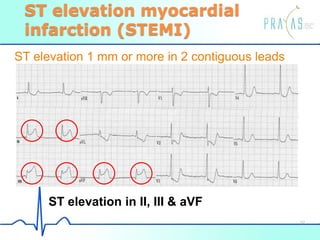
ST elevation myocardial
infarction (STEMI)
ST elevation 1 mm or more in 2 contiguous leads
ST elevation in II, III & aVF
32
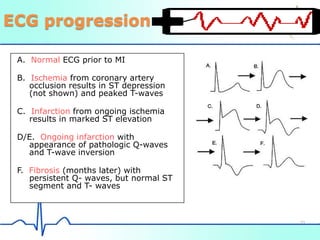
Evolving infarction:
ECG progression
A. Normal ECG prior to MI
B. Ischemia from coronary artery
occlusion results in ST depression
(not shown) and peaked T-waves
C. Infarction from ongoing ischemia
results in marked ST elevation
D/E. Ongoing infarction with
appearance of pathologic Q-waves
and T-wave inversion
F. Fibrosis (months later) with
persistent Q- waves, but normal ST
segment and T- waves
33
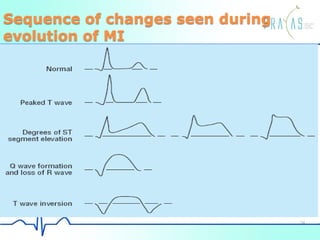
Sequence of changes seen during
evolution of MI
34
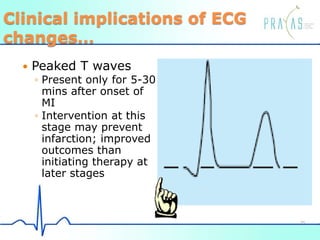
Clinical implications of ECG
changes…
 Peaked T waves
◦ Present only for 5-30
mins after onset of
MI
◦ Intervention at this
stage may prevent
infarction; improved
outcomes than
initiating therapy at
later stages
35
Clinical implications of ECG
changes …
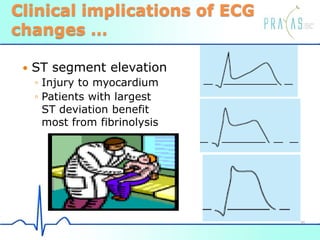
 ST segment elevation
◦ Injury to myocardium
◦ Patients with largest
ST deviation benefit
most from fibrinolysis
36
Clinical implications of ECG
changes …
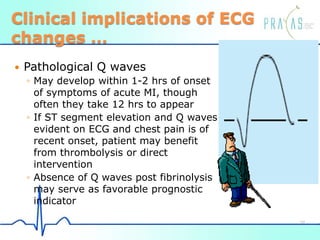
 Pathological Q waves
◦ May develop within 1-2 hrs of onset
of symptoms of acute MI, though
often they take 12 hrs to appear
◦ If ST segment elevation and Q waves
evident on ECG and chest pain is of
recent onset, patient may benefit
from thrombolysis or direct
intervention
◦ Absence of Q waves post fibrinolysis
may serve as favorable prognostic
indicator
37
Clinical implications of ECG
changes…
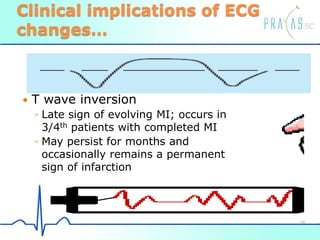
 T wave inversion
◦ Late sign of evolving MI; occurs in
3/4th patients with completed MI
◦ May persist for months and
occasionally remains a permanent
sign of infarction
38
Clinical implications of ECG
changes
 Normalization of ST segment
◦ Last ECG change during MI; occurs when
transmural MI progresses to completed
infarction
◦ ST elevation with an inferior MI may take up
to two weeks to resolve, may persist even
longer with anterior MI and may persist
indefinitely if left ventricular aneurysm
develops
◦ Role of reperfusion therapy limited
39
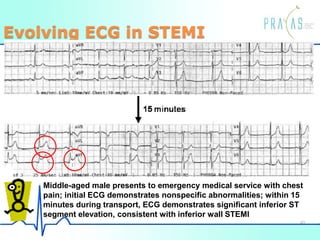
Evolving ECG in STEMI
Middle-aged male presents to emergency medical service with chest
pain; initial ECG demonstrates nonspecific abnormalities; within 15
minutes during transport, ECG demonstrates significant inferior ST
segment elevation, consistent with inferior wall STEMI
40
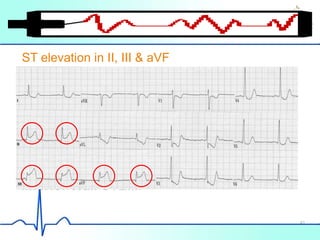
Inferior Wall STEMI
ST elevation in II, III & aVF
41
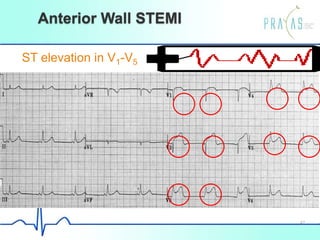
Anterior Wall STEMI
ST elevation in V1-V5
42
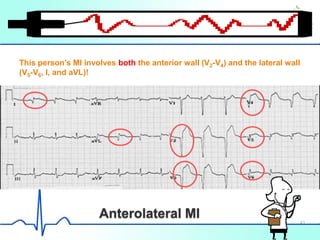
Anterolateral MI
This person’s MI involves both the anterior wall (V2-V4) and the lateral wall
(V5-V6, I, and aVL)!
43
Unstable angina/NSTEMI
 ECG ST-segment depression or prominent T-
wave inversion and/or positive biomarkers
of necrosis in absence of ST-segment
elevation and appropriate clinical setting
(chest discomfort or anginal equivalent)
 NSTEMI if elevated biomarkers present
(Troponin T, Troponin I or Creatine Kinase-
MB [CK-MB])
44
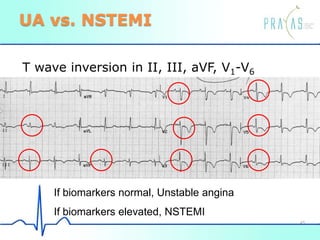
UA vs. NSTEMI
T wave inversion in II, III, aVF, V1-V6
If biomarkers normal, Unstable angina
If biomarkers elevated, NSTEMI
45
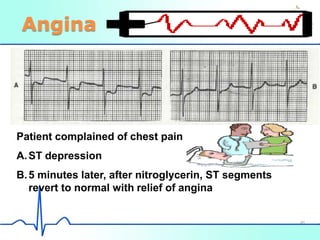
Angina
Patient complained of chest pain
A.ST depression
B.5 minutes later, after nitroglycerin, ST segments
revert to normal with relief of angina
46
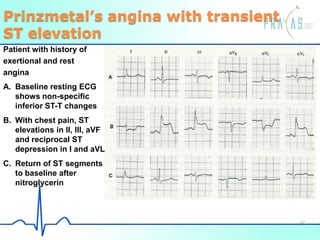
Prinzmetal’s angina with transient
ST elevation
Patient with history of
exertional and rest
angina
A. Baseline resting ECG
shows non-specific
inferior ST-T changes
B. With chest pain, ST
elevations in II, III, aVF
and reciprocal ST
depression in I and aVL
C. Return of ST segments
to baseline after
nitroglycerin
47
Summary
 ECG an essential adjunct to clinical history
& physical examination in patients with
chest pain
 ECG adds considerable information for risk
stratification and clinical decision support
for treatment strategies in ACS
48
Ecg.exe
49
Consulting
Physician,Beed
50

Ecg

  • 1.
  • 2.
    Electrocardiogram (ECG)  Providesrepresentation of the electrical activity of the heart  Extremely important diagnostic tool for various cardiac dysfunctions  Used extensively in healthcare systems 3 2
  • 3.
  • 4.
    Dr. Nagel developedthe first telemetry unit for transmitting E.C.G.recordings via radio waves from the field to the hospital. 4 4
  • 5.
  • 6.
  • 7.
  • 8.
  • 9.
  • 10.
    Summary of eventsof cardiac cycle 10 10
  • 11.
  • 12.
  • 13.
    ECG Reported as: 1.Standardisation9.QRS Complex 2.Voltage 10.QRS Duration 3.Rate 11.ST Segment 4.Rhythm 12.T Wave 5.Axis 13.QT Interval 6.Position 14.U Waves 7.P Waves 15. Conclusion 8.PR Interval 14 13
  • 14.
    Step - Rate Method Countthe number of R waves for a six second interval and multiply by ten 3 sec 3 sec 6 sec (can be used for regular & irregular) 15 14
  • 15.
    Step - Rate Method: Count the number of 5mm squares in R-R interval and divide into 300 300 150 100 75 60 50 43 37 33 30 … slow 16 15
  • 16.
    Step 1 -Rate RATE:  Tachycardia exists if the rate is greater than 100 beats/min.  Bradycardia exists if the rate is less than 60 beats/min. 17 16
  • 17.
    Step : Rhythm RHYTHM: Determine if the ventricular rhythm is regular or irregular (pattern to irreg.?)  R-R intervals should measure the same  P-P intervals should also measure the same 18 17
  • 18.
  • 19.
    STEP - RhythmExample • Irregularly Irregular 20 19
  • 20.
    STEP 3 –Is the P Wave Normal? Relation to QRS? Appearance ? Consistency? Identify and examine P waves: Present? 21 20
  • 21.
  • 22.
  • 23.
    STEP 3 -Is the P Wave Normal ? Normal P wave with no QRS complex Normal Same Shape Associated with a QRS Complex? 24 23
  • 24.
    STEP 4 –PRInterval/Relationship Consistent PRI of <0.20 secs is normal, lengthened or variant PRIs could indicate an AV block 25 24
  • 25.
    STEP 5 –QRSDURATION • A narrow QRS complex (< 0.12), indicates the impulse has followed the normal conduction pathway • A widened QRS complex (> 0.12), may indicate the impulse was generated somewhere in the ventricles 25
  • 26.
  • 27.
  • 28.
  • 29.
    STEP 6 –ST segment & T wave • Ventricular repolarization characterized on ECG as ST segment and T wave • Changes in ST segment and T wave often seen in ischemic heart disease ST depression T wave inversion ST elevation 29
  • 30.
  • 31.
    Regional association withECG Area of infarction Leads associated Vessels involved Inferior Leads II, III, and aVF; ST elevations Right coronary artery, left circumflex Posterior Leads V1, V2, V3 ST depression; large R wave Proximal right coronary artery, left circumflex Anterior Leads V1, V2, V3, V4; ST elevation Left anterior descending Lateral Leads V1, AVL, V5, V6; ST elevation Left circumflex Right ventricular Elevations in leads II, III, aVF, and V1; elevation greater in III than II; large R wave V4 Proximal right coronary artery 31
  • 32.
    ST elevation myocardial infarction(STEMI) ST elevation 1 mm or more in 2 contiguous leads ST elevation in II, III & aVF 32
  • 33.
    Evolving infarction: ECG progression A.Normal ECG prior to MI B. Ischemia from coronary artery occlusion results in ST depression (not shown) and peaked T-waves C. Infarction from ongoing ischemia results in marked ST elevation D/E. Ongoing infarction with appearance of pathologic Q-waves and T-wave inversion F. Fibrosis (months later) with persistent Q- waves, but normal ST segment and T- waves 33
  • 34.
    Sequence of changesseen during evolution of MI 34
  • 35.
    Clinical implications ofECG changes…  Peaked T waves ◦ Present only for 5-30 mins after onset of MI ◦ Intervention at this stage may prevent infarction; improved outcomes than initiating therapy at later stages 35
  • 36.
    Clinical implications ofECG changes …  ST segment elevation ◦ Injury to myocardium ◦ Patients with largest ST deviation benefit most from fibrinolysis 36
  • 37.
    Clinical implications ofECG changes …  Pathological Q waves ◦ May develop within 1-2 hrs of onset of symptoms of acute MI, though often they take 12 hrs to appear ◦ If ST segment elevation and Q waves evident on ECG and chest pain is of recent onset, patient may benefit from thrombolysis or direct intervention ◦ Absence of Q waves post fibrinolysis may serve as favorable prognostic indicator 37
  • 38.
    Clinical implications ofECG changes…  T wave inversion ◦ Late sign of evolving MI; occurs in 3/4th patients with completed MI ◦ May persist for months and occasionally remains a permanent sign of infarction 38
  • 39.
    Clinical implications ofECG changes  Normalization of ST segment ◦ Last ECG change during MI; occurs when transmural MI progresses to completed infarction ◦ ST elevation with an inferior MI may take up to two weeks to resolve, may persist even longer with anterior MI and may persist indefinitely if left ventricular aneurysm develops ◦ Role of reperfusion therapy limited 39
  • 40.
    Evolving ECG inSTEMI Middle-aged male presents to emergency medical service with chest pain; initial ECG demonstrates nonspecific abnormalities; within 15 minutes during transport, ECG demonstrates significant inferior ST segment elevation, consistent with inferior wall STEMI 40
  • 41.
    Inferior Wall STEMI STelevation in II, III & aVF 41
  • 42.
    Anterior Wall STEMI STelevation in V1-V5 42
  • 43.
    Anterolateral MI This person’sMI involves both the anterior wall (V2-V4) and the lateral wall (V5-V6, I, and aVL)! 43
  • 44.
    Unstable angina/NSTEMI  ECGST-segment depression or prominent T- wave inversion and/or positive biomarkers of necrosis in absence of ST-segment elevation and appropriate clinical setting (chest discomfort or anginal equivalent)  NSTEMI if elevated biomarkers present (Troponin T, Troponin I or Creatine Kinase- MB [CK-MB]) 44
  • 45.
    UA vs. NSTEMI Twave inversion in II, III, aVF, V1-V6 If biomarkers normal, Unstable angina If biomarkers elevated, NSTEMI 45
  • 46.
    Angina Patient complained ofchest pain A.ST depression B.5 minutes later, after nitroglycerin, ST segments revert to normal with relief of angina 46
  • 47.
    Prinzmetal’s angina withtransient ST elevation Patient with history of exertional and rest angina A. Baseline resting ECG shows non-specific inferior ST-T changes B. With chest pain, ST elevations in II, III, aVF and reciprocal ST depression in I and aVL C. Return of ST segments to baseline after nitroglycerin 47
  • 48.
    Summary  ECG anessential adjunct to clinical history & physical examination in patients with chest pain  ECG adds considerable information for risk stratification and clinical decision support for treatment strategies in ACS 48
  • 49.
  • 50.