Yandi Ariffudin, dr
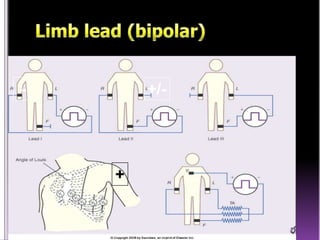
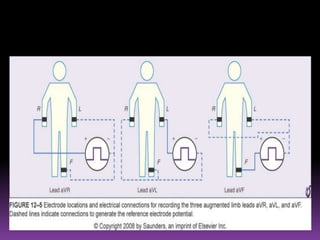
-       +/-


    +
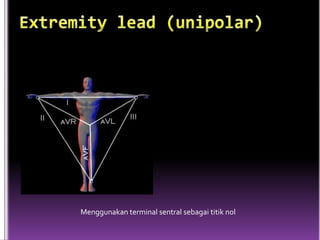
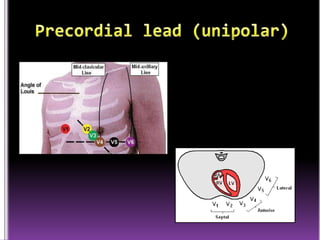
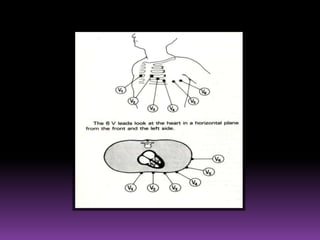
Menggunakan terminal sentral sebagai titik nol
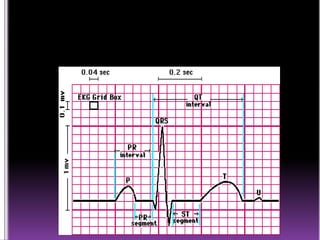
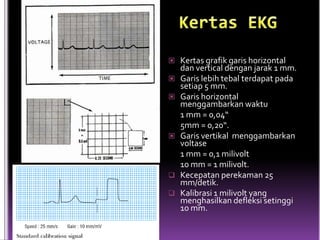
 Kertas grafik garis horizontal
    dan vertical dengan jarak 1 mm.
   Garis lebih tebal terdapat pada
    setiap 5 mm.
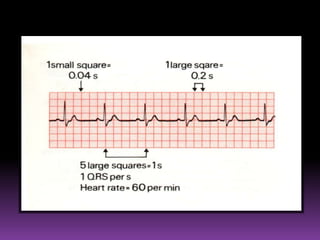
   Garis horizontal
    menggambarkan waktu
    1 mm = 0,04“
    5mm = 0,20“.
   Garis vertikal menggambarkan
    voltase
    1 mm = 0,1 milivolt
    10 mm = 1 milivolt.
   Kecepatan perekaman 25
    mm/detik.
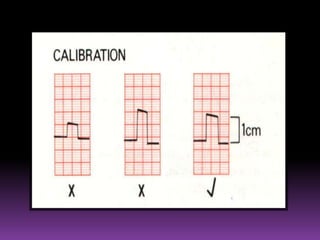
   Kalibrasi 1 milivolt yang
    menghasilkan defleksi setinggi
    10 mm.
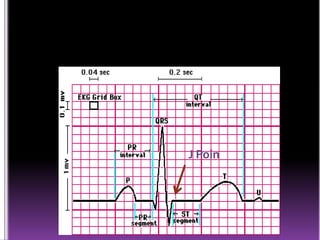
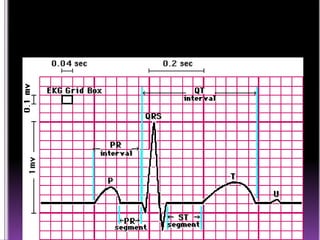
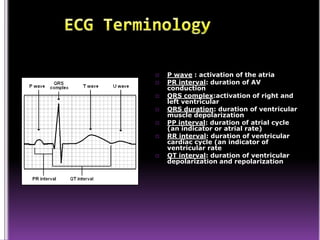
   P wave : activation of the atria
   PR interval: duration of AV
    conduction
   QRS complex:activation of right and
    left ventricular
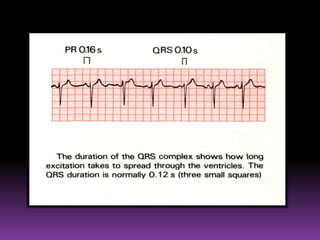
   QRS duration: duration of ventricular
    muscle depolarization
   PP interval: duration of atrial cycle
    (an indicator or atrial rate)
   RR interval: duration of ventricular
    cardiac cycle (an indicator of
    ventricular rate
   QT interval: duration of ventricular
    depolarization and repolarization
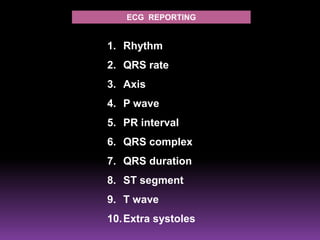
ECG REPORTING


1. Rhythm
2. QRS rate
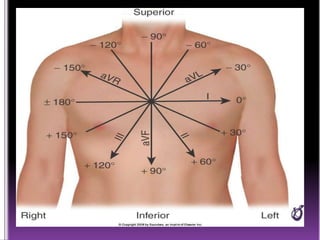
3. Axis
4. P wave
5. PR interval
6. QRS complex
7. QRS duration
8. ST segment
9. T wave
10. Extra systoles
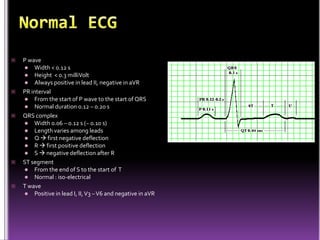
   P wave
     Width < 0.12 s
     Height < 0.3 milliVolt
     Always positive in lead II, negative in aVR
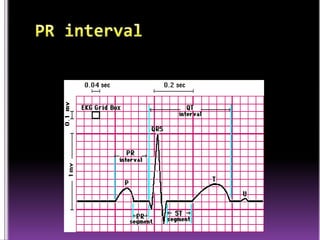
   PR interval
     From the start of P wave to the start of QRS
     Normal duration 0.12 – 0.20 s
   QRS complex
     Width 0.06 – 0.12 s (~ 0.10 s)
     Length varies among leads
     Q  first negative deflection
     R  first positive deflection
     S  negative deflection after R
   ST segment
     From the end of S to the start of T
     Normal : iso-electrical
   T wave
     Positive in lead I, II, V3 – V6 and negative in aVR
ECG REPORTING


1. Rhythm
2. QRS rate
3. Axis
4. P wave
5. PR interval
6. QRS complex
7. QRS duration
8. ST segment
9. T wave
10. Extra systoles
KELAINAN
ECG REPORTING


1. Rhythm
2. QRS rate
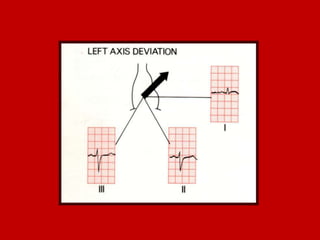
3. Axis
4. P wave
5. PR interval
6. QRS complex
7. QRS duration
8. ST segment
9. T wave
10. Extra systoles
 Rule of 300
   300/[number of large boxes between two R waves].
   only works for regular rhythms !!


                                                  300/7.5 large boxes = rate 40


   Six second methods
       Count the number of R-R intervals in six seconds and multiply by
        10
       Useful for irregular rhythm  average rate

                                                         There are 8 R-R intervals
                                                         within 30 boxes. Multiply 8 x
                                                         10 = Rate 80
ECG REPORTING


1. Rhythm
2. QRS rate
3. Axis
4. P wave
5. PR interval
6. QRS complex
7. QRS duration
8. ST segment
9. T wave
10. Extra systoles
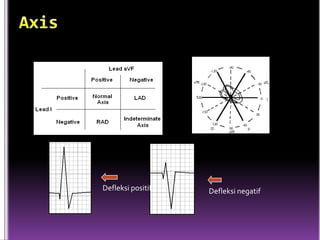
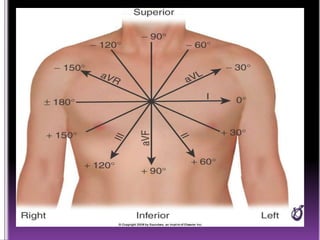
Defleksi positif   Defleksi negatif
—

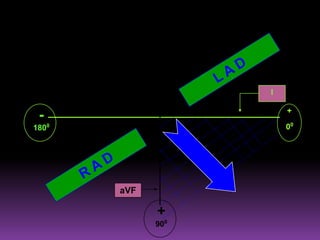
             3600


                    I

                        +
 -
1800                    00


       aVF

              +
              900
ECG REPORTING


1. Rhythm
2. QRS rate
3. Axis
4. P wave
5. PR interval
6. QRS complex
7. QRS duration
8. ST segment
9. T wave
10. Extra systoles
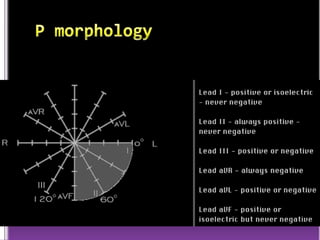
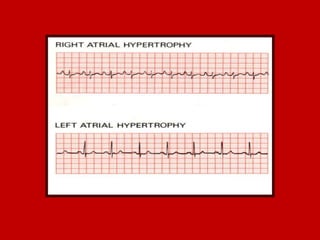
 Indicate wave of atrial depolarization
 Normal characteristic:
  1. Smooth and rounded
  2. Upright in leads I, II, aVF, aVL
  3. Upright or downward in lead III
  4. Biphasic in right precordial lead (V1,V2)
  5. P wave duration: 120 milliseconds (measured in
     the widest P wave)
  6. Amplitude in limb lead: < 0.25 mV and terminal
     negative deflection in V1 or V2 < 0.1 mV in depth
ECG REPORTING


1. Rhythm
2. QRS rate
3. Axis
4. P wave
5. PR interval
6. QRS complex
7. QRS duration
8. ST segment
9. T wave
10. Extra systoles
 Mulai dari awal gelombang P sampai dengan
  permulaan kompleks QRS
 Durassi normal 0.12-0.2 detik
ECG REPORTING


1. Rhythm
2. QRS rate
3. Axis
4. P wave
5. PR interval
6. QRS complex
7. QRS duration
8. ST segment
9. T wave
10. Extra systoles
 Wave of ventricular depolarization
 5-20 mm tall
 Duration 0.06-0.10/0.12 seconds
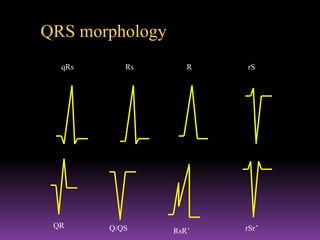
QRS morphology
  qRs      Rs       R   rS


 QR     Q/QS            rSr’
                 RsR’
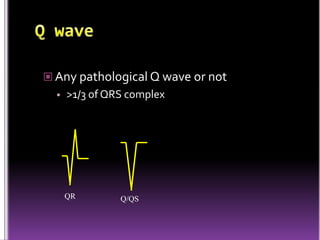
 Any pathological Q wave or not
  •   >1/3 of QRS complex


      QR        Q/QS
ECG REPORTING


1. Rhythm
2. QRS rate
3. Axis
4. P wave
5. PR interval
6. QRS complex
7. QRS duration
8. ST segment
9. T wave
10. Extra systoles
 Begins at J point
 Between ventricular depolarization and
  ventricular repolarization
 Generally isoelectric
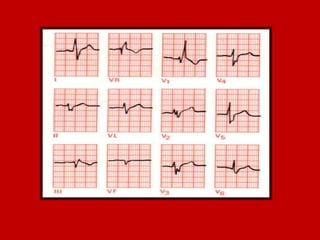
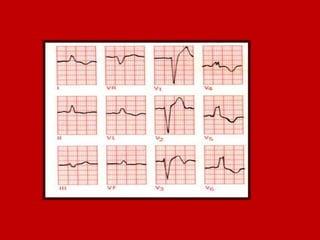
J Poin
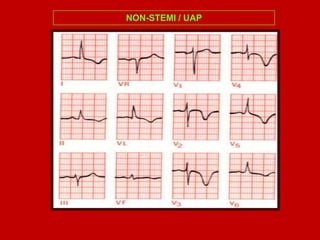
NON-STEMI / UAP
ECG REPORTING


1. Rhythm
2. QRS rate
3. Axis
4. P wave
5. PR interval
6. QRS complex
7. QRS duration
8. ST segment
9. T wave
10. Extra systoles
 Ventricular repolarization, followed by
  ventricular relaxation
 Positive in lead : I, II, V3-V6
 Negative in lead avR
ECG REPORTING


1. Rhythm
2. QRS rate
3. Axis
4. P wave
5. PR interval
6. QRS complex
7. QRS duration
8. ST segment
9. T wave
10. Extra systoles
Sekian

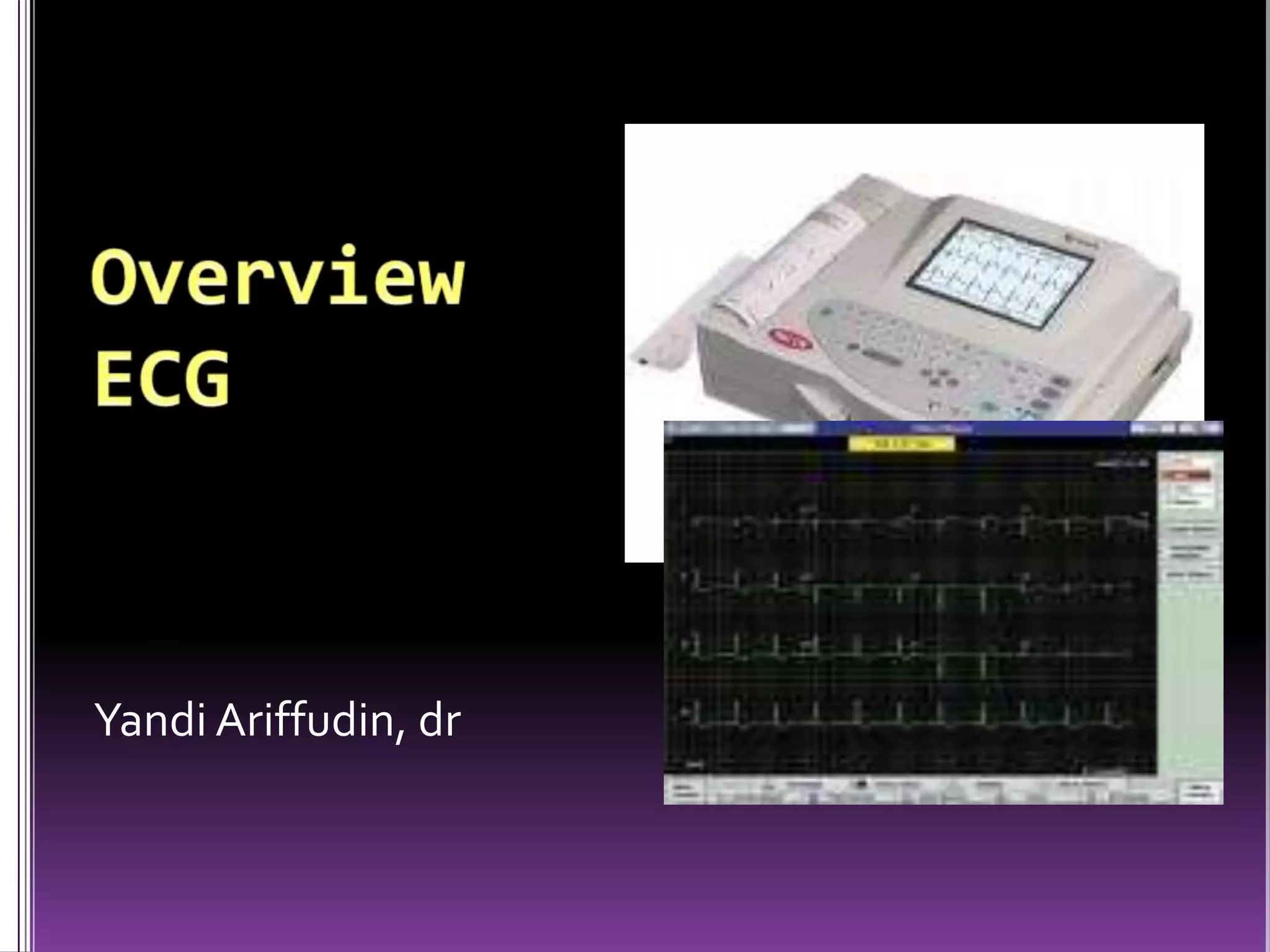
Overview ecg

  • 1.
  • 3.
    - +/- +
  • 4.
  • 9.
     Kertas grafikgaris horizontal dan vertical dengan jarak 1 mm.  Garis lebih tebal terdapat pada setiap 5 mm.  Garis horizontal menggambarkan waktu 1 mm = 0,04“ 5mm = 0,20“.  Garis vertikal menggambarkan voltase 1 mm = 0,1 milivolt 10 mm = 1 milivolt.  Kecepatan perekaman 25 mm/detik.  Kalibrasi 1 milivolt yang menghasilkan defleksi setinggi 10 mm.
  • 12.
    P wave : activation of the atria  PR interval: duration of AV conduction  QRS complex:activation of right and left ventricular  QRS duration: duration of ventricular muscle depolarization  PP interval: duration of atrial cycle (an indicator or atrial rate)  RR interval: duration of ventricular cardiac cycle (an indicator of ventricular rate  QT interval: duration of ventricular depolarization and repolarization
  • 14.
    ECG REPORTING 1. Rhythm 2.QRS rate 3. Axis 4. P wave 5. PR interval 6. QRS complex 7. QRS duration 8. ST segment 9. T wave 10. Extra systoles
  • 15.
    P wave  Width < 0.12 s  Height < 0.3 milliVolt  Always positive in lead II, negative in aVR  PR interval  From the start of P wave to the start of QRS  Normal duration 0.12 – 0.20 s  QRS complex  Width 0.06 – 0.12 s (~ 0.10 s)  Length varies among leads  Q  first negative deflection  R  first positive deflection  S  negative deflection after R  ST segment  From the end of S to the start of T  Normal : iso-electrical  T wave  Positive in lead I, II, V3 – V6 and negative in aVR
  • 16.
    ECG REPORTING 1. Rhythm 2.QRS rate 3. Axis 4. P wave 5. PR interval 6. QRS complex 7. QRS duration 8. ST segment 9. T wave 10. Extra systoles
  • 18.
  • 27.
    ECG REPORTING 1. Rhythm 2.QRS rate 3. Axis 4. P wave 5. PR interval 6. QRS complex 7. QRS duration 8. ST segment 9. T wave 10. Extra systoles
  • 28.
     Rule of300  300/[number of large boxes between two R waves].  only works for regular rhythms !! 300/7.5 large boxes = rate 40  Six second methods  Count the number of R-R intervals in six seconds and multiply by 10  Useful for irregular rhythm  average rate There are 8 R-R intervals within 30 boxes. Multiply 8 x 10 = Rate 80
  • 29.
    ECG REPORTING 1. Rhythm 2.QRS rate 3. Axis 4. P wave 5. PR interval 6. QRS complex 7. QRS duration 8. ST segment 9. T wave 10. Extra systoles
  • 31.
    Defleksi positif Defleksi negatif
  • 33.
    3600 I + - 1800 00 aVF + 900
  • 38.
    ECG REPORTING 1. Rhythm 2.QRS rate 3. Axis 4. P wave 5. PR interval 6. QRS complex 7. QRS duration 8. ST segment 9. T wave 10. Extra systoles
  • 39.
     Indicate waveof atrial depolarization  Normal characteristic: 1. Smooth and rounded 2. Upright in leads I, II, aVF, aVL 3. Upright or downward in lead III 4. Biphasic in right precordial lead (V1,V2) 5. P wave duration: 120 milliseconds (measured in the widest P wave) 6. Amplitude in limb lead: < 0.25 mV and terminal negative deflection in V1 or V2 < 0.1 mV in depth
  • 42.
    ECG REPORTING 1. Rhythm 2.QRS rate 3. Axis 4. P wave 5. PR interval 6. QRS complex 7. QRS duration 8. ST segment 9. T wave 10. Extra systoles
  • 43.
     Mulai dariawal gelombang P sampai dengan permulaan kompleks QRS  Durassi normal 0.12-0.2 detik
  • 49.
    ECG REPORTING 1. Rhythm 2.QRS rate 3. Axis 4. P wave 5. PR interval 6. QRS complex 7. QRS duration 8. ST segment 9. T wave 10. Extra systoles
  • 50.
     Wave ofventricular depolarization  5-20 mm tall  Duration 0.06-0.10/0.12 seconds
  • 52.
    QRS morphology qRs Rs R rS QR Q/QS rSr’ RsR’
  • 53.
     Any pathologicalQ wave or not • >1/3 of QRS complex QR Q/QS
  • 59.
    ECG REPORTING 1. Rhythm 2.QRS rate 3. Axis 4. P wave 5. PR interval 6. QRS complex 7. QRS duration 8. ST segment 9. T wave 10. Extra systoles
  • 60.
     Begins atJ point  Between ventricular depolarization and ventricular repolarization  Generally isoelectric
  • 61.
  • 68.
  • 69.
    ECG REPORTING 1. Rhythm 2.QRS rate 3. Axis 4. P wave 5. PR interval 6. QRS complex 7. QRS duration 8. ST segment 9. T wave 10. Extra systoles
  • 70.
     Ventricular repolarization,followed by ventricular relaxation  Positive in lead : I, II, V3-V6  Negative in lead avR
  • 72.
    ECG REPORTING 1. Rhythm 2.QRS rate 3. Axis 4. P wave 5. PR interval 6. QRS complex 7. QRS duration 8. ST segment 9. T wave 10. Extra systoles
  • 77.