SEMINAR
                   ON
ECall-Compliant Early Crash Notification
               Service for
     Portable and Nomadic Devices
            Submitted by
        SHEETHAL RAJAGOPAL
              111006065

          Under the guidance of
           Mrs. Deepthi . R.S
OVERVIEW
 Introduction


 Architecture and standardization of eCALL


 Implementation


 Analysis


 Conclusion
INTRODUCTION
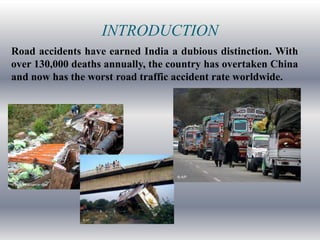
Road accidents have earned India a dubious distinction. With
over 130,000 deaths annually, the country has overtaken China
and now has the worst road traffic accident rate worldwide.
Situation
  To provide immediate assistance to victims on spot
   we need to know basic information like Location
   of the accident site, the severity of crash , the
   number of people in the crash site ,etc
Solution
 An intelligent emergency call system
• utilising sensors to automatically detect a crash and using
wireless network to send critical systems to emergency
services
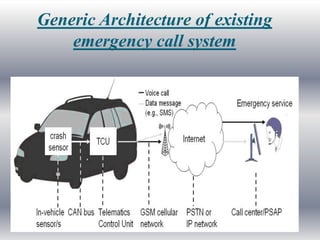
•Invehicle telematics control unit with a GPS receiver and
cellular network connectivity ,As in a GSM communication
,connected to the car sensors
Generic Architecture of existing
    emergency call system
ARCHITECTURE AND STANDARDIZATION
              OF eCALL
•Use GSM Network to communicate between the vehicle in
the incident and the PSAP
•In Europe , the emergency call number E112 used
•Two main issues for the standardization
   •The transport protocol by which the Minimum Set of
   Data (MSD) will be sent.
   •The content and the format of the MSD. It could amount
   to 140 bytes including info like time stamp, vehicle
   number and location.

   European Telecommunications Standards Institute (ETSI)
   is incharge in setting the standards for the architecture.
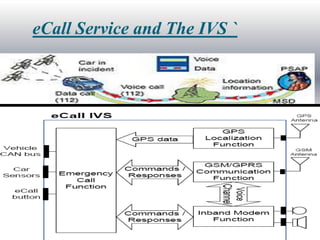
eCall Service and The IVS `
IMPLEMENTATION
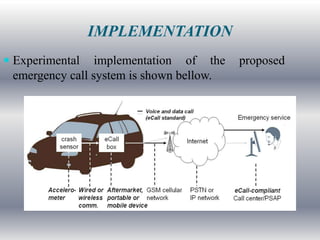
 Experimental implementation of the       proposed
  emergency call system is shown bellow.
Crash sensor
  An accelerometer was chosen as the crash sensor
  It is a low-cost solution capable of detecting frontal,
   lateral and roll-over crashes.
  Can Use pressure sensors to react to side impacts
   monitoring changes in air pressure in vehicle body
   cavities
  Crash Impact Sound Sensor ,detects vibrations in
   material for judgement of deformation being
   experienced can also be used
  Censor should be placed in a suitable place
    In car, at the front .
    In Bike , below the seat or in the helmet
eCall Box
 The eCall box is a communications-enabled device,


 Shall encompass at least GSM and may include Short-
  Range Communications (SRC) if the crash sensor is
  physically separated from the eCall box hosting the
  proposed emergency call service.

 Communicates with the crash sensor through wired or
  wireless link
.
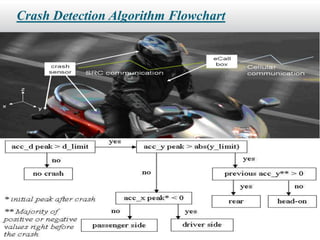
Crash Detection Algorithm Flowchart


    Implementation of the crash sensor and eCall box on a motorbike
MSD
 The MSD includes vehicle location information, time
  stamp, number of passengers, Vehicle Identification
  Number (VIN), and geographical locations along with
  other relevant information
 SRC helps detecting the number of Bluetooth active
  handheld devices which provides the estimation of
  the number of people in the car.
 The other ways of finding the number of people can
  be seat belt sensors and also pressure on the seats can
  be used for the same
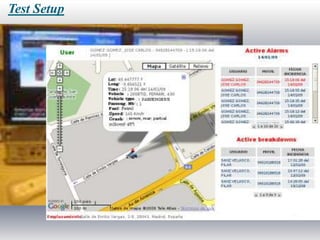
Test Setup
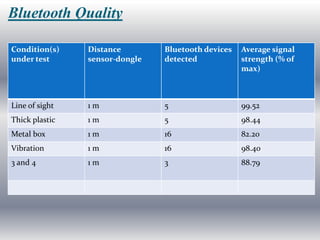
Bluetooth Quality

Condition(s)    Distance        Bluetooth devices   Average signal
under test      sensor-dongle   detected            strength (% of
                                                    max)


Line of sight   1m              5                   99.52
Thick plastic   1m              5                   98.44
Metal box       1m              16                  82.20
Vibration       1m              16                  98.40
3 and 4         1m              3                   88.79
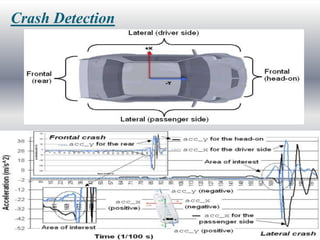
Crash Detection
ANALYSIS
 Advantages:
   Studies show that the emergency response time could be
    reduced by about 50% in rural areas and 40% in urban
    areas.

   It is estimated that the e-Call system could save up to 2 500
    lives a year in the EU and, in particular, could significantly
    reduce the severity of the injuries sustained in 15% of cases.

   Also the GPS tracker in the vehicle helps to find the location
    of the car when it is stolen, thus it helps to find about
    missing vehicles also.

   The system will also ensure a corresponding reduction in the
    number of traffic jams.
CONCLUSION
 To improve the notification of road accidents and speeding up
  emergency service response.

 This service, which was expected to be offered in all new four-
  wheeled vehicles by 2010, will provide E112 with information
  about the vehicle and its location.

 As a future work , implementing sensor in a miniaturised board
  containing       an accelerometer ,a controller, Bluetooth
  transreceiver , and autonomous battery .
 Implementation of the system on mobile phones resulted in
  battery drain out in 2.5 to 3.5 h
 Characterize the system on bike , if in case is ejected out due
  to a crash and is unreachable
REFERENCES

 [1] US Patent 6141611, “Mobile vehicle accident data system”, 2000.
 [2] US Patent 7133661, “Emergency information notifying system, and
    apparatus, method and moving object utilizing the emergency information
    notifying system”, 2006.
   [3] US Patent 6587042, “Automatic accident informing apparatus for two
    wheel vehicle”, 2003.
   [4] eCall Driving Group, "Recommendations of the DG eCall for the
    introduction of the pan-European eCall", 2006.
   [5] European Committee for Standardization TC 278 WG, “Road transport
    and traffic telematics - ESafety - ECall minimum set of data”, 2008.
   [6] E. Zafeiratou, “Options for eCall MSD signalling”,GSM Europe, 2006.
   [7] M. Feser, et al., “Advanced crash discrimination using crash impact
    sound sensing”, in Proc. SAE World Congress & Exhibition, 2006.
Ecall :
Ecall :

Ecall :

  • 1.
    SEMINAR ON ECall-Compliant Early Crash Notification Service for Portable and Nomadic Devices Submitted by SHEETHAL RAJAGOPAL 111006065 Under the guidance of Mrs. Deepthi . R.S
  • 2.
    OVERVIEW  Introduction  Architectureand standardization of eCALL  Implementation  Analysis  Conclusion
  • 3.
    INTRODUCTION Road accidents haveearned India a dubious distinction. With over 130,000 deaths annually, the country has overtaken China and now has the worst road traffic accident rate worldwide.
  • 4.
    Situation  Toprovide immediate assistance to victims on spot we need to know basic information like Location of the accident site, the severity of crash , the number of people in the crash site ,etc Solution An intelligent emergency call system • utilising sensors to automatically detect a crash and using wireless network to send critical systems to emergency services •Invehicle telematics control unit with a GPS receiver and cellular network connectivity ,As in a GSM communication ,connected to the car sensors
  • 5.
    Generic Architecture ofexisting emergency call system
  • 6.
    ARCHITECTURE AND STANDARDIZATION OF eCALL •Use GSM Network to communicate between the vehicle in the incident and the PSAP •In Europe , the emergency call number E112 used •Two main issues for the standardization •The transport protocol by which the Minimum Set of Data (MSD) will be sent. •The content and the format of the MSD. It could amount to 140 bytes including info like time stamp, vehicle number and location. European Telecommunications Standards Institute (ETSI) is incharge in setting the standards for the architecture.
  • 7.
  • 8.
    IMPLEMENTATION  Experimental implementationof the proposed emergency call system is shown bellow.
  • 9.
    Crash sensor An accelerometer was chosen as the crash sensor  It is a low-cost solution capable of detecting frontal, lateral and roll-over crashes.  Can Use pressure sensors to react to side impacts monitoring changes in air pressure in vehicle body cavities  Crash Impact Sound Sensor ,detects vibrations in material for judgement of deformation being experienced can also be used  Censor should be placed in a suitable place  In car, at the front .  In Bike , below the seat or in the helmet
  • 10.
    eCall Box  TheeCall box is a communications-enabled device,  Shall encompass at least GSM and may include Short- Range Communications (SRC) if the crash sensor is physically separated from the eCall box hosting the proposed emergency call service.  Communicates with the crash sensor through wired or wireless link .
  • 11.
    Crash Detection AlgorithmFlowchart Implementation of the crash sensor and eCall box on a motorbike
  • 12.
    MSD  The MSDincludes vehicle location information, time stamp, number of passengers, Vehicle Identification Number (VIN), and geographical locations along with other relevant information  SRC helps detecting the number of Bluetooth active handheld devices which provides the estimation of the number of people in the car.  The other ways of finding the number of people can be seat belt sensors and also pressure on the seats can be used for the same
  • 13.
  • 14.
    Bluetooth Quality Condition(s) Distance Bluetooth devices Average signal under test sensor-dongle detected strength (% of max) Line of sight 1m 5 99.52 Thick plastic 1m 5 98.44 Metal box 1m 16 82.20 Vibration 1m 16 98.40 3 and 4 1m 3 88.79
  • 15.
  • 16.
    ANALYSIS  Advantages:  Studies show that the emergency response time could be reduced by about 50% in rural areas and 40% in urban areas.  It is estimated that the e-Call system could save up to 2 500 lives a year in the EU and, in particular, could significantly reduce the severity of the injuries sustained in 15% of cases.  Also the GPS tracker in the vehicle helps to find the location of the car when it is stolen, thus it helps to find about missing vehicles also.  The system will also ensure a corresponding reduction in the number of traffic jams.
  • 17.
    CONCLUSION  To improvethe notification of road accidents and speeding up emergency service response.  This service, which was expected to be offered in all new four- wheeled vehicles by 2010, will provide E112 with information about the vehicle and its location.  As a future work , implementing sensor in a miniaturised board containing an accelerometer ,a controller, Bluetooth transreceiver , and autonomous battery .  Implementation of the system on mobile phones resulted in battery drain out in 2.5 to 3.5 h  Characterize the system on bike , if in case is ejected out due to a crash and is unreachable
  • 18.
    REFERENCES  [1] USPatent 6141611, “Mobile vehicle accident data system”, 2000.  [2] US Patent 7133661, “Emergency information notifying system, and apparatus, method and moving object utilizing the emergency information notifying system”, 2006.  [3] US Patent 6587042, “Automatic accident informing apparatus for two wheel vehicle”, 2003.  [4] eCall Driving Group, "Recommendations of the DG eCall for the introduction of the pan-European eCall", 2006.  [5] European Committee for Standardization TC 278 WG, “Road transport and traffic telematics - ESafety - ECall minimum set of data”, 2008.  [6] E. Zafeiratou, “Options for eCall MSD signalling”,GSM Europe, 2006.  [7] M. Feser, et al., “Advanced crash discrimination using crash impact sound sensing”, in Proc. SAE World Congress & Exhibition, 2006.