The	
  current	
  state	
  of	
  	
  
automo/ve	
  security	
  
Dr.	
  Charlie	
  Miller	
  (@0xcharlie)	
  
Chris	
  Valasek	
  (@nudehaberdasher)	
  
INTRODUCTION	
  
Who	
  
•  Charlie	
  Miller	
  	
  
[Security	
  Engineer]	
  	
  
|Twi2er|	
  
•  Chris	
  Valasek	
  	
  
[Director	
  of	
  Security	
  Intelligence]	
  |
IOAc8ve|	
  	
  
Agenda	
  
•  Anatomy	
  of	
  an	
  aJack	
  
•  CAN	
  Basics	
  
•  AJacking	
  the	
  CAN	
  bus	
  
•  Securing	
  the	
  modern	
  vehicle	
  
ANATOMY	
  OF	
  AN	
  ATTACK	
  
Step	
  1:	
  Code	
  execu/on	
  
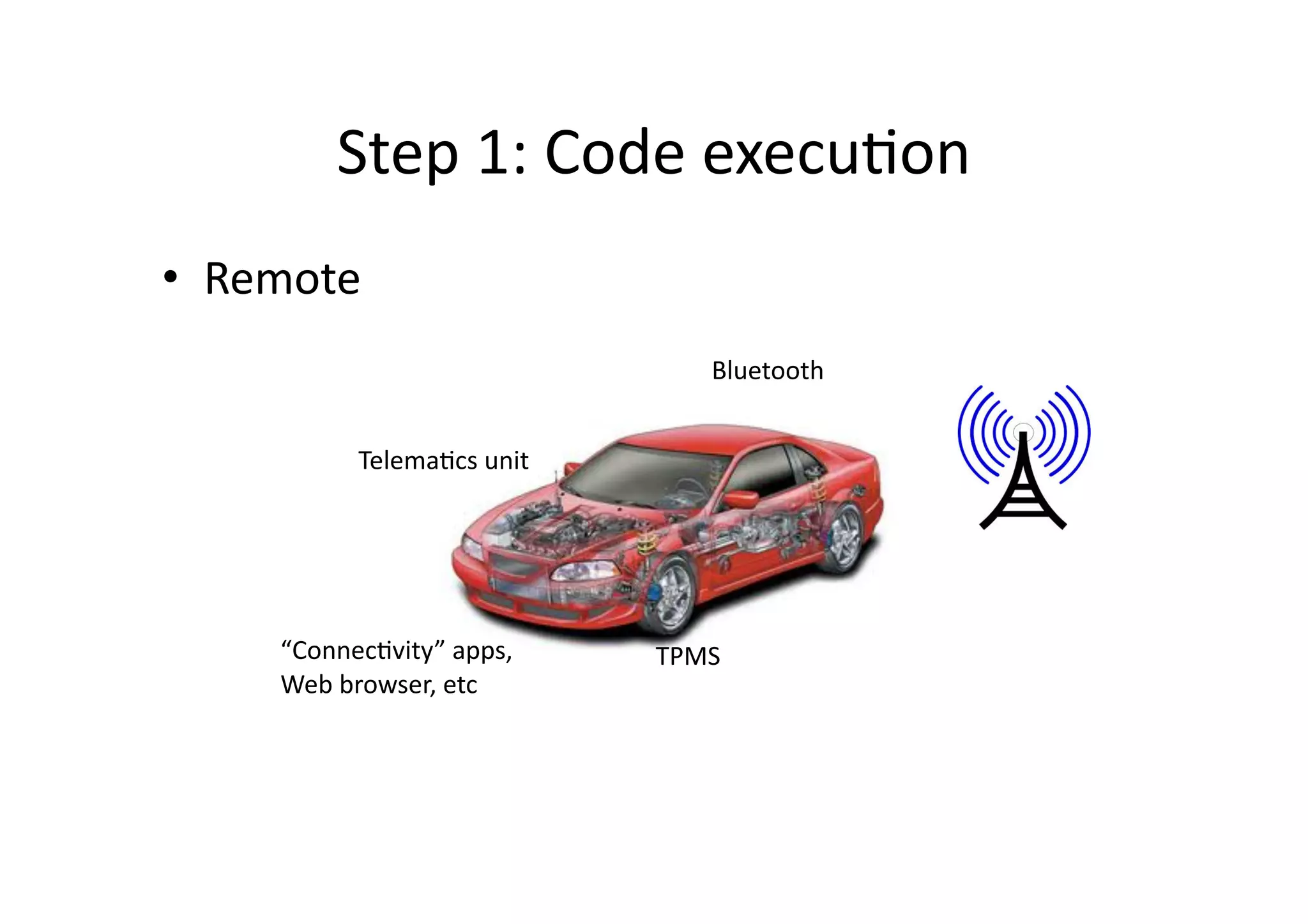
•  Remote	
  
Telema/cs	
  unit	
  
TPMS	
  
Bluetooth	
  
“Connec/vity”	
  apps,	
  
Web	
  browser,	
  etc	
  
Step	
  1:	
  Code	
  execu/on	
  (cont.)	
  
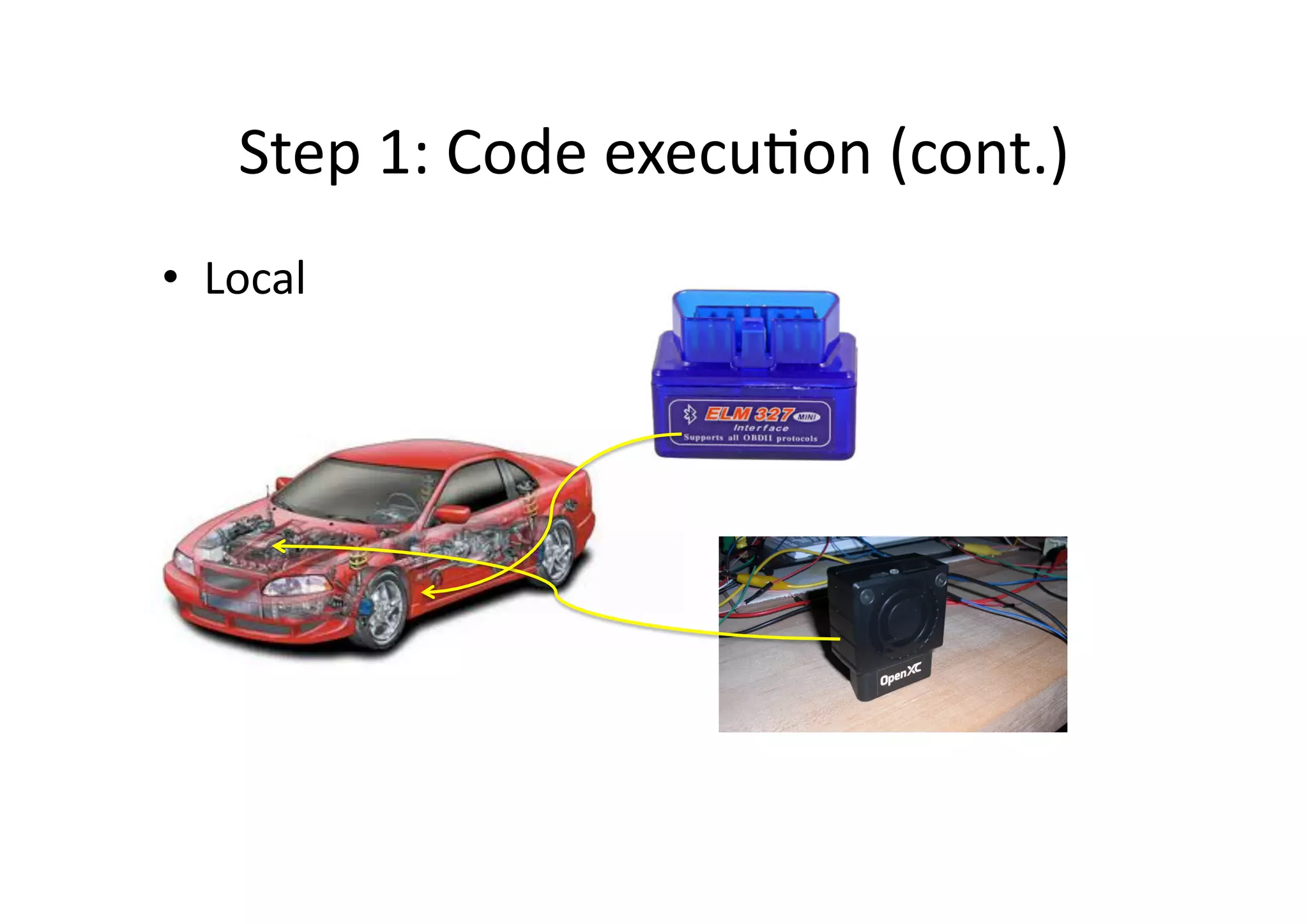
•  Local	
  
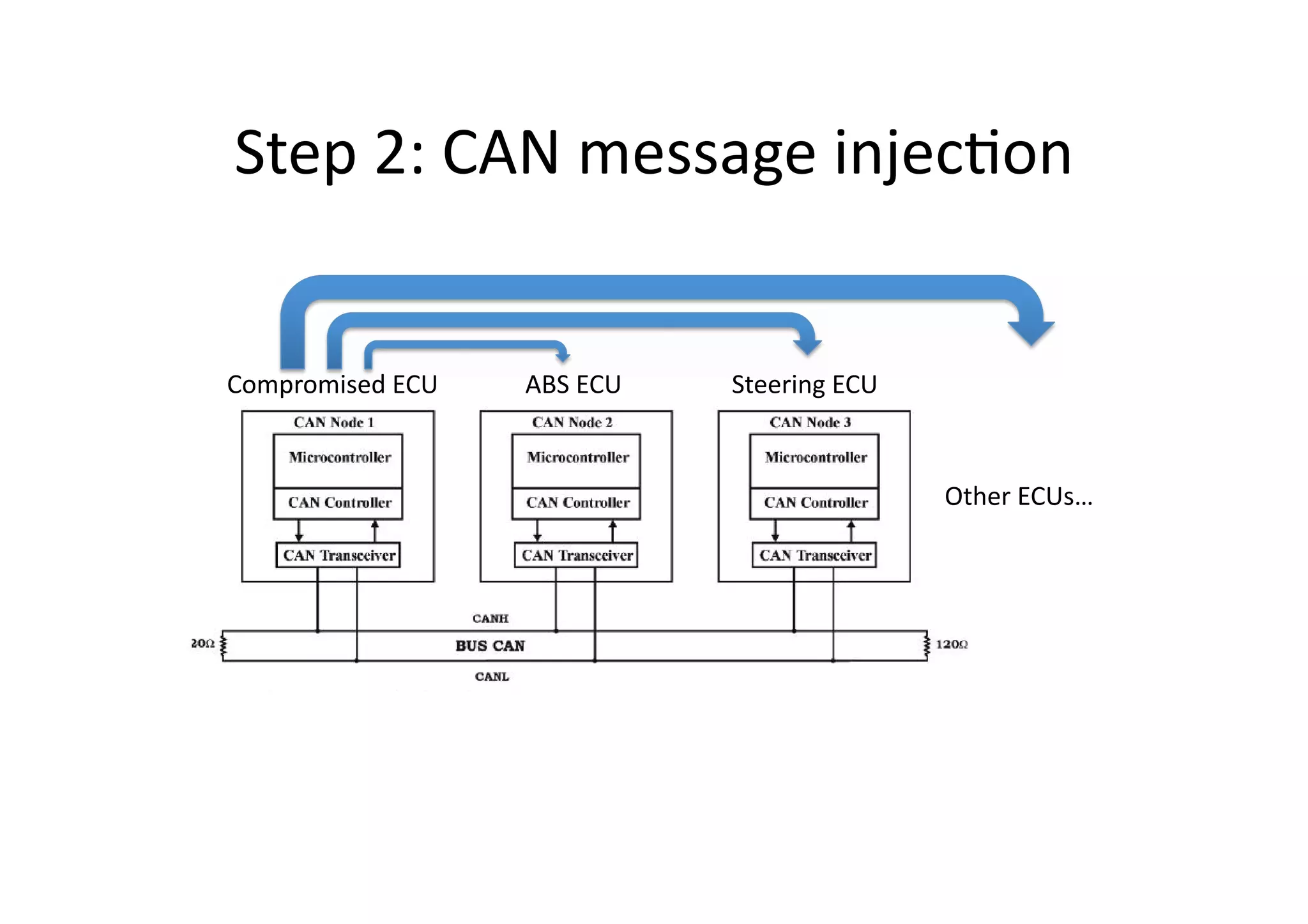
Step	
  2:	
  CAN	
  message	
  injec/on	
  
Compromised	
  ECU	
   ABS	
  ECU	
   Steering	
  ECU	
  
Other	
  ECUs…	
  
AJack	
  Scenario	
  
•  A	
  remote	
  vulnerability	
  s/ll	
  relies	
  on	
  ‘local’	
  
informa/on	
  
–  Example:	
  A	
  remote	
  exploit	
  targe/ng	
  a	
  vulnerability	
  in	
  
the	
  Bluetooth	
  receiver	
  is	
  only	
  harmful	
  if	
  the	
  aJacker	
  
knows	
  specific	
  informa/on	
  about	
  the	
  vehicle	
  
•  Both	
  learning	
  the	
  local	
  control	
  and	
  remote	
  
vulnerability	
  are	
  required	
  	
  
•  Local	
  can	
  actually	
  take	
  longer	
  due	
  to	
  being	
  
different	
  for	
  every	
  vehicle	
  
–  Remote	
  can	
  span	
  makes/models	
  due	
  to	
  nature	
  of	
  
OEM	
  purchasing	
  of	
  devices	
  (i.e.	
  infotainment	
  systems)	
  
ELECTRONIC	
  CONTROL	
  UNITS	
  
(ECUS)	
  
Electronic	
  Control	
  Units	
  
•  Controls	
  almost	
  every	
  aspect	
  of	
  the	
  modern	
  
automobile	
  
•  Take	
  input	
  from	
  sensors	
  and	
  provide	
  output	
  to	
  
actuators	
  	
  
•  Located	
  in	
  various	
  places	
  throughout	
  the	
  car	
  
•  ECUs	
  are	
  running	
  custom	
  code	
  on	
  unusual	
  
hardware	
  
– Infotainment	
  systems	
  may	
  be	
  Linux/Windows	
  
variant,	
  but	
  func/on	
  ECUs	
  are	
  custom	
  code	
  
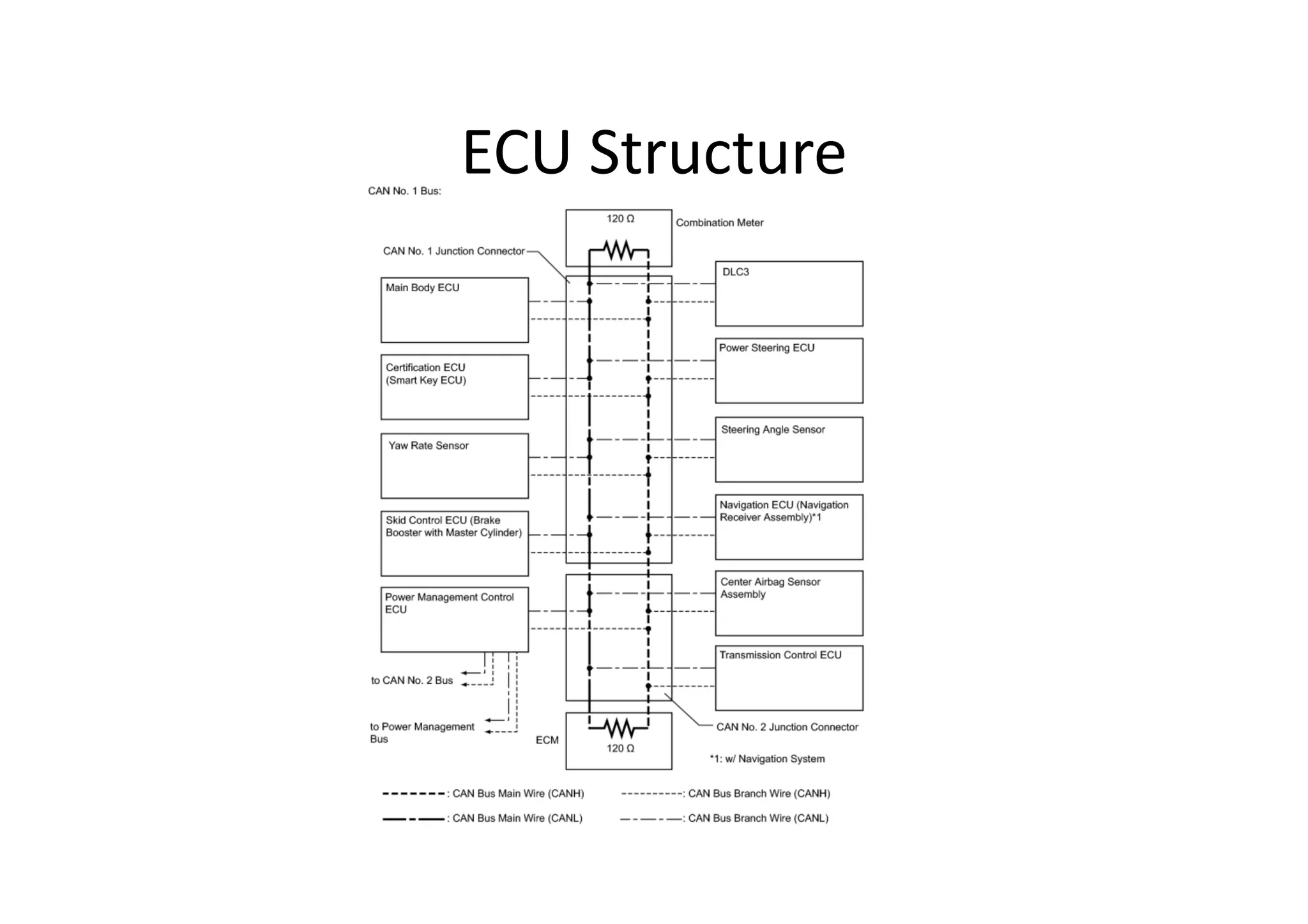
ECU	
  Structure	
  
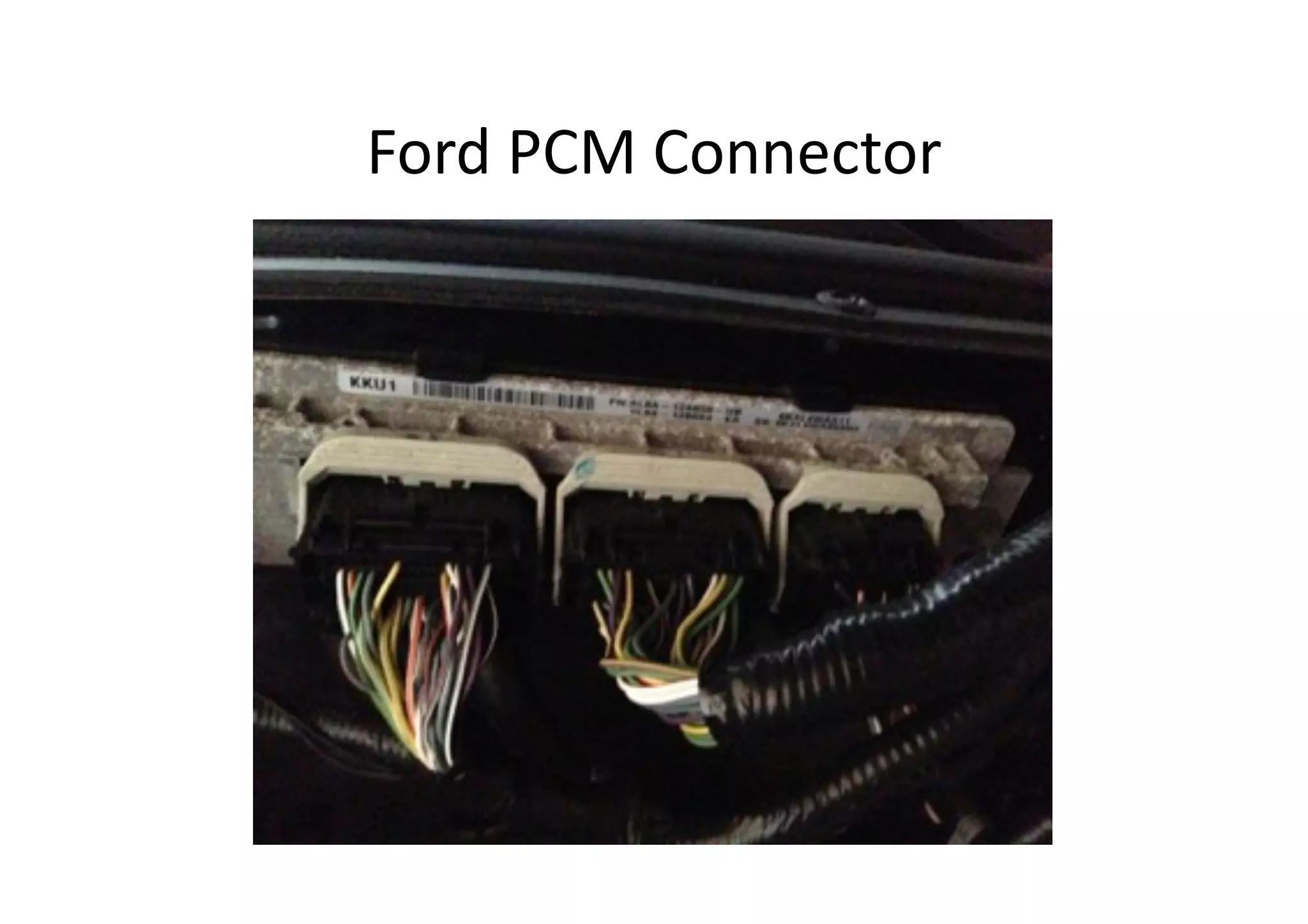
Ford	
  PCM	
  Connector	
  
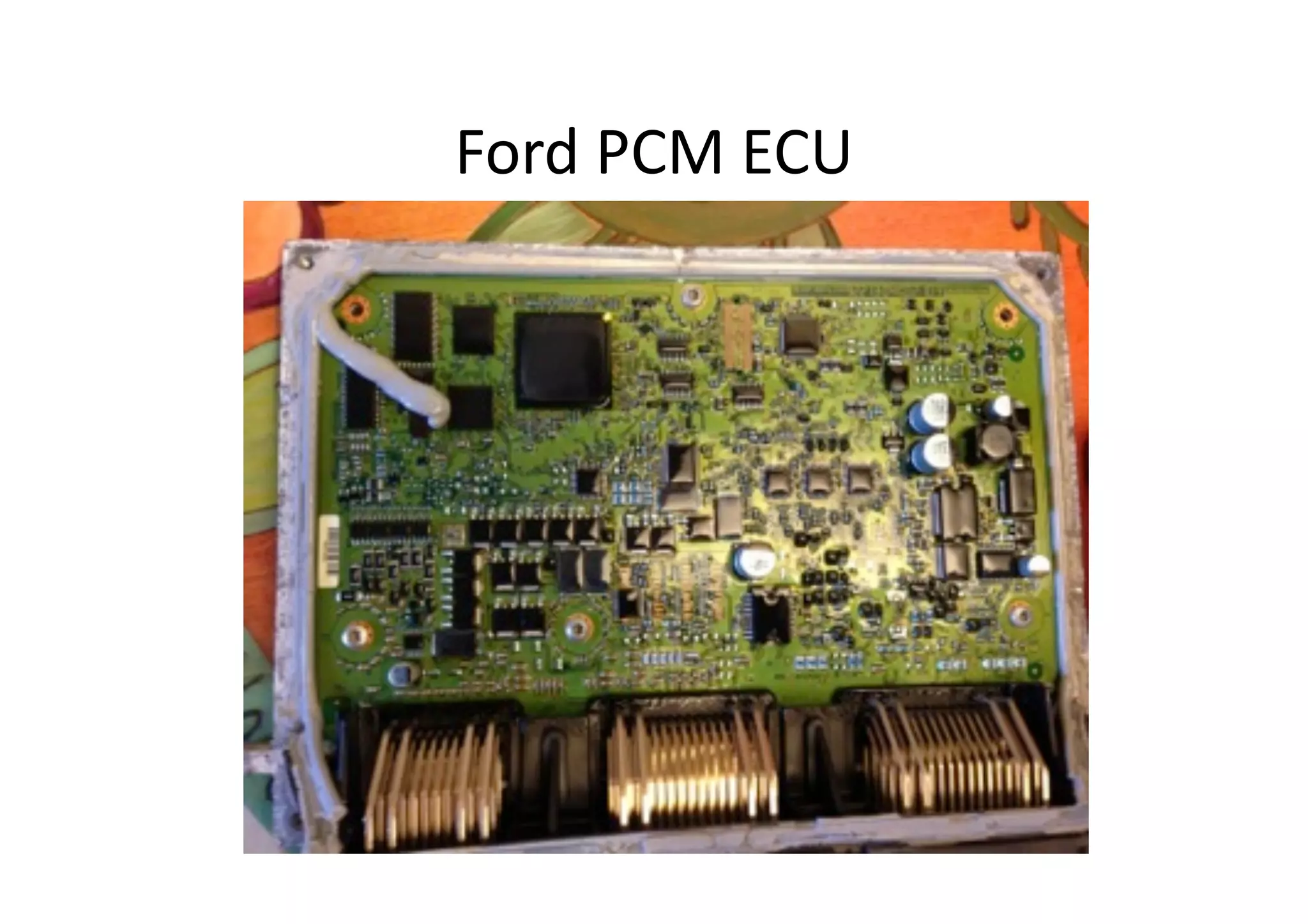
Ford	
  PCM	
  ECU	
  
CAN	
  BASICS	
  
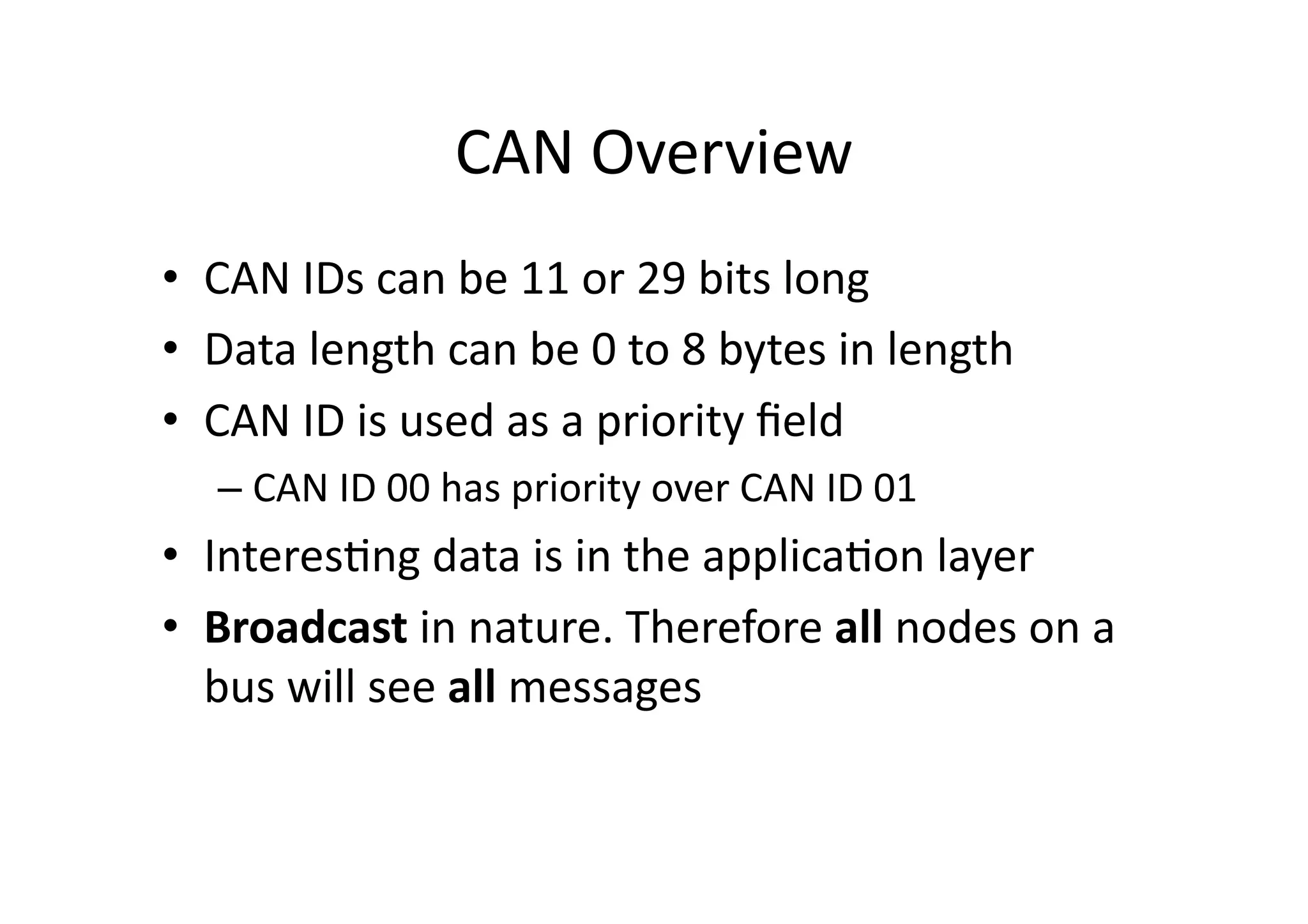
CAN	
  Overview	
  
•  CAN	
  IDs	
  can	
  be	
  11	
  or	
  29	
  bits	
  long	
  
•  Data	
  length	
  can	
  be	
  0	
  to	
  8	
  bytes	
  in	
  length	
  
•  CAN	
  ID	
  is	
  used	
  as	
  a	
  priority	
  field	
  
– CAN	
  ID	
  00	
  has	
  priority	
  over	
  CAN	
  ID	
  01	
  
•  Interes/ng	
  data	
  is	
  in	
  the	
  applica/on	
  layer	
  
•  Broadcast	
  in	
  nature.	
  Therefore	
  all	
  nodes	
  on	
  a	
  
bus	
  will	
  see	
  all	
  messages	
  
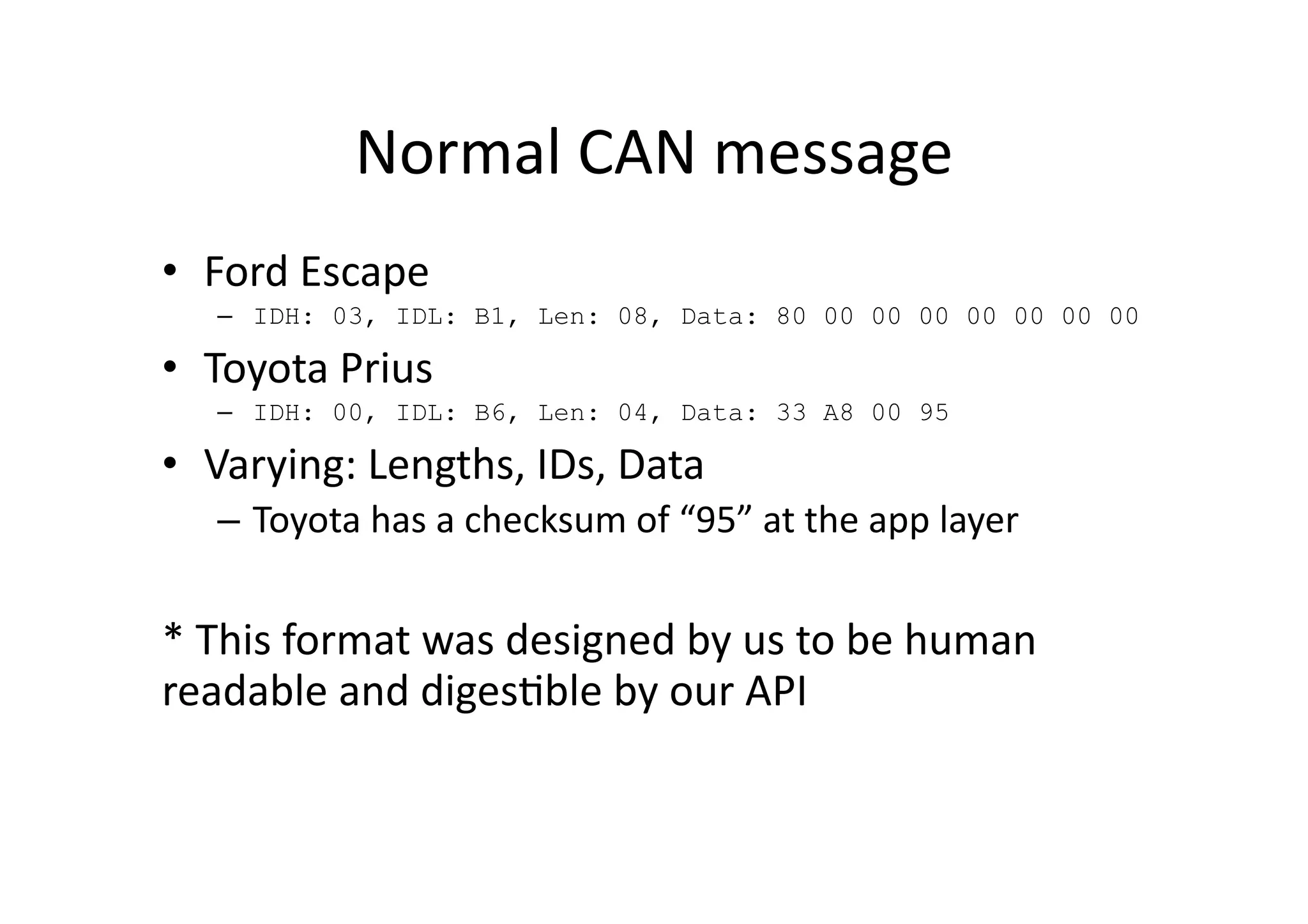
Normal	
  CAN	
  message	
  
•  Ford	
  Escape	
  	
  
–  IDH: 03, IDL: B1, Len: 08, Data: 80 00 00 00 00 00 00 00
•  Toyota	
  Prius	
  
–  IDH: 00, IDL: B6, Len: 04, Data: 33 A8 00 95
•  Varying:	
  Lengths,	
  IDs,	
  Data	
  
–  Toyota	
  has	
  a	
  checksum	
  of	
  “95”	
  at	
  the	
  app	
  layer	
  
*	
  This	
  format	
  was	
  designed	
  by	
  us	
  to	
  be	
  human	
  
readable	
  and	
  diges/ble	
  by	
  our	
  API	
  
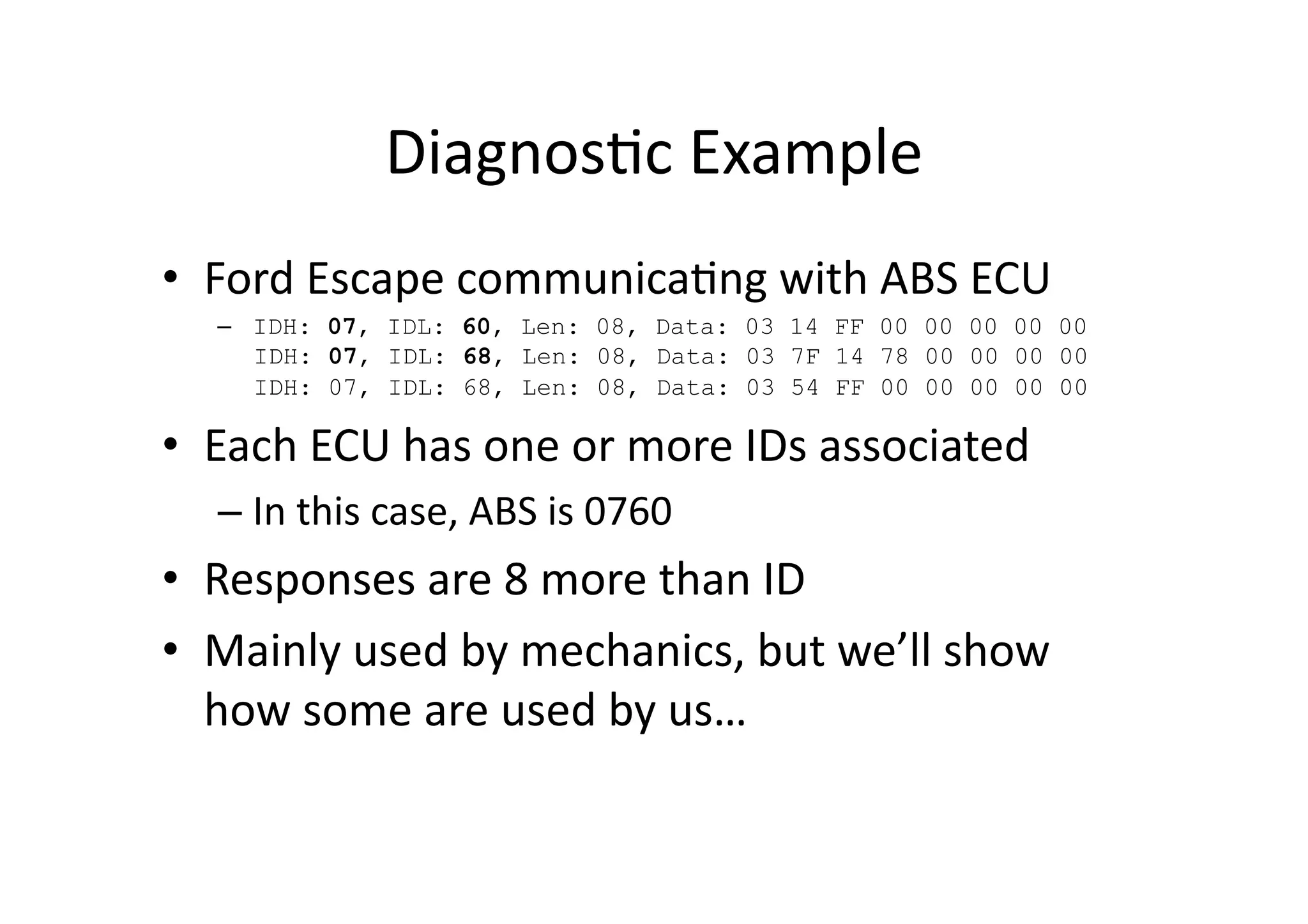
Diagnos/c	
  Example	
  
•  Ford	
  Escape	
  communica/ng	
  with	
  ABS	
  ECU	
  
–  IDH: 07, IDL: 60, Len: 08, Data: 03 14 FF 00 00 00 00 00
IDH: 07, IDL: 68, Len: 08, Data: 03 7F 14 78 00 00 00 00
IDH: 07, IDL: 68, Len: 08, Data: 03 54 FF 00 00 00 00 00
•  Each	
  ECU	
  has	
  one	
  or	
  more	
  IDs	
  associated	
  
– In	
  this	
  case,	
  ABS	
  is	
  0760	
  
•  Responses	
  are	
  8	
  more	
  than	
  ID	
  
•  Mainly	
  used	
  by	
  mechanics,	
  but	
  we’ll	
  show	
  
how	
  some	
  are	
  used	
  by	
  us…	
  
STANDARDS	
  &	
  PROTOCOLS	
  
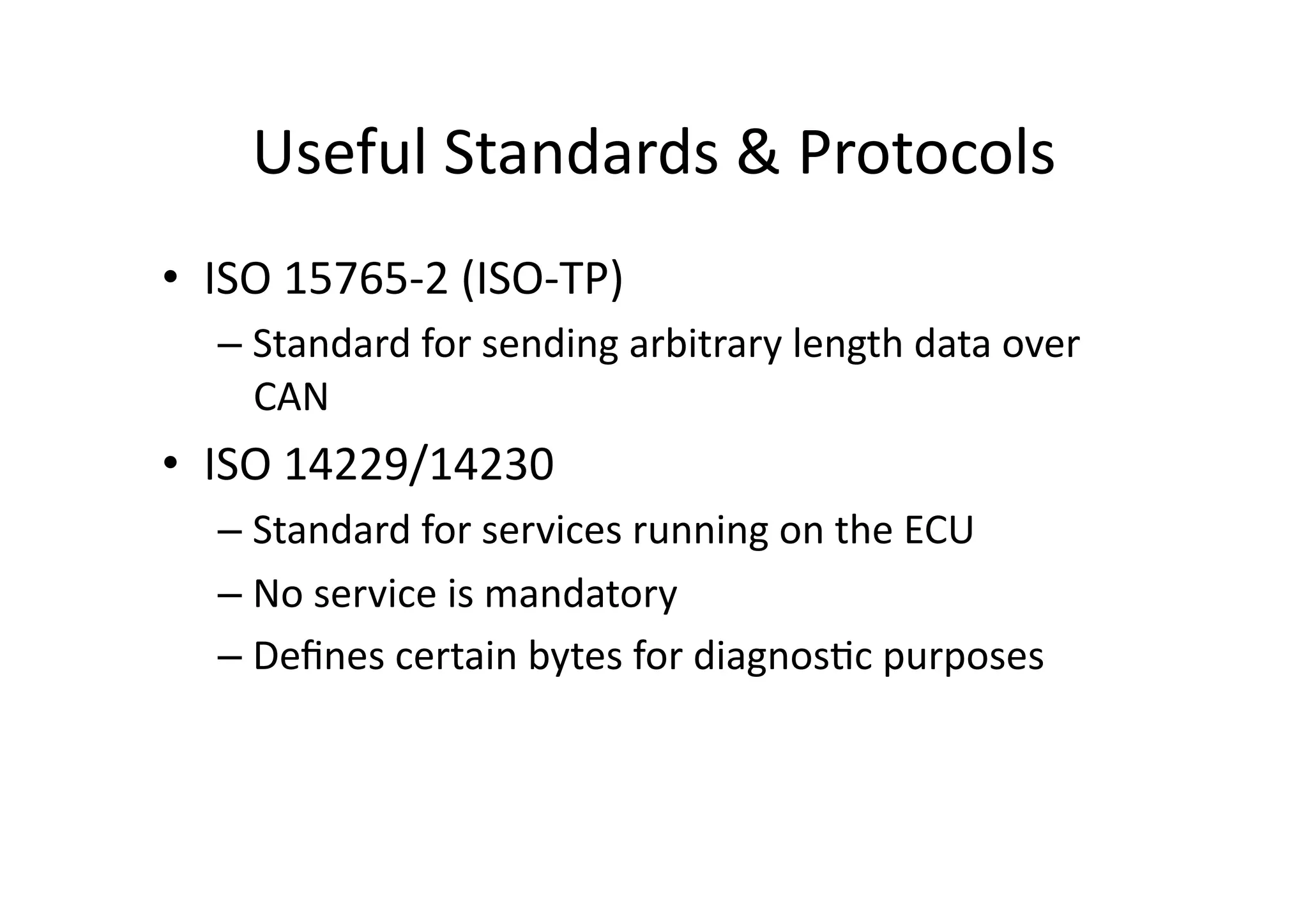
Useful	
  Standards	
  &	
  Protocols	
  
•  ISO	
  15765-­‐2	
  (ISO-­‐TP)	
  
– Standard	
  for	
  sending	
  arbitrary	
  length	
  data	
  over	
  
CAN	
  
•  ISO	
  14229/14230	
  
– Standard	
  for	
  services	
  running	
  on	
  the	
  ECU	
  
– No	
  service	
  is	
  mandatory	
  
– Defines	
  certain	
  bytes	
  for	
  diagnos/c	
  purposes	
  
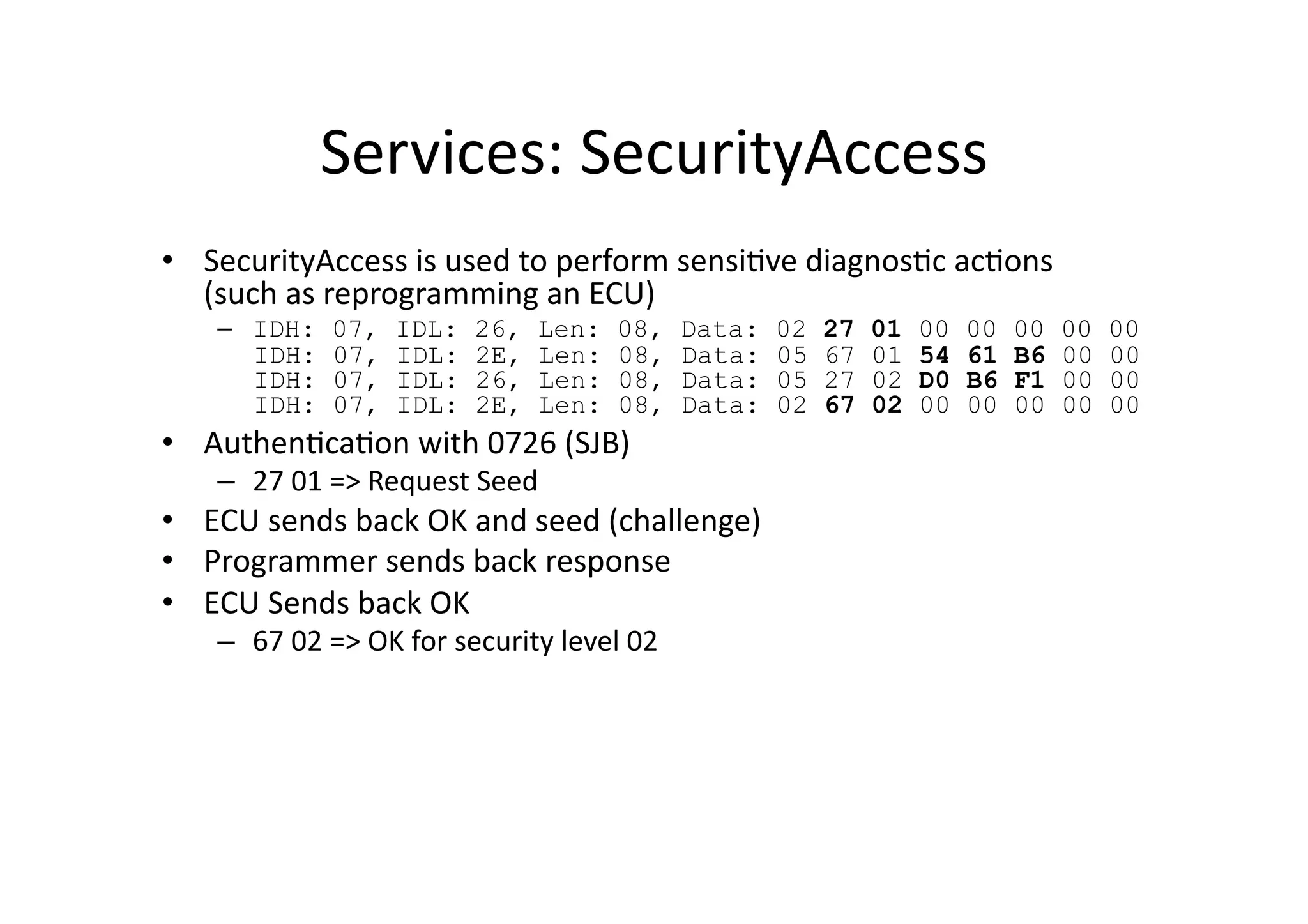
Services:	
  SecurityAccess	
  
•  SecurityAccess	
  is	
  used	
  to	
  perform	
  sensi/ve	
  diagnos/c	
  ac/ons	
  	
  
(such	
  as	
  reprogramming	
  an	
  ECU)	
  
–  IDH: 07, IDL: 26, Len: 08, Data: 02 27 01 00 00 00 00 00
IDH: 07, IDL: 2E, Len: 08, Data: 05 67 01 54 61 B6 00 00
IDH: 07, IDL: 26, Len: 08, Data: 05 27 02 D0 B6 F1 00 00
IDH: 07, IDL: 2E, Len: 08, Data: 02 67 02 00 00 00 00 00
•  Authen/ca/on	
  with	
  0726	
  (SJB)	
  
–  27	
  01	
  =>	
  Request	
  Seed	
  
•  ECU	
  sends	
  back	
  OK	
  and	
  seed	
  (challenge)	
  
•  Programmer	
  sends	
  back	
  response	
  
•  ECU	
  Sends	
  back	
  OK	
  
–  67	
  02	
  =>	
  OK	
  for	
  security	
  level	
  02	
  
Services:	
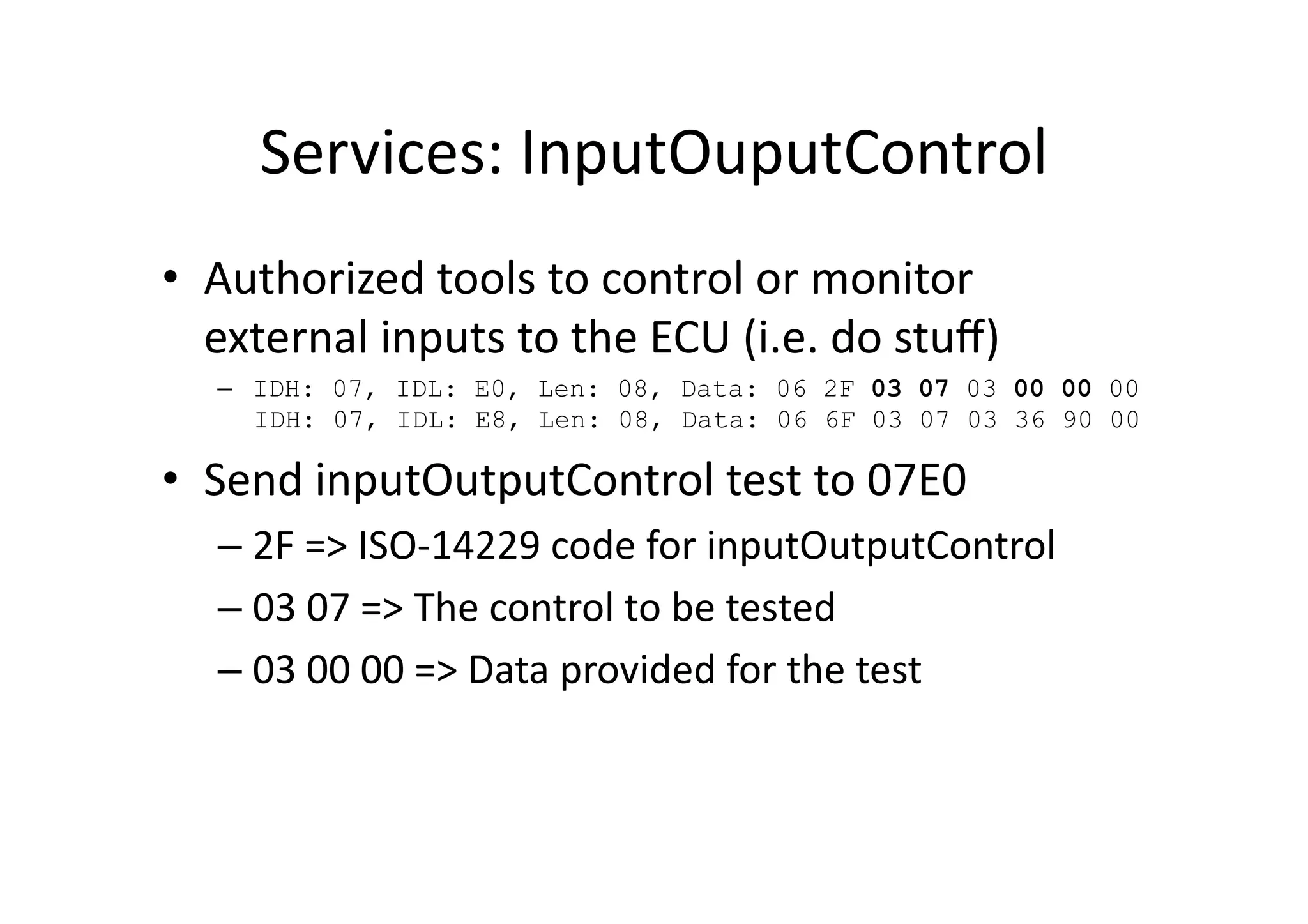
  InputOuputControl	
  
•  Authorized	
  tools	
  to	
  control	
  or	
  monitor	
  
external	
  inputs	
  to	
  the	
  ECU	
  (i.e.	
  do	
  stuff)	
  
–  IDH: 07, IDL: E0, Len: 08, Data: 06 2F 03 07 03 00 00 00
IDH: 07, IDL: E8, Len: 08, Data: 06 6F 03 07 03 36 90 00
•  Send	
  inputOutputControl	
  test	
  to	
  07E0	
  
– 2F	
  =>	
  ISO-­‐14229	
  code	
  for	
  inputOutputControl	
  
– 03	
  07	
  =>	
  The	
  control	
  to	
  be	
  tested	
  
– 03	
  00	
  00	
  =>	
  Data	
  provided	
  for	
  the	
  test	
  
Some	
  other	
  interes/ng	
  PIDs	
  
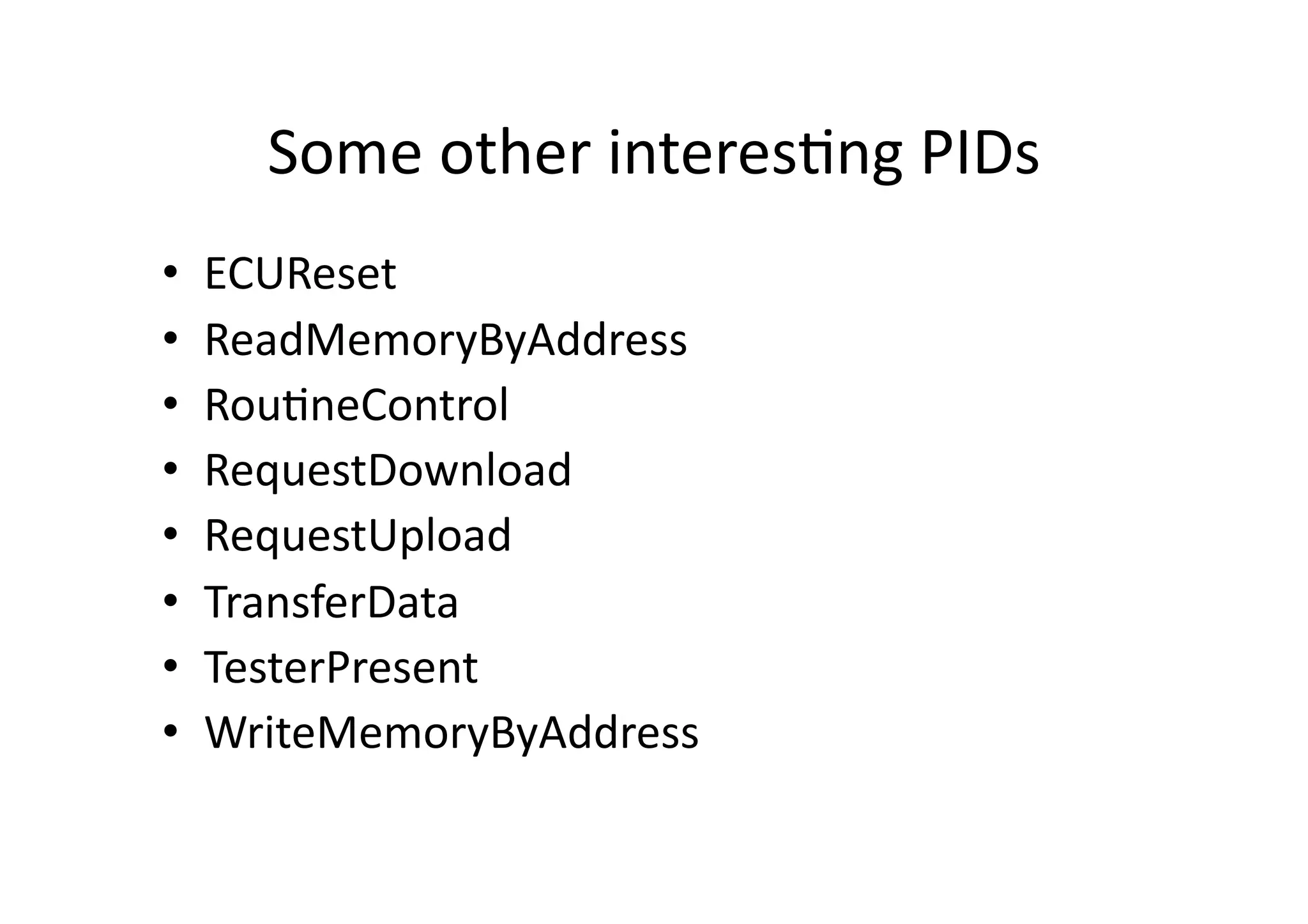
•  ECUReset	
  
•  ReadMemoryByAddress	
  
•  Rou/neControl	
  	
  
•  RequestDownload	
  
•  RequestUpload	
  
•  TransferData	
  
•  TesterPresent	
  
•  WriteMemoryByAddress	
  
Systemic	
  Issues	
  
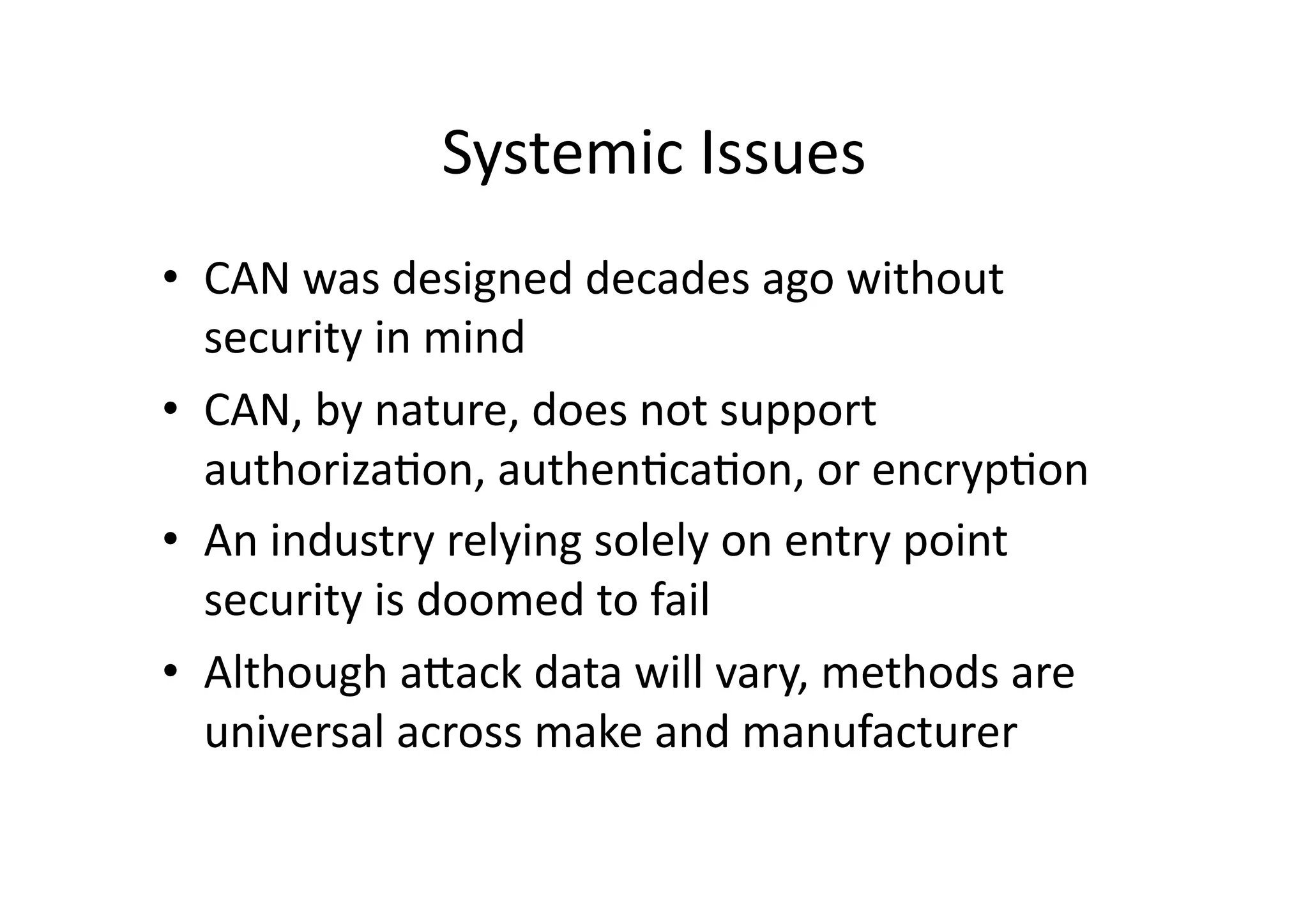
•  CAN	
  was	
  designed	
  decades	
  ago	
  without	
  
security	
  in	
  mind	
  
•  CAN,	
  by	
  nature,	
  does	
  not	
  support	
  
authoriza/on,	
  authen/ca/on,	
  or	
  encryp/on	
  
•  An	
  industry	
  relying	
  solely	
  on	
  entry	
  point	
  
security	
  is	
  doomed	
  to	
  fail	
  
•  Although	
  aJack	
  data	
  will	
  vary,	
  methods	
  are	
  
universal	
  across	
  make	
  and	
  manufacturer	
  
CURRENT	
  ATTACKS	
  
Injec/on	
  Limita/ons	
  
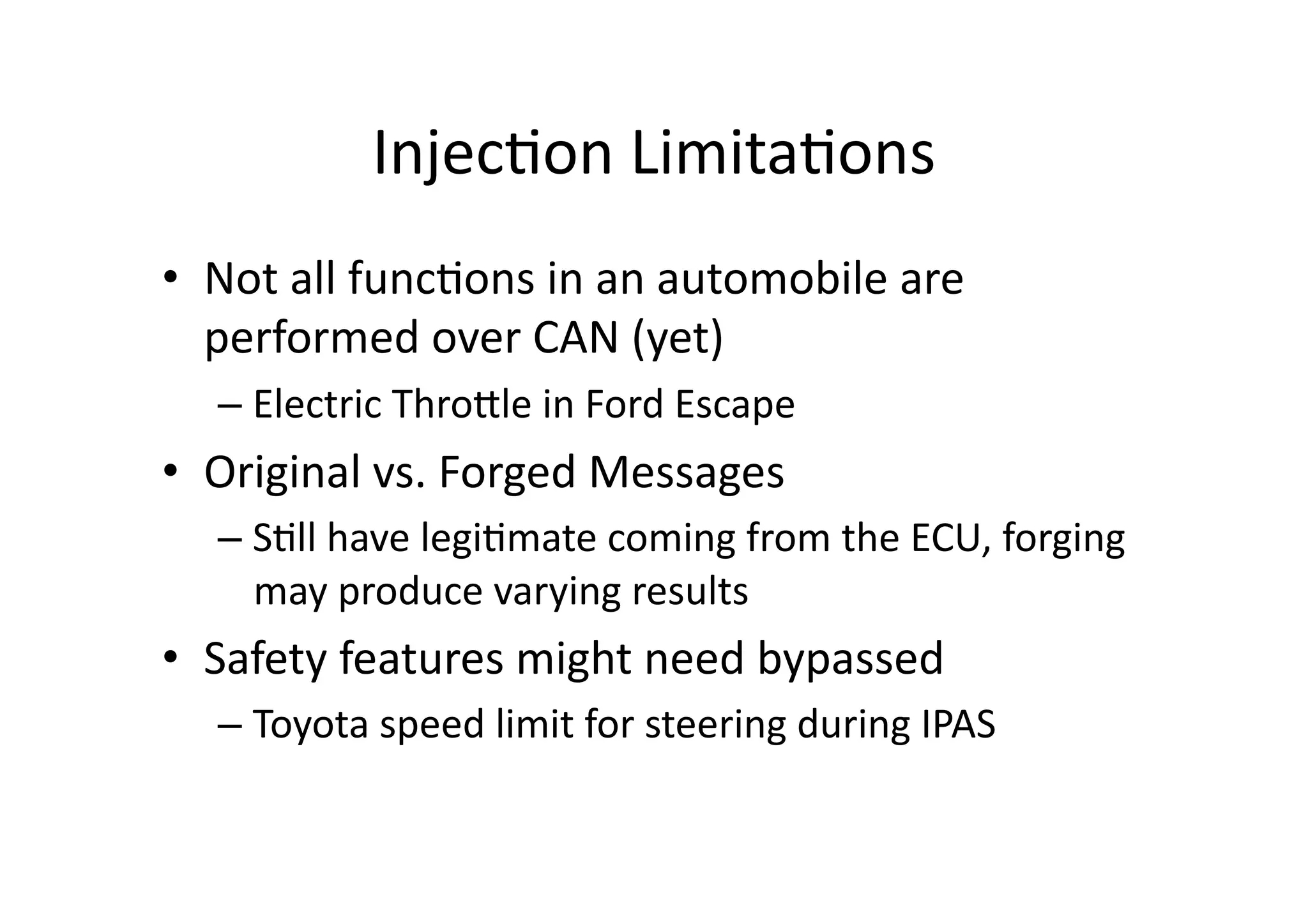
•  Not	
  all	
  func/ons	
  in	
  an	
  automobile	
  are	
  
performed	
  over	
  CAN	
  (yet)	
  
– Electric	
  ThroJle	
  in	
  Ford	
  Escape	
  	
  
•  Original	
  vs.	
  Forged	
  Messages	
  
– S/ll	
  have	
  legi/mate	
  coming	
  from	
  the	
  ECU,	
  forging	
  
may	
  produce	
  varying	
  results	
  
•  Safety	
  features	
  might	
  need	
  bypassed	
  
– Toyota	
  speed	
  limit	
  for	
  steering	
  during	
  IPAS	
  	
  
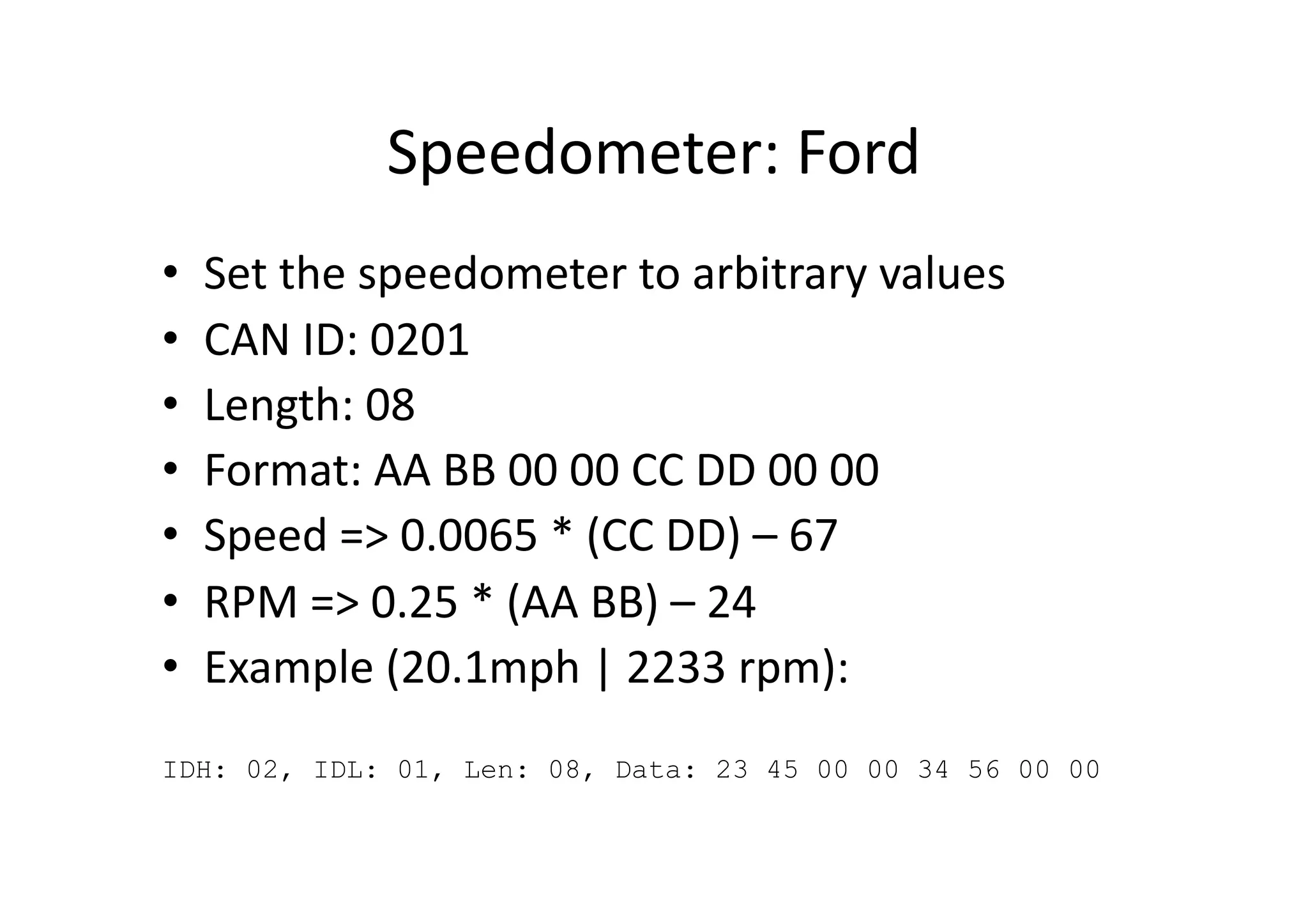
Speedometer:	
  Ford	
  
•  Set	
  the	
  speedometer	
  to	
  arbitrary	
  values	
  
•  CAN	
  ID:	
  0201	
  
•  Length:	
  08	
  
•  Format:	
  AA	
  BB	
  00	
  00	
  CC	
  DD	
  00	
  00	
  
•  Speed	
  =>	
  0.0065	
  *	
  (CC	
  DD)	
  –	
  67	
  
•  RPM	
  =>	
  0.25	
  *	
  (AA	
  BB)	
  –	
  24	
  
•  Example	
  (20.1mph	
  |	
  2233	
  rpm):	
  	
  
IDH: 02, IDL: 01, Len: 08, Data: 23 45 00 00 34 56 00 00
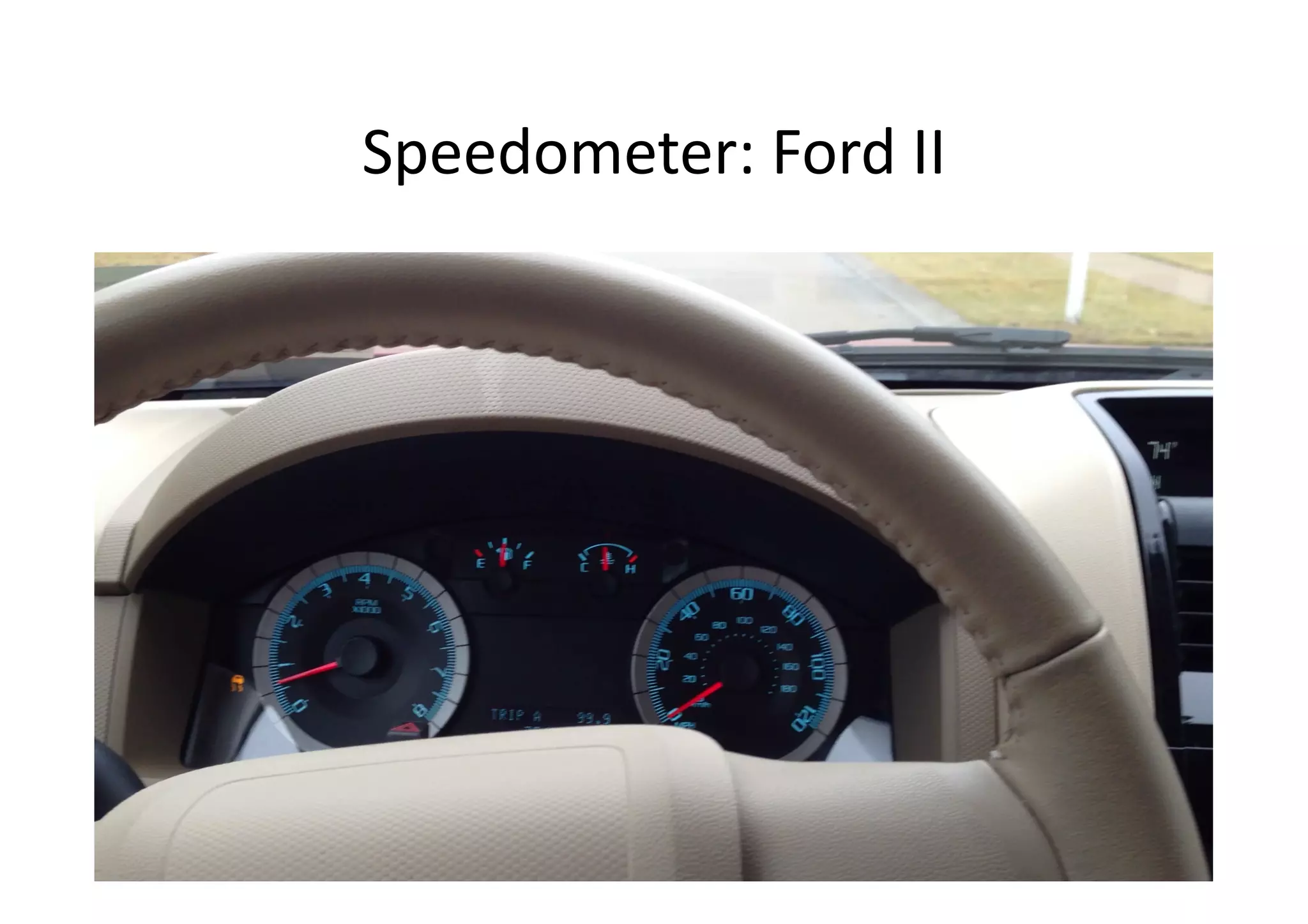
Speedometer:	
  Ford	
  II	
  
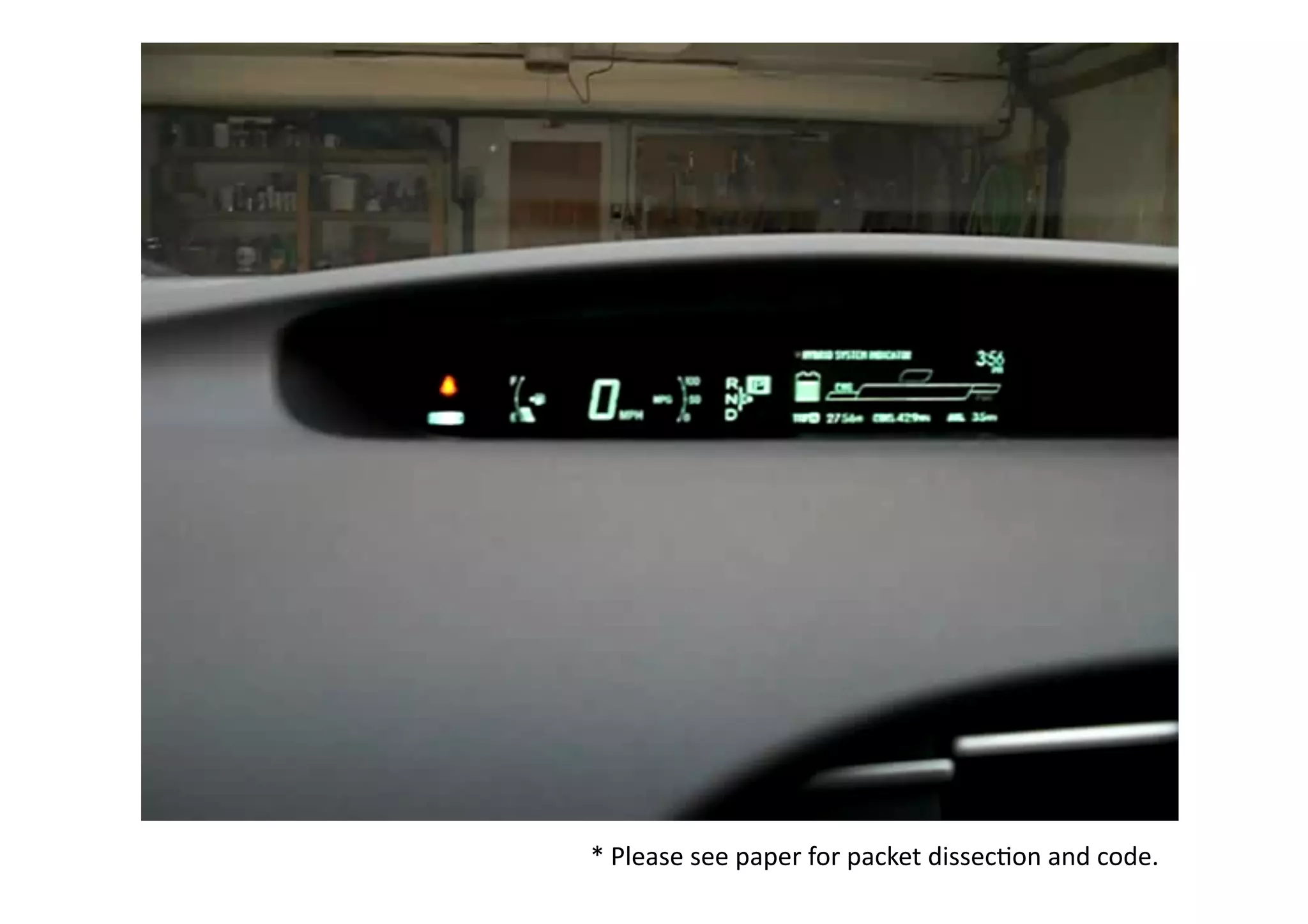
*	
  Please	
  see	
  paper	
  for	
  packet	
  dissec/on	
  and	
  code.	
  	
  
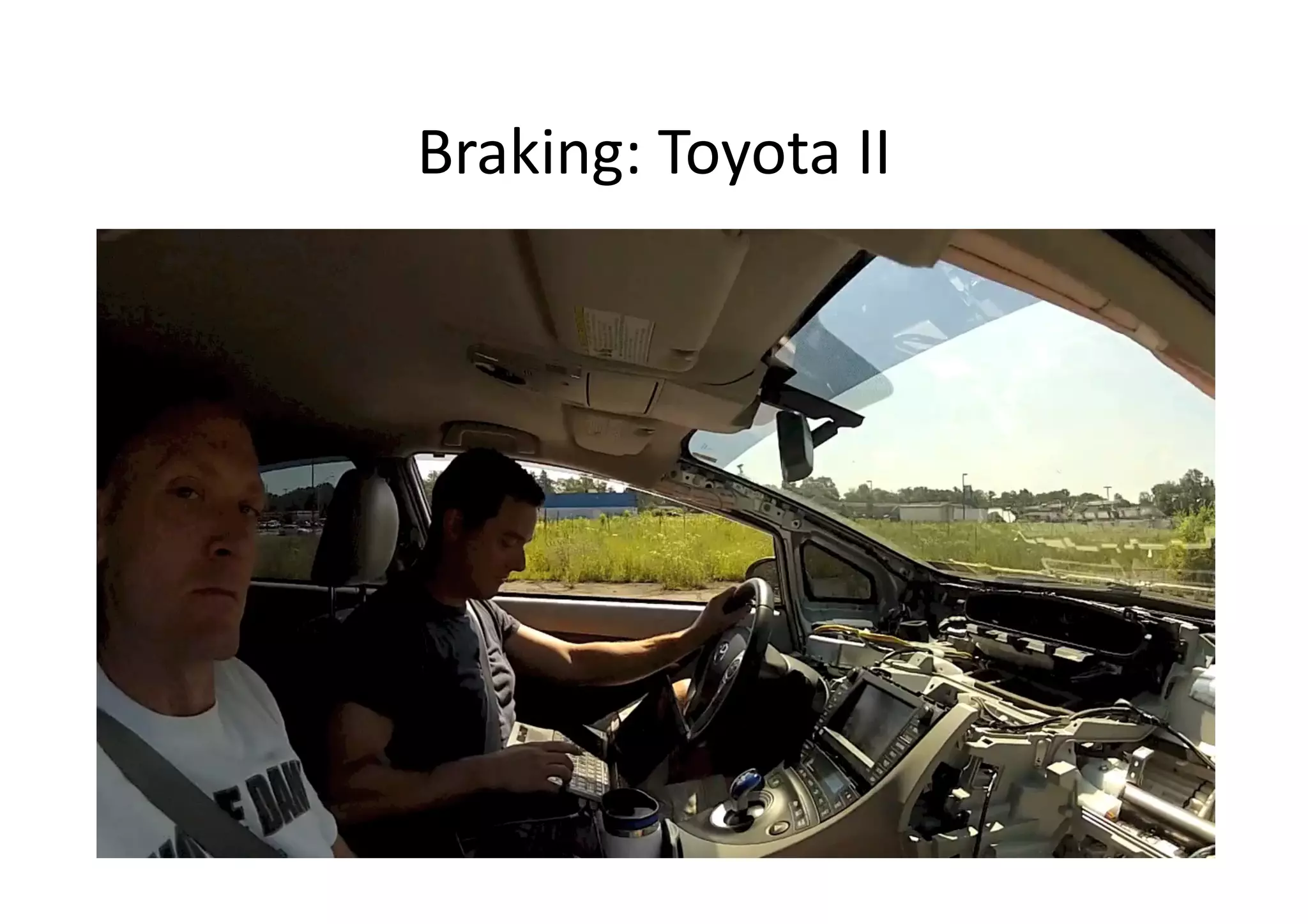
Braking:	
  Toyota	
  II	
  	
  
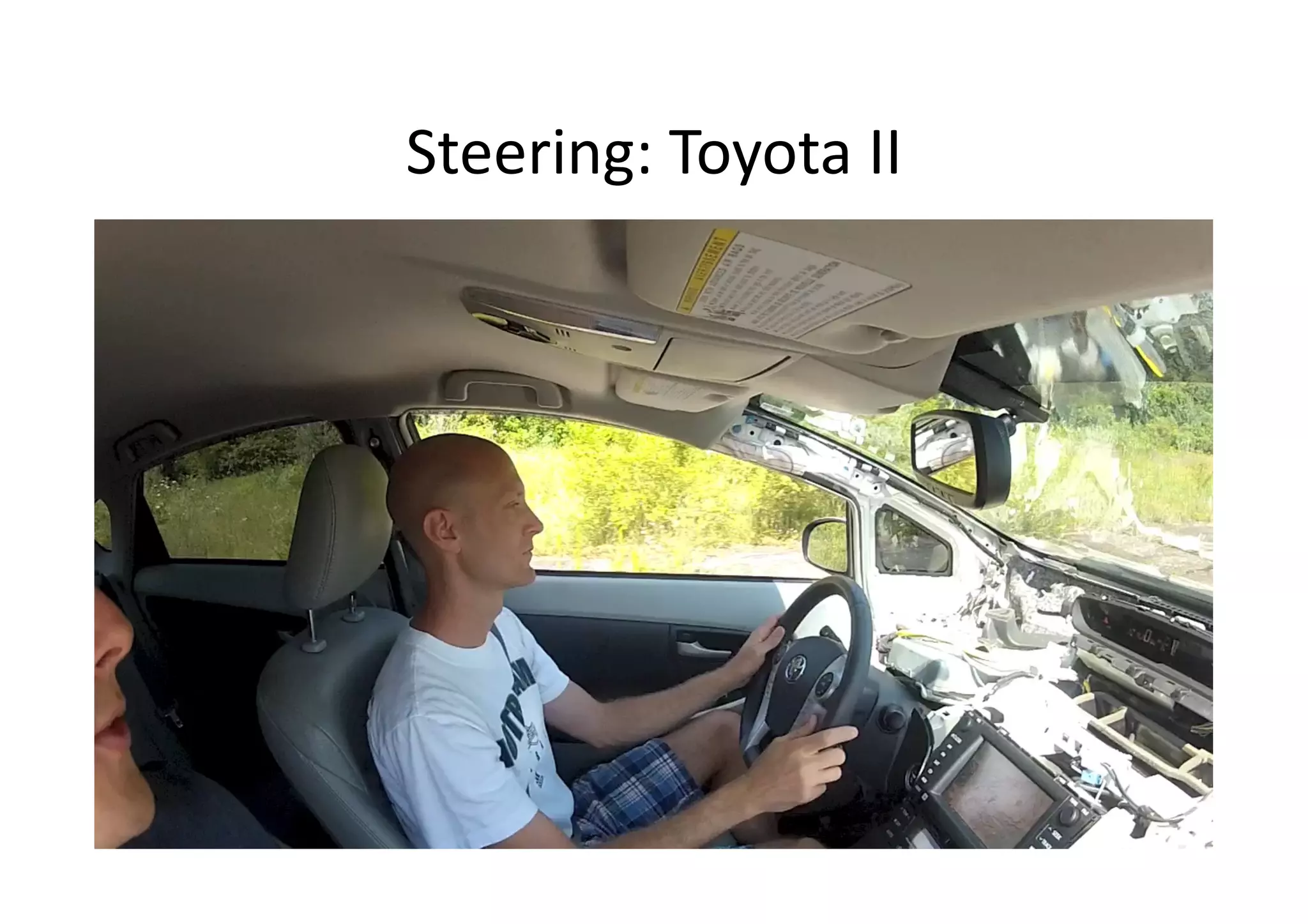
Steering:	
  Toyota	
  II	
  
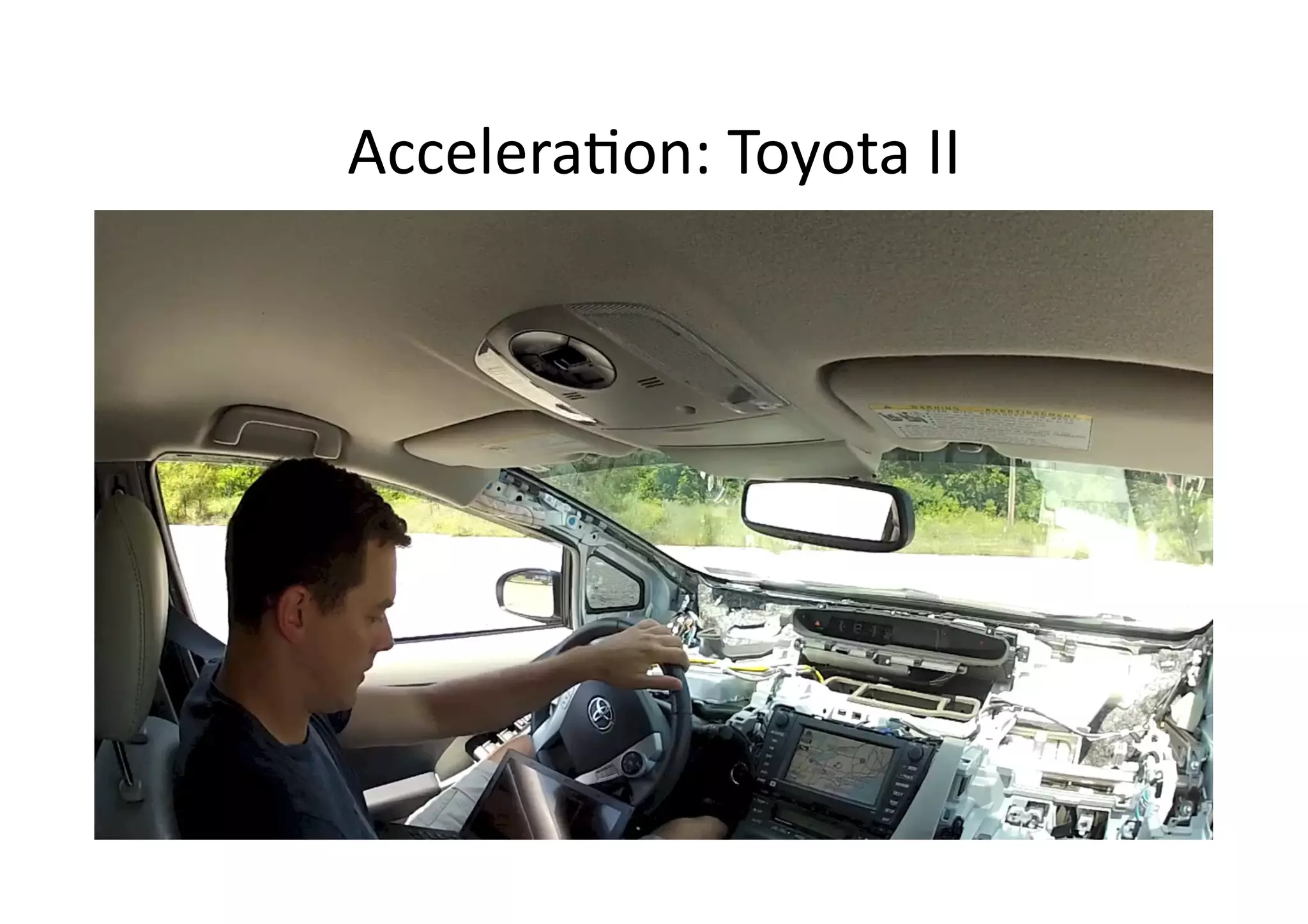
Accelera/on:	
  Toyota	
  II	
  
DIAGNOSTIC	
  CAN	
  INJECTION	
  
SecurityAccess	
  
•  A	
  few	
  ECUs	
  from	
  each	
  car	
  responded	
  and	
  
accepted	
  the	
  SecurityAccess	
  service	
  
•  For	
  these	
  ECUs	
  we’ve	
  figured	
  out	
  the	
  secrets	
  
to	
  produce	
  valid	
  keys	
  from	
  the	
  seeds	
  provided	
  
•  This	
  permits	
  the	
  ECUs	
  to	
  be	
  put	
  in	
  
reprogramming	
  mode	
  and	
  other	
  special	
  
diagnos/c	
  states	
  
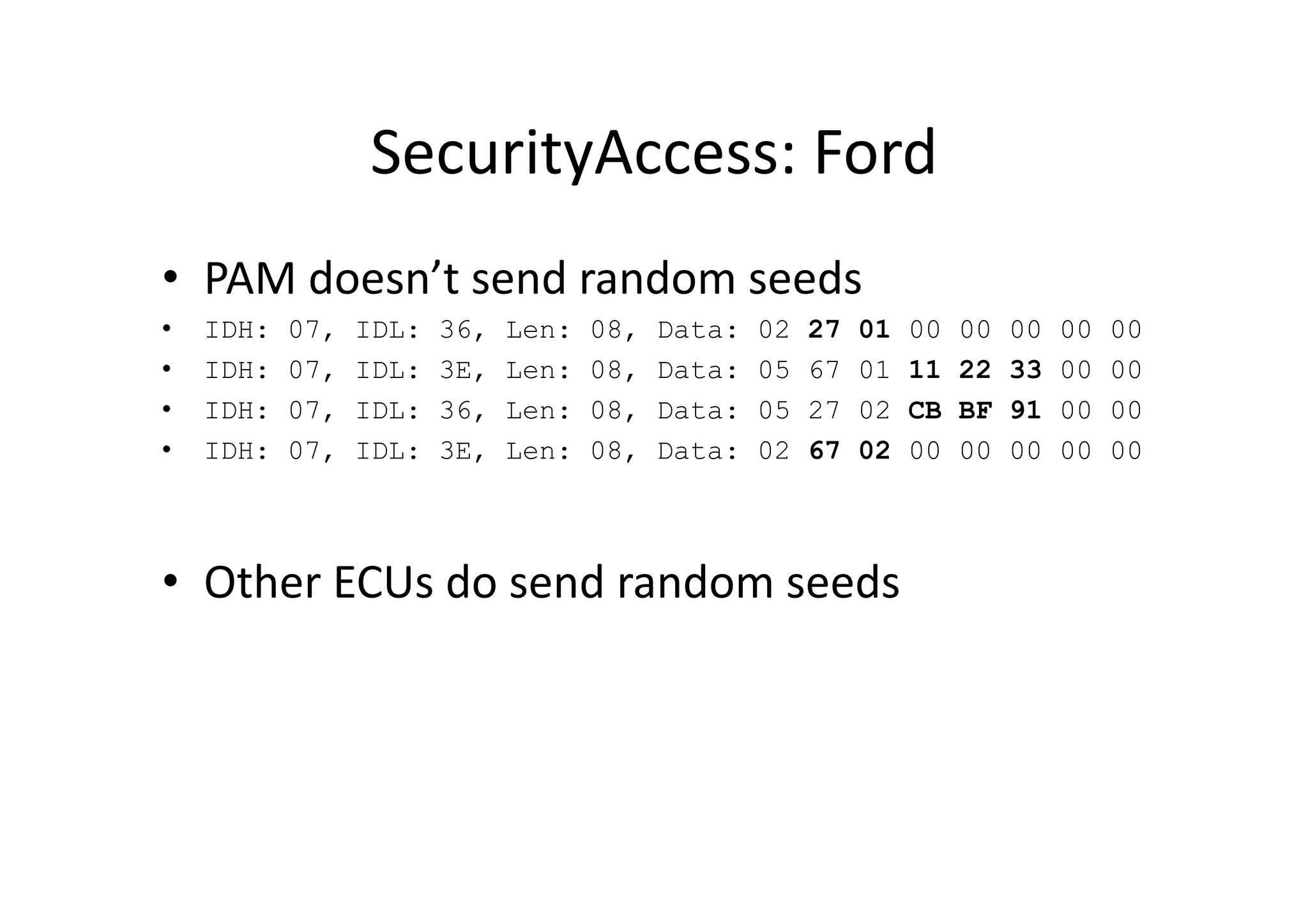
SecurityAccess:	
  Ford	
  
•  PAM	
  doesn’t	
  send	
  random	
  seeds	
  
•  IDH: 07, IDL: 36, Len: 08, Data: 02 27 01 00 00 00 00 00
•  IDH: 07, IDL: 3E, Len: 08, Data: 05 67 01 11 22 33 00 00
•  IDH: 07, IDL: 36, Len: 08, Data: 05 27 02 CB BF 91 00 00
•  IDH: 07, IDL: 3E, Len: 08, Data: 02 67 02 00 00 00 00 00
•  Other	
  ECUs	
  do	
  send	
  random	
  seeds	
  
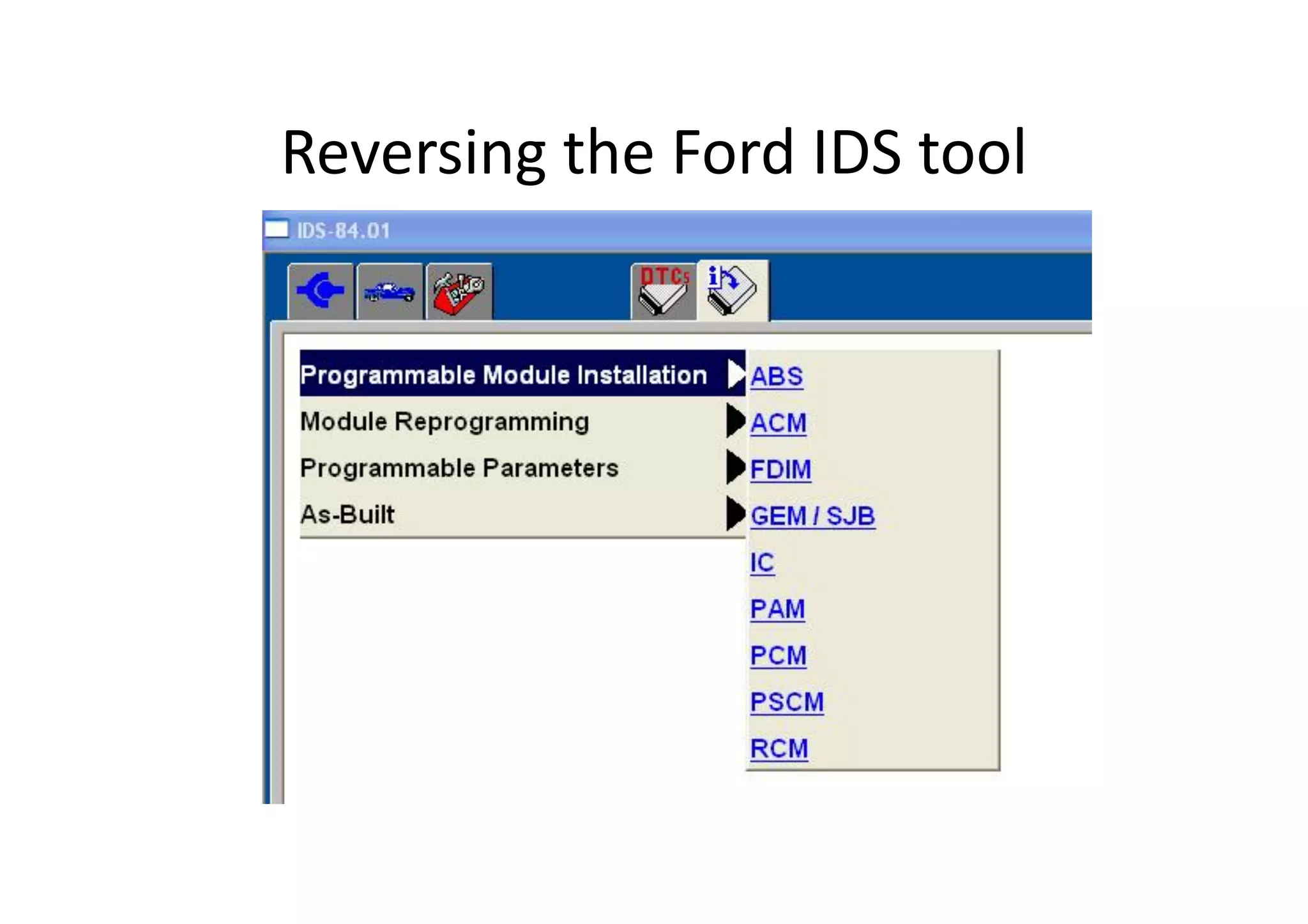
Reversing	
  the	
  Ford	
  IDS	
  tool	
  
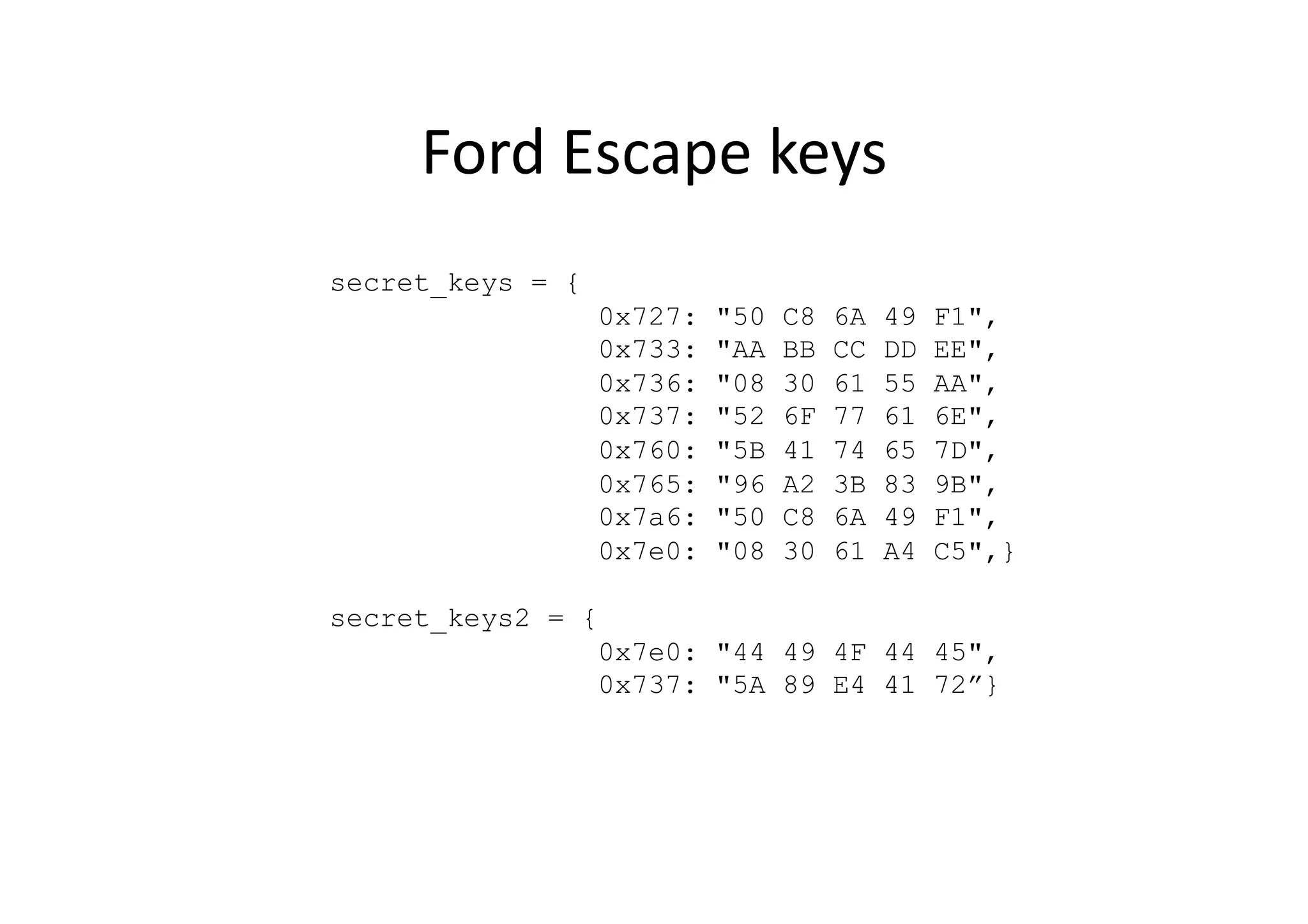
Ford	
  Escape	
  keys	
  
secret_keys = {
0x727: "50 C8 6A 49 F1",
0x733: "AA BB CC DD EE",
0x736: "08 30 61 55 AA",
0x737: "52 6F 77 61 6E",
0x760: "5B 41 74 65 7D",
0x765: "96 A2 3B 83 9B",
0x7a6: "50 C8 6A 49 F1",
0x7e0: "08 30 61 A4 C5",}
secret_keys2 = {
0x7e0: "44 49 4F 44 45",
0x737: "5A 89 E4 41 72”}
Academic	
  research	
  
•  securityAccess	
  to	
  ECU	
  then	
  diagnos/c	
  messages	
  using	
  the	
  
‘DeviceControl’	
  Service	
  	
  
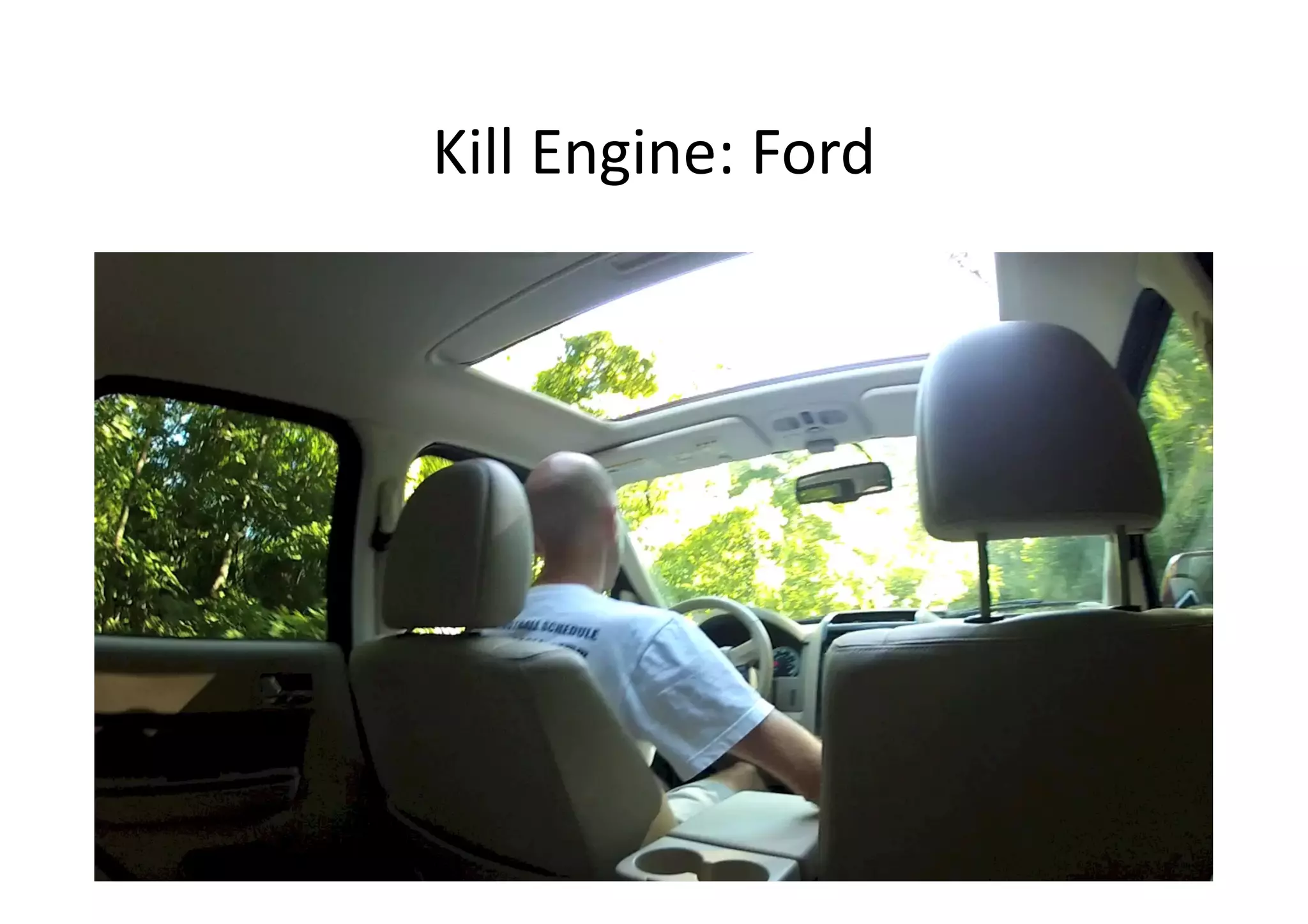
Kill	
  Engine:	
  Ford	
  
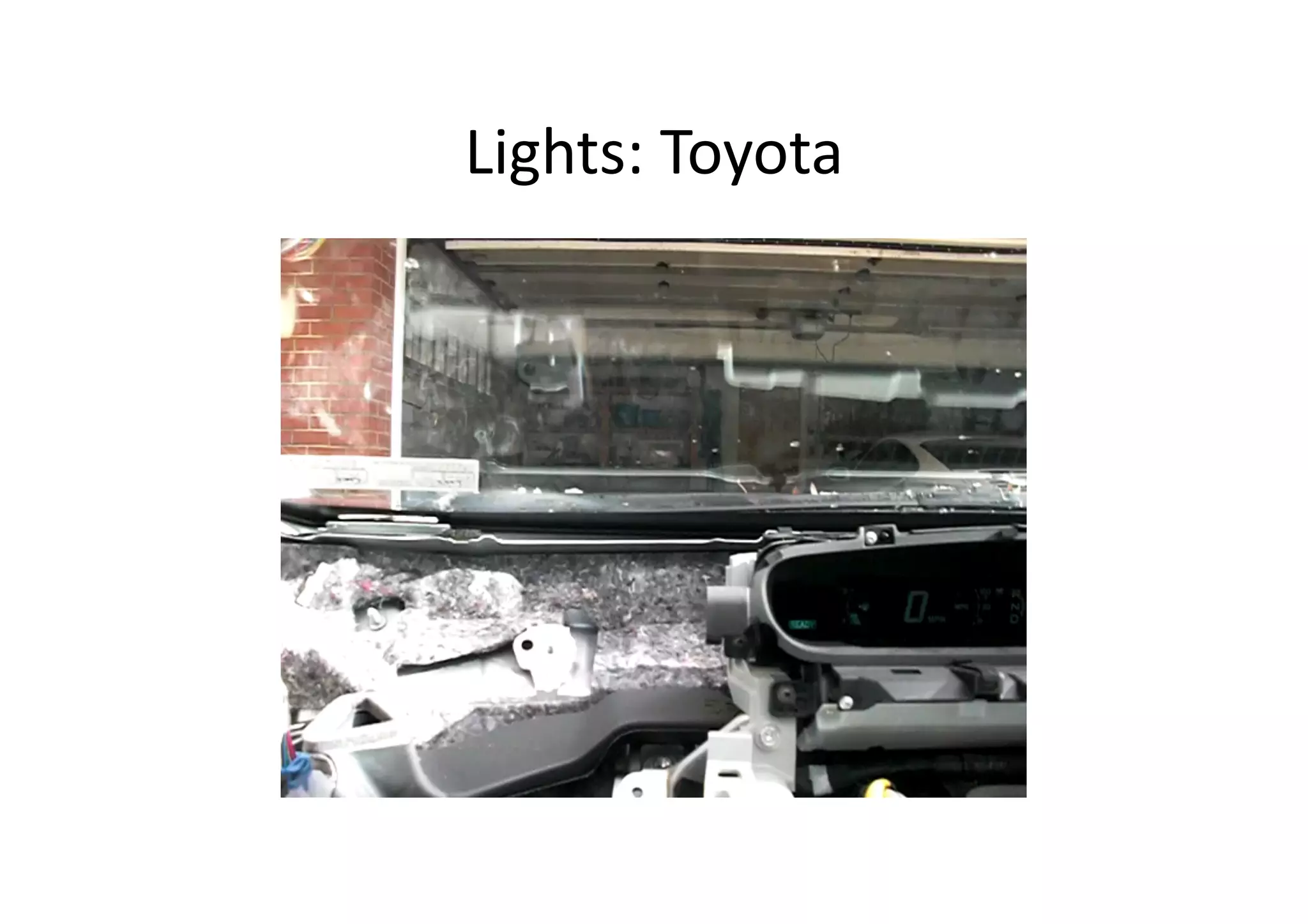
Lights:	
  Toyota	
  
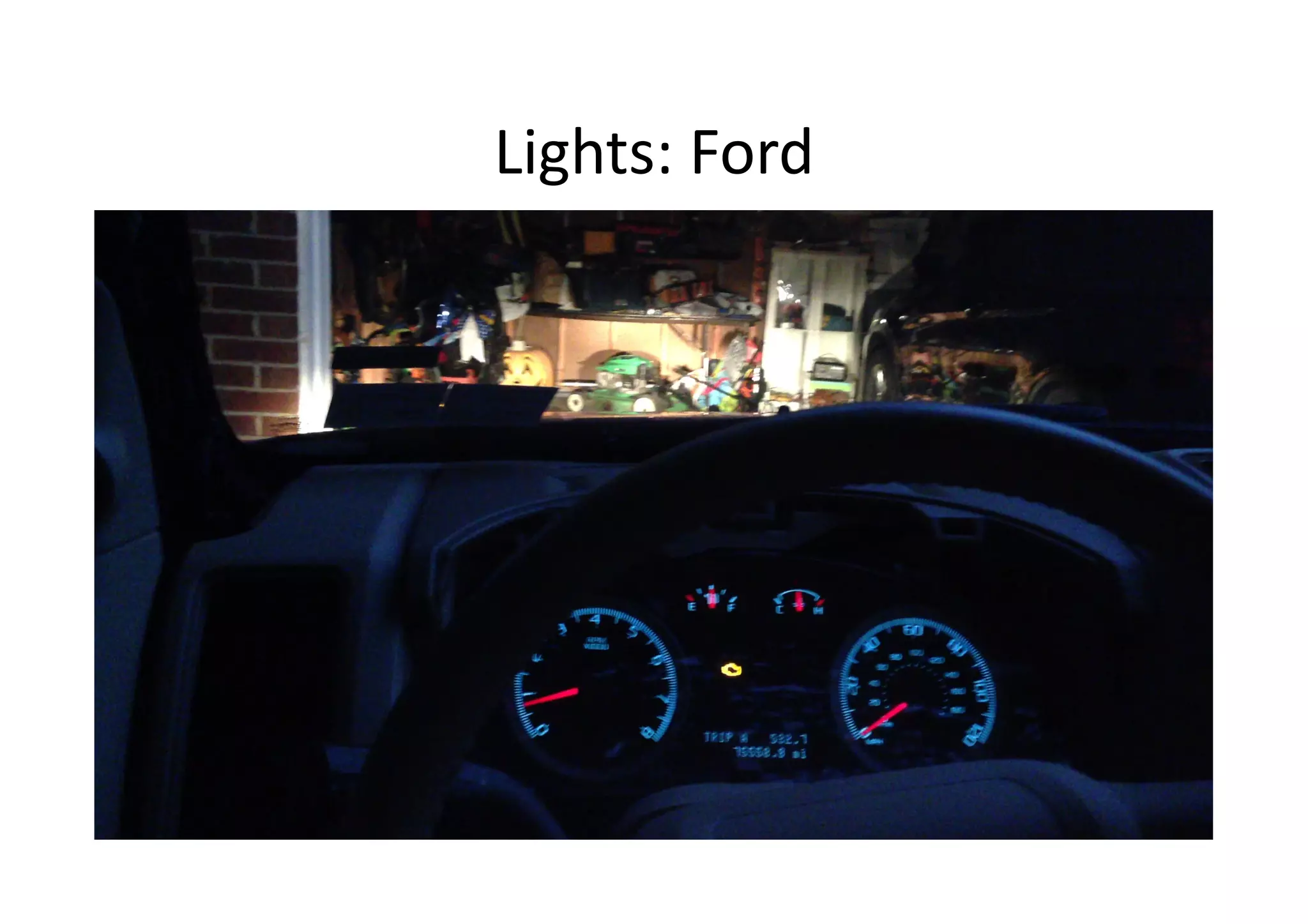
Lights:	
  Ford	
  
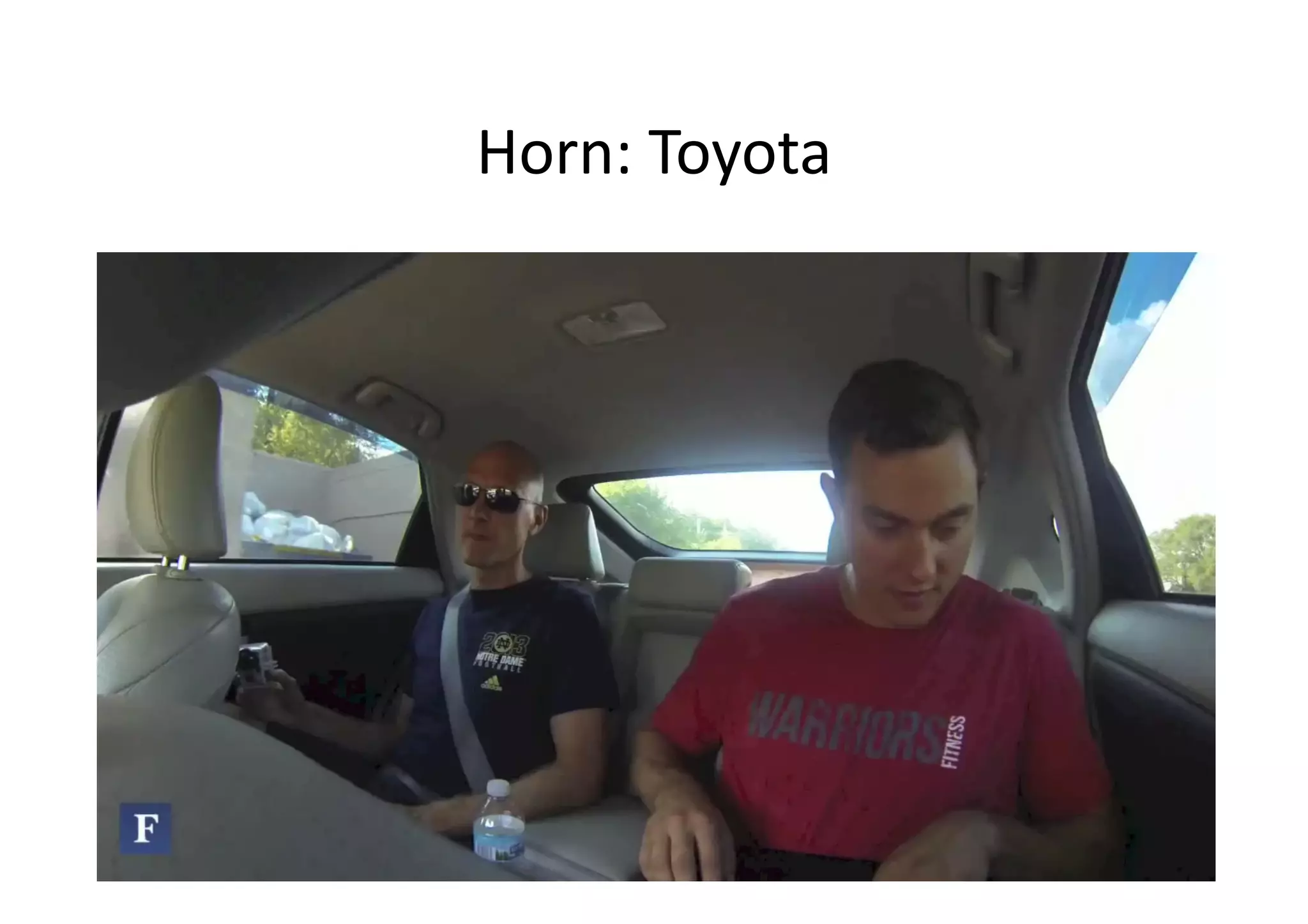
Horn:	
  Toyota	
  
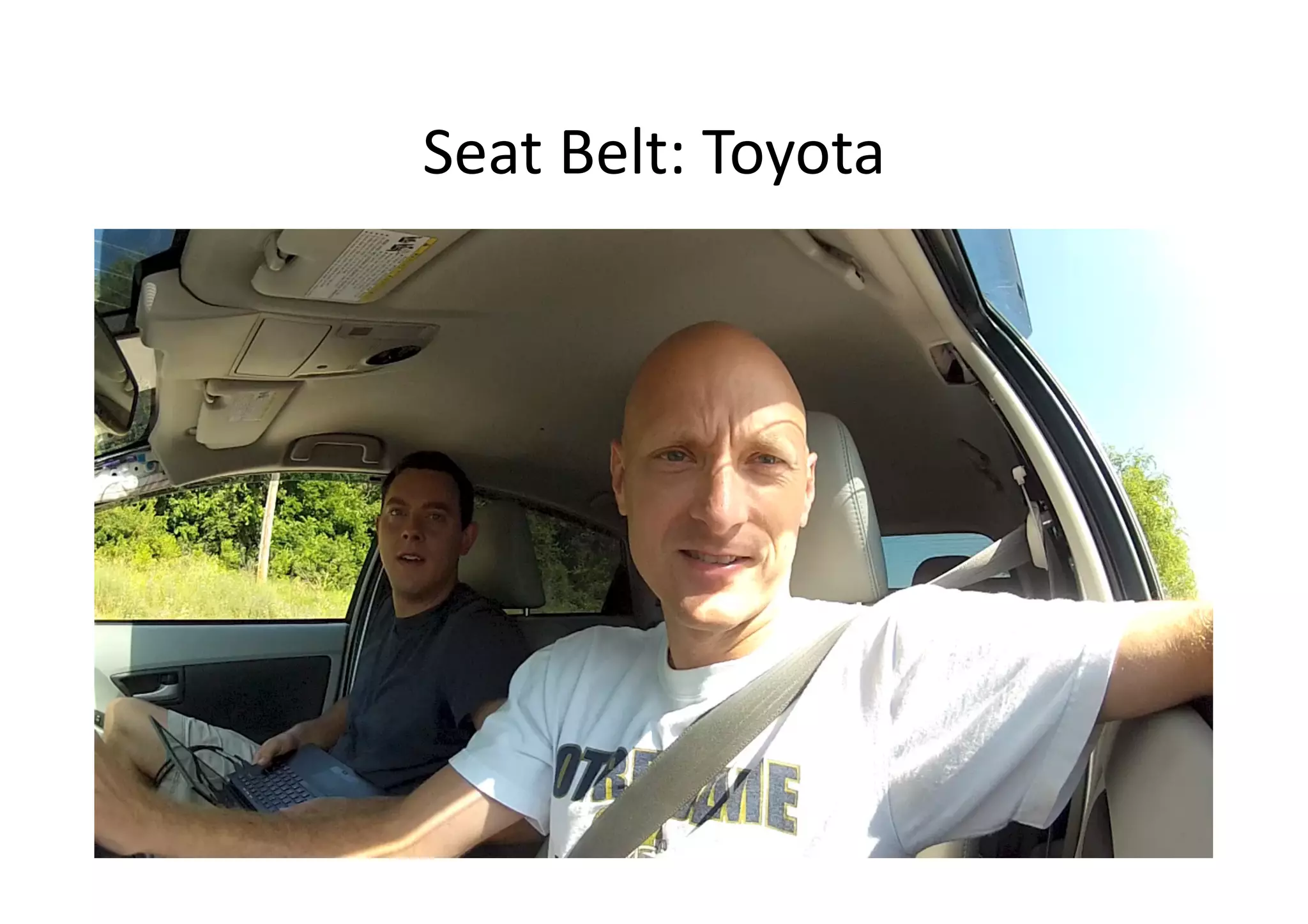
Seat	
  Belt:	
  Toyota	
  
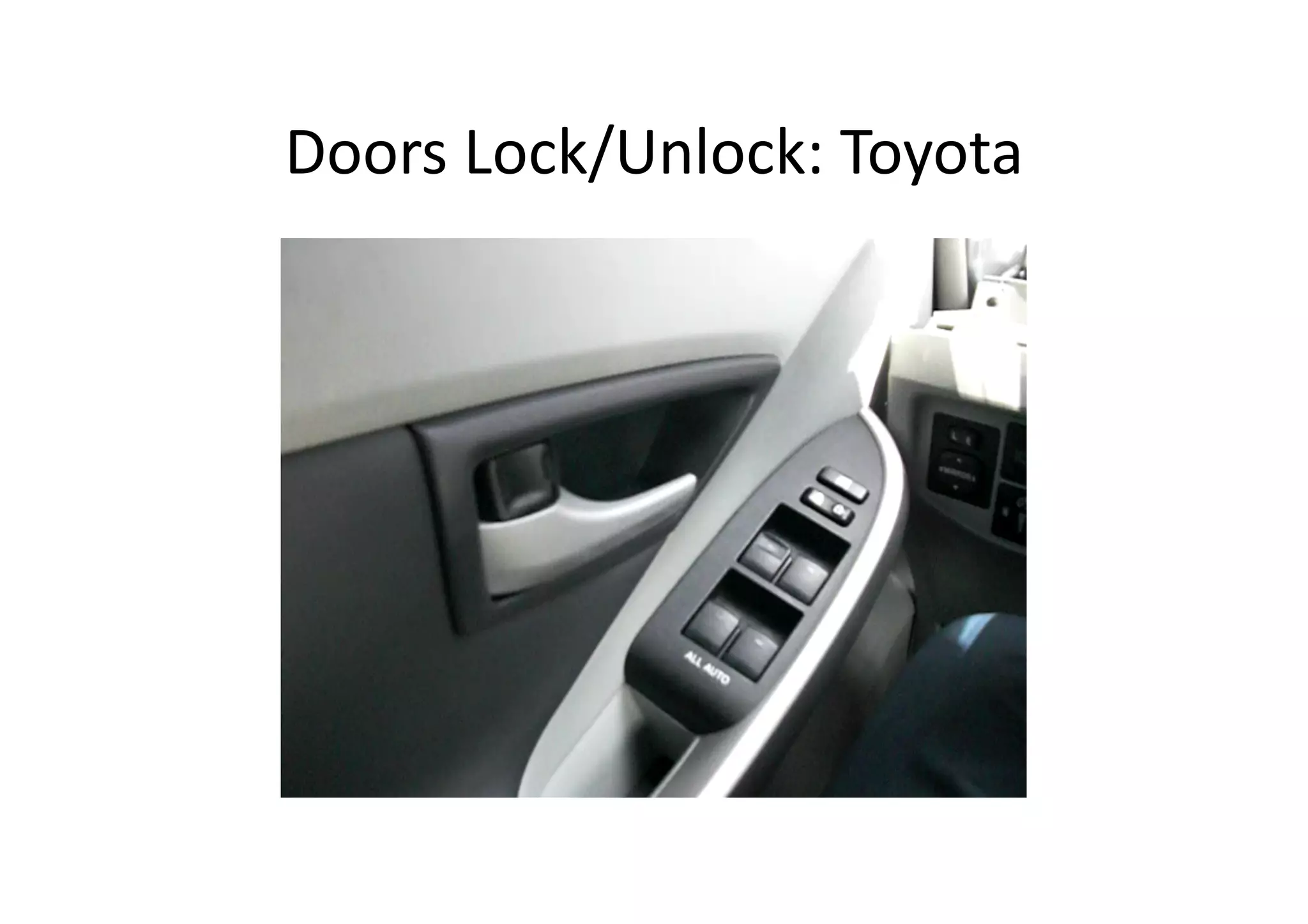
Doors	
  Lock/Unlock:	
  Toyota	
  
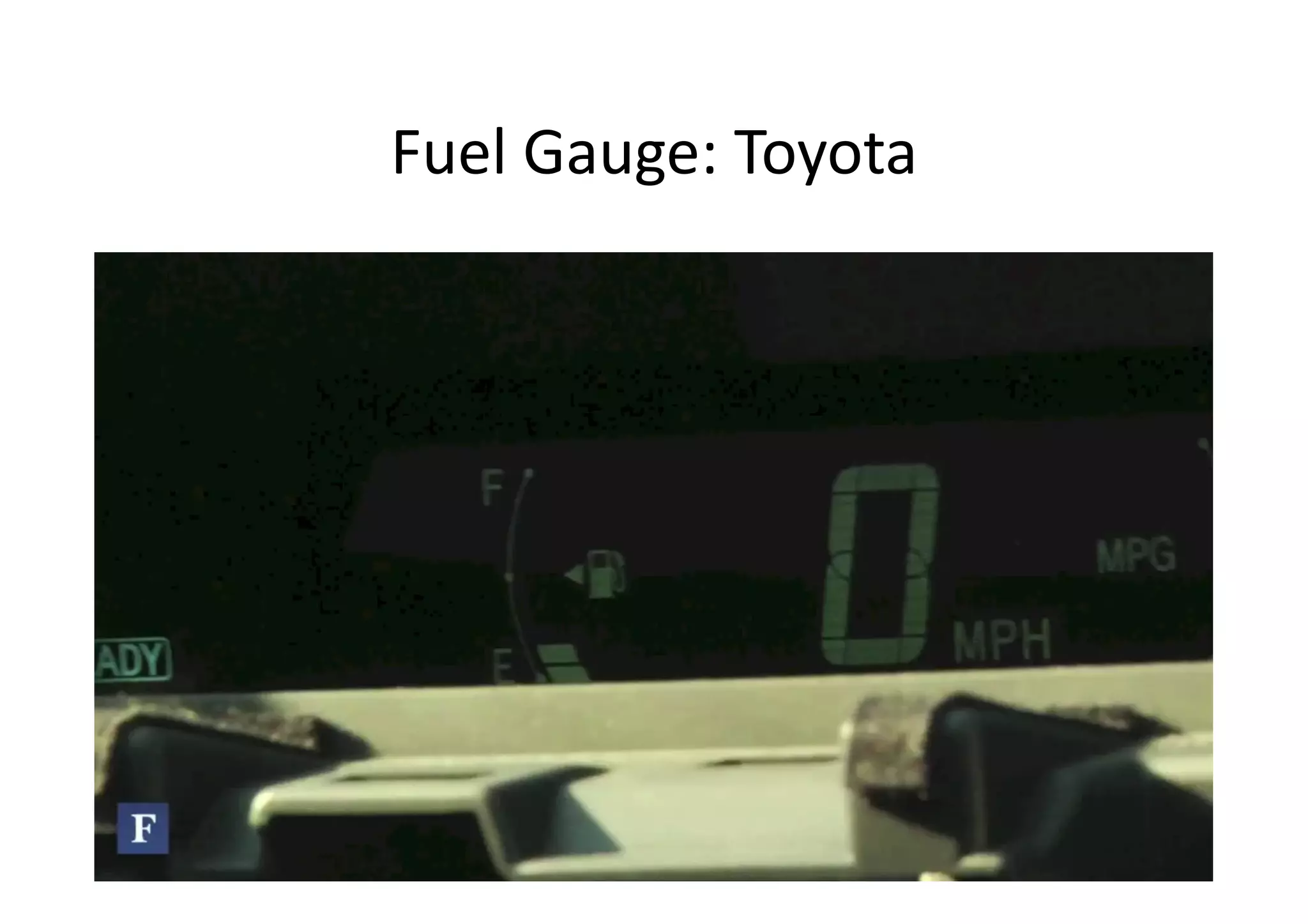
Fuel	
  Gauge:	
  Toyota	
  
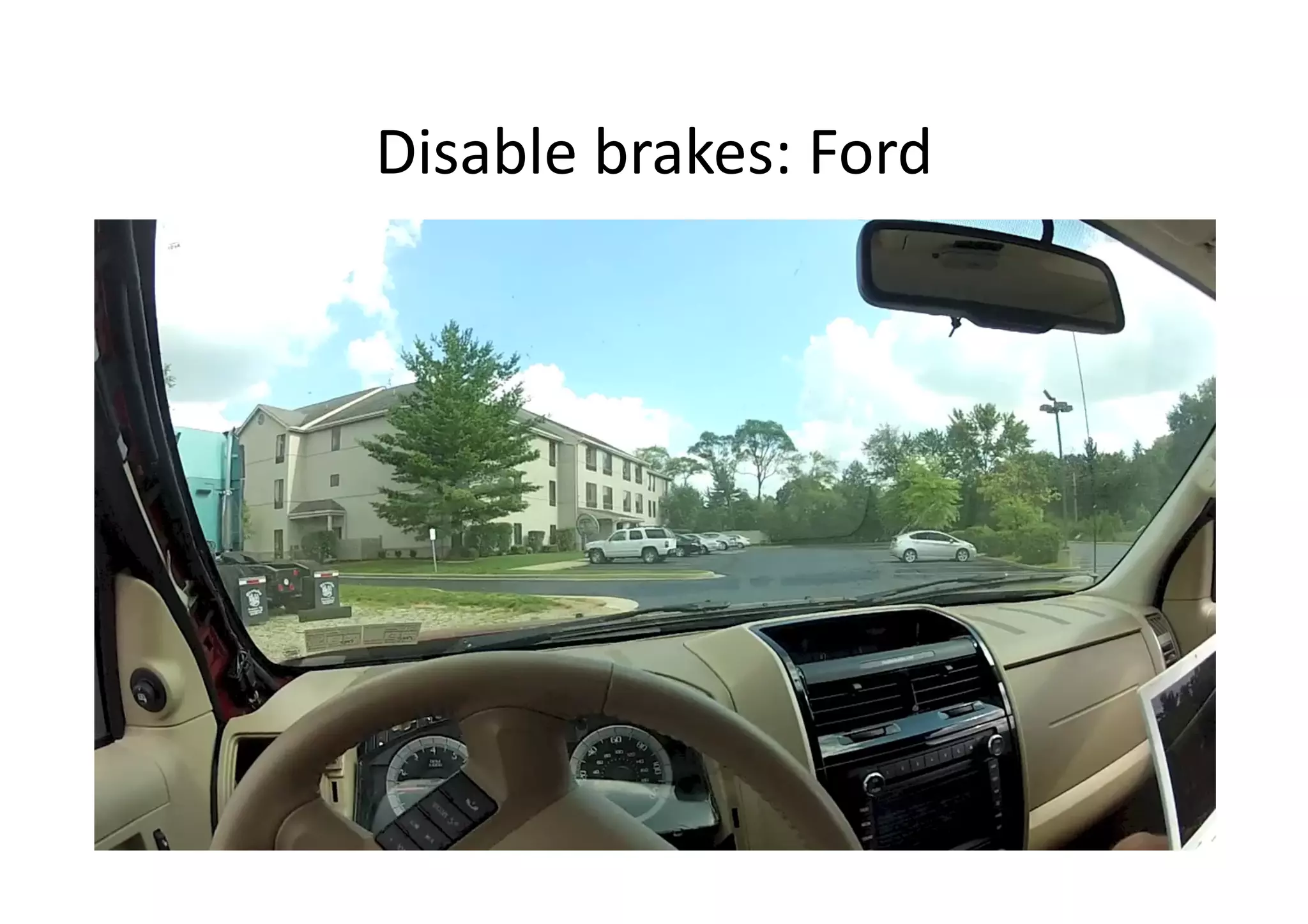
Disable	
  brakes:	
  Ford	
  
FIRMWARE	
  
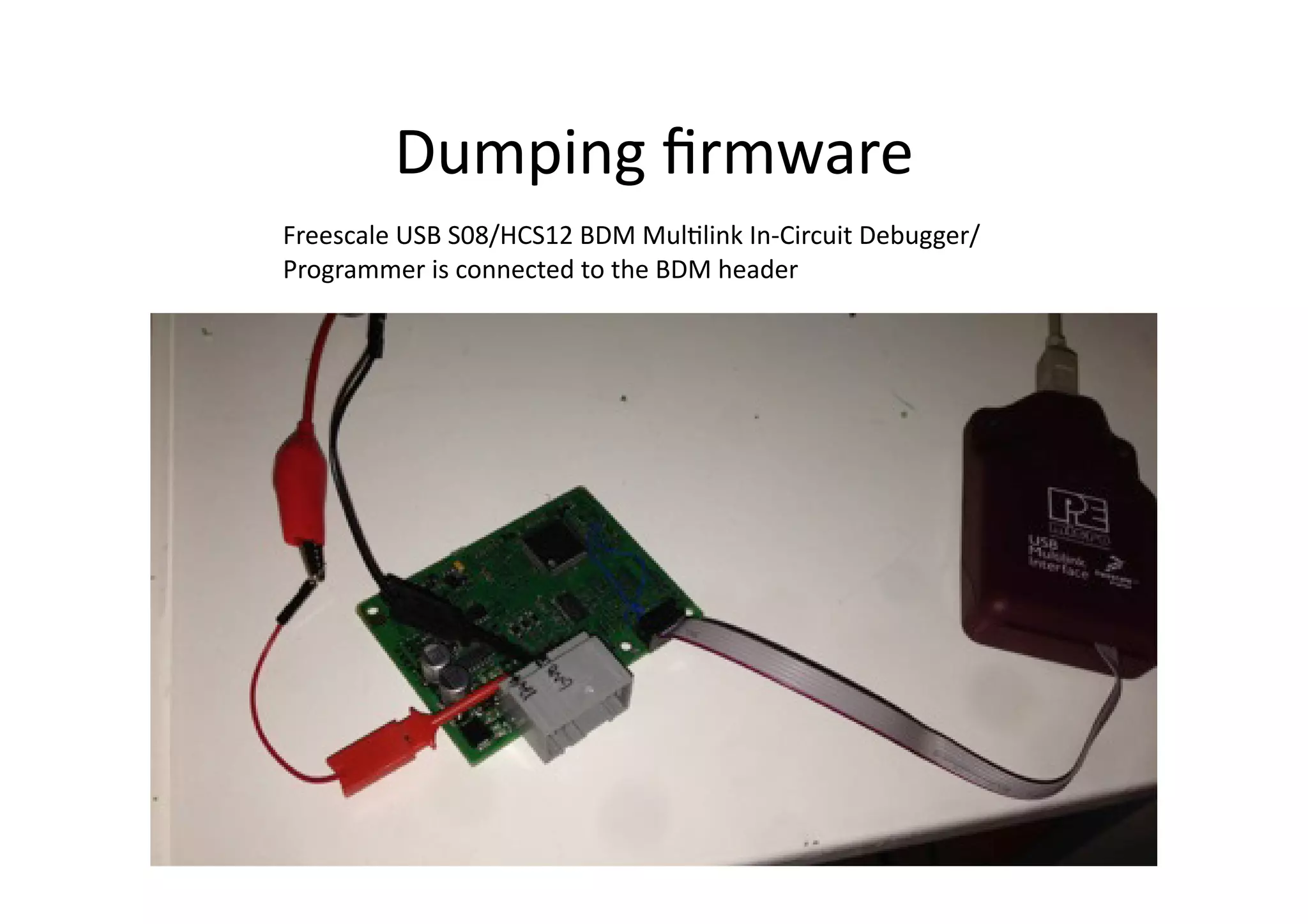
Dumping	
  firmware	
  
Freescale	
  USB	
  S08/HCS12	
  BDM	
  Mul/link	
  In-­‐Circuit	
  Debugger/
Programmer	
  is	
  connected	
  to	
  the	
  BDM	
  header	
  
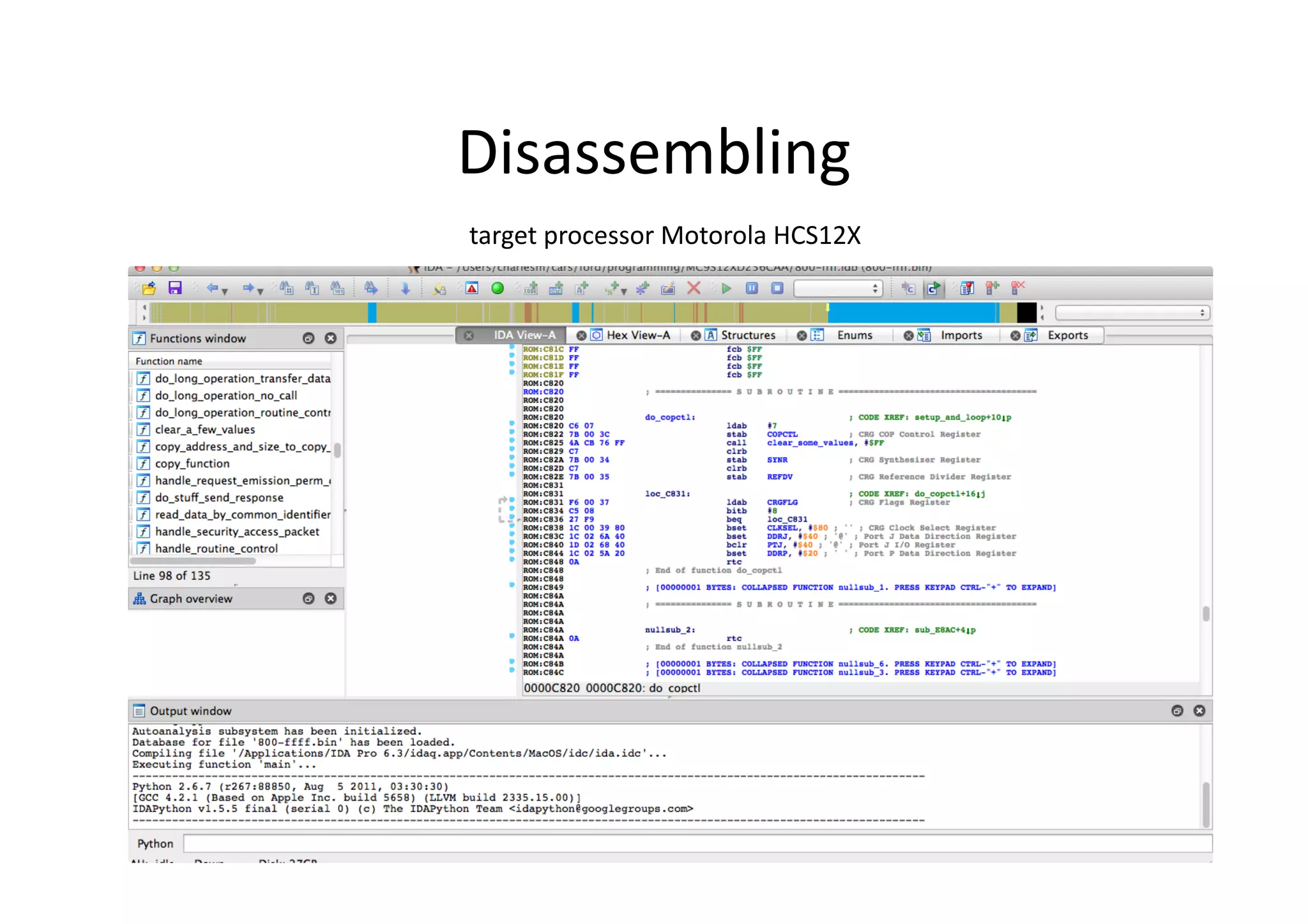
Disassembling	
  
target	
  processor	
  Motorola	
  HCS12X	
  
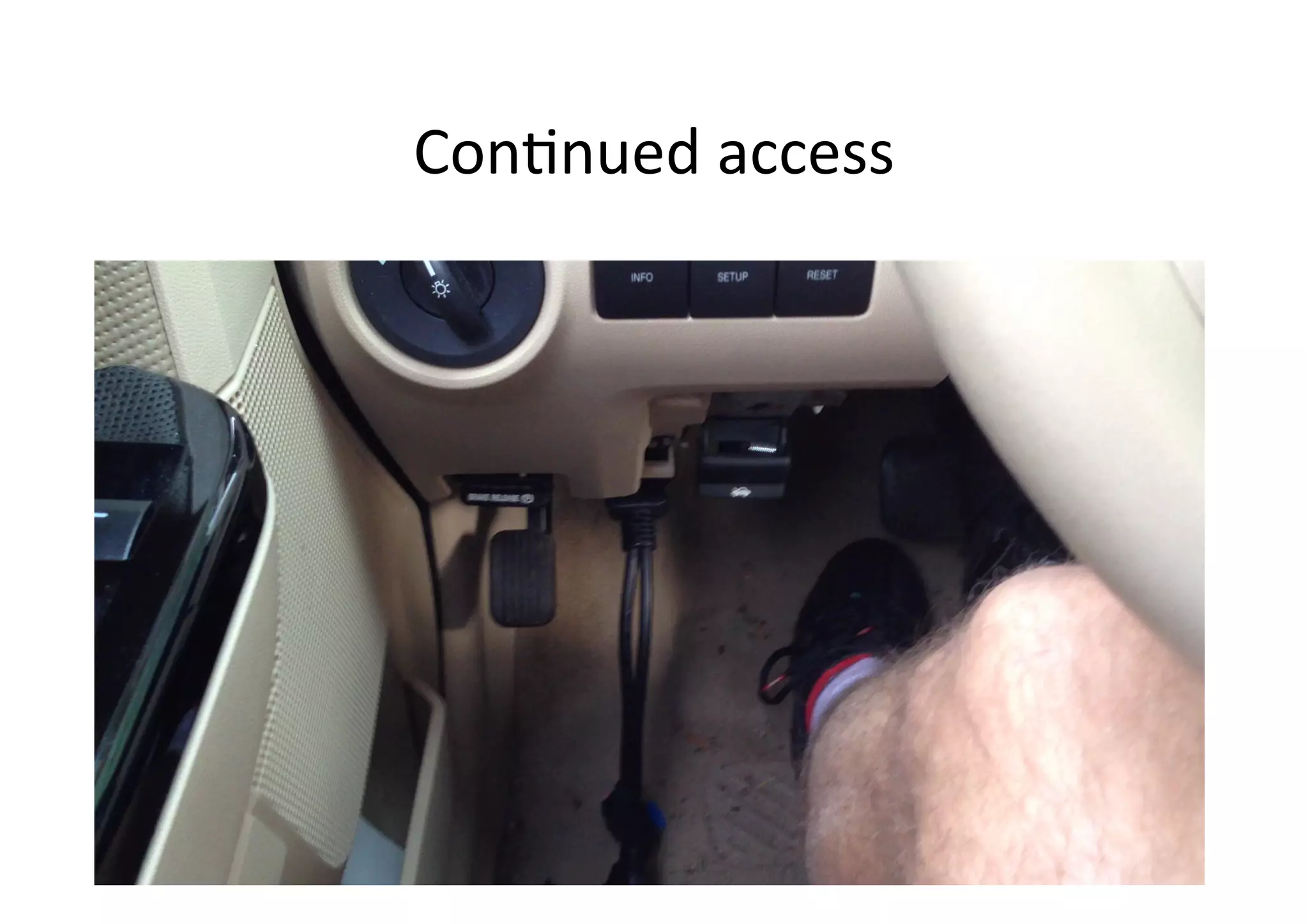
Con/nued	
  access	
  
SECURING	
  THE	
  MODERN	
  VEHICLE	
  
There	
  are	
  a	
  few	
  strategies	
  
•  Secure	
  remote	
  endpoints	
  
•  Cryptographically	
  verify	
  messages	
  
•  Segment	
  CAN	
  network/isolate	
  ECUs	
  
•  Detect/prevent	
  aJacks	
  real-­‐/me	
  
Industry	
  Statement	
  
“Our	
  focus,	
  and	
  that	
  of	
  the	
  en/re	
  auto	
  industry,	
  is	
  
to	
  prevent	
  hacking	
  into	
  a	
  vehicle's	
  by-­‐wire	
  control	
  
system	
  from	
  a	
  remote/wireless	
  device	
  outside	
  of	
  
the	
  vehicle.	
  	
  Toyota	
  has	
  developed	
  very	
  strict	
  and	
  
effec/ve	
  firewall	
  technology	
  against	
  such	
  remote	
  
and	
  wireless	
  services.	
  	
  We	
  con/nue	
  to	
  try	
  to	
  hack	
  
our	
  	
  systems	
  and	
  have	
  a	
  considerable	
  investment	
  in	
  
state	
  of	
  the	
  art	
  electro-­‐magne/c	
  R&D	
  facili/es.	
  	
  We	
  
believe	
  our	
  systems	
  are	
  robust	
  and	
  secure.”	


  -­‐	
  John	
  Hanson	
  |	
  Toyota	
  Motor	
  Sales	
  U.S.A	
  
External	
  Security	
  Dependencies	
  
•  Total	
  security	
  is	
  not	
  achievable	
  	
  
–  Humans	
  make	
  mistakes	
  
–  We	
  haven’t	
  been	
  able	
  to	
  secure	
  PCs,	
  what	
  make	
  you	
  
think	
  automo/ve	
  is	
  different?	
  
–  Enterprises	
  do	
  not	
  implement	
  a	
  single	
  /ered	
  approach	
  
with	
  PCs,	
  why	
  should	
  automobiles?	
  	
  
–  3rd	
  party	
  assessment	
  appears	
  to	
  be	
  rare	
  
–  ECU	
  patching	
  for	
  known	
  vulnerabili/es	
  can	
  be	
  
complicated	
  
–  Addi/onal	
  remote	
  aJack	
  vectors	
  being	
  added	
  each	
  
year	
  
Cryptography/Authen/ca/on	
  
•  Many	
  suggest	
  encryp/ng	
  applica/on-­‐layer	
  data	
  
–  Unfortunately	
  doesn’t	
  seem	
  viable	
  at	
  this	
  point	
  due	
  to	
  
real-­‐/me	
  necessity	
  of	
  the	
  automo/ve	
  system	
  
–  Example:	
  The	
  brakes	
  have	
  to	
  work	
  in	
  real-­‐/me	
  and	
  can	
  
NEVER	
  take	
  too	
  long	
  
–  Key	
  management	
  is	
  also	
  difficult	
  
•  If	
  its	
  in	
  the	
  ECU,	
  it	
  can	
  probably	
  be	
  reversed	
  
–  Reverse	
  Engineering	
  of	
  the	
  ECU/mechanics	
  tools	
  can	
  
result	
  in	
  cryptography	
  being	
  subverted	
  
–  Should	
  not	
  rely	
  on	
  obscurity	
  to	
  protect	
  driver	
  
More	
  on	
  obscurity	
  and	
  security	
  
•  "One	
  reason	
  for	
  the	
  industry's	
  success	
  in	
  preven4ng	
  bad	
  
actors	
  from	
  doing	
  malicious	
  things	
  to	
  vehicles	
  is	
  that	
  
individual	
  automakers	
  have	
  done	
  a	
  very	
  good	
  job	
  of	
  keeping	
  
security	
  sensi4ve	
  informa4on	
  from	
  falling	
  into	
  the	
  wrong	
  
hands,"	
  wrote	
  Mitch	
  Bainwol,	
  the	
  CEO	
  of	
  the	
  Alliance	
  of	
  
Automobile	
  Manufacturers	
  and	
  Mike	
  Stanton	
  of	
  the	
  
Associa/on	
  of	
  Global	
  Automakers	
  
•  If	
  the	
  only	
  thing	
  preven/ng	
  a	
  bad	
  guy	
  from	
  crashing	
  your	
  car	
  
is	
  that	
  they	
  have	
  to	
  look	
  hard	
  for	
  the	
  info,	
  there	
  is	
  no	
  real	
  
security	
  
Segmenta/on	
  
•  Isolate	
  ECUs	
  on	
  different	
  CAN	
  buses	
  
– Bridging	
  traffic	
  is	
  s/ll	
  necessary	
  
•  Example:	
  Infotainment	
  system	
  s/ll	
  needs	
  to	
  get	
  
messages	
  about	
  speed	
  
•  Status	
  of	
  car	
  must	
  be	
  presented	
  on	
  instrument	
  cluster	
  
– Bridge	
  must	
  NOT	
  forward	
  incorrect	
  traffic	
  
– Bridge	
  is	
  now	
  the	
  weakest	
  link	
  /	
  aJack	
  target	
  
– CAN	
  bridges	
  will	
  be	
  proprietary	
  in	
  nature,	
  forcing	
  
them	
  to	
  be	
  updated	
  &	
  augmented	
  constantly	
  
Detec/on	
  of	
  aJacks	
  
•  Don’t	
  exclusively	
  rely	
  on	
  making	
  aJacks	
  
difficult,	
  instead	
  focus	
  on	
  detec/ng	
  aJacks	
  
and	
  taking	
  ac/on	
  
•  Can’t	
  always	
  stop	
  aJack,	
  but	
  you	
  can	
  take	
  
ac/on	
  when	
  one	
  is	
  happening	
  
•  Analogous	
  to	
  IDS/IPS	
  in	
  enterprise	
  
environments	
  
Advantages	
  
•  Vehicular	
  networks	
  are	
  especially	
  well	
  suited	
  
for	
  aJack	
  detec/on	
  
•  CAN	
  messages	
  are	
  very	
  standard	
  and	
  
predictable	
  
•  The	
  frequency	
  of	
  messages	
  and	
  their	
  content	
  
vary	
  in	
  predictable	
  ways	
  
•  AJacks	
  stand	
  out	
  and	
  can	
  easily	
  be	
  detected	
  
CAN	
  Traffic	
  is	
  Simple	
  
•  We	
  recorded	
  CAN	
  traffic	
  while	
  driving	
  around	
  
for	
  15	
  minutes	
  
•  The	
  CAN	
  ID’s	
  found	
  in	
  the	
  first	
  second	
  of	
  the	
  
trip	
  were	
  recorded	
  for	
  both	
  Ford	
  and	
  Toyota	
  
•  No	
  addi/onal	
  CAN	
  ID’s	
  were	
  found	
  the	
  rest	
  of	
  
the	
  trip	
  
•  Any	
  addi/onal	
  CAN	
  ID’s	
  (such	
  as	
  diagnos/c	
  
messages)	
  would	
  be	
  suspicious	
  
Frequency	
  of	
  CAN	
  messages	
  
•  Frequency	
  of	
  messages	
  from	
  IDs	
  does	
  not	
  have	
  
much	
  devia/on	
  
•  Comparison	
  of	
  messages	
  from	
  the	
  start	
  of	
  a	
  
capture	
  and	
  in	
  random	
  loca/ons	
  within	
  the	
  same	
  
capture	
  
Hit	
  Counts:	
  Primary[03A9]	
  =>	
  9	


  |	
  Secondary[03A9]	
  =>	
  5	
  
Hit	
  Counts:	
  Primary[0255]	
  =>	
  166	
  |	
  Secondary[0255]	
  =>	
  119	
  
Hit	
  Counts:	
  Primary[0230]	
  =>	
  991	
  |	
  Secondary[0230]	
  =>	
  1011	
  
Hit	
  Counts:	
  Primary[0250]	
  =>	
  168	
  |	
  Secondary[0250]	
  =>	
  209	
  
Hit	
  Counts:	
  Primary[03C4]	
  =>	
  41	
  	
  	
  |	
  Secondary[03C4]	
  =>	
  46	
  
Hit	
  Counts:	
  Primary[0340]	
  =>	
  80	
  	
  	
  |	
  Secondary[0340]	
  =>	
  82	
  
Hit	
  Counts:	
  Primary[0422]	
  =>	
  83	
  	
  	
  |	
  Secondary[0422]	
  =>	
  36	
  
Hit	
  Counts:	
  Primary[0423]	
  =>	
  17	
  	
  	
  |	
  Secondary[0423]	
  =>	
  6	
  
Hit	
  Counts:	
  Primary[0420]	
  =>	
  83	
  	
  	
  |	
  Secondary[0420]	
  =>	
  47	
  
Hit	
  Counts:	
  Primary[0200]	
  =>	
  496	
  |	
  Secondary[0200]	
  =>	
  630	
  
Detec/ng	
  AJacks:	
  Normal	
  Packets	
  
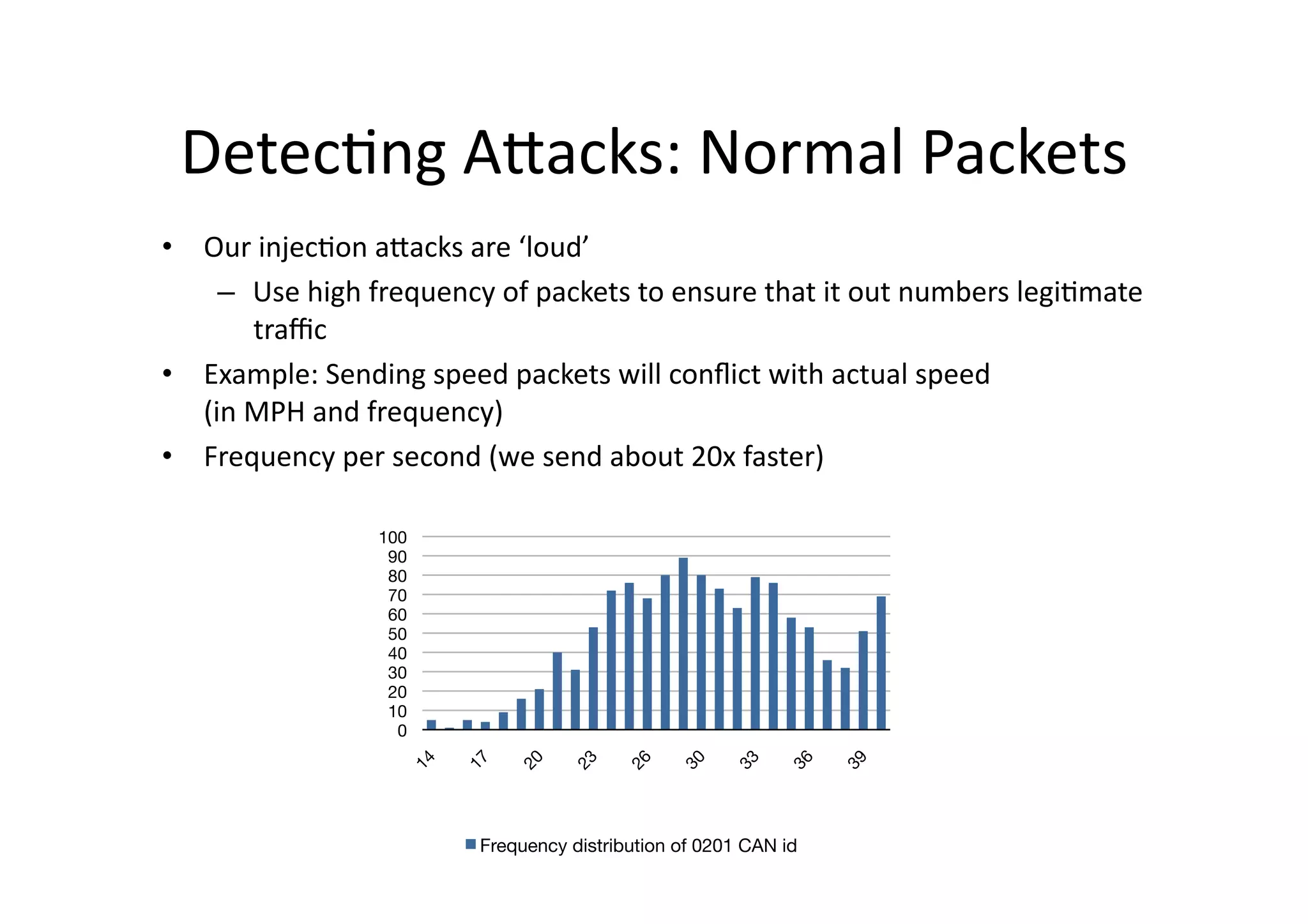
•  Our	
  injec/on	
  aJacks	
  are	
  ‘loud’	
  
–  Use	
  high	
  frequency	
  of	
  packets	
  to	
  ensure	
  that	
  it	
  out	
  numbers	
  legi/mate	
  
traffic	
  
•  Example:	
  Sending	
  speed	
  packets	
  will	
  conflict	
  with	
  actual	
  speed	
  	
  
(in	
  MPH	
  and	
  frequency)	
  
•  Frequency	
  per	
  second	
  (we	
  send	
  about	
  20x	
  faster)	
  
0
10
20
30
40
50
60
70
80
90
100
Frequency distribution of 0201 CAN id
Detec/ng	
  AJacks:	
  Diagnos/c	
  
Messages	
  
•  Diagnos/c	
  packets	
  are	
  usually	
  performed	
  
when	
  mechanics	
  are	
  performing	
  tests	
  
– Not	
  while	
  car	
  is	
  moving	
  (or	
  at	
  least	
  driving	
  at	
  
highway	
  speeds)	
  
•  Our	
  aJacks	
  based	
  on	
  this	
  would	
  easily	
  be	
  
detected	
  
•  ALL	
  significant	
  aJacks	
  outlines	
  in	
  
“Experimental	
  Security	
  Analysis	
  of	
  a	
  Modern	
  
Automobile”	
  stem	
  from	
  diagnos/c	
  messages	
  
Ac/ons	
  to	
  take	
  
•  Alert	
  driver	
  
•  Shut	
  down	
  CAN	
  network	
  	
  
(for	
  example,	
  short	
  CAN	
  Hi	
  to	
  CAN	
  Lo)	
  
•  Safely	
  stop	
  vehicle	
  
•  Poten/ally	
  ignore	
  certain	
  messages	
  for	
  a	
  
period	
  of	
  /me	
  (if	
  not	
  cri/cal)	
  
The	
  detec/on	
  code	
  
•  Add	
  an	
  IPS	
  ECU	
  to	
  each	
  CAN	
  network	
  
•  Add	
  code	
  to	
  exis/ng	
  ECUs	
  
•  Add	
  hardware	
  module	
  which	
  plugs	
  into	
  obdii	
  
port	
  
CONCLUSION	
  
Conclusion	
  
•  AJacks	
  consist	
  of	
  two	
  sides:	
  compromise	
  &	
  control	
  
•  Vehicles	
  can	
  be	
  physically	
  controlled	
  via	
  the	
  CAN	
  bus	
  
by	
  malicious	
  aJackers	
  
•  CAN	
  and	
  corresponding	
  architecture	
  were	
  NOT	
  
designed	
  with	
  security	
  in	
  mind	
  
•  Relying	
  solely	
  on	
  external	
  input	
  security	
  is	
  imperfect	
  at	
  
best	
  
•  A	
  layered	
  approach	
  to	
  security	
  is	
  beJer	
  (and	
  cheaper)	
  
•  Generically	
  detec/ng	
  &	
  protec/ng	
  the	
  vehicle	
  appears	
  
to	
  be	
  the	
  most	
  effec/ve	
  method	
  for	
  automo/ve	
  safety	
  
Ques/ons?	
  
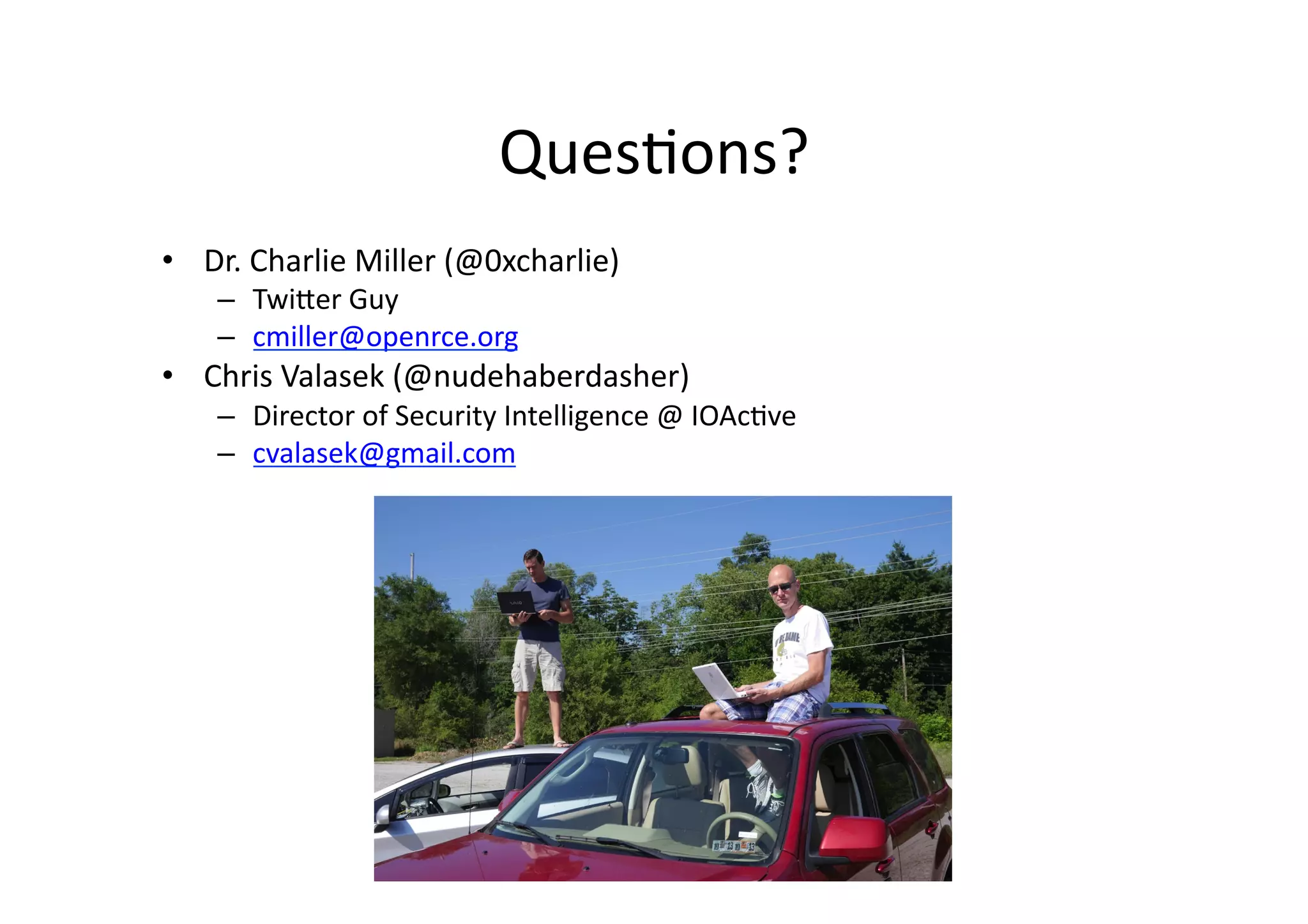
•  Dr.	
  Charlie	
  Miller	
  (@0xcharlie)	
  
–  TwiJer	
  Guy	
  
–  cmiller@openrce.org	
  
•  Chris	
  Valasek	
  (@nudehaberdasher)	
  
–  Director	
  of	
  Security	
  Intelligence	
  @	
  IOAc/ve	
  
–  cvalasek@gmail.com	
  

The Current State of Automotive Security by Chris Valasek

  • 1.
    The  current  state  of     automo/ve  security   Dr.  Charlie  Miller  (@0xcharlie)   Chris  Valasek  (@nudehaberdasher)  
  • 2.
  • 3.
    Who   •  Charlie  Miller     [Security  Engineer]     |Twi2er|   •  Chris  Valasek     [Director  of  Security  Intelligence]  | IOAc8ve|    
  • 4.
    Agenda   •  Anatomy  of  an  aJack   •  CAN  Basics   •  AJacking  the  CAN  bus   •  Securing  the  modern  vehicle  
  • 5.
    ANATOMY  OF  AN  ATTACK  
  • 6.
    Step  1:  Code  execu/on   •  Remote   Telema/cs  unit   TPMS   Bluetooth   “Connec/vity”  apps,   Web  browser,  etc  
  • 7.
    Step  1:  Code  execu/on  (cont.)   •  Local  
  • 8.
    Step  2:  CAN  message  injec/on   Compromised  ECU   ABS  ECU   Steering  ECU   Other  ECUs…  
  • 9.
    AJack  Scenario   • A  remote  vulnerability  s/ll  relies  on  ‘local’   informa/on   –  Example:  A  remote  exploit  targe/ng  a  vulnerability  in   the  Bluetooth  receiver  is  only  harmful  if  the  aJacker   knows  specific  informa/on  about  the  vehicle   •  Both  learning  the  local  control  and  remote   vulnerability  are  required     •  Local  can  actually  take  longer  due  to  being   different  for  every  vehicle   –  Remote  can  span  makes/models  due  to  nature  of   OEM  purchasing  of  devices  (i.e.  infotainment  systems)  
  • 10.
  • 11.
    Electronic  Control  Units   •  Controls  almost  every  aspect  of  the  modern   automobile   •  Take  input  from  sensors  and  provide  output  to   actuators     •  Located  in  various  places  throughout  the  car   •  ECUs  are  running  custom  code  on  unusual   hardware   – Infotainment  systems  may  be  Linux/Windows   variant,  but  func/on  ECUs  are  custom  code  
  • 12.
  • 13.
  • 14.
  • 15.
  • 16.
    CAN  Overview   • CAN  IDs  can  be  11  or  29  bits  long   •  Data  length  can  be  0  to  8  bytes  in  length   •  CAN  ID  is  used  as  a  priority  field   – CAN  ID  00  has  priority  over  CAN  ID  01   •  Interes/ng  data  is  in  the  applica/on  layer   •  Broadcast  in  nature.  Therefore  all  nodes  on  a   bus  will  see  all  messages  
  • 17.
    Normal  CAN  message   •  Ford  Escape     –  IDH: 03, IDL: B1, Len: 08, Data: 80 00 00 00 00 00 00 00 •  Toyota  Prius   –  IDH: 00, IDL: B6, Len: 04, Data: 33 A8 00 95 •  Varying:  Lengths,  IDs,  Data   –  Toyota  has  a  checksum  of  “95”  at  the  app  layer   *  This  format  was  designed  by  us  to  be  human   readable  and  diges/ble  by  our  API  
  • 18.
    Diagnos/c  Example   • Ford  Escape  communica/ng  with  ABS  ECU   –  IDH: 07, IDL: 60, Len: 08, Data: 03 14 FF 00 00 00 00 00 IDH: 07, IDL: 68, Len: 08, Data: 03 7F 14 78 00 00 00 00 IDH: 07, IDL: 68, Len: 08, Data: 03 54 FF 00 00 00 00 00 •  Each  ECU  has  one  or  more  IDs  associated   – In  this  case,  ABS  is  0760   •  Responses  are  8  more  than  ID   •  Mainly  used  by  mechanics,  but  we’ll  show   how  some  are  used  by  us…  
  • 19.
  • 20.
    Useful  Standards  &  Protocols   •  ISO  15765-­‐2  (ISO-­‐TP)   – Standard  for  sending  arbitrary  length  data  over   CAN   •  ISO  14229/14230   – Standard  for  services  running  on  the  ECU   – No  service  is  mandatory   – Defines  certain  bytes  for  diagnos/c  purposes  
  • 21.
    Services:  SecurityAccess   • SecurityAccess  is  used  to  perform  sensi/ve  diagnos/c  ac/ons     (such  as  reprogramming  an  ECU)   –  IDH: 07, IDL: 26, Len: 08, Data: 02 27 01 00 00 00 00 00 IDH: 07, IDL: 2E, Len: 08, Data: 05 67 01 54 61 B6 00 00 IDH: 07, IDL: 26, Len: 08, Data: 05 27 02 D0 B6 F1 00 00 IDH: 07, IDL: 2E, Len: 08, Data: 02 67 02 00 00 00 00 00 •  Authen/ca/on  with  0726  (SJB)   –  27  01  =>  Request  Seed   •  ECU  sends  back  OK  and  seed  (challenge)   •  Programmer  sends  back  response   •  ECU  Sends  back  OK   –  67  02  =>  OK  for  security  level  02  
  • 22.
    Services:  InputOuputControl   • Authorized  tools  to  control  or  monitor   external  inputs  to  the  ECU  (i.e.  do  stuff)   –  IDH: 07, IDL: E0, Len: 08, Data: 06 2F 03 07 03 00 00 00 IDH: 07, IDL: E8, Len: 08, Data: 06 6F 03 07 03 36 90 00 •  Send  inputOutputControl  test  to  07E0   – 2F  =>  ISO-­‐14229  code  for  inputOutputControl   – 03  07  =>  The  control  to  be  tested   – 03  00  00  =>  Data  provided  for  the  test  
  • 23.
    Some  other  interes/ng  PIDs   •  ECUReset   •  ReadMemoryByAddress   •  Rou/neControl     •  RequestDownload   •  RequestUpload   •  TransferData   •  TesterPresent   •  WriteMemoryByAddress  
  • 24.
    Systemic  Issues   • CAN  was  designed  decades  ago  without   security  in  mind   •  CAN,  by  nature,  does  not  support   authoriza/on,  authen/ca/on,  or  encryp/on   •  An  industry  relying  solely  on  entry  point   security  is  doomed  to  fail   •  Although  aJack  data  will  vary,  methods  are   universal  across  make  and  manufacturer  
  • 25.
  • 26.
    Injec/on  Limita/ons   • Not  all  func/ons  in  an  automobile  are   performed  over  CAN  (yet)   – Electric  ThroJle  in  Ford  Escape     •  Original  vs.  Forged  Messages   – S/ll  have  legi/mate  coming  from  the  ECU,  forging   may  produce  varying  results   •  Safety  features  might  need  bypassed   – Toyota  speed  limit  for  steering  during  IPAS    
  • 27.
    Speedometer:  Ford   • Set  the  speedometer  to  arbitrary  values   •  CAN  ID:  0201   •  Length:  08   •  Format:  AA  BB  00  00  CC  DD  00  00   •  Speed  =>  0.0065  *  (CC  DD)  –  67   •  RPM  =>  0.25  *  (AA  BB)  –  24   •  Example  (20.1mph  |  2233  rpm):     IDH: 02, IDL: 01, Len: 08, Data: 23 45 00 00 34 56 00 00
  • 28.
  • 29.
    *  Please  see  paper  for  packet  dissec/on  and  code.    
  • 30.
  • 31.
  • 32.
  • 33.
  • 34.
    SecurityAccess   •  A  few  ECUs  from  each  car  responded  and   accepted  the  SecurityAccess  service   •  For  these  ECUs  we’ve  figured  out  the  secrets   to  produce  valid  keys  from  the  seeds  provided   •  This  permits  the  ECUs  to  be  put  in   reprogramming  mode  and  other  special   diagnos/c  states  
  • 35.
    SecurityAccess:  Ford   • PAM  doesn’t  send  random  seeds   •  IDH: 07, IDL: 36, Len: 08, Data: 02 27 01 00 00 00 00 00 •  IDH: 07, IDL: 3E, Len: 08, Data: 05 67 01 11 22 33 00 00 •  IDH: 07, IDL: 36, Len: 08, Data: 05 27 02 CB BF 91 00 00 •  IDH: 07, IDL: 3E, Len: 08, Data: 02 67 02 00 00 00 00 00 •  Other  ECUs  do  send  random  seeds  
  • 36.
    Reversing  the  Ford  IDS  tool  
  • 37.
    Ford  Escape  keys   secret_keys = { 0x727: "50 C8 6A 49 F1", 0x733: "AA BB CC DD EE", 0x736: "08 30 61 55 AA", 0x737: "52 6F 77 61 6E", 0x760: "5B 41 74 65 7D", 0x765: "96 A2 3B 83 9B", 0x7a6: "50 C8 6A 49 F1", 0x7e0: "08 30 61 A4 C5",} secret_keys2 = { 0x7e0: "44 49 4F 44 45", 0x737: "5A 89 E4 41 72”}
  • 38.
    Academic  research   • securityAccess  to  ECU  then  diagnos/c  messages  using  the   ‘DeviceControl’  Service    
  • 39.
  • 40.
  • 41.
  • 42.
  • 43.
  • 44.
  • 45.
  • 46.
  • 47.
  • 48.
    Dumping  firmware   Freescale  USB  S08/HCS12  BDM  Mul/link  In-­‐Circuit  Debugger/ Programmer  is  connected  to  the  BDM  header  
  • 49.
  • 50.
  • 51.
  • 52.
    There  are  a  few  strategies   •  Secure  remote  endpoints   •  Cryptographically  verify  messages   •  Segment  CAN  network/isolate  ECUs   •  Detect/prevent  aJacks  real-­‐/me  
  • 53.
    Industry  Statement   “Our  focus,  and  that  of  the  en/re  auto  industry,  is   to  prevent  hacking  into  a  vehicle's  by-­‐wire  control   system  from  a  remote/wireless  device  outside  of   the  vehicle.    Toyota  has  developed  very  strict  and   effec/ve  firewall  technology  against  such  remote   and  wireless  services.    We  con/nue  to  try  to  hack   our    systems  and  have  a  considerable  investment  in   state  of  the  art  electro-­‐magne/c  R&D  facili/es.    We   believe  our  systems  are  robust  and  secure.”      -­‐  John  Hanson  |  Toyota  Motor  Sales  U.S.A  
  • 54.
    External  Security  Dependencies   •  Total  security  is  not  achievable     –  Humans  make  mistakes   –  We  haven’t  been  able  to  secure  PCs,  what  make  you   think  automo/ve  is  different?   –  Enterprises  do  not  implement  a  single  /ered  approach   with  PCs,  why  should  automobiles?     –  3rd  party  assessment  appears  to  be  rare   –  ECU  patching  for  known  vulnerabili/es  can  be   complicated   –  Addi/onal  remote  aJack  vectors  being  added  each   year  
  • 55.
    Cryptography/Authen/ca/on   •  Many  suggest  encryp/ng  applica/on-­‐layer  data   –  Unfortunately  doesn’t  seem  viable  at  this  point  due  to   real-­‐/me  necessity  of  the  automo/ve  system   –  Example:  The  brakes  have  to  work  in  real-­‐/me  and  can   NEVER  take  too  long   –  Key  management  is  also  difficult   •  If  its  in  the  ECU,  it  can  probably  be  reversed   –  Reverse  Engineering  of  the  ECU/mechanics  tools  can   result  in  cryptography  being  subverted   –  Should  not  rely  on  obscurity  to  protect  driver  
  • 56.
    More  on  obscurity  and  security   •  "One  reason  for  the  industry's  success  in  preven4ng  bad   actors  from  doing  malicious  things  to  vehicles  is  that   individual  automakers  have  done  a  very  good  job  of  keeping   security  sensi4ve  informa4on  from  falling  into  the  wrong   hands,"  wrote  Mitch  Bainwol,  the  CEO  of  the  Alliance  of   Automobile  Manufacturers  and  Mike  Stanton  of  the   Associa/on  of  Global  Automakers   •  If  the  only  thing  preven/ng  a  bad  guy  from  crashing  your  car   is  that  they  have  to  look  hard  for  the  info,  there  is  no  real   security  
  • 57.
    Segmenta/on   •  Isolate  ECUs  on  different  CAN  buses   – Bridging  traffic  is  s/ll  necessary   •  Example:  Infotainment  system  s/ll  needs  to  get   messages  about  speed   •  Status  of  car  must  be  presented  on  instrument  cluster   – Bridge  must  NOT  forward  incorrect  traffic   – Bridge  is  now  the  weakest  link  /  aJack  target   – CAN  bridges  will  be  proprietary  in  nature,  forcing   them  to  be  updated  &  augmented  constantly  
  • 58.
    Detec/on  of  aJacks   •  Don’t  exclusively  rely  on  making  aJacks   difficult,  instead  focus  on  detec/ng  aJacks   and  taking  ac/on   •  Can’t  always  stop  aJack,  but  you  can  take   ac/on  when  one  is  happening   •  Analogous  to  IDS/IPS  in  enterprise   environments  
  • 59.
    Advantages   •  Vehicular  networks  are  especially  well  suited   for  aJack  detec/on   •  CAN  messages  are  very  standard  and   predictable   •  The  frequency  of  messages  and  their  content   vary  in  predictable  ways   •  AJacks  stand  out  and  can  easily  be  detected  
  • 60.
    CAN  Traffic  is  Simple   •  We  recorded  CAN  traffic  while  driving  around   for  15  minutes   •  The  CAN  ID’s  found  in  the  first  second  of  the   trip  were  recorded  for  both  Ford  and  Toyota   •  No  addi/onal  CAN  ID’s  were  found  the  rest  of   the  trip   •  Any  addi/onal  CAN  ID’s  (such  as  diagnos/c   messages)  would  be  suspicious  
  • 61.
    Frequency  of  CAN  messages   •  Frequency  of  messages  from  IDs  does  not  have   much  devia/on   •  Comparison  of  messages  from  the  start  of  a   capture  and  in  random  loca/ons  within  the  same   capture   Hit  Counts:  Primary[03A9]  =>  9          |  Secondary[03A9]  =>  5   Hit  Counts:  Primary[0255]  =>  166  |  Secondary[0255]  =>  119   Hit  Counts:  Primary[0230]  =>  991  |  Secondary[0230]  =>  1011   Hit  Counts:  Primary[0250]  =>  168  |  Secondary[0250]  =>  209   Hit  Counts:  Primary[03C4]  =>  41      |  Secondary[03C4]  =>  46   Hit  Counts:  Primary[0340]  =>  80      |  Secondary[0340]  =>  82   Hit  Counts:  Primary[0422]  =>  83      |  Secondary[0422]  =>  36   Hit  Counts:  Primary[0423]  =>  17      |  Secondary[0423]  =>  6   Hit  Counts:  Primary[0420]  =>  83      |  Secondary[0420]  =>  47   Hit  Counts:  Primary[0200]  =>  496  |  Secondary[0200]  =>  630  
  • 62.
    Detec/ng  AJacks:  Normal  Packets   •  Our  injec/on  aJacks  are  ‘loud’   –  Use  high  frequency  of  packets  to  ensure  that  it  out  numbers  legi/mate   traffic   •  Example:  Sending  speed  packets  will  conflict  with  actual  speed     (in  MPH  and  frequency)   •  Frequency  per  second  (we  send  about  20x  faster)   0 10 20 30 40 50 60 70 80 90 100 Frequency distribution of 0201 CAN id
  • 63.
    Detec/ng  AJacks:  Diagnos/c   Messages   •  Diagnos/c  packets  are  usually  performed   when  mechanics  are  performing  tests   – Not  while  car  is  moving  (or  at  least  driving  at   highway  speeds)   •  Our  aJacks  based  on  this  would  easily  be   detected   •  ALL  significant  aJacks  outlines  in   “Experimental  Security  Analysis  of  a  Modern   Automobile”  stem  from  diagnos/c  messages  
  • 64.
    Ac/ons  to  take   •  Alert  driver   •  Shut  down  CAN  network     (for  example,  short  CAN  Hi  to  CAN  Lo)   •  Safely  stop  vehicle   •  Poten/ally  ignore  certain  messages  for  a   period  of  /me  (if  not  cri/cal)  
  • 65.
    The  detec/on  code   •  Add  an  IPS  ECU  to  each  CAN  network   •  Add  code  to  exis/ng  ECUs   •  Add  hardware  module  which  plugs  into  obdii   port  
  • 66.
  • 67.
    Conclusion   •  AJacks  consist  of  two  sides:  compromise  &  control   •  Vehicles  can  be  physically  controlled  via  the  CAN  bus   by  malicious  aJackers   •  CAN  and  corresponding  architecture  were  NOT   designed  with  security  in  mind   •  Relying  solely  on  external  input  security  is  imperfect  at   best   •  A  layered  approach  to  security  is  beJer  (and  cheaper)   •  Generically  detec/ng  &  protec/ng  the  vehicle  appears   to  be  the  most  effec/ve  method  for  automo/ve  safety  
  • 68.
    Ques/ons?   •  Dr.  Charlie  Miller  (@0xcharlie)   –  TwiJer  Guy   –  cmiller@openrce.org   •  Chris  Valasek  (@nudehaberdasher)   –  Director  of  Security  Intelligence  @  IOAc/ve   –  cvalasek@gmail.com