Design of Accident Detection
and Alert
System for Motor Cycles
Presented By, Guided By,
Althaf A Nishadha S G
S7 CSE Asst.Professor
CONTENTS
• Abstract.
• Introduction.
• System Layout.
• System Implementation.
• Hardware Architecture.
• Software Architecture.
• Flowchart.
• Conclusion.
2
ABSTRACT
• Detect accident.
• 3 parameters - Acceleration / Deceleration
Tilt of the Vehicle
Pressure change / Impact
• Coordinates of the vehicle – GPS Technology.
3
INTRODUCTION
• Millions of vehicles are being produced annually.
• The accident rates are also getting significantly increased .
• Every second waiting for the medical help can cost the victims their life.
• Self automated electronic system will be more reliable.
• Explicitly designed for motorcycles.
• The hardware part is implemented on a motorcycle and the software part in a tablet/mobile phone
etc….
4
SYSTEM LAYOUT
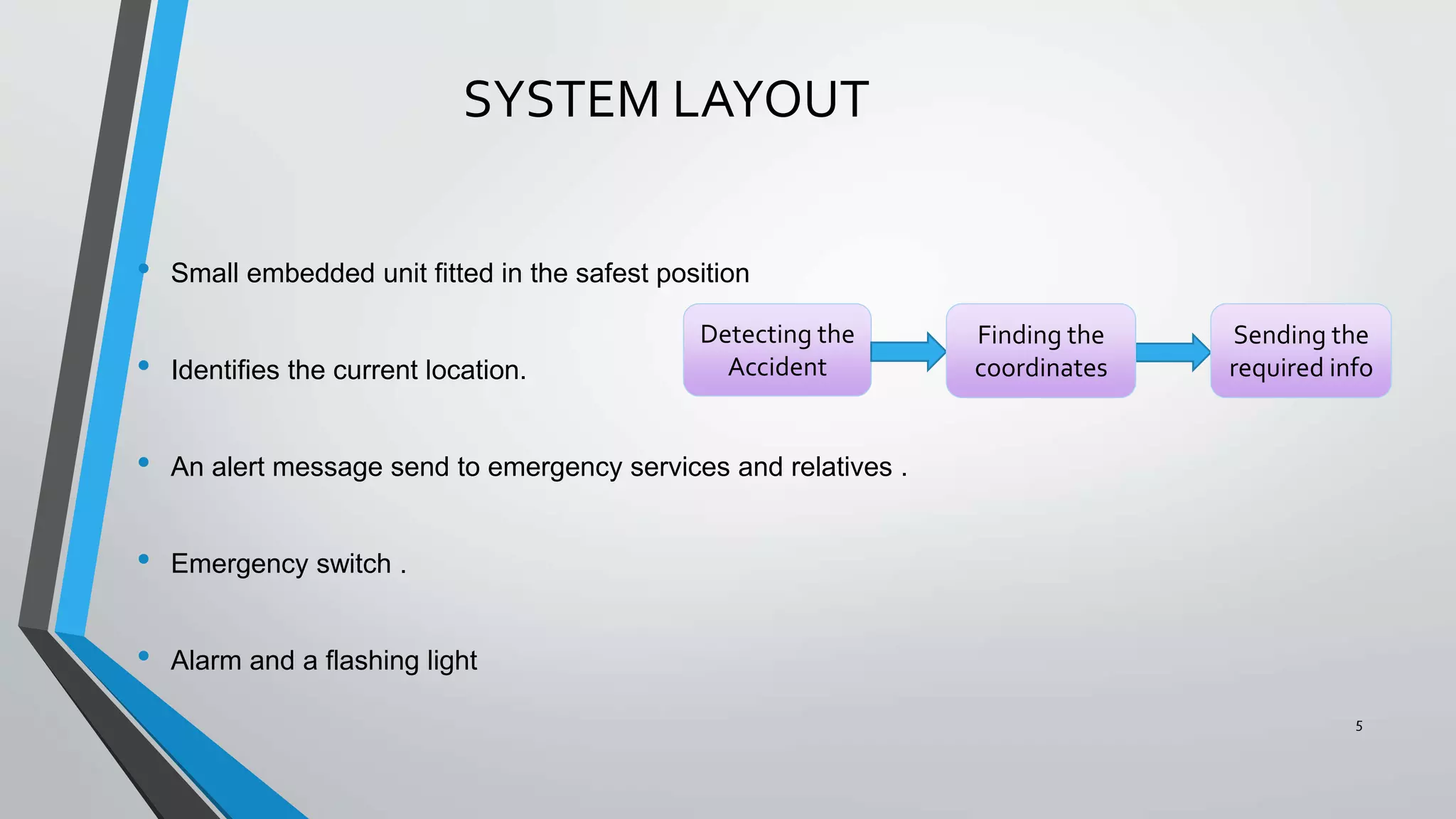
• Small embedded unit fitted in the safest position
• Identifies the current location.
• An alert message send to emergency services and relatives .
• Emergency switch .
• Alarm and a flashing light
5
Detecting the
Accident
Finding the
coordinates
Sending the
required info
SYSTEM IMPLEMENTATION
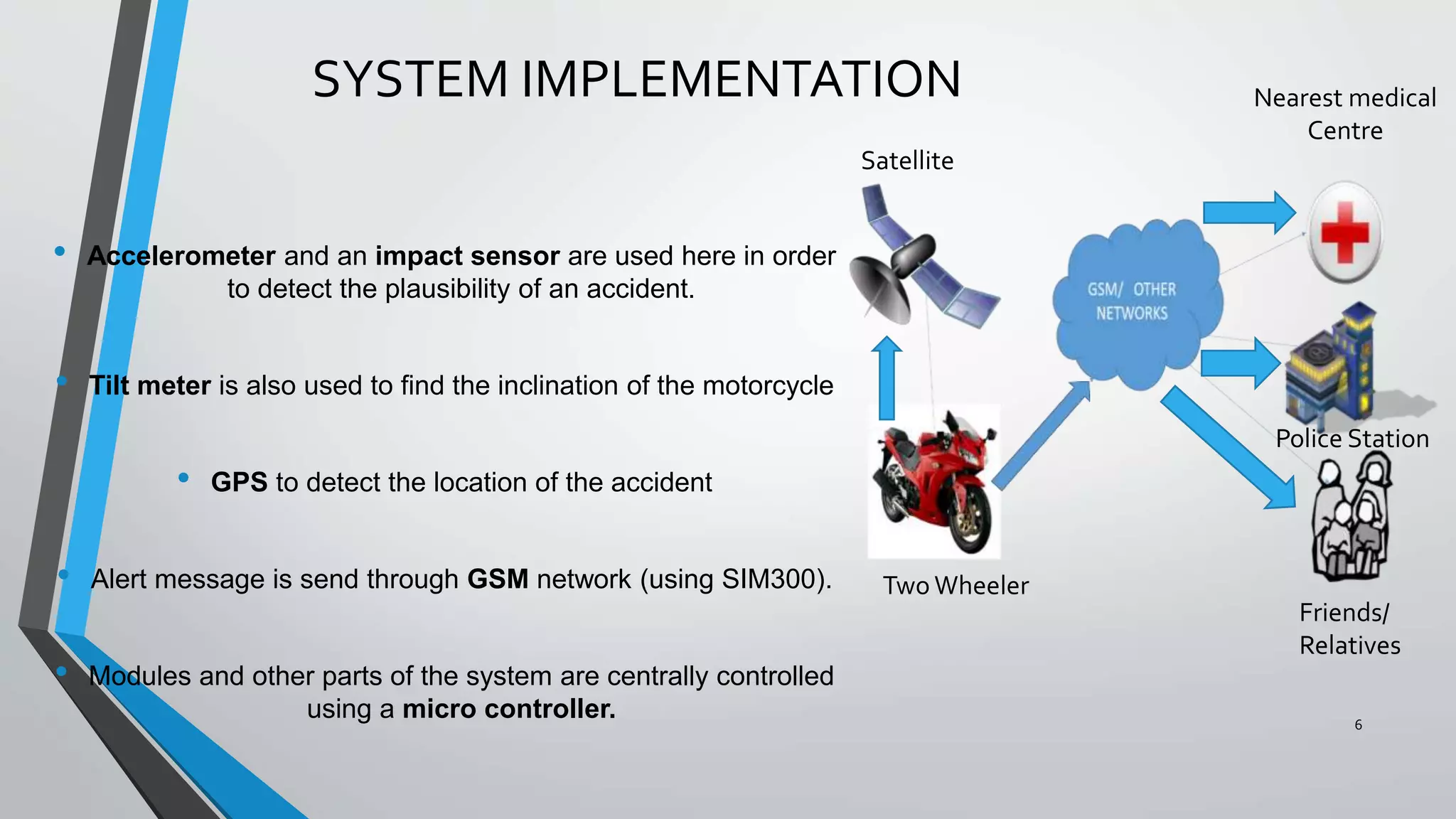
• Accelerometer and an impact sensor are used here in order
to detect the plausibility of an accident.
• Tilt meter is also used to find the inclination of the motorcycle
• GPS to detect the location of the accident
• Alert message is send through GSM network (using SIM300).
• Modules and other parts of the system are centrally controlled
using a micro controller. 6
Satellite
Two Wheeler
Friends/
Relatives
Nearest medical
Centre
Police Station
HardwareArchitecture
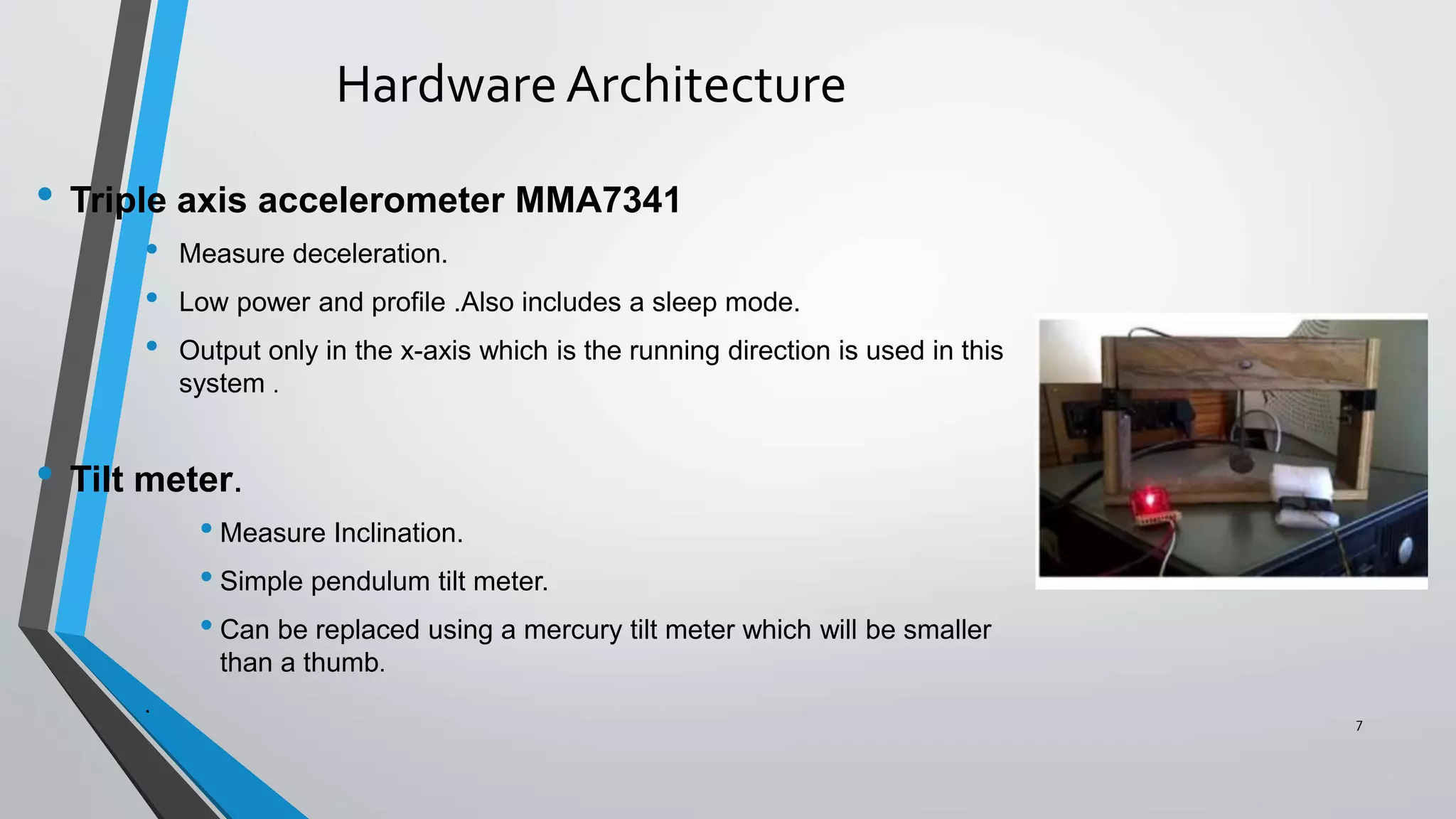
• Triple axis accelerometer MMA7341
• Measure deceleration.
• Low power and profile .Also includes a sleep mode.
• Output only in the x-axis which is the running direction is used in this
system .
• Tilt meter.
• Measure Inclination.
• Simple pendulum tilt meter.
• Can be replaced using a mercury tilt meter which will be smaller
than a thumb.
.
7
Hardware Architecture Contd..
• Flexible piezo film sensor.
• used for measuring the physical impact.
• 3 grams .
• Has a good sensitivity of 10mV/g.
• Has a frequency range of 1Hz to 20 kHz .
• Can survive a shock up to 1000g (g=9.8m/s2).
8
GPS Module
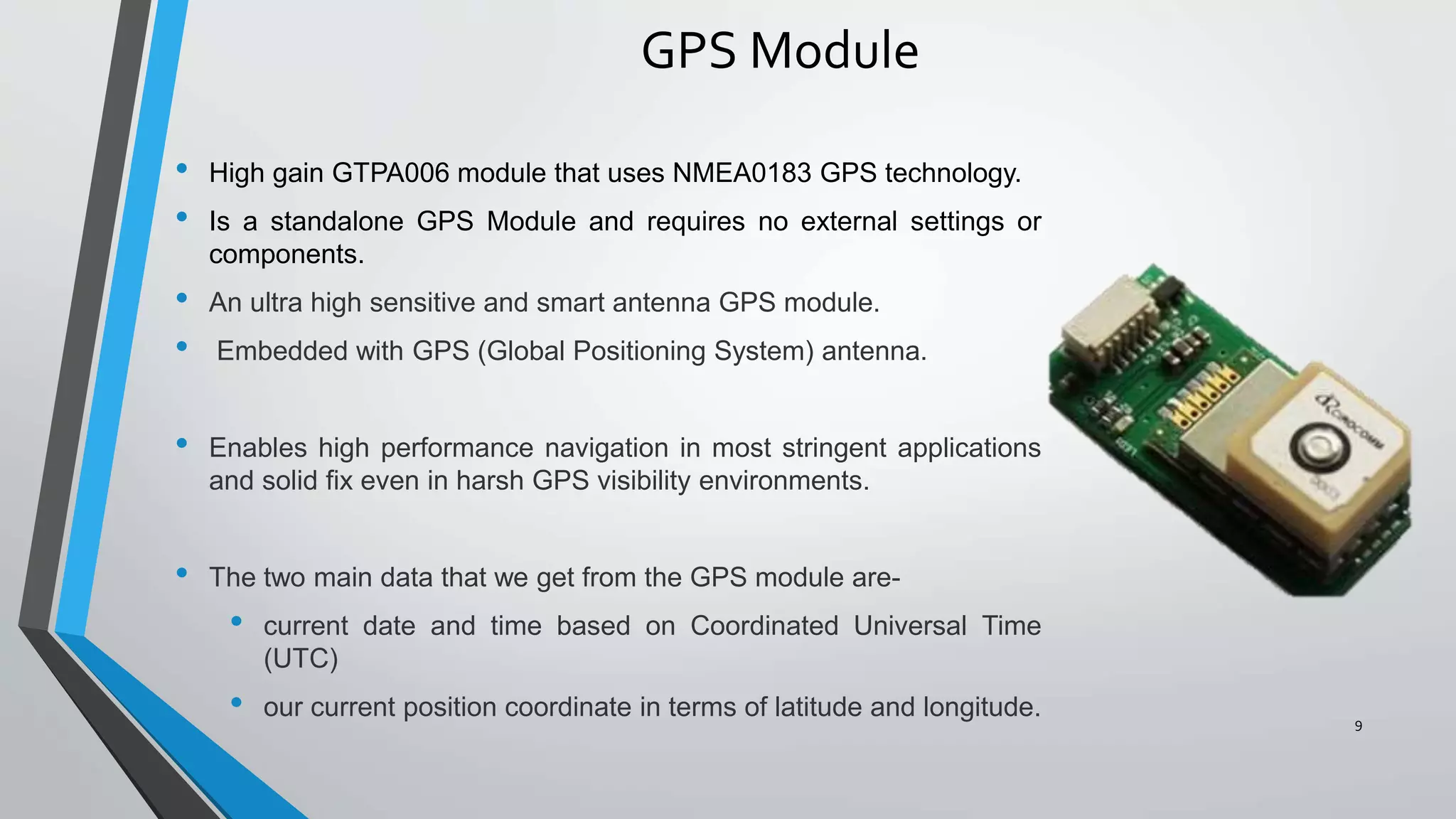
• High gain GTPA006 module that uses NMEA0183 GPS technology.
• Is a standalone GPS Module and requires no external settings or
components.
• An ultra high sensitive and smart antenna GPS module.
• Embedded with GPS (Global Positioning System) antenna.
• Enables high performance navigation in most stringent applications
and solid fix even in harsh GPS visibility environments.
• The two main data that we get from the GPS module are-
• current date and time based on Coordinated Universal Time
(UTC)
• our current position coordinate in terms of latitude and longitude. 9
GSM SIM300
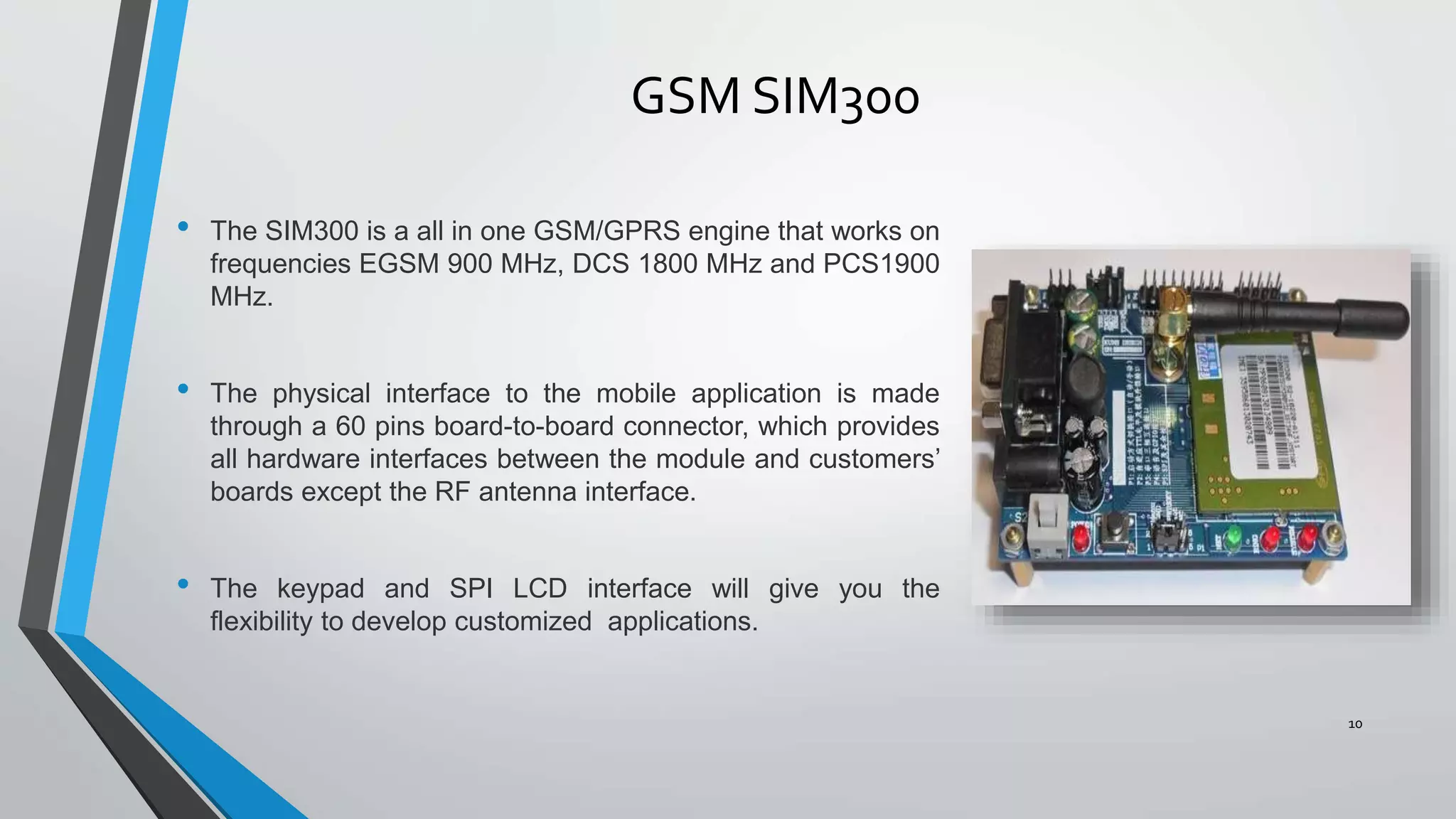
• The SIM300 is a all in one GSM/GPRS engine that works on
frequencies EGSM 900 MHz, DCS 1800 MHz and PCS1900
MHz.
• The physical interface to the mobile application is made
through a 60 pins board-to-board connector, which provides
all hardware interfaces between the module and customers’
boards except the RF antenna interface.
• The keypad and SPI LCD interface will give you the
flexibility to develop customized applications.
10
Software Architecture and Decision making
Algorithm
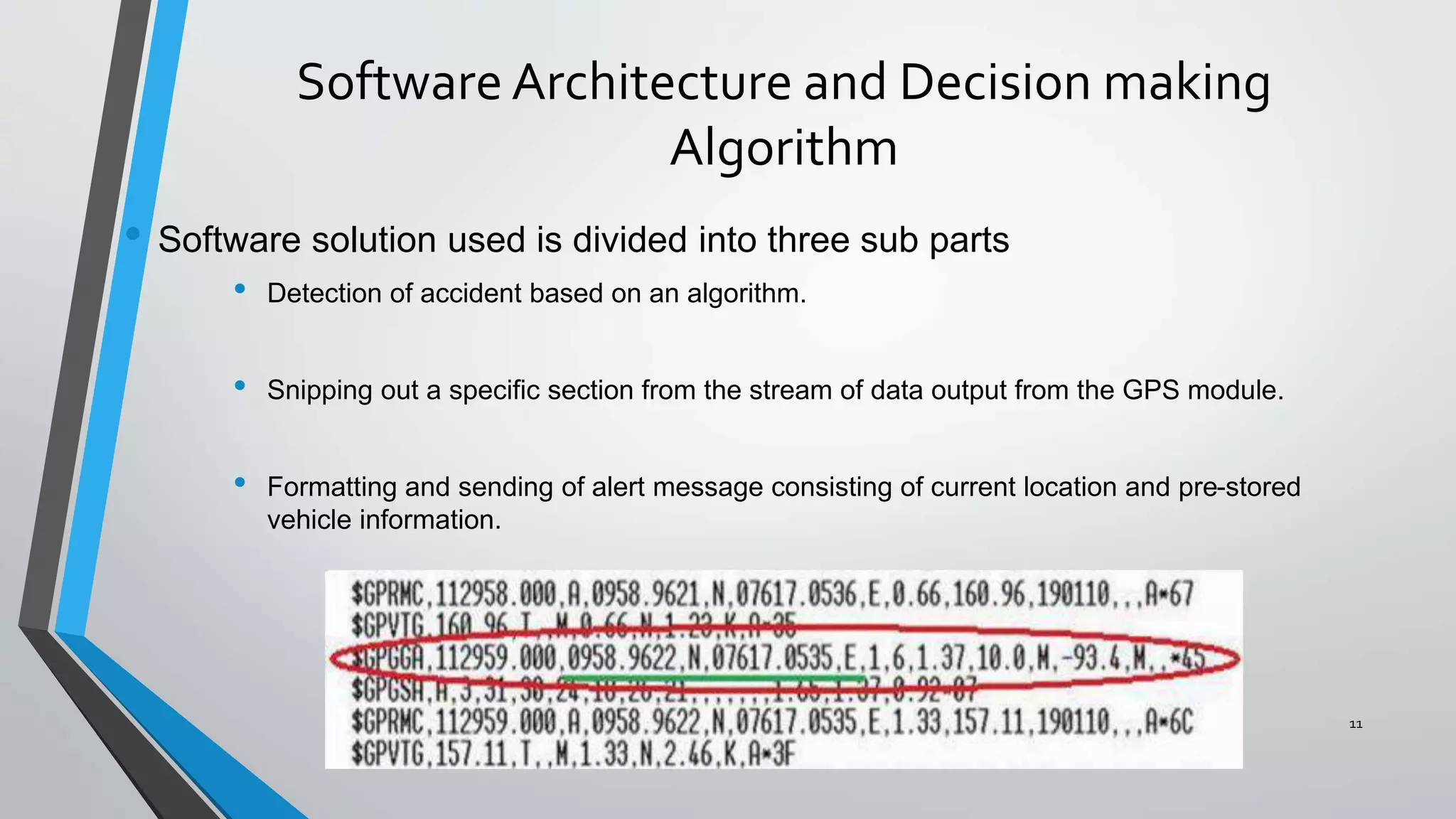
• Software solution used is divided into three sub parts
• Detection of accident based on an algorithm.
• Snipping out a specific section from the stream of data output from the GPS module.
• Formatting and sending of alert message consisting of current location and pre-stored
vehicle information.
11
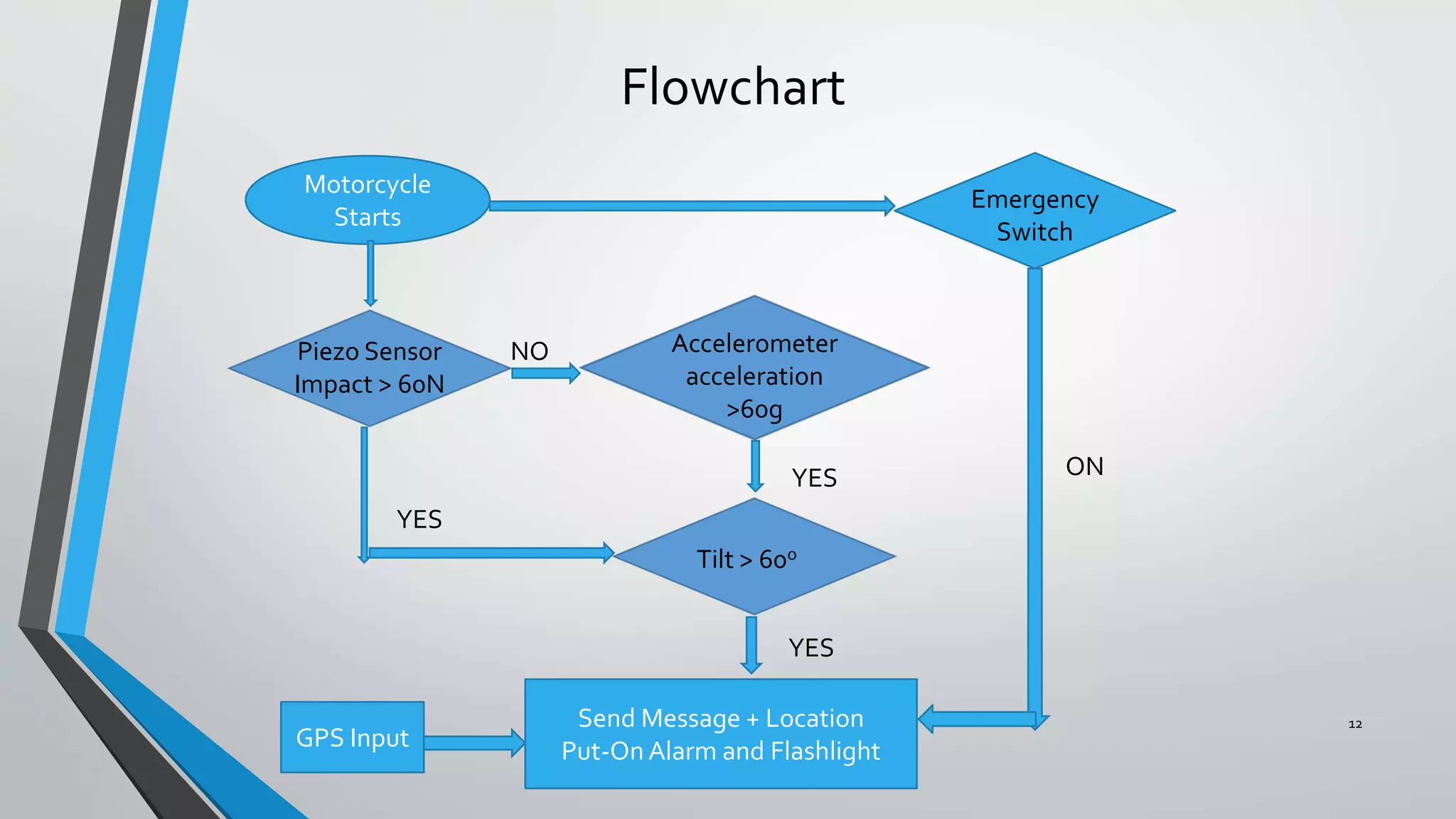
Flowchart
12
Motorcycle
Starts
Send Message + Location
Put-On Alarm and FlashlightGPS Input
Piezo Sensor
Impact > 60N
Accelerometer
acceleration
>60g
Emergency
Switch
Tilt > 60o
NO
YES
YES
YES
ON
PROTOTYPE DESIGN
• The MMA7431 and Piezo film sensor give analog voltage outputs
corresponding to the deceleration and impact.
• A deceleration above 2.5g is not likely to occur during a normal bike ride.
• An output of 2.8V is obtained from the accelerometer.
• A comparator circuit with a reference voltage of 2.8V is used to detect this.
• A similar method is followed for the impact sensor
• The reference voltage set to 1V.
• Corresponding to a force of 100g.
13
• The tilt meter output is a digital signal and is directly interfaced to the micro controller.
• When the accident is confirmed, the controller talks to GPS module through the UART
communication at 9600 baud rate.
• The GSM module also works via the UART at the same baud rate as that of GPS
• The communication is initiated via AT commands.
• GPS and GSM are operated with a single UART channel in the micro controller.
• Power for all the devices is taken from the vehicle battery.
14
PROTOTYPETESTING AND DISCUSSION
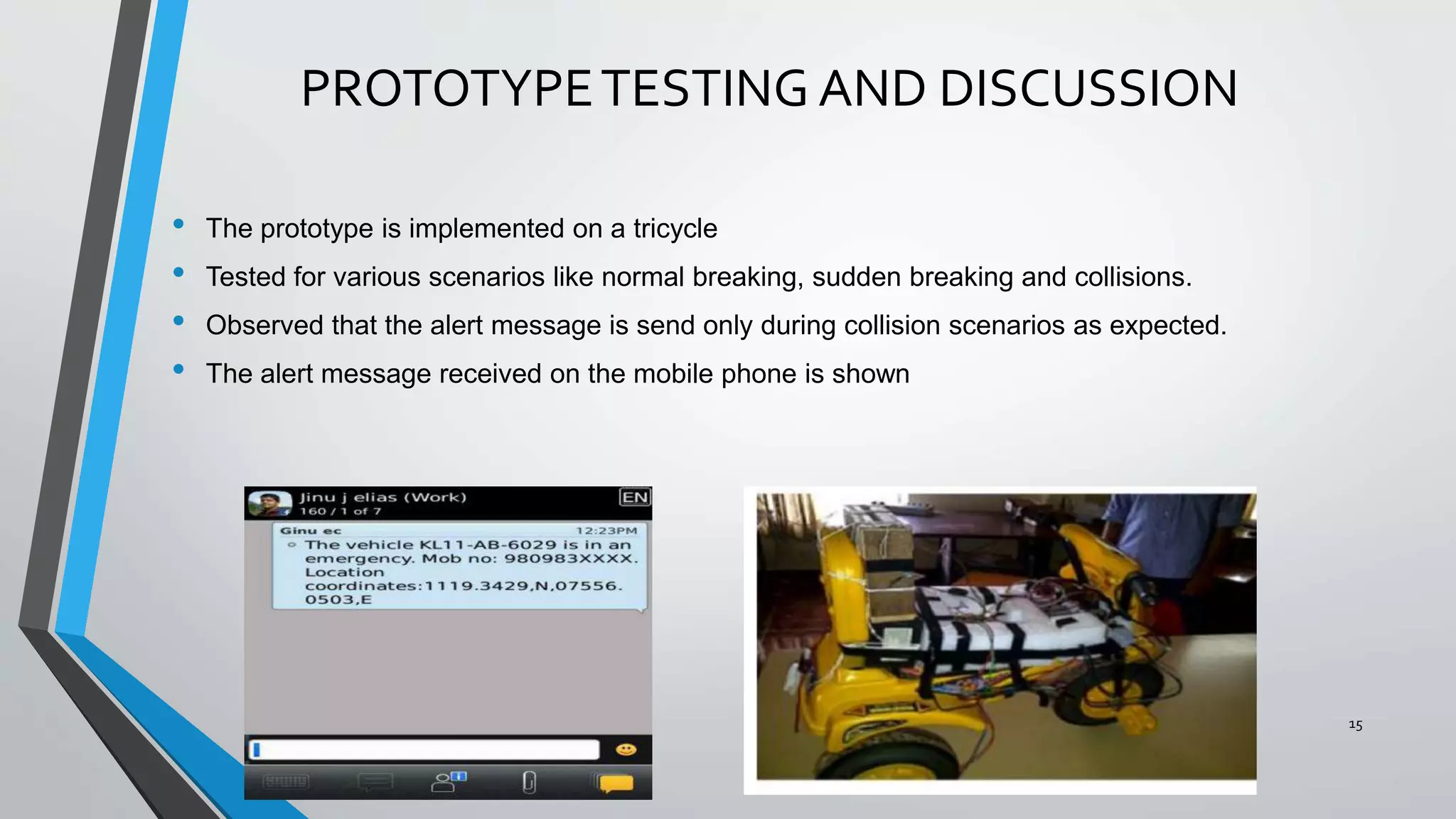
• The prototype is implemented on a tricycle
• Tested for various scenarios like normal breaking, sudden breaking and collisions.
• Observed that the alert message is send only during collision scenarios as expected.
• The alert message received on the mobile phone is shown
15
CHALLENGES FACED
• Deceleration.
• Impact value.
• Safety of the System.
• Positioning of sensor.
16
SUGGESTED IMPROVEMENTS
• The deceleration in the remaining directions(y and z axis).
• An intermediate dedicated system server placed between the GSM
device and end clients.
• Send out a voice message along with the text.
• Dedicated network.`
17
CONCLUSION
• Proves the feasibility of implementing automatic accident alert system for motorcycles.
• Accident information reached the emergency services within seconds
• Significantly improve the time gap for rescue operation and save the lives of huge number of
victims
• Should be a well structured 'system in place', to support this endeavour.
• Should be a central node which accepts the alert message and take necessary action.
• Coordination between this central node and other services like ambulance, police force, hospitals
and other medical facilities, social forms etc. is also necessary.
• System has a lot of potential to improve the accident rescue operations and with better resources
and innovations
18
REFERENCES
• [1].Victor Olugbemiga Matthews and Emmanuel Adetiba;Vehicle Accident Alert and
Locator (VAAL); International Journal of Electrical &
• Computer Sciences IJECS-IJENSVol: 11 No: 02
• [2]. Scott J.Weiner; Feasibility of a 802.11VANET Based CarAccident Alert System;
• Northeastern University
• [3]. RoadAccidents In India 2009 – Government of India, Ministry of road transport and
highways, transport research wing, New Delhi
• [4] K. Shiraram, K.V. Kalligudd, “Development and Demonstration of a GPS/GSM Based
Affordable Fleet Management System for Indian Roadways”[Online],
Available:liu.divaportal.org/smash/get/diva2:22123 /FULLTEXT01.pdf
• [5]Megan Bayly, Brian Fildes, Michael Regan, KristieYoung , “Review of crash effectiveness
of IntelligentTransport Systems” Project No. 027763 –TRACE
• [6]B. Huang and J. Preston, “A Literature Review on Motorcycle Collisions”,Transport
Studies Unit Oxford UniversityApril 2004 19
20
THANK YOU
21

Design of Accident Detection and Alert System for Motor Cycles

  • 1.
    Design of AccidentDetection and Alert System for Motor Cycles Presented By, Guided By, Althaf A Nishadha S G S7 CSE Asst.Professor
  • 2.
    CONTENTS • Abstract. • Introduction. •System Layout. • System Implementation. • Hardware Architecture. • Software Architecture. • Flowchart. • Conclusion. 2
  • 3.
    ABSTRACT • Detect accident. •3 parameters - Acceleration / Deceleration Tilt of the Vehicle Pressure change / Impact • Coordinates of the vehicle – GPS Technology. 3
  • 4.
    INTRODUCTION • Millions ofvehicles are being produced annually. • The accident rates are also getting significantly increased . • Every second waiting for the medical help can cost the victims their life. • Self automated electronic system will be more reliable. • Explicitly designed for motorcycles. • The hardware part is implemented on a motorcycle and the software part in a tablet/mobile phone etc…. 4
  • 5.
    SYSTEM LAYOUT • Smallembedded unit fitted in the safest position • Identifies the current location. • An alert message send to emergency services and relatives . • Emergency switch . • Alarm and a flashing light 5 Detecting the Accident Finding the coordinates Sending the required info
  • 6.
    SYSTEM IMPLEMENTATION • Accelerometerand an impact sensor are used here in order to detect the plausibility of an accident. • Tilt meter is also used to find the inclination of the motorcycle • GPS to detect the location of the accident • Alert message is send through GSM network (using SIM300). • Modules and other parts of the system are centrally controlled using a micro controller. 6 Satellite Two Wheeler Friends/ Relatives Nearest medical Centre Police Station
  • 7.
    HardwareArchitecture • Triple axisaccelerometer MMA7341 • Measure deceleration. • Low power and profile .Also includes a sleep mode. • Output only in the x-axis which is the running direction is used in this system . • Tilt meter. • Measure Inclination. • Simple pendulum tilt meter. • Can be replaced using a mercury tilt meter which will be smaller than a thumb. . 7
  • 8.
    Hardware Architecture Contd.. •Flexible piezo film sensor. • used for measuring the physical impact. • 3 grams . • Has a good sensitivity of 10mV/g. • Has a frequency range of 1Hz to 20 kHz . • Can survive a shock up to 1000g (g=9.8m/s2). 8
  • 9.
    GPS Module • Highgain GTPA006 module that uses NMEA0183 GPS technology. • Is a standalone GPS Module and requires no external settings or components. • An ultra high sensitive and smart antenna GPS module. • Embedded with GPS (Global Positioning System) antenna. • Enables high performance navigation in most stringent applications and solid fix even in harsh GPS visibility environments. • The two main data that we get from the GPS module are- • current date and time based on Coordinated Universal Time (UTC) • our current position coordinate in terms of latitude and longitude. 9
  • 10.
    GSM SIM300 • TheSIM300 is a all in one GSM/GPRS engine that works on frequencies EGSM 900 MHz, DCS 1800 MHz and PCS1900 MHz. • The physical interface to the mobile application is made through a 60 pins board-to-board connector, which provides all hardware interfaces between the module and customers’ boards except the RF antenna interface. • The keypad and SPI LCD interface will give you the flexibility to develop customized applications. 10
  • 11.
    Software Architecture andDecision making Algorithm • Software solution used is divided into three sub parts • Detection of accident based on an algorithm. • Snipping out a specific section from the stream of data output from the GPS module. • Formatting and sending of alert message consisting of current location and pre-stored vehicle information. 11
  • 12.
    Flowchart 12 Motorcycle Starts Send Message +Location Put-On Alarm and FlashlightGPS Input Piezo Sensor Impact > 60N Accelerometer acceleration >60g Emergency Switch Tilt > 60o NO YES YES YES ON
  • 13.
    PROTOTYPE DESIGN • TheMMA7431 and Piezo film sensor give analog voltage outputs corresponding to the deceleration and impact. • A deceleration above 2.5g is not likely to occur during a normal bike ride. • An output of 2.8V is obtained from the accelerometer. • A comparator circuit with a reference voltage of 2.8V is used to detect this. • A similar method is followed for the impact sensor • The reference voltage set to 1V. • Corresponding to a force of 100g. 13
  • 14.
    • The tiltmeter output is a digital signal and is directly interfaced to the micro controller. • When the accident is confirmed, the controller talks to GPS module through the UART communication at 9600 baud rate. • The GSM module also works via the UART at the same baud rate as that of GPS • The communication is initiated via AT commands. • GPS and GSM are operated with a single UART channel in the micro controller. • Power for all the devices is taken from the vehicle battery. 14
  • 15.
    PROTOTYPETESTING AND DISCUSSION •The prototype is implemented on a tricycle • Tested for various scenarios like normal breaking, sudden breaking and collisions. • Observed that the alert message is send only during collision scenarios as expected. • The alert message received on the mobile phone is shown 15
  • 16.
    CHALLENGES FACED • Deceleration. •Impact value. • Safety of the System. • Positioning of sensor. 16
  • 17.
    SUGGESTED IMPROVEMENTS • Thedeceleration in the remaining directions(y and z axis). • An intermediate dedicated system server placed between the GSM device and end clients. • Send out a voice message along with the text. • Dedicated network.` 17
  • 18.
    CONCLUSION • Proves thefeasibility of implementing automatic accident alert system for motorcycles. • Accident information reached the emergency services within seconds • Significantly improve the time gap for rescue operation and save the lives of huge number of victims • Should be a well structured 'system in place', to support this endeavour. • Should be a central node which accepts the alert message and take necessary action. • Coordination between this central node and other services like ambulance, police force, hospitals and other medical facilities, social forms etc. is also necessary. • System has a lot of potential to improve the accident rescue operations and with better resources and innovations 18
  • 19.
    REFERENCES • [1].Victor OlugbemigaMatthews and Emmanuel Adetiba;Vehicle Accident Alert and Locator (VAAL); International Journal of Electrical & • Computer Sciences IJECS-IJENSVol: 11 No: 02 • [2]. Scott J.Weiner; Feasibility of a 802.11VANET Based CarAccident Alert System; • Northeastern University • [3]. RoadAccidents In India 2009 – Government of India, Ministry of road transport and highways, transport research wing, New Delhi • [4] K. Shiraram, K.V. Kalligudd, “Development and Demonstration of a GPS/GSM Based Affordable Fleet Management System for Indian Roadways”[Online], Available:liu.divaportal.org/smash/get/diva2:22123 /FULLTEXT01.pdf • [5]Megan Bayly, Brian Fildes, Michael Regan, KristieYoung , “Review of crash effectiveness of IntelligentTransport Systems” Project No. 027763 –TRACE • [6]B. Huang and J. Preston, “A Literature Review on Motorcycle Collisions”,Transport Studies Unit Oxford UniversityApril 2004 19
  • 20.
  • 21.