ALFA College of Engineering and Technology
ALLAGADDA
Merited
presentation
A CALL BETWEEN LIFE AND DEATH
INTRODUCTION
E-CALL MEANS
WHY E-CALL
PRINCIPLE
E-CALL SYSTEM FUNCTIONS
SYSTEM GENERIC ARCHITECTURE
E-CALL SIGNALLING PROCEDURE
HARDWARE USED IN E-CALL
TECHNOLOGY OVERVIEW
ADVANTAGES
DISADVANTAGES
FUTURE
CONCLUSION
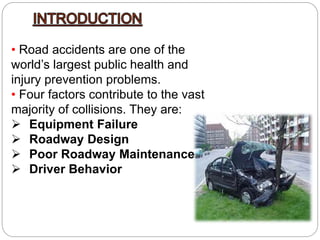
• Road accidents are one of the
world’s largest public health and
injury prevention problems.
• Four factors contribute to the vast
majority of collisions. They are:
 Equipment Failure
 Roadway Design
 Poor Roadway Maintenance
 Driver Behavior
E-CALL MEANS???
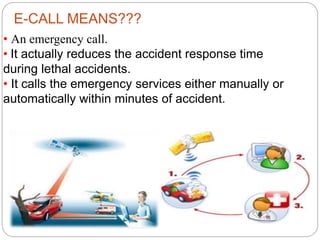
• An emergency call.
• It actually reduces the accident response time
during lethal accidents.
• It calls the emergency services either manually or
automatically within minutes of accident.
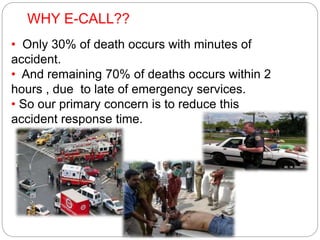
WHY E-CALL??
• Only 30% of death occurs with minutes of
accident.
• And remaining 70% of deaths occurs within 2
hours , due to late of emergency services.
• So our primary concern is to reduce this
accident response time.
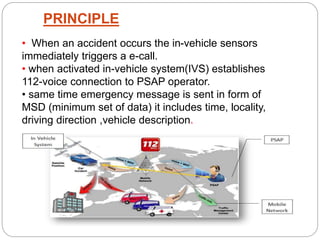
PRINCIPLE
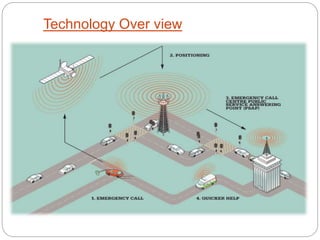
• When an accident occurs the in-vehicle sensors
immediately triggers a e-call.
• when activated in-vehicle system(IVS) establishes
112-voice connection to PSAP operator.
• same time emergency message is sent in form of
MSD (minimum set of data) it includes time, locality,
driving direction ,vehicle description.
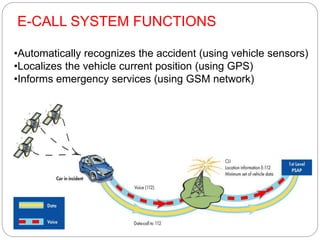
E-CALL SYSTEM FUNCTIONS
•Automatically recognizes the accident (using vehicle sensors)
•Localizes the vehicle current position (using GPS)
•Informs emergency services (using GSM network)
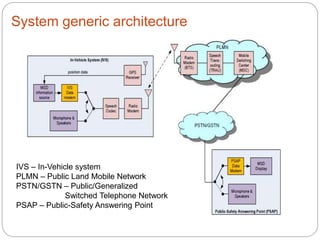
System generic architecture
IVS – In-Vehicle system
PLMN – Public Land Mobile Network
PSTN/GSTN – Public/Generalized
Switched Telephone Network
PSAP – Public-Safety Answering Point
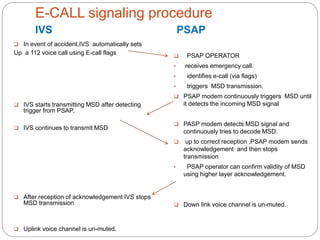
E-CALL signaling procedure
IVS
 In event of accident,IVS automatically sets
Up a 112 voice call using E-call flags
 IVS starts transmitting MSD after detecting
trigger from PSAP.
 IVS continues to transmit MSD
 After reception of acknowledgement IVS stops
MSD transmission
 Uplink voice channel is un-muted.
PSAP
 PSAP OPERATOR
• receives emergency call.
• identifies e-call (via flags)
• triggers MSD transmission.
 PSAP modem continuously triggers MSD until
it detects the incoming MSD signal
 PASP modem detects MSD signal and
continuously tries to decode MSD.
 up to correct reception ,PSAP modem sends
acknowledgement and then stops
transmission
• PSAP operator can confirm validity of MSD
using higher layer acknowledgement.
 Down link voice channel is un-muted.
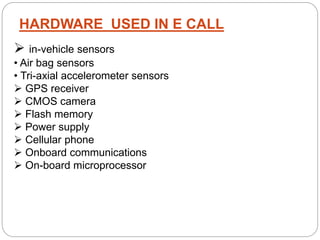
HARDWARE USED IN E CALL
 in-vehicle sensors
• Air bag sensors
• Tri-axial accelerometer sensors
 GPS receiver
 CMOS camera
 Flash memory
 Power supply
 Cellular phone
 Onboard communications
 On-board microprocessor
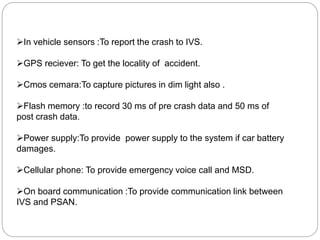
In vehicle sensors :To report the crash to IVS.
GPS reciever: To get the locality of accident.
Cmos cemara:To capture pictures in dim light also .
Flash memory :to record 30 ms of pre crash data and 50 ms of
post crash data.
Power supply:To provide power supply to the system if car battery
damages.
Cellular phone: To provide emergency voice call and MSD.
On board communication :To provide communication link between
IVS and PSAN.
Technology Over view
Advantages :
It is estimated that E-call system can save lives
up to 2,500 per year.
Reduces severity of the injuries in worst
accidents.
GPS system in vehicle also enables location of
the vehicle when it was stolen.
This System also ensures a corresponding
reduction in the number of traffic jams.
Disadvantages:
 costly technology.
 complex for maintenance.
Future:
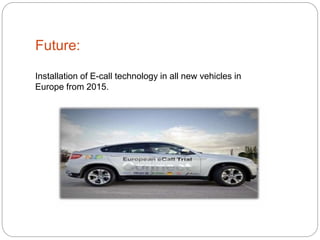
Installation of E-call technology in all new vehicles in
Europe from 2015.
Conclusion:
Highly efficient.
Saves life.
The government must take the responsibility of
implementing this technology.
Drivers can be assured of a healthy drive and a
pleasant ride .
TIME SAVED=LIVES SAVED
QUERIES
Thank You

E call ppt

  • 1.
    ALFA College ofEngineering and Technology ALLAGADDA Merited presentation
  • 2.
    A CALL BETWEENLIFE AND DEATH
  • 3.
    INTRODUCTION E-CALL MEANS WHY E-CALL PRINCIPLE E-CALLSYSTEM FUNCTIONS SYSTEM GENERIC ARCHITECTURE E-CALL SIGNALLING PROCEDURE HARDWARE USED IN E-CALL TECHNOLOGY OVERVIEW ADVANTAGES DISADVANTAGES FUTURE CONCLUSION
  • 4.
    • Road accidentsare one of the world’s largest public health and injury prevention problems. • Four factors contribute to the vast majority of collisions. They are:  Equipment Failure  Roadway Design  Poor Roadway Maintenance  Driver Behavior
  • 5.
    E-CALL MEANS??? • Anemergency call. • It actually reduces the accident response time during lethal accidents. • It calls the emergency services either manually or automatically within minutes of accident.
  • 6.
    WHY E-CALL?? • Only30% of death occurs with minutes of accident. • And remaining 70% of deaths occurs within 2 hours , due to late of emergency services. • So our primary concern is to reduce this accident response time.
  • 7.
    PRINCIPLE • When anaccident occurs the in-vehicle sensors immediately triggers a e-call. • when activated in-vehicle system(IVS) establishes 112-voice connection to PSAP operator. • same time emergency message is sent in form of MSD (minimum set of data) it includes time, locality, driving direction ,vehicle description.
  • 8.
    E-CALL SYSTEM FUNCTIONS •Automaticallyrecognizes the accident (using vehicle sensors) •Localizes the vehicle current position (using GPS) •Informs emergency services (using GSM network)
  • 9.
    System generic architecture IVS– In-Vehicle system PLMN – Public Land Mobile Network PSTN/GSTN – Public/Generalized Switched Telephone Network PSAP – Public-Safety Answering Point
  • 10.
    E-CALL signaling procedure IVS In event of accident,IVS automatically sets Up a 112 voice call using E-call flags  IVS starts transmitting MSD after detecting trigger from PSAP.  IVS continues to transmit MSD  After reception of acknowledgement IVS stops MSD transmission  Uplink voice channel is un-muted. PSAP  PSAP OPERATOR • receives emergency call. • identifies e-call (via flags) • triggers MSD transmission.  PSAP modem continuously triggers MSD until it detects the incoming MSD signal  PASP modem detects MSD signal and continuously tries to decode MSD.  up to correct reception ,PSAP modem sends acknowledgement and then stops transmission • PSAP operator can confirm validity of MSD using higher layer acknowledgement.  Down link voice channel is un-muted.
  • 11.
    HARDWARE USED INE CALL  in-vehicle sensors • Air bag sensors • Tri-axial accelerometer sensors  GPS receiver  CMOS camera  Flash memory  Power supply  Cellular phone  Onboard communications  On-board microprocessor
  • 12.
    In vehicle sensors:To report the crash to IVS. GPS reciever: To get the locality of accident. Cmos cemara:To capture pictures in dim light also . Flash memory :to record 30 ms of pre crash data and 50 ms of post crash data. Power supply:To provide power supply to the system if car battery damages. Cellular phone: To provide emergency voice call and MSD. On board communication :To provide communication link between IVS and PSAN.
  • 13.
  • 14.
    Advantages : It isestimated that E-call system can save lives up to 2,500 per year. Reduces severity of the injuries in worst accidents. GPS system in vehicle also enables location of the vehicle when it was stolen. This System also ensures a corresponding reduction in the number of traffic jams. Disadvantages:  costly technology.  complex for maintenance.
  • 15.
    Future: Installation of E-calltechnology in all new vehicles in Europe from 2015.
  • 16.
    Conclusion: Highly efficient. Saves life. Thegovernment must take the responsibility of implementing this technology. Drivers can be assured of a healthy drive and a pleasant ride . TIME SAVED=LIVES SAVED
  • 17.
  • 18.