AUTONOMOUS
VEHICLES
ABSTRACT
This report study the
autonomous vehicles history,
present & future. And give a
quick look over their theory of
operating and their effects on
the economic and energy usage.
Omer Mohammed Omer
125067
Self-driving vehicles are cars or trucks in which human
drivers are never required to take control to safely operate the
vehicle. Also known as autonomous or “driverless” cars, they
combine sensors and software to control, navigate, and drive the
vehicle.
How they work:
Various self-driving technologies have been developed by
Google, Uber, Tesla, Nissan, and other major automakers,
researchers, and technology companies.
While design details vary, most self-driving systems create and
maintain an internal map of their surroundings, based on a wide
array of sensors, like radar. Uber’s self-driving prototypes use
sixty-four laser beams, along with other sensors, to construct
their internal map; Google’s prototypes have, at various stages,
used lasers, radar, high-powered cameras, and sonar.
Software then processes those inputs, plots a path, and sends
instructions to the vehicle’s “actuators,” which control
acceleration, braking, and steering. Hard-coded rules, obstacle
avoidance algorithms, predictive modeling, and “smart” object
discrimination (ie, knowing the difference between a bicycle and
a motorcycle) help the software follow traffic rules and navigate
obstacles.Partially-autonomous vehicles may require a human
driver to intervene if the system encounters uncertainty; fully-
autonomous vehicles may not even offer a steering wheel.
History of Autonomous Vehicles:
Autonomous vehicle industry can be considered as an
evolutionary industry rooted and started since the 70th
of the 20
century. The graph below can give a quick look at the evaluation
of Autonomous vehicle industry.
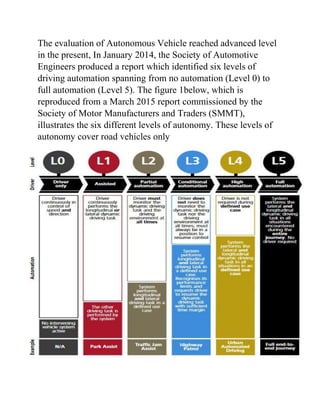
The evaluation of Autonomous Vehicle reached advanced level
in the present, In January 2014, the Society of Automotive
Engineers produced a report which identified six levels of
driving automation spanning from no automation (Level 0) to
full automation (Level 5). The figure 1below, which is
reproduced from a March 2015 report commissioned by the
Society of Motor Manufacturers and Traders (SMMT),
illustrates the six different levels of autonomy. These levels of
autonomy cover road vehicles only
Autonomous Vehicle Equipment and Service Requirements:
Autonomous vehicle manufacturing isn’t easy as it seems, it
require many high cost components like:
 Automatic transmissions.
 Diverse and redundant sensors (optical infrared, radar,
ultrasonic and laser) capable of operating in diverse
conditions (rain, snow, unpaved roads, tunnels, etc.).
 Wireless networks. Short range systems for vehicle-to-vehicle
communications, and long-range systems to access to maps,
software upgrades, road condition reports, and emergency
messages.
 Navigation, including GPS systems and special maps.
 Automated controls (steering, braking, signals, etc.).
 Servers, software and power supplies with high reliability
standards. Additional testing, maintenance and repair costs for
critical components such as sensors and controls
Effect of Autonomous Vehicle on Energy:
Since Google’s demonstration of the driverless car in 2012,
it has attracted large interest from the media and the public, as
well as from the transport academics. Self-driving, driverless or
fully automated autonomous vehicles are often expected to solve
transport’s energy use and carbon emissions related problems.
Research done at the University of Leeds in collaboration
with the University of Washington and Oak Ridge National
Laboratory bounds the potential ranges of energy impacts of
self-driving cars in the US through the energy efficiency and
travel demand mechanisms, the key messages for the research
were:
 Automation can result in substantial reduction in energy
demand, but this reduction is not a direct consequence of
automation per se, rather due to changes in vehicle design,
vehicle operations, transport system optimization facilitated
by vehicle automation.
 Some of the reductions in energy demand could be brought
about by a higher degree of connectivity, even at a lower
level of automation than self-driving cars. Yet, for fully
self-driving cars, there is a substantial risk of increased
travel and energy demand. Thus, stopping short of fully
self-driving cars may be more beneficial from an energy
perspective.
 There are large uncertainties in the quantification of net
energy effects of self-driving cars. Therefore it is vital that
the various mechanisms discussed here are aligned in the
correct directions through appropriate policies in order to
reap full energy and carbon benefits of automation.
References:
 Autonomous Vehicle Implementation Predictions, Todd
litman, 2017, Victoria Transport Policy Institute.
 Autonomous Cars: Self-Driving the New Auto Industry
Paradigm, 2013, Morgan Stanley Research.
 Connected and Autonomous Vehicles: The future? , 2017,
House of Lords
 SELF-DRIVING CARS: WILL THEY REDUCE
ENERGY USE?, Zia Wadud and Greg Marsden, 2017
Energy Leeds.

AUTONOMOUS VEHICLES

  • 1.
    AUTONOMOUS VEHICLES ABSTRACT This report studythe autonomous vehicles history, present & future. And give a quick look over their theory of operating and their effects on the economic and energy usage. Omer Mohammed Omer 125067
  • 2.
    Self-driving vehicles arecars or trucks in which human drivers are never required to take control to safely operate the vehicle. Also known as autonomous or “driverless” cars, they combine sensors and software to control, navigate, and drive the vehicle. How they work: Various self-driving technologies have been developed by Google, Uber, Tesla, Nissan, and other major automakers, researchers, and technology companies. While design details vary, most self-driving systems create and maintain an internal map of their surroundings, based on a wide array of sensors, like radar. Uber’s self-driving prototypes use sixty-four laser beams, along with other sensors, to construct their internal map; Google’s prototypes have, at various stages, used lasers, radar, high-powered cameras, and sonar. Software then processes those inputs, plots a path, and sends instructions to the vehicle’s “actuators,” which control acceleration, braking, and steering. Hard-coded rules, obstacle avoidance algorithms, predictive modeling, and “smart” object discrimination (ie, knowing the difference between a bicycle and a motorcycle) help the software follow traffic rules and navigate obstacles.Partially-autonomous vehicles may require a human driver to intervene if the system encounters uncertainty; fully- autonomous vehicles may not even offer a steering wheel.
  • 3.
    History of AutonomousVehicles: Autonomous vehicle industry can be considered as an evolutionary industry rooted and started since the 70th of the 20 century. The graph below can give a quick look at the evaluation of Autonomous vehicle industry.
  • 4.
    The evaluation ofAutonomous Vehicle reached advanced level in the present, In January 2014, the Society of Automotive Engineers produced a report which identified six levels of driving automation spanning from no automation (Level 0) to full automation (Level 5). The figure 1below, which is reproduced from a March 2015 report commissioned by the Society of Motor Manufacturers and Traders (SMMT), illustrates the six different levels of autonomy. These levels of autonomy cover road vehicles only
  • 5.
    Autonomous Vehicle Equipmentand Service Requirements: Autonomous vehicle manufacturing isn’t easy as it seems, it require many high cost components like:  Automatic transmissions.  Diverse and redundant sensors (optical infrared, radar, ultrasonic and laser) capable of operating in diverse conditions (rain, snow, unpaved roads, tunnels, etc.).  Wireless networks. Short range systems for vehicle-to-vehicle communications, and long-range systems to access to maps, software upgrades, road condition reports, and emergency messages.  Navigation, including GPS systems and special maps.  Automated controls (steering, braking, signals, etc.).  Servers, software and power supplies with high reliability standards. Additional testing, maintenance and repair costs for critical components such as sensors and controls Effect of Autonomous Vehicle on Energy: Since Google’s demonstration of the driverless car in 2012, it has attracted large interest from the media and the public, as well as from the transport academics. Self-driving, driverless or fully automated autonomous vehicles are often expected to solve transport’s energy use and carbon emissions related problems. Research done at the University of Leeds in collaboration with the University of Washington and Oak Ridge National Laboratory bounds the potential ranges of energy impacts of self-driving cars in the US through the energy efficiency and travel demand mechanisms, the key messages for the research were:
  • 6.
     Automation canresult in substantial reduction in energy demand, but this reduction is not a direct consequence of automation per se, rather due to changes in vehicle design, vehicle operations, transport system optimization facilitated by vehicle automation.  Some of the reductions in energy demand could be brought about by a higher degree of connectivity, even at a lower level of automation than self-driving cars. Yet, for fully self-driving cars, there is a substantial risk of increased travel and energy demand. Thus, stopping short of fully self-driving cars may be more beneficial from an energy perspective.  There are large uncertainties in the quantification of net energy effects of self-driving cars. Therefore it is vital that the various mechanisms discussed here are aligned in the correct directions through appropriate policies in order to reap full energy and carbon benefits of automation.
  • 7.
    References:  Autonomous VehicleImplementation Predictions, Todd litman, 2017, Victoria Transport Policy Institute.  Autonomous Cars: Self-Driving the New Auto Industry Paradigm, 2013, Morgan Stanley Research.  Connected and Autonomous Vehicles: The future? , 2017, House of Lords  SELF-DRIVING CARS: WILL THEY REDUCE ENERGY USE?, Zia Wadud and Greg Marsden, 2017 Energy Leeds.