EPIDEMIOLOGY, 
DISEASE AND SITUATION 
ASSESSMENT 
BY, 
DR. B. GURUMURTHY 
HOUSE SURGEON 
EBOLA – 
GUIDE-DR. 
LAXMIKANT L 
ASSOCIATE PROFESSOR, 
DEPT OF COMMUNITY MEDICINE
AGENT FACTORS 
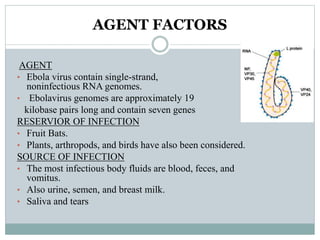
AGENT 
• Ebola virus contain single-strand, 
noninfectious RNA genomes. 
• Ebolavirus genomes are approximately 19 
kilobase pairs long and contain seven genes 
RESERVIOR OF INFECTION 
• Fruit Bats. 
• Plants, arthropods, and birds have also been considered. 
SOURCE OF INFECTION 
• The most infectious body fluids are blood, feces, and 
vomitus. 
• Also urine, semen, and breast milk. 
• Saliva and tears
HOST FACTORS 
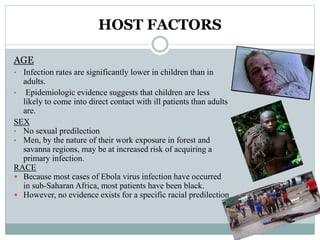
AGE 
• Infection rates are significantly lower in children than in 
adults. 
• Epidemiologic evidence suggests that children are less 
likely to come into direct contact with ill patients than adults 
are. 
SEX 
• No sexual predilection 
• Men, by the nature of their work exposure in forest and 
savanna regions, may be at increased risk of acquiring a 
primary infection. 
RACE 
 Because most cases of Ebola virus infection have occurred 
in sub-Saharan Africa, most patients have been black. 
 However, no evidence exists for a specific racial predilection
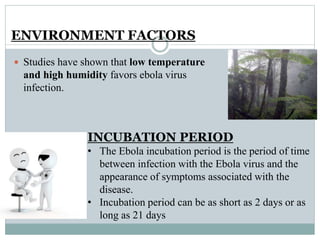
ENVIRONMENT FACTORS 
 Studies have shown that low temperature 
and high humidity favors ebola virus 
infection. 
INCUBATION PERIOD 
• The Ebola incubation period is the period of time 
between infection with the Ebola virus and the 
appearance of symptoms associated with the 
disease. 
• Incubation period can be as short as 2 days or as 
long as 21 days
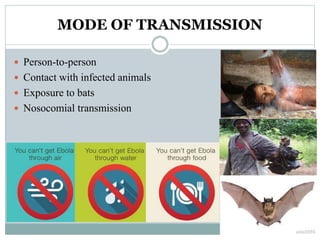
MODE OF TRANSMISSION 
 Person-to-person 
 Contact with infected animals 
 Exposure to bats 
 Nosocomial transmission
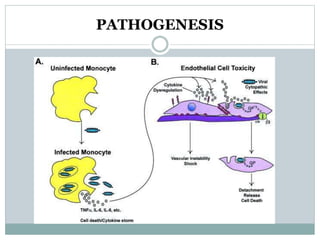
PATHOGENESIS
DIFFERENTIAL DIAGNOSIS 
 Malaria 
 Dengue 
 Marburg virus disease 
 Other viral hemorrhagic fevers
INVESTIGATIONS 
Basic Investigation: 
 low platelet count 
 initially decreased white blood cell count followed by an increase in the 
white blood cell count 
 elevated levels of the liver enzymes alanine aminotransferase (ALT) 
and aspartate aminotransferase (AST) 
 abnormalities in clotting such as a prolonged prothrombin time, partial 
thromboplastin time, and bleeding time 
Specific Investigations: 
Studies for isolating virus 
RT-PCR 
Tissue culture 
Serologic testing for antibody and antigen 
IgM-capture ELISA 
IgG-capture ELISA 
Antigen detection ELISA
DIAGNOSIS 
 Medical history, especially travel and work history 
along with exposure to wildlife 
 Diagnosis is confirmed by isolating the virus, detecting 
its RNA or proteins, or detecting antibodies against the 
virus in a person's blood. 
 Cell culture 
 PCR 
 ELISA 
 During outbreaks most common diagnostic methods 
are real time PCR and ELISA detection of proteins,
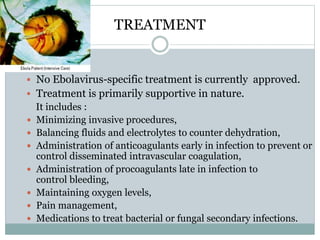
TREATMENT 
 No Ebolavirus-specific treatment is currently approved. 
 Treatment is primarily supportive in nature. 
It includes : 
 Minimizing invasive procedures, 
 Balancing fluids and electrolytes to counter dehydration, 
 Administration of anticoagulants early in infection to prevent or 
control disseminated intravascular coagulation, 
 Administration of procoagulants late in infection to 
control bleeding, 
 Maintaining oxygen levels, 
 Pain management, 
 Medications to treat bacterial or fungal secondary infections.
EBOLA DISEASE : 
SITUATION 
ASSESSMENT
Barriers to rapid containment 
of the Ebola outbreak 
11 AUGUST,2014 
• LACK OF CAPACITY MAKES INFECTION 
CONTROL DIFFICULT 
• FEAR IS HARD TO OVERCOME 
• TRANSMISSION 
• VIGILANCE MEANS BETTER DETECTION 
EMERGENCY MEETING ON THE ROLE OF 
EXPERIMENTAL THERAPIES IN OUTBREAK 
RESPONSE
Ebola: Experimental therapies and 
rumoured remedies 
15 AUGUST 2014 
 Intense media coverage of experimental medicines and 
vaccines is creating some unrealistic expectations 
 WHO has advised that the use of experimental medicines 
and vaccines under the exceptional circumstances of this 
outbreak is ethically acceptable. 
 All rumours of any other effective products or practices are 
false
Ebola situation in Nigeria and Guinea: 
encouraging signs 
19 AUGUST 2014 
In Nigeria 
 The situation in Lagos, Nigeria, where the first 
imported case was detected in July, looks reassuring. 
 The city’s 12 confirmed cases are all part of a single 
chain of transmission. 
 There were no further confirmed cases outside the 
initial transmission chain. 
 The full recovery to date of one infected contact is 
additional good news.
Ebola situation in Nigeria and Guinea: 
encouraging signs 
19 AUGUST 2014 
In Guinea 
 Public awareness of the facts about Ebola is higher 
there than in the other affected countries. 
 Innovative solutions are being found 
 But progress is fragile, with a real risk that the 
outbreak could experience another flare-up.
Anecdotal evidence about experimental 
Ebola therapies 
21 AUGUST 2014 
 Clinicians working in Liberia have informed WHO 
that 2 doctors and 1 nurse have now received the 
experimental Ebola therapy, ZMapp. 
 The nurse and one of the doctors show a marked 
improvement. The condition of the second doctor is 
serious but has improved somewhat. 
 ZMapp is one of several experimental treatments and 
vaccines for Ebola that are currently undergoing 
investigation. 
 At present, supplies of all are extremely limited.
Why the Ebola outbreak has been 
underestimated 
22 AUGUST 2014 
 Many families hide infected loved ones in their homes 
 Others deny that a patient has Ebola 
 Most fear the stigma and social rejection when a diagnosis 
is confirmed 
 Quantities of staff, supplies, and equipment, including 
personal protective equipment, cannot keep up with the 
need 
 Hospital and diagnostic capacities have been overwhelmed 
 In rural villages, corpses are buried without notifying 
health officials and with no investigation of the cause of 
death 
 The existence of numerous “shadow-zones”.
Unprecedented number of medical staff 
infected with Ebola 
25 AUGUST 2014 
 To date, more than 240 health care workers have developed the 
disease in Guinea, Liberia, Nigeria, and Sierra Leone, and more 
than 120 have died. 
 The factors that help explain the high proportion of infected 
medical staff: 
 Shortages of personal protective equipment or its 
improper use 
 Few medical staff for such a large outbreak 
 The compassion 
 WHO estimates that, in the three hardest-hit countries, only one 
to two doctors are available to treat 100,000 people 
 Increase in the level of anxiety: if doctors and nurses are getting 
infected, what chance does the general public have?
Ebola situation in Port Harcourt, Nigeria 
3 SEPTEMBER 2014 
THE RESPONSE: 
 Nigerian health workers and WHO epidemiologists are monitoring more than 
200 contacts. Of these, around 60 are considered to have had high-risk or very 
high-risk exposure. 
 An Ebola Emergency Operations Centre has been activated, with support from 
the US Centers for Disease Control and Prevention. 
 A mobile laboratory, with RT-PCR diagnostic capacity, is set up and 
functional. 
 A 26-bed isolation facility for the management of Ebola cases is in place, with 
plans for possible expansion. 
 WHO has 15 technical experts on the ground. 
 Twenty-one contact-tracing teams are at work and adequate transportation. 
 Two decontamination teams are equipped and operational, as is a burial 
team. 
 Screening is under way at domestic and international airport gates. 
 Social mobilization efforts have been stepped up, initially targeting key 
community and religious leaders.
Ebola situation in Liberia: non-conventional 
interventions needed 
8 SEPTEMBER 2014 
 THE RESPONSE: 
Liberia yields 3 important conclusions that need to shape the 
Ebola response in high-transmission countries. 
 First, conventional Ebola control interventions are not having an 
adequate impact in Liberia, though they appear to be working 
elsewhere in areas of limited transmission, most notably in 
Nigeria, Senegal, and the Democratic Republic of Congo. 
 Second, far greater community engagement is the cornerstone of 
a more effective response. Where communities take charge, 
especially in rural areas, and put in place their own solutions and 
protective measures, Ebola transmission has slowed 
considerably. 
 Third, key development partners who are supporting the 
response in Liberia and elsewhere need to prepare to scale up 
their current efforts by three- to four-fold.
Ebola situation in Senegal remains stable 
12 SEPTEMBER 2014 
Preventing further transmission of Ebola: 
 Aggressive efforts to identify additional contacts continue 
 The investigation and response teams face difficulties in 
keeping close contacts in isolation for the 21-day monitoring 
period. 
 Contacts have remained in their homes, usually with their 
families, where they are checked twice daily for symptoms and 
tested if symptoms develop. 
 Some contacts have resisted monitoring, but none has been lost 
to follow-up. 
 Although Senegal has banned all flights from other affected 
countries, road travellers from Guinea and elsewhere can cross 
the country’s porous borders. 
 WHO has repeatedly advised countries not to issue travel bans 
 To support the global response, Senegal has agreed to open a 
humanitarian corridor to facilitate the transport and delivery of 
international personnel and supplies to affected countries.
Experimental therapies: growing interest in the 
use of whole blood or plasma from recovered 
Ebola patients (convalescent therapies) 
 Convalescent therapy was first used for a young 
woman infected with Ebola in the Democratic Republic 
of Congo (then Zaire) in 1976 – the year the virus first 
emerged 
 During the 1995 Ebola outbreak in Kikwit, Democratic 
Republic of Congo, whole blood collected from 
recovered patients was administered to eight patients 
 In the current outbreak, convalescent therapies have 
been used in a few patients. 
 In one well-known case, an American doctor, who became infected while 
working in Monrovia, Liberia, received whole blood from a recovered 
patient 
26 SEPTEMBER 2014
CONT.. 
26 SEPTEMBER 2014 
 As the epidemic worsens, interest in convalescent therapies 
grows 
 The number of cases continues to grow exponentially 
 Good supportive clinical care is becoming increasingly 
difficult to implement. 
 WHO is currently holding discussions with health experts 
in the Democratic Republic of Congo, Guinea, Liberia, 
Nigeria, and Sierra Leone with aim to identify practical 
needs for implementation
How does WHO declare the end of an Ebola 
outbreak? 
14 OCTOBER 2014 
For WHO to declare an Ebola outbreak over, a country must 
pass through 42 days, with active surveillance demonstrably in 
place, supported by good diagnostic capacity, and with no new 
cases detected. Active surveillance is essential to detect chains 
of transmission that might otherwise remain hidden. 
Incubation period 
The period of 42 days, with active case-finding in place, is twice 
the maximum incubation period for Ebola virus disease and is 
considered by WHO as sufficient to generate confidence in a 
declaration that an Ebola outbreak has ended.
The outbreak of Ebola virus disease in 
Senegal is over 
17 OCTOBER 2014 
Senegal is free of Ebola virus transmission 
Factors that contributed to success: 
 Strong political leadership at the highest level. 
 Early detection and response, aided by a detailed plan and a 
quickly-activated National Crisis Committee. 
 Stepped up surveillance, especially at the country’s many 
entry points by road. 
 Rapid mobilization of resources from both domestic and 
international sources; solid preparedness plans are thought 
to have earned the confidence of donors. 
 Support from operational partners, including WHO.
CONT.. 
 Nationwide public awareness campaigns that made good use 
of media experts, embedded in the Ministry of Health and 
Welfare and allowed to closely observe its emergency 
actions, and local radio networks. 
 Deliberate and heavy emphasis on multisectoral 
collaboration among all relevant government ministries, 
backed by community engagement every step along the way. 
 Direct support to patient contacts as a strong incentive for 
cooperation and compliance, through the provision of social 
support in the form of money, food, and psychological 
counselling. 
 Support for reintegration of the recovered patient into a 
society that could understand why he posed no risk of 
contagion to others.
Nigeria is now free of Ebola virus 
transmission 
20 OCTOBER 2014 
What accounts for this great news? 
 The country’s strong leadership and effective coordination of the 
response. 
 The Nigerian response to the outbreak was greatly aided by the 
rapid utilization of a national public institution (NCDC) and the 
prompt establishment of an Emergency Operations Centre, 
supported by the Disease Prevention and Control Cluster within the 
WHO country office. 
 Another key asset was the country’s first-rate virology laboratory 
affiliated with the Lagos University Teaching Hospital. 
 In addition, high-quality contact tracing by experienced 
epidemiologists expedited the early detection of cases and their 
rapid movement to an isolation ward, thereby greatly diminishing 
opportunities for further transmission.
REFERENCES 
 emedicine.medscape.com 
 en.wikipedia.org 
 www.forbes.com 
 www.who.int 
 www.uptodate.com 
 www.afro.who.int
ebola-epidemiology

ebola-epidemiology

  • 1.
    EPIDEMIOLOGY, DISEASE ANDSITUATION ASSESSMENT BY, DR. B. GURUMURTHY HOUSE SURGEON EBOLA – GUIDE-DR. LAXMIKANT L ASSOCIATE PROFESSOR, DEPT OF COMMUNITY MEDICINE
  • 2.
    AGENT FACTORS AGENT • Ebola virus contain single-strand, noninfectious RNA genomes. • Ebolavirus genomes are approximately 19 kilobase pairs long and contain seven genes RESERVIOR OF INFECTION • Fruit Bats. • Plants, arthropods, and birds have also been considered. SOURCE OF INFECTION • The most infectious body fluids are blood, feces, and vomitus. • Also urine, semen, and breast milk. • Saliva and tears
  • 3.
    HOST FACTORS AGE • Infection rates are significantly lower in children than in adults. • Epidemiologic evidence suggests that children are less likely to come into direct contact with ill patients than adults are. SEX • No sexual predilection • Men, by the nature of their work exposure in forest and savanna regions, may be at increased risk of acquiring a primary infection. RACE  Because most cases of Ebola virus infection have occurred in sub-Saharan Africa, most patients have been black.  However, no evidence exists for a specific racial predilection
  • 4.
    ENVIRONMENT FACTORS Studies have shown that low temperature and high humidity favors ebola virus infection. INCUBATION PERIOD • The Ebola incubation period is the period of time between infection with the Ebola virus and the appearance of symptoms associated with the disease. • Incubation period can be as short as 2 days or as long as 21 days
  • 5.
    MODE OF TRANSMISSION  Person-to-person  Contact with infected animals  Exposure to bats  Nosocomial transmission
  • 6.
  • 8.
    DIFFERENTIAL DIAGNOSIS Malaria  Dengue  Marburg virus disease  Other viral hemorrhagic fevers
  • 9.
    INVESTIGATIONS Basic Investigation:  low platelet count  initially decreased white blood cell count followed by an increase in the white blood cell count  elevated levels of the liver enzymes alanine aminotransferase (ALT) and aspartate aminotransferase (AST)  abnormalities in clotting such as a prolonged prothrombin time, partial thromboplastin time, and bleeding time Specific Investigations: Studies for isolating virus RT-PCR Tissue culture Serologic testing for antibody and antigen IgM-capture ELISA IgG-capture ELISA Antigen detection ELISA
  • 10.
    DIAGNOSIS  Medicalhistory, especially travel and work history along with exposure to wildlife  Diagnosis is confirmed by isolating the virus, detecting its RNA or proteins, or detecting antibodies against the virus in a person's blood.  Cell culture  PCR  ELISA  During outbreaks most common diagnostic methods are real time PCR and ELISA detection of proteins,
  • 11.
    TREATMENT  NoEbolavirus-specific treatment is currently approved.  Treatment is primarily supportive in nature. It includes :  Minimizing invasive procedures,  Balancing fluids and electrolytes to counter dehydration,  Administration of anticoagulants early in infection to prevent or control disseminated intravascular coagulation,  Administration of procoagulants late in infection to control bleeding,  Maintaining oxygen levels,  Pain management,  Medications to treat bacterial or fungal secondary infections.
  • 12.
    EBOLA DISEASE : SITUATION ASSESSMENT
  • 13.
    Barriers to rapidcontainment of the Ebola outbreak 11 AUGUST,2014 • LACK OF CAPACITY MAKES INFECTION CONTROL DIFFICULT • FEAR IS HARD TO OVERCOME • TRANSMISSION • VIGILANCE MEANS BETTER DETECTION EMERGENCY MEETING ON THE ROLE OF EXPERIMENTAL THERAPIES IN OUTBREAK RESPONSE
  • 14.
    Ebola: Experimental therapiesand rumoured remedies 15 AUGUST 2014  Intense media coverage of experimental medicines and vaccines is creating some unrealistic expectations  WHO has advised that the use of experimental medicines and vaccines under the exceptional circumstances of this outbreak is ethically acceptable.  All rumours of any other effective products or practices are false
  • 15.
    Ebola situation inNigeria and Guinea: encouraging signs 19 AUGUST 2014 In Nigeria  The situation in Lagos, Nigeria, where the first imported case was detected in July, looks reassuring.  The city’s 12 confirmed cases are all part of a single chain of transmission.  There were no further confirmed cases outside the initial transmission chain.  The full recovery to date of one infected contact is additional good news.
  • 16.
    Ebola situation inNigeria and Guinea: encouraging signs 19 AUGUST 2014 In Guinea  Public awareness of the facts about Ebola is higher there than in the other affected countries.  Innovative solutions are being found  But progress is fragile, with a real risk that the outbreak could experience another flare-up.
  • 17.
    Anecdotal evidence aboutexperimental Ebola therapies 21 AUGUST 2014  Clinicians working in Liberia have informed WHO that 2 doctors and 1 nurse have now received the experimental Ebola therapy, ZMapp.  The nurse and one of the doctors show a marked improvement. The condition of the second doctor is serious but has improved somewhat.  ZMapp is one of several experimental treatments and vaccines for Ebola that are currently undergoing investigation.  At present, supplies of all are extremely limited.
  • 18.
    Why the Ebolaoutbreak has been underestimated 22 AUGUST 2014  Many families hide infected loved ones in their homes  Others deny that a patient has Ebola  Most fear the stigma and social rejection when a diagnosis is confirmed  Quantities of staff, supplies, and equipment, including personal protective equipment, cannot keep up with the need  Hospital and diagnostic capacities have been overwhelmed  In rural villages, corpses are buried without notifying health officials and with no investigation of the cause of death  The existence of numerous “shadow-zones”.
  • 19.
    Unprecedented number ofmedical staff infected with Ebola 25 AUGUST 2014  To date, more than 240 health care workers have developed the disease in Guinea, Liberia, Nigeria, and Sierra Leone, and more than 120 have died.  The factors that help explain the high proportion of infected medical staff:  Shortages of personal protective equipment or its improper use  Few medical staff for such a large outbreak  The compassion  WHO estimates that, in the three hardest-hit countries, only one to two doctors are available to treat 100,000 people  Increase in the level of anxiety: if doctors and nurses are getting infected, what chance does the general public have?
  • 20.
    Ebola situation inPort Harcourt, Nigeria 3 SEPTEMBER 2014 THE RESPONSE:  Nigerian health workers and WHO epidemiologists are monitoring more than 200 contacts. Of these, around 60 are considered to have had high-risk or very high-risk exposure.  An Ebola Emergency Operations Centre has been activated, with support from the US Centers for Disease Control and Prevention.  A mobile laboratory, with RT-PCR diagnostic capacity, is set up and functional.  A 26-bed isolation facility for the management of Ebola cases is in place, with plans for possible expansion.  WHO has 15 technical experts on the ground.  Twenty-one contact-tracing teams are at work and adequate transportation.  Two decontamination teams are equipped and operational, as is a burial team.  Screening is under way at domestic and international airport gates.  Social mobilization efforts have been stepped up, initially targeting key community and religious leaders.
  • 21.
    Ebola situation inLiberia: non-conventional interventions needed 8 SEPTEMBER 2014  THE RESPONSE: Liberia yields 3 important conclusions that need to shape the Ebola response in high-transmission countries.  First, conventional Ebola control interventions are not having an adequate impact in Liberia, though they appear to be working elsewhere in areas of limited transmission, most notably in Nigeria, Senegal, and the Democratic Republic of Congo.  Second, far greater community engagement is the cornerstone of a more effective response. Where communities take charge, especially in rural areas, and put in place their own solutions and protective measures, Ebola transmission has slowed considerably.  Third, key development partners who are supporting the response in Liberia and elsewhere need to prepare to scale up their current efforts by three- to four-fold.
  • 22.
    Ebola situation inSenegal remains stable 12 SEPTEMBER 2014 Preventing further transmission of Ebola:  Aggressive efforts to identify additional contacts continue  The investigation and response teams face difficulties in keeping close contacts in isolation for the 21-day monitoring period.  Contacts have remained in their homes, usually with their families, where they are checked twice daily for symptoms and tested if symptoms develop.  Some contacts have resisted monitoring, but none has been lost to follow-up.  Although Senegal has banned all flights from other affected countries, road travellers from Guinea and elsewhere can cross the country’s porous borders.  WHO has repeatedly advised countries not to issue travel bans  To support the global response, Senegal has agreed to open a humanitarian corridor to facilitate the transport and delivery of international personnel and supplies to affected countries.
  • 23.
    Experimental therapies: growinginterest in the use of whole blood or plasma from recovered Ebola patients (convalescent therapies)  Convalescent therapy was first used for a young woman infected with Ebola in the Democratic Republic of Congo (then Zaire) in 1976 – the year the virus first emerged  During the 1995 Ebola outbreak in Kikwit, Democratic Republic of Congo, whole blood collected from recovered patients was administered to eight patients  In the current outbreak, convalescent therapies have been used in a few patients.  In one well-known case, an American doctor, who became infected while working in Monrovia, Liberia, received whole blood from a recovered patient 26 SEPTEMBER 2014
  • 24.
    CONT.. 26 SEPTEMBER2014  As the epidemic worsens, interest in convalescent therapies grows  The number of cases continues to grow exponentially  Good supportive clinical care is becoming increasingly difficult to implement.  WHO is currently holding discussions with health experts in the Democratic Republic of Congo, Guinea, Liberia, Nigeria, and Sierra Leone with aim to identify practical needs for implementation
  • 25.
    How does WHOdeclare the end of an Ebola outbreak? 14 OCTOBER 2014 For WHO to declare an Ebola outbreak over, a country must pass through 42 days, with active surveillance demonstrably in place, supported by good diagnostic capacity, and with no new cases detected. Active surveillance is essential to detect chains of transmission that might otherwise remain hidden. Incubation period The period of 42 days, with active case-finding in place, is twice the maximum incubation period for Ebola virus disease and is considered by WHO as sufficient to generate confidence in a declaration that an Ebola outbreak has ended.
  • 26.
    The outbreak ofEbola virus disease in Senegal is over 17 OCTOBER 2014 Senegal is free of Ebola virus transmission Factors that contributed to success:  Strong political leadership at the highest level.  Early detection and response, aided by a detailed plan and a quickly-activated National Crisis Committee.  Stepped up surveillance, especially at the country’s many entry points by road.  Rapid mobilization of resources from both domestic and international sources; solid preparedness plans are thought to have earned the confidence of donors.  Support from operational partners, including WHO.
  • 27.
    CONT..  Nationwidepublic awareness campaigns that made good use of media experts, embedded in the Ministry of Health and Welfare and allowed to closely observe its emergency actions, and local radio networks.  Deliberate and heavy emphasis on multisectoral collaboration among all relevant government ministries, backed by community engagement every step along the way.  Direct support to patient contacts as a strong incentive for cooperation and compliance, through the provision of social support in the form of money, food, and psychological counselling.  Support for reintegration of the recovered patient into a society that could understand why he posed no risk of contagion to others.
  • 28.
    Nigeria is nowfree of Ebola virus transmission 20 OCTOBER 2014 What accounts for this great news?  The country’s strong leadership and effective coordination of the response.  The Nigerian response to the outbreak was greatly aided by the rapid utilization of a national public institution (NCDC) and the prompt establishment of an Emergency Operations Centre, supported by the Disease Prevention and Control Cluster within the WHO country office.  Another key asset was the country’s first-rate virology laboratory affiliated with the Lagos University Teaching Hospital.  In addition, high-quality contact tracing by experienced epidemiologists expedited the early detection of cases and their rapid movement to an isolation ward, thereby greatly diminishing opportunities for further transmission.
  • 29.
    REFERENCES  emedicine.medscape.com  en.wikipedia.org  www.forbes.com  www.who.int  www.uptodate.com  www.afro.who.int