Journal Club: Critical Appraisal of an Article on Therapy
Sudan Evidence-Based Medicine Association Template
Developed by:
Dr. Imad Salah Ahmed Hassan
MD (UK) FACP FRCPI MemAcadMEd (UK) MSc (UK) MBBS (U of K)
Clinical Scenario
Formulate a Well-Built Clinical
Question
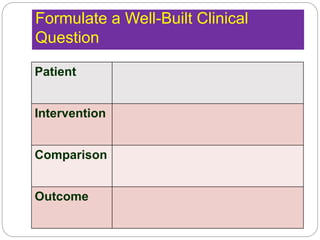
Patient
Intervention
Comparison
Outcome
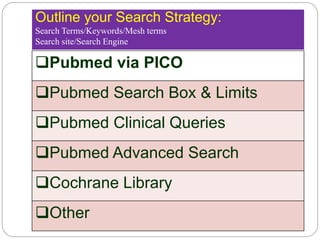
Outline your Search Strategy:
Search Terms/Keywords/Mesh terms
Search site/Search Engine
Pubmed via PICO
Pubmed Search Box & Limits
Pubmed Clinical Queries
Pubmed Advanced Search
Cochrane Library
Other
Outline Current Practice
 Tip: From the Introduction Section or from a
Guideline
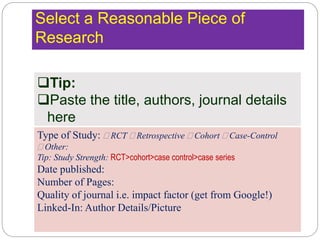
Select a Reasonable Piece of
Research
Tip:
Paste the title, authors, journal details
here
Type of Study:  RCT  Retrospective  Cohort  Case-Control
 Other:
Tip: Study Strength: RCT>cohort>case control>case series
Date published:
Number of Pages:
Quality of journal i.e. impact factor (get from Google!)
Linked-In: Author Details/Picture
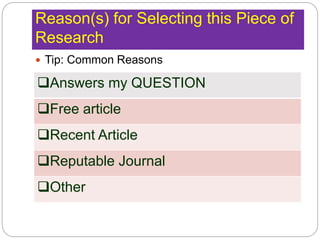
Reason(s) for Selecting this Piece of
Research
 Tip: Common Reasons
Answers my QUESTION
Free article
Recent Article
Reputable Journal
Other
Summarize the Results of your
Article
 Tip: Paste the Abstract/Conclusion from the
Abstract here
 Paste Abstract here: use several slides if it is
long-remember the 6X6 rule in power-point
presentations!
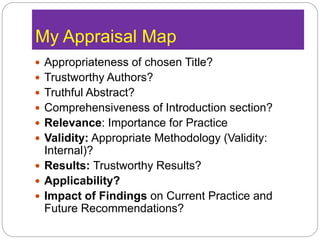
My Appraisal Map
 Appropriateness of chosen Title?
 Trustworthy Authors?
 Truthful Abstract?
 Comprehensiveness of Introduction section?
 Relevance: Importance for Practice
 Validity: Appropriate Methodology (Validity:
Internal)?
 Results: Trustworthy Results?
 Applicability?
 Impact of Findings on Current Practice and
Future Recommendations?
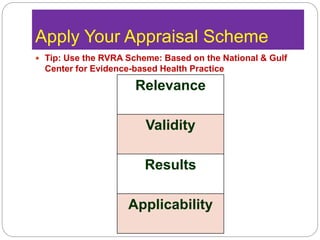
Apply Your Appraisal Scheme
 Tip: Use the RVRA Scheme: Based on the National & Gulf
Center for Evidence-based Health Practice
Relevance
Validity
Results
Applicability
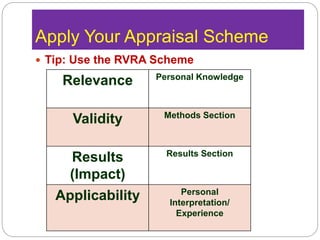
Apply Your Appraisal Scheme
 Tip: Use the RVRA Scheme
Relevance Personal Knowledge
Validity Methods Section
Results
(Impact)
Results Section
Applicability Personal
Interpretation/
Experience
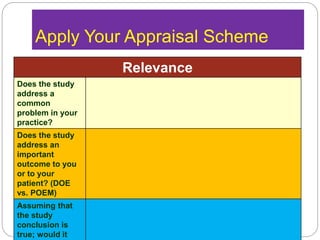
Apply Your Appraisal Scheme
Relevance
Does the study
address a
common
problem in your
practice?
Does the study
address an
important
outcome to you
or to your
patient? (DOE
vs. POEM)
Assuming that
the study
conclusion is
true; would it
Apply Your Appraisal Scheme
Validity
Describe the Research
Design
Tip:
 Name the Study Design
Apply Your Appraisal Scheme
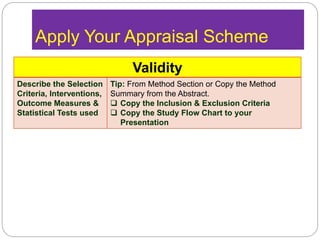
Validity
Describe the Selection
Criteria, Interventions,
Outcome Measures &
Statistical Tests used
Tip: From Method Section or Copy the Method
Summary from the Abstract.
 Copy the Inclusion & Exclusion Criteria
 Copy the Study Flow Chart to your
Presentation
Apply Your Appraisal Scheme
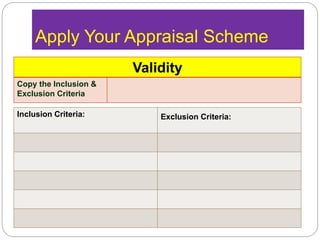
Validity
Copy the Inclusion &
Exclusion Criteria
Inclusion Criteria: Exclusion Criteria:
Apply Your Appraisal Scheme
Validity
Interventions
Apply Your Appraisal Scheme
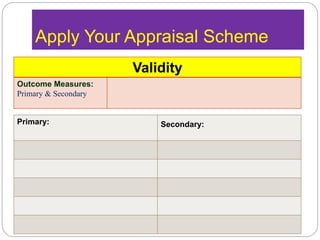
Validity
Outcome Measures:
Primary & Secondary
Primary: Secondary:
Apply Your Appraisal Scheme
Validity
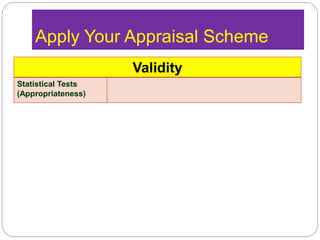
Statistical Tests
(Appropriateness)
Apply Your Appraisal Scheme
Validity
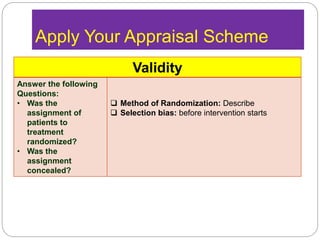
Answer the following
Questions:
• Was the
assignment of
patients to
treatment
randomized?
• Was the
assignment
concealed?
 Method of Randomization: Describe
 Selection bias: before intervention starts
Apply Your Appraisal Scheme
Validity
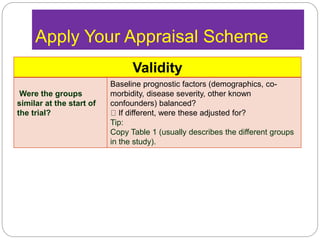
Were the groups
similar at the start of
the trial?
Baseline prognostic factors (demographics, co-
morbidity, disease severity, other known
confounders) balanced?
If different, were these adjusted for?
Tip:
Copy Table 1 (usually describes the different groups
in the study).
Apply Your Appraisal Scheme
Validity
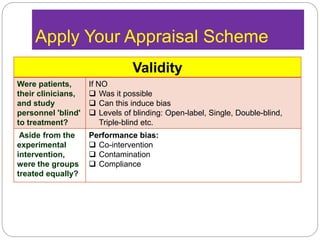
Were patients,
their clinicians,
and study
personnel 'blind'
to treatment?
If NO
 Was it possible
 Can this induce bias
 Levels of blinding: Open-label, Single, Double-blind,
Triple-blind etc.
Aside from the
experimental
intervention,
were the groups
treated equally?
Performance bias:
 Co-intervention
 Contamination
 Compliance
Validity
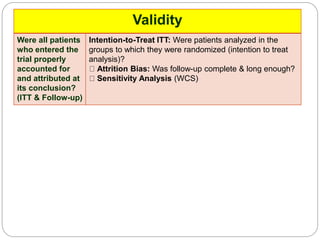
Were all patients
who entered the
trial properly
accounted for
and attributed at
its conclusion?
(ITT & Follow-up)
Intention-to-Treat ITT: Were patients analyzed in the
groups to which they were randomized (intention to treat
analysis)?
Attrition Bias: Was follow-up complete & long enough?
Sensitivity Analysis (WCS)
Validity
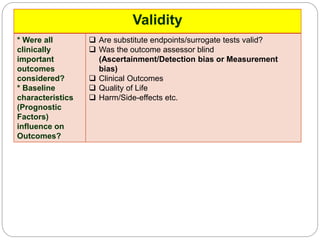
* Were all
clinically
important
outcomes
considered?
* Baseline
characteristics
(Prognostic
Factors)
influence on
Outcomes?
 Are substitute endpoints/surrogate tests valid?
 Was the outcome assessor blind
(Ascertainment/Detection bias or Measurement
bias)
 Clinical Outcomes
 Quality of Life
 Harm/Side-effects etc.
Validity
Overall, is the
method of the
study valid?
[ ] Yes (100%) [ ] No (0%) [ ] In-between ( ___%) [ ] Can't
Tell
Apply Your Appraisal Scheme
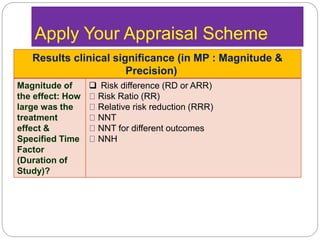
Results clinical significance (in MP : Magnitude &
Precision)
Magnitude of
the effect: How
large was the
treatment
effect &
Specified Time
Factor
(Duration of
Study)?
 Risk difference (RD or ARR)
Risk Ratio (RR)
Relative risk reduction (RRR)
NNT
NNT for different outcomes
NNH
Apply Your Appraisal Scheme
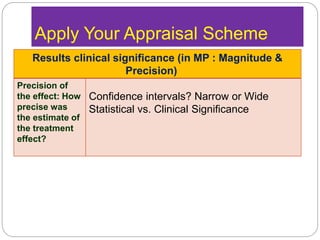
Results clinical significance (in MP : Magnitude &
Precision)
Precision of
the effect: How
precise was
the estimate of
the treatment
effect?
Confidence intervals? Narrow or Wide
Statistical vs. Clinical Significance
Summarize the Study Biases
Selection, Attrition, Performance,
Detection Biases, Conflict of
Interest etc.
Summarize the Study Strength
Tip: From the Discussion or
Letter to the Editor/Editorial
Comment etc.
E.G.: Number of Patients, Randomization Method,
Least Biases, Statistical Tests used, Outcome
Measures, Ascertainment, Drop-outs, Length of
Follow-up etc.
Summarize the Study
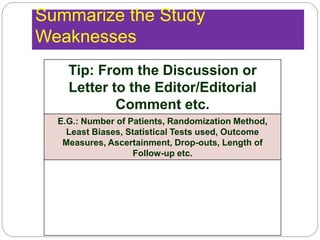
Weaknesses
Tip: From the Discussion or
Letter to the Editor/Editorial
Comment etc.
E.G.: Number of Patients, Randomization Method,
Least Biases, Statistical Tests used, Outcome
Measures, Ascertainment, Drop-outs, Length of
Follow-up etc.
Summarize the Study
Tip: From the Discussion or
Letter to the Editor/Editorial
Comment etc.
Unanswered Questions from the
Study
Tip: From the Discussion or
Letter to the Editor/Editorial
Comment etc.
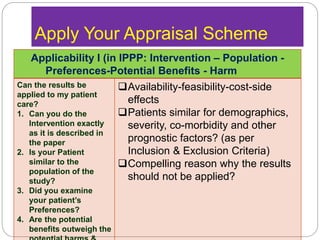
Apply Your Appraisal Scheme
Applicability I (in IPPP: Intervention – Population -
Preferences-Potential Benefits - Harm
Can the results be
applied to my patient
care?
1. Can you do the
Intervention exactly
as it is described in
the paper
2. Is your Patient
similar to the
population of the
study?
3. Did you examine
your patient’s
Preferences?
4. Are the potential
benefits outweigh the
Availability-feasibility-cost-side
effects
Patients similar for demographics,
severity, co-morbidity and other
prognostic factors? (as per
Inclusion & Exclusion Criteria)
Compelling reason why the results
should not be applied?
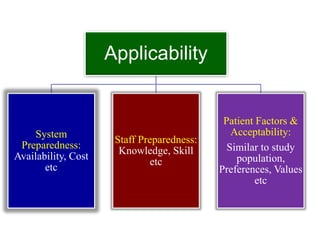
Applicability
System
Preparedness:
Availability, Cost
etc
Staff Preparedness:
Knowledge, Skill
etc
Patient Factors &
Acceptability:
Similar to study
population,
Preferences, Values
etc
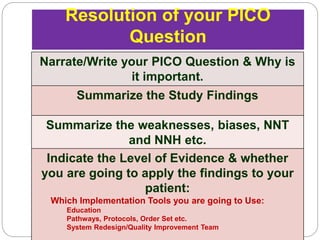
Resolution of your PICO
Question
Narrate/Write your PICO Question & Why is
it important.
Summarize the Study Findings
Summarize the weaknesses, biases, NNT
and NNH etc.
Indicate the Level of Evidence & whether
you are going to apply the findings to your
patient:
Which Implementation Tools you are going to Use:
Education
Pathways, Protocols, Order Set etc.
System Redesign/Quality Improvement Team
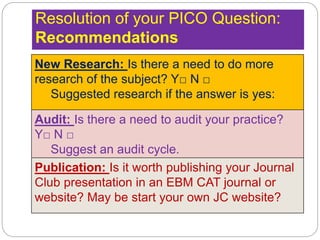
Resolution of your PICO Question:
Recommendations
New Research: Is there a need to do more
research of the subject? Y□ N □
Suggested research if the answer is yes:
Audit: Is there a need to audit your practice?
Y□ N □
Suggest an audit cycle.
Publication: Is it worth publishing your Journal
Club presentation in an EBM CAT journal or
website? May be start your own JC website?
Useful Links
 EBM Glossary of Terms: http://www.cebm.net/glossary/
 EBM Calculators:
http://ktclearinghouse.ca/cebm/practise/ca/calculators
 EBM NNT, LR etc. Websites:
 http://ktclearinghouse.ca/cebm/toolbox
 http://www.thennt.com/
 EBM Critical Appraisal Worksheets:
http://ktclearinghouse.ca/cebm/practise/ca/worksheets
 Diagnosis worksheet
 Harm worksheet
 Prognosis worksheet
 Systematic review (of therapy) worksheet
 Therapy worksheet
EBM Therapy Appraisal Template F1

EBM Therapy Appraisal Template F1

  • 1.
    Journal Club: CriticalAppraisal of an Article on Therapy Sudan Evidence-Based Medicine Association Template Developed by: Dr. Imad Salah Ahmed Hassan MD (UK) FACP FRCPI MemAcadMEd (UK) MSc (UK) MBBS (U of K)
  • 3.
  • 4.
    Formulate a Well-BuiltClinical Question Patient Intervention Comparison Outcome
  • 5.
    Outline your SearchStrategy: Search Terms/Keywords/Mesh terms Search site/Search Engine Pubmed via PICO Pubmed Search Box & Limits Pubmed Clinical Queries Pubmed Advanced Search Cochrane Library Other
  • 6.
    Outline Current Practice Tip: From the Introduction Section or from a Guideline
  • 7.
    Select a ReasonablePiece of Research Tip: Paste the title, authors, journal details here Type of Study:  RCT  Retrospective  Cohort  Case-Control  Other: Tip: Study Strength: RCT>cohort>case control>case series Date published: Number of Pages: Quality of journal i.e. impact factor (get from Google!) Linked-In: Author Details/Picture
  • 8.
    Reason(s) for Selectingthis Piece of Research  Tip: Common Reasons Answers my QUESTION Free article Recent Article Reputable Journal Other
  • 9.
    Summarize the Resultsof your Article  Tip: Paste the Abstract/Conclusion from the Abstract here  Paste Abstract here: use several slides if it is long-remember the 6X6 rule in power-point presentations!
  • 10.
    My Appraisal Map Appropriateness of chosen Title?  Trustworthy Authors?  Truthful Abstract?  Comprehensiveness of Introduction section?  Relevance: Importance for Practice  Validity: Appropriate Methodology (Validity: Internal)?  Results: Trustworthy Results?  Applicability?  Impact of Findings on Current Practice and Future Recommendations?
  • 11.
    Apply Your AppraisalScheme  Tip: Use the RVRA Scheme: Based on the National & Gulf Center for Evidence-based Health Practice Relevance Validity Results Applicability
  • 12.
    Apply Your AppraisalScheme  Tip: Use the RVRA Scheme Relevance Personal Knowledge Validity Methods Section Results (Impact) Results Section Applicability Personal Interpretation/ Experience
  • 13.
    Apply Your AppraisalScheme Relevance Does the study address a common problem in your practice? Does the study address an important outcome to you or to your patient? (DOE vs. POEM) Assuming that the study conclusion is true; would it
  • 14.
    Apply Your AppraisalScheme Validity Describe the Research Design Tip:  Name the Study Design
  • 15.
    Apply Your AppraisalScheme Validity Describe the Selection Criteria, Interventions, Outcome Measures & Statistical Tests used Tip: From Method Section or Copy the Method Summary from the Abstract.  Copy the Inclusion & Exclusion Criteria  Copy the Study Flow Chart to your Presentation
  • 16.
    Apply Your AppraisalScheme Validity Copy the Inclusion & Exclusion Criteria Inclusion Criteria: Exclusion Criteria:
  • 17.
    Apply Your AppraisalScheme Validity Interventions
  • 18.
    Apply Your AppraisalScheme Validity Outcome Measures: Primary & Secondary Primary: Secondary:
  • 19.
    Apply Your AppraisalScheme Validity Statistical Tests (Appropriateness)
  • 20.
    Apply Your AppraisalScheme Validity Answer the following Questions: • Was the assignment of patients to treatment randomized? • Was the assignment concealed?  Method of Randomization: Describe  Selection bias: before intervention starts
  • 21.
    Apply Your AppraisalScheme Validity Were the groups similar at the start of the trial? Baseline prognostic factors (demographics, co- morbidity, disease severity, other known confounders) balanced? If different, were these adjusted for? Tip: Copy Table 1 (usually describes the different groups in the study).
  • 22.
    Apply Your AppraisalScheme Validity Were patients, their clinicians, and study personnel 'blind' to treatment? If NO  Was it possible  Can this induce bias  Levels of blinding: Open-label, Single, Double-blind, Triple-blind etc. Aside from the experimental intervention, were the groups treated equally? Performance bias:  Co-intervention  Contamination  Compliance
  • 23.
    Validity Were all patients whoentered the trial properly accounted for and attributed at its conclusion? (ITT & Follow-up) Intention-to-Treat ITT: Were patients analyzed in the groups to which they were randomized (intention to treat analysis)? Attrition Bias: Was follow-up complete & long enough? Sensitivity Analysis (WCS)
  • 24.
    Validity * Were all clinically important outcomes considered? *Baseline characteristics (Prognostic Factors) influence on Outcomes?  Are substitute endpoints/surrogate tests valid?  Was the outcome assessor blind (Ascertainment/Detection bias or Measurement bias)  Clinical Outcomes  Quality of Life  Harm/Side-effects etc.
  • 25.
    Validity Overall, is the methodof the study valid? [ ] Yes (100%) [ ] No (0%) [ ] In-between ( ___%) [ ] Can't Tell
  • 26.
    Apply Your AppraisalScheme Results clinical significance (in MP : Magnitude & Precision) Magnitude of the effect: How large was the treatment effect & Specified Time Factor (Duration of Study)?  Risk difference (RD or ARR) Risk Ratio (RR) Relative risk reduction (RRR) NNT NNT for different outcomes NNH
  • 27.
    Apply Your AppraisalScheme Results clinical significance (in MP : Magnitude & Precision) Precision of the effect: How precise was the estimate of the treatment effect? Confidence intervals? Narrow or Wide Statistical vs. Clinical Significance
  • 28.
    Summarize the StudyBiases Selection, Attrition, Performance, Detection Biases, Conflict of Interest etc.
  • 29.
    Summarize the StudyStrength Tip: From the Discussion or Letter to the Editor/Editorial Comment etc. E.G.: Number of Patients, Randomization Method, Least Biases, Statistical Tests used, Outcome Measures, Ascertainment, Drop-outs, Length of Follow-up etc.
  • 30.
    Summarize the Study Weaknesses Tip:From the Discussion or Letter to the Editor/Editorial Comment etc. E.G.: Number of Patients, Randomization Method, Least Biases, Statistical Tests used, Outcome Measures, Ascertainment, Drop-outs, Length of Follow-up etc.
  • 31.
    Summarize the Study Tip:From the Discussion or Letter to the Editor/Editorial Comment etc.
  • 32.
    Unanswered Questions fromthe Study Tip: From the Discussion or Letter to the Editor/Editorial Comment etc.
  • 33.
    Apply Your AppraisalScheme Applicability I (in IPPP: Intervention – Population - Preferences-Potential Benefits - Harm Can the results be applied to my patient care? 1. Can you do the Intervention exactly as it is described in the paper 2. Is your Patient similar to the population of the study? 3. Did you examine your patient’s Preferences? 4. Are the potential benefits outweigh the Availability-feasibility-cost-side effects Patients similar for demographics, severity, co-morbidity and other prognostic factors? (as per Inclusion & Exclusion Criteria) Compelling reason why the results should not be applied?
  • 34.
    Applicability System Preparedness: Availability, Cost etc Staff Preparedness: Knowledge,Skill etc Patient Factors & Acceptability: Similar to study population, Preferences, Values etc
  • 35.
    Resolution of yourPICO Question Narrate/Write your PICO Question & Why is it important. Summarize the Study Findings Summarize the weaknesses, biases, NNT and NNH etc. Indicate the Level of Evidence & whether you are going to apply the findings to your patient: Which Implementation Tools you are going to Use: Education Pathways, Protocols, Order Set etc. System Redesign/Quality Improvement Team
  • 36.
    Resolution of yourPICO Question: Recommendations New Research: Is there a need to do more research of the subject? Y□ N □ Suggested research if the answer is yes: Audit: Is there a need to audit your practice? Y□ N □ Suggest an audit cycle. Publication: Is it worth publishing your Journal Club presentation in an EBM CAT journal or website? May be start your own JC website?
  • 38.
    Useful Links  EBMGlossary of Terms: http://www.cebm.net/glossary/  EBM Calculators: http://ktclearinghouse.ca/cebm/practise/ca/calculators  EBM NNT, LR etc. Websites:  http://ktclearinghouse.ca/cebm/toolbox  http://www.thennt.com/  EBM Critical Appraisal Worksheets: http://ktclearinghouse.ca/cebm/practise/ca/worksheets  Diagnosis worksheet  Harm worksheet  Prognosis worksheet  Systematic review (of therapy) worksheet  Therapy worksheet