DR. SABHA TALIB NEAZEE.
ATOPIC
DERMATITIS
1
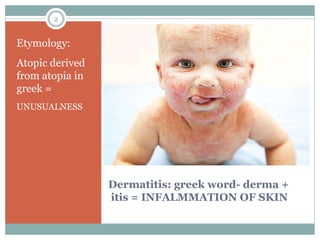
Dermatitis: greek word- derma +
itis = INFALMMATION OF SKIN
Etymology:
Atopic derived
from atopia in
greek =
UNUSUALNESS
2
AN ITCHY, CHRONIC OR
CHRONICALLY RELAPSING SKIN
CONDITION OFTEN STARTING EARLY
IN CHILHOOD WITH RASH
CHARACTERIZED BY ERYTHEMA,
ITCHY PAPULES/ PAPULOVESICLES
WHICH MAY BECOME EXCORIATED
AND LICHENIFIED.
DEFINITION
3
PERSONAL OR FAMILIAL TENDENCY
TO PRODUCE IGE ANTIBODIES IN
RESPONSE TO LOW DOSE OF
ALLERGENS ,USUALLY PROTEINS
AND TO DEVELOP TYPICAL
SYMPTOMS OF ASTHMA,
RHINOCONJUCTIVITIS OR ECZEMA /
DERMATITIS.
ATOPY
4
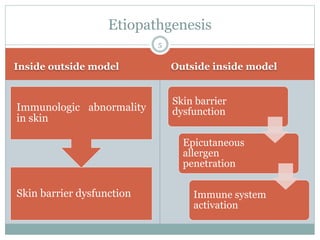
Inside outside model Outside inside model
Skin barrier dysfunction
Immunologic abnormality
in skin
Skin barrier
dysfunction
Epicutaneous
allergen
penetration
Immune system
activation
5
Etiopathgenesis
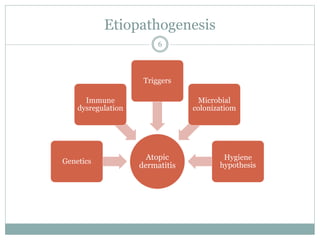
Etiopathogenesis
6
Atopic
dermatitis
Genetics
Immune
dysregulation
Triggers
Microbial
colonizatiom
Hygiene
hypothesis
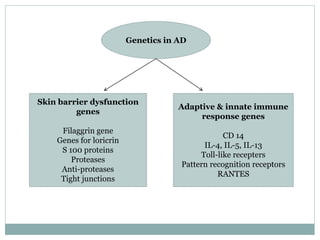
Genetics in AD
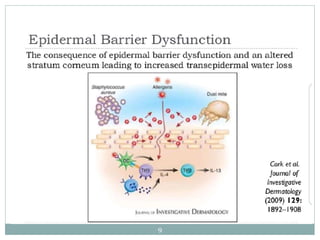
Skin barrier dysfunction
genes
Filaggrin gene
Genes for loricrin
S 100 proteins
Proteases
Anti-proteases
Tight junctions
Adaptive & innate immune
response genes
CD 14
IL-4, IL-5, IL-13
Toll-like recepters
Pattern recognition receptors
RANTES
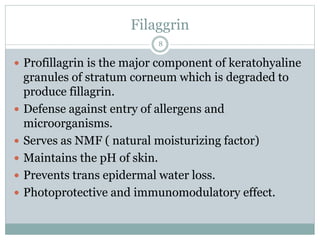
Filaggrin
8
 Profillagrin is the major component of keratohyaline
granules of stratum corneum which is degraded to
produce fillagrin.
 Defense against entry of allergens and
microorganisms.
 Serves as NMF ( natural moisturizing factor)
 Maintains the pH of skin.
 Prevents trans epidermal water loss.
 Photoprotective and immunomodulatory effect.
9
Tendency of AD to precede the
other allergic disorders in temporal
sequence.
Atopic
March :
Natural history
of allergic
manifestations.
10
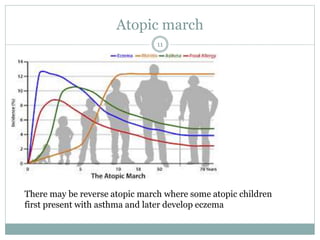
Atopic march
There may be reverse atopic march where some atopic children
first present with asthma and later develop eczema
11
IMMUNE DYSREGULATION IN AD
12
1) Increased Th2-derived cytokine activity.
2) Increased numbers of T-cells expressing cutaneous
lymphocytes-associated antigen(CLA)
3) Increase numbers of regulatory T-cells(Tregs) in the
peripheral blood– these cells normally inhibit
antigen-specific Th2 responses
4) Increased total and specific serum IgE level
5) Increased expression of the IgE receptor FcέR1 on
Langerhans cells & dendritic cells
6) Decreased expression of antimicrobial peptides
Increased thymic stromal lymphopoietin (TSLP)
Hygiene Hypothesis
13
 Early childhood infections caused by unhygienic
contact with older siblings confers protection from
development of allergic diseases
 Farm effect- children living on farms, having contact
with farm animals, drinking unprocessed cow`s
milk, increased exposure to microbes have less
incidence of AD and asthma.
Trigger factors
14
1) Changes in temperature
2) Sweating
3) Decrease in huminity
4) Contact with irritants
5) Aeroallergens
6) Food allergens
7) Emotional stress
8) harmones
Clinical
features
Atopic
dermatitis
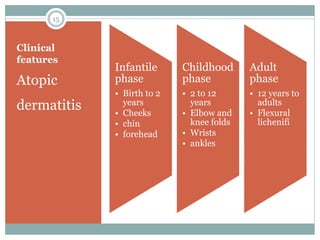
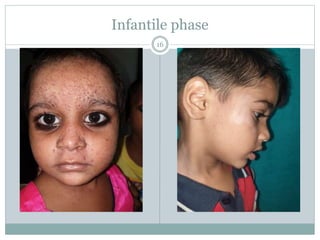
Infantile
phase
• Birth to 2
years
• Cheeks
• chin
• forehead
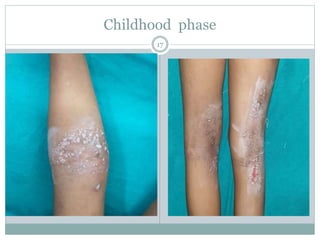
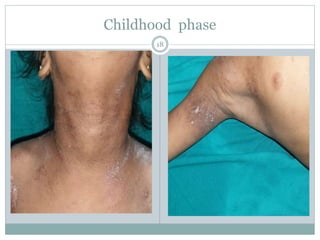
Childhood
phase
• 2 to 12
years
• Elbow and
knee folds
• Wrists
• ankles
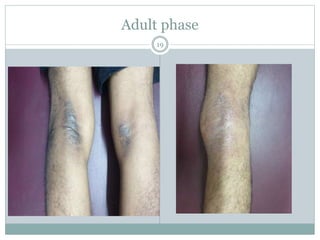
Adult
phase
• 12 years to
adults
• Flexural
lichenifi
15
Infantile phase
16
Childhood phase
17
Childhood phase
18
Adult phase
19
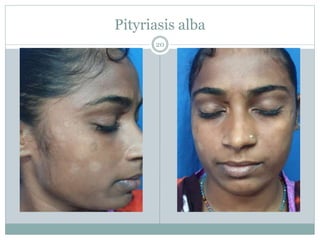
Pityriasis alba
20
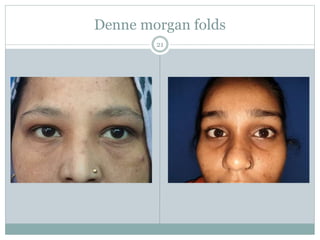
Denne morgan folds
21
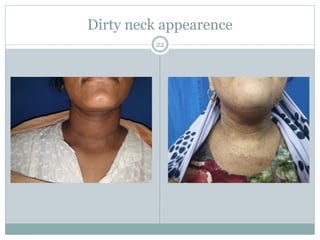
Dirty neck appearence
22
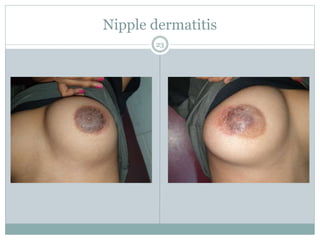
Nipple dermatitis
23
24
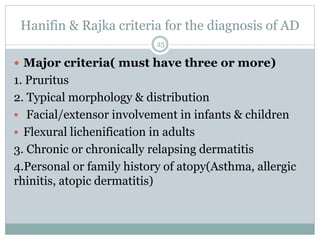
Hanifin & Rajka criteria for the diagnosis of AD
 Major criteria( must have three or more)
1. Pruritus
2. Typical morphology & distribution
 Facial/extensor involvement in infants & children
 Flexural lichenification in adults
3. Chronic or chronically relapsing dermatitis
4.Personal or family history of atopy(Asthma, allergic
rhinitis, atopic dermatitis)
25
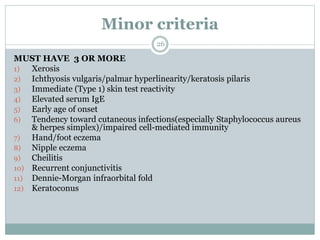
Minor criteria
26
MUST HAVE 3 OR MORE
1) Xerosis
2) Ichthyosis vulgaris/palmar hyperlinearity/keratosis pilaris
3) Immediate (Type 1) skin test reactivity
4) Elevated serum IgE
5) Early age of onset
6) Tendency toward cutaneous infections(especially Staphylococcus aureus
& herpes simplex)/impaired cell-mediated immunity
7) Hand/foot eczema
8) Nipple eczema
9) Cheilitis
10) Recurrent conjunctivitis
11) Dennie-Morgan infraorbital fold
12) Keratoconus
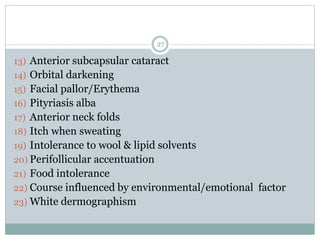
27
13) Anterior subcapsular cataract
14) Orbital darkening
15) Facial pallor/Erythema
16) Pityriasis alba
17) Anterior neck folds
18) Itch when sweating
19) Intolerance to wool & lipid solvents
20) Perifollicular accentuation
21) Food intolerance
22) Course influenced by environmental/emotional factor
23) White dermographism
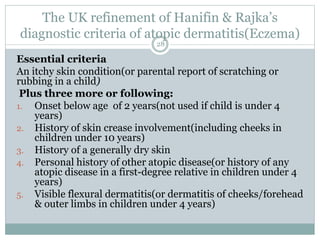
The UK refinement of Hanifin & Rajka’s
diagnostic criteria of atopic dermatitis(Eczema)
28
Essential criteria
An itchy skin condition(or parental report of scratching or
rubbing in a child)
Plus three more or following:
1. Onset below age of 2 years(not used if child is under 4
years)
2. History of skin crease involvement(including cheeks in
children under 10 years)
3. History of a generally dry skin
4. Personal history of other atopic disease(or history of any
atopic disease in a first-degree relative in children under 4
years)
5. Visible flexural dermatitis(or dermatitis of cheeks/forehead
& outer limbs in children under 4 years)
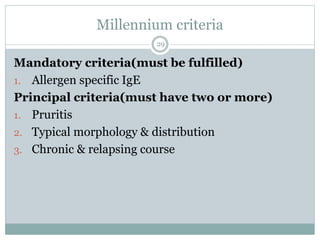
Millennium criteria
29
Mandatory criteria(must be fulfilled)
1. Allergen specific IgE
Principal criteria(must have two or more)
1. Pruritis
2. Typical morphology & distribution
3. Chronic & relapsing course
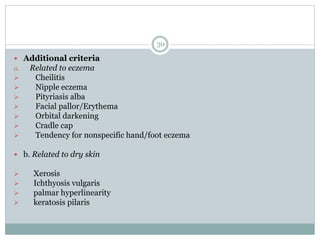
30
 Additional criteria
a. Related to eczema
 Cheilitis
 Nipple eczema
 Pityriasis alba
 Facial pallor/Erythema
 Orbital darkening
 Cradle cap
 Tendency for nonspecific hand/foot eczema
 b. Related to dry skin
 Xerosis
 Ichthyosis vulgaris
 palmar hyperlinearity
 keratosis pilaris
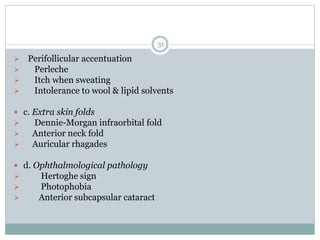
31
 Perifollicular accentuation
 Perleche
 Itch when sweating
 Intolerance to wool & lipid solvents
 c. Extra skin folds
 Dennie-Morgan infraorbital fold
 Anterior neck fold
 Auricular rhagades
 d. Ophthalmological pathology
 Hertoghe sign
 Photophobia
 Anterior subcapsular cataract
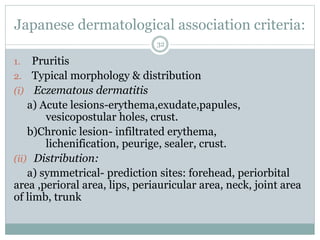
Japanese dermatological association criteria:
32
1. Pruritis
2. Typical morphology & distribution
(i) Eczematous dermatitis
a) Acute lesions-erythema,exudate,papules,
vesicopostular holes, crust.
b)Chronic lesion- infiltrated erythema,
lichenification, peurige, sealer, crust.
(ii) Distribution:
a) symmetrical- prediction sites: forehead, periorbital
area ,perioral area, lips, periauricular area, neck, joint area
of limb, trunk
33
b) Age related characteristics
 Infantile phase-starts on scalp & face, often spreads to
trunk & extremity
 Childhood phase- neck, flexural surface of arms & legs
 Adolescent/adult phase-tendency to be severe, on upper
half of the body
(iii) Chronic or chronically relapsing course:
 More than 2 months in infancy
 More than 6 months in childhood, adolescence &
adulthood
A M E R I C A N A C A D E M Y O F D E R M A T I L O G Y
34
Guidelines of care for
management of AD
Recommendation for non pharmacologic interventions for the
treatment of atopic dermatitis
35
 Moisturizers should be an integral part of the treatment.
 Bathing is suggested for the patient with AD as part of
treatment &maintenance
 Moisturizers should be applied soon after bathing
 Limited use of non soap cleansers is recommended
 The additions of oils, emollients & most other additives
to bath waters cannot be recommended
 Use of wet-wrap therapy with or without a topical
corticosteroid can be recommended for patient with
moderate to severe AD to decrease disease severity &
water loss during flares.
Recommendation for the use of topical
corticosteroids for the treatment of atopic dermatitis.36
 Recommended for AD-affected individuals who have
failed to respond to good skin care & regular use of
emollients alone.
 A variety of factors should be considered including
patient age, body area , & other patient factors such as
degree of xerosis, patient preference & cost of medication
 Twice daily application of corticosteroids is generally
recommended
 Proactive intermittent use of topical corticosteroids as
maintenance therapy(1-2 times/wk) on area that
commonly flare is recommended to help prevent relapses
& is more effective than use of emollients alone
Recommendations for the use of topical calcineurin inhibitors
for the treatment of atopic dermatitis
37
Effective for acute & chronic treatment along with
maintenance, in both adults & children with AD and
are particularly useful in selected clinical situation:
 Recalcitrant to steroids
 Sensitive areas(eg, Face, anogenital, skin folds)
 Steroid-induced atrophy
 Long-term uninterrupted topical steroid use
38
 As a steroid-sparing agent
 For patient with AD < 2 years of age with mild to severe
disease, off label use of 0.03 % tacrolimus or 1 %
pimecrolimus ointment can be recommended.
 Initial treatment of patient with AD using topical
corticosteroids should be considered to minimize TCI
 Proactive treatment use of TCI as maintenance
therapy(2-3 times per week) on area that commonly flare
is recommended.
 The concomitant use of a topical corticosteroid with a
TCI may be recommended for the treatment of AD
39
Topical antimicrobials and antiseptics
40
Except for bleach baths with intranasal mupirocin,
no topical antistaphylococcal treatment has been
shown to be clinically helpful in patient with AD & is
not routinely recommended.
In patient with moderate to severe AD & clinical
signs of secondary bacterial infection, bleach baths &
intranasal mupirocin may be recommended to
reduce disease severity
Topical antihistamines
41
The use of topical antihistamines for the treatment of
patients with atopic dermatitis is not recommended
because of the risk of absorption & of contact
dermatitis.

Atopic dermatitis

  • 1.
    DR. SABHA TALIBNEAZEE. ATOPIC DERMATITIS 1
  • 2.
    Dermatitis: greek word-derma + itis = INFALMMATION OF SKIN Etymology: Atopic derived from atopia in greek = UNUSUALNESS 2
  • 3.
    AN ITCHY, CHRONICOR CHRONICALLY RELAPSING SKIN CONDITION OFTEN STARTING EARLY IN CHILHOOD WITH RASH CHARACTERIZED BY ERYTHEMA, ITCHY PAPULES/ PAPULOVESICLES WHICH MAY BECOME EXCORIATED AND LICHENIFIED. DEFINITION 3
  • 4.
    PERSONAL OR FAMILIALTENDENCY TO PRODUCE IGE ANTIBODIES IN RESPONSE TO LOW DOSE OF ALLERGENS ,USUALLY PROTEINS AND TO DEVELOP TYPICAL SYMPTOMS OF ASTHMA, RHINOCONJUCTIVITIS OR ECZEMA / DERMATITIS. ATOPY 4
  • 5.
    Inside outside modelOutside inside model Skin barrier dysfunction Immunologic abnormality in skin Skin barrier dysfunction Epicutaneous allergen penetration Immune system activation 5 Etiopathgenesis
  • 6.
  • 7.
    Genetics in AD Skinbarrier dysfunction genes Filaggrin gene Genes for loricrin S 100 proteins Proteases Anti-proteases Tight junctions Adaptive & innate immune response genes CD 14 IL-4, IL-5, IL-13 Toll-like recepters Pattern recognition receptors RANTES
  • 8.
    Filaggrin 8  Profillagrin isthe major component of keratohyaline granules of stratum corneum which is degraded to produce fillagrin.  Defense against entry of allergens and microorganisms.  Serves as NMF ( natural moisturizing factor)  Maintains the pH of skin.  Prevents trans epidermal water loss.  Photoprotective and immunomodulatory effect.
  • 9.
  • 10.
    Tendency of ADto precede the other allergic disorders in temporal sequence. Atopic March : Natural history of allergic manifestations. 10
  • 11.
    Atopic march There maybe reverse atopic march where some atopic children first present with asthma and later develop eczema 11
  • 12.
    IMMUNE DYSREGULATION INAD 12 1) Increased Th2-derived cytokine activity. 2) Increased numbers of T-cells expressing cutaneous lymphocytes-associated antigen(CLA) 3) Increase numbers of regulatory T-cells(Tregs) in the peripheral blood– these cells normally inhibit antigen-specific Th2 responses 4) Increased total and specific serum IgE level 5) Increased expression of the IgE receptor FcέR1 on Langerhans cells & dendritic cells 6) Decreased expression of antimicrobial peptides Increased thymic stromal lymphopoietin (TSLP)
  • 13.
    Hygiene Hypothesis 13  Earlychildhood infections caused by unhygienic contact with older siblings confers protection from development of allergic diseases  Farm effect- children living on farms, having contact with farm animals, drinking unprocessed cow`s milk, increased exposure to microbes have less incidence of AD and asthma.
  • 14.
    Trigger factors 14 1) Changesin temperature 2) Sweating 3) Decrease in huminity 4) Contact with irritants 5) Aeroallergens 6) Food allergens 7) Emotional stress 8) harmones
  • 15.
    Clinical features Atopic dermatitis Infantile phase • Birth to2 years • Cheeks • chin • forehead Childhood phase • 2 to 12 years • Elbow and knee folds • Wrists • ankles Adult phase • 12 years to adults • Flexural lichenifi 15
  • 16.
  • 17.
  • 18.
  • 19.
  • 20.
  • 21.
  • 22.
  • 23.
  • 24.
  • 25.
    Hanifin & Rajkacriteria for the diagnosis of AD  Major criteria( must have three or more) 1. Pruritus 2. Typical morphology & distribution  Facial/extensor involvement in infants & children  Flexural lichenification in adults 3. Chronic or chronically relapsing dermatitis 4.Personal or family history of atopy(Asthma, allergic rhinitis, atopic dermatitis) 25
  • 26.
    Minor criteria 26 MUST HAVE3 OR MORE 1) Xerosis 2) Ichthyosis vulgaris/palmar hyperlinearity/keratosis pilaris 3) Immediate (Type 1) skin test reactivity 4) Elevated serum IgE 5) Early age of onset 6) Tendency toward cutaneous infections(especially Staphylococcus aureus & herpes simplex)/impaired cell-mediated immunity 7) Hand/foot eczema 8) Nipple eczema 9) Cheilitis 10) Recurrent conjunctivitis 11) Dennie-Morgan infraorbital fold 12) Keratoconus
  • 27.
    27 13) Anterior subcapsularcataract 14) Orbital darkening 15) Facial pallor/Erythema 16) Pityriasis alba 17) Anterior neck folds 18) Itch when sweating 19) Intolerance to wool & lipid solvents 20) Perifollicular accentuation 21) Food intolerance 22) Course influenced by environmental/emotional factor 23) White dermographism
  • 28.
    The UK refinementof Hanifin & Rajka’s diagnostic criteria of atopic dermatitis(Eczema) 28 Essential criteria An itchy skin condition(or parental report of scratching or rubbing in a child) Plus three more or following: 1. Onset below age of 2 years(not used if child is under 4 years) 2. History of skin crease involvement(including cheeks in children under 10 years) 3. History of a generally dry skin 4. Personal history of other atopic disease(or history of any atopic disease in a first-degree relative in children under 4 years) 5. Visible flexural dermatitis(or dermatitis of cheeks/forehead & outer limbs in children under 4 years)
  • 29.
    Millennium criteria 29 Mandatory criteria(mustbe fulfilled) 1. Allergen specific IgE Principal criteria(must have two or more) 1. Pruritis 2. Typical morphology & distribution 3. Chronic & relapsing course
  • 30.
    30  Additional criteria a.Related to eczema  Cheilitis  Nipple eczema  Pityriasis alba  Facial pallor/Erythema  Orbital darkening  Cradle cap  Tendency for nonspecific hand/foot eczema  b. Related to dry skin  Xerosis  Ichthyosis vulgaris  palmar hyperlinearity  keratosis pilaris
  • 31.
    31  Perifollicular accentuation Perleche  Itch when sweating  Intolerance to wool & lipid solvents  c. Extra skin folds  Dennie-Morgan infraorbital fold  Anterior neck fold  Auricular rhagades  d. Ophthalmological pathology  Hertoghe sign  Photophobia  Anterior subcapsular cataract
  • 32.
    Japanese dermatological associationcriteria: 32 1. Pruritis 2. Typical morphology & distribution (i) Eczematous dermatitis a) Acute lesions-erythema,exudate,papules, vesicopostular holes, crust. b)Chronic lesion- infiltrated erythema, lichenification, peurige, sealer, crust. (ii) Distribution: a) symmetrical- prediction sites: forehead, periorbital area ,perioral area, lips, periauricular area, neck, joint area of limb, trunk
  • 33.
    33 b) Age relatedcharacteristics  Infantile phase-starts on scalp & face, often spreads to trunk & extremity  Childhood phase- neck, flexural surface of arms & legs  Adolescent/adult phase-tendency to be severe, on upper half of the body (iii) Chronic or chronically relapsing course:  More than 2 months in infancy  More than 6 months in childhood, adolescence & adulthood
  • 34.
    A M ER I C A N A C A D E M Y O F D E R M A T I L O G Y 34 Guidelines of care for management of AD
  • 35.
    Recommendation for nonpharmacologic interventions for the treatment of atopic dermatitis 35  Moisturizers should be an integral part of the treatment.  Bathing is suggested for the patient with AD as part of treatment &maintenance  Moisturizers should be applied soon after bathing  Limited use of non soap cleansers is recommended  The additions of oils, emollients & most other additives to bath waters cannot be recommended  Use of wet-wrap therapy with or without a topical corticosteroid can be recommended for patient with moderate to severe AD to decrease disease severity & water loss during flares.
  • 36.
    Recommendation for theuse of topical corticosteroids for the treatment of atopic dermatitis.36  Recommended for AD-affected individuals who have failed to respond to good skin care & regular use of emollients alone.  A variety of factors should be considered including patient age, body area , & other patient factors such as degree of xerosis, patient preference & cost of medication  Twice daily application of corticosteroids is generally recommended  Proactive intermittent use of topical corticosteroids as maintenance therapy(1-2 times/wk) on area that commonly flare is recommended to help prevent relapses & is more effective than use of emollients alone
  • 37.
    Recommendations for theuse of topical calcineurin inhibitors for the treatment of atopic dermatitis 37 Effective for acute & chronic treatment along with maintenance, in both adults & children with AD and are particularly useful in selected clinical situation:  Recalcitrant to steroids  Sensitive areas(eg, Face, anogenital, skin folds)  Steroid-induced atrophy  Long-term uninterrupted topical steroid use
  • 38.
    38  As asteroid-sparing agent  For patient with AD < 2 years of age with mild to severe disease, off label use of 0.03 % tacrolimus or 1 % pimecrolimus ointment can be recommended.  Initial treatment of patient with AD using topical corticosteroids should be considered to minimize TCI  Proactive treatment use of TCI as maintenance therapy(2-3 times per week) on area that commonly flare is recommended.  The concomitant use of a topical corticosteroid with a TCI may be recommended for the treatment of AD
  • 39.
  • 40.
    Topical antimicrobials andantiseptics 40 Except for bleach baths with intranasal mupirocin, no topical antistaphylococcal treatment has been shown to be clinically helpful in patient with AD & is not routinely recommended. In patient with moderate to severe AD & clinical signs of secondary bacterial infection, bleach baths & intranasal mupirocin may be recommended to reduce disease severity
  • 41.
    Topical antihistamines 41 The useof topical antihistamines for the treatment of patients with atopic dermatitis is not recommended because of the risk of absorption & of contact dermatitis.