
Jewish General Hospital
  LIFE SCIENCES LIBRARY       Library


           Workshop 5: Journal Club &
                   Review


                          Chantal Cassis, MD
                          Robin Featherstone, MLIS
                          Francesca Frati, MLIS
Summer/Fall 2012          Roland Grad, MDCM, MSc, FCFP
Workshop 5 - Objectives

By the end of the workshop, you will be able to:
1. Present clinical EBM summaries to your peers
2. Critically reflect on the practical application of a
   clinical study
3. Describe benefits and challenges to integrating
   EBM into clinical practice
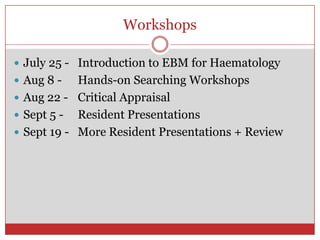
Workshops

 July 25 - Introduction to EBM for Haematology
 Aug 8 -   Hands-on Searching Workshops
 Aug 22 - Critical Appraisal
 Sept 5 - Resident Presentations
 Sept 19 - More Resident Presentations + Review
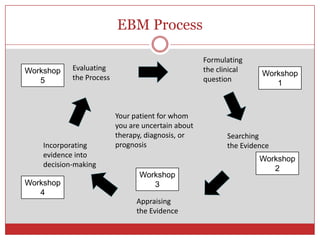
EBM Process

                                                    Formulating
Workshop    Evaluating                              the clinical
            the Process                                              Workshop
   5                                                question
                                                                        1


                          Your patient for whom
                          you are uncertain about
                          therapy, diagnosis, or           Searching
    Incorporating         prognosis                        the Evidence
    evidence into
                                                                    Workshop
    decision-making
                                                                       2
                                 Workshop
Workshop                            3
   4
                                Appraising
                                the Evidence
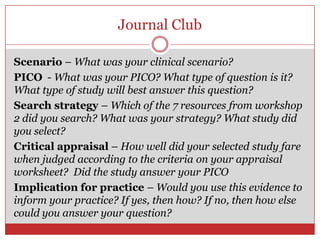
Journal Club

Scenario – What was your clinical scenario?
PICO - What was your PICO? What type of question is it?
What type of study will best answer this question?
Search strategy – Which of the 7 resources from workshop
2 did you search? What was your strategy? What study did
you select?
Critical appraisal – How well did your selected study fare
when judged according to the criteria on your appraisal
worksheet? Did the study answer your PICO
Implication for practice – Would you use this evidence to
inform your practice? If yes, then how? If no, then how else
could you answer your question?
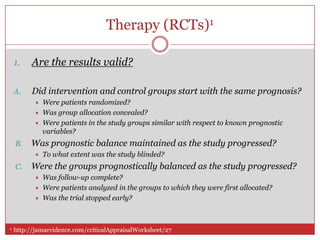
Therapy (RCTs)1

 1.    Are the results valid?

 A.    Did intervention and control groups start with the same prognosis?
           Were patients randomized?
           Was group allocation concealed?
           Were patients in the study groups similar with respect to known prognostic
            variables?
 B.    Was prognostic balance maintained as the study progressed?
           To what extent was the study blinded?
 C.    Were the groups prognostically balanced as the study progressed?
           Was follow-up complete?
           Were patients analyzed in the groups to which they were first allocated?
           Was the trial stopped early?


1. http://jamaevidence.com/criticalAppraisalWorksheet/27
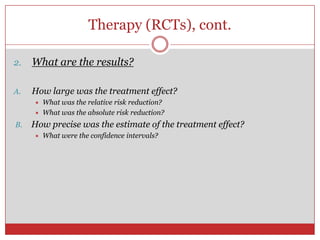
Therapy (RCTs), cont.

2.   What are the results?

A.   How large was the treatment effect?
        What was the relative risk reduction?
        What was the absolute risk reduction?
B.   How precise was the estimate of the treatment effect?
        What were the confidence intervals?
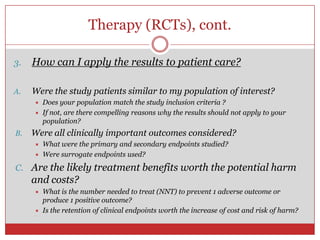
Therapy (RCTs), cont.

3.   How can I apply the results to patient care?

A.   Were the study patients similar to my population of interest?
        Does your population match the study inclusion criteria ?
        If not, are there compelling reasons why the results should not apply to your
         population?
B.   Were all clinically important outcomes considered?
        What were the primary and secondary endpoints studied?
        Were surrogate endpoints used?
C. Are the likely treatment benefits worth the potential harm
     and costs?
        What is the number needed to treat (NNT) to prevent 1 adverse outcome or
         produce 1 positive outcome?
        Is the retention of clinical endpoints worth the increase of cost and risk of harm?
     
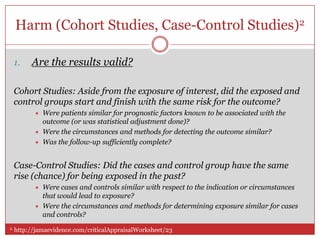
Harm (Cohort Studies, Case-Control Studies)2

 1.    Are the results valid?

 Cohort Studies: Aside from the exposure of interest, did the exposed and
 control groups start and finish with the same risk for the outcome?
           Were patients similar for prognostic factors known to be associated with the
            outcome (or was statistical adjustment done)?
           Were the circumstances and methods for detecting the outcome similar?
           Was the follow-up sufficiently complete?


 Case-Control Studies: Did the cases and control group have the same
 rise (chance) for being exposed in the past?
           Were cases and controls similar with respect to the indication or circumstances
            that would lead to exposure?
           Were the circumstances and methods for determining exposure similar for cases
            and controls?
2. http://jamaevidence.com/criticalAppraisalWorksheet/23
Harm (Cohort Studies, Case-Control Studies), cont.

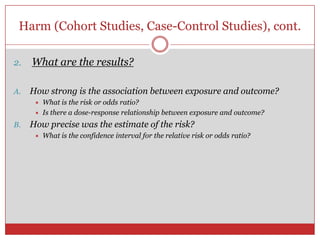
2.   What are the results?

A.   How strong is the association between exposure and outcome?
         What is the risk or odds ratio?
         Is there a dose-response relationship between exposure and outcome?
B.   How precise was the estimate of the risk?
         What is the confidence interval for the relative risk or odds ratio?
Harm (Cohort Studies, Case-Control Studies), cont.

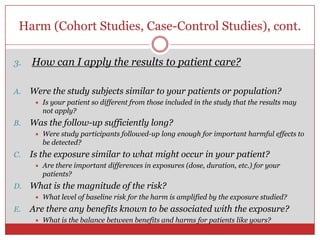
3.   How can I apply the results to patient care?

A.   Were the study subjects similar to your patients or population?
         Is your patient so different from those included in the study that the results may
          not apply?
B.   Was the follow-up sufficiently long?
         Were study participants followed-up long enough for important harmful effects to
          be detected?
C.   Is the exposure similar to what might occur in your patient?
         Are there important differences in exposures (dose, duration, etc.) for your
          patients?
D.   What is the magnitude of the risk?
         What level of baseline risk for the harm is amplified by the exposure studied?
E.   Are there any benefits known to be associated with the exposure?
         What is the balance between benefits and harms for patients like yours?
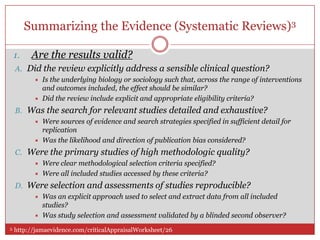
Summarizing the Evidence (Systematic Reviews)3

 1.    Are the results valid?
 A. Did the review explicitly address a sensible clinical question?
           Is the underlying biology or sociology such that, across the range of interventions
            and outcomes included, the effect should be similar?
           Did the review include explicit and appropriate eligibility criteria?
 B. Was the search for relevant studies detailed and exhaustive?
           Were sources of evidence and search strategies specified in sufficient detail for
            replication
           Was the likelihood and direction of publication bias considered?
 C. Were the primary studies of high methodologic quality?
           Were clear methodological selection criteria specified?
           Were all included studies accessed by these criteria?
 D. Were selection and assessments of studies reproducible?
           Was an explicit approach used to select and extract data from all included
            studies?
           Was study selection and assessment validated by a blinded second observer?
3. http://jamaevidence.com/criticalAppraisalWorksheet/26
Summarizing the Evidence (Systematic Reviews),
                         cont.

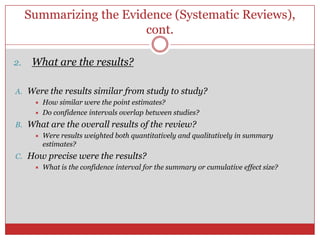
2.    What are the results?

A. Were the results similar from study to study?
         How similar were the point estimates?
         Do confidence intervals overlap between studies?
B. What are the overall results of the review?
         Were results weighted both quantitatively and qualitatively in summary
          estimates?
C. How precise were the results?
         What is the confidence interval for the summary or cumulative effect size?
Summarizing the Evidence (Systematic Reviews),
                         cont.

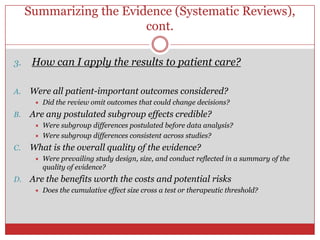
3.    How can I apply the results to patient care?

A.   Were all patient-important outcomes considered?
         Did the review omit outcomes that could change decisions?
B.   Are any postulated subgroup effects credible?
         Were subgroup differences postulated before data analysis?
         Were subgroup differences consistent across studies?
C.   What is the overall quality of the evidence?
         Were prevailing study design, size, and conduct reflected in a summary of the
          quality of evidence?
D.   Are the benefits worth the costs and potential risks
         Does the cumulative effect size cross a test or therapeutic threshold?
Review

Discussion Questions:
1. How did EBM improve your practice?
2. What challenges did you face integrating EBM into your
   practice?
3. Will EBM continue to influence your practice?


 Slides available: http://www.slideshare.net/featherr

EBM for Haematology - Workshop 5

  • 1.
    Jewish General Hospital LIFE SCIENCES LIBRARY Library Workshop 5: Journal Club & Review Chantal Cassis, MD Robin Featherstone, MLIS Francesca Frati, MLIS Summer/Fall 2012 Roland Grad, MDCM, MSc, FCFP
  • 2.
    Workshop 5 -Objectives By the end of the workshop, you will be able to: 1. Present clinical EBM summaries to your peers 2. Critically reflect on the practical application of a clinical study 3. Describe benefits and challenges to integrating EBM into clinical practice
  • 3.
    Workshops  July 25- Introduction to EBM for Haematology  Aug 8 - Hands-on Searching Workshops  Aug 22 - Critical Appraisal  Sept 5 - Resident Presentations  Sept 19 - More Resident Presentations + Review
  • 4.
    EBM Process Formulating Workshop Evaluating the clinical the Process Workshop 5 question 1 Your patient for whom you are uncertain about therapy, diagnosis, or Searching Incorporating prognosis the Evidence evidence into Workshop decision-making 2 Workshop Workshop 3 4 Appraising the Evidence
  • 5.
    Journal Club Scenario –What was your clinical scenario? PICO - What was your PICO? What type of question is it? What type of study will best answer this question? Search strategy – Which of the 7 resources from workshop 2 did you search? What was your strategy? What study did you select? Critical appraisal – How well did your selected study fare when judged according to the criteria on your appraisal worksheet? Did the study answer your PICO Implication for practice – Would you use this evidence to inform your practice? If yes, then how? If no, then how else could you answer your question?
  • 6.
    Therapy (RCTs)1 1. Are the results valid? A. Did intervention and control groups start with the same prognosis?  Were patients randomized?  Was group allocation concealed?  Were patients in the study groups similar with respect to known prognostic variables? B. Was prognostic balance maintained as the study progressed?  To what extent was the study blinded? C. Were the groups prognostically balanced as the study progressed?  Was follow-up complete?  Were patients analyzed in the groups to which they were first allocated?  Was the trial stopped early? 1. http://jamaevidence.com/criticalAppraisalWorksheet/27
  • 7.
    Therapy (RCTs), cont. 2. What are the results? A. How large was the treatment effect?  What was the relative risk reduction?  What was the absolute risk reduction? B. How precise was the estimate of the treatment effect?  What were the confidence intervals?
  • 8.
    Therapy (RCTs), cont. 3. How can I apply the results to patient care? A. Were the study patients similar to my population of interest?  Does your population match the study inclusion criteria ?  If not, are there compelling reasons why the results should not apply to your population? B. Were all clinically important outcomes considered?  What were the primary and secondary endpoints studied?  Were surrogate endpoints used? C. Are the likely treatment benefits worth the potential harm and costs?  What is the number needed to treat (NNT) to prevent 1 adverse outcome or produce 1 positive outcome?  Is the retention of clinical endpoints worth the increase of cost and risk of harm? 
  • 9.
    Harm (Cohort Studies,Case-Control Studies)2 1. Are the results valid? Cohort Studies: Aside from the exposure of interest, did the exposed and control groups start and finish with the same risk for the outcome?  Were patients similar for prognostic factors known to be associated with the outcome (or was statistical adjustment done)?  Were the circumstances and methods for detecting the outcome similar?  Was the follow-up sufficiently complete? Case-Control Studies: Did the cases and control group have the same rise (chance) for being exposed in the past?  Were cases and controls similar with respect to the indication or circumstances that would lead to exposure?  Were the circumstances and methods for determining exposure similar for cases and controls? 2. http://jamaevidence.com/criticalAppraisalWorksheet/23
  • 10.
    Harm (Cohort Studies,Case-Control Studies), cont. 2. What are the results? A. How strong is the association between exposure and outcome?  What is the risk or odds ratio?  Is there a dose-response relationship between exposure and outcome? B. How precise was the estimate of the risk?  What is the confidence interval for the relative risk or odds ratio?
  • 11.
    Harm (Cohort Studies,Case-Control Studies), cont. 3. How can I apply the results to patient care? A. Were the study subjects similar to your patients or population?  Is your patient so different from those included in the study that the results may not apply? B. Was the follow-up sufficiently long?  Were study participants followed-up long enough for important harmful effects to be detected? C. Is the exposure similar to what might occur in your patient?  Are there important differences in exposures (dose, duration, etc.) for your patients? D. What is the magnitude of the risk?  What level of baseline risk for the harm is amplified by the exposure studied? E. Are there any benefits known to be associated with the exposure?  What is the balance between benefits and harms for patients like yours?
  • 12.
    Summarizing the Evidence(Systematic Reviews)3 1. Are the results valid? A. Did the review explicitly address a sensible clinical question?  Is the underlying biology or sociology such that, across the range of interventions and outcomes included, the effect should be similar?  Did the review include explicit and appropriate eligibility criteria? B. Was the search for relevant studies detailed and exhaustive?  Were sources of evidence and search strategies specified in sufficient detail for replication  Was the likelihood and direction of publication bias considered? C. Were the primary studies of high methodologic quality?  Were clear methodological selection criteria specified?  Were all included studies accessed by these criteria? D. Were selection and assessments of studies reproducible?  Was an explicit approach used to select and extract data from all included studies?  Was study selection and assessment validated by a blinded second observer? 3. http://jamaevidence.com/criticalAppraisalWorksheet/26
  • 13.
    Summarizing the Evidence(Systematic Reviews), cont. 2. What are the results? A. Were the results similar from study to study?  How similar were the point estimates?  Do confidence intervals overlap between studies? B. What are the overall results of the review?  Were results weighted both quantitatively and qualitatively in summary estimates? C. How precise were the results?  What is the confidence interval for the summary or cumulative effect size?
  • 14.
    Summarizing the Evidence(Systematic Reviews), cont. 3. How can I apply the results to patient care? A. Were all patient-important outcomes considered?  Did the review omit outcomes that could change decisions? B. Are any postulated subgroup effects credible?  Were subgroup differences postulated before data analysis?  Were subgroup differences consistent across studies? C. What is the overall quality of the evidence?  Were prevailing study design, size, and conduct reflected in a summary of the quality of evidence? D. Are the benefits worth the costs and potential risks  Does the cumulative effect size cross a test or therapeutic threshold?
  • 15.
    Review Discussion Questions: 1. Howdid EBM improve your practice? 2. What challenges did you face integrating EBM into your practice? 3. Will EBM continue to influence your practice?  Slides available: http://www.slideshare.net/featherr

Editor's Notes

  • #5 Process can also be described as: Ask, Acquire, Appraise, Apply and Assess