15.4 COMPRESSORS


    http://part66.blogspot.com/
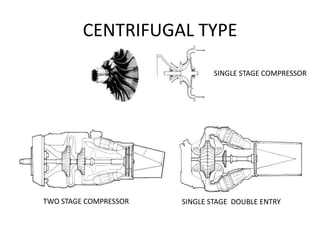
CENTRIFUGAL TYPE

                               SINGLE STAGE COMPRESSOR


TWO STAGE COMPRESSOR   SINGLE STAGE DOUBLE ENTRY
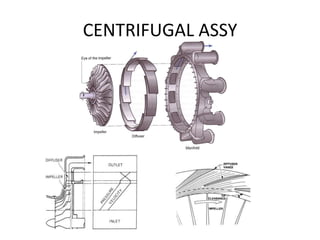
CENTRIFUGAL ASSY
CENTRIFUGAL FEATURES
• ADVANTAGE
  –   Cheap and simple
  –   Not prone to FOD and icing
  –   Stable, no stall and surge
  –   Large rise in air pressure over distance

• DISADVANTAGE
  –   Limited compression ration 4:1
  –   Large frontal area
  –   Capacity is limit by impaler tip speed
  –   Easyly loss pressure due to severe change airflow direction
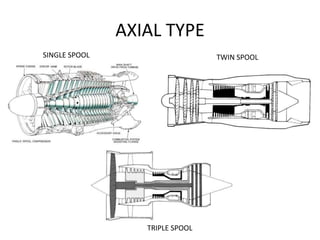
AXIAL TYPE
SINGLE SPOOL                     TWIN SPOOL


                  TRIPLE SPOOL
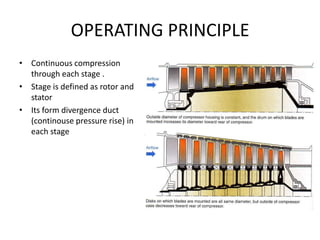
OPERATING PRINCIPLE
• Continuous compression
  through each stage .
• Stage is defined as rotor and
  stator
• Its form divergence duct
  (continouse pressure rise) in
  each stage
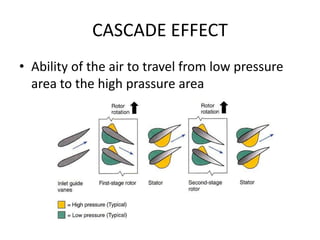
CASCADE EFFECT
• Ability of the air to travel from low pressure
  area to the high prassure area
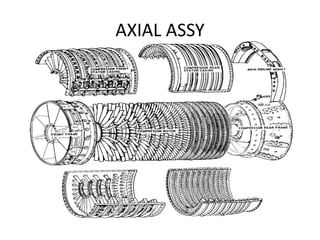
AXIAL ASSY
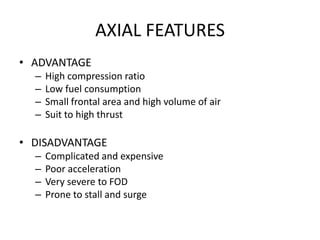
AXIAL FEATURES
• ADVANTAGE
  –   High compression ratio
  –   Low fuel consumption
  –   Small frontal area and high volume of air
  –   Suit to high thrust

• DISADVANTAGE
  –   Complicated and expensive
  –   Poor acceleration
  –   Very severe to FOD
  –   Prone to stall and surge
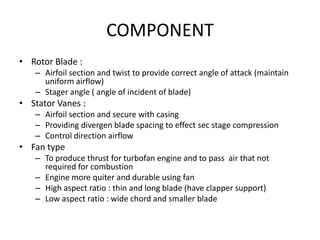
COMPONENT
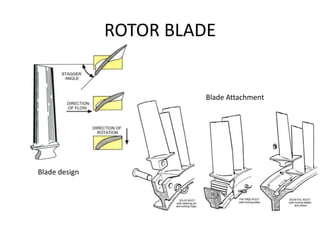
• Rotor Blade :
   – Airfoil section and twist to provide correct angle of attack (maintain
     uniform airflow)
   – Stager angle ( angle of incident of blade)
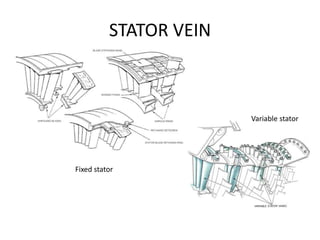
• Stator Vanes :
   – Airfoil section and secure with casing
   – Providing divergen blade spacing to effect sec stage compression
   – Control direction airflow
• Fan type
   – To produce thrust for turbofan engine and to pass air that not
     required for combustion
   – Engine more quiter and durable using fan
   – High aspect ratio : thin and long blade (have clapper support)
   – Low aspect ratio : wide chord and smaller blade
ROTOR BLADE


                         Blade Attachment


Blade design
STATOR VEIN


                        Variable stator


Fixed stator
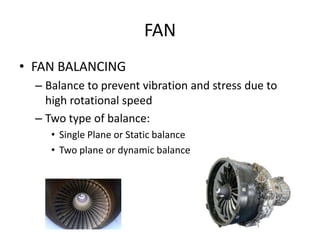
FAN
• FAN BALANCING
  – Balance to prevent vibration and stress due to
    high rotational speed
  – Two type of balance:
     • Single Plane or Static balance
     • Two plane or dynamic balance
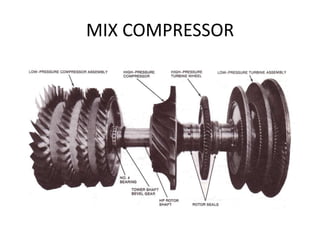
MIX COMPRESSOR
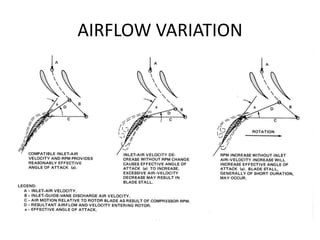
STALL AND SURGE
• Stall :
    – Angle of attack of blade become to high or low due to airflow entry
      condition.
    – Indicate by increase in EGT, vibration and coughing noise
    – Transition stall If slight vibration and poor acceleration occur shortly
    – Hung stall cause all stage compressor stall and airflow will become
      reverse flow (surge)

• Surge :
    – Complete breakdown of airflow (all compressor stage stall)
    – Due FOD, distored airfoil, bleed valve mailfunction cause the rear
      compressor stage chock or exessive pressure ratio
    – Indicate by abnormal engine noise, high EGT, vibration, flame emiting
      in exhaust
    – In extream condition, engine completely destroy
AIRFLOW VARIATION
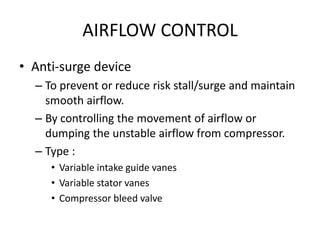
AIRFLOW CONTROL
• Anti-surge device
  – To prevent or reduce risk stall/surge and maintain
    smooth airflow.
  – By controlling the movement of airflow or
    dumping the unstable airflow from compressor.
  – Type :
     • Variable intake guide vanes
     • Variable stator vanes
     • Compressor bleed valve
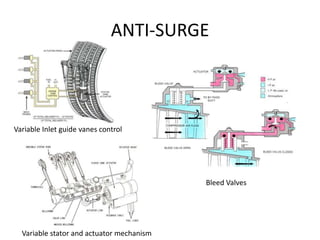
ANTI-SURGE


Variable Inlet guide vanes control


                                           Bleed Valves


  Variable stator and actuator mechanism
COMPRESSOR RATIO
• Calculated by dividing total pressure after last
  stage of compresssion by total inlet pressure.
• Varies with RPM, intake temperature and
  blade damage
• Overall pressure ratio for axial compressor is
  30:1

EASA Part 66 Module 15.4 : Compressors

  • 1.
    15.4 COMPRESSORS http://part66.blogspot.com/
  • 2.
    CENTRIFUGAL TYPE SINGLE STAGE COMPRESSOR TWO STAGE COMPRESSOR SINGLE STAGE DOUBLE ENTRY
  • 3.
  • 4.
    CENTRIFUGAL FEATURES • ADVANTAGE – Cheap and simple – Not prone to FOD and icing – Stable, no stall and surge – Large rise in air pressure over distance • DISADVANTAGE – Limited compression ration 4:1 – Large frontal area – Capacity is limit by impaler tip speed – Easyly loss pressure due to severe change airflow direction
  • 5.
    AXIAL TYPE SINGLE SPOOL TWIN SPOOL TRIPLE SPOOL
  • 6.
    OPERATING PRINCIPLE • Continuouscompression through each stage . • Stage is defined as rotor and stator • Its form divergence duct (continouse pressure rise) in each stage
  • 7.
    CASCADE EFFECT • Abilityof the air to travel from low pressure area to the high prassure area
  • 8.
  • 9.
    AXIAL FEATURES • ADVANTAGE – High compression ratio – Low fuel consumption – Small frontal area and high volume of air – Suit to high thrust • DISADVANTAGE – Complicated and expensive – Poor acceleration – Very severe to FOD – Prone to stall and surge
  • 10.
    COMPONENT • Rotor Blade: – Airfoil section and twist to provide correct angle of attack (maintain uniform airflow) – Stager angle ( angle of incident of blade) • Stator Vanes : – Airfoil section and secure with casing – Providing divergen blade spacing to effect sec stage compression – Control direction airflow • Fan type – To produce thrust for turbofan engine and to pass air that not required for combustion – Engine more quiter and durable using fan – High aspect ratio : thin and long blade (have clapper support) – Low aspect ratio : wide chord and smaller blade
  • 11.
    ROTOR BLADE Blade Attachment Blade design
  • 12.
    STATOR VEIN Variable stator Fixed stator
  • 13.
    FAN • FAN BALANCING – Balance to prevent vibration and stress due to high rotational speed – Two type of balance: • Single Plane or Static balance • Two plane or dynamic balance
  • 14.
  • 15.
    STALL AND SURGE •Stall : – Angle of attack of blade become to high or low due to airflow entry condition. – Indicate by increase in EGT, vibration and coughing noise – Transition stall If slight vibration and poor acceleration occur shortly – Hung stall cause all stage compressor stall and airflow will become reverse flow (surge) • Surge : – Complete breakdown of airflow (all compressor stage stall) – Due FOD, distored airfoil, bleed valve mailfunction cause the rear compressor stage chock or exessive pressure ratio – Indicate by abnormal engine noise, high EGT, vibration, flame emiting in exhaust – In extream condition, engine completely destroy
  • 16.
  • 17.
    AIRFLOW CONTROL • Anti-surgedevice – To prevent or reduce risk stall/surge and maintain smooth airflow. – By controlling the movement of airflow or dumping the unstable airflow from compressor. – Type : • Variable intake guide vanes • Variable stator vanes • Compressor bleed valve
  • 18.
    ANTI-SURGE Variable Inlet guidevanes control Bleed Valves Variable stator and actuator mechanism
  • 19.
    COMPRESSOR RATIO • Calculatedby dividing total pressure after last stage of compresssion by total inlet pressure. • Varies with RPM, intake temperature and blade damage • Overall pressure ratio for axial compressor is 30:1