AIRCRAFT PROPELLER
MAINTENANCE
DESIGN DAMAGE AND FAILURES
PROPELLER MAJOR REPAIRS AND ALTERATIONS. Major repairs or alterations are
only permitted when a propeller manufacturer’s data approves that major repair or alteration.
Only an appropriately rated repair station may accomplish major repairs or alterations. Refer to
Title 14 of the Code of Federal Regulations (14 CFR) part 43, Appendix A, for identification of
major alterations and repairs to propellers.
PROPELLER DESIGN AND CAUSES OF FAILURE.
a. A propeller is one of the most highly stressed components on an aircraft. During normal
operation, 10 to 25 tons of centrifugal force pull the blades from the hub while the blades are
bending and flexing due to thrust and torque loads and engine, aerodynamic and gyroscopic
vibratory loads. A properly maintained propeller is designed to perform normally under these
loads, but when propeller components are damaged by corrosion, stone nicks, ground strikes,
etc., an additional unintended stress concentration is imposed and the design margin of safety
may not be adequate. The result is excessive stress and the propeller may fail.
b. Additional causes of overstress conditions are exposure to overspeed conditions, other object
strikes, unauthorized alterations, engine problems, worn engine vibration dampers, lightning
strike, etc. Most mechanical damage takes the form of sharp-edged nicks and scratches created
by the displacement of material from the blade surface and corrosion that forms pits and other
defects in the blade surface. This small-scale damage tends to concentrate stress in the affected
area and eventually, these high-stress areas may develop cracks. As a crack propagates, the stress
becomes increasingly concentrated, increasing the crack growth rate. The growing crack may
result in blade failure.
• TYPES OF PROPELLER DAMAGE. Many types of damage cause propellers to fail or become unairworthy.
FAA data on propeller failures indicates that the majority of failures occur in the blade at the tip region, usually
within several inches from the tip and often due to a crack initiator such as a pit, nick, or gouge. However, a
blade failure can occur along any portion of a blade, including the mid-blade, shank, and hub, particularly when
nicks, scratches, corrosion, and cracks are present. Therefore, during propeller inspection and routine
maintenance, it is important to inspect the entire blade. The severity of the damage determines the type of repairs
required. Additional guidance on damage is given in manufacturers’ service documents, Chapter 2, paragraph
205, of this AC, and AC 43.13-1, current edition. The following paragraphs describe some of the types of
damage that may be found in propellers.
• a. Corrosion. One of the principal causes of loss of airworthiness in propellers is corrosion. External
corrosion on metal blades, hubs, and other components poses a serious problem. Internal corrosion may exist
where moisture may collect in internal cavities such as hubs, blade clamps, and pitch control mechanisms. This
threatens propeller structural integrity and performance without being noticed. The overhaul calendar time
periods for propellers are established so that the propeller can be disassembled to inspect internal surfaces.
Moreover, corrosion acts continuously, regardless of the actual time in operation. Corrosion on metal propeller
components can be classified into three distinct types.
(1) Surface Corrosion. The loss of surface metal due to chemical or electro-chemical action with visible
oxidation products usually having a contrasting color and texture to the base metal. Surface corrosion, as shown in
Figures 1-1 and 1-2, generally results when the corrosion protection on a metal surface has been removed by
erosion or by polishing. Therefore, removing paint and corrosion protection, such as when polishing blades, is not
recommended.
FIGURE 1-1.
Hub Surface Corrosion
FIGURE 1-2.
Polished Blade Surface Corrosion
(2) Pitting. Pits consist of visible corrosion cavities extending inward from the metal surface. They can grow on the surface,
under decals, or under improperly installed de-ice boots. Pitting can appear to be relatively minor - 0.010 inches deep - and still cause
major problems since the pits could be a precursor to the initiation of cracks (see Figures 1-3 and 1-4).
FIGURE 1-3.
Pitting
FIGURE 1-4. Pitting on a Shot Peened Surface
(3) Intergranular Corrosion. Occurs in grain boundaries. The presence of intergranular corrosion may be the
result of the continued presence of moisture such as under a decal, in a fastener hole, or where the anodize and paint
protective barriers have been lost. Exfoliation is a form of intergranular corrosion that occurs more often in forgings
or rolled
sheets, and less often in castings. Exfoliation is sometimes visible as metal flaking and cracks on a blade leading edge
(see Figure 1-5).
FIGURE 1-5.
Exfoliation on the Blade Leading Edge
b. Face, Leading Edge, or Twist Misalignment. When propeller blades are bent, twisted, or cocked, they will not be properly
aligned with each other in operation. This will cause vibration and may cause a loss of thrust. The level of vibration can be severe and
depending on the severity of the misalignment, could lead to catastrophic failure (see Chapter 2,
paragraph 203a).
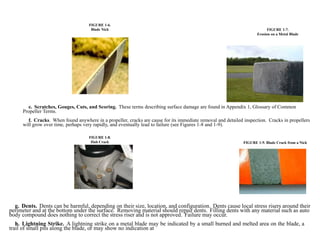
c. Nick. A sharp, notch-like displacement of metal usually found on leading and trailing edges. All nicks are potential crack
starters (see Figure 1-6).
d. Erosion. The loss of material from blade surface by the action of small particles such as sand or water and is usually present on
the leading edge close to the tip. This damage destroys the blades’ corrosion protection, which might lead to blade failure (see Figure
1-7).
FIGURE 1-6.
Blade Nick FIGURE 1-7.
Erosion on a Metal Blade
e. Scratches, Gouges, Cuts, and Scoring. These terms describing surface damage are found in Appendix 1, Glossary of Common
Propeller Terms.
f. Cracks. When found anywhere in a propeller, cracks are cause for its immediate removal and detailed inspection. Cracks in propellers
will grow over time, perhaps very rapidly, and eventually lead to failure (see Figures 1-8 and 1-9).
FIGURE 1-8.
Hub Crack FIGURE 1-9. Blade Crack from a Nick
g. Dents. Dents can be harmful, depending on their size, location, and configuration. Dents cause local stress risers around their
perimeter and at the bottom under the surface. Removing material should repair dents. Filling dents with any material such as auto
body compound does nothing to correct the stress riser and is not approved. Failure may occur.
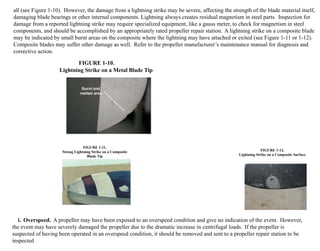
h. Lightning Strike. A lightning strike on a metal blade may be indicated by a small burned and melted area on the blade, a
trail of small pits along the blade, or may show no indication at
all (see Figure 1-10). However, the damage from a lightning strike may be severe, affecting the strength of the blade material itself,
damaging blade bearings or other internal components. Lightning always creates residual magnetism in steel parts. Inspection for
damage from a reported lightning strike may require specialized equipment, like a gauss meter, to check for magnetism in steel
components, and should be accomplished by an appropriately rated propeller repair station. A lightning strike on a composite blade
may be indicated by small burnt areas on the composite where the lightning may have attached or exited (see Figure 1-11 or 1-12).
Composite blades may suffer other damage as well. Refer to the propeller manufacturer’s maintenance manual for diagnosis and
corrective action.
FIGURE 1-10.
Lightning Strike on a Metal Blade Tip
FIGURE 1-11.
Strong Lightning Strike on a Composite
Blade Tip
FIGURE 1-12.
Lightning Strike on a Composite Surface
i. Overspeed. A propeller may have been exposed to an overspeed condition and give no indication of the event. However,
the event may have severely damaged the propeller due to the dramatic increase in centrifugal loads. If the propeller is
suspected of having been operated in an overspeed condition, it should be removed and sent to a propeller repair station to be
inspected
for elongation of boltholes, dimension changes, or other signs of stress in accordance with the appropriate manufacturer’s
maintenance instructions. Sometimes excessive tolerances in engine or propeller governor settings can permit overspeed conditions
into restricted rotational speed ranges without the knowledge of the operator.
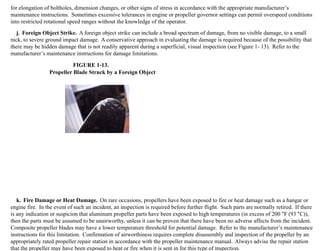
j. Foreign Object Strike. A foreign object strike can include a broad spectrum of damage, from no visible damage, to a small
nick, to severe ground impact damage. A conservative approach in evaluating the damage is required because of the possibility that
there may be hidden damage that is not readily apparent during a superficial, visual inspection (see Figure 1- 13). Refer to the
manufacturer’s maintenance instructions for damage limitations.
FIGURE 1-13.
Propeller Blade Struck by a Foreign Object
k. Fire Damage or Heat Damage. On rare occasions, propellers have been exposed to fire or heat damage such as a hangar or
engine fire. In the event of such an incident, an inspection is required before further flight. Such parts are normally retired. If there
is any indication or suspicion that aluminum propeller parts have been exposed to high temperatures (in excess of 200 °F (93 °C)),
then the parts must be assumed to be unairworthy, unless it can be proven that there have been no adverse affects from the incident.
Composite propeller blades may have a lower temperature threshold for potential damage. Refer to the manufacturer’s maintenance
instructions for this limitation. Confirmation of airworthiness requires complete disassembly and inspection of the propeller by an
appropriately rated propeller repair station in accordance with the propeller maintenance manual. Always advise the repair station
that the propeller may have been exposed to heat or fire when it is sent in for this type of inspection.

aircraft-propeller-maintenance.pptx

  • 1.
  • 2.
    DESIGN DAMAGE ANDFAILURES PROPELLER MAJOR REPAIRS AND ALTERATIONS. Major repairs or alterations are only permitted when a propeller manufacturer’s data approves that major repair or alteration. Only an appropriately rated repair station may accomplish major repairs or alterations. Refer to Title 14 of the Code of Federal Regulations (14 CFR) part 43, Appendix A, for identification of major alterations and repairs to propellers. PROPELLER DESIGN AND CAUSES OF FAILURE. a. A propeller is one of the most highly stressed components on an aircraft. During normal operation, 10 to 25 tons of centrifugal force pull the blades from the hub while the blades are bending and flexing due to thrust and torque loads and engine, aerodynamic and gyroscopic vibratory loads. A properly maintained propeller is designed to perform normally under these loads, but when propeller components are damaged by corrosion, stone nicks, ground strikes, etc., an additional unintended stress concentration is imposed and the design margin of safety may not be adequate. The result is excessive stress and the propeller may fail. b. Additional causes of overstress conditions are exposure to overspeed conditions, other object strikes, unauthorized alterations, engine problems, worn engine vibration dampers, lightning strike, etc. Most mechanical damage takes the form of sharp-edged nicks and scratches created by the displacement of material from the blade surface and corrosion that forms pits and other defects in the blade surface. This small-scale damage tends to concentrate stress in the affected area and eventually, these high-stress areas may develop cracks. As a crack propagates, the stress becomes increasingly concentrated, increasing the crack growth rate. The growing crack may result in blade failure.
  • 3.
    • TYPES OFPROPELLER DAMAGE. Many types of damage cause propellers to fail or become unairworthy. FAA data on propeller failures indicates that the majority of failures occur in the blade at the tip region, usually within several inches from the tip and often due to a crack initiator such as a pit, nick, or gouge. However, a blade failure can occur along any portion of a blade, including the mid-blade, shank, and hub, particularly when nicks, scratches, corrosion, and cracks are present. Therefore, during propeller inspection and routine maintenance, it is important to inspect the entire blade. The severity of the damage determines the type of repairs required. Additional guidance on damage is given in manufacturers’ service documents, Chapter 2, paragraph 205, of this AC, and AC 43.13-1, current edition. The following paragraphs describe some of the types of damage that may be found in propellers. • a. Corrosion. One of the principal causes of loss of airworthiness in propellers is corrosion. External corrosion on metal blades, hubs, and other components poses a serious problem. Internal corrosion may exist where moisture may collect in internal cavities such as hubs, blade clamps, and pitch control mechanisms. This threatens propeller structural integrity and performance without being noticed. The overhaul calendar time periods for propellers are established so that the propeller can be disassembled to inspect internal surfaces. Moreover, corrosion acts continuously, regardless of the actual time in operation. Corrosion on metal propeller components can be classified into three distinct types.
  • 4.
    (1) Surface Corrosion.The loss of surface metal due to chemical or electro-chemical action with visible oxidation products usually having a contrasting color and texture to the base metal. Surface corrosion, as shown in Figures 1-1 and 1-2, generally results when the corrosion protection on a metal surface has been removed by erosion or by polishing. Therefore, removing paint and corrosion protection, such as when polishing blades, is not recommended. FIGURE 1-1. Hub Surface Corrosion FIGURE 1-2. Polished Blade Surface Corrosion (2) Pitting. Pits consist of visible corrosion cavities extending inward from the metal surface. They can grow on the surface, under decals, or under improperly installed de-ice boots. Pitting can appear to be relatively minor - 0.010 inches deep - and still cause major problems since the pits could be a precursor to the initiation of cracks (see Figures 1-3 and 1-4). FIGURE 1-3. Pitting FIGURE 1-4. Pitting on a Shot Peened Surface (3) Intergranular Corrosion. Occurs in grain boundaries. The presence of intergranular corrosion may be the result of the continued presence of moisture such as under a decal, in a fastener hole, or where the anodize and paint protective barriers have been lost. Exfoliation is a form of intergranular corrosion that occurs more often in forgings or rolled
  • 5.
    sheets, and lessoften in castings. Exfoliation is sometimes visible as metal flaking and cracks on a blade leading edge (see Figure 1-5). FIGURE 1-5. Exfoliation on the Blade Leading Edge b. Face, Leading Edge, or Twist Misalignment. When propeller blades are bent, twisted, or cocked, they will not be properly aligned with each other in operation. This will cause vibration and may cause a loss of thrust. The level of vibration can be severe and depending on the severity of the misalignment, could lead to catastrophic failure (see Chapter 2, paragraph 203a). c. Nick. A sharp, notch-like displacement of metal usually found on leading and trailing edges. All nicks are potential crack starters (see Figure 1-6). d. Erosion. The loss of material from blade surface by the action of small particles such as sand or water and is usually present on the leading edge close to the tip. This damage destroys the blades’ corrosion protection, which might lead to blade failure (see Figure 1-7).
  • 6.
    FIGURE 1-6. Blade NickFIGURE 1-7. Erosion on a Metal Blade e. Scratches, Gouges, Cuts, and Scoring. These terms describing surface damage are found in Appendix 1, Glossary of Common Propeller Terms. f. Cracks. When found anywhere in a propeller, cracks are cause for its immediate removal and detailed inspection. Cracks in propellers will grow over time, perhaps very rapidly, and eventually lead to failure (see Figures 1-8 and 1-9). FIGURE 1-8. Hub Crack FIGURE 1-9. Blade Crack from a Nick g. Dents. Dents can be harmful, depending on their size, location, and configuration. Dents cause local stress risers around their perimeter and at the bottom under the surface. Removing material should repair dents. Filling dents with any material such as auto body compound does nothing to correct the stress riser and is not approved. Failure may occur. h. Lightning Strike. A lightning strike on a metal blade may be indicated by a small burned and melted area on the blade, a trail of small pits along the blade, or may show no indication at
  • 7.
    all (see Figure1-10). However, the damage from a lightning strike may be severe, affecting the strength of the blade material itself, damaging blade bearings or other internal components. Lightning always creates residual magnetism in steel parts. Inspection for damage from a reported lightning strike may require specialized equipment, like a gauss meter, to check for magnetism in steel components, and should be accomplished by an appropriately rated propeller repair station. A lightning strike on a composite blade may be indicated by small burnt areas on the composite where the lightning may have attached or exited (see Figure 1-11 or 1-12). Composite blades may suffer other damage as well. Refer to the propeller manufacturer’s maintenance manual for diagnosis and corrective action. FIGURE 1-10. Lightning Strike on a Metal Blade Tip FIGURE 1-11. Strong Lightning Strike on a Composite Blade Tip FIGURE 1-12. Lightning Strike on a Composite Surface i. Overspeed. A propeller may have been exposed to an overspeed condition and give no indication of the event. However, the event may have severely damaged the propeller due to the dramatic increase in centrifugal loads. If the propeller is suspected of having been operated in an overspeed condition, it should be removed and sent to a propeller repair station to be inspected
  • 8.
    for elongation ofboltholes, dimension changes, or other signs of stress in accordance with the appropriate manufacturer’s maintenance instructions. Sometimes excessive tolerances in engine or propeller governor settings can permit overspeed conditions into restricted rotational speed ranges without the knowledge of the operator. j. Foreign Object Strike. A foreign object strike can include a broad spectrum of damage, from no visible damage, to a small nick, to severe ground impact damage. A conservative approach in evaluating the damage is required because of the possibility that there may be hidden damage that is not readily apparent during a superficial, visual inspection (see Figure 1- 13). Refer to the manufacturer’s maintenance instructions for damage limitations. FIGURE 1-13. Propeller Blade Struck by a Foreign Object k. Fire Damage or Heat Damage. On rare occasions, propellers have been exposed to fire or heat damage such as a hangar or engine fire. In the event of such an incident, an inspection is required before further flight. Such parts are normally retired. If there is any indication or suspicion that aluminum propeller parts have been exposed to high temperatures (in excess of 200 °F (93 °C)), then the parts must be assumed to be unairworthy, unless it can be proven that there have been no adverse affects from the incident. Composite propeller blades may have a lower temperature threshold for potential damage. Refer to the manufacturer’s maintenance instructions for this limitation. Confirmation of airworthiness requires complete disassembly and inspection of the propeller by an appropriately rated propeller repair station in accordance with the propeller maintenance manual. Always advise the repair station that the propeller may have been exposed to heat or fire when it is sent in for this type of inspection.