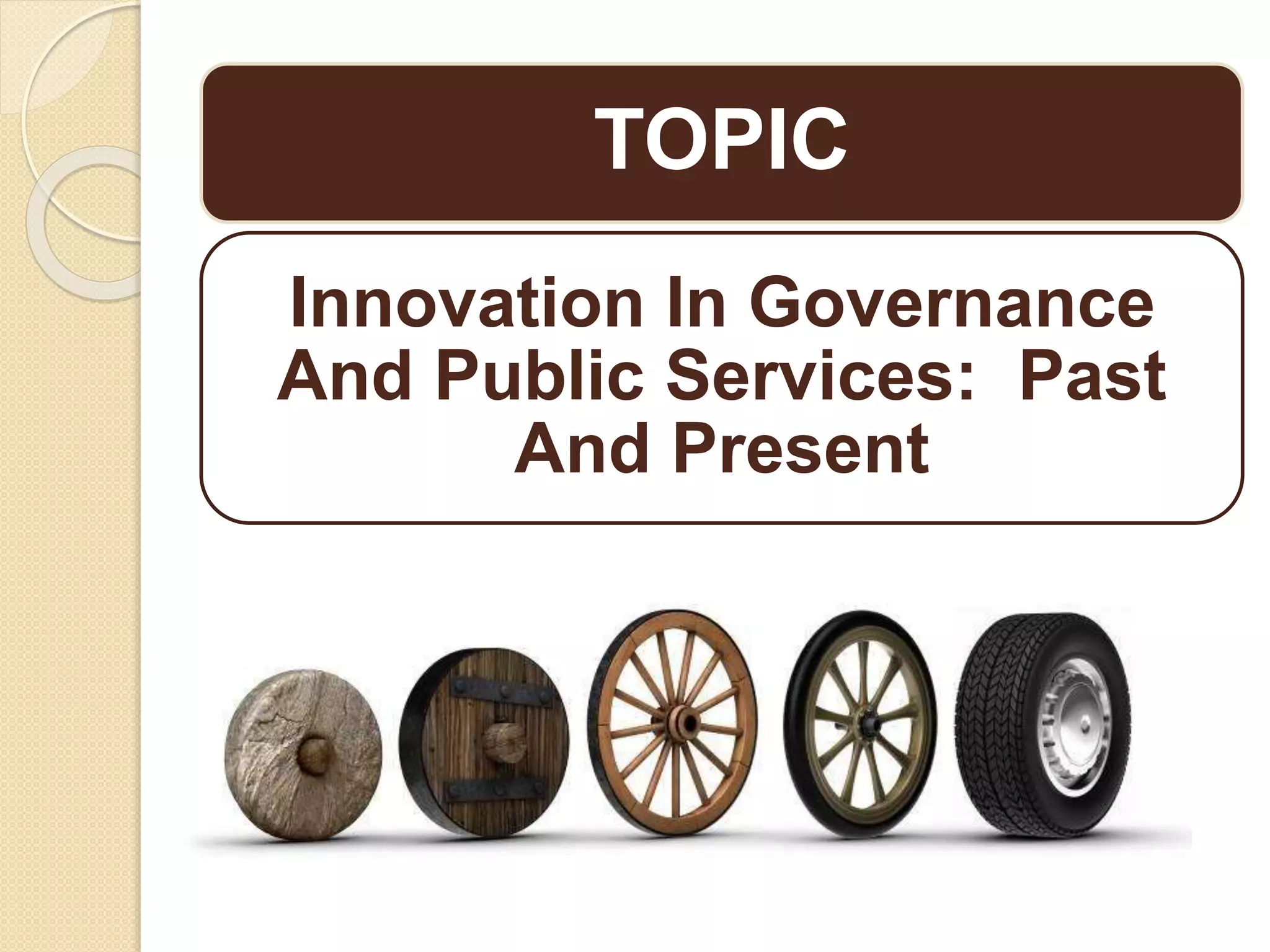
TOPIC
Innovation In Governance
And Public Services: Past
And Present
Group Members
Bilal Khan
Shahzeb
Hamid Yaqoob
Saddam hussain
Syed Kashif Shah
Presentation Contents
 Innovation and its types
 Innovation in Public Services
 Innovation with or without
improvement
 What we still need to know
 Conclusion
Definition of Innovation
 Novelty in action; Its not just a new idea but
a new practice.
 Differently explained by writers, some
writers suggest that innovation is radical or
complex, while others consider it as small as
well as large scale innovation.
 Moore defined Innovation as,
“ Those changes worth recognizing as
innovation should be new to the
organization, be large enough, general
enough and durable enough to appreciably
affect the operations of the organization”.
 Most of innovation theory and literature
is derived from new product
development such as in private sector.
 Innovation in governance and public
services are more uncertain, here
innovation may not be just a physical
change but a change in relationship
between service providers and their
users.
 Diffusion of innovation:
This theory suggests that how new
technological and other advancements
spread throughout societies from
introduction to wider adoption.
Differences between Private Sector and
Public Sector Innovation
 Private Sector Innovation:
Innovation help private sector to cut costs,
improve their products and open new
markets. Here innovation is mostly done for
competitive advantage.
 Public Sector Innovation:
It involves significant improvements in the
services that government has a
responsibility to provide. Such innovation
bring positive changes in efficiencies and
increase public value.
Types of Innovation
 Product Innovation:
It is actually new or improved version of
product. E.g. digital reader is an
improved version of traditional book.
 Service Innovation:
It include new ways in which services
are provided to customers/users. E.g.
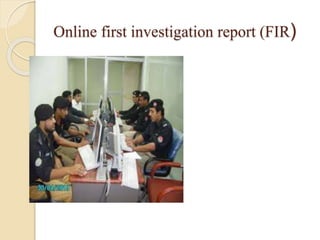
Online Tax Forms, Online FIR System.
Etc
 Process Innovation:
It include significant changes in
techniques, equipments and software.
E.g. Administration re-organization.
 Position Innovation:
It involves changes user perception about a
certain product. e.g. Jane and Austen wrote a
book, initially it was regarded as a good book
but now that book is considered as great
classic essential literature, which is how it is
now advertised.
 Strategic Innovation:
New goals or purposes of the organization is
known as strategic innovation. E.g.
Community policies.
 Rhetorical Innovation:
It includes new language and new concept.
E.g. Congestion Charging for London.
Innovation in public services:
an historical perspective
 Private Sector
 Public sector
 Traditional public administration
 New public management
 Networked governance
Private sector
 The private sector is the part of a
country’s economy that is not
controlled directly by the government
like, household, businessman
 In the private sector, the focus is on
managers and staff as sources of
innovation, both working inside the
organization, and networking outside
it.
Public sector
 The public sector is that portion of
an economic system that is
controlled by national, state or
provincial, and local governments.
 In the public sector we have to
consider the role of policy-makers
and policy-advisors in the
innovation process.
Traditional public
administration
 The traditional public administration
consists in the bureaucratic system of
max weber. Which is represent the
traditional system of public
management.
 Charismatic Authority-
the appeal of an extraordinary leader
 Traditional Authority- such as the
authority of a tribal chief; and rational
/ legal authority
 Hierarchy that is supervision of the
lower offices by the higher ones
 Rules and regulations
 Authority and command
New public management
 The new public management is
defined as” a vision, an ideology or a
set of approaches and managerial
techniques mostly specific to the
public sector
 The second theory is that of the new
public management which has been
developed at the end of the 70’s and
which has imposed in most of the
countries.
Networked governance
 Networked governance can be
defined as the interconnectedness of
independent units of authority and
power, whether individual,
community, state, or corporate.
Networked governance moves from
vertical to horizontal approaches to
decision making and is characterized
by systems of communications,
knowledge exchange and dialogue.
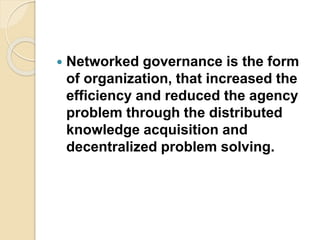
 Networked governance is the form
of organization, that increased the
efficiency and reduced the agency
problem through the distributed
knowledge acquisition and
decentralized problem solving.
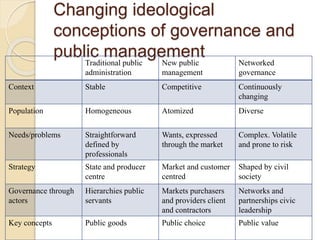
Changing ideological
conceptions of governance and
public managementTraditional public
administration
New public
management
Networked
governance
Context Stable Competitive Continuously
changing
Population Homogeneous Atomized Diverse
Needs/problems Straightforward
defined by
professionals
Wants, expressed
through the market
Complex. Volatile
and prone to risk
Strategy State and producer
centre
Market and customer
centred
Shaped by civil
society
Governance through
actors
Hierarchies public
servants
Markets purchasers
and providers client
and contractors
Networks and
partnerships civic
leadership
Key concepts Public goods Public choice Public value
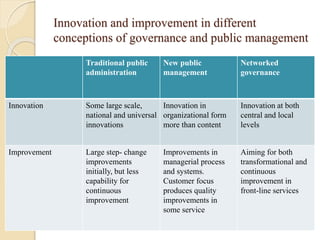
Innovation and improvement in different
conceptions of governance and public management
Traditional public
administration
New public
management
Networked
governance
Innovation Some large scale,
national and universal
innovations
Innovation in
organizational form
more than content
Innovation at both
central and local
levels
Improvement Large step- change
improvements
initially, but less
capability for
continuous
improvement
Improvements in
managerial process
and systems.
Customer focus
produces quality
improvements in
some service
Aiming for both
transformational and
continuous
improvement in
front-line services
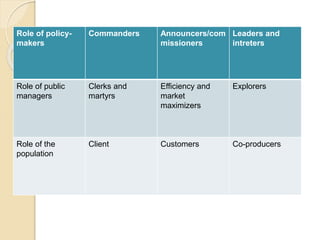
Role of policy-
makers
Commanders Announcers/com
missioners
Leaders and
intreters
Role of public
managers
Clerks and
martyrs
Efficiency and
market
maximizers
Explorers
Role of the
population
Client Customers Co-producers
Online first investigation report (FIR)
Biometric attendance system
high secondary school and
colleges
Innovation with or without
improvement
 Improvement is doing things better
 Innovation is doing things differently
 Public money and management show
important difference in innovation
between
public and privet sector
 In privet sector
 In public sector
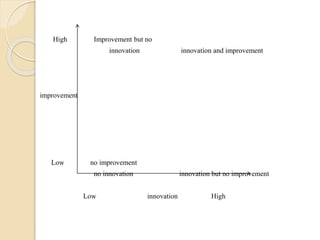
High Improvement but no
innovation innovation and improvement
improvement
Low no improvement
no innovation innovation but no improvement
Low innovation High
Conclusions
 Innovation is considerable issue
 Private sector
 Public Sector
 Three different conceptions of
governance & public mgt.
 Traditional Public Admin.
 New Public Mgt.
 Network Governance
 These three Conception in which
ways pursed by
 Policy makers
 Managers
 citizens
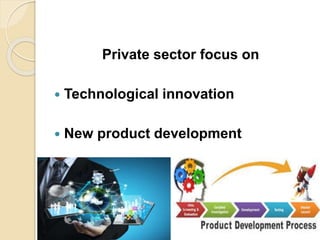
Private sector focus on
 Technological innovation
 New product development
limitations
 product innovation to
 Service innovation
 Organizational innovation
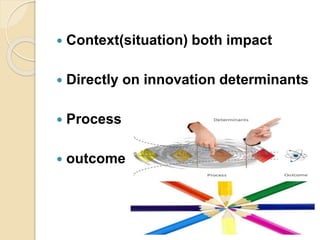
 Context(situation) both impact
 Directly on innovation determinants
 Process
 outcomes
 Indirectly through
 Organization features such as


 The amount of organization
 Resources
 strategy
 Tidd (2001)argues that the
complexity of the innovation &
uncertainty of the environment
substantially shape innovation.
 These are key dimensions for
public service organizations
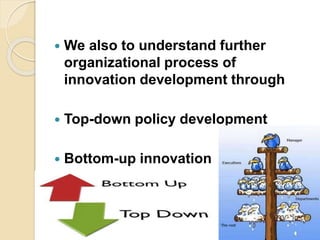
 We also to understand further
organizational process of
innovation development through
 Top-down policy development
 Bottom-up innovation
 One element of complexity of
public service organization
producing not only benefits for
individual but also providing goods
services & establishing collective
efficiency & creating rules &
purpose.
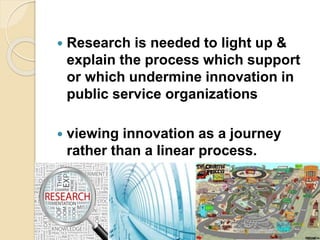
 Research is needed to light up &
explain the process which support
or which undermine innovation in
public service organizations
 viewing innovation as a journey
rather than a linear process.
Innovation in governance ppt

Innovation in governance ppt

  • 1.
    TOPIC Innovation In Governance AndPublic Services: Past And Present
  • 2.
    Group Members Bilal Khan Shahzeb HamidYaqoob Saddam hussain Syed Kashif Shah
  • 3.
    Presentation Contents  Innovationand its types  Innovation in Public Services  Innovation with or without improvement  What we still need to know  Conclusion
  • 4.
    Definition of Innovation Novelty in action; Its not just a new idea but a new practice.  Differently explained by writers, some writers suggest that innovation is radical or complex, while others consider it as small as well as large scale innovation.  Moore defined Innovation as, “ Those changes worth recognizing as innovation should be new to the organization, be large enough, general enough and durable enough to appreciably affect the operations of the organization”.
  • 5.
     Most ofinnovation theory and literature is derived from new product development such as in private sector.  Innovation in governance and public services are more uncertain, here innovation may not be just a physical change but a change in relationship between service providers and their users.  Diffusion of innovation: This theory suggests that how new technological and other advancements spread throughout societies from introduction to wider adoption.
  • 6.
    Differences between PrivateSector and Public Sector Innovation  Private Sector Innovation: Innovation help private sector to cut costs, improve their products and open new markets. Here innovation is mostly done for competitive advantage.  Public Sector Innovation: It involves significant improvements in the services that government has a responsibility to provide. Such innovation bring positive changes in efficiencies and increase public value.
  • 7.
    Types of Innovation Product Innovation: It is actually new or improved version of product. E.g. digital reader is an improved version of traditional book.  Service Innovation: It include new ways in which services are provided to customers/users. E.g. Online Tax Forms, Online FIR System. Etc  Process Innovation: It include significant changes in techniques, equipments and software. E.g. Administration re-organization.
  • 8.
     Position Innovation: Itinvolves changes user perception about a certain product. e.g. Jane and Austen wrote a book, initially it was regarded as a good book but now that book is considered as great classic essential literature, which is how it is now advertised.  Strategic Innovation: New goals or purposes of the organization is known as strategic innovation. E.g. Community policies.  Rhetorical Innovation: It includes new language and new concept. E.g. Congestion Charging for London.
  • 9.
    Innovation in publicservices: an historical perspective
  • 10.
     Private Sector Public sector  Traditional public administration  New public management  Networked governance
  • 11.
    Private sector  Theprivate sector is the part of a country’s economy that is not controlled directly by the government like, household, businessman  In the private sector, the focus is on managers and staff as sources of innovation, both working inside the organization, and networking outside it.
  • 12.
    Public sector  Thepublic sector is that portion of an economic system that is controlled by national, state or provincial, and local governments.  In the public sector we have to consider the role of policy-makers and policy-advisors in the innovation process.
  • 13.
    Traditional public administration  Thetraditional public administration consists in the bureaucratic system of max weber. Which is represent the traditional system of public management.  Charismatic Authority- the appeal of an extraordinary leader  Traditional Authority- such as the authority of a tribal chief; and rational / legal authority
  • 14.
     Hierarchy thatis supervision of the lower offices by the higher ones  Rules and regulations  Authority and command
  • 15.
    New public management The new public management is defined as” a vision, an ideology or a set of approaches and managerial techniques mostly specific to the public sector  The second theory is that of the new public management which has been developed at the end of the 70’s and which has imposed in most of the countries.
  • 16.
    Networked governance  Networkedgovernance can be defined as the interconnectedness of independent units of authority and power, whether individual, community, state, or corporate. Networked governance moves from vertical to horizontal approaches to decision making and is characterized by systems of communications, knowledge exchange and dialogue.
  • 17.
     Networked governanceis the form of organization, that increased the efficiency and reduced the agency problem through the distributed knowledge acquisition and decentralized problem solving.
  • 18.
    Changing ideological conceptions ofgovernance and public managementTraditional public administration New public management Networked governance Context Stable Competitive Continuously changing Population Homogeneous Atomized Diverse Needs/problems Straightforward defined by professionals Wants, expressed through the market Complex. Volatile and prone to risk Strategy State and producer centre Market and customer centred Shaped by civil society Governance through actors Hierarchies public servants Markets purchasers and providers client and contractors Networks and partnerships civic leadership Key concepts Public goods Public choice Public value
  • 19.
    Innovation and improvementin different conceptions of governance and public management Traditional public administration New public management Networked governance Innovation Some large scale, national and universal innovations Innovation in organizational form more than content Innovation at both central and local levels Improvement Large step- change improvements initially, but less capability for continuous improvement Improvements in managerial process and systems. Customer focus produces quality improvements in some service Aiming for both transformational and continuous improvement in front-line services
  • 20.
    Role of policy- makers CommandersAnnouncers/com missioners Leaders and intreters Role of public managers Clerks and martyrs Efficiency and market maximizers Explorers Role of the population Client Customers Co-producers
  • 21.
  • 22.
    Biometric attendance system highsecondary school and colleges
  • 23.
    Innovation with orwithout improvement  Improvement is doing things better  Innovation is doing things differently
  • 24.
     Public moneyand management show important difference in innovation between public and privet sector  In privet sector  In public sector
  • 25.
    High Improvement butno innovation innovation and improvement improvement Low no improvement no innovation innovation but no improvement Low innovation High
  • 26.
    Conclusions  Innovation isconsiderable issue  Private sector  Public Sector
  • 27.
     Three differentconceptions of governance & public mgt.  Traditional Public Admin.  New Public Mgt.  Network Governance
  • 28.
     These threeConception in which ways pursed by  Policy makers  Managers  citizens
  • 29.
    Private sector focuson  Technological innovation  New product development
  • 30.
    limitations  product innovationto  Service innovation  Organizational innovation
  • 31.
     Context(situation) bothimpact  Directly on innovation determinants  Process  outcomes
  • 32.
     Indirectly through Organization features such as  The amount of organization  Resources  strategy
  • 33.
     Tidd (2001)arguesthat the complexity of the innovation & uncertainty of the environment substantially shape innovation.  These are key dimensions for public service organizations
  • 34.
     We alsoto understand further organizational process of innovation development through  Top-down policy development  Bottom-up innovation
  • 35.
     One elementof complexity of public service organization producing not only benefits for individual but also providing goods services & establishing collective efficiency & creating rules & purpose.
  • 36.
     Research isneeded to light up & explain the process which support or which undermine innovation in public service organizations  viewing innovation as a journey rather than a linear process.