Earthquakes
What are Earthquakes?
•The shaking or trembling caused by the sudden
release of energy
•Usually associated with faulting or breaking of rocks
•Continuing adjustment of position results in
aftershocks
What is the Elastic Rebound Theory?
• Explains how energy is
stored in rocks
• Rocks bend until the
strength of the rock is
exceeded
• Rupture occurs and the
rocks quickly rebound
to an undeformed
shape
• Energy is released in
waves that radiate
outward from the fault
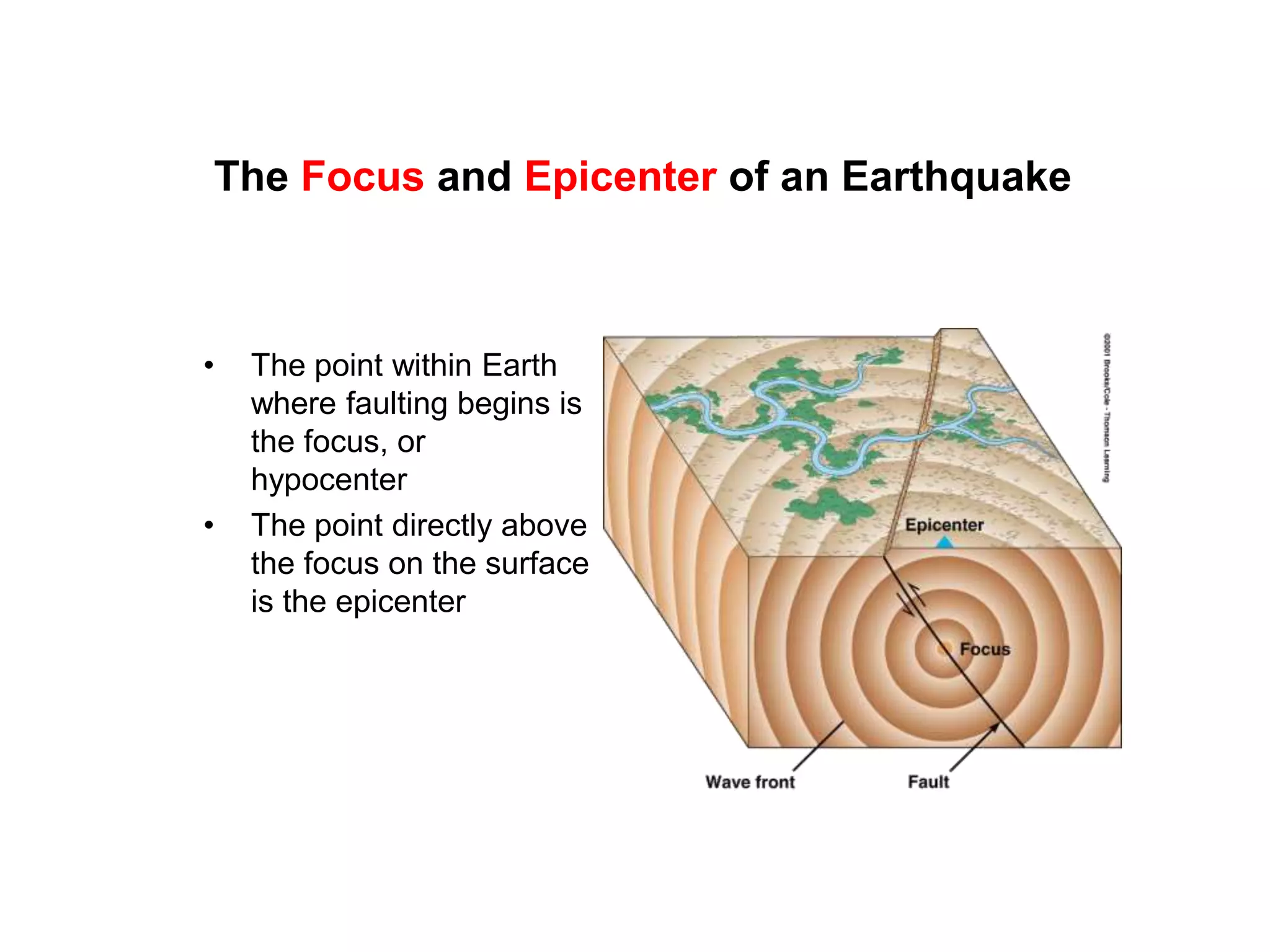
The Focus and Epicenter of an Earthquake
• The point within Earth
where faulting begins is
the focus, or
hypocenter
• The point directly above
the focus on the surface
is the epicenter
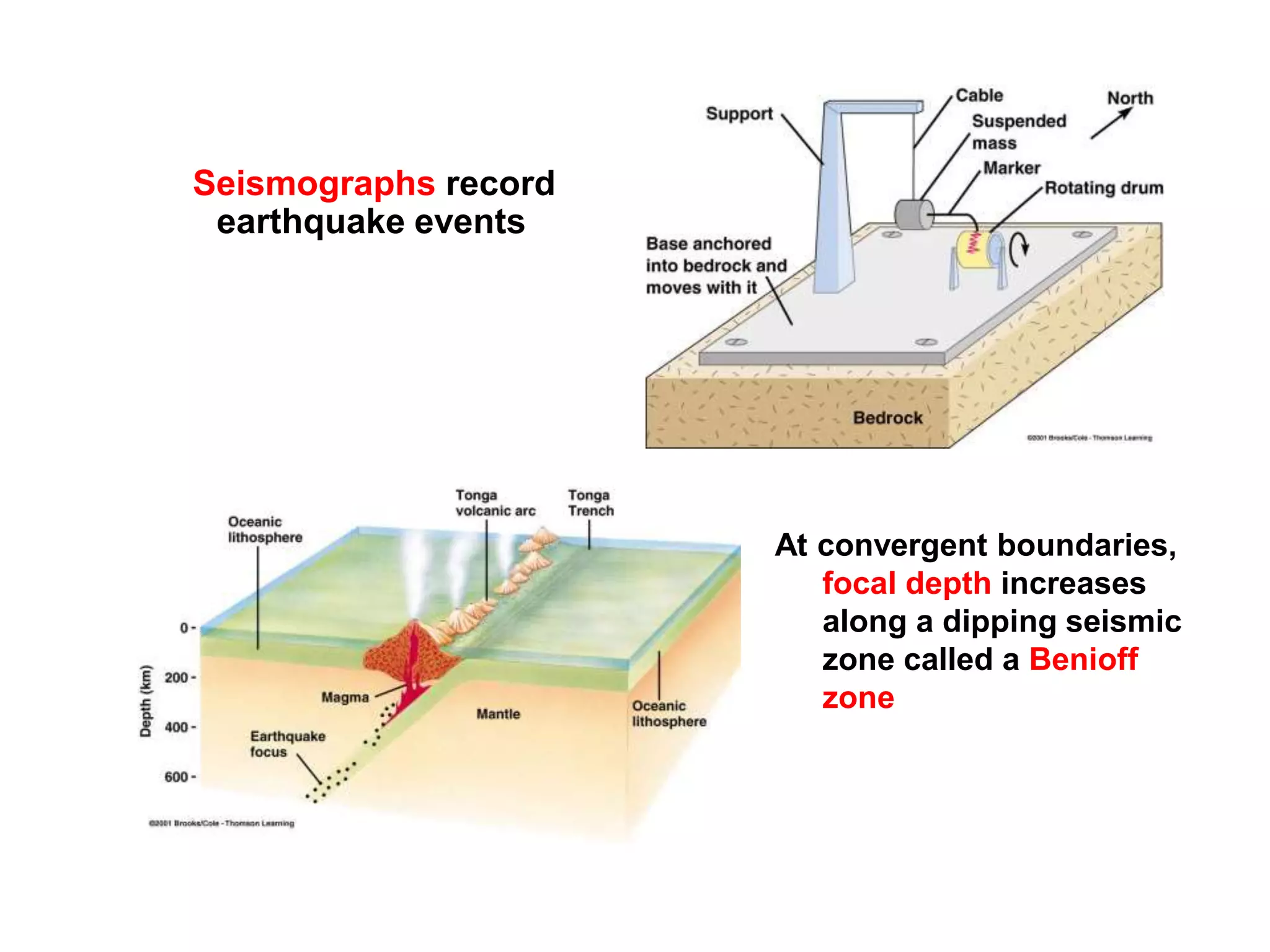
Seismographs record
earthquake events
At convergent boundaries,
focal depth increases
along a dipping seismic
zone called a Benioff
zone
Where Do Earthquakes Occur and How Often?
~80% of all earthquakes occur in the circum-Pacific belt
• most of these result from convergent margin activity
• ~15% occur in the Mediterranean-Asiatic belt
• remaining 5% occur in the interiors of plates and on spreading
ridge centers
• more than 150,000 quakes strong enough to be felt are
recorded each year
The Economics and Societal Impacts of EQs
Damage in Oakland, CA, 1989
• Building collapse
• Fire
• Tsunami
• Ground failure
What are Seismic Waves?
•Response of material to the
arrival of energy fronts released
by rupture
•Two types:
• Body waves
• P and S
• Surface waves
• R and L
Body Waves: P and S waves
• Body waves
• P or primary waves
• fastest waves
• travel through solids,
liquids, or gases
• compressional wave,
material movement is in
the same direction as
wave movement
• S or secondary waves
• slower than P waves
• travel through solids
only
• shear waves - move
material perpendicular
to wave movement
Surface Waves: R and L waves
• Surface Waves
• Travel just below or along the ground’s surface
• Slower than body waves; rolling and side-to-side
movement
• Especially damaging to buildings
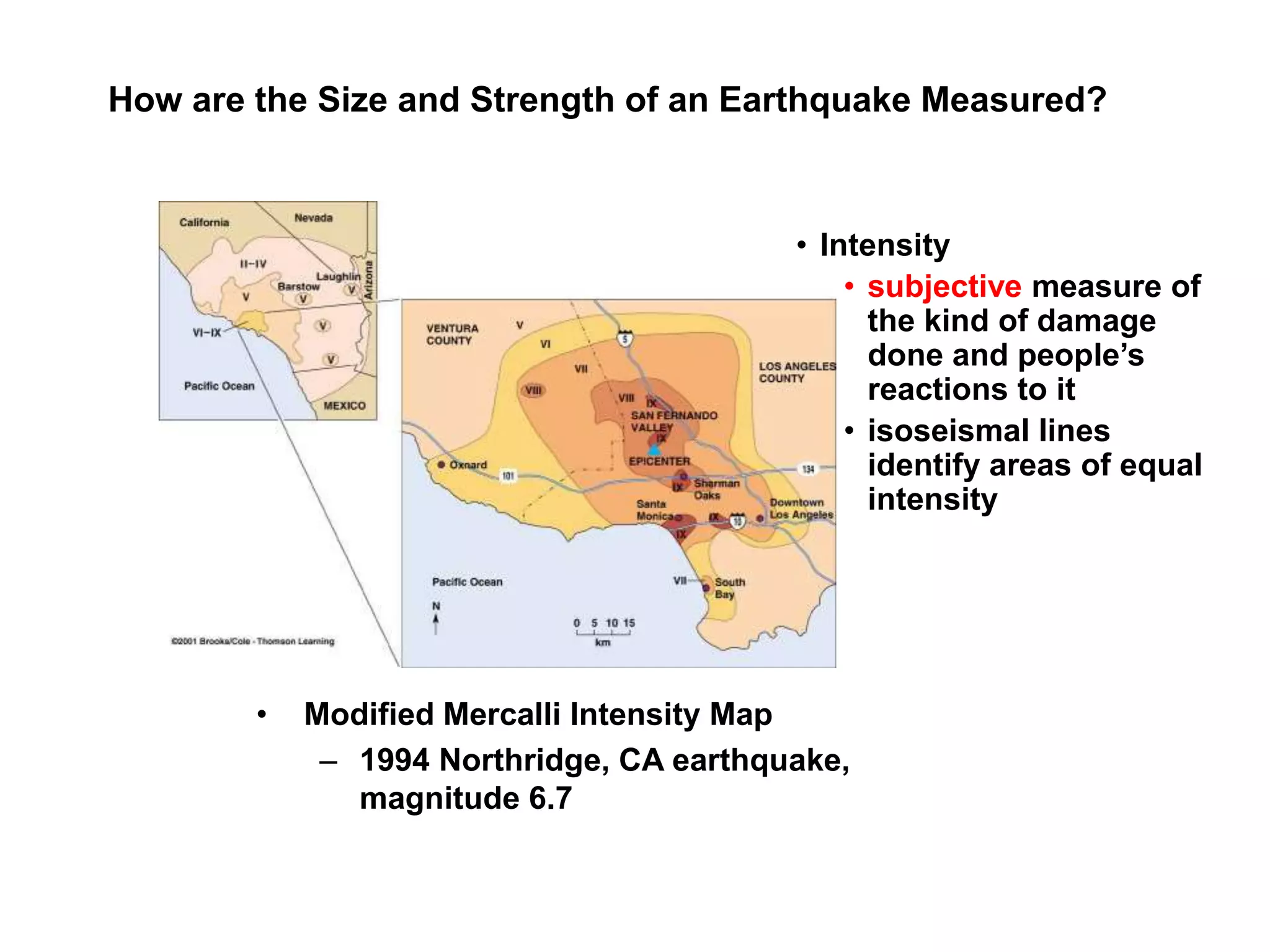
How are the Size and Strength of an Earthquake Measured?
• Intensity
• subjective measure of
the kind of damage
done and people’s
reactions to it
• isoseismal lines
identify areas of equal
intensity
• Modified Mercalli Intensity Map
– 1994 Northridge, CA earthquake,
magnitude 6.7
How are the Size and Strength of an Earthquake Measured?
• Magnitude
• Richter scale measures
total amount of energy
released by an
earthquake; independent
of intensity
• Amplitude of the largest
wave produced by an
event is corrected for
distance and assigned a
value on an open-ended
logarithmic scale
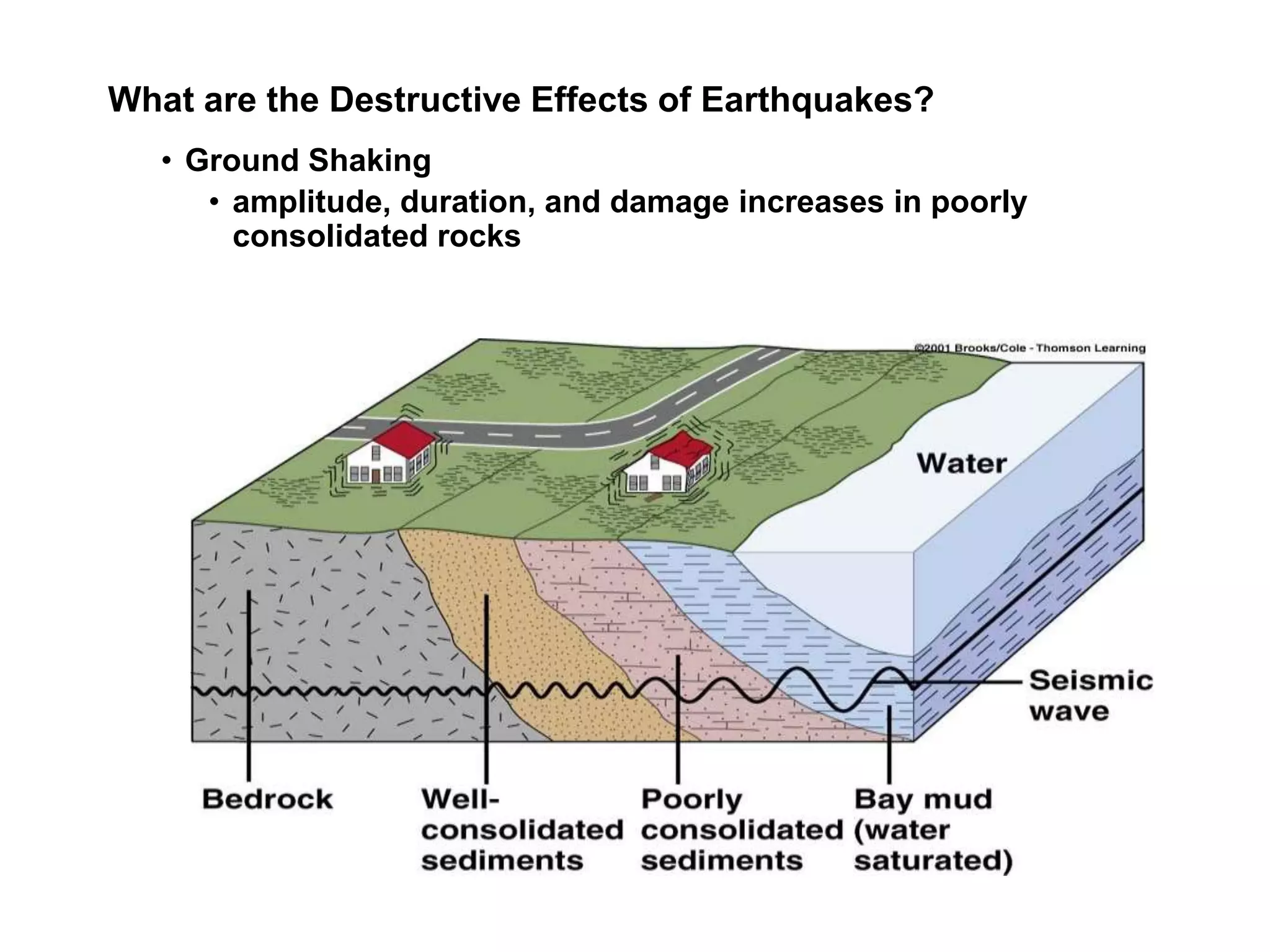
What are the Destructive Effects of Earthquakes?
• Ground Shaking
• amplitude, duration, and damage increases in poorly
consolidated rocks
Can Earthquakes be Predicted?
Earthquake Precursors
• changes in elevation or tilting of land surface, fluctuations
in groundwater levels, magnetic field, electrical resistance
of the ground
• seismic dilatancy model
• seismic gaps
Can Earthquakes be Predicted?
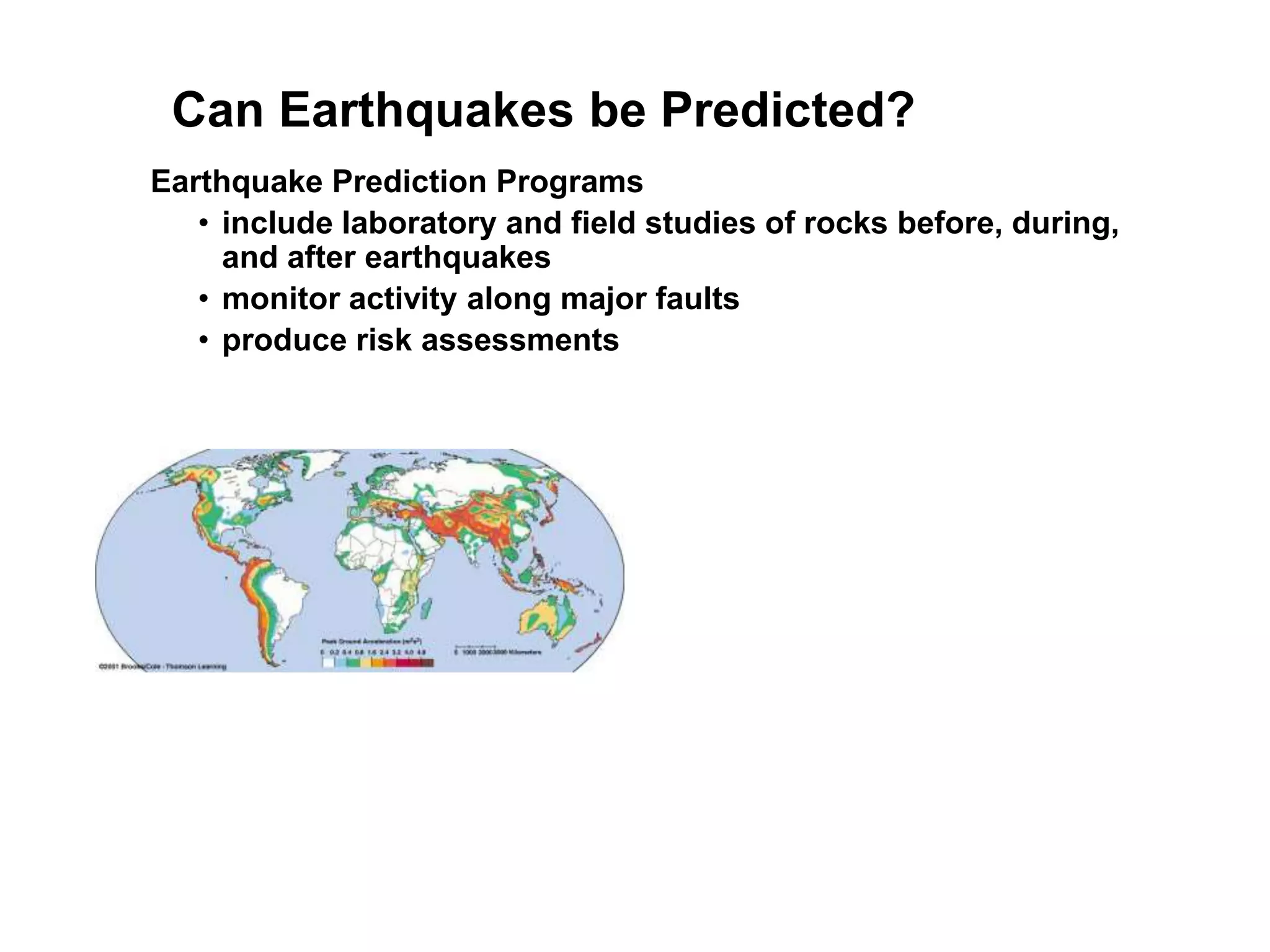
Earthquake Prediction Programs
• include laboratory and field studies of rocks before, during,
and after earthquakes
• monitor activity along major faults
• produce risk assessments
Can Earthquakes be Controlled?
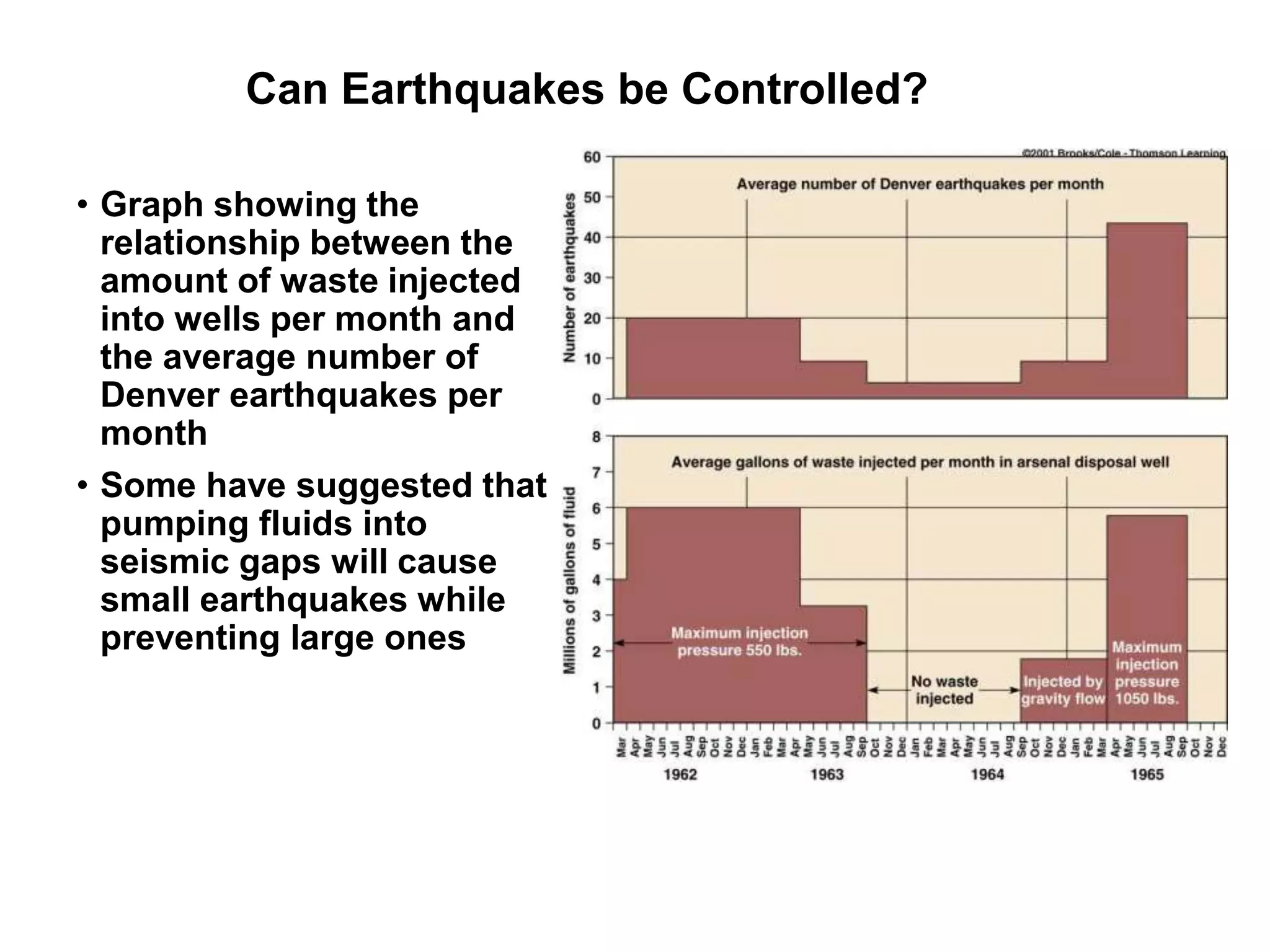
• Graph showing the
relationship between the
amount of waste injected
into wells per month and
the average number of
Denver earthquakes per
month
• Some have suggested that
pumping fluids into
seismic gaps will cause
small earthquakes while
preventing large ones

Earthquakes 2.ppt

  • 1.
  • 2.
    What are Earthquakes? •Theshaking or trembling caused by the sudden release of energy •Usually associated with faulting or breaking of rocks •Continuing adjustment of position results in aftershocks
  • 3.
    What is theElastic Rebound Theory? • Explains how energy is stored in rocks • Rocks bend until the strength of the rock is exceeded • Rupture occurs and the rocks quickly rebound to an undeformed shape • Energy is released in waves that radiate outward from the fault
  • 4.
    The Focus andEpicenter of an Earthquake • The point within Earth where faulting begins is the focus, or hypocenter • The point directly above the focus on the surface is the epicenter
  • 5.
    Seismographs record earthquake events Atconvergent boundaries, focal depth increases along a dipping seismic zone called a Benioff zone
  • 6.
    Where Do EarthquakesOccur and How Often? ~80% of all earthquakes occur in the circum-Pacific belt • most of these result from convergent margin activity • ~15% occur in the Mediterranean-Asiatic belt • remaining 5% occur in the interiors of plates and on spreading ridge centers • more than 150,000 quakes strong enough to be felt are recorded each year
  • 7.
    The Economics andSocietal Impacts of EQs Damage in Oakland, CA, 1989 • Building collapse • Fire • Tsunami • Ground failure
  • 8.
    What are SeismicWaves? •Response of material to the arrival of energy fronts released by rupture •Two types: • Body waves • P and S • Surface waves • R and L
  • 9.
    Body Waves: Pand S waves • Body waves • P or primary waves • fastest waves • travel through solids, liquids, or gases • compressional wave, material movement is in the same direction as wave movement • S or secondary waves • slower than P waves • travel through solids only • shear waves - move material perpendicular to wave movement
  • 10.
    Surface Waves: Rand L waves • Surface Waves • Travel just below or along the ground’s surface • Slower than body waves; rolling and side-to-side movement • Especially damaging to buildings
  • 11.
    How are theSize and Strength of an Earthquake Measured? • Intensity • subjective measure of the kind of damage done and people’s reactions to it • isoseismal lines identify areas of equal intensity • Modified Mercalli Intensity Map – 1994 Northridge, CA earthquake, magnitude 6.7
  • 12.
    How are theSize and Strength of an Earthquake Measured? • Magnitude • Richter scale measures total amount of energy released by an earthquake; independent of intensity • Amplitude of the largest wave produced by an event is corrected for distance and assigned a value on an open-ended logarithmic scale
  • 13.
    What are theDestructive Effects of Earthquakes? • Ground Shaking • amplitude, duration, and damage increases in poorly consolidated rocks
  • 14.
    Can Earthquakes bePredicted? Earthquake Precursors • changes in elevation or tilting of land surface, fluctuations in groundwater levels, magnetic field, electrical resistance of the ground • seismic dilatancy model • seismic gaps
  • 15.
    Can Earthquakes bePredicted? Earthquake Prediction Programs • include laboratory and field studies of rocks before, during, and after earthquakes • monitor activity along major faults • produce risk assessments
  • 16.
    Can Earthquakes beControlled? • Graph showing the relationship between the amount of waste injected into wells per month and the average number of Denver earthquakes per month • Some have suggested that pumping fluids into seismic gaps will cause small earthquakes while preventing large ones