LESSONS LEARNED FROM PAST
EARTHQUAKE
Presented By
Satish Kumar.R
Final Year Civil
Guided by shanmugasundram AP/Civil
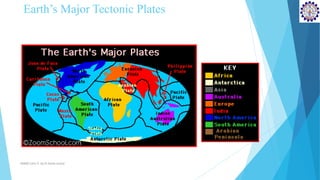
Earth’s Major Tectonic Plates
SD&EE/Unit-4 by,R.Satish kumar
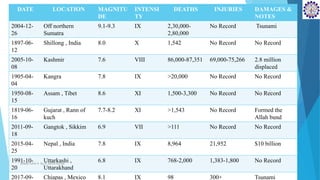
TOP 10 EARTHQUAKE IN INDIA
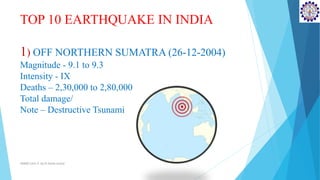
1) OFF NORTHERN SUMATRA (26-12-2004)
Magnitude - 9.1 to 9.3
Intensity - IX
Deaths – 2,30,000 to 2,80,000
Total damage/
Note – Destructive Tsunami
SD&EE/Unit-4 by,R.Satish kumar
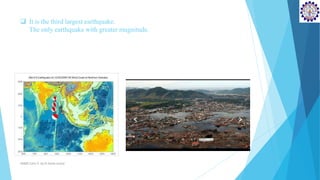
 It is the third largest earthquake.
The only earthquake with greater magnitude.
SD&EE/Unit-4 by,R.Satish kumar
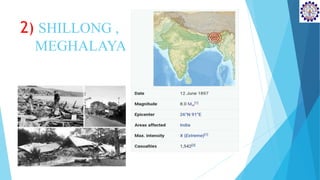
2) SHILLONG ,
MEGHALAYA
SD&EE/Unit-4 by,R.Satish kumar
Reasons
 Himalayan thrust propagating south of Bhutan. We show here that this view is
incorrect. The northern edge of the Shillong Plateau rose violently more than 11 m
during rupture of a buried, 110km-long, reverse fault, dipping steeply away from the
Himalaya.
 The stress drop implied by the rupture geometry and the prodigious fault slip of 18±7
m, explains observed epicentral accelerations exceeding 1 g vertically, and surface
velocities exceeding 3 m/s1.
 Our finding represents the first quantitative observation of active deformation of a
"pop-up" structure, and confirms that faults bounding such structures can penetrate the
whole crust.
 Plateau uplift in the past 2-5 million years has caused the Indian plate to contract locally
by 4±2 mm/year, reducing seismic risk in Bhutan, but increasing it to the large
populations of northern Bangladesh.
SD&EE/Unit-4 by,R.Satish kumar
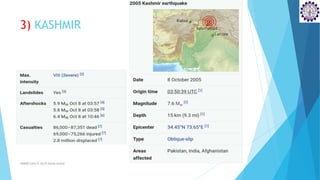
3) KASHMIR
SD&EE/Unit-4 by,R.Satish kumar
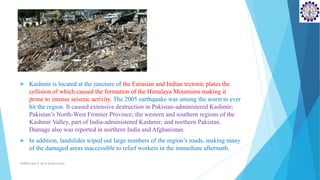
 Kashmir is located at the juncture of the Eurasian and Indian tectonic plates the
collision of which caused the formation of the Himalaya Mountains making it
prone to intense seismic activity. The 2005 earthquake was among the worst to ever
hit the region. It caused extensive destruction in Pakistan-administered Kashmir;
Pakistan’s North-West Frontier Province; the western and southern regions of the
Kashmir Valley, part of India-administered Kashmir; and northern Pakistan.
Damage also was reported in northern India and Afghanistan.
 In addition, landslides wiped out large numbers of the region’s roads, making many
of the damaged areas inaccessible to relief workers in the immediate aftermath.
SD&EE/Unit-4 by,R.Satish kumar
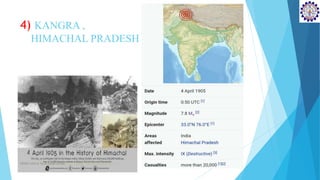
4) KANGRA ,
HIMACHAL PRADESH
SD&EE/Unit-4 by,R.Satish kumar
Reasons
 The calculated epicenter of the earthquake lies within the zone of thrusts along
the front of the Himalayas formed by the continuing collision of the Indian
plate into the Eurasian plate.
 There was also major damage to the network of hillside aqueducts that fed
water to the affected area. The total cost of recovering from the effects of the
earthquake were calculated as 2.9 million (1905) rupees.
SD&EE/Unit-4 by,R.Satish kumar
5) ASSAM & TIBET
SD&EE/Unit-4 by,R.Satish kumar
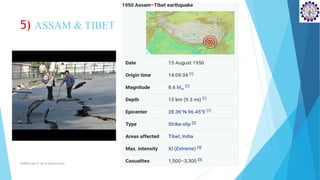
 Great Assam Earthquake was caused by a slip on the Jiali and Po Chu Faults in southern
Xizang, along the border with northeast India. The epicenter of the earthquake was Rima, a
sparsely populated region in the Indo-China border. It first hit at 19:39 pm on August 15,
1950. The surface wave was felt throughout the entire north-eastern India and in many parts
of eastern India.
 This quake was caused by two continental plates colliding.
It was the sixth largest earthquake of the 20th century.
SD&EE/Unit-4 by,R.Satish kumar
6) Gujarat Rann of Kutch earthquake
SD&EE/Unit-4 by,R.Satish kumar
Reasons
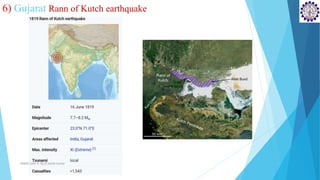
 There was a local tsunami that flooded the area known as the Great Rann immediately
after the earthquake. The fort at Sindri was destroyed by the earthquake and then partly
submerged by the tsunami, "forcing survivors to climb to the top of the ruins“.
 The Kutch District of modern-day Gujarat lies 3–400 km from the plate boundary
between the Indian Plate and the Eurasian Plate, but the current tectonics is still
governed by the effects of the continuing continental collision along this boundary.
 During the collision with Eurasia the area has undergone shortening, involving both
reactivation of the original rift faults and development of new low-angle thrust faults.
SD&EE/Unit-4 by,R.Satish kumar
7) Gangtok , Sikkim
SD&EE/Unit-4 by,R.Satish kumar
Reasons
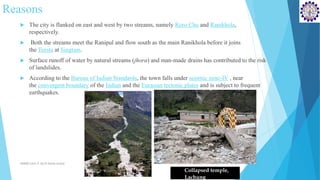
 The city is flanked on east and west by two streams, namely Roro Chu and Ranikhola,
respectively.
 Both the streams meet the Ranipul and flow south as the main Ranikhola before it joins
the Teesta at Singtam.
 Surface runoff of water by natural streams (jhora) and man-made drains has contributed to the risk
of landslides.
 According to the Bureau of Indian Standards, the town falls under seismic zone-IV , near
the convergent boundary of the Indian and the Eurasian tectonic plates and is subject to frequent
earthquakes.
Collapsed temple,
Lachung
SD&EE/Unit-4 by,R.Satish kumar
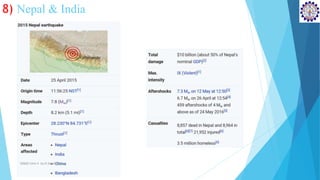
8) Nepal & India
SD&EE/Unit-4 by,R.Satish kumar
Reasons
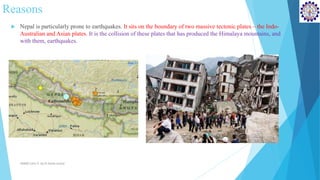
 Nepal is particularly prone to earthquakes. It sits on the boundary of two massive tectonic plates – the Indo-
Australian and Asian plates. It is the collision of these plates that has produced the Himalaya mountains, and
with them, earthquakes.
SD&EE/Unit-4 by,R.Satish kumar
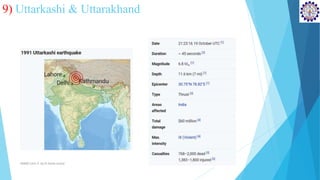
9) Uttarkashi & Uttarakhand
SD&EE/Unit-4 by,R.Satish kumar
Reasons
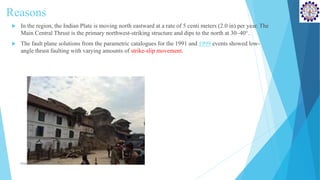
 In the region, the Indian Plate is moving north eastward at a rate of 5 centi meters (2.0 in) per year. The
Main Central Thrust is the primary northwest-striking structure and dips to the north at 30–40°.
 The fault plane solutions from the parametric catalogues for the 1991 and 1999 events showed low-
angle thrust faulting with varying amounts of strike-slip movement.
SD&EE/Unit-4 by,R.Satish kumar
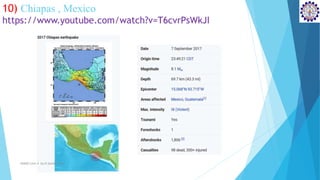
10) Chiapas , Mexico
https://www.youtube.com/watch?v=T6cvrPsWkJI
SD&EE/Unit-4 by,R.Satish kumar
Reasons
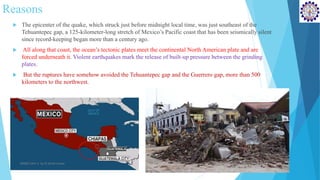
 The epicenter of the quake, which struck just before midnight local time, was just southeast of the
Tehuantepec gap, a 125-kilometer-long stretch of Mexico’s Pacific coast that has been seismically silent
since record-keeping began more than a century ago.
 All along that coast, the ocean’s tectonic plates meet the continental North American plate and are
forced underneath it. Violent earthquakes mark the release of built-up pressure between the grinding
plates.
 But the ruptures have somehow avoided the Tehuantepec gap and the Guerrero gap, more than 500
kilometers to the northwest.
SD&EE/Unit-4 by,R.Satish kumar
DATE LOCATION MAGNITU
DE
INTENSI
TY
DEATHS INJURIES DAMAGES &
NOTES
2004-12-
26
Off northern
Sumatra
9.1-9.3 IX 2,30,000-
2,80,000
No Record Tsunami
1897-06-
12
Shillong , India 8.0 X 1,542 No Record No Record
2005-10-
08
Kashmir 7.6 VIII 86,000-87,351 69,000-75,266 2.8 million
displaced
1905-04-
04
Kangra 7.8 IX >20,000 No Record No Record
1950-08-
15
Assam , Tibet 8.6 XI 1,500-3,300 No Record No Record
1819-06-
16
Gujarat , Rann of
kuch
7.7-8.2 XI >1,543 No Record Formed the
Allah bund
2011-09-
18
Gangtok , Sikkim 6.9 VII >111 No Record No Record
2015-04-
25
Nepal , India 7.8 IX 8,964 21,952 $10 billion
1991-10-
20
Uttarkashi ,
Uttarakhand
6.8 IX 768-2,000 1,383-1,800 No Record
2017-09- Chiapas , Mexico 8.1 IX 98 300+ Tsunami
SD&EE/Unit-4 by,R.Satish kumar
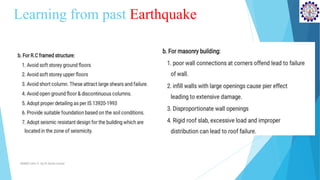
Learning from past Earthquake
SD&EE/Unit-4 by,R.Satish kumar
ANY QuEsTiOnS
SD&EE/Unit-4 by,R.Satish kumar

Lessons learned from past earthquake - Structural dynamics and Earthquake Engineering (SD&EE)

  • 1.
    LESSONS LEARNED FROMPAST EARTHQUAKE Presented By Satish Kumar.R Final Year Civil Guided by shanmugasundram AP/Civil
  • 2.
    Earth’s Major TectonicPlates SD&EE/Unit-4 by,R.Satish kumar
  • 3.
    TOP 10 EARTHQUAKEIN INDIA 1) OFF NORTHERN SUMATRA (26-12-2004) Magnitude - 9.1 to 9.3 Intensity - IX Deaths – 2,30,000 to 2,80,000 Total damage/ Note – Destructive Tsunami SD&EE/Unit-4 by,R.Satish kumar
  • 4.
     It isthe third largest earthquake. The only earthquake with greater magnitude. SD&EE/Unit-4 by,R.Satish kumar
  • 5.
  • 6.
    Reasons  Himalayan thrustpropagating south of Bhutan. We show here that this view is incorrect. The northern edge of the Shillong Plateau rose violently more than 11 m during rupture of a buried, 110km-long, reverse fault, dipping steeply away from the Himalaya.  The stress drop implied by the rupture geometry and the prodigious fault slip of 18±7 m, explains observed epicentral accelerations exceeding 1 g vertically, and surface velocities exceeding 3 m/s1.  Our finding represents the first quantitative observation of active deformation of a "pop-up" structure, and confirms that faults bounding such structures can penetrate the whole crust.  Plateau uplift in the past 2-5 million years has caused the Indian plate to contract locally by 4±2 mm/year, reducing seismic risk in Bhutan, but increasing it to the large populations of northern Bangladesh. SD&EE/Unit-4 by,R.Satish kumar
  • 7.
  • 8.
     Kashmir islocated at the juncture of the Eurasian and Indian tectonic plates the collision of which caused the formation of the Himalaya Mountains making it prone to intense seismic activity. The 2005 earthquake was among the worst to ever hit the region. It caused extensive destruction in Pakistan-administered Kashmir; Pakistan’s North-West Frontier Province; the western and southern regions of the Kashmir Valley, part of India-administered Kashmir; and northern Pakistan. Damage also was reported in northern India and Afghanistan.  In addition, landslides wiped out large numbers of the region’s roads, making many of the damaged areas inaccessible to relief workers in the immediate aftermath. SD&EE/Unit-4 by,R.Satish kumar
  • 9.
    4) KANGRA , HIMACHALPRADESH SD&EE/Unit-4 by,R.Satish kumar
  • 10.
    Reasons  The calculatedepicenter of the earthquake lies within the zone of thrusts along the front of the Himalayas formed by the continuing collision of the Indian plate into the Eurasian plate.  There was also major damage to the network of hillside aqueducts that fed water to the affected area. The total cost of recovering from the effects of the earthquake were calculated as 2.9 million (1905) rupees. SD&EE/Unit-4 by,R.Satish kumar
  • 11.
    5) ASSAM &TIBET SD&EE/Unit-4 by,R.Satish kumar
  • 12.
     Great AssamEarthquake was caused by a slip on the Jiali and Po Chu Faults in southern Xizang, along the border with northeast India. The epicenter of the earthquake was Rima, a sparsely populated region in the Indo-China border. It first hit at 19:39 pm on August 15, 1950. The surface wave was felt throughout the entire north-eastern India and in many parts of eastern India.  This quake was caused by two continental plates colliding. It was the sixth largest earthquake of the 20th century. SD&EE/Unit-4 by,R.Satish kumar
  • 13.
    6) Gujarat Rannof Kutch earthquake SD&EE/Unit-4 by,R.Satish kumar
  • 14.
    Reasons  There wasa local tsunami that flooded the area known as the Great Rann immediately after the earthquake. The fort at Sindri was destroyed by the earthquake and then partly submerged by the tsunami, "forcing survivors to climb to the top of the ruins“.  The Kutch District of modern-day Gujarat lies 3–400 km from the plate boundary between the Indian Plate and the Eurasian Plate, but the current tectonics is still governed by the effects of the continuing continental collision along this boundary.  During the collision with Eurasia the area has undergone shortening, involving both reactivation of the original rift faults and development of new low-angle thrust faults. SD&EE/Unit-4 by,R.Satish kumar
  • 15.
    7) Gangtok ,Sikkim SD&EE/Unit-4 by,R.Satish kumar
  • 16.
    Reasons  The cityis flanked on east and west by two streams, namely Roro Chu and Ranikhola, respectively.  Both the streams meet the Ranipul and flow south as the main Ranikhola before it joins the Teesta at Singtam.  Surface runoff of water by natural streams (jhora) and man-made drains has contributed to the risk of landslides.  According to the Bureau of Indian Standards, the town falls under seismic zone-IV , near the convergent boundary of the Indian and the Eurasian tectonic plates and is subject to frequent earthquakes. Collapsed temple, Lachung SD&EE/Unit-4 by,R.Satish kumar
  • 17.
    8) Nepal &India SD&EE/Unit-4 by,R.Satish kumar
  • 18.
    Reasons  Nepal isparticularly prone to earthquakes. It sits on the boundary of two massive tectonic plates – the Indo- Australian and Asian plates. It is the collision of these plates that has produced the Himalaya mountains, and with them, earthquakes. SD&EE/Unit-4 by,R.Satish kumar
  • 19.
    9) Uttarkashi &Uttarakhand SD&EE/Unit-4 by,R.Satish kumar
  • 20.
    Reasons  In theregion, the Indian Plate is moving north eastward at a rate of 5 centi meters (2.0 in) per year. The Main Central Thrust is the primary northwest-striking structure and dips to the north at 30–40°.  The fault plane solutions from the parametric catalogues for the 1991 and 1999 events showed low- angle thrust faulting with varying amounts of strike-slip movement. SD&EE/Unit-4 by,R.Satish kumar
  • 21.
    10) Chiapas ,Mexico https://www.youtube.com/watch?v=T6cvrPsWkJI SD&EE/Unit-4 by,R.Satish kumar
  • 22.
    Reasons  The epicenterof the quake, which struck just before midnight local time, was just southeast of the Tehuantepec gap, a 125-kilometer-long stretch of Mexico’s Pacific coast that has been seismically silent since record-keeping began more than a century ago.  All along that coast, the ocean’s tectonic plates meet the continental North American plate and are forced underneath it. Violent earthquakes mark the release of built-up pressure between the grinding plates.  But the ruptures have somehow avoided the Tehuantepec gap and the Guerrero gap, more than 500 kilometers to the northwest. SD&EE/Unit-4 by,R.Satish kumar
  • 23.
    DATE LOCATION MAGNITU DE INTENSI TY DEATHSINJURIES DAMAGES & NOTES 2004-12- 26 Off northern Sumatra 9.1-9.3 IX 2,30,000- 2,80,000 No Record Tsunami 1897-06- 12 Shillong , India 8.0 X 1,542 No Record No Record 2005-10- 08 Kashmir 7.6 VIII 86,000-87,351 69,000-75,266 2.8 million displaced 1905-04- 04 Kangra 7.8 IX >20,000 No Record No Record 1950-08- 15 Assam , Tibet 8.6 XI 1,500-3,300 No Record No Record 1819-06- 16 Gujarat , Rann of kuch 7.7-8.2 XI >1,543 No Record Formed the Allah bund 2011-09- 18 Gangtok , Sikkim 6.9 VII >111 No Record No Record 2015-04- 25 Nepal , India 7.8 IX 8,964 21,952 $10 billion 1991-10- 20 Uttarkashi , Uttarakhand 6.8 IX 768-2,000 1,383-1,800 No Record 2017-09- Chiapas , Mexico 8.1 IX 98 300+ Tsunami SD&EE/Unit-4 by,R.Satish kumar
  • 24.
    Learning from pastEarthquake SD&EE/Unit-4 by,R.Satish kumar
  • 25.