Geological Processes
Md. Yousuf Gazi, Lecturer, Department of Geology, University of Dhaka (yousuf.geo@du.ac.bd)
Geological Processes
I. Endogenetic Processes: Those operate within the Earth's crust,
viz. earthquake, volcanic eruption.
II. Exogentic Processes: Those which are active on the Earth’s
surface, viz. weathering, erosion.
Md. Yousuf Gazi, Lecturer, Department of Geology, University of Dhaka (yousuf.geo@du.ac.bd)
Geological processes: A number of processes which shape the planet on which we live
and concentrate the resources on which we depend.
Md. Yousuf Gazi, Lecturer, Department of Geology, University of Dhaka (yousuf.geo@du.ac.bd)
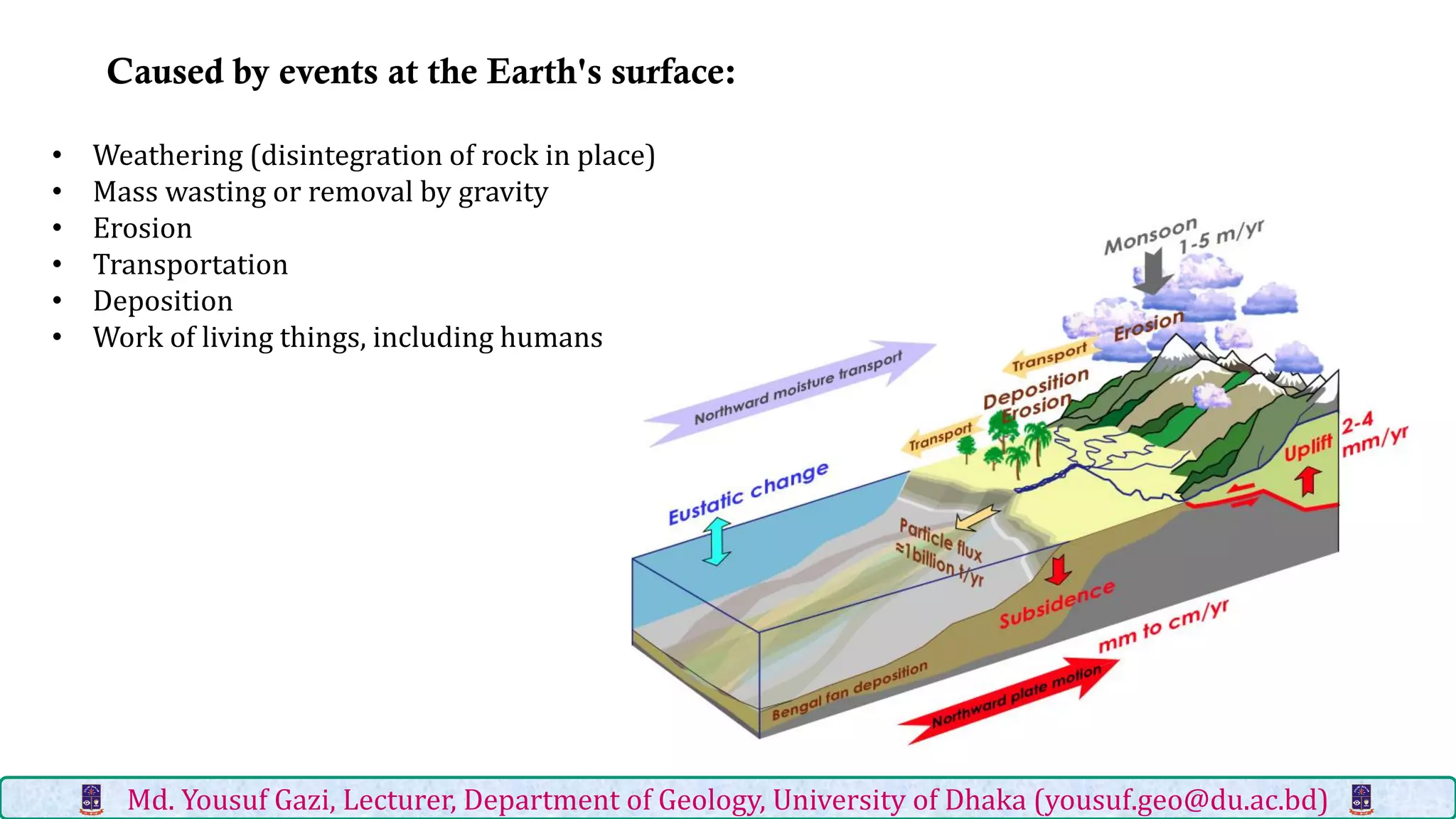
Caused by events at the Earth's surface:
• Weathering (disintegration of rock in place)
• Mass wasting or removal by gravity
• Erosion
• Transportation
• Deposition
• Work of living things, including humans
Md. Yousuf Gazi, Lecturer, Department of Geology, University of Dhaka (yousuf.geo@du.ac.bd)
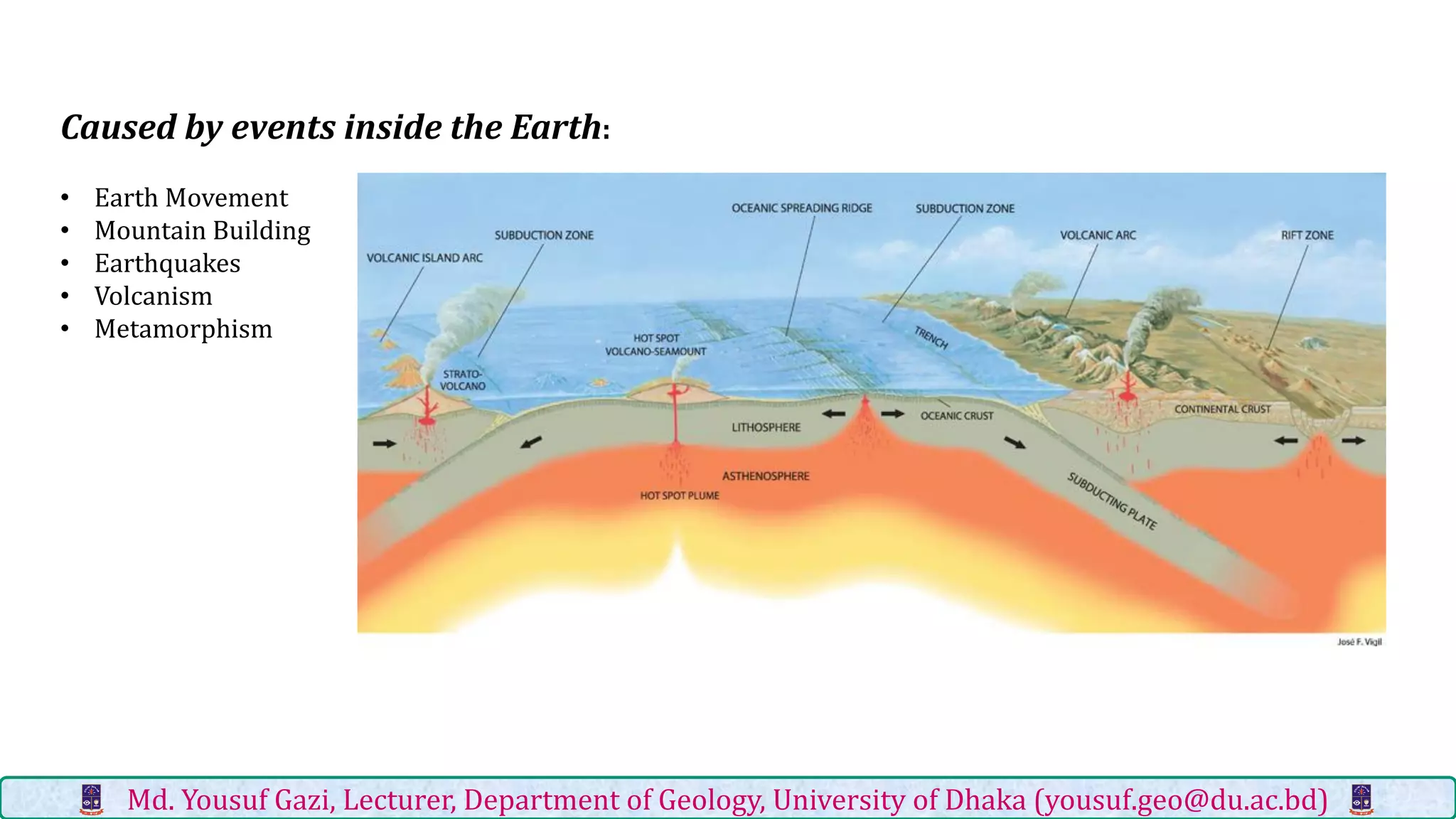
Caused by events inside the Earth:
• Earth Movement
• Mountain Building
• Earthquakes
• Volcanism
• Metamorphism
Md. Yousuf Gazi, Lecturer, Department of Geology, University of Dhaka (yousuf.geo@du.ac.bd)
Caused by events off the Earth:
• Meteorites
Md. Yousuf Gazi, Lecturer, Department of Geology, University of Dhaka (yousuf.geo@du.ac.bd)
Weathering:
▪ Weathering is an aggregate of processes
involving physical destruction and chemical
decomposition of earth material on exposure
to atmosphere at the site of their occurrence
with little or no transport.
Md. Yousuf Gazi, Lecturer, Department of Geology, University of Dhaka (yousuf.geo@du.ac.bd)
Types:
1. Physical/Mechanical Weathering – Disintegration
(physical breakdown)
2. Chemical Weathering – Decomposition (chemical
alteration)
Very difficult to separate the two types in nature as they
often go hand in hand.
Md. Yousuf Gazi, Lecturer, Department of Geology, University of Dhaka (yousuf.geo@du.ac.bd)
Weathering:
Weathering vs. Erosion
• Weathering is related to, but not the same as, erosion!
• Weathering occurs in place. No movement of material. Rocks are broken up into
pieces that can be moved.
• Erosion implies the transport (movement) of the material made during weathering.
Md. Yousuf Gazi, Lecturer, Department of Geology, University of Dhaka (yousuf.geo@du.ac.bd)
Mechanical Weathering:
• Physical breakdown of rock (disintegration).
• Processes involve breaking rocks and minerals into smaller pieces.
• Composition of the pieces is identical to the source rock.
• Just change in size and shape.
Md. Yousuf Gazi, Lecturer, Department of Geology, University of Dhaka (yousuf.geo@du.ac.bd)
• Frost action = repeated freezing and thawing of water in cracks and crevices.
• Water expands by 9% in volume when it freezes → substantial tensional forces
produced within the rock, sufficient to detach pieces (frost wedging).
Mechanical Weathering:
Md. Yousuf Gazi, Lecturer, Department of Geology, University of Dhaka (yousuf.geo@du.ac.bd)
• Crystal growth – growth of salt (and other crystals) in cracks and voids. New minerals
grow (volume change) and induce stresses in the rock leading to fracture.
• Just like frost action.
• Action of salt crystals is most common in arid and coastal areas.
Mechanical Weathering:
Md. Yousuf Gazi, Lecturer, Department of Geology, University of Dhaka (yousuf.geo@du.ac.bd)
• Pressure release: Rocks formed at depth are used to elevated ambient pressure.
• When rock is exhumed (uplifted & exposed at the surface somehow), the pressure is
less.
• Fractures (sheet joints) form parallel to the surface of the rock. Material “peels off”
exfoliation.
Mechanical Weathering:
Md. Yousuf Gazi, Lecturer, Department of Geology, University of Dhaka (yousuf.geo@du.ac.bd)
• Biological factors:
– Plant roots forcing open cracks
– Animals burrowing
• These processes physically disrupt geologic materials. Also enable and cause other, non-mechanical
weathering processes…
Mechanical Weathering:
Md. Yousuf Gazi, Lecturer, Department of Geology, University of Dhaka (yousuf.geo@du.ac.bd)
Mechanical Weathering
Chemical Weathering:
• Minerals are decomposed by chemical alteration. New minerals replace pre-existing ones according to
stability.
• Variety of chemical reactions:
– Dissolution (“dissolving”)
– Oxidation (“rusting”)
– Hydrolysis (just add water…)
Md. Yousuf Gazi, Lecturer, Department of Geology, University of Dhaka (yousuf.geo@du.ac.bd)
• Dissolution: dissolving of minerals into a solution (usually aqueous e.g. water).
• Few minerals are very soluble in pure water. Acidic water (carbonic, hydrochloric, sulfuric, etc.)
helps things along.
• Carbonates dissolve readily → chemically made/weathered rocks (chemical sediment)
Md. Yousuf Gazi, Lecturer, Department of Geology, University of Dhaka (yousuf.geo@du.ac.bd)
CaCO3 + H20 + CO2 -> CaCO3 + H+ + HCO3
- -> Ca2+ + 2HCO3
-
Chemical Weathering:
• Oxidation: minerals react with oxygen. Metal cations form oxides/hydroxides that
are more stable at surface free-oxygen concentrations. Rusting.
• Important way of altering ferromagnesian minerals.
• Generally slow. Water helps the process.
Md. Yousuf Gazi, Lecturer, Department of Geology, University of Dhaka (yousuf.geo@du.ac.bd)
Chemical Weathering:
4Fe + 3O2 -> 2Fe2O3
• Hydrolysis: reaction of minerals and “water ions” (H+ and OH-).
• H+ can replace cations in minerals. OH- can substitute for anions.
• Mineral becomes “hydrated” with water in its structure.
– Ions are released
– Mineral structure/properties may change
– Mineral may become soluble
• Example: hydrolysis of feldspar produces clay minerals
2KAlSi3O8 + 2H+ + 2HCO3
- + H2O Al2Si2O5(OH)4 + 2K+ + 2HCO3
- + 4SiO2
Md. Yousuf Gazi, Lecturer, Department of Geology, University of Dhaka (yousuf.geo@du.ac.bd)
Chemical Weathering:
Weathering rates depend on the following factors:
Surface Area: Weathering is a process that acts on surfaces, the more surface area available, the
more damage weathering can do.
Environmental Factors:
o Higher temperatures tend to accelerate chemical reactions.
o Wetter climates promote chemical weathering.
o Biology contributes to both mechanical and chemical weathering.
o Weathering is faster in the tropics than in deserts.
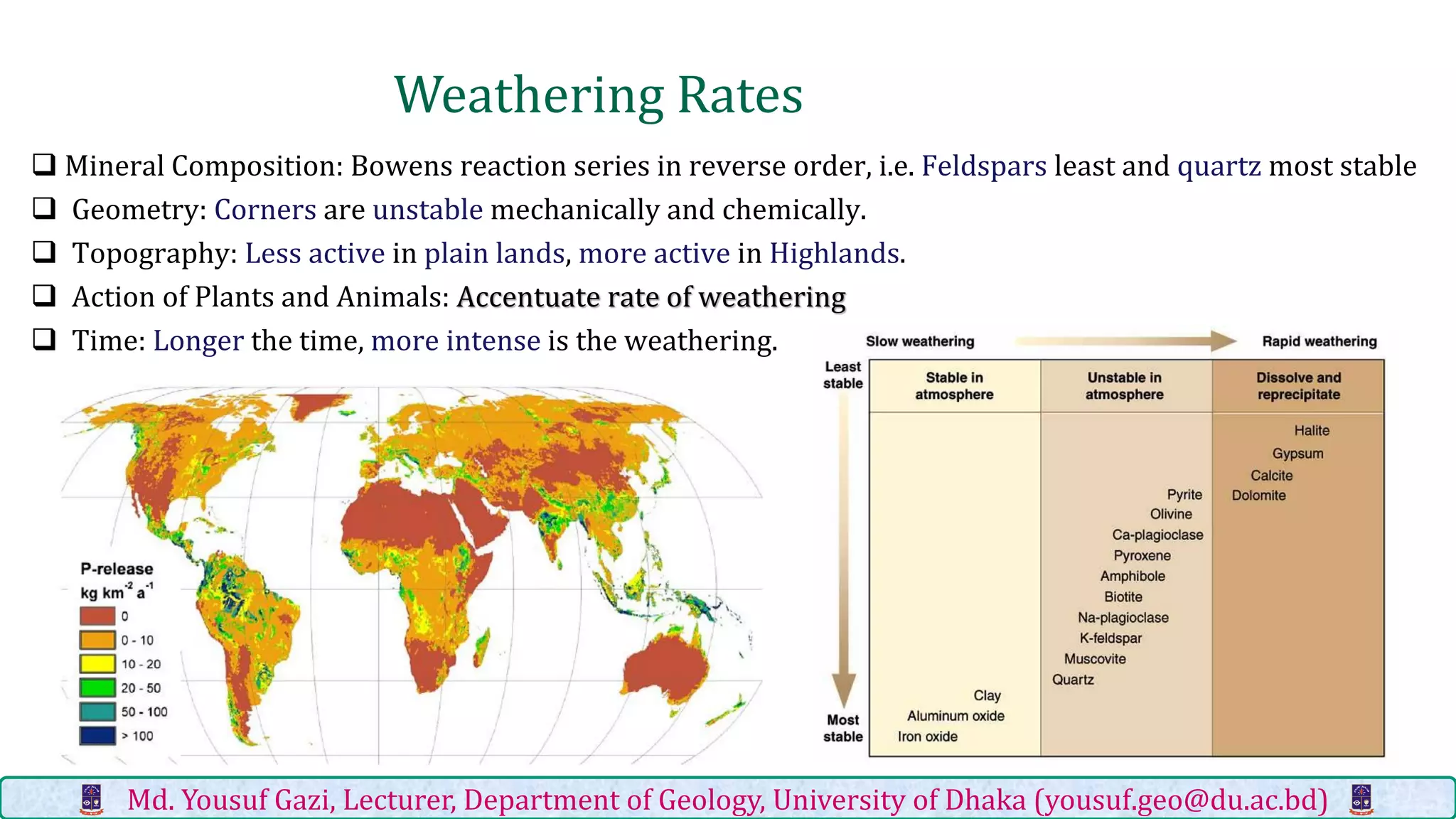
Weathering Rates
Md. Yousuf Gazi, Lecturer, Department of Geology, University of Dhaka (yousuf.geo@du.ac.bd)
❑ Mineral Composition: Bowens reaction series in reverse order, i.e. Feldspars least and quartz most stable
❑ Geometry: Corners are unstable mechanically and chemically.
❑ Topography: Less active in plain lands, more active in Highlands.
❑ Action of Plants and Animals: Accentuate rate of weathering
❑ Time: Longer the time, more intense is the weathering.
Md. Yousuf Gazi, Lecturer, Department of Geology, University of Dhaka (yousuf.geo@du.ac.bd)
Weathering Rates
Weathering and Soil
• Regolith: unconsolidated rock and mineral fragments
• Soil: regolith with weathered material, water, air, & organic matter that can support plant growth
• Humus: organic material processed by bacterial decay → Enriched in N, less C than original organic matter
Sand, silt, clay make up ~ 45% of fertile soil.
Sand & silt = mostly quartz; create pore spaces
Clay = mostly weathered feldspar; important nutrient supply
Md. Yousuf Gazi, Lecturer, Department of Geology, University of Dhaka (yousuf.geo@du.ac.bd)
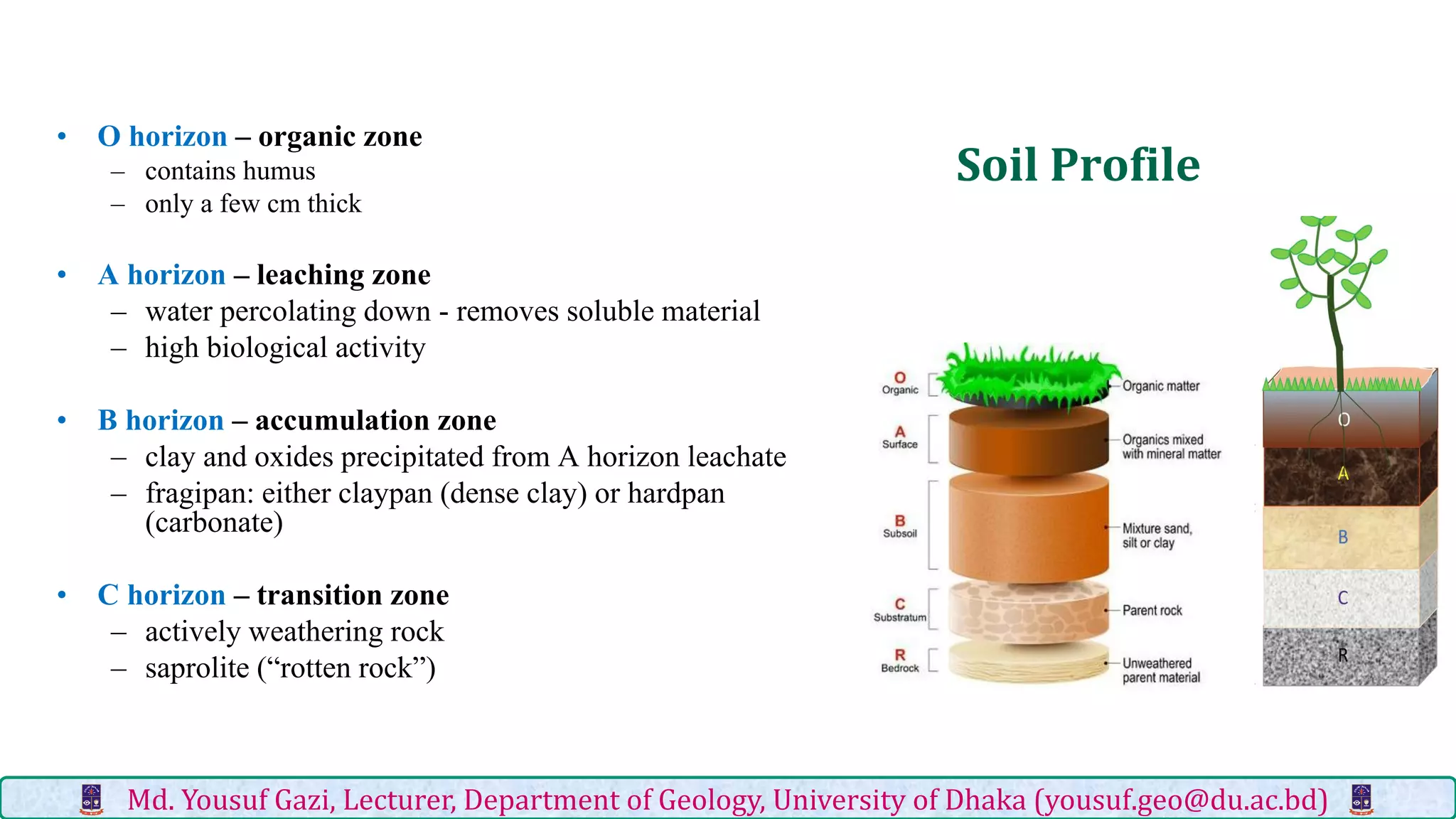
Soil Profile
• O horizon – organic zone
– contains humus
– only a few cm thick
• A horizon – leaching zone
– water percolating down - removes soluble material
– high biological activity
• B horizon – accumulation zone
– clay and oxides precipitated from A horizon leachate
– fragipan: either claypan (dense clay) or hardpan
(carbonate)
• C horizon – transition zone
– actively weathering rock
– saprolite (“rotten rock”)
Md. Yousuf Gazi, Lecturer, Department of Geology, University of Dhaka (yousuf.geo@du.ac.bd)
Soil Formation:
• Residual soil: formed by in-place weathering of parent material.
• Transported soil: weathered material is transported to another place where it is converted to soil.
Md. Yousuf Gazi, Lecturer, Department of Geology, University of Dhaka (yousuf.geo@du.ac.bd)
Factors controlling soil formation:
▪ Climate is the most important factor
– moisture & temperature controls on weathering
– climate determines extent of soil transport
▪ Parent material helps determine soil type and depth and fertility
▪ Organisms are active soil formers
▪ Topography (relief and slope and elevation) affects climate and has mechanical controls (slope stability)
▪ Time: Soil forming processes act at different rates and compete with soil degradational processes.
Md. Yousuf Gazi, Lecturer, Department of Geology, University of Dhaka (yousuf.geo@du.ac.bd)
Soil Formation:
Erosion:
Processes that loosen and transport rock and soil down slopes or downwind.
Agents of Erosion:
1. Moving water
i. Rain
ii. Stream
iii. Groundwater
Md. Yousuf Gazi, Lecturer, Department of Geology, University of Dhaka (yousuf.geo@du.ac.bd)
2. Wind
3. Glaciers
5. Waves and currents
Factors Affecting erosion: Medium, velocity of the medium,
rock type
4. Gravity
▪ Several types of movement are recognized. Mass wasting/Mass Movement/Slope Movement events
may involve only one type of movement, or combinations of movement types.
▪ Mass movements are classified by their dominant behavior according to:
the type of motion
the rate of motion, and
the type of material involved
▪ Materials moving down slope may behave as an elastic solid, a plastic substance, or as a liquid.
▪ In some mass movements, the material may exhibit more than one type of movement.
Types of Movement
Md. Yousuf Gazi, Lecturer, Department of Geology, University of Dhaka (yousuf.geo@du.ac.bd)
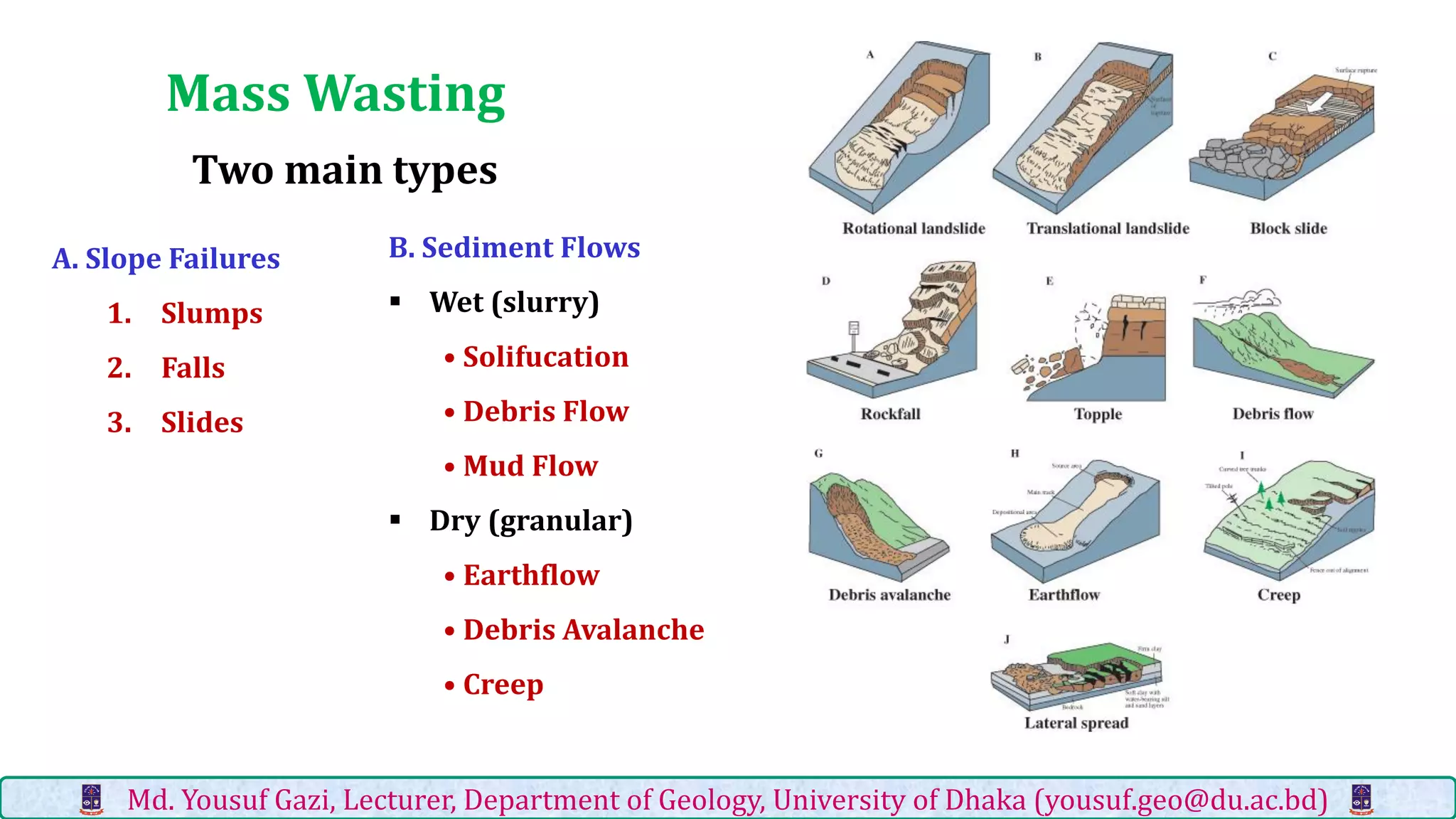
A. Slope Failures
1. Slumps
2. Falls
3. Slides
Mass Wasting
B. Sediment Flows
▪ Wet (slurry)
• Solifucation
• Debris Flow
• Mud Flow
▪ Dry (granular)
• Earthflow
• Debris Avalanche
• Creep
Two main types
Md. Yousuf Gazi, Lecturer, Department of Geology, University of Dhaka (yousuf.geo@du.ac.bd)
Basic Types of Slope Processes:
1. Flows – chaotic mixing
during movement
(example: debris flow)
2. Slides – movement of coherent
mass of material
(example: rock slide)
3. Falls – material free falls
through air
(example: rock fall)
Md. Yousuf Gazi, Lecturer, Department of Geology, University of Dhaka (yousuf.geo@du.ac.bd)
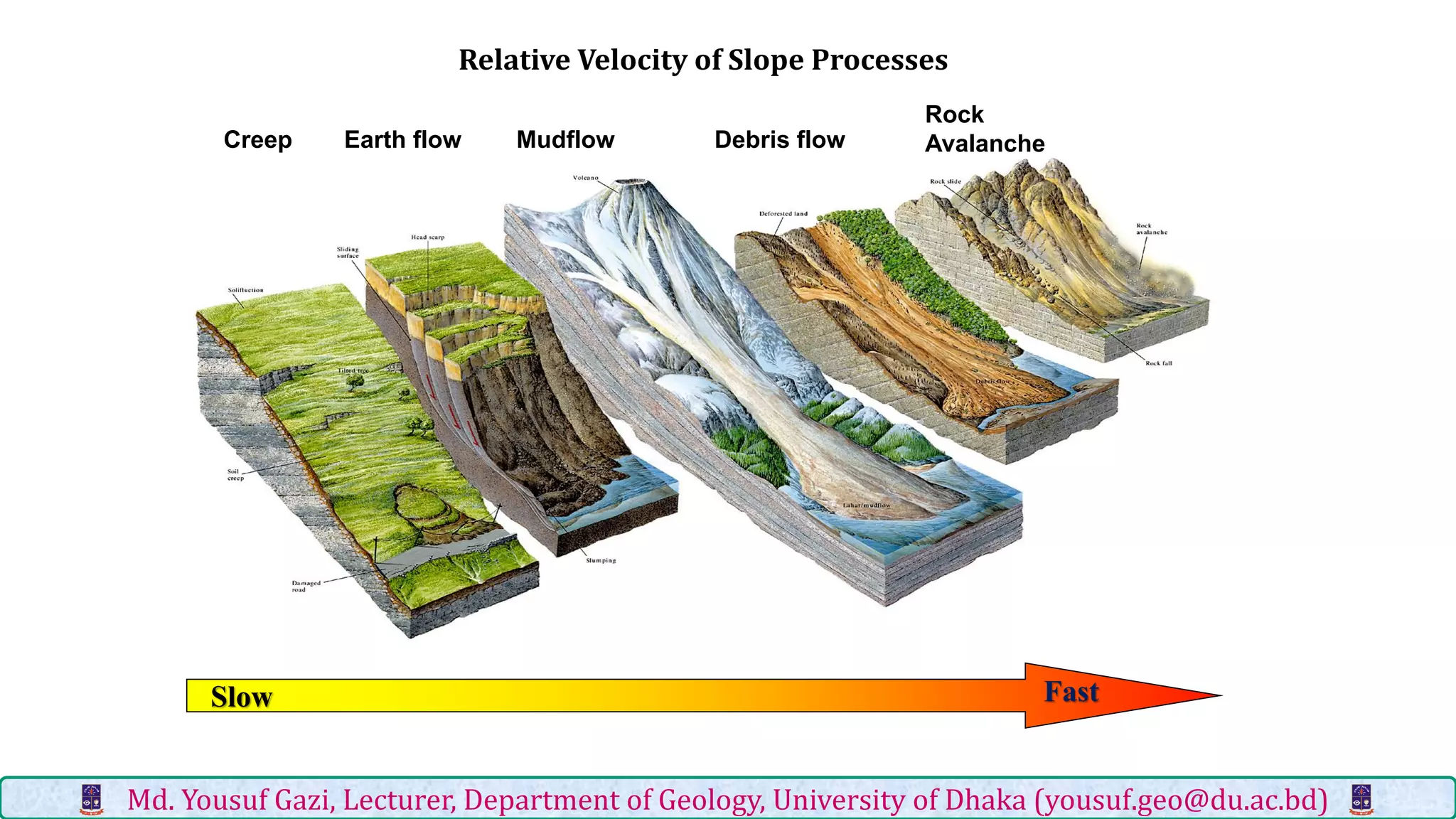
Relative Velocity of Slope Processes
Slow Fast
Creep Earth flow Mudflow Debris flow
Rock
Avalanche
Md. Yousuf Gazi, Lecturer, Department of Geology, University of Dhaka (yousuf.geo@du.ac.bd)
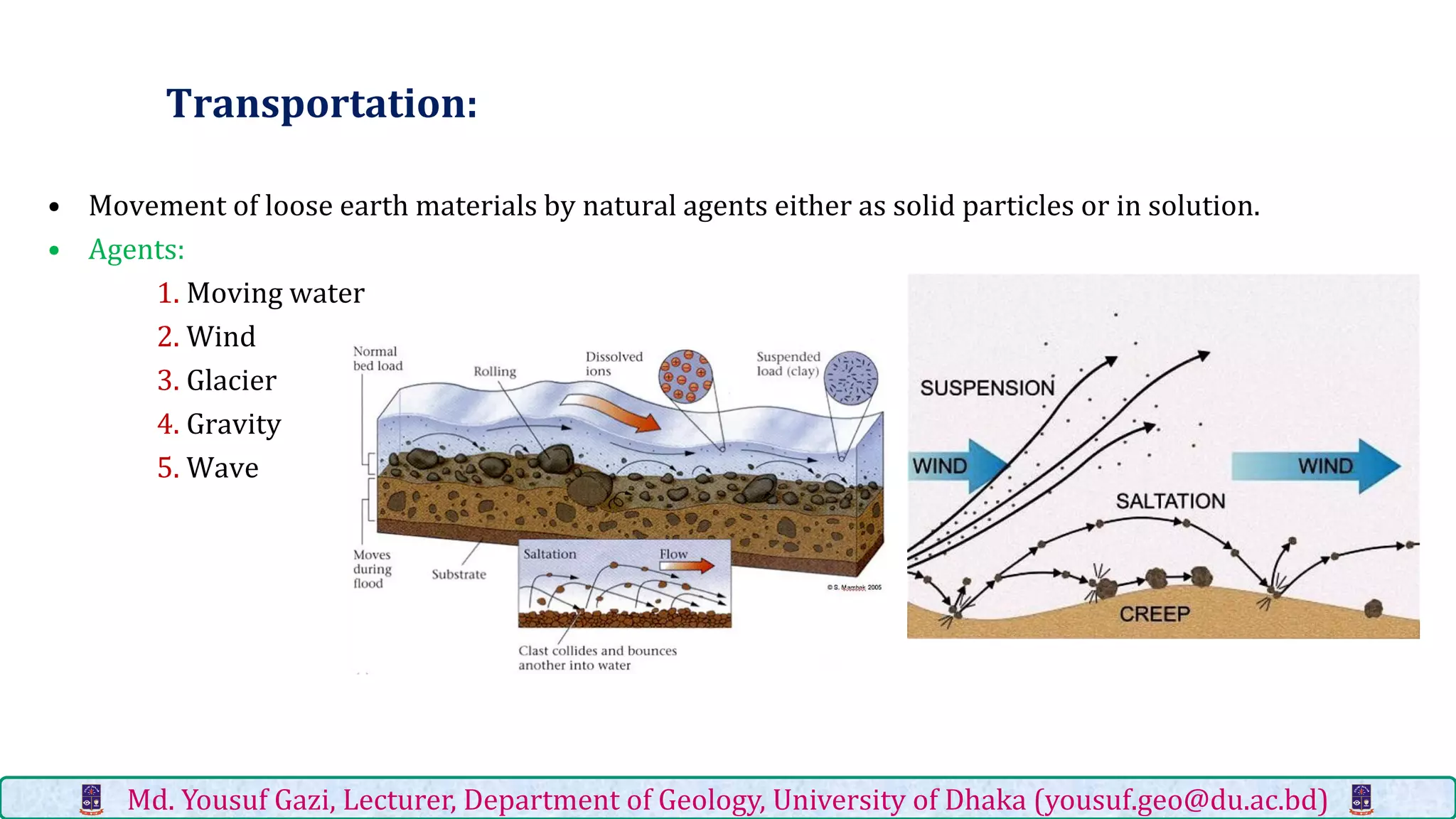
Transportation:
• Movement of loose earth materials by natural agents either as solid particles or in solution.
• Agents:
1. Moving water
2. Wind
3. Glacier
4. Gravity
5. Wave
Md. Yousuf Gazi, Lecturer, Department of Geology, University of Dhaka (yousuf.geo@du.ac.bd)
Deposition:
• Mechanical Deposition: materials carried in suspension or in other way by water, wind, ice, is
deposited when the transporting medium is overloaded, when velocity is checked or when it
suffers a chemical/physical change, e.g. Clay, Silt, Sand.
Md. Yousuf Gazi, Lecturer, Department of Geology, University of Dhaka (yousuf.geo@du.ac.bd)
Chemical Deposition: soluble matters derived from weathering my be deposited either on land or in water,
directly by physico-chemical processes such as precipitation and evaporation or indirectly by the activity of
organism, e.g. Limestone, Halite.
Deposition:
Md. Yousuf Gazi, Lecturer, Department of Geology, University of Dhaka (yousuf.geo@du.ac.bd)

Earth surface processes md. yousuf gazi

  • 1.
    Geological Processes Md. YousufGazi, Lecturer, Department of Geology, University of Dhaka (yousuf.geo@du.ac.bd)
  • 2.
    Geological Processes I. EndogeneticProcesses: Those operate within the Earth's crust, viz. earthquake, volcanic eruption. II. Exogentic Processes: Those which are active on the Earth’s surface, viz. weathering, erosion. Md. Yousuf Gazi, Lecturer, Department of Geology, University of Dhaka (yousuf.geo@du.ac.bd) Geological processes: A number of processes which shape the planet on which we live and concentrate the resources on which we depend.
  • 3.
    Md. Yousuf Gazi,Lecturer, Department of Geology, University of Dhaka (yousuf.geo@du.ac.bd)
  • 4.
    Md. Yousuf Gazi,Lecturer, Department of Geology, University of Dhaka (yousuf.geo@du.ac.bd)
  • 5.
    Caused by eventsat the Earth's surface: • Weathering (disintegration of rock in place) • Mass wasting or removal by gravity • Erosion • Transportation • Deposition • Work of living things, including humans Md. Yousuf Gazi, Lecturer, Department of Geology, University of Dhaka (yousuf.geo@du.ac.bd)
  • 6.
    Caused by eventsinside the Earth: • Earth Movement • Mountain Building • Earthquakes • Volcanism • Metamorphism Md. Yousuf Gazi, Lecturer, Department of Geology, University of Dhaka (yousuf.geo@du.ac.bd)
  • 7.
    Caused by eventsoff the Earth: • Meteorites Md. Yousuf Gazi, Lecturer, Department of Geology, University of Dhaka (yousuf.geo@du.ac.bd)
  • 8.
    Weathering: ▪ Weathering isan aggregate of processes involving physical destruction and chemical decomposition of earth material on exposure to atmosphere at the site of their occurrence with little or no transport. Md. Yousuf Gazi, Lecturer, Department of Geology, University of Dhaka (yousuf.geo@du.ac.bd)
  • 9.
    Types: 1. Physical/Mechanical Weathering– Disintegration (physical breakdown) 2. Chemical Weathering – Decomposition (chemical alteration) Very difficult to separate the two types in nature as they often go hand in hand. Md. Yousuf Gazi, Lecturer, Department of Geology, University of Dhaka (yousuf.geo@du.ac.bd) Weathering:
  • 10.
    Weathering vs. Erosion •Weathering is related to, but not the same as, erosion! • Weathering occurs in place. No movement of material. Rocks are broken up into pieces that can be moved. • Erosion implies the transport (movement) of the material made during weathering. Md. Yousuf Gazi, Lecturer, Department of Geology, University of Dhaka (yousuf.geo@du.ac.bd)
  • 11.
    Mechanical Weathering: • Physicalbreakdown of rock (disintegration). • Processes involve breaking rocks and minerals into smaller pieces. • Composition of the pieces is identical to the source rock. • Just change in size and shape. Md. Yousuf Gazi, Lecturer, Department of Geology, University of Dhaka (yousuf.geo@du.ac.bd)
  • 12.
    • Frost action= repeated freezing and thawing of water in cracks and crevices. • Water expands by 9% in volume when it freezes → substantial tensional forces produced within the rock, sufficient to detach pieces (frost wedging). Mechanical Weathering: Md. Yousuf Gazi, Lecturer, Department of Geology, University of Dhaka (yousuf.geo@du.ac.bd)
  • 13.
    • Crystal growth– growth of salt (and other crystals) in cracks and voids. New minerals grow (volume change) and induce stresses in the rock leading to fracture. • Just like frost action. • Action of salt crystals is most common in arid and coastal areas. Mechanical Weathering: Md. Yousuf Gazi, Lecturer, Department of Geology, University of Dhaka (yousuf.geo@du.ac.bd)
  • 14.
    • Pressure release:Rocks formed at depth are used to elevated ambient pressure. • When rock is exhumed (uplifted & exposed at the surface somehow), the pressure is less. • Fractures (sheet joints) form parallel to the surface of the rock. Material “peels off” exfoliation. Mechanical Weathering: Md. Yousuf Gazi, Lecturer, Department of Geology, University of Dhaka (yousuf.geo@du.ac.bd)
  • 15.
    • Biological factors: –Plant roots forcing open cracks – Animals burrowing • These processes physically disrupt geologic materials. Also enable and cause other, non-mechanical weathering processes… Mechanical Weathering: Md. Yousuf Gazi, Lecturer, Department of Geology, University of Dhaka (yousuf.geo@du.ac.bd)
  • 16.
    Md. Yousuf Gazi,Lecturer, Department of Geology, University of Dhaka (yousuf.geo@du.ac.bd) Mechanical Weathering
  • 17.
    Chemical Weathering: • Mineralsare decomposed by chemical alteration. New minerals replace pre-existing ones according to stability. • Variety of chemical reactions: – Dissolution (“dissolving”) – Oxidation (“rusting”) – Hydrolysis (just add water…) Md. Yousuf Gazi, Lecturer, Department of Geology, University of Dhaka (yousuf.geo@du.ac.bd)
  • 18.
    • Dissolution: dissolvingof minerals into a solution (usually aqueous e.g. water). • Few minerals are very soluble in pure water. Acidic water (carbonic, hydrochloric, sulfuric, etc.) helps things along. • Carbonates dissolve readily → chemically made/weathered rocks (chemical sediment) Md. Yousuf Gazi, Lecturer, Department of Geology, University of Dhaka (yousuf.geo@du.ac.bd) CaCO3 + H20 + CO2 -> CaCO3 + H+ + HCO3 - -> Ca2+ + 2HCO3 - Chemical Weathering:
  • 19.
    • Oxidation: mineralsreact with oxygen. Metal cations form oxides/hydroxides that are more stable at surface free-oxygen concentrations. Rusting. • Important way of altering ferromagnesian minerals. • Generally slow. Water helps the process. Md. Yousuf Gazi, Lecturer, Department of Geology, University of Dhaka (yousuf.geo@du.ac.bd) Chemical Weathering: 4Fe + 3O2 -> 2Fe2O3
  • 20.
    • Hydrolysis: reactionof minerals and “water ions” (H+ and OH-). • H+ can replace cations in minerals. OH- can substitute for anions. • Mineral becomes “hydrated” with water in its structure. – Ions are released – Mineral structure/properties may change – Mineral may become soluble • Example: hydrolysis of feldspar produces clay minerals 2KAlSi3O8 + 2H+ + 2HCO3 - + H2O Al2Si2O5(OH)4 + 2K+ + 2HCO3 - + 4SiO2 Md. Yousuf Gazi, Lecturer, Department of Geology, University of Dhaka (yousuf.geo@du.ac.bd) Chemical Weathering:
  • 21.
    Weathering rates dependon the following factors: Surface Area: Weathering is a process that acts on surfaces, the more surface area available, the more damage weathering can do. Environmental Factors: o Higher temperatures tend to accelerate chemical reactions. o Wetter climates promote chemical weathering. o Biology contributes to both mechanical and chemical weathering. o Weathering is faster in the tropics than in deserts. Weathering Rates Md. Yousuf Gazi, Lecturer, Department of Geology, University of Dhaka (yousuf.geo@du.ac.bd)
  • 22.
    ❑ Mineral Composition:Bowens reaction series in reverse order, i.e. Feldspars least and quartz most stable ❑ Geometry: Corners are unstable mechanically and chemically. ❑ Topography: Less active in plain lands, more active in Highlands. ❑ Action of Plants and Animals: Accentuate rate of weathering ❑ Time: Longer the time, more intense is the weathering. Md. Yousuf Gazi, Lecturer, Department of Geology, University of Dhaka (yousuf.geo@du.ac.bd) Weathering Rates
  • 23.
    Weathering and Soil •Regolith: unconsolidated rock and mineral fragments • Soil: regolith with weathered material, water, air, & organic matter that can support plant growth • Humus: organic material processed by bacterial decay → Enriched in N, less C than original organic matter Sand, silt, clay make up ~ 45% of fertile soil. Sand & silt = mostly quartz; create pore spaces Clay = mostly weathered feldspar; important nutrient supply Md. Yousuf Gazi, Lecturer, Department of Geology, University of Dhaka (yousuf.geo@du.ac.bd)
  • 24.
    Soil Profile • Ohorizon – organic zone – contains humus – only a few cm thick • A horizon – leaching zone – water percolating down - removes soluble material – high biological activity • B horizon – accumulation zone – clay and oxides precipitated from A horizon leachate – fragipan: either claypan (dense clay) or hardpan (carbonate) • C horizon – transition zone – actively weathering rock – saprolite (“rotten rock”) Md. Yousuf Gazi, Lecturer, Department of Geology, University of Dhaka (yousuf.geo@du.ac.bd)
  • 25.
    Soil Formation: • Residualsoil: formed by in-place weathering of parent material. • Transported soil: weathered material is transported to another place where it is converted to soil. Md. Yousuf Gazi, Lecturer, Department of Geology, University of Dhaka (yousuf.geo@du.ac.bd)
  • 26.
    Factors controlling soilformation: ▪ Climate is the most important factor – moisture & temperature controls on weathering – climate determines extent of soil transport ▪ Parent material helps determine soil type and depth and fertility ▪ Organisms are active soil formers ▪ Topography (relief and slope and elevation) affects climate and has mechanical controls (slope stability) ▪ Time: Soil forming processes act at different rates and compete with soil degradational processes. Md. Yousuf Gazi, Lecturer, Department of Geology, University of Dhaka (yousuf.geo@du.ac.bd) Soil Formation:
  • 27.
    Erosion: Processes that loosenand transport rock and soil down slopes or downwind. Agents of Erosion: 1. Moving water i. Rain ii. Stream iii. Groundwater Md. Yousuf Gazi, Lecturer, Department of Geology, University of Dhaka (yousuf.geo@du.ac.bd) 2. Wind 3. Glaciers 5. Waves and currents Factors Affecting erosion: Medium, velocity of the medium, rock type 4. Gravity
  • 28.
    ▪ Several typesof movement are recognized. Mass wasting/Mass Movement/Slope Movement events may involve only one type of movement, or combinations of movement types. ▪ Mass movements are classified by their dominant behavior according to: the type of motion the rate of motion, and the type of material involved ▪ Materials moving down slope may behave as an elastic solid, a plastic substance, or as a liquid. ▪ In some mass movements, the material may exhibit more than one type of movement. Types of Movement Md. Yousuf Gazi, Lecturer, Department of Geology, University of Dhaka (yousuf.geo@du.ac.bd)
  • 29.
    A. Slope Failures 1.Slumps 2. Falls 3. Slides Mass Wasting B. Sediment Flows ▪ Wet (slurry) • Solifucation • Debris Flow • Mud Flow ▪ Dry (granular) • Earthflow • Debris Avalanche • Creep Two main types Md. Yousuf Gazi, Lecturer, Department of Geology, University of Dhaka (yousuf.geo@du.ac.bd)
  • 30.
    Basic Types ofSlope Processes: 1. Flows – chaotic mixing during movement (example: debris flow) 2. Slides – movement of coherent mass of material (example: rock slide) 3. Falls – material free falls through air (example: rock fall) Md. Yousuf Gazi, Lecturer, Department of Geology, University of Dhaka (yousuf.geo@du.ac.bd)
  • 31.
    Relative Velocity ofSlope Processes Slow Fast Creep Earth flow Mudflow Debris flow Rock Avalanche Md. Yousuf Gazi, Lecturer, Department of Geology, University of Dhaka (yousuf.geo@du.ac.bd)
  • 32.
    Transportation: • Movement ofloose earth materials by natural agents either as solid particles or in solution. • Agents: 1. Moving water 2. Wind 3. Glacier 4. Gravity 5. Wave Md. Yousuf Gazi, Lecturer, Department of Geology, University of Dhaka (yousuf.geo@du.ac.bd)
  • 33.
    Deposition: • Mechanical Deposition:materials carried in suspension or in other way by water, wind, ice, is deposited when the transporting medium is overloaded, when velocity is checked or when it suffers a chemical/physical change, e.g. Clay, Silt, Sand. Md. Yousuf Gazi, Lecturer, Department of Geology, University of Dhaka (yousuf.geo@du.ac.bd)
  • 34.
    Chemical Deposition: solublematters derived from weathering my be deposited either on land or in water, directly by physico-chemical processes such as precipitation and evaporation or indirectly by the activity of organism, e.g. Limestone, Halite. Deposition: Md. Yousuf Gazi, Lecturer, Department of Geology, University of Dhaka (yousuf.geo@du.ac.bd)