Exogenic Processes
Definition and Types
Exogenic Processes:
 include geological phenomena and processes that
originate externally to the Earth's surface. They are
genetically related to the atmosphere, hydrosphere and
biosphere, and therefore to processes of weathering,
erosion, mass wasting, sedimentation, transportation,
deposition, denudation, etc.
 are processes that takes place at or near Earth’s surface
that makes the surface wear away. These processes are
very destructive, they are responsible for degradation and
sculpting the Earth’s surface.
Exogenic Processes have four main types;
Weathering, Erosion, Mass wasting,
Deposition
• Weathering
 Is the general term applied to the
combined action of all processes that
cause rock to disintegrate physically and
decompose chemically because of exposure
near the Earth's surface through the
elements of “weather” such as
temperature, rainfall, frost, fog and ice.
Factors of Weathering:
• Erosion
 In the most broad and common
meaning, erosion includes all exogenic
processes, in the absence of weathering
(which causes the breakdown of rock
material) and mass movements. Natural
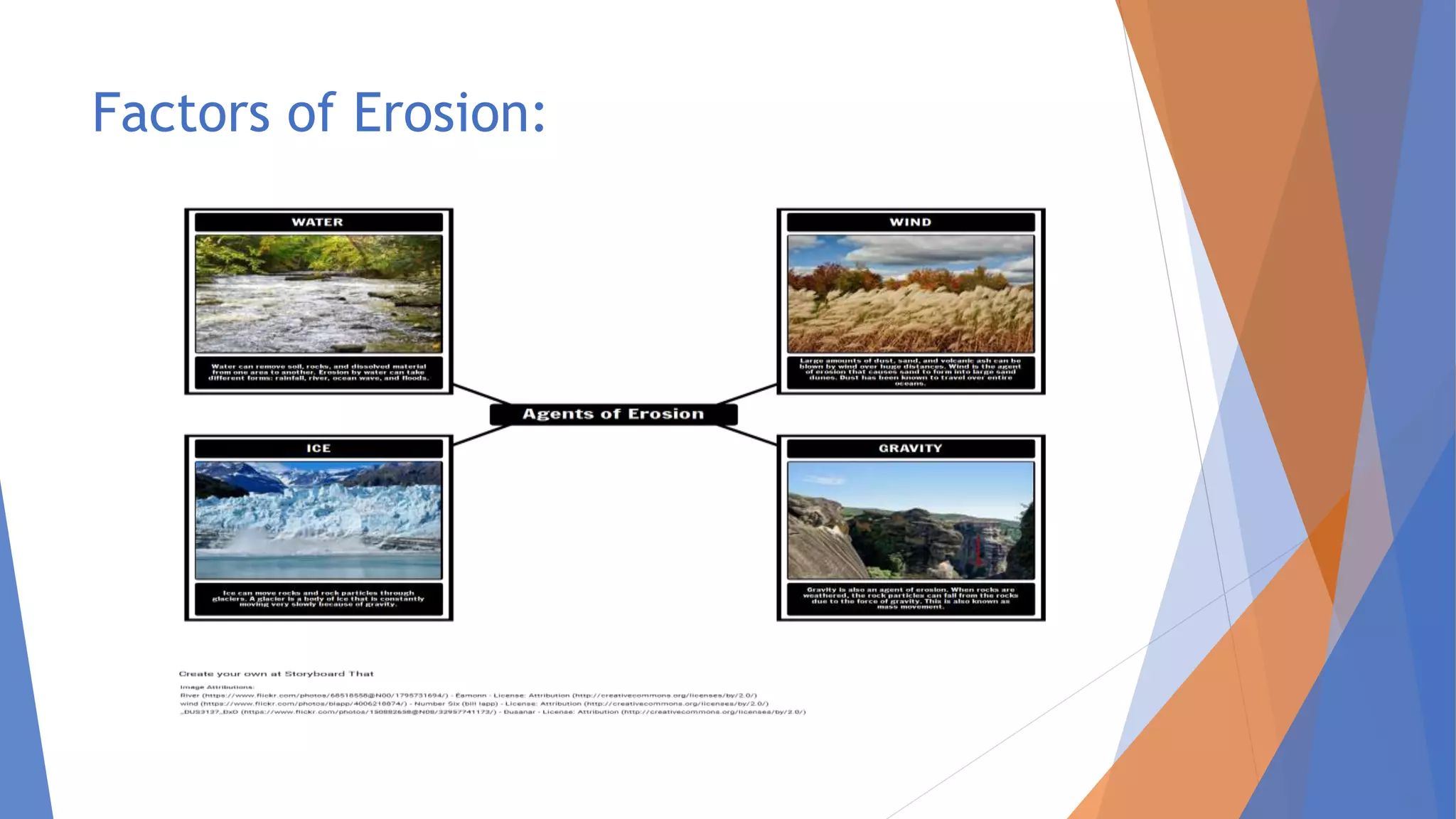
agents of erosion include water, wind,
glaciers, snow, sea/lake waves, and gravity
(as a constant force on unstable slopes).
Factors of Erosion:
• Mass Wasting
 defined as the down slope movement of
rock and regolith near the Earth's surface
mainly due to the force of gravity. ... Mass-
wasting processes are occurring
continuously on all slopes; some mass-
wasting processes act very slowly, others
occur very suddenly, often with disastrous
results.
Factors of Mass Wasting:
• Deposition
 is the geological process in which
sediments, soil and rocks are added to a
landform or land mass. Wind, ice, water,
and gravity transport previously weathered
surface material, which, at the loss of
enough kinetic energy in the fluid,
is deposited, building up layers of
sediment.
Factors of Deposition:
 Exogenic processes (e.g., mass movement,
erosion, deposition, and weathering) play
an important role in the formation of relief
and create a variety of landscapes.
Exogenic processes may be destructive but
on good side it also help us on reshaping or
rechanging our surface.
Thank You!!

Exogenic processes

  • 1.
  • 2.
    Exogenic Processes:  includegeological phenomena and processes that originate externally to the Earth's surface. They are genetically related to the atmosphere, hydrosphere and biosphere, and therefore to processes of weathering, erosion, mass wasting, sedimentation, transportation, deposition, denudation, etc.  are processes that takes place at or near Earth’s surface that makes the surface wear away. These processes are very destructive, they are responsible for degradation and sculpting the Earth’s surface.
  • 3.
    Exogenic Processes havefour main types; Weathering, Erosion, Mass wasting, Deposition
  • 4.
    • Weathering  Isthe general term applied to the combined action of all processes that cause rock to disintegrate physically and decompose chemically because of exposure near the Earth's surface through the elements of “weather” such as temperature, rainfall, frost, fog and ice.
  • 5.
  • 6.
    • Erosion  Inthe most broad and common meaning, erosion includes all exogenic processes, in the absence of weathering (which causes the breakdown of rock material) and mass movements. Natural agents of erosion include water, wind, glaciers, snow, sea/lake waves, and gravity (as a constant force on unstable slopes).
  • 7.
  • 8.
    • Mass Wasting defined as the down slope movement of rock and regolith near the Earth's surface mainly due to the force of gravity. ... Mass- wasting processes are occurring continuously on all slopes; some mass- wasting processes act very slowly, others occur very suddenly, often with disastrous results.
  • 9.
  • 10.
    • Deposition  isthe geological process in which sediments, soil and rocks are added to a landform or land mass. Wind, ice, water, and gravity transport previously weathered surface material, which, at the loss of enough kinetic energy in the fluid, is deposited, building up layers of sediment.
  • 11.
  • 12.
     Exogenic processes(e.g., mass movement, erosion, deposition, and weathering) play an important role in the formation of relief and create a variety of landscapes. Exogenic processes may be destructive but on good side it also help us on reshaping or rechanging our surface.
  • 13.