BATHYMETRIC DISTRIBUTION
OF
ANIMAL
S.K PATRE
Bathymetric distribution concerns to the vertical
range of organisms in space i.e. from the high
Alpine peak to the abyssal depth of the sea.
Primary conditions affecting:
(i) The air or water medium which affects the
methods of breathing
(ii) The presence or absence of light
(iii) The presence or absence of substratum
Secondary condition affecting:
(i) whether the water is fresh or salty
(ii)The increase of pressure with depth
Three organic realms of bathymetric distribution
of animals
• GEOBIOTIC REALM :This realm extents from
high tide mark along the shares of all continents
and island to summits highest elevation.
• LIMNOBIOTIC(FRESH WATER) REALM: It
contains limited fauna due to freshness and
continuous flow. They live in standing water pond,
lakes.
HALOBIOTIC(MARINE)REALM
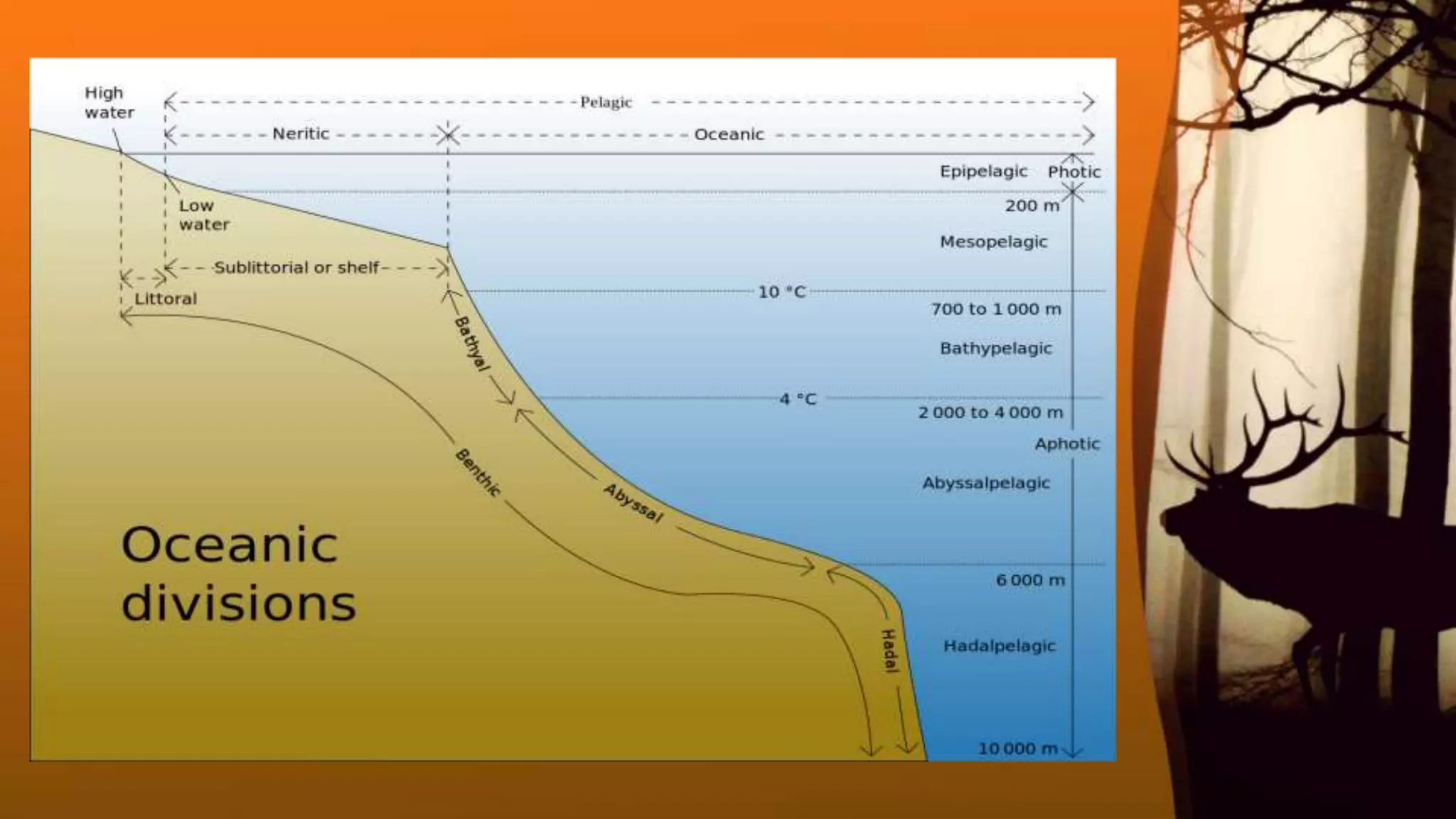
• The marine realm is divided into four sub-
realm, whose characteristics are as follows:
• Strand,- light, substratum present
• Flat sea,- light, substratum present
• Pelagic,- light, substratum present
• Abyssal,- dark, substratum present or absent
• Hadal zone- cold , dark, increase pressure
AQUATIC ANIMALS
• PELAGIC: INHABITING IN OPEN SEA, LAKE WATER.
• BENTHONIC: LIVING IN OR BOTTOM.
• PELAGIC i. Neritopelagic living in lithoral and neratic.
• Ii. Oceanopelagic
epipelagic(200m),mesopelagic(1000m),bathypelagic(4000m)
• PLANKTON : Little or no locomotory organ.
• NEKTON: LOCOMOTORY ORGAN TO SWIM.
Migration is the relatively long-distance movement of individual animals, usually
on a seasonal basis. It is the most common form of migration in ecology. It is found
in all major animal groups, including birds, mammals, fish,reptiles, amphibians,
insects, and crustaceans . The trigger for the migration may be local climate, local
availability of food, the season of the year or for mating reasons. To be counted as
a true migration, and not just a local dispersal or
irruption,
MIGRATION
Long-distance Travelers
Animal Distance
• Gray Whale12,500 miles
• Caribou700 miles
• Monarch Butterfly2,000 miles
• Chinook Salmon900 miles
• Arctic Tern11,000 miles
• Sooty Shearwater20,000 miles
TYPES
• Complete migration is when all individuals migrate.
• Partial migration is when some individuals migrate
while others do not.
• Differential migration is when the difference
between migratory and non-migratory individuals is
based on age or sex
• Seasonal migration is the movement of various
species from one habitat to another during the
year.
• Circadian Migration is where birds utilize circadian
rhythm (CR) to regulate migration in both the fall
and the spring. In circadian migration clocks of
both circadian (daily) and circannual (annual)
patterns
• Tidal Migration is the use of tides by organisms to
move periodically from one habitat to another. This
type of migration is often used in order to find food
or mates.
EXTINCTION
Extinction is the termination of a kind of organism or of a
group of kinds (taxon), usually a species. The moment of
extinction is generally considered to be the death of the last
individual of the species,
Extinction occurs
• when species are diminished because of environmental
forces (habitat fragmentation ,global change, natural
disaster, overexploitation of species for human use) or
because of evolutionary changes in their members
(genetic inbreeding, poor reproduction, decline in
population numbers).
Mass extinctions
• The fossil record reveals FIVE unusually large
extinctions, each involving the demise of vast numbers
of species. These conspicuous declines in diversity are
referred to as mass extinctions
Ranked in
descending order of severity
 Permian extinction (about 265.1 million to about 251.9
million years ago), the most dramatic die-off, eliminating
about half of all families, some 95 percent of marine species
(nearly wiping out brachiopods and corals), and about 70
percent of land species (including plants, insects, and
vertebrates).
 Ordovician-Silurian extinction (about 443.8 million years
ago), which included about 25 percent of marine families and
85 percent of marine species, with brachiopods, conodonts,
bryozoans, and trilobites suffering greatly.
 Cretaceous-Tertiary (K-T), or Cretaceous-Paleogene (KPg),
extinction (about 66.0 million years ago), involving about 80
percent of all animal species, including the dinosaurs and
many species of plants. Although many scientists contend that
this event was caused by one or more large comets or
asteroids striking Earth, others maintain that it was caused by
climatic changes associated with the substantial volcanic
activity of the time.
 End-Triassic extinction (about 201.3 million years ago),
possibly caused by rapid climate change or by an asteroid
striking Earth. This mass extinction event caused about 20
percent of marine families and some 76 percent of all extant
species to die out, possibly within a span of about 10,000
years, thus opening up numerous ecological niches into
which the dinosaurs evolved.
 Devonian extinctions (407.6 million to about 358.9 million
years ago), which included 15–20 percent of marine families
and 70–80 percent of all animal species. Roughly 86 percent
of marine brachiopod species perished, along with many
corals, conodonts,and trilobites.
THANK YOU

BATHYMETRIC DISTRIBUTION OF ANIMALS

  • 1.
  • 2.
    Bathymetric distribution concernsto the vertical range of organisms in space i.e. from the high Alpine peak to the abyssal depth of the sea.
  • 3.
    Primary conditions affecting: (i)The air or water medium which affects the methods of breathing (ii) The presence or absence of light (iii) The presence or absence of substratum Secondary condition affecting: (i) whether the water is fresh or salty (ii)The increase of pressure with depth
  • 4.
    Three organic realmsof bathymetric distribution of animals • GEOBIOTIC REALM :This realm extents from high tide mark along the shares of all continents and island to summits highest elevation. • LIMNOBIOTIC(FRESH WATER) REALM: It contains limited fauna due to freshness and continuous flow. They live in standing water pond, lakes.
  • 5.
    HALOBIOTIC(MARINE)REALM • The marinerealm is divided into four sub- realm, whose characteristics are as follows: • Strand,- light, substratum present • Flat sea,- light, substratum present • Pelagic,- light, substratum present • Abyssal,- dark, substratum present or absent • Hadal zone- cold , dark, increase pressure
  • 7.
    AQUATIC ANIMALS • PELAGIC:INHABITING IN OPEN SEA, LAKE WATER. • BENTHONIC: LIVING IN OR BOTTOM. • PELAGIC i. Neritopelagic living in lithoral and neratic. • Ii. Oceanopelagic epipelagic(200m),mesopelagic(1000m),bathypelagic(4000m) • PLANKTON : Little or no locomotory organ. • NEKTON: LOCOMOTORY ORGAN TO SWIM.
  • 8.
    Migration is therelatively long-distance movement of individual animals, usually on a seasonal basis. It is the most common form of migration in ecology. It is found in all major animal groups, including birds, mammals, fish,reptiles, amphibians, insects, and crustaceans . The trigger for the migration may be local climate, local availability of food, the season of the year or for mating reasons. To be counted as a true migration, and not just a local dispersal or irruption, MIGRATION
  • 9.
    Long-distance Travelers Animal Distance •Gray Whale12,500 miles • Caribou700 miles • Monarch Butterfly2,000 miles • Chinook Salmon900 miles • Arctic Tern11,000 miles • Sooty Shearwater20,000 miles
  • 10.
    TYPES • Complete migrationis when all individuals migrate. • Partial migration is when some individuals migrate while others do not. • Differential migration is when the difference between migratory and non-migratory individuals is based on age or sex
  • 11.
    • Seasonal migrationis the movement of various species from one habitat to another during the year. • Circadian Migration is where birds utilize circadian rhythm (CR) to regulate migration in both the fall and the spring. In circadian migration clocks of both circadian (daily) and circannual (annual) patterns
  • 12.
    • Tidal Migrationis the use of tides by organisms to move periodically from one habitat to another. This type of migration is often used in order to find food or mates.
  • 13.
    EXTINCTION Extinction is thetermination of a kind of organism or of a group of kinds (taxon), usually a species. The moment of extinction is generally considered to be the death of the last individual of the species,
  • 14.
    Extinction occurs • whenspecies are diminished because of environmental forces (habitat fragmentation ,global change, natural disaster, overexploitation of species for human use) or because of evolutionary changes in their members (genetic inbreeding, poor reproduction, decline in population numbers).
  • 15.
    Mass extinctions • Thefossil record reveals FIVE unusually large extinctions, each involving the demise of vast numbers of species. These conspicuous declines in diversity are referred to as mass extinctions
  • 16.
    Ranked in descending orderof severity  Permian extinction (about 265.1 million to about 251.9 million years ago), the most dramatic die-off, eliminating about half of all families, some 95 percent of marine species (nearly wiping out brachiopods and corals), and about 70 percent of land species (including plants, insects, and vertebrates).
  • 17.
     Ordovician-Silurian extinction(about 443.8 million years ago), which included about 25 percent of marine families and 85 percent of marine species, with brachiopods, conodonts, bryozoans, and trilobites suffering greatly.  Cretaceous-Tertiary (K-T), or Cretaceous-Paleogene (KPg), extinction (about 66.0 million years ago), involving about 80 percent of all animal species, including the dinosaurs and many species of plants. Although many scientists contend that this event was caused by one or more large comets or asteroids striking Earth, others maintain that it was caused by climatic changes associated with the substantial volcanic activity of the time.
  • 18.
     End-Triassic extinction(about 201.3 million years ago), possibly caused by rapid climate change or by an asteroid striking Earth. This mass extinction event caused about 20 percent of marine families and some 76 percent of all extant species to die out, possibly within a span of about 10,000 years, thus opening up numerous ecological niches into which the dinosaurs evolved.  Devonian extinctions (407.6 million to about 358.9 million years ago), which included 15–20 percent of marine families and 70–80 percent of all animal species. Roughly 86 percent of marine brachiopod species perished, along with many corals, conodonts,and trilobites.
  • 22.